國
立
交
通
大
學
資訊科學與工程研究所
碩
士
論
文
增強立方體之最大區域連通性質
Maximally Local Connectivity on Augmented Cubes
研 究 生:陳孟宏
指導教授:譚建民 教授
Contents
1 Introduction 4
2 The Augmented Cube AQn 7
3 Maximally Connected Component 9
4 Vertex-Disjoint Paths 16
List of Figures
2.1 The augmented cubes AQ1, AQ2, and AQ3. . . 8
3.1 The graph of AQ0
3− F0. . . 12
List of Tables
Chapter 1
Introduction
For the graph definitions and notations, we follow [2]. G = (V, E) is a graph if V is a finite set and E is a subset of {(a, b)|(a, b) is an unordered pair of V }. We say that V is the vertex set and
E is the edge set. For the interconnection network topology, it is usually represented by a graph G = (V, E), while vertices represent processors and edges represent links between processors.
The neighborhood of vertex v, denoted by N(v), is {x|(v, x) ∈ E}. The degree of a vertex v, denoted by deg(v), is the number of vertices in N(v). A graph G is k-regular if deg(v) = k for every vertex v ∈ V . For the purpose of connecting hundreds or thousands of processing elements, many interconnection network topologies have been proposed in the literature. Graph theory can be used to analyze the network reliability. We use the terminology of graphs and
networks synonymously.
The fault tolerance of a network with respect to processor failures is directly related to the connectivity of the corresponding graph. The connectivity of a graph is an important issue related to the reliability and fault tolerance of a network in graph theory. The connectivity of
G, denoted by κ(G), is defined as the minimum size of a vertex cut if G is not a complete graph,
many faulty vertices, the network may be disconnected. We know that κ(G) ≤ δ(G), where
δ(G) is the minimum degree of G. However, while the number of faulty vertices is greater
than the connectivity of a network, what will happen? Many measures on fault tolerance of networks are related to the maximal size of connected component of networks with faulty vertices. To estimate the maximal connected component of the network with the faulty vertices is essential [1], Yang et al. [11, 12, 13] have continually proposed results on the maximal connected component of the n-dimensional hypercube.
A useful distributed system offers the advantage of improved connectivity. Menger’s The-orem [7] is a famous result on connectivity, it shows that if a network G is k-connected, then every pair of vertices in G is connected by k vertex-disjoint (parallel) paths. An efficient routing can be achieved by vertex-disjoint paths. A routing using vertex-disjoint paths provides parallel routing and high fault tolerance, increases the efficiency of data transmission, and decreases transmission time. Saad and Schultz [9] have shown the n vertex-disjoint parallel paths of an
n-dimensional hypercube Qn. Day and Tripathi [5] also have shown the n − 1 vertex-disjoint
parallel paths of an (n − 1)-dimensional star graph Sn for any two vertices of Sn.
There are many useful topologies proposed to balance the performance and some cost pa-rameters. Among them, the binary hypercube Qn is one of the most popular topologies, and
has been studied for parallel networks. The augmented cubes are derivatives of the hypercubes with good geometric nature and retain all the favorable properties of the hypercubes, such as vertex symmetry, maximum connectivity, best possible wide diameter, routing, and broadcast-ing procedures with linear time complexity. The augmented cube of dimension n is a Cayley
graph, (2n − 1)-regular, (2n − 1)-connected, and has diameter dn/2e [4]. In this paper, we consider the maximal connected component of the augmented cube with faulty vertices. We shall show that for any faulty vertex set F ⊂ V (AQn) and |F | ≤ 4n − 9 for n ≥ 4, the maximal
connected component of AQn− F has at least 2n− |F | − 1 vertices. In addition, we show that
for any faulty vertex set F ⊂ V (AQn) and |F | ≤ 2n − 7 for n ≥ 4, each pair of non-faulty
vertices u and v in AQn− F is connected by min{degf(u), degf(v)} vertex-disjoint fault-free
paths, where degf(u) and degf(v) are the degree of u and v in AQn− F , respectively.
In the next chapter, we give the definition of the augmented cube AQn for n ≥ 1. Chapter
3 deals with the maximal connected component of AQn − F with |F | ≤ 4n − 9 for n ≥ 4.
Chapter 4 studies the vertex-disjoint fault-free paths in AQn− F with |F | ≤ 2n − 7 for n ≥ 4.
Chapter 2
The Augmented Cube AQ
n
The definition of the n-dimensional augmented cube is stated as follows. Let n ≥ 1 be a positive integer. The n-dimensional augmented cube [4], denoted by AQn, is a vertex transitive
and (2n − 1)-regular graph with 2n vertices. Each vertex is labeled by an n-bit binary string
and V (AQn) = {unun−1...u1|ui ∈ {0, 1}}. AQ1 is the complete graph K2 with vertex set {0, 1}
and edge set {(0, 1)}. As for n ≥ 2, AQn consists of (1)two copies of (n − 1)-dimensional
augmented cubes, denoted by AQ0
n−1 and AQ1n−1; and (2)2n edges (two perfect matchings
of AQn) between AQ0n−1 and AQ1n−1. We may write AQn as AQ0n−1♦AQ1n−1 for n ≥ 2.
V (AQ0
n−1) = {0un−1un−2...u1 | ui ∈ {0, 1}} and V (AQ1n−1) = {1vn−1vn−2...v1 | vi ∈ {0, 1}}.
Vertex u = 0un−1un−2...u1 of AQ0n−1 is joined to vertex v = 1vn−1vn−2...v1 of AQ1n−1 if and only
if either
(i) ui = vi for 1 ≤ i ≤ n − 1; in this case, (u, v) is called a hypercube edge and we set v = uh,
or
(ii) ui = ¯vi for 1 ≤ i ≤ n − 1; in this case, (u, v) is called a complement edge and we set v = uc.
000 001 010 011 100 101 110 111
AQ
1 0AQ
00 01 10 11AQ
(a)
(b)
(c)
1 2 3Figure 2.1: The augmented cubes AQ1, AQ2, and AQ3.
Let the hypercube edge set of AQn be Enh and the complete edge set of AQn be Enc. Thus,
Eh
n = {(u, uh)| u ∈ V (AQ0n−1)} and Enc = {(u, uc)| u ∈ V (AQ0n−1)}. Obviously, each of Enh and
Ec
n is a perfect matching between the vertices of AQ0n−1 and AQ1n−1. Then, both |Enh| and |Enc|
Chapter 3
Maximally Connected Component
Lemma 1 Assume n is an integer with n ≥ 3. Let AQn = AQ0n−1♦AQ1n−1 be an n-dimensional
augmented cube, and let u and v be any two vertices in AQ0
n−1. Then, the vertices u and v
have totally two distinct neighborhoods in AQ1
n−1 if u = 0an−1. . . a1 and v = 0an−1. . . a1 with
ai ∈ {0, 1} for 1 ≤ i ≤ n − 1. Otherwise, the vertices u and v have totally four distinct
neighborhoods in AQ1 n−1. That is, |(N(u) ∪ N(v)) ∩ V (AQ1 n−1)| = 2 if u = 0an−1. . . a1 and v = 0an−1. . . a1, 4 otherwise.
Proof. We first suppose that u = 0an−1. . . a1 and v = 0an−1. . . a1 with ai ∈ {0, 1} for
1 ≤ i ≤ n − 1. Then, vertices u and v have two distinct neighborhoods 1an−1. . . a1 and
1an−1. . . a1 in AQ1n−1. Otherwise, suppose that u = 0an−1. . . a1 and v = 0bn−1. . . b1, where
an−1. . . a1 6= bn−1. . . b1. Then, vertices u and v have four distinct neighborhoods 1an−1. . . a1,
1an−1. . . a1, 1bn−1. . . b1, and 1bn−1. . . b1 in AQ1n−1. As a result, this lemma follows. 2
Lemma 2 For n ≥ 3, let AQn be an n-dimensional augmented cube, any two vertices u and v
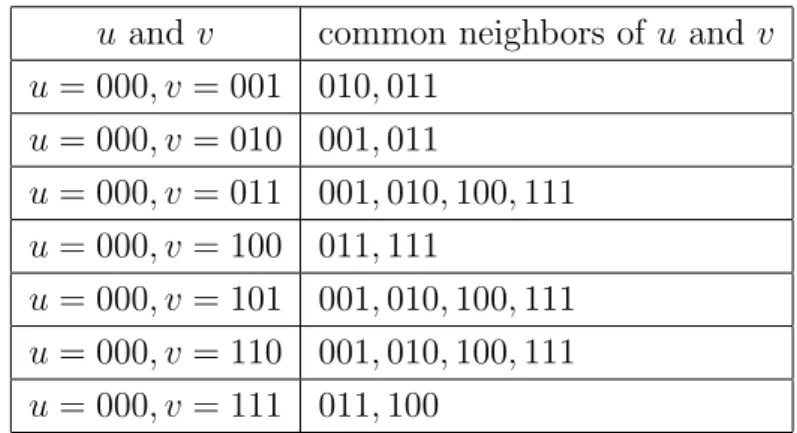
Proof. We shall prove it by induction. For n = 3, it is clear that |N(u) ∩ N(v)| ≤ 4 by Table 3.1. As for the inductive hypothesis, we assume that the result is true for AQn−1. Now
we consider AQn and show that any two vertices u and v of AQn have at most four common
neighborhoods. Without loss of generality, we may divide the proof into the following two cases.
Case 1: u ∈ AQ0
n−1 and v ∈ AQ1n−1. Because u has two neighborhoods in AQ1n−1 and v has
two neighborhoods in AQ0
n−1, |N(u) ∩ N(v) ∩ AQ0n−1| ≤ 2 and |N(v) ∩ N(u) ∩ AQ1n−1| ≤ 2.
Therefore, |N(u) ∩ N(v)| ≤ 4.
Case 2: Both u and v are in AQ0
n−1. By Lemma 1, u and v have no common neighborhood
in AQ1
n−1 except for the case that u = 0an−1. . . a1 and v = 0an−1. . . a1 with ai ∈ {0, 1}
for 1 ≤ i ≤ n − 1. Now, consider that u = 0an−1. . . a1 and v = 0an−1. . . a1, vertices u and v
have two common neighborhoods in AQ1
n−1and two common neighborhoods in AQ0n−1. That is,
N(u)∩N(v)∩V (AQ1
n−1) = {1an−1an−2. . . a1, 1an−1an−2. . . a1} and N(u)∩N(v)∩V (AQ0n−1) =
{0an−1an−2. . . a1, 0an−1an−2. . . a1}. Hence, u and v have at most four common neighborhoods
in AQn and this lemma follows. 2
u and v common neighbors of u and v
u = 000, v = 001 010, 011 u = 000, v = 010 001, 011 u = 000, v = 011 001, 010, 100, 111 u = 000, v = 100 011, 111 u = 000, v = 101 001, 010, 100, 111 u = 000, v = 110 001, 010, 100, 111 u = 000, v = 111 011, 100
Lemma 3 [4] κ(AQn) = 2n − 1 except κ(AQ3) = 4.
Lemma 4 Assume that n is an integer with n ≥ 2. Let AQn = AQ0n−1♦AQ1n−1 be an
n-dimensional augmented cube, F ⊂ V (AQn) be a set of vertices of AQn, and F1 = F ∩V (AQ1n−1)
with |F1| ≤ 1. Then AQn− F is still a connected graph containing 2n− |F | vertices.
Proof. According to Lemma 3, AQ1
n−1−F1 is a connected component with 2n−1−|F1| vertices.
For each vertex v ∈ V (AQ0
n−1), at least one of its two neighborhoods located in V (AQ1n−1) is
fault-free since |F1| ≤ 1. Therefore, AQn− F is connected, and its cardinality of the fault-free
vertex set is 2n− |F |. This lemma is completed. 2
Lemma 5 For a 4-dimensional augmented cube AQ4, let F ⊂ V (AQ4) be a faulty vertex
set with |F | = 4n − 9 = 7. Then, AQ4 − F has a connected component containing at least
2n− |F | − 1 = 8 vertices.
Proof. Let F0 = F ∩ V (AQ03) and F1 = F ∩ V (AQ13), thus F = F0 ∪ F1. Without loss of
generality, we may assume that |F0| ≥ |F1|. Thus, |F0| ≥ 4, |F1| ≤ 3, and AQ13−F1 is connected
by Lemma 3. In the following, we divide the proof according to the cardinality of F0.
Case 1: |F0| ≥ 6.
Since |F0| ≥ 6, |F1| ≤ 1. By Lemma 4, AQ4 − F is a connected component containing 9
vertices, and this case follows.
Let C be the connected component with minimal cardinality in AQ0
3− F0. First, suppose C
consists of only one vertex, say vertex u. Then, NAQ0
3(u) ⊂ F and |F0| = 5. Then, AQ
0
3− (F0∪
{u}) is a connected component with 2 vertices, and thus AQ4− F has a connected component
containing at least 8 vertices.
Second, suppose C consists of two vertices, then either F0 = {0000, 0011, 0101, 0110} or
F0 = {0001, 0010, 0100, 0111}. Thus, AQ03 − F0 is composed of two connected components
with two vertices respectively. The vertex set of AQ0
3 − F0 is either {0001, 0010, 0100, 0111}
or {0000, 0011, 0101, 0110}, and both are illustrated in Figure 3.1. In addition, AQ1 3 − F1
is connected. For each of the two connected components in AQ0
3 − F0, it has four distinct
neighborhoods in AQ1
3, and it is connected to AQ13 − F1. Therefore, AQ4− F is a connected
component containing 9 vertices.
Now, suppose C consists of three or four vertices, it is easy to see that AQ0
3−F0is connected.
Let u,v be two vertices in C such that u = 0a3a2a1 and v 6= 0a3a2a1. Hence, by Lemma 1,
u or v has at least one fault-free neighborhood in AQ1
3. Therefore, AQ4 − F is a connected
component containing 9 vertices, and this lemma follows. 2
0010 0100 0111 0001
(a)
(b)
0000 0011 0110 0101Figure 3.1: The graph of AQ0 3− F0.
Theorem 1 Let AQn be an n-dimensional augmented cube with n ≥ 4 and let F ⊂ V (AQn)
be a faulty vertex set with |F | = 4n − 9. Then, AQn− F has a connected component containing
at least 2n− |F | − 1 vertices.
Proof. We prove this theorem by inducting on n. For n = 4, it is already proved by Lemma 5 that AQ4− F has a connected component containing at least 8 vertices. As the inductive
hypothesis, we assume that the result is true for AQn−1 with |F | = 4 × (n − 1) − 9 = 4n − 13.
Now we consider AQn with |F | = 4n − 9 and show that AQn− F has a connected component
containing at least 2n− |F | − 1 vertices.
Let F0 = F ∩ V (AQ0n−1) and F1 = F ∩ V (AQ1n−1). Without loss of generality, we may
assume that |F0| ≥ |F1|. Thus |F0| ≥ 2n − 4, |F1| ≤ 2n − 5, and AQ1n−1 − F1 is connected
according to Lemma 3. In the following, we divide the proof into three cases according to the cardinality of F0.
Case 1: |F0| ≥ 4n − 10.
Since |F0| ≥ 4n − 10, |F1| ≤ 1. According to Lemma 4, AQn− F is a connected component
containing 2n− |F | vertices, and this case follows.
Case 2: 4n − 11 ≥ |F0| ≥ 4n − 12. Let AQ0n−1− F0 be composed of connected components
C1, C2, . . . , Cx, and let |V (C1)| ≤ |V (C2)| ≤ . . . ≤ |V (Cx)| with x ≥ 1. Now, we shall show that
(1) |V (Ci)| ≥ 2 for 2 ≤ i ≤ x; and (2) For each |V (Ci)| ≥ 2 where 1 ≤ i ≤ x, Ci is connected
to AQ1
n−1− F1. With (1) and (2) holds, AQn− F contains a connected component containing
Proof of (1): Suppose (1) is incorrect, then |V (C1)| = |V (C2)| = 1, we denote that
V (C1) = {u}, V (C2) = {v}, and (u, v) 6∈ E(AQn). Because any two vertices have at most four
common neighborhoods by Lemma 2, |F0| ≥ |NAQ0
n−1(u) ∪ NAQ0n−1(v)| ≥ (2(n − 1) − 1) × 2 − 4 =
4n − 10, which is a contradiction to our assumption that 4n − 11 ≥ |F0| ≥ 4n − 12.
Proof of (2): First, suppose |V (Ci)| = 2. Let (u, v) be the edge of Ci. By Lemma 1,
|(N(u) ∪ N(v)) ∩ V (AQ1
n−1)| is either 2 or 4. Suppose |(N(u) ∪ N(v)) ∩ V (AQ1n−1)| = 2, u and
v will have at most two common neighborhoods in AQ0
n−1 according to Lemma 2. Thus, |F0| ≥
|(NAQ0
n−1(u) ∪ NAQ0n−1(v)) − {u, v}| ≥ (2(n − 1) − 2) × 2 − 2 = 4n − 10, which is a contradiction
to our assumption that 4n − 11 ≥ |F0| ≥ 4n − 12. Suppose |(N(u) ∪ N(v)) ∩ V (AQ1n−1)| = 4.
Because |F1| ≤ 3, there is at least one fault-free edge between Ci and AQ1n−1− F1. Therefore,
Ci is connected to AQ1n−1− F1.
Now, suppose |V (Ci)| ≥ 3. Each Ci in AQ0n−1has two vertices u and v such that u = 0an−1. . . a1
and v 6= 0an−1. . . a1. Note that |F1| ≤ 3. Hence, according to Lemma 1, u or v has at least one
fault-free neighborhood in AQ1
n−1. As a result, Ci is connected to AQ1n−1− F1.
Case 3: |F0| ≤ 4n − 13. By inductive hypothesis, AQ0n−1 − F0 has a connected component
containing at least 2n−1− |F
0| − 1 vertices. In addition, AQ1n−1− F1 is a connected component
with 2n−1− |F
1| vertices. Suppose n = 4, |F | = 4n − 9 = 7 and |F0| ≤ 4n − 13 = 3, which
contradicts to our assumption that |F0| ≥ |F1|. Hence, without loss of generality, we may
assume that n ≥ 5. Now, AQ0
n−1− F0 is connected to AQ1n−1 − F1 since (2n−1− |F0| − 1) +
(2n−1 − |F
component containing at least (2n−1− |F
0| − 1) + (2n−1− |F1|) = 2n− |F | − 1 vertices and the
theorem is established. 2
Corollary 1 For an n-dimensional augmented cube AQn with n ≥ 4, let F ⊂ V (AQn) be any
vertex set with |F | ≤ 4n − 9. Then, AQn− F has a connected component containing at least
Chapter 4
Vertex-Disjoint Paths
Menger’s Theorem [7] is a classical result on connectivity and it states that if a network G
is k-connected, then every pair of vertices in G is connected by k vertex-disjoint paths. A
k-regular graph G is strongly Menger-connected if for any copy G − F of G with at most k − 2
vertices removed, each pair u and v of G − F is connected by min{degf(u), degf(v)} vertex-disjoint fault-free paths in G − F , where degf(u) and degf(v) are the degree of u and v in
G − F , respectively [8]. It is proved in [8] that the star graphs are strongly Menger-connected.
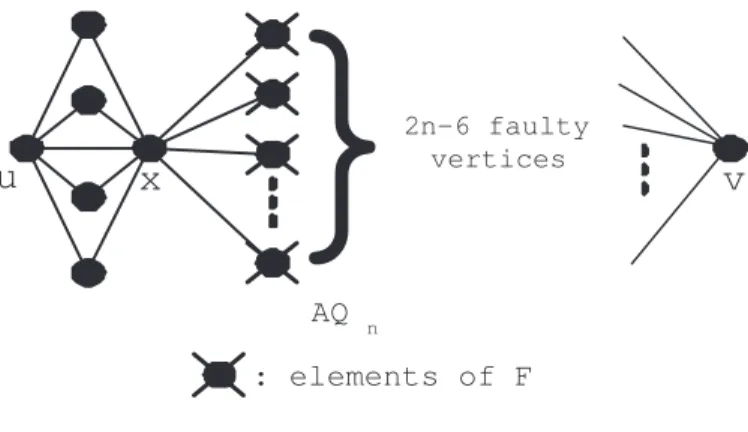
However, the augmented cubes are not strongly Menger-connected according to their struc-tures. Figure 4.1 provides an example. For an n-dimensional augmented cube AQnwith n ≥ 4,
AQn is (2n − 1)-regular. Let (u, x) be an edge of AQn such that |N(u) ∩ N(x)| = 4, F be
a faulty vertex set such that F = N(x) − (N(u) ∪ {u}), and v be a vertex of AQn such that
v ∈ V (AQn) − (N(u) ∪ N(x)). Note that |F | = 2n − 6. As a result, the vertices u and v are
not connected by min{degf(u), degf(v)} = 2n − 1 vertex-disjoint fault-free paths in AQn− F .
Now, we give the definition of maximally local connectivity. Given a graph G and a vertex set F ⊂ V (G), (G, F ) is said to be maximally local connected if and only if for each pair
u
x
v
: elements of F AQ n
}
2n-6 faultyvertices
Figure 4.1: An example for |F | = 2n − 6.
of vertices, denoted by u and v, of G − F , u and v are connected by min{degf(u), degf(v)} vertex-disjoint fault-free paths in G − F , where degf(u) and degf(v) are the degree of u and
v in G − F , respectively. For the vertex-disjoint fault-free paths of AQn under a set of faulty
vertices with |F | ≤ 2n − 7, we have the following result.
Theorem 2 For an n-dimensional augmented cube AQn with n ≥ 4, let F ⊂ V (AQn) be a
set of faulty vertices with |F | ≤ 2n − 7. Then, each pair of vertices u and v in AQn− F is
connected by min{degf(u), degf(v)} vertex-disjoint fault-free paths in AQn− F .
Proof. We shall prove this theorem by using contradiction. Let u and v be two distinct vertices in AQn − F and let m = min{degf(u), degf(v)}. Suppose that there do not exist
m vertex-disjoint fault-free paths connecting u and v in AQn − F . By Menger Theorem, u
and v will be separated in (AQn− F ) − Vf for some faulty vertex sets Vf ⊂ V (AQn− F ) and
|Vf| = m−1. Thus, the total number of faulty vertices in AQnis |F |+|Vf| ≤ (2n−7)+(m−1) ≤
containing at least 2n− (4n − 9) − 1 vertices. That is, if (AQ
n− F ) − Vf is disconnected, it
consists of two connected components and one of which is an isolated vertex, denoted by s. We may let s = u or s = v. Hence, Vf must contain all the neighbors of s, so |Vf| ≥ m, which is a
contradiction to our assumption that |Vf| = m − 1. Consequently, this theorem is proved. 2
Corollary 2 For an n-dimensional augmented cube AQn with n ≥ 4, let F ⊂ V (AQn) be any
Chapter 5
Conclusion
The hypercube, which is discussed extensively, plays an important role among many topolo-gies. Many graphs relevant to the hypercube are brought up in succession, and the augmented cube is one of them. Both the augmented cubes and the hypercube have many good quali-ties and are appropriate for parallel routing. In this paper, we discuss the maximal connected component of the augmented cube with faulty vertices. We show that for any faulty vertex set
F ⊂ V (AQn) and |F | ≤ 4n − 9 for n ≥ 4, the maximal connected component of AQn− F has
at least 2n− |F | − 1 vertices. In addition, we show that for any faulty vertex set F ⊂ V (AQ n)
and |F | ≤ 2n − 7 for n ≥ 4, each pair of non-faulty vertices u and v in AQn− F is connected
Bibliography
[1] C. A. Barefoot, R. Entringer, and H. Swart, Vulnerability in graphs - a comparative survey,
Journal of Combinatorial Mathematics and Combinatorial Computing 1 (1987), 12–22.
[2] J. A. Bondy and U. S. R. Murty, Graph theory with applications, North Holland, New York, 1980.
[3] Y. C. Chen, J. J. M. Tan, and L. H. Hsu, Super-connectivity and super-edge-connectivity for some interconnection networks, Applied Mathematics and Computation 140 (2003), 245–254.
[4] S. A. Choudum and V. Sunitha, Augmented cubes, Networks 40(2) (2002), 71–84.
[5] K. Day and A. Tripathi, A comparative study of topologies properties of hypercubes and star graphs, IEEE Transactions on Parallel and Distributed Systems 5 (1994), 31–38.
[6] M. Ma, G. Liu, and J. M. Xu, Panconnectivity and edge-fault-tolerant pancyclicity of augmented cubes, Parallel Computing 33 (2007), 36–42.
[7] K. Menger, Zur allgemeinen kurventheorie, Fundamenta Mathematicae 10 (1927), 96–115.
[8] E. Oh and J. Chen, On strong Menger-connectivity of star graphs, Discrete Applied
[9] Y. Saad and M. H. Schultz, Topological properties of hypercubes, IEEE Transactions on
Computers 37 (1988), 867–872.
[10] L. M. Shih and J. J. M. Tan, Strong Menger connectivity on the class of hypercube-like networks, Proceedings of the International Computer Symposium 2006 2 (2006), 546–548.
[11] X. Yang, D. J. Evans, B. Chen, G. M. Megson, and H. Lai, On the maximal connected com-ponent of hpercube with faulty vertices, International Journal of Computer Mathematics 81 (2004), 515–525.
[12] X. Yang, D. J. Evans, and G. M. Megson, On the maximal connected component of hpercube with faulty vertices II, International Journal of Computer Mathematics 81 (2004), 1175–1185.
[13] X. Yang, D. J. Evans, and G. M. Megson, On the maximal connected component of hper-cube with faulty vertices III, International of Journal Computer Mathematics 83 (2006), 27–37.