
Combining Multiple Features for High Performance Face Recognition System
6
0
0
全文
(2) Int. Computer Symposium, Dec. 15-17, 2004, Taipei, Taiwan. image features extraction and as the consequences. There are many traditional algorithms [3-7], [14-17] successfully applied to face recognition, but they are too complex to be applied in real-time face recognition. To address these problems related to computational and memory requirements, we focus our investigation on low complexity and high accurate face recognition system. Firstly, to reduce system complexity, we use horizontal projection of 2-D image to obtain 1-D accumulated energy profile signal. The face image is replaced with 1-D energy profile signal. But the 1-D energy profile signal is affected by rotation, shift of facial images. To address the problem, we propose a method combining the previous algorithm and the information of face gray level as two sets of feature vectors, because the information of face gray level are against the rotation, shift of facial image. The combination of two facial features can provide much better recognition performance. Secondly, we adopt 1-D discrete wavelet transform to extract low frequency coefficients as feature vector from the two facial features. In our experiments, the wavelet permits to further reduce the system complexity and obtain discriminant feature vectors. PNN [12-13] is a very simple classifier model that has proved to be effective for face recognition. Finally, the combination of the new method and PNN is evaluated on the ORL face database [11] for face recognition. The basic conclusion drawn from our experiments is that the proposed method is well suitable for a low complex computation and low power devices.. 2.. University, U.K. [11] Let X be an face image of size 112x92 x1x 1 L x1x 92 X= M O M x112x1 L x112x 92 . According to the symmetric property of the face, the horizontal signal can be accumulated as 1-D energy signal as fig 2(b).. y1 Y= M y112 . Fig 2. (a) Facial image (b) 1-D energy signal. 2.2 Representation of face gray level information Owing to the 1-D profile signal is affected by rotation, shift of the facial images. In order to improve the recognition performance, we extract the information about the distribution of facial gray level values as fig 3. The range of gray level values is from 0 to 255. But the dimensionality of facial gray image is so large, we adopt wavelet transform to reduce the dimension.. Low complexity face recognition system Fig 3. The distribution of facial gray image. The proposed method is different from traditional 2-D face feature extraction method [17]. Firstly, 2-D image is transformed into 1-D energy profile signal and the distribution of facial gray information is also extracted. The 1-D wavelet transform is applied in the two facial features. Finally, the PNN is selected as the pattern recognition classifier because of its high performance and high efficiency.. 2.3 Wavelet transform The wavelets [9-10] to signal and image processing have provided a very flexible tool for engineers to apply in various fields such as speech and image processing. In a face recognition system, the 2-D wavelet transform is only used for preprocessing. The goal of preprocessing often reduces the dimensions of feature vectors and removes noise. Nevertheless, the computational complexity is comparatively high. Thus, the paper proposes 1-D wavelet transform as filters to extract feature vectors, and it can reduce the computational complexity. Here, we develop a feature extraction algorithm based on the 1-D wavelet transform. By combining the appropriate wavelet transform coefficients with the PNN gets an excellent result.. 2.1 Horizontal projection To reduce system complexity, we adopt horizontal projection to obtain 1-D energy profile signal. The exploit the benefits driving from concentrated energy, every column are accumulated as energy signal. This method is evaluated on the face database, which contains a set face images as fig 2 (a) taken at the Olivetti Research Laboratory (ORL) in Cambridge. 388.
(3) Int. Computer Symposium, Dec. 15-17, 2004, Taipei, Taiwan. The wavelet is constructed from two-channels filter bank as Fig. 4. In wavelet decomposition of 1-D signal, a signal is put through both a low-pass filter L and a high-pass filter H and the results are both low frequency components A [n] and high frequency components D [n]. The signal y [n] is reconstructed by the construction filters ~ ~ H and L . The wavelet filters are used to decompose signal s into high and low frequency by convolution.. D[n ] =. A[n ] =. (b) Fig 6. (a) The 3-level wavelet transform of 1-D energy signal (b) The 4-level wavelet transform of facial gray image. ∞. ∑ s[k ]⋅ H [n − k ] ⇔ D =. s, H. 3. PNN classifier. ∑ s[k ] ⋅ L [n − k ] ⇔ A =. s, L. In 1988, D.F.specht [12] have designed a very efficiency probabilistic neural network (PNN) that is well adapted to manipulate classification problem. The purpose of this paper is for speaker recognition. The experiment reveals it is excellent in efficiency and performance. The basic concept cited Bayesian classifier to PNN model as fig 7. To probability density function, it has three assumptions: 1. The classification of probability density function is the same. 2. Probability density function is Gaussian distribute. 3. The variance matrix of Gaussian distribute probability density function is diagonal matrix.. k= −∞ ∞. k = −∞. In order to construct multi-channel filter, we can cascade channel filter banks. Fig.5 is a 3-level symmetric octave structure filter bank. This is an important concept from multi-resolution analysis (MRA). D s[n]. H. 2. L. 2. 2. ~ H. 2. ~ L. A. y[n]. Fig.4. Two-channels filter bank D1. H. s[n]. D2. H L. H. D3. L. A. L. Fig.5. 3-level octave band filter bank The purpose of the horizontal projection approach is to reduce dimensions of face vectors and to become a 1-D energy profile signal. Besides, the energy is more concentrated in the signal so that the wavelet coefficients are more discriminant. But the energy signal is affected by rotation, shift of the facial images. To cope with this problem, we propose the information of facial gray image as second facial feature. The two facial feature vectors are so large. We resort to wavelet transform to decompose the two facial feature vectors into low frequency as feature vector (fig 6).. X1. X2. E= (X −Y′)⋅ ( X−Y') 1. X3. -1. 1. P=e. E − 2 δ. X p. Fig 7. The simplified structure of PNN model When the external factor is change, the PNN only change the weight of new data. The other neural network needs not to change all network weights. The PNN model has been used for classification, because of its simplicity, performance and efficiency. Hence, this paper adopt PNN model as classifier.. 4. Experiment procedure and its result. (a). In this section, we refer to the proposed method as the feature extraction method for face recognition. The face database used in the comparison is the ORL face database and the. 389.
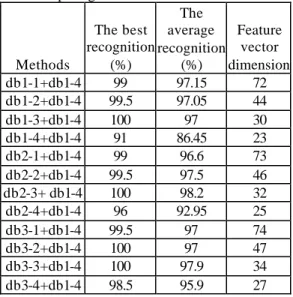
(4) Int. Computer Symposium, Dec. 15-17, 2004, Taipei, Taiwan. classifier used is a probabilistic neural network (PNN). The database contains 400 face images acquired of 40 individuals (10 images per individual). The images were taken at different times, which contain quite a high degree of variability in lighting, facial expression (open/closed eyes, smiling/nonsmiling etc), pose (upright, frontal position etc), and facial details (glasses/no glasses). In the following experiments, a total of 200 images were randomly selected as the train set and another 200 images as the testing set, in which each person has five images. Such procedure was carried out 10 times. The experimental platform is the AMD K7 Athlon 750 MHz processor, 384M SDRAM, Windows XP, and the software is Matlab 6.1.. R=. Where N1 denotes the number of correct recognition in face images, N2 the total number of face images. Our experiment results compare with the different levels of 1-D wavelet decomposition. The results show in Table 1. The represent of db is the different length of Daubechies filters. The represent of db1-1+db1-4 is lo w frequency component of 1-D energy profile signal extracted by first level wavelet transform and low frequency component of face gray level information extracted by the fourth level wavelet transform. Table 1. The recognition performance of comparing with different level wavelet The The best average Feature recognition recognition vector Methods (%) (%) dimension db1-1+db1-4 99 97.15 72 db1-2+db1-4 99.5 97.05 44 db1-3+db1-4 100 97 30 db1-4+db1-4 91 86.45 23 db2-1+db1-4 99 96.6 73 db2-2+db1-4 99.5 97.5 46 db2-3+ db1-4 100 98.2 32 db2-4+db1-4 96 92.95 25 db3-1+db1-4 99.5 97 74 db3-2+db1-4 100 97 47 db3-3+db1-4 100 97.9 34 db3-4+db1-4 98.5 95.9 27 From these results of Table 1, it shows the superiority of using the proposed method. The 1-D wavelet transform can achieve the average recognition rate of 98.2 and the best recognition rate of 100 percent using db2-3 +db 1-4. The db2-3 +db1-4 provides the best recognition performance and we select it for subsequent evaluation.. 4.1 Evaluation on face identification with. the proposed methods For face identification system, the goal is to determine which one of a group of known face images best matches the input face image samples. Firstly, the feature vectors are extracted from all image samples. All feature data is randomly divided into train data X and test data Y. Train data X directly input PNN as weight of hidden layer. To input a test data Y is to obtain a reference output P in PNN model.. P=e. N1 × 100 % N2. E − 2 δ. Where. E = ( X − Y ′) ⋅ ( X − Y ' ). Let j the number of train data. Thus, we set the reference probabilistic values of 1-D profile signal feature is P1j , the reference probabilistic values of face gray level feature is P2j , the threshold of 1-D profile signal feature is T1, and the threshold of facial gray image feature is T2. The decision function P (j) consists of output probabilistic values. The OR and AND logical operators is adopted as the fusion technique. If P1j is greater than T1 or P2j is greater than T2, then output the P1j into P. If P1j and P2j are greater than threshold, then output probabilistic value P1j into P (j). Finally, P (j) includes one and more output probabilistic values. To select the maximum value of P (j) determines the class of Y. This method is better than the traditional PNN. In order of the consistence of output probabilistic value, we select the P1j as the output probabilistic value. Besides, it can also provide better parameter estimates and decrease the computational complexity. The face recognition rate R is defined:. 4.2 Evaluation on face identification with existing methods The previous methods [3-8], [14-18] for face recognition mainly focus on feature extraction and matching. Thus, we only analyze and compare the performance and efficiency of feature representation and matching of these methods. Here, we will present a comparison between the proposed method and their methods described on the ORL databases. Each person randomly chose five images as train set and the other five images as test set. In the same comparison standard, table 2 gives the results of these methods.. 390.
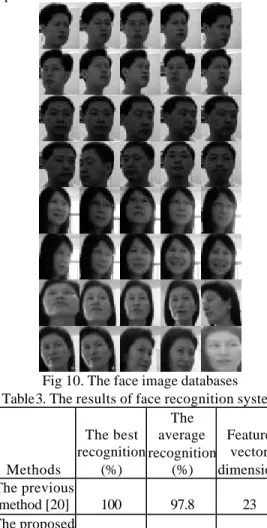
(5) Int. Computer Symposium, Dec. 15-17, 2004, Taipei, Taiwan. Table2. The results of comparing with different method The best Feature recognition vector Methods rates (%) dimension Wavelet 98 140 +eigenfaces[3] discriminant waveletface +NFS [18] 96.4 60 PCA (eigenfaces)[19] 93.5 37 2DPCA[19] 96 (112*3) The previous method [20] 99 16 The proposed method 100 32 Looking at the results shown in Table 2, we can find the proposed method has the best performance. That is, the performance of the proposed method is much better than the other methods.. Fig 9. The captured facial image Secondly, we can perform face verification and the captured facial image is compared to the images in the database. Finally, we set a threshold. If the PNN output probability is greater than the threshold, the person is accepted. Otherwise, the person is rejected. We capture 40 facial images from 4 people on fig 10. For each person, we randomly sampled 5 images as train set, and the remaining 5 images as test set. To prove the reliability of the face recognition system, all recognition rates are determined by averaging 1000 different rounds of face recognition. The evaluation is reported in Table 3.. 4.3 Implement and evaluation the proposed method for real-time face recognition on PC In this experiment, we want to prove the proposed method suitable for real-time face recognition system in real life. Our experimental setup is simple: a cheap web camera is plugged into a personal computer. The camera is pointing to a complex background. A person moves in the scene, the facial image is captured and matched with face databases for verification. The face recognition system is based on builder c++ 6.0. The face recognition system consists of three sub-system: a face detection system that include detecting and locating faces, feature extraction system that composes of horizontal projection and 1-D wavelet transform, and a Probabilistic Neural Network (PNN) used as pattern classifier. Firstly, the face recognition system is to detect, locate the person’s facial image (fig 8). Thus, the facial image is captured shown in fig 9.. Fig 10. The face image databases Table3. The results of face recognition system The The best average Feature recognition recognition vector Methods (%) (%) dimension The previous method [20] 100 97.8 23 The proposed method 100 99.99 34 From the results, the proposed method can achieve the average recognition rate of 99.99 and the best recognition rate of 100 percent. This is an excellent recognition performance.. Fig 8. Finding the person’s facial image. 391.
(6) Int. Computer Symposium, Dec. 15-17, 2004, Taipei, Taiwan. [8] A.M.Martnez and A.C.Kak, “PCA versus LDA,” IEEE Trans. Neural Networks, vol.8, pp98-113 ,Jan. 1997. [9] Jaideva C.Goswami and Andrew K. Chan “Fundamentals of Wavelets” 1999. [10] C. Sidney Burrus Ramesh A.Gopinath Hai ta Guo, “Introduction to Wavelets and Wavelet Transforms: A Primer”, 1998. [11] ORL face database. AT&T Laboratories, Cambridge, U.K.[Online]. Available:http://www.uk.research.att.com:pub/da ta/att_faces.zip. [12] D.F.Specht,”Probabilistic Neural Network for Classification, Map, or Associative Memory”, Proceeding of the IEEE International Conference on Neural Network, vol.1, pp525-532, 1988. [13] Simon Haykin, ”Neural networks: a comprehensive foundation”, 1999. [14] Meng Joo Er, Member; Siqian Wu Member, IEEE, Juwei Lu Student Member, IEEE, and Hock Lye Toh, Member, IEEE “Face recognition with radial basis function (RBF) Neural networks”, IEEE Trans. Neural Netwroks, vol. 13, No. 3, pp. 697-710, May 2002. [15] C.Garcia, G..Zikos, G.Tziritas, “A wavelet-based framework for face recognition”, Presented at Int. Workshop on Advances in Facial Image Analysis and Recognition Technology, 5th European Conference on Computer Vision Freiburg, Germany, June 2-6, 1998. [16] Cover, T.M., “Geometrical and statistical properties of systems of linear inequalities with applications in pattern recognition,” IEEE Trans on Electronic Computers, Vol. EC-14, pp.326-334, 1965. [17] Jen-Tzung Chien, Member, IEEE, and Chia-Chen WU “Discriminant Waveletfaces and Neareast Feature Classifiers for Face Recognition”, IEEE Trans, Pattern Analysis and Machine Intelligence vol.24, no. 12, pp.1644-1649, Dec, 2002 [18] Jian Yang, David Zhang, Senior Member, IEEE, Alejandro F. Frangi, and Jing-yu Yang “Two-Dimensional PCA: A New Approach to Appearance-Based Face Representation and Recognition”, IEEE Trans, Pattern Analysis and Mac [19] Mhaskar H.N. and C.A. Micchelli, “Approximation by superposition of sigmoidal and radial basis functions,” Advances in Applied Mathematics, Vol. 13, pp.350-373, 1992. [20] Ching-Han CHEN and Chia-Te CHU, “High Efficiency Feature Extraction Based on 1-D Wavelet Transform for Real-Time Face Recognition”, WSEAS Trans. on INFORMATION SCIENCE & APPLICATIONS. Issue 1, Vol. 1, pp.411-417, July 2004.. The face recognition system is implemented on the PC. From the results, the proposed method can achieve the average recognition rate of 99.99 and the best recognition rate of 100 percent. The advantage of the proposed algorithm is its simplicity and excellent performance. Thus, The proposed technique is very suitable for real-time face recognition system. The system performed very well on our different experiments.. 5. Conclusions It is well-known that if the dimension of the network input is comparable to the size of the training set, which is the usual case in face recognition, the system will easily bring about over-fitting and result in poor generalization. In this paper, a general design approach using a PNN classifier for face recognition to cope with small training sets of high dimensional problems is presented. A novel paradigm, the results of combining the multiple features, and PNN is encountering and has excellent performance and efficiency. Fro m the simulation results described in experiments, it is clear that the proposed method has excellently high performance and efficiency than the traditional methods. The complexity of feature extraction method for face recognition is excellently low. The recognition time of each image is less than 50 ms. The face recognition has proved to be very effective, achieving a considerable computational reduction while keeping excellent performance. We have proved the proposed method is suitable for embedded system.. References [1] R.Chellappa,C.L. Wilson, and S.Sirohey, “Human and machine recognition of faces: A survey,” Proc. IEEE, vol.83, pp. 705-740, May 1995. [2] I.T.Jolliffe, Principal Component Analysis, Springer, New York, 1986. [3] Bai Li*, Yihui Liu “When eigenfaces are combined with wavelets”, Knowledge-Based Systems, Vol.15 (2002), pp 343-347. [4] M.Turk, A. Pentland, Eigenface for recognition, Journal of Cognitive Neuroscience 3(1) (1991) [5] T.Phiasai,S. Arunrungrusmi,and K. Chamnongthai, ”Face recognition system with PCA and moment invariant method,” in Proc. IEEE Int. Symp. Circuits Syst., 2001,pp. III 65 III 68. [6] M.A. Turk and A.P.Pentland, “Eigenfaces for recognition,” J.Cognitive Necuro sci., vol.3, pp.71-86,1991. [7] Juwei Lu, Kostantinos N. Plataniotis, and Anasios N. Venetsanopoulos, “ Face Recognition Using LDA-Based Algorithms,” IEEE Trans. Neural Networks, vol.14, no.1, Jan 2003.. 392.
(7)
數據


相關文件
For a deep NNet for written character recognition from raw pixels, which type of features are more likely extracted after the first hidden layer.
Tekalp, “Frontal-View Face Detection and Facial Feature Extraction Using Color, Shape and Symmetry Based Cost Functions,” Pattern Recognition Letters, vol.. Fujibayashi,
• When the coherence bandwidth is low, but we need to use high data rate (high signal bandwidth). • Channel is unknown
• When the coherence bandwidth is low, but we need to use high data rate (high signal bandwidth). • Channel is unknown
Filter coefficients of the biorthogonal 9/7-5/3 wavelet low-pass filter are quantized before implementation in the high-speed computation hardware In the proposed architectures,
The scenarios fuzzy inference system is developed for effectively manage all the low-level sensors information and inductive high-level context scenarios based
Sugii, “Junction profile engineering with a novel multiple laser spike annealing scheme for 45-nm node high performance and low leakage CMOS technology,” in IEDM
In this paper, a novel feature set derived from modulation spectrum analysis of Mel-frequency cepstral coefficients (MFCC), octave-based spectral contrast (OSC), and
