國立交通大學
科技法律研究所
碩士論文
網路中立管制:
差別待遇之經濟效應及其合理性認定
A Study on Network Neutrality:
Reconsidering Economic Impact as a Factor
in Determining Reasonable Discrimination
研究生:劉昊恩
指導教授:王立達 博士
李 淳 博士
網路中立管制:
差別待遇之經濟效應及其合理性認定
A Study on Network Neutrality: Reconsidering Economic Impact
as a Factor in Determining Reasonable Discrimination
Student: Hao-En Liu Advisor: Li-Dar Wang Chun Lee
國立交通大學 科技法律研究所
碩士論文
A Thesis
Submitted to Institute of Technology Law College of Management
National Chiao Tung University in partial Fulfillment of the Requirements
for the Degree of Master
in Laws July 2012
Hsinchu, Taiwan, Republic of China 中華民國一百零ㄧ年七月 研究生: 劉昊恩 指導教授: 王立達
網路中立管制:
差別待遇之經濟效應及其合理性認定
研究生:劉昊恩 指導教授:王立達 博士
李淳 博士
國立交通大學科技法律研究所碩士班
摘 要
歷年來網路端對端的架構,導致對於經由網路設備傳輸的封包之個別屬性及內容一 無所知。此類型開放性的架構促使了網路前所未見的創新及競爭,其擔任的角色廣被推 崇。然而,日新月異的電腦運算已構成威脅並足以改變現狀,它使網路業者不僅能辨識 封包的屬性及內容,也能決定如何處理其內容。 為因應這項新威脅,呼籲透過立法管制業者行為規範的聲浪四起,期能藉以防止業 者利用他們新具有的技術能力成為網際網路的看守者。近年來,美國聯邦通訊委員會也 已初步研擬了一套規範, 希望能夠化解這些疑慮,但實施這些規範可能面臨一些挑戰。 本文將著重於其中一項可能面臨的挑戰- 第五修正案的徵收條款,其討論重點為如沒 有足夠證據證明業者的行為將強力影響網路創新的潛力時,限制業者特定的成本控制或 利潤開發的行為,可能會構成第五修正案所為無合理賠償之徵收行為。 關鍵字: 網路中立、網路差別待遇、端對端、開放網際網路、美國國家通訊委員會、徵收 條款、頻寬費用A Study on Network Neutrality: Reconsidering Economic Impact
as a Factor in Determining Reasonable Discrimination
Student: Hao-En Liu Advisor: Dr. Li-Dar Wang
Dr. Chun Lee
Institute of Technology Law
National Chao Tung University
Abstract
The end-to-end architecture of the Internet has historically resulted in an open network lacking in significant awareness of the nature of the content passing through it. This open architecture has been widely praised for its key role in fostering the unprecedented level of innovation and competition that is evident on the Internet today. However, technological advances in computing have threatened to alter the status quo, giving network providers not only the ability to identify the nature of all content passing through their wires, but also the ability to decide how to treat that content.
In response to this new threat, there have been calls to regulate the conduct of network providers, seeking to prevent them from using their newfound capabilities to act as gatekeepers of the Internet. In recent years, the Federal Communications Commission has tentatively introduced a new set of rules, hoping to allay these concerns. However, enforcement of these rules is likely to meet numerous challenges. This paper seeks to highlight one of those challenges in particular – the Takings Clause of the Fifth Amendment. It argues that absent significant proof that a network provider’s conduct will significantly affect the innovative potential of the Internet, restrictions on certain cost-controlling or profit-seeking conduct may constitute a taking of property without just compensation.
Key words: Net Neutrality, Network Discrimination, End-to-End, Open Internet, Federal Communications Commission, Takings Clause, Bandwidth Costs
Acknowledgements
The timely completion of this dissertation is nothing short of a miracle, and would never have been possible in absence of the ridiculous amount of help and support I received from so
many selflessly kind-hearted individuals, some of whom leaned over backwards to assist me,
despite barely knowing me at all. To everyone who extended a hand to me throughout the way, I would like to take this opportunity to convey my sincere gratitude.
First and foremost, I would like to express my most heartfelt appreciation to my advisor Prof. Li-Dar Wang for his valuable guidance, support, and motivation, but most of all for his extreme patience and understanding. I would also like to thank my advisor Prof. Chun Lee, who could always take time out of his ultra busy schedule to provide me with valuable suggestions and point me in the right direction. Besides my advisors, I would like to thank all the entire ITL office staff, especially Andrea, Peiyu, Cindy, and Judy, who have constantly encouraged me and proactively looked out for me every step of the way, making sure I never miss a deadline, and taking care of all the nasty procedural stuff that without them I would never have been able to keep track of. Knowing that they had my back made all the difference, and I cannot be more grateful for their help.
I must also express my deepest gratitude to my classmate Alice Shiu, who went out of her way to assist me in my time of need, showing me the way when I was lost. I am most grateful for her introduction to Tsai-Wen Yang, her friend and classmate, who provided me with invaluable research materials that went on to become the core references for my thesis. Make no mistake that this thesis would not have been possible without the materials that Tsai-Wen lavishly prepared for me. “Lavish” is no exaggeration. I am greatly indebted to her.
I’d also like to thank Serena Wang for her timely assistance on my thesis formatting. Without her template and formatting tips, the process would never have been as smooth and painless as it was. I would like to thank my peers for encouraging me, believing in me, and giving me much needed suggestions. I would further like to thank my company PIXNET for allowing me to take on this endeavor while under employment. I’d like to thank my bosses Jenny and JR for their understanding, and all my colleagues for their support, especially in the last few weeks of the ordeal when I barely had time to work at all. I want to thank JR in particular for generously leveraging his personal connections to help me gain access to respected scholars in the field, like Prof. Ching-Yi Liu of NTU, whose valuable insight and comments gave me a boost of confidence at precisely the moment I needed it the most.
Last but not least, I would like to thank my parents and my sister for giving me the strength to see this through. I love you all, forever and always.
Table of Contents
Chinese Abstract ... i English Abstract ... ii Acknowledgements ... iii Table of Contents ... iv List of Tables ... vi List of Figures ... vi I. Introduction ... 1 1.1 Introduction ... 1 1.2 Framework ... 3II. Network Neutrality and the Evolving Internet ... 4
2.1 Framing Network Neutrality ... 4
2.2 The Underlying Architecture of the Internet ... 5
2.2.1 The Internet: a Network of Layers ... 6
2.2.2 The End-to-End Argument ... 10
2.2.3 Lack of Application Awareness in the Core ... 15
2.3 The Emergence of Application Awareness in the Core... 16
2.4 Packet Inspection and the Growing Threat of Discrimination ... 17
2.4.1 The Mechanics of Network Discrimination ... 18
2.4.2 Possible Purposes of Network Discrimination ... 21
2.5 Responding to the Threat of Discrimination ... 26
III. The Current State of Net Neutrality Regulation ... 29
3.1 The FCC and the Telecommunications Act of 1996 ... 29
3.1.1 The FCC’s Statutory Authority for Internet Regulation... 29
3.1.2 The FCC’s Evolving Approach to Net Neutrality ... 32
3.1.3 The Madison River Case ... 34
3.2 The Comcast BitTorrent Case ... 35
3.2.1 FCC Findings and Ruling ... 36
3.2.2 Comcast v. FCC ... 37
3.2.3 Implications of the Comcast Decision ... 39
3.3 FCC Open Internet Order of 2010 ... 40
3.3.1 Open Internet Rules ... 40
IV. Possible Challenges to Open Internet Rules ... 45
5.1 Net Neutrality and the Fifth Amendment ... 45
5.2 Identifying the Legitimate Interests for Enacting Open Internet Rules ... 47
5.3 On the Economic Impact of Restrictions on P2P Throttling ... 52
5.3.1 Peering and Transit: An Analysis of Bandwidth Costs ... 53
5.3.2 The Legitimate Concerns of Bandwidth Costs ... 55
5.3.3 The Cost-Shifting Nature of P2P Protocols ... 57
5.3.4 Cost Management as a Legitimate Network Management Purpose ... 59
5.4 On the Economic Impact of Restrictions on Pay-for-Priority ... 61
5.4.1 Innovation in High-Bandwidth Applications and Services ... 62
5.4.2 The Myth of the Low Barrier of Entry ... 63
5.4.3 The Myth of the Level Playing Field ... 64
5.4.4 Bandwidth Guarantees as a Form of Reasonable Discrimination ... 65
5.5 Summary ... 66
V. Conclusion ... 68
References ... 70
List of Tables
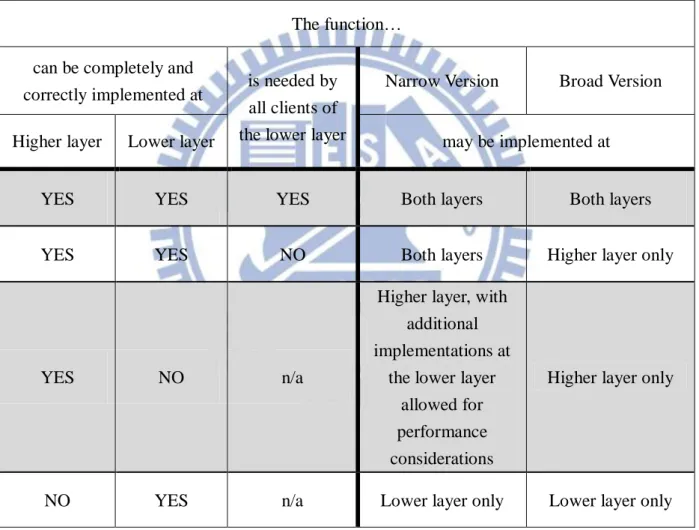
Table 1 Differences between narrow and broad versions of the end-to-end argument ... 12
List of Figures
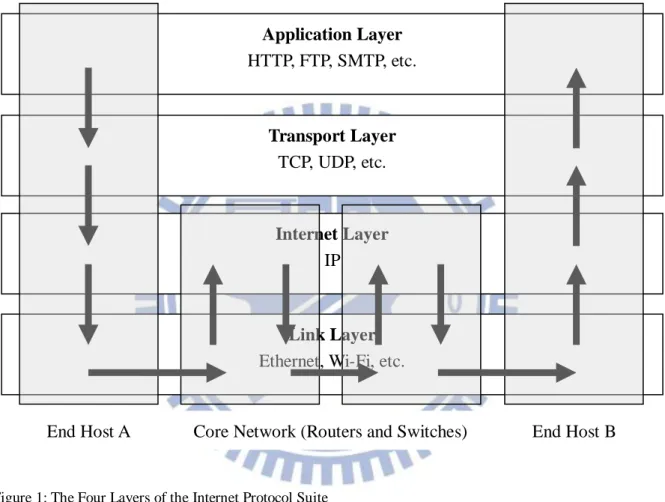
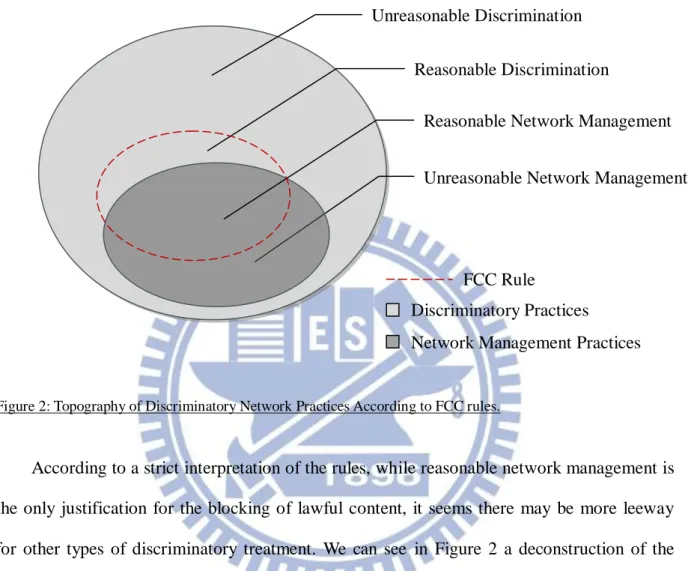
Figure 1 The Four Layers of the Internet Protocol Suite ... 8Figure 2 Topography of Discriminatory Network Practices According to FCC rules ... 43
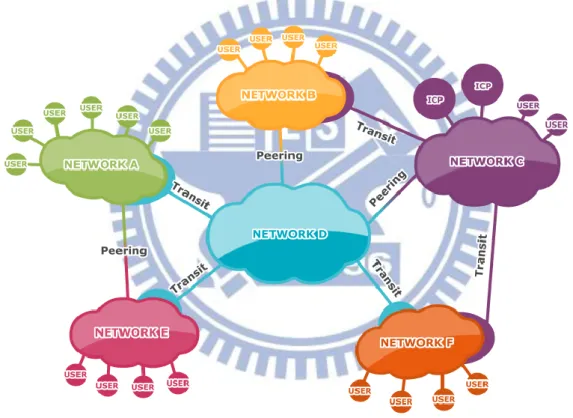
Figure 3 A Network of Networks Interconnected Through Peering and Transit ... 53
I. Introduction
1.1 Introduction
For many younger generations, it is hard to imagine life before the Internet. This global
system of interconnected computer networks – linking together millions of private, public,
academic, business, and government networks through a broad array of electronic, wireless
and optical networking technologies – has had a profound impact on our economies, societies,
and our way of life, fundamentally changing the way people communicate with each other,
the way we consume, share and interact with information, and basically every other facet of
our daily lives.
The Internet was first conceptualized in writing by J.C.R. Licklider of MIT, who
envisioned a “galactic” network of interconnected computers through which users could
seamlessly collaborate and share information and network resources1. This vision eventually
took shape in the form of the ARPANET, an experimental network commissioned by DARPA2,
a research branch of the United States Department of Defense. Initially, the ARPANET
connected the mainframes of four universities on the west coast of the United States, allowing
researchers to share the mainframes at any of the networked institutions – a practice known as
time-sharing.3 The ARPANET grew rapidly, adding new nodes to its network at a steady pace.
At the same time, other networks began to emerge, each with their own protocols and network
infrastructures. It was only a matter of time before the demand emerged for these networks to
interconnect with each other.
1
See J.C.R. Licklider and Welden E. Clark, On-Line Man Computer Communication (Aug. 1962), available at http://www.computer.org/csdl/proceedings/afips/1962/5060/00/50600113-abs.html.
2
Then known as the Advanced Research Projects Agency (ARPA), later renamed Defense Advanced Research Projects Agency (DARPA).
3
See Barry M. Leiner et. al., A Brief History of the Internet (Dec. 2003), available at http://www.internetsociety.org/internet/internet-51/history-internet/brief-history-internet.
In order to unify these networks, a new protocol was needed that would be able to
support the wildly different network architectures in use. Since each of these networks was
independently run, the goal was to create a protocol that would allow each stand-alone
network to communicate with each other over its existing infrastructure, without needing
internal changes, and with no centralized management necessary4. What emerged would
eventually be known as the TCP/IP protocol, and the merged networks would later grow into
the Internet we know today.
The open and decentralized architecture of this new “inter-network” based on TCP/IP
meant that no one entity was in control of the Internet. Individual networks were free to
introduce whatever uses they wished to the “inter-network,” and they would remain
interoperable with all other networks as long as they conformed to the protocol’s standards.
This spawned the broad deployment and adoption of a wide variety of uses for the network,
including electronic mail, file transfer, and probably most importantly, the World Wide Web.
The Internet has grown immensely since its humble beginnings. In the last decade alone,
the number of estimated Internet users has grown five-fold, from around 360 million to nearly
2.3 billion5, and this number continues to rise at a steady rate. The meteoric growth of the
Internet has fueled – and been fueled by – the extraordinary explosion in innovation that has
brought about all kinds of ingenious uses and applications unimaginable at the time the
Internet was conceived. Voice and video conferencing has enabled people to communicate
over great distances, and work or collaborate remotely in real-time. Blogs and social networks
allow individuals to make their voices heard around the world, creating “a forum for a true
diversity of political discourse [and] unique opportunities for cultural development.”6
4
See id.
5
See World Internet Users and Population Stats, Internet Usage Statistics, INTERNET WORLD STATS, http://www.internetworldstats.com/stats.htm (last visited Jun. 3, 2012).
6
E-commerce has transformed our economy, allowing businesses and individuals alike to buy
and sell goods and services online. Audio and video streaming have revolutionized the
entertainment industry, offering consumers a wealth of content at the click of a button. All
these innovations were made possible by the open architecture of the Internet. Professor
Lessig, a leading thinker on Internet policy, describes the Internet as one of the most
important “innovation commons” the world has ever seen, and remarks that it forms this
commons not just through norms, but also through its specific technical architecture7.
Recent advances in computing, however, have led many to fear that the underlying
architecture of the Internet may be on the brink of change. These changes threaten to affect
the “neutrality” of the Internet, in a way that could significantly affect its innovative potential.
In this paper, we address the nature of these changes, the concerns they raise, and the
regulatory regime that has emerged in response.
1.2 Framework
This paper is divided into three sections. Part one is an introduction of the architectural
principles that have underpinned the Internet. We take an in depth look at the design
principles that helped shape the so-called “neutral” Internet, and how these principles have
evolved over the years. We discuss the implications of these changes in technical terms, and
how these changes threaten to alter the status quo. Part two focuses on the regulatory
framework that has developed in response to these changes. We track the development of
regulatory proposals over the years, and conduct an analysis of the rules that have developed.
Finally, in part three we explore possible challenges to the rules, and highlight factors that the
regulatory agency must take into account to ensure its enforcement of these new rules
achieves its goals without running into constitutional concerns.
7
II. Network Neutrality and the Evolving Internet
2.1 Framing Network Neutrality
The network neutrality debate is actually a conflation of several issues. There are
generally three ways to frame the debate. The first approach is one that attempts to define
neutrality. In other words, this approach focuses on what it means for a network to be “neutral”, and what a “neutral” network entails for the different actors in the system. Much of the literature on the topic of “network neutrality” understandably starts off this way, either
with a definition of the term, or an attempt to define it. This may seem like a reasonable thing
to do, but there are several key shortcomings to such an approach of analyzing this particular
issue. For starters, the term “network neutrality” can mean a whole host of different things to
a whole lot of people, in a whole range of different contexts8. Commentators have recognized
since the start that “neutrality” was an imprecise term. In fact, in one of his earliest papers on net neutrality, Tim Wu commented that “neutrality, as a concept, is finicky, and depends entirely on what set of subjects you choose to be neutral among.”9
Simply by choosing the
range of subjects in defining the term, one inevitably risks betraying a bias that ends up
framing the debate in a certain way.10 Secondly, by starting out with a definition of the
principle, one risks unintentionally setting the stage for a pro and against debate with
8
Compare G. Knieps & P. Zenhäusern, The Fallacies of Network Neutrality Regulation, 9 COMPETITION AND
REG. IN NETWORK INDUS. 119 (2008) (“network neutrality is basically a debate on how best to finance the
construction and maintenance of a broadband network”) with Robert W. Hahn and Scott Wallsten, The Economics of Net Neutrality, 3 THE ECONOMISTS’VOICE 8 (Apr. 2006) (“net neutrality is actually a
friendly-sounding name for price regulation”) and Nicholas Economides and Joacim Tåg, Network Neutrality on the Internet: A Two-Sided Market Analysis, 24 INFO.ECON.&POLICY 91 (Dec. 12, 2001) (“net neutrality is defined as a restriction that Internet Service providers cannot directly charge content providers for access to consumers”); See also Rachelle B. Chong, The 31 Flavors of Net Neutrality: A Policymaker's View, 12 INTELL. PROP.L.BULL. 147 (2008) (“Net Neutrality is like the Baskin-Robbins ice cream store. There are several flavors that appeal to various tastes. Whatever you want, we can serve it up in a Net Neutrality cone.”).
9
See Tim Wu, Network Neutrality, Broadband Discrimination, 2 J. OF TELECOMM.&HIGH TECH.L. 141 (2003).
10
But see Daniel S. Isenberg, Framing Network Neutrality Right, DAVID S.ISENBERG'S MUSINGS ABOUT LOCI OF INTELLIGENCE AND STUPIDITY (Dec. 6, 2006). (opining that it is clear what net neutrality means, and that by not recognizing that fact, we are falling into the trap of telecommunications and cable companies, who want “to keep Network Neutrality amorphous and undefinable [so that] we can't pass a law against it”).
strawmen arguments that ultimately end up distorting the debate11.
A second approach focuses on the regulatory means to address net neutrality: how we
should regulate, and the desirability of regulation12. This approach mostly focuses the
question of how net neutrality laws should best be enforced – for example, in the form of
ex-ante regulations or ex-post remedies – or under what regime or authority the rules should
be enforced – e.g. under the FCC’s ancillary jurisdiction, a reclassification of broadband as a
Title II telecommunications service, or with new explicit mandates from Congress.
The third and last approach is one that addresses specific goals of net neutrality. This
focuses on what we wish to achieve, and the values we wish to protect, beyond neutrality of
the network per se. Instead of defining neutrality, this approach focuses on identifying specific
problems, and finding an answer for those problems.
This paper adopts the latter approach. Hence, for the moment, we will refrain from
assigning the term any definition at all, short of its literal reading. This paper also does not
seek to answer the question of how network neutrality rules should best be enforced, or by
whom. Instead, we look towards the technical and architectural origins of the Internet to help
shape our view of what “network neutrality” actually is – and how well the current policies
reflect that – rather than what activists and stakeholders want it to mean, or think it means.
2.2 The Underlying Architecture of the Internet
There are several features of the Internet that have led to it being hailed as a “neutral”
network. Before we can truly understand the “neutral” nature of the original Internet, we must
11
For example, in reality very few commentators disagree with the advantages of an open Internet, but rather, most “opponents” of net neutrality actually oppose the need for regulatory oversight.
12
See, e.g., Jonathan E. Nuechterlein, Antitrust Oversight of an Antitrust Dispute: An Institutional Perspective on the Net Neutrality Debate, 7 J. ON TELECOMM.&HIGH TECH.L. 19 (2009) (“This paper focuses instead on the comparatively neglected institutional dimension of the debate: an inquiry into which federal agencies are best positioned to resolve net neutrality disputes when they arise.”).
have a basic understanding of how the Internet works.
2.2.1 The Internet: a Network of Layers
In order to communicate over the Internet, a host computer relies on set of protocols
known as the Internet protocol suite or TCP/IP, after its two main protocols, the Transmission
Control Protocol (TCP) and the Internet Protocol (IP). The TCP/IP model enables seamless
communication between different host devices running on a diverse array of hardware and
software platforms, each connected to the network through a variety of types of physical
mediums. In fact, TCP/IP was designed to be able to run over anything. It achieves this by
employing a system of layers, whereby each layer implements a certain predefined set of
functions via its own internal-layer actions, while relying on functions provided by the layer
below. Listed from lowest to highest, the four layers of the TCP/IP protocol are:
A. The Link Layer
The link layer contains a wide variety of protocols responsible for physically
transporting data packets across a point-to-point link. To transmit and receive data from the
network, a host must implement a communication link to interface with the network. As
previously mentioned, this link may be realized through a variety of types of physical media,
including but not limited to coaxial cable, copper wire, fiber optics, or radio spectrum. Link
layer protocols define the procedures for interfacing with network hardware and accessing the
transmission medium, providing higher layers with a consistent and predictable data transport
mechanism regardless of the underlying physical link.13
B. The Internet Layer
The purpose of the Internet layer is to select the best route through the network for data
13
packets to travel across the link layer to their destinations. It is the only layer of the Internet
protocol suite with one single common protocol: the Internet Protocol (IP). All Internet
transport protocols use the IP to carry data from one end host to another. To do so, the data
must pass through a series of routers. It is the job of IP to manage the addressing and delivery
of these raw data packets so they can travel successfully from router to router across the
physical network. However, IP does not provide end-to-end delivery guarantees. It is a
connectionless protocol, transmitting each and every data packet independently, based on each
router’s best guess as to where the packet should go next. Data packets may arrive damaged,
out of order, or even be lost altogether. It is the job of higher layers to make sure data is
correct and complete.14
C. The Transport Layer
The transport layer is responsible for the sending and receiving of data between different
end hosts. On a sending host, it processes data from the application layer and determines
where that data should be sent. On a receiving host, it receives incoming packets from the
Internet layer, and determines which application it is destined for. It is also be responsible for
making sure (if required by the application) that the data it sends or receives is complete and
error-free when it arrives, and may implement mechanisms for retransmission of lost or
damaged data. This extra layer shields applications from the unreliable nature of the IP
protocol.15
D. The Application Layer
The application layer consists of the higher-level protocols applications use to
communicate amongst each other. Well known application layer protocols include the
14
Id. at 85.
15
Hypertext Transfer Protocol (HTTP), the File Transfer Protocol (FTP), and the Simple Mail
Transfer Protocol (SMTP). These protocols specify the rules and syntax according to which
data should be formatted and transmitted, the request methods and responses, and the
appropriate procedures and behaviors expected of the applications, so they can work with
each other in a seamless manner.16
Figure 1: The Four Layers of the Internet Protocol Suite
Source: Adapted from Barbara van Schewick, Internet Architecture and Innovation
To put the four layers into a practical context, when an application on End Host A wants
to communicate a piece of information to its counterpart on End Host B, it first formats the
information according to the specifications set forth by the application’s protocol of choice
(e.g. HTTP) at the Application Layer, then submits a request to the Transport Layer to
transmit that information to the designated destination on the network (End Host B). The 16 Id. at 87. Application Layer HTTP, FTP, SMTP, etc. Transport Layer TCP, UDP, etc. Internet Layer IP Link Layer
Ethernet, Wi-Fi, etc.
Transport Layer will establish a connection with End Host B using TCP or some other
Transport Layer protocol, and the data will be encapsulated into packets that will be routed
using IP over the Internet layer, running over whatever physical media happens to be
providing the Link Layer.
This layered approach realizes a separation of concerns among different components of
the system, whereby each layer performs a clearly defined function, independent of the other
layers. Each layer in turn has a set of “visible information,” which allows it to interface with
other layers in a predetermined and predictable manner. This modular design creates an
architecture in which components can be designed and improved independently but still work
together17. As long as the visible service interface provided by the lower layer does not
change, the inner workings of the layer can be changed without breaking functionality at other
layers in the system. This insulates applications on the end hosts from changes caused by the
inevitable changes in the Internet’s routing architecture. At the same time, since lower layers
are not allowed to use the services of higher layers, the Internet layer and the link layer
remain unaffected by innovations in the transport and application layers. Thus, the Internet
Protocol can support an unlimited variety of application protocols at the higher layers, while
taking advantage of all kinds of new physical network infrastructures and improved
transmission and link technologies at the lower layers, without requiring corresponding
changes at the higher layers.
Continuing with the previous illustration, this means the application does not need to be
concerned with the inner workings of the lower layers, like how the data is being routed to the
destination, or on what type of medium. As far as the application is concerned, everything
below the transport layer is a black box. It communicates on an end-to-end basis directly
across the Application Layer. The application on End Host A sends out a piece of data, and the
17
application on End Host B receives that data. All it needs to know is that the lower layers will
faithfully handle the data as it requests, so that it will be delivered to the destination. As for
the lower layers, all they need to be concerned about is executing orders from the layer above
them. A real-world analogy for this would be the postal service, where the mail senders do not
need to know the inner workings of the post office, and the delivery guy does not need to
know the content of people’s packages.
On its face, the layering principle may seem pretty straight-forward, but it raises a
critical question for network designers: At which layer should specific functionality be
implemented on the network?
2.2.2 The End-to-End Argument
The “end-to-end” argument is a design principle that attempts to serve as a guide for
resolving the issue of how to allocate functions among the layers. At its core, it argues for a
framework for organizing the distribution of functionality within a network in a way that “intelligence” in the network be implemented at the “ends” of the network, where the higher layers of the network are. In the context of the Internet, this is the Application Layer at the
end host. On the flip side, it calls for the lower layer communications protocols themselves to be as “simple and general” as possible, in order to maximize its utility for all applications.18
The end-to-end principle has implicitly guided the development of the Internet since its
inception, but it was not explicitly recognized as a design principle until the early 1980s, in a
paper entitled End-to-end Arguments in System Design19, by Professors Jerome Saltzer, David Reed, and David Clark. In various subsequent papers, the same authors have, jointly and
18
See Mark A. Lemley and Lawrence Lessig, The End of End-to-End: Preserving the Architecture of the Internet in the Broadband Era, 48 UCLAL.REV. 925 (Oct. 1, 2000).
19
Jerome H. Saltzer, David. P. Reed, and David. D. Clark, End-to-End Arguments in System Design, 2 ACM TRANSACTIONS ON COMPUTER SYSTEMS 277-288 (Nov. 1984). An earlier version appeared in the
independently, sought to refine and clarify the principle and what it means for the underlying
architecture of the Internet. One general depiction of the principle is as follows:
End to end arguments have … two complimentary goals: (1) Higher-level layers, more specific to an application, are free to (and thus expected to) organize lower level network resources to achieve application-specific design goals efficiently (application autonomy); (2) lower-level layers, which support many independent applications, should provide only resources of broad utility across applications, while providing to applications useable means for effective sharing of resources and resolution of resource conflicts (network transparency).20
The principle, however, is not without its own uncertainties. For one, it relies on the
ability to distinguish clearly between application specific and non-application specific
functions. At a more technical level, it is ambiguous as to how it should allocate potentially
application specific functions that may be possible to “completely and correctly” implement
at multiple layers. As such, it is not always clear what exactly the end-to-end principle entails
in certain specific cases, resulting in the awkward situation in which both proponents and
opponents of a technical implementation invoke the end-to-end-principle to back up their
views.21
In her book, Internet Architecture and Innovation22, Professor Barbara van Schewick is
one of the first academics to it undertake a critical analysis of the inconsistencies in the
different interpretations of the end-to-end principle. She finds that even in the writings of
Saltzer, Reed, and Clark, there exist “two versions of the end-to-end arguments that represent
different rules for architectural design.”23 The first version (the “narrow” version) states that “a function should only be implemented in a lower layer, if it can be completely and correctly implemented at that layer. Sometimes an incomplete implementation of the function at the
20
Jerome H. Saltzer, David. P. Reed, and David. D. Clark, Active Networking and End-To-End Arguments, 12 IEEENETWORK 66, 70 (May 1998).
21
See VAN SCHEWICK, supra note 13, at 81.
22
Id.
23
lower layer may be useful as a performance enhancement.”24 The second version (the “broad” version) states that “a function or service should be carried out within a network layer only if it is needed by all clients of that layer, and it can be completely implemented in that
layer.”25 Van Shewick notes that technical discussions tend to focus on the narrow version,
whereas policy texts and descriptions of the Internet’s architecture tend to focus on the broad
version. Generally speaking, most of the literature that refers to the end-to-end arguments
simply quotes one or the other.
The function…
can be completely and
correctly implemented at is needed by all clients of the lower layer
Narrow Version Broad Version
Higher layer Lower layer may be implemented at
YES YES YES Both layers Both layers
YES YES NO Both layers Higher layer only
YES NO n/a
Higher layer, with additional implementations at
the lower layer allowed for performance considerations
Higher layer only
NO YES n/a Lower layer only Lower layer only
Table 1: Differences between narrow and broad versions of the end-to-end argument Source: Adapted from Barbara van Schewick, Internet Architecture and Innovation
From Table 1, we can see that in practice, the adoption of the narrow or broad version of
24
See Saltzer, Reed, and Clark 1984, supra note 19, at 278.
25
the principle can result in a different implementation in network architecture in two sets of
circumstances:
(1) When a function can be implemented in both layers, but is not needed by all clients of
the lower layer, the narrow version allows implementation at both layers, while the
broad version allows implementation at the higher layer only.
(2) When a function can only be completely and correctly implemented at the higher layer,
the narrow version allows for additional incomplete implementations at the lower
layer for performance considerations.
The differences between the two versions may seem trivial, but the distinction is
important for reasons that will later become apparent. The narrow version focuses on an
end-to-end system where the sole emphasis is placed on “correctness”26 — functions can be
implemented at any layer where they may be “correctly and completely” implemented,
whether at the ends, or at the core. The broad version, on the other hand, goes beyond the
concept of correctness, and insists on implementations of any type of non-general, application
specific functions being placed at the higher layers, which by extension means placing them at
the end points, away from the core of the network.27 Van Schewick lays out several key
advantages to the latter approach, in terms of the network and the applications:
A. Network Evolvability
As a general purpose network, the Internet needs to have the flexibility to be able to
support any kind of application. Since each type of application may have a different set of
requirements, implementing functions at a lower layer to increase the performance of a certain
26
See VAN SCHEWICK, supra note 13, at 79.
27
type of application may increase the overhead for another, or even render the network
unusable for some other type of application.
Van Schewick cites a classic example of network optimizations that ended up presenting
unintended obstacles for subsequent application innovations: the use of load coils in
traditional public switched telephone networks to boost the transmission of high frequency
voice communications.28 A side effect of the use of load coils was that frequencies above 3.4
kHz would be cut off. Since voice telephony did not use frequencies over 3.4 kHz at the time,
network designers did not see this as a problem. However, this limitation later posed serious
problems for the introduction of Digital Subscriber Line (DSL) services over the same lines,
as DSL used higher 25 kHz frequencies that were effectively cut off by the load coils. The
moral of the story is that optimizations that appear benign in the context of one type of
application (voice telephony) could become catastrophic in the context of another application
(DSL). By placing application-specific functionality in a higher-layer protocol at the end hosts,
we avoid the possibility of lower layers becoming a bottleneck in future innovation. The
network itself remains free evolve, as the lower layer continues to accommodate any kind of
innovation that may come along.
B. Application Autonomy
It is undisputable fact that applications will always know their own needs better than the
network. Van Schewick notes that it is virtually impossible that lower-layer designers will be
able to guess in advance all the features applications at the higher layers will potentially need,
especially in the case of applications that have yet to materialize. However many features
lower-layer designers attempt to cram into the network, applications will most likely end up
having to implement application-specific services themselves anyway. Furthermore,
28
additional features may not be suitable for all uses of the application, and may create extra
overhead, ending up being more harmful than helpful in certain cases. Placing application
specific functions at the higher layers ensures that applications have the freedom to determine
their own actions, and most importantly, the consequences thereof.29
C. Reliability
By implementing functionality specific to certain applications at the lower layer, we may
be introducing additional points of failure in the system for those applications that rely on
these functions. Since these network functions are not under the direct control of the designer
or user of the application, they have no means to correct those problems when they arise. By
restricting the placement of application specific functions at the higher layers, we can ensure
that all potential points of failure for an application can be addressed by the designer or user
of the application, without needing intervention from the lower layers. At the same time, this
approach reduces the complexity of the software that needs to be implemented on the
hardware at the lower layers. This makes designing and maintaining the network easier, and
less prone to malfunction. Together, this makes both the applications and the network more
reliable.30
D. Lack of Application Awareness in the Core
This is not so much a “feature” of the broad version of the end-to-end principle, as it is a
consequence of the architectural limitations set by the principle. Since all application specific
functionality is systematically removed from the lower layers, this inevitably results in a
network core that lacks any sort of application awareness. With all the “intelligence” placed at
the ends, the network itself becomes a “stupid” network, responsible only for the transmission
29
See id. at 71.
30
of raw data packets, without regard as to the nature of the content in the packets. This
effectively places control of how to use the network in the hands of the applications and the
users of the end hosts.31
2.3 The Emergence of Application Awareness in the Core
The layering principle in conjunction with an adherence to a broad interpretation of the
end-to-end principle necessarily results in an architecture where the core of the network is not
able to distinguish between applications. However, for the most part of its history, the choice
of whether to adhere to the narrow or broad version of the end-to-end principle did not make
all that much of a difference. Computing resources were scarce, and any kind of application
specific functionality would have added immense overhead to the routers in a manner that
would have greatly impacted throughput. The performance trade-off meant that regardless of
which version of the principle one chose to follow, it was generally more rational to leave
such functionality at the higher layers on the end points, where computing resources where far
more abundant, even if it would have been acceptable in principle to implement those
functions at the lower layers.
As computing power continued to grow at an exponential rate, this began to change. At
the turn of the century, technological capabilities had advanced enough that hardware
equipment vendors began to introduce new network hardware with enhanced capabilities that
could inspect data packets as they passed through the network. Later, new hardware would
appear that not only allowed network providers to know exactly what was passing through
their systems, but also gave them the capability to assign priorities to packets, and most
importantly, change the way it handled them. This was a fundamental departure from the
original Internet’s lack of application awareness.
31
2.4 Packet Inspection and the Growing Threat of Discrimination
Up until then, the only way network providers had been able to control the end user ’s use
of the network was through contractual usage restrictions and acceptable use policies. Now,
through packet identifying technologies such as Deep Packet Inspection (DPI), they had the
capability to directly control how users made use of the network.32 Suddenly, the choice
between adhering to a narrow or broad version of end-to-end made the world of a difference,
and the prospect of network providers controlling the flow of information on their networks
became so much more realistic. This development understandably had many stakeholders and
policy makers worried. It signaled a return to the centralized architecture of the telephone
system, where the network provider could act as a gatekeeper, and decide who would get what
kind of treatment. In an article ominously titled Deep Packet Inspection, one commentator
remarked on the implications of the technology:
Operators can tag packets for fast-lane or slow-lane treatment – or block the packets altogether – based on what they contain or which application sent them…When a network provider chooses to install DPI equipment, that provider knowingly arms itself with the capacity to monitor and monetize the Internet in ways that threaten to destroy Net Neutrality and the essential open nature of the Internet.33
The ability to discriminate on the basis of content or application was definitely a
legitimate concern. However, despite the long list of potentially unsavory uses, not all types
of discrimination were inherently bad. In fact, there were equally as many ways
discrimination could be used for the benefit of the user. In the following section, we take a
look at the mechanics of network discrimination from a technical perspective, and how they
may be used for good and problematic purposes.
32
See Jon M. Peha, The Benefits and Risks of Mandating Network Neutrality, and the Quest for a Balanced Policy, 1 INT’L J.COMM.644, 648-50 (2007).
33
M. Chris Riley and Ben Scott, Deep Packet Inspection (Mar. 2009), available at http://www.wired.com/images_blogs/threatlevel/files/dpi.pdf.
2.4.1 The Mechanics of Network Discrimination
To understand how network discrimination works in practice, we must first understand
how data traverses the network. Picture a scenario where end host A and B are respectively
located on separate networks X and Y, which are connected through Z. When host A sends a
packet to B, the data is transferred from network X, through Z, to network Y, via a series of
routers and switches along the network. Whenever a router receives a packet, it must first
determine which outgoing link to send it on. If the link is available, the packet is sent on its
way. If the link is busy, the packet is queued in a buffer, and waits its turn to use the link. If
the buffer is full, which happens when the network is overloaded, the packet may be
dropped34.
In the original application-agnostic Internet, all packets were transferred on a first come
first serve basis. In an application aware network, the system has far more choices when it
comes to deciding what to do with the packet. In the paper Nuts and Bolts of Network
Neutrality35, Edward Felten describes some of the different approaches network owners may take, which we adapt here.
A. Best Efforts or Absolute Non-Discrimination
Absolute non-discrimination is where the network does not discriminate at all between
the single bits that pass through it. Every individual packet transmitted through the system is
treated in exactly the same way, on a first-come-first-serve basis, regardless of its properties.
This was referred to as a “best-efforts” service, whereby the network would attempt to deliver
any packet based on its best guess and best effort as to how to get it to its destination. When a
34
According to the TCP/IP protocol, a dropped packet signals to the sending end host that the link is congested, and a well behaved host will then back off and reduce the rate of transmission until the link returns to an uncongested state.
35
Edward W. Felten, Nuts and Bolts of Network Neutrality (Aug. 2006), http://itpolicy. princeton. edu/pub/neutrality. pdf.
link buffer is full and a new packet comes in, the router has several choices: (1) it can drop the
new incoming packet, or (2) it can allow it into the queue by dropping another packet in the
queue, likely the oldest packet in the queue, if not some other packet at random. In such a
scenario, any packet has an equal chance of being dropped.
B. Minimal Discrimination
There are, however, no rules requiring the router to drop packets in a certain way. In fact,
a router can discard packets in any way it pleases. Minimal discrimination is a scenario
whereby the network assigns priorities to packets in the queue. When necessary, rather than
dropping packets at random, or based on their order of arrival, the router will drop packets
with the lowest priority first. For example, whenever the buffer is full, the router may decide
to drop P2P packets first. Felten calls this “minimal” discrimination36, because it only
discriminates against certain types of packets when the network is congested and therefore
cannot serve all packets at once. Most of the time, when the network is not congested, there is
no difference between treatment of higher and lower priority packets.
C. Non-Minimal Discrimination
There is another type of implementation, however, in which the routers may selectively
discard low priority packets even if there is enough capacity on the network to deliver them.
For example, the router may be set to reserve 50% of the network’s capacity for high priority
packets. When the percentage of lower priority packets reaches the threshold, they may face
being dropped, even if the remaining 50% stays idle. Felten calls this kind of discrimination “non-minimal,” because it artificially restricts certain packets to an arbitrary percentage of
36
capacity. 37
D. Delay Discrimination
Another type of discrimination possible is delay discrimination. This type of
discrimination can happen in conjunction with minimal and non-minimal discrimination.
Unlike the previous two types of discrimination, which are executed through the dropping of
packets, this type of discrimination works through the reordering of packets. Just as the
Internet Protocol does not specify what in what order packets should be dropped, it likewise
does not specify the order in which they should be sent. While routers generally route packets
on a first-come-first-serve basis, it is equally acceptable to send packets in a different order.
For example, a router could allow high priority packets to always cut in front of the line, or
advance through the queue at a faster pace. Low priority packets therefore experience an extra
delay when passing through the router, much like humans do when people cut in line. This
delay is known as “latency.” Another consequence of delay discrimination is that packets may
be sent out of order, or experience different delays. This variation in delay is known as “jitter.” 38
E. Absolute Discrimination
This is the most extreme type of discrimination, and in practice this is synonymous with
blocking. What happens is that certain types of packets are categorically blocked when they
pass through the router, regardless of whether or not there is a link available, or if there is a
buffer queue. For example, a network provider with incentives to block Internet voice services
could decide to drop all voice packets passing through their network, rendering the network
unusable for VoIP.
37
See id.
38
2.4.2 Possible Purposes of Network Discrimination
So far we have discussed the means available to network providers for discrimination,
but what would be their rationales for engaging in such practices? There are several purposes
for which a network provider might choose to employ discriminatory practices on their
networks. Some are mostly benign, others more problematic. We discuss some of the most
common applications here:
A. Network Congestion Control
In the age of dial-up or “narrowband” Internet, congestion was not much of an issue for
network providers. The voice networks that were provided over traditional copper wire could
only support a maximum throughput of 56.6 kilobits per second for Internet access, setting a
hard cap on the amount of bandwidth each user could use. Furthermore, most of these
connections were rarely continuous for long periods of time. This was due to (1) the costs
associated with dial-up, and (2) the cost of Internet access being billed in hours. This meant
that the level of bandwidth in use at any one time was far lower than necessary to become a
cause for concern at the backbone level, where bandwidth was comparably more plentiful.
Eventually, however, Internet access moved from voice to other more efficient modes of
transport such as DSL and cable, and more currently fiber and wireless, bringing about highly
increased access speeds and “always on” connections, often at flat rates. End users were no
longer physically capped by the speeds of their access equipment, but instead by artificial
limits set by the network providers. Since it was unlikely that all users would be using 100%
of their bandwidth at the same time, ISPs generally adopted a practice known as “oversubscription” when setting such user bandwidth limits. Oversubscription is the practice of selling more bandwidth than you have capacity for, by planning for the typical demand
“supports the maximum amount of subscribers on the least amount of infrastructure.”39 It
also allows users of the network to take advantage of a higher level of bandwidth at any given
moment than would be possible in a non-oversold network.
However, usage trends gradually evolved, and users began to use the network in ways
not previously envisioned by the network providers. As the Internet began to exhibit a shift in
behavior towards more bandwidth-intensive, rich-media content, such as streaming video and
peer-to-peer (P2P) file sharing, these bandwidth-intensive uses inevitably put an increasing
strain on the backbone. This resulted in more frequent congestion as users began to use up
more and more of their bandwidth allotments on a regular basis.
During periods of congestion, the network provider may have an incentive to employ
network management policies to ensure fair and/or efficient allocation of network resources.
Network management does not necessarily have to be employed in an application
discriminating manner; however, there may be certain benefits to doing so. For example,
instead of slowing down all the traffic from a user using a high amount of bandwidth, the
network could have a congestion policy that slowed down a user’s file downloads but not
VoIP packets. This can be achieved through a combination of minimal discrimination and
delay discrimination. By giving higher packet priority to VoIP packets, the network provider
could ensure that user’s connection could be used normally for voice communications even
during periods of congestion. This may make the network more useful as a whole. On the
other hand, application specific network management can also be used in more sinister ways,
for example, by slowing down access to certain high bandwidth sites during periods of
congestion. Determining what types of congestion management policies are acceptable is
often a core issue of the net neutrality debate.
39
See Tom Mitchell, Avoiding the Pitfalls of Oversubscription in DSL Networks, VISION2MOBILE, Apr. 2000,
B. Quality of Service Assurances
Another application of network discrimination is to provide Quality of Service (“QoS”)
assurances. In simple terms, QoS entails the prioritization of certain types of data over others
based on their special requirements. We already discussed in the previous section how
network providers could prioritize VoIP packets so voice communications could continue to
function when the network was saturated. While this is especially important during periods of
congestion, there are equally compelling reasons to employ such prioritization during periods
of non-congestion.
Some applications are not sensitive to packet delay. For example, it does not matter as
much if your file takes 10 more seconds to download, or if the packets for your website arrive
in a slightly different order. However, the same may be detrimental for a real-time application
such as VoIP or IPTV. Generally, there are two types of QoS guarantees a network may
provide:
(1) Bandwidth guarantees
While most applications can adapt to available bandwidth by sacrificing either speed
or quality, some network applications require a constant level of bandwidth. This is
most often the case with streaming audio of video, which can sacrifice neither
transfer speed nor quality. By reserving resources in the system and
under-subscribing for those resources, the network can make sure certain applications
will always receive a certain share of the link capacity, even during periods of
congestion. In practice, this is a kind of non-minimal discrimination. 40
(2) Delay guarantees
40
See Deploying Guaranteed-Bandwidth Services with MPLS (2002), CISCO SYS.,INC.,
Bandwidth guarantees alone may not ensure low latency or low jitter. For example, a
longer route through the network may guarantee bandwidth, but result in a higher
delay. It may not matter to you that your Internet video stream plays at a five second
delay as long as it is continuous and clear, but that same five second delay may
render applications such as voice communications or online-gaming unusable. This is
even more crucial in the case of mission-critical applications, such as financial or
medical applications, where the difference of a millisecond may be the difference
between millions of dollars, or worse, life and death. By assigning a higher priority
to latency sensitive data, the network can ensure the data arrives with the least
amount of latency possible. This, however, has the consequence of imposing delay
discrimination on other lower priority packets. 41
There are clear benefits to providing QoS guarantees on the Internet, but the fact is that
prioritizing one type of data necessarily means de-prioritizing some other type of data. How
the network provider may decide which packets to prioritize (and by extension, what it may
de-prioritize) is the subject of much controversy. QoS may be employed for public good, like
in many of the examples above, or for self serving interests, like prioritizing services of
favored partners only. Determining how the network provider may prioritize, and under what
conditions it may prioritize, is another core issue of the net neutrality debate.
C. Blocking, Filtering and Censorship
Network discrimination may also be applied to block, filter and censor content or traffic.
This may sound highly problematic in terms of net neutrality, but there are actually many
non-sinister reasons a network provider might choose to do so. For one, the network might be
required to filter or block content in accordance to the law. The one extreme example of such
41
an application of network discrimination would be China. Of course, due to strong First
Amendment protections built into the Constitution, there is currently no comparable situation
in the United States, and in practice there is very little, if any, government mandated technical
filtering42. However, there have been attempts to introduce proposals that could have brought
precisely such requirements into law43. Regardless of whether such laws are desirable or not,
it is generally not considered controversial for the network provider to comply with such legal
obligations.
Another quite legitimate purpose for filtering is network security. There are many
harmful and abusive uses of the network that can threaten the utility of the Internet for the
public as a whole. For example, denial of service attacks can flood the network with bogus
packets, clogging the network and rendering it unusable for other purposes. Viruses may
attempt to replicate through the network, infecting other computers on the network through
weaknesses in their systems. Malicious software or end users may attempt to exploit the
network in a way that violates or interferes with standard protocols, monopolizing the
resources or affecting other users’ ability to use the network. Compromised machines may be
remotely controlled by hackers to send spam and launch distributed denial of service attacks.
An application aware network can easily filter out such communications at the lower level,
employing absolute discrimination policies on harmful traffic, ensuring the network can
continue to function properly, and providing end users with an extra level of protection. This
is one of least controversial rationales for network discrimination.
Of course, there remains the very real possibility that network providers discriminate for
self-serving purposes. For every legitimate filtering purpose, one can easily think of a hundred
ways network providers could employ filtering for far more unfavorable purposes. For
42
But see Children's Internet Protection Act of 1999, S. 97, 106th Cong. (1999).
43
See, e.g., Stop Online Piracy Act of 2011, H.R. 3261, 112th Cong. (2011); PROTECT IP Act of 2011, S. 968, 112th Cong. (2011).
example, network providers could block competing websites or applications, and censor
content that it does not like, or demand a fee to deliver content to their users. These are all
legitimate concerns that would likely raise opposition.
D. Intentional Degradation of Service
This is not so much a “purpose” of discriminatory network practices as it is a crude
application of such practices absent of any of the legitimate purposes outlined above. It
basically serves no goal at all other than the degrading of service per se. There are hardly any
justifications for this type of discriminatory conduct, as it puts the discriminated entity at a
great disadvantage, while benefiting no one, except maybe the network provider.
2.5 Responding to the Threat of Discrimination
While the layering principle and the end-to-end argument have historically resulted in a
network lacking application awareness at the core, technological advances have rendered that
limitation irrelevant. The core network is now more intelligent than ever, whether we like it or
not. We have presented several ways that intelligence can be used to discriminate against
different types of traffic, and we have discussed how they can be employed to achieve several
different types of objectives, some of which may be beneficial and others which may be
harmful. The question, therefore, is whether network providers should be prevented from
harnessing that intelligence.
The stakes are high in this debate. Some, like Lemley and Lessig, argue that the network
providers should not be allowed to use that intelligence, because to do so would “compromise
Nothing less than the structure of the Internet itself is at stake in this debate.”44
As we’ve seen, the broad version of the end-to-end principle calls for the network to be “dumb”, and it presents several sound architectural justifications for doing so. But it is not simply the architectural justifications that matter the most for advocates of regulation. It is the “relationship between these architectural principles and the innovation of the Internet.” Lessig writes:
While the [end-to-end] design principle was first adopted for technical reasons, it has important social and competitive features as well. [end-to-end] expands the competitive horizon, by enabling a wider variety of applications to connect and use the network. It maximizes the number of entities that can compete for the use and applications of the network. As there is no single strategic actor who can tilt the competitive environment (the network) in favor of itself, or no hierarchical entity that can favor some applications over others, an [end-to-end] network creates a maximally competitive environment for innovation, which by design assures competitors that they will not confront strategic network behavior.45
The consequences of these architectural principles have indeed been profound, but they
are still just that: architectural principles. In Internet Engineering Task Force (IETF) Request
for Comments No. 1958, a “snapshot” of the then-current principles of Internet architecture,
then-Chair of the IETF Brian Carpenter thusly wrote:
In searching for Internet architectural principles, we must remember that technical change is continuous in the information technology industry. The Internet reflects this. Over the 25 years since the ARPANET started, various measures of the size of the Internet have increased by factors between 1000 (backbone speed) and 1000000 (number of hosts). In this environment, some architectural principles inevitably change. Principles that seemed inviolable a few years ago are deprecated today. Principles that seem sacred today will be deprecated tomorrow. The principle of constant change is perhaps the only
44
See Lemley and Lessig, supra note 18, at 925.
45
principle of the Internet that should survive indefinitely.46
Few would dispute the very real benefits that the end-to-end architecture and the
consequentially “neutral” Internet have created for society. However, the desirability of
hard-coding those architectural principles into law is debatable. Some argue that while the
threat is indeed possible, it is for the moment speculative at best. Others worry that
hard-coding technological principles into law may have unintended consequences further
down the road.
It is these differing responses to threat of network discrimination – rather than
disagreements over definitions – that form the core of the net neutrality debate.
46
See Brian Carpenter, Architectural Principles of the Internet, IETF RFC 1958 (Jun. 1996), http://www.ietf.org/rfc/rfcl958.txt.