An Investigation of the Optical Analysis in
White Light-Emitting Diodes With Conformal
and Remote Phosphor Structure
Kuo-Ju Chen, Hsin-Chu Chen, Chien-Chung Lin, Member, IEEE, Chao-Hsun Wang, Chia-Chi Yeh,
Hsin-Han Tsai, Shih-Hsuan Chien, Min-Hsiung Shih, Member, IEEE, and Hao-Chung Kuo, Senior Member, IEEE
Abstract—An effective emission model of phosphor film is
proposed by using bidirectional scattering distribution function
system (BSDF), and the model is verified by white light-emitting
diodes (LEDs) with conformal and remote phosphor structure.
The emission model is built to clarify the optical characteristics
by analyzing the angular-dependent distribution of emission
and excitation behaviors in phosphor film. The white LEDs with
conformal and remote phosphor structure are also fabricated for
experimental comparison. The uniformity of angular correlated
color temperature (CCT) in white LEDs can be determined by
the angular distribution of blue and yellow light, which is in turns
decided by the refractive index variation between chip a©nd
phosphor layers. Finally, the experimental results are found to
have good agreement with the simulation results performing by
the Monte Carlo method.
Index Terms—GaN, light-emitting diodes (LEDs), optical
simu-lation, phosphor.
I. I
NTRODUCTIONR
ECENTLY, white light-emitting diodes (LEDs) have
been regarded as the next-generation light source due
to the small size, environmental friendly process as well as
high luminous efficiency [1]–[3]. In general, combining the
blue LED chip with the yellow luminary such as Y Al O
phosphor is the most promising method to generate the white
light [4], [5]. For the significant progress in phosphor-converted
white LEDs had been strongly motivated by the advances in
III-Nitride LEDs [6]–[14] serving as pump excitation sources.
The availability of high performance nitride LEDs enables
the practical implementation of phosphor-based LEDs. The
Manuscript received January 13, 2013; revised March 14, 2013; accepted May 14, 2013. Date of publication July 10, 2013; date of current version November 12, 2013. This work was supported in part by the National Science Council in Taiwan under Grant NSC 102-3113-P-009-007-CC2 and Grant NSC 99-2221-E-009-030-MY3.
K.-J. Chen, C.-H. Wang, C.-C. Yeh, H.-H. Tsai, S.-H. Chien, M.-H. Shih, and H.-C. Kuo are with the Department of Photonics and Institute of Electro-Optical Engineering, National Chiao Tung University, Hsinchu 30010, Taiwan (e-mail: [email protected]).
H.-C. Chen is with the Department of Photonics and Institute of Electro-Op-tical Engineering, National Chiao Tung University, Hsinchu 30010, Taiwan, and also with the Electronics and Optoelectronics Research Laboratories, Industrial Technology Research Institute, Hsinchu 30010, Taiwan.
C.-C. Lin is with the Institute of Photonics System, National Chiao Tung University, Tainan 711, Taiwan (e-mail: [email protected]. edu.tw). M.-H. Shih is with the Department of Photonics and Institute of Electro-Op-tical Engineering, National Chiao Tung University, Hsinchu 30010, Taiwan, and also with the Research Center for Applied Sciences, Academia Sinica, Taipei 115 Taiwan.
Color versions of one or more of the figures are available online at http:// ieeexplore.ieee.org.
Digital Object Identifier 10.1109/JDT.2013.2272644
advances in III-Nitride LEDs had been attributed to the new
approaches for reducing the charge separation issues in active
region [6]–[8], methods for suppression of efficiency-droop [9],
[10], and growth methods to suppress the dislocation density in
materials [10]–[14]. Furthermore, for the fields of phosphors,
there are also some novel materials developed to use in the
solid-state lighting such as oxyfluoride [15], nitride [16], boride
[17] and phosphide [18] hosts. As the results, in order to meet
the practical need in the solid state lighting, high luminous
efficiency and uniformity of angular-dependent correlated color
temperature (CCT) become two major challenges to overcome
in white LEDs [19].
For the high luminous efficiency, remote phosphor packages
which separate the phosphor layer away from the chip could
effectively reduce the backscattering and exhibit higher
conver-sion efficiency, and many examples were demonstrated before
such as the scattered photon extraction package and the
ring-re-mote structure [20]–[23]. However, the disadvantages of rering-re-mote
phosphor structure such as concave surface and non-uniform
an-gular CCT still exist. Therefore, the patterned structure of
re-mote phosphor structure was proposed to improve the
unifor-mity of CCT [24]. Conversely, for the highly uniform color
dis-tribution, conformal phosphor structure is found to be a more
suitable way to improve the distribution of angular CCT [25],
[26]. In this structure, the scattering and reflection
characteris-tics of the phosphor particles are considered as the key
param-eters because it was shown that nearly 60% re-emitted light are
reflected backward [27]. Therefore, large amount of light is
re-flected back and forth and eventually lost inside the package,
resulting in the lower light output in the conformal phosphor
structure.
The backscattering and reflection of light caused by phosphor
could be minimized by optimizing the size of the phosphor
par-ticles [28]. Furthermore, Yamada et al. defined the transmitted
and reflected flux of the blue and yellow light to build the
phos-phor film model [29] and Zhu et al. used the fiber-guided source
to illuminate the characteristic of the phosphor slide [30].
More-over, some research has simulated the relationship between
par-ticle size of phosphor and efficiency in different packages [31].
In general, the emission distribution of phosphor particle is
usu-ally regarded to be ideusu-ally isotropic to simplify the calculation
in phosphor model. However, the scattering distribution in the
phosphor layer usually disagrees with this assumption.
There-fore, the bidirectional scattering distribution function system
(BSDF) system is employed to measure the scattering
phenom-enon and provide the better understanding, which could be
In this study, the emission model of phosphor film is
inves-tigated using BSDF system. Besides, the emission distribution
of phosphor film and the analysis of emission distribution in
remote and conformal phosphor are demonstrated. Then, the
corresponding white LEDs with remote and conformal
phos-phor structure are both experimentally and numerically
inves-tigated. Finally, the refractive index at the air/phosphor layers
interface is verified as a key factor leading to the intensity
dis-tribution of blue and yellow light in remote and conformal
phos-phor structures.
II. E
XPERIMENTThe pulsed spray coating (PSC) method is adopted in the
experiment to form a thin, uniform phosphor layer on the
sur-face of the sample [34], [35]. First, the polyethylene
terephtha-late (PET) with transmittance of 90% is used as the substrate.
Phosphor powder, silicone binder, and an alkyl-based solvent
are blended together to form phosphor suspension slurry and
sprayed onto the surface of PET. The thickness and
weight-per-centage of phosphor slurry was about 100 m and 50 wt. %,
respectively. The emission distribution of the PET with
phos-phor sample is measured by BSDF system. The PET films were
applied for BSDF measurement due to the low cost, easy-to-cut
sizes, and high transparency across the visible band. The glass
material, which can provide a higher stability in thermal
treat-ment and wider transparency, can also be considered for the
measurement [36]. Once the BSDF measurement is finished,
the final package is made of phosphor-doped silicone without
any PET films to match the standard process. Furthermore, the
diagrams of conformal and remote phosphor LEDs are shown
in Fig. 1. For the both structures, the blue LED chips have peak
emission wavelength at about 450 nm and are placed in the
com-mercial plastic lead-frame package. For conformal structure,
the phosphor slurry is sprayed in the lead-frame, then filling
the silicone glue and baked at 150 C for two hours. In
re-mote phosphor structure, the silicone encapsulant is filled in the
lead-frame and the PSC method is employed to perform
phos-phor coating on the top of the samples. These samples are driven
at the 120 mA to measure the color temperature. The luminous
efficiency of the conformal and remote phosphor structure was
about 100 lm/W and 105 lm/W, respectively. When the
lumi-nous efficiencies of devices are put together for comparison,
the remote phosphor structure is about 5% higher than the
con-formal phosphor structure at the same CCT.
III. S
IMULATIONIn the simulation, OpticsWorks software was used and based
on Monte Carlo method incorporated with Mie scattering, which
is common in the LED simulation [37], [38]. Fig. 3 shows the
TABLE I
PARAMETERS OFSTIMULATEDLEDCHIP
simulated structure of remote and conformal phosphor structure.
The particle size distribution and the extinction coefficients of
the phosphor and were considered as the important condition in
the software. The particle sizes of phosphor are set as average
diameter of 12 m and a standard deviation of 0.5. The blue
emission of LED chip and yellow emission of phosphor are set
as 460 nm and 560 nm.
The simulated LED structures were composed of 4- m-thick
n-type GaN layer,multiple-quantum wells (MQWs) with
2.5-nm-thick wells and 200-nm-thick p-type GaN layer. The
blue LED chips dimension is
and the
re-fractive indexes of n-GaN, p-GaN, and MQW are 2.42, 2.45,
2.54, respectively, as shown in Table I [39]. The reflectance
of the surface in the leadframe was 90% [40]. The emission
spectra of blue LED chip and the phosphor are centered at 455
and 560 nm, which are the same as the experiment. Moreover,
for the phosphor model, the phosphor layer was simulated and
calculated the scattering effect of photons through medium with
particles. Furthermore, the distribution of emission obtained by
experiments could input in the software to verify the results.
IV. R
ESULT ANDD
ISCUSSIONIn this study, BSDF system is employed to measure the
dis-tribution with different incident angle. First, the emission
distri-butions of the blue chip and blue chip with and without silicone
glue are measured and input into the simulation, as shown in
Fig. 2(a). As a matter of fact, the angular intensity of the blue
light from the LED chip can be directly measured, but the
inten-sity of blue light emitting into the phosphor layer still could not
be measured directly. Therefore, the intensity of blue light in
the phosphor layer is simulated according to the previous
infor-mation in Fig. 2(b). Meanwhile, the angular distribution of the
blue light emitting into phosphor layer is narrow and this could
be attributed to the different refractive index between interfaces.
Fig. 2. Blue light intensity distribution of emitting into (a) glue (b) phosphor layer.
Fig. 3. Simulated structure of (a) remote (b) conformal phosphor structure.
Fig. 4. Distribution of emission at different incident from 15 to 60 .
After identifying the distribution of blue light versus different
interfaces including air, silicone glue and phosphor layer, the
emission distribution of phosphor film is measured by using the
collimated light source whose emission wavelength is about 450
nm. The emission distribution patterns from the phosphor film
at different incident angles from 0 to 60 with interval of 15
are shown in Fig. 4.
Fig. 5. Distribution of emission at all direction with the mixed of blue and yellow light.
The phosphor film could be rotated to measure the emission
distribution at different incident angles and the angle between
incident light and phosphor film is about 90- degree. For the
normal incident light, the emission distribution demonstrates
that the intensity at large angle is higher than that at small angle.
Furthermore, with the larger incident angle, emission
distribu-tion is unsymmetrical due to the incident angle at the different
angle.
We can further combine the data in Fig. 4 to obtain the graph
in Fig. 5, which can be interpreted as possible outcome of a real
chip. The excitation from different angles can simulate the all
direction excitation of phosphors in a blue chip. Therefore, it is
found that there is nearly 50% of light emit backward, which is
similar to the results in [9]. This result could explain the
emis-sion behavior of the phosphor layer which is excited by a blue
LED. Moreover, to verify this model, conformal and remote
phosphor structure is demonstrated both numerically and
exper-imentally as following in Fig. 6. The simulation results show
good agreement with experiment both in the yellow and blue
light.
Our statement on CCT can be also examined in previous
publication that remote phosphor has the higher intensity than
conformal phosphor structure, but the CCT distribution of
con-formal phosphor is much better than remote phosphor [39], [40].
As can be seen in Fig. 7, for conformal phosphor structure, the
intensity of blue light is higher than remote phosphor structure at
the large angle. However, the intensity of yellow light shows
al-most the same phenomenon in both remote and conformal
phos-phor structure. When putting their structure difference into
con-sideration, we could see that the different distribution of
mate-rial leading to different refractive index could be the key.
There-fore, it might be reasonable to cast some calculation to verify it.
Moreover, the calculation of the refractive index (RI) in the
different phosphor concentration, the RI of the phosphor layer
with silicone is given by [43], [44]
where
and
are concentration of the materials. Here, the
RI of silicone glue is 1.4 and the phosphor is 1.8. To verify the
assumption in conformal and remote phosphor structures, the
Fig. 6. Yellow and blue light intensity of (a) remote (b) conformal phosphor structure in simulation and experiment.
Fig. 7. (a) Normalized blue light intensity and (b) normalized yellow light in-tensity of remote and conformal phosphor.
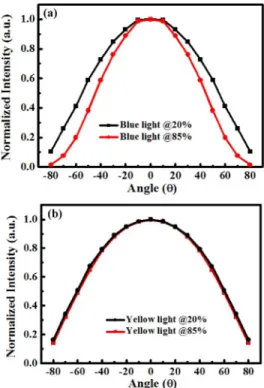
different concentrations of phosphor layer for 20% and 85% in
remote phosphor are fabricated.
The RI of the different phosphor concentration at 20% and
85% is about 1.74 and 1.48, respectively. It is obvious that the
normalized intensity of blue light for the concentration of 20%
is larger than 85% in the large divergent angle, as shown in
Fig. 8(a). However, the yellow light still remain the same at the
Fig. 8. Normalized intensity of different concentration: (a) blue light and (b) yellow.
both concentration in Fig. 8(b). According to Snell’s law, the
blue light, emitted into the air from the package, would cause
a different divergence angle when passing through the different
refractive index. Therefore, the smaller divergence angle could
be attributed to the large discrepancy of the refractive index in
the interface and the refractive index is the main reason to
dom-inate the blue light intensity at large angle.
V. C
ONCLUSIONIn conclusion, the emission model of phosphor film with
BSDF system is investigated and verified both in conformal
and remote phosphor structure. Accordingly, the simulation
results agree well to experimental results in conformal and
remote phosphor structure. Furthermore, the blue and yellow
light are treated separately to discuss the optical characteristic
in simulation and experiment. Finally, we think the refractive
index between air and phosphor layers is the main reason for
the different distribution of the intensity in the blue and yellow
light, which could influence the uniformity of angular CCT in
white LEDs. Such phosphor model could provide the
informa-tion to understand the influence of phosphor, and is important
in discussing about the optical characteristic in white LEDs.
A
CKNOWLEDGMENTThe authors would like to thank HELIO Optoelectronics
Cor-poration, Kismart CorCor-poration, and Wellypower Optronics for
their technical support.
R
EFERENCES[1] S. Pimputkar, J. S. Speck, S. P. DenBaars, and S. Nakamura, “Prospects for LED lighting,” Nat. Photon., vol. 3, no. 4, pp. 179–181, 2009.
[2] E. F. Schubert and J. K. Kim, “Solid-state light sources getting smart,” Science, vol. 308, no. 5726, pp. 1274–1278, 2005.
[3] K. J. Chen, H. C. Chen, M. H. Shih, C. H. Wang, M. Y. Kuo, Y. C. Yang, C. C. Lin, and H. C. Kuo, “The Influence of the thermal effect on CdSe/ZnS quantum dots in light-emitting diodes,” J. Lightw. Technol., vol. 30, no. 14, pp. 2256–2261, Jul. 2012.
[4] H. T. Huang, Y. P. Huang, and C. C. Tsai, “Planar lighting system using array of blue LEDs to excite yellow remote phosphor film,” J. Display Technol., vol. 7, no. 1, pp. 44–51, Jan. 2011.
[5] H. C. Chen, K. J. Chen, C. H. Wang, C. C. Lin, C. C. Yeh, H. H. Tsai, M. H. Shih, H. C. Kuo, and T. C. Lu, “A novel randomly textured phosphor structure for highly efficient white light-emitting diodes,” Nanoscale Res. Lett., vol. 7, pp. 1–5, 2012.
[6] R. M. Farrell, E. C. Young, F. Wu, S. P. DenBaars, and J. S. Speck, “Materials and growth issues for high-performance nonpolar and semipolar light-emitting devices,” Semicond. Sci. Tech., vol. 27, no. 2, p. 024001, 2012.
[7] H. Zhao, G. Liu, J. Zhang, J. D. Poplawsky, V. Dierolf, and N. Tansu, “Approaches for high internal quantum efficiency green InGaN light-emitting diodes with large overlap quantum wells,” Opt. Express, vol. 19, no. 14, pp. A991–A1007, 2011.
[8] J. Zhang and N. Tansu, “Improvement in spontaneous emission rates for InGaN quantum wells on ternary InGaN substrate for light-emitting diodes,” J. Appl. Phys., vol. 110, no. 11, p. 113110, 2011.
[9] Z. Hongping, L. Guangyu, R. A. Arif, and N. Tansu, “Current injection efficiency induced efficiency-droop in InGaN quantum well light-emit-ting diodes,” Solid-State Electron., vol. 54, no. 10, pp. 1119–1124, 2010.
[10] C. H. Wang, S. P. Chang, P. H. Ku, J. C. Li, Y. P. Lan, C. C. Lin, H. C. Yang, H. C. Kuo, T. C. Lu, S. C. Wang, and C. Y. Chang, “Hole transport improvement in InGaN/GaN light-emitting diodes by graded-composition multiple quantum barriers,” Appl. Phys. Lett., vol. 99, no. 17, p. 171106, 2011.
[11] Y. K. Ee, J. M. Biser, W. Cao, H. M. Chan, R. P. Vinci, and N. Tansu, “Metalorganic vapor phase epitaxy of III-nitride light-emitting diodes on nanopatterned AGOG sapphire substrate by abbreviated growth mode,” IEEE J. Sel. Topics Quantum Electron., vol. 15, no. 4, pp. 1066–1072, Jul.,/Aug. 2009.
[12] Y. J. Lee, C. H. Chiu, C. C. Ke, P. C. Lin, T. C. Lu, H. C. Kuo, and S. C. Wang, “Study of the excitation power dependent internal quantum ef-ficiency in InGaN/GaN LEDs grown on patterned sapphire substrate,” IEEE J. Sel. Topics Quantum Electron., vol. 15, no. 4, pp. 1137–1143, Jul.,/Aug. 2009.
[13] Y. K. Ee, X. H. Li, J. Biser, W. Cao, H. M. Chan, R. P. Vinci, and N. Tansu, “Abbreviated MOVPE nucleation of III-nitride light-emitting diodes on nano-patterned sapphire,” J. Cryst. Growth, vol. 312, no. 8, pp. 1311–1315, 2010.
[14] Y. Li, S. You, M. Zhu, L. Zhao, W. Hou, T. Detchprohm, Y. Taniguchi, N. Tamura, S. Tanaka, and C. Wetzel, “Defect-reduced green GaInN/GaN light-emitting diode on nanopatterned sapphire,” Appl. Phys. Lett., vol. 98, no. 15, p. 151102, 2011.
[15] W. Bin Im, N. George, J. Kurzman, S. Brinkley, A. Mikhailovsky, J. Hu, B. F. Chmelka, S. P. DenBaars, and R. Seshadri, “Efficient and color-tunable oxyfluoride solid solution phosphors for solid-state white lighting,” Adv. Mater., vol. 23, no. 20, pp. 2300–2305, 2011. [16] S. E. Brinkley, N. Pfaff, K. A. Denault, Z. Zhang, H. T. Hintzen, R.
Seshadri, S. Nakamura, and S. P. DenBaars, “Robust thermal perfor-mance of Sr Si N Eu : An efficient red emitting phosphor for light emitting diode based white lighting,” Appl. Phys. Lett., vol. 99, no. 24, p. 241106, 2011.
[17] Y. Zhang, L. Wu, M. Ji, B. Wang, Y. Kong, and J. Xu, “Structure and photoluminescence properties of KSr BO Eu red-emitting phosphor,” Opt. Mater. Express, vol. 2, no. 1, pp. 92–102, 2012. [18] H. Li, H. K. Yang, B. K. Moon, B. C. Choi, J. H. Jeong, K. Jang, H.
S. Lee, and S. S. Yi, “Tunable photoluminescence properties of Eu(II)-and Sm(III)-coactivated Ca Y PO and energy transfer between Eu(II) and Sm(III),” Opt. Mater. Express, vol. 2, no. 4, pp. 443–451, 2012.
[19] S. Yun, N. T. Tran, and F. G. Shi, “Nonmonotonic phosphor size de-pendence of luminous efficacy for typical white LED emitters,” IEEE Photon. Technol. Lett., vol. 23, no. 5, pp. 552–554, Mar. 2011. [20] J. K. Kim, H. Luo, E. F. Schubert, J. Cho, C. Sone, and Y. Park,
“Strongly enhanced phosphor efficiency in GaInN white light-emitting diodes using remote phosphor configuration and diffuse reflector cup,” Jpn. J. Appl. Phys., vol. 44, no. 20, pp. 649–651, 2010.
[21] M. T. Lin, S. P. Ying, M. Y. Lin, K. Y. Tai, S. C. Tai, C. H. Liu, J. C. Chen, and C. C. Sun, “Ring remote phosphor structure for phosphor-converted white LEDs,” IEEE Photon. Technol. Lett., vol. 22, no. 8, pp. 574–576, Nov. 2010.
[22] H. C. Chen, K. J. Chen, C. C. Lin, C. H. Wang, H. V. Han, H. H. Tsai, H. T. Kuo, S. H. Chien, M. H. Shih, and H. C. Kuo, “Improvement in uniformity of emission by ZrO2 nano-particles for white LEDs,” Nanotechnol., vol. 23, no. 26, p. 265201, 2012.
[23] H. T. Huang, C. C. Tsai, and Y. P. Huang, “A direct-view backlight with UV excited trichromatic phosphor conversion film,” J. Display Technol., vol. 6, no. 4, pp. 28–134, Apr. 2010.
[24] H. C. Kuo, C. W. Hung, H. C. Chen, K. J. Chen, C. H. Wang, C. W. Sher, C. C. Yeh, C. C. Lin, C. H. Chen, and Y. J. Cheng, “Patterned structure of REMOTE PHOSPHOR for phosphor-converted white LEDs,” Opt. Express, vol. 19, no. 14, pp. A930–A936, 2011. [25] M. R. Krames, O. B. Shchekin, R. Mueller-Mach, G. O. Mueller, L.
Zhou, G. Harbers, and M. G. Craford, “Status and future of high-power light-emitting diodes for solid-state lighting,” J. Dis. Technol., vol. 3, no. 2, pp. 160–175, 2007.
[26] C. Sommer, J. R. Krenn, P. Hartmann, P. Pachler, M. Schweighart, S. Tasch, and F. P. Wenzl, “The effect of the phosphor particle sizes on the angular homogeneity of phosphor-converted high-power white LED light sources,” IEEE J. Sel. Topics. Quantum Electron., vol. 15, no. 4, pp. 1181–1188, Jul./Aug. 2009.
[27] N. Narendran, Y. Gu, J. P. Freyssinier-Nova, and Y. Zhu, “Extracting phosphor-scattered photons to improve white LED efficiency,” Phys. Stat. Solidi (a), vol. 202, no. 6, pp. 60–62, 2005.
[28] Y. C. Kang, I. W. Lenggoro, S. B. Park, and K. Okuyama, “YAG: Ce phosphor particles prepared by ultrasonic spray pyrolysis,” Mater. Res. Bull., vol. 35, no. 5, pp. 789–798, 2000.
[29] K. Yamada, Y. Imai, and K. Ishi, “Optical simulation of light source devices composed of blue LEDs and YAG phosphor,” J. Light Vis. Env., vol. 27, no. 2, pp. 70–74, 2003.
[30] Y. Zhu, N. Narendran, and Y. Gu, “Investigation of the optical proper-ties of YAG:Ce phosphor,” in Proc. SPIE, 2006, vol. 6337.
[31] T. N. The, Y. J. Pyng, and F. G. Shi, “Effect of phosphor particle size on luminous efficacy of phosphor-converted white LED,” J. Lightw. Technol., vol. 27, no. 22, pp. 5145–50, Nov. 2009.
[32] C. H. Hung and C. H. Tien, “Phosphor-converted LED modeling by bidirectional photometric data,” Opt. Express, vol. 18, no. 19, pp. A261–A271, 2010.
[33] Y. W. Yu, Y. L. Chen, W. H. Chen, H. X. Chen, X. H. Lee, C. C. Lin, and C. C. Sun, “Bidirectional scattering distribution function by screen imaging synthesis,” Opt. Express, vol. 20, no. 2, pp. 1268–1280, 2012. [34] H. T. Huang, C. C. Tsai, and Y. P. Huang, “Conformal phosphor coating using pulsed spray to reduce color deviation of white LEDs,” Opt. Express, vol. 18, no. 13, pp. A201–A206, 2010.
[35] K. J. Chen, H. C. Chen, K. A. Tsai, C. C. Lin, H. H. Tsai, S. H. Chien, B. S. Cheng, Y. J. Hsu, M. H. Shih, C. H. Tsai, H. H. Shih, and H. C. Kuo, “Resonant-enhanced full-color emission of quantum-dot-based display technology using a pulsed spray method,” Adv. Funct. Mater., vol. 22, no. 24, pp. 5138–5143, 2012.
[36] J. Wang, C. C. Tsai, W. C. Cheng, M. H. Chen, C. H. Chung, and W. H. Cheng, “High thermal stability of phosphor-converted white light-emitting diodes employing Ce:YAG-doped glass,” IEEE J. Sel. Topics Quantum Electron., vol. 17, no. 3, pp. 741–746, May/Jun. 2011. [37] S. J. Lee, “Analysis of light-emitting diodes by Monte Carlo photon
simulation,” Appl. Opt., vol. 40, no. 9, pp. 1427–1437, 2001. [38] A. Borbely and S. G. Johnson, “Performance of phosphor-coated
light-emitting diode optics in ray-trace simulations,” Opt. Eng., vol. 44, no. 11, p. 111308, 2005.
[39] C. Sommer, F. Reil, J. R. Krenn, P. Hartmann, P. Pachler, S. Tasch, and F. P. Wenzl, “The impact of inhomogeneities in the phosphor dis-tribution on the device performance of phosphor-converted high-power white LED light sources,” J. Lightw. Technol., vol. 28, no. 22, pp. 3226–3232, Nov. 2010.
[40] N. T. Tran and F. G. Shi, “Studies of phosphor concentration and thickness for phosphor-based white light-emitting-diodes,” J. Lightw. Technol., vol. 26, no. 21, pp. 3556–3559, Nov. 2008.
[41] S. Yun, Y. He, N. T. Tran, and F. G. Shi, “Angular CCT uniformity of phosphor converted white LEDs: Effects of phosphor materials and packaging structures,” IEEE Photon. Technol. Lett., vol. 23, no. 3, pp. 137–139, Mar. 2011.
[42] Z. Liu, S. Liu, K. Wang, and X. Luo, “Optical analysis of color distri-bution in white LEDs with various packaging methods,” IEEE Photon. Technol. Lett., vol. 20, no. 24, pp. 2027–2029, Dec. 2008.
at the National Chiao-Tung University, Hsinchu, Taiwan.
His study is focus on UV excitable phosphate which has high luminous ef-ficiency and high stability. He used the combinatorial chemistry to develop UV-excited phosphor for his master thesis. His Ph.D. research includes fab-rication, simulation, and characterization for high power light-emitted diodes.
Hsin-Chu Chen was born in Miaoli, Taiwan, R.O.C., in 1981. He received the
Ph.D. degree at Institute of Electro-Optical Engineering, National Chiao Tung University, Taiwan, in 2012. His thesis work focused on quantum dots and the nanostructure with optoelectronics devices, which includes fabrication, simula-tion, and measurement.
Since 2013, he has been at Industrial Technology Research (ITRI) in Hsinchu, Taiwan, where he holds an engineer. He has been working for the development of high color uniformity and high lumen efficiency of white light LED devices, which includes structure design, fabrication, simulation, and measurement.
Chien-Chung Lin (S’93–M’02) was born in Taipei, Taiwan, R.O.C., in 1970.
He received the B.S. degree in electrical engineering from the National Taiwan University in 1993, and the M.S. and Ph.D. degrees in electrical engineering from Stanford University, Stanford, CA, in 1997 and 2002, respectively. His thesis work focused on design, modeling, and fabrication of micromachined tunable optoelectronic devices.
Since 2009, he has been with National Chiao-Tung University (NCTU) in Tainan, Taiwan, where he holds a position as an assistant professor. The major research efforts in his group are in design and fabrication of semiconductor optoelectronic devices, including LEDs, solar cells, and lasers. Before joining NCTU, he worked for different start-ups in the United States. After graduating from Stanford in 2002, he joined E2O Communications, Inc in Calabasas, Cali-fornia as a senior optoelectronic engineer. His main research interests then were in optically and electrically pumped long-wavelength vertical cavity surface emitting lasers. In 2004, he joined Santur Corporation in Fremont California, where he initially worked as a member of technical staff then became Manager of Laser Chip Engineering later. He had worked on various projects such as monolithic multi-wavelength DFB Laser arrays for data and telecommunica-tions applicatelecommunica-tions, yield and reliability analysis of DFB Laser arrays, etc.
Dr. Lin has more than 30 journal and conference publications and is a member of the IEEE Photonics Society and IEEE Electron Devices Society.
Chao-Hsun Wang received the B.S. and M.S. degrees in Department of
Pho-tonics from the National Chiao-Tung University, Hsinchu, Taiwan, in 2008 and 2009, respectively, and is currently working toward the Ph.D. degree in the De-partment of Photonics, National Chiao-Tung University. His current research interests include the efficiency droop behavior in GaN-based LEDs and high lumen efficiency white LEDs.
cludes white light LED packaging, simulation, and measurement.
Shih-Hsuan Chien was born in Taoyuan, Taiwan, ROC. He received the
B.S degree in National Chiao-Tung University(NCTU), HsinChu, Taiwan, in 2012, and is currently pursuing the M.S. degree at National Chiao-Tung University, Hsinchu, Taiwan. His master’s degree focus is on high-powered white light-emitting diodes, including fabrication, simulation, measurement, and optical characteristic study. In addition, he researches optical applications of a promising material quantum dot.
Min-Hsiung Shih received the B.S degree in physics from the National Cheng
Kung University, Tainan, Taiwan, in 1995, the M.S. degree in physics from the National Tsing Hua University (NTHU), Taiwan in 1997, and the Ph.D. degree in electrical engineering/electrophysics from the University of Southern Cali-fornia (USC), Los Angeles, in 2006.
He is currently an associate research fellow in the Research Center for Ap-plied Sciences (RCAS), Academia Sinica, Nankang, Taiwan. He has authored more than 50 journal and conference publications. His research interests include integrated photonic circuits, photonic crystals, GaN based lasers, surface plas-monics, and cavity quantum electrodynamics.
Hao-Chung Kuo (S’98–M’99–SM’06) received the B.S. degree in physics
from National Taiwan University, Taiwan, the M.S. degree in electrical and computer engineering from Rutgers University—State University of New Jersey, New Brunswick, NJ, in 1995, and the Ph.D. degree from Electrical and Computer Engineering Department, University of Illinois at Urbana Champaign, in 1999.
He has an extensive professional career both in research and industrial research institutions that includes: Research Assistant in Lucent Technologies, Bell Laboratories (1993–1995); and a Senior R&D Engineer in Fiber-Optics Division at Agilent Technologies (1999–2001) and LuxNet Corporation (2001–2002). Since October 2002, he has been with the National Chiao Tung University as a Faculty Member of the Institute of Electro-Optical Engineering. He is now the Associate Dean, Office of International Affair, NCTU. His current research interests include semiconductor lasers, VCSELs, blue and UV LED lasers, quantum-confined optoelectronic structures, optoelectronic materials, and Solar cell. He has authored and coauthored 300 internal journal papers, 2 invited book chapter, 6 granted and 12 pending patents.
Prof. Kuo is an Associate Editor of IEEE/OSA JOURNAL OFLIGHTWAVE
TECHNOLOGY and IEEE JOURNAL OF SELECTED TOPICS IN QUANTUM
ELECTRONICS Special Issue on Solid State Lighting (2009). He received Ta-You Wu Young Scholar Award from National Science Council Taiwan in 2007 and Young Photonics researcher award from OSA/SPIE Taipei chapter in 2007. He was elected as OSA fellow and SPIE fellow in 2012.