ORIGINAL ARTICLE
C.T. Peng 7 C.H. Tsai 7 T.P. Lin 7 L.I. Perng M.C. Kao 7 T.Y. Yang 7 N.M. Wang 7 T.C. Liu S.F. Lin 7 J.G. Chang
Molecular characterization of secretor type
a
(1,2)-fucosyltransferase
gene deficiency in the Philippine population
Received: March 23, 1999 / Accepted: April 29, 1999
This study was supported by a grant from China Medical College, Taichung, Taiwan (CMC 86-TH-05).
C.T. Peng
Department of Pediatrics, Division of Molecular Medicine, Department of Medical Research, China Medical College Hospital, 2, Yuh Der Road, Taichung, Taiwan
J.G. Chang (Y) 7 C.H. Tsai 7 M.C. Kao 7 N.M. Wang Division of Molecular Medicine, Department of Medical Research, China Medical College Hospital, 2, Yuh Der Road, Taichung, Taiwan
Tel.: 00886-4-2052121, ext. 7461, Fax: 00886-4-2033295
T.P. Lin 7 L.I. Perng 7 T.Y. Yang
Department of Molecular Medicine and Blood Bank, Taipei Municipal Jen-Ai Hospital, Taipei, Taiwan T.C. Liu 7 S.F. Lin
Division of Hematology/Oncology, Department of Internal Medicine, Kaohsiung Medical College Hospital, Kaohsiung,
Abstract We analyzed the seven mutations which are
responsible for the deficiency of the secretor type a(1,2)-fucosyltransferase gene product, Se enzyme, in the Philippine population. One hundred and one unre-lated Filipinos in Taiwan were studied. A new muta-tion, a 3-base pair deletion from nt 688 through 690, was found in two (0.1%) of 202 chromosomes. The fre-quencies of six other mutated alleles were as follows: 71/202 (35.2%) were cDNA 385 A]T missensed tion (se2), 28/202 (13.9%) were C571T nonsense tion (se3), 16/202 (7.9%) were G849A nonsense tion (se4), 4/202 (1.9%) were G428A nonsense muta-tion (se1), and 81/202 (40.1%) were wild-type allele (Se). No C628T nonsense mutations (se5) or fusion genes of pseudogene and FUT2 gene (se 6) were found in this population. For the molecular basis of pheno-type Le(ac b–): eight cases had se2/se2, six cases had se2/se3, two cases had se3/se4, one case was homozy-gous of se4, one case was se3/se1, and two cases were se2/se7. For the Le(ac bc) phenotype: four cases had
se2/se2, two cases had se2/se3, one case was se3/se3, and one case was se2/se4. For the Le(a– bc) pheno-type: 16 cases were Se/Se, 21 cases were Se/se2, six cases were Se/se3, five cases were Se/se4, and two cases had Se/se1. Our results suggest that the genotypes of the a(1,2)-fucosyltransferase gene in phenotypes Le(ac bc) and Le(ac b–) are the same. Other factors that play important roles may cause the differences be-tween these two phenotypes. Several hotspot mutations in the a(1,2)-fucosyltransferase gene are responsible for the nonsecretor phenotype.
Key words Filipino 7 a(1,2)-fucosyltransferase 7
Secretor phenotype 7 Nonsecretor 7 Mutation analysis
Introduction
The human Lewis histo-blood group system belongs to a family of structurally related oligosaccharides that are synthesized by the sequential action of fucosyltransfer-ase. The molecules were first identified as red cell (RBC) antigens, and later they were also discovered in tissues such as the salivary gland and digestive mucosa. In this polymorphic blood group system, the genes coded for the two fucosyltransferases responsible for the synthesis of the Lea and Leb glycoconjugates have been very well characterized [10, 15]. The Lewis gene (FUT3) codes for an a(1,3/1,4)-fucosyltransferase that can add fucose to either the type-1 precursor to form Lea antigens or to the H-type 1 to form Leb antigens [13]. The secretor gene (FUT2) codes for an a(1,2)-fucosyltransferase that adds fucose onto the type-1 pre-cursor to form H-type1, the prepre-cursor of Leb. Major RBC and salivary ABH secretor phenotypes result from the polymorphism of the Lewis and secretor sys-tems, which are genetically independent, and the inter-action of the transferase. The RBC phenotypes are (a) Lewis negative secretor and nonsecretor Le(a– b–), (b) Lewis positive nonsecretor Le(ac b–), (c) Lewis
posi-464
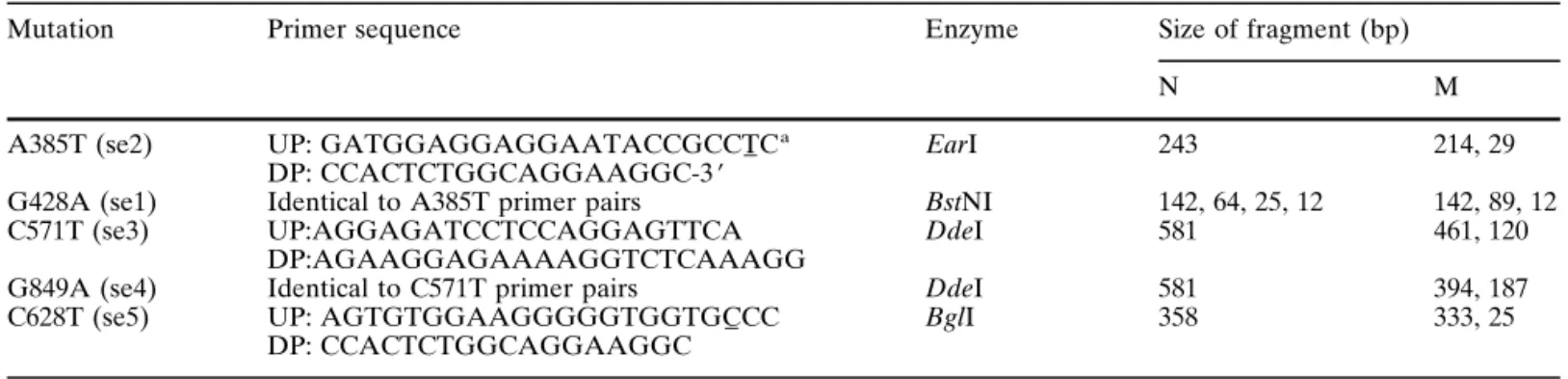
Table 1 Primer sequences, restriction enzymes, and restriction fragment sizes of the mutation in FUT2 deficiency (UP upstream
primer, DP downstream primer)
Mutation Primer sequence Enzyme Size of fragment (bp)
N M
A385T (se2) UP: GATGGAGGAGGAATACCGCCT_Ca EarI 243 214, 29
DP: CCACTCTGGCAGGAAGGC-3b
G428A (se1) Identical to A385T primer pairs BstNI 142, 64, 25, 12 142, 89, 12
C571T (se3) UP:AGGAGATCCTCCAGGAGTTCA DdeI 581 461, 120
DP:AGAAGGAGAAAAGGTCTCAAAGG
G849A (se4) Identical to C571T primer pairs DdeI 581 394, 187
C628T (se5) UP: AGTGTGGAAGGGGGTGGTGC_ CC BglI 358 333, 25
DP: CCACTCTGGCAGGAAGGC
a
Underlined: mutagenic base
Le(ac bc), which is caused by an inefficient secretor transferase.
Recently, six mutations were reported to be respon-sible for the Lewis phenotypes Le(ac b–) or Le(ac bc) [6, 7, 11, 18, 19]. A mutation caused by substitu-tion of G]A at nucleotide 428 of cDNA was responsi-ble for Le(ac b–) in Caucasians [10]. Mutations C571T and G849A responsible for Le(ac b–), and mutation A385T responsible for Le(ac bc) were found in Tai-wanese [18, 19]. Among the screened Japanese popula-tion, four mutations responsible for Le(ac b–) were found. They include A385T, C571T, C628T, and a fu-sion gene consisting of the 5b region of the pseudogene and the 3b region of the functional FUT2 gene [11]. An A385T individual was also found in an Indonesian fam-ily [6]. To date, a similar study concerning FUT2 poly-morphism in Filipinos has not been done. We develop-ed a nonradioactive assay using normal or mismatchdevelop-ed primers to explore the molecular basis of secretor FUT2 gene deficiency in the Filipino population.
Materials and methods Subjects
DNA was extracted from blood samples of 101 unrelated Filipi-nos in Taiwan. The RBC Lewis phenotype was determined using a commercial antibody (Gamma-CloneR, anti-Lea, anti-Leb;
Gamma Biologicals, Inc. Houston, Tex., USA) by tube test or by the manual polybrene method.
DNA amplification and restriction enzyme analysis
Total genomic DNA was isolated from peripheral blood leuko-cytes of the subjects as described previously [3]. We used the same strategy of oligonucleotide primer design and restriction en-zyme analysis as in our previous studies [3, 4] (Table 1). The main purpose of our study was to design an accurate and affordable method for screening by creating a restriction site in mutations that do not have a natural restriction site. Three sets of amplifica-tion for five common mutaamplifica-tions were used. The first set was used to detect A385T and G428A mutations, the second set to detect C628T mutation, and the third set to detect C571T and G849A mutations. For the A385T mutation, the mutant does not create any restriction sites (though the wild normal allele has a FokI
site). The mutagenic base T located at nt 383, introduced by an upstream primer with mutant T at nt 385, will create a CTCTTC site of EarI. The normal allele CTCATC would disrupt the re-striction site. For G428A, there is a Bst NI site (CCTGG) in a normal allele. Though the C628T mutation creates a new HphI or AgeI site, obtaining the enzymes is expensive. For the normal al-lele, we introduced an artificial base C at nt 618, with the base C at nt 628 to create BglI restriction site GCCN5GGC. For C571T
and G849A, both mutations have a natural DdeI restriction site (CTNAG). To detect the fusion gene, consisting of the 5b region of the pseudogene and 3b region of the functional FUT2 gene, we used the method of Koda et al. [11].
Molecular cloning or direct sequencing of se allele
For uncertain cases or those without any of the mutations men-tioned above, a pair of primers specifically for the Sec 2 DNA segment encoding the secretor FUT2 gene was used to amplify the coding region. The upstream primer locates at nt –65 through –45 of the gene (5b-CTAAC GTGTCCCGTTTTCCTC-3b), 5b to the first initiation codon. The downstream primer (5b-GTCCTGCTCATGGAACCATG-3b) is complementary to nt 1072 through 1091 within the 3b untranslated region of FUT2 gene. The polymerase chain reaction (PCR) products were either cloned into T vector (pT7 Blue T-vector kit, Novagen, Inc., Madi-son, Wis., USA) or directly sequenced. DNA sequences were de-termined by means of the dideoxy chain termination method us-ing an Amplicycle Sequencus-ing Kit (Perkin Elmer Cetus, Foster City, Calif., USA).
The DNA amplification was performed as described previous-ly [6], except that the annealing temperature was changed accord-ing to the meltaccord-ing temperature (Tm) of the primers. The amplif-ied products were digested with appropriate restriction enzymes and then electrophoresed on 1.5–3.5% agarose gels. A few cases were confirmed by direct sequencing of the PCR product and were used as positive or negative controls.
Results
Results of the restriction map change of secretor type FUT2 gene deficiency after restriction enzyme diges-tion are shown in Fig. 1a–d. For A385T, a 243-base pair (bp) fragment was amplified by the appropriate primer pairs and a new EarI (Ksp632 I or Eam1104 I) restric-tion site was created in the mutant allele. A 243-bp band identical to the undigested product was noted in the normal allele after EarI digestion, whereas the
mu-Fig. 1A–D (A) Detection of the A385T mutation: lanes 2, 5, 6,
and 9 are heterozygous mutations, lane 8 is a homozygous muta-tion, and lanes 1, 3, 4, and 7 have no mutation. (B) Detection of the G428A mutation: lanes 1–8 have no mutation, and lane 9 is a heterozygous mutation. (C) Detection of C571T and G849A mu-tations: lane 6 is a heterozygous mutation of C571T, lane 8 is a homozygous mutation of C571T, and lane 4 is a heterozygous mu-tation of G849A. (D) The results of C628T mumu-tation: lanes 2–8 have no mutation, lane 1 is an uncut control
tant product was cleaved into a 214- and a 29 bp frag-ment. A band of less than 35 bp was not well visualized in a 3.5% agarose gel (Fig. 1a). Bst NI cleavage of the normal allele PCR product yields four segments (142, 64, 25, and 12 bp), while three fragments (142-, 89-, and 12-bp bands) were generated for the G428A mutant case (Fig. 1b). For C571T and G849A mutations, a 581-bp fragment was PCR amplified, and this was followed by DdeI restriction enzyme digestion. As shown in Fig. 1c, the DNA size of the normal allele remained un-changed (581 bp); however, the products of C571T were cleaved into 120- and a 461-bp fragments and the products from G849A were cleaved into 394- and 187-bp DNA fragments. Digestion of the C628T mutation PCR products by BglI showed a 358-bp fragment and two fragments (333 and 25 bp) in a normal allele (Fig. 1d).
There were two Le(ac b–) subjects found to have a heterozygous A385T mutation among the 101 cases (1.98%). In order to explore the relationship between phenotype and genotype, we amplified the whole FUT2 gene in these two cases and sequenced the PCR
prod-tation, after sequencing of the whole FUT2 gene these two cases also had a heterozygous three-base deletion (nt 688 through 690) (Fig. 2a) and the deletion abol-ished its authentic BstEII site (Fig. 2b). The PCR prod-ucts used for detection of C571T and G849A mutations were also used to detect the deletion mutation. The 581-bp PCR products were digested using BstEII, and the wild-type allele was cut into 237- and 344-bp frag-ments. An undigested 578-bp fragment was noted in the mutant allele.
The serological data and results of mutation analysis of 101 unrelated Filipinos are summarized in Table 2. The results show that 35.2% (71/202 alleles) were A385T mutation (se2), 13.9% (28/202) were C571T mu-tation (se3), 7.9% (16/202) were G849A mumu-tation (se4), 1.9% (4/202) were G428A mutation (se1), 0.1% (2/202) were nt 688 through 690 deletional mutation (se7), and 40.1% (81/202) were normal allele (Se). No C628T mu-tations (se5) or the fusion gene (se6) were found in this population.
The genetic basis for the Lewis phenotype in Filipi-nos differs from that in other populations. Among 23 individuals with Le(ac b–), eight were homozygous for the se2 allele, six were found to be se2/se3, three were se2/se4, two were se3/se4, two were se2/se7, one was se3/se1, and one was homozygous for se4. Among eight Le(ac bc) individuals, four were homozygous for se2, two were se2/se3, one was se2/se4, and one was homo-zygous for se3. Among 50 individuals with Le(a– bc), 16 were homozygous for Se allele, 21 were Se/se2, six were Se/se3, five were Se/se4, and two were Se/se1.
466
Fig. 2A,B (A) Direct sequencing data of a novel mutation (se7).
The left picture is a normal control. The right picture shows the heterozygote of a three-base deletion (GTC underlined); the dou-ble bases in the same lane are due to a normal allele and a frame-shift mutant allele. (B) Results of three-base deletion detected by Bst EII digestion. Lanes 1–5 are normal controls, lane 6 is a het-erozygote of deletion from nt 688 to 690. (M 100-bp ladder mark-er, U uncut control)
Table 2 Distribution of FUT2 genotypes and allele frequencies in the Filipino population
Genotype Lewis phenotype Total Allele frequencies
Le(aPbc) Le(acbP) Le(acbc) Le(aPbP)
Se/Se 16 0 0 5 21 Se/se1 2 0 0 1 3 Se/se2 21 0 0 3 24 se p.401 Se/se3 6 0 0 1 7 se1p.019 Se/se4 5 0 0 0 5 se2p.352 Se/se7 0 0 0 0 0 se3p.139 se2/se2 0 8 4 3 15 se4p.079 se2/se3 0 6 2 3 11 se7p.010 se2/se4 0 3 1 0 4 se2/se7 0 2 0 0 2 se3/se3 0 0 1 2 3 se3/se4 0 2 0 1 3 se3/se1 0 1 0 0 1 se4/se4 0 1 0 1 2
were Se/se2, three were se2/se2, three were se2/se3, two were se3/se3, and there was one case each of the follow-ing: Se/se1, Se/se3, se3/se4, and se4/se4 (Table 2).
Discussion
In the genes of secretor type FUT2 gene deficiency, six mutations have been identified. All of them either create or abolish a normal enzyme restriction site. In this study, we devised a nonradioactive method for
se-lective amplification of the part of the FUT2 gene or pseudogene with specific oligonucleotide primers, fol-lowed by digestion of particular restriction enzymes. The enzymes recognize the natural or artificial restric-tion sites. In a total of 101 individuals studied, 7.4% were homozygous for se2, and the incidence of this mu-tation was 35.2% (71/202 alleles). The results indicate that se2 is the most common Se enzyme-deficient allele found in this population. This is similar to the FUT2 polymorphism found in Japanese populations [11]. Two unusual polymorphic variants, the se5 allele and a rela-tively high (5.7%) fusion gene mutation, were com-monly found in Japanese populations, but they were not found in this Filipino population. The rate of the most common nonsense mutation of G428A, responsi-ble for the nonsecretor phenotype in Caucasians [10], was 1.9% in the current population. On tracing the family history of these subjects, we found that they are descendents of an inter-racial mixture of Filipino and Caucasian.
For the C571T (se3) mutation and the G849A (se4) mutation, which had been found in the Taiwanese indi-genous Paiwan group, there is a high carrier rate in the Philippines. Data from previous studies of Japanese and Polynesians suggest that Se enzyme-deficient al-leles are race specific [7, 11]. Our results suggest either that the Taiwanese Paiwan group may have migrated to or from the Philippines, or that these two populations have identical ancestors. Further investigations need to be done to support this hypothesis.
The three-base (nt 688 through 690) deletion muta-tion (se7) was first discovered in the present study. Among all the 202 alleles of the Filipino population, only two had the mutation, and both cases (se2/se7) had the Le(ac b–) phenotype. These results indirectly demonstrat that se7 is a deficient mutant of FUT2 gene.
Results from this study are consistent with others re-ported in the literature [5, 6, 7, 10, 11, 18]. Several hot-spot mutations in the FUT2 gene are responsible for the nonsecretor phenotype. Some mutations are race specific and are predominant, such as the G428A muta-tion found in Caucasians and the A385T mutamuta-tion in Asians. We also analyzed the C357T polymorphism with two different alleles which have been reported in other studies [11, 12].We found similar results in the Filipino population.
The Lewis Le(ac bc) phenotype has been found among Taiwanese [2], Indonesians [14], Polynesians [8], Japanese [9, 16], and Australian aborigines [1, 17]. The Le(ac bc) phenotype is virtually absent in Caucasians but has a relatively high frequency (22–25%) in Taiwa-nese [2]. Upon comparison, no difference was found between the genotypes Le(ac bc) and Le(ac b–). This phenomenon suggests that some factors may mod-ify the mutated se enzyme, which has the low activity of the FUT2 enzyme. If the activity of se increases after the reaction of these factors, the phenotype will be Le(ac bc). When activity decreases, the phenotype will be Le(ac b–). The current study provides a genetic basis that can be used to solve the discrepancy between the phenotypes Le(ac bc) and Le(ac b–).
References
1. Boettcher B, Kenny R (1971) A quantitative study of Lea, A and H antigens in saliva of Australian Caucasians and abori-gines. Hum Hered 21 : 334–345
2. Broadberry RE, Lin-Chu M (1991) The Lewis blood group system among Chinese in Taiwan. Hum Hered 41 : 290–294 3. Chang JG, Chen PH, Chiou SS, Lee LS, Perng LI, Liu TC
(1992) Rapid diagnosis of b-thalassemia mutations in Chinese by naturally and amplified created restriction sites. Blood 80 : 2092–2096
4. Chang JG, Chiou SS, Perng LI, Chen TC, Liu TC, Lee LS, Chen PH, Tang TK (1992) Molecular characterization of glu-cose-6-phosphate dehydrogenase (G6PD) deficiency by natu-rally and amplification created restriction sites – five muta-tions account for most G6PD deficiency cases in Taiwan. Blood 80 : 1079–1082
5. Henry S, Oriol R, Samuelsson B (1995) Lewis histo-blood group system and associated secretory phenotypes. Vox Sang 69 : 166–182
6. Henry S, Mollicone R, Fernandez P, Samuelsson B, Oriol R, Larson G (1996) Homozygous expression of a missense muta-tion at nucleotide 385 in the FUT2 gene associates with the Le(ac bc) partial-secretor phenotype in an Indonesian fam-ily. Biochem Biophys Res Commun 219 : 675–678
7. Henry S, Mollicone R, Lowe JB, Samuelsson R, Larson G (1996) A second nonsecretor allele of blood group a (1,2)-fucosyltransferase gene (FUT2). Vox Sang 70 : 21–25 8. Henry SM, Simpson LA, Woodfield DG (1988) The Le (ac
bc) phenotype in Polynesians. Hum Hered 38 : 111–116 9. Hirano K, Kawa S, Oguchi H, Kobayashi T, Yonekura H,
Ogata H, Homma T (1987) Loss of Lewis antigen expression on erythrocyte in some cancer patients with high serum CA-19-9 levels. J Natl Cancer Inst 79 : 1261–1268
10. Kelly RJ, Rouquier S, Giorgi D, Lennon GG, Lowe JB (1995) Sequence and expression of a candidate for the human secretor blood group a(1,2)-fucosyltransferase gene (FUT2). Homozygosity for an enzyme-inactivating nonsense mutation commonly correlates with the non-secretor phenotype. J Biol Chem 270 : 4640–4649
11. Koda Y, Soejima M, Liu Y, Kimura H (1996) Molecular basis for secretor type a(1,2)-fucosyltransferase gene deficiency in a Japanese population: a fusion gene generated by unequal crossover responsible for the enzyme deficiency. Am J Hum Genet 59 : 343–350
12. Kudo T, Iwasaki H, Nishihara S, Shinya N, Ando T, Narimat-su I, NarimatNarimat-su H (1996) Molecular genetic analysis of the human Lewis histo-blood group system. II. Secretor gene inactivation by a novel single missense mutation A385T in Ja-panese nonsecretor individuals. J Biol Chem 271 : 9830–9837 13. Kukowska-Latallo JF, Larsen RD, Nair RP, Lowe JB (1990)
A cloned human cDNA determines expression of a mouse stage-specific embryonic antigen and the Lewis blood group a(1,3/1,4)-fucosyltransferase. Genes Dev 4 : 1288–1303 14. Mollicone R, Reguigne I, Kelly RJ, Fletcher A, Watt J,
Chat-field S, Aziz A, Cameron HS, Weston BW, Lowe JB, Oriol R (1994) Molecular basis for Lewis a(1,3/1,4)-fucosyltransferase gene deficiency (FUT3). J Biol Chem 269 : 20987–20994 15. Rouquier S, Lowe JB, Kelly RJ, Fertitta AL, Lennon GG,
Giorgi D (1995) Molecular cloning of a human genomic re-gion containing the H blood group a(1,2)-fucosyltransferase gene and two H locus related DNA restriction fragments: iso-lation of a candidate for the human secretor blood group lo-cus. J Biol Chem 270 : 632–4639
16. Sturgeon P, Archilla MB (1970) Studies on the secretion of blood group substances. I: Observations on the red cell phe-notype Le(ac bc xc). Vox Sang 18 : 301–322
17. Vos GH, Comley P (1967) Red cell and saliva studies for the evaluation of ABH and Lewis factors among the Caucasians and aboriginal populations of Western Australia. Acta Genet 17 : 495–510
18. Yu LC, Yang YH, Broadberry RE, Chen YH, Chan YS, Lin M (1995) Correlation of a missense mutation in the human secretor a(1,2)-fucosyltransferase gene with the Lewis(ac bc) phenotype: a potential molecular basis for the weak se-cretor allele (Sew). Biochem J 312 : 329–332
19. Yu LC, Broadberry RE, Yang YH, Chen YH, Lin M (1996) Heterogeneity of the human secretor a(1,2)-fucosyltransfer-ase gene among Lewis(ac b–) non-secretors. Biochem Bio-phys Res Commun 222 : 390–394