
前瞻台灣生技製藥產業政策—結合德菲法與Q方法
152
0
0
全文
(2) 中文摘要 中文摘要 台灣早在 1980 年代就將生物科技產業列為發展重點,行政院在 2007 年 指出生技製藥產業為國家產業發展主軸之一,更於 2009 年推出「生技起飛鑽 石方案」以活絡整個產業。生技製藥產業在面對未來的不確定時,更需要有全 盤的前瞻計劃來做長期規劃。目前國內並無生技製藥產業前瞻相關研究,本研 究希望藉由國外生技製藥前瞻 2030 年的相關文獻,找出台灣未來 20 年生技製 藥產業能在國際上發光的立足點。因此本研究之研究問題有三: 1. 未來 20 年,台灣生技製藥將會面臨什麼樣的機會與挑戰? 2. 產官學研各界對於生技製藥產業是否存在認知差異?各利害關係人的 政策偏好又是如何? 3. 台灣政府應該如何前瞻未來台灣生技製藥產業? 本研究蒐集了英國與美國的生技製藥產業前瞻計畫之文獻後,將其摘錄成 130 句語匯,接著再以競爭條件與生技製藥生產價值鏈構成的語句架構來做篩 選,濃縮成為 24 句訪談敘述句。為了讓訪談敘述句更有權威、可靠性,本研 究特別採用修正式的德菲法,在經過 13 位專家學者全程參與二輪之德菲問卷 後,最後收斂成為 24 句訪談敘述句。 本研究採用 Q 方法,其為結合質化與量化的研究方法。本研究利用 24 句 收斂後訪談敘述句讓 30 位產、官、學、研各界專家進行 Q 排列與訪談。在經 過 PQMethod 軟體分析後,本研究發現在未來 20 年台灣生技製藥產業應以四 項為優先發展重點:間接支援政策、直接支援政策、投入更多資源在研發階段、 以及跨界的共同合作。而間接與直接支援政策、投入更多資源在研發階段等機 制更被各界視為政策優先。本研究發現為:各利害關係人存在認知落差、政府 與產業界資訊不對稱、未來應增加研發資源投入、產業合作應多元跨域。 本研究對於未來 20 年台灣生技製藥產業之建議為:1.政府應利用政策行 銷手法來推廣產業政策,以減少認知落差,尤其是中小企業。2.政府應利用政 I.
(3) 策工具來配置政府資源,尤其是應該培育商業行銷人才以獲取更多國外投資。 3.共同合作的部分有可以非常多元,包括跨科技、跨產業與跨區域的合作,有 助於創新研發與拓展新市場。. 關鍵字:前瞻、台灣生技製藥產業、產業政策、德菲法、Q 方法. II.
(4) Abstract Foresight programs in science and technology policy across Europe have been examined as responses from government to the changes and uncertainty in the future. The foresight studies have become a common tool to investigate what priorities should be set and how the resources will be allocated. However, there are not sufficient foresight researches on the biopharmaceutical industry in Taiwan. Although the cooperation of the government and stakeholders contribute enormously to the industry competition, there may be the existence of conceptualizing differentiation among them which results in inconsistency in policymaking and implementation. Therefore, this study aims to find out what the biopharmaceutical industry will be like in the next 20 years. Q methodology integrates qualitative and quantitative techniques to reveal social perspectives, and is often used to handle multi-view issues which are helpful for the interviewees to raise the real point of view on the research topic. This research aims at investigating officials’ and stakeholders’ patterns of cognitions toward policy foresight of biotechnology in Taiwan by using Q method. As mentioned above, biopharmaceutical industry is one of the main economical development objectives which were set by Taiwan government. This research aims to find out: 1. What opportunities and challenges will Taiwan’s biopharmaceutical industry encounter in the next 20 years? 2. Is there any existence of cognitive differences toward biopharmaceutical industry among the sectors of industry, government, academia, and research institution? And what are the policy preferences of the stakeholders? 3. How does Taiwan government foresee the future of the bio-pharmaceutical III.
(5) industry in Taiwan? In this research, 130 statements were collected from varied literatures published by OECD, American and European government to form a concourse. At the same time, a factorial design was formulated for this research based on the industrial value chain and competitive conditions matrix to make 24 statements. The 24 statements which are based on an extensive review of the biopharmaceutical literature were applied to conduct the modified Delphi survey. After two rounds of Delphi survey, 24 modified or new statements will become 24 Q cards to exam 30 interviewees’ points of view. In the end, the consensus would be formed and the priorities would be set. Moreover, policy instruments will be applied to provide policy suggestions and resources will be allocated to the right place and in the right time in the future. After applying the Q methodology, I found out the policy priorities which come from the interviewees’ perspectives could be ordered and divided into four patterns: indirectly supported policy, directly supported policy, investment in R&D and collaboration. The main priorities for the biopharmaceutical industry in Taiwan are directly and indirectly supported policy and collaboration. The findings in this study are: cognition gap among stakeholders, uneven information between the government and the industry, increase R&D resource and investment, and collaboration with cross-field. This research suggested that the government should apply policy marketing strategies to bridge the cognition gaps and policy instrument to bridge the policy gaps. Meanwhile, policy instruments and policy marketing will be given to suggest how to distribute resources and bridge the cognition gap while Taiwan has the determination to cultivate the biopharmaceutical industry for next 20 years. IV.
(6) The contributions of this study are to provide some directions for the government, which wants to cultivate the biopharmaceutical industry, to know the developing priorities, and then to allocate resources with limited budget. Keywords: :Foresight, Taiwan biopharmaceutical industry, Public policy, Delphi survey, Q methodology. V.
(7) 誌 謝 經過兩年的日以繼夜、焚膏繼晷的努力,論文總算完成了。歷經了論文題 目的挑選、文獻的蒐集、Q方法的學習、語匯的篩選、專家學者訪談等難題,能 夠順利完成首先必須感謝的就是 李亭林老師的用心,並啟發學生許多論文靈 感;銘傳大學公共事務學系 方凱弘老師教導Q方法軟體操作與解讀,讓學生減 少在研究方法上的困難;政治大學公共行政學系 蕭乃沂老師的細心指導,讓學 生的論文能更有條理。 本論文主要是透過專家學者訪談而成的,受訪者的熱情參與,讓學生甚是 感激。感謝喬志亞生物科技股份有限公司董事長 黃文田先生與高雄醫學大學藥 學系暨天然藥物研究所 顏銘宏老師的熱心幫助,學生才能與更多的專家學者接 洽。感謝高雄醫學大學 陳義龍老師、顏峰霖老師、王記慧老師,高雄大學 楊 佳寧老師、楊文仁老師,中山醫學大學 關宇翔老師、李怡靜老師、楊建洲老師、 林明忠老師,義守大學 洪哲穎老師,台灣大學 陳婷婷博士候選人,喬志亞生 技 曾煥中總經理、許夏芬博士,德英生技 郭國華總經理,昌達生化 陳筱苓處 長,德林生技 林枝輝總經理、黃靜玲研究員,羅東博愛醫院 林俊良醫師,輝 瑞製藥 楊桂婷襄理,行政院衛生署食品藥物管理局 葉宏一博士、黃淑萍技正, 經濟部工業局生物技術與醫藥工業發展推動小組 陳啟祥主任、楊志浩經理,行 政院科技顧問組生技小組,財團法人醫藥品查驗中心 王明哲博士,台灣經濟研 究院生物科技產業研究中心 孫智麗主任、黃奕儒博士,工業技術研究院 周綸 音組長,財團法人生物技術開發中心 羅淑慧研究員、廖美智副研究員。 感謝我的父親 王瑞嘉先生、母親 王黃麗英女士,讓我可以無憂無慮專心 學校課業;謝謝姐姐 怡蓁支援我在台北流浪的日子,弟弟 中昱善解人意的關 心。 最後,謹以此論文,獻給我在天上的阿公 王令得先生,感謝您給我的一切, 我永遠想念您! 於國立高雄大學 VI. 王郁倫 謹誌 民國一百年七月.
(8) Table of Contents 摘要. ................................................................................................ I. Abstract. ................................................................................................... III. 誌 謝. ................................................................................................... VI. Table of Contents .......................................................................................... VII List of Tables .................................................................................................... X List of Figures .................................................................................................. XI CHAPTER ONE INTRODUCTION .............................................................. 1 1.1 Research Background ...................................................................................................... 1 1.2 Research Motivation........................................................................................................ 3 1.3 Research Questions ......................................................................................................... 5 1.4 Research Process ............................................................................................................. 6 1.5 Contributions ................................................................................................................... 7. CHAPTER TWO LITERATURE REVIEW ................................................. 8 2.1 Foresight ........................................................................................................................ 8 2.1.1 Definition of Foresight ............................................................................................. 8 2.1.2 Foresight in Practice ............................................................................................... 10 2.2 Policy Planning.............................................................................................................. 15 2.2.1 The National Technological System in Taiwan ..................................................... 15 2.3Biopharmaceutical Industry............................................................................................ 20 2.3.1 Biopharmaceutical Industry in Taiwan................................................................... 20 2.3.2 Biopharmaceutical in the USA and the UK............................................................ 26. CHAPTER THREE METHODOLOGY ...................................................... 30 3.1 Research Structure ......................................................................................................... 30 VII.
(9) 3.2 Factorial Design ............................................................................................................ 31 3.2.1 The Competitiveness of Biopharmaceutical industry ............................................. 33 3.2.2 Biopharmaceutical Industrial Value Chain............................................................. 36 3.3 Introduction of Delphi Survey ....................................................................................... 39 3.3.1 The Basic Concept.................................................................................................. 39 3.3.2 The Process of Classical Delphi Survey ................................................................. 40 3.3.3 The Delphi Process of This Study .......................................................................... 41 3.4 Introduction of Q Methodology..................................................................................... 42 3.4.1 The Basic Concept.................................................................................................. 42 3.4.2 Q and R Methods .................................................................................................... 43 3.4.3 Q Sorting ................................................................................................................ 44 3.5 Selection of Q participants ............................................................................................ 46 3.6 Interview Design and Q sorting instructions ................................................................. 46. CHAPTER FOUR EMPIRICAL STUDY .................................................... 50 4.1 Delphi Survey ................................................................................................................ 50 4.1.1 Expert Panel of the Delphi Survey ......................................................................... 50 4.1.2 Delphi Data Analysis.............................................................................................. 50 4.2 Analysis for Q Methodology ......................................................................................... 57 4.2.1 Participants for Q Sorting ....................................................................................... 57 4.3 Data analysis by using PQ Method ............................................................................... 58 4.3.1 The Revealed Patterns ............................................................................................ 58 4.3.2 Definig and Understanding Patterns ....................................................................... 59 4.3.3 Policy Priorities ...................................................................................................... 79 4.4 Discussions .................................................................................................................... 81 4.5 Remarks ...................................................................................................................... 81. CHAPTER FIVE FINDINGS AND SUGGESTIONS ................................ 85 VIII.
(10) 5.1 Findings ...................................................................................................................... 85 5.1.1 Cognition Gap among Stakeholders ....................................................................... 85 5.1.2 Uneven Information................................................................................................ 86 5.1.3 Increase R&D Resource and Investment ................................................................ 87 5.1.4Collaboration with Cross-filed ................................................................................ 87 5.2 Suggestions.................................................................................................................... 87 5.2.1 Bridging the Cognition Gaps .................................................................................. 88 5.2.2 Bridging the Policy Gap ......................................................................................... 90 5.3 Research limitations ...................................................................................................... 92 5.4 Further Research............................................................................................................ 93. REFERENCE .................................................................................................. 88 Appendix A—Sources of Sentences ............................................................. 100 Appendix B-- Result and Discussion for the First Round of Delphi Survey..................................................................................... 112 Appendix C-- Result and Discussion for the Second Round of Delphi Survey..................................................................................... 128 Appendix D—Factor Matrix ........................................................................ 138 Appendix E –Factor Correlation ................................................................. 139. IX.
(11) List of Tables Table 2- 1Definitions of Foresight ...................................................................... 9 Table 2- 2 History of TFP ................................................................................. 12 Table 2-3 Classification of Foresight Methods by Type of Technique ............. 14 Table 2- 4 Definitions of Biopharmaceuticals .................................................. 24 Table 3- 1 Factorial Design of This Study ........................................................ 32 Table 3- 2Contents of Indicators ....................................................................... 35 Table 3- 3 The comparison between R and Q methodology ............................. 44 Table 4-1 Analysis of First Round of Delphi Survey ....................................... 51 Table 4-2 Analysis of Second Round of Delphi Survey ................................... 52 Table 4-3Experts for Q Sorting ......................................................................... 57 Table 4-4 Factor Loadings for This Study (interpretable) ................................ 59 Table 4-5 Factor Arrays for this Study .............................................................. 60 Table 4-6 Sum of Factor Scores for Each Category of Factorial Design.......... 61 Table 4-7 Sum of Factor Scores for Three Value Chain Stages ........................ 61 Table 4-8 Sum of Factor Scores for Three Competitive Conditions ................ 62 Table 4-9 Summary of Each Pattern’s Main Ideas for “Factors Conditions” ... 63 Table 4-10 Summary of Each Pattern’s Main Ideas for “Industrialized Conditions” ........................................................................................ 65 Table 4-11 Summary of Each Pattern’s Main Ideas for “Regulations Conditions” ........................................................................................ 66 Table 4-12 Q Statements within Similar Scores-- Pattern I v.s. Pattern II ....... 72 Table 4-13 Features of the Patterns ................................................................... 83. X.
(12) List of Figures Figure 1- 1 Research process .............................................................................. 7 Figure 2- 1 Typical foresight project structure.................................................. 10 Figure 2- 2 Taiwan's Organizational Framework for the Development of Science and Technology ................................................................ 17 Figure 2- 3 Science Planning and Evaluation System of Taiwan ..................... 18 Figure 2- 4 Policy Discourse of Biopharmaceutical Industry Value Chain ...... 19 Figure 2- 5 Investment of Taiwan Biotech Industry ......................................... 21 Figure 2- 6 Taiwan Biotechnology Production Value ....................................... 22 Figure 2- 7 Pharmaceutical Industry Categorized by Making Process ............. 23 Figure 2- 8 Pharmaceutical Industry Categorized by Regulations ................... 23 Figure 3- 1 Research Structure.......................................................................... 31 Figure 3- 2 Competitive Indicators for Factorial Design .................................. 34 Figure 3-3 Brief Overview for Delphi Survey .................................................. 41 Figure 3-4 Score Sheet ...................................................................................... 48 Figure 4-1 Factor Arrays for Pattern I............................................................... 70 Figure 4-2 Factor Arrays for Pattern II ............................................................. 72 Figure 4-3 Factor Arrays for Pattern III ............................................................ 76 Figure 4-4 Factor Arrays for Pattern IV ............................................................ 79 Figure 4-5 Remarks of Patterns ........................................................................ 84 Figure 5-1 Suggestion Structure ....................................................................... 88. XI.
(13) CHAPTER ONE INTRODUCTION Taiwan has achieved remarkable economic success by producing electronic products, applications of information technology (IT), and IC products. Although the IC and IT industry is notable, Taiwan government still has to find out the “next step” for the national development, especially after the Asian Financial Crisis in 1997 and the financial crisis in 2007.. 1.1 Research Background Though the Taiwan government had proposed biotechnology policies in 1982, the spotlight of the Taiwan industry still focuses on the ICT industry. In the early 1980s, the Taiwan government listed the biotechnology industry as one of its priorities in industrial development. Since the promulgation of the “Biotechnology Industry Promotion Program” after the Executive Yuan’s No. 2443 Meeting in August 1995, the Taiwan government had launched the development of the biotechnology industry, including the improvement of statutory regulations, the execution of key plans, the encouragement of private enterprises to invest in research and development, the transfer of technology, the advanced training of human resource, the promotion of investment and international collaboration. At that time it began to vigorously promote research in related industries, as well as encouraging overseas Chinese scientists to return to Taiwan to offer their experience and expertise to the nation. Until 2009, the Taiwan government has proposed biotech policies which are called “The Diamond Action Plan for Biotech Takeoff” to show the determination to cultivate the biotechnology industry in Taiwan. The Executive Yuan’s consultative committee on strategies for the biotechnology industry met in October 2008 and recommended that Taiwan’s 1.
(14) biotech industry put top priority on developing new pharmaceuticals. The recommendation was nothing new, since this has been the shared consensus within both government and academic circles ever since the Legislative Yuan passed the Act for the Development of Biotech and New Pharmaceuticals Industry in June 2007. The Committee's recommendation nevertheless did serve to signal the government's continued commitment to this course of action. The previous descriptions have shown that the prospected investment object in biotechnology field is focused on “biopharmaceutical” field which also can be observed on the plan of “The Diamond Action Plan for Biotech Takeoff” launched in March 2009. The goal of this plan is to develop biotech industry into Taiwan's next "trillion-NT-dollar industry" over the coming 10 years, following the path taken with semiconductors, liquid-crystal displays, and precision equipment. The biotechnology industry is one of the emerging industries that have been generally acknowledged to have the greatest potential for development and the most significant impact on the quality of human life in the future. In truth, Taiwan has much strength that gives it the edge over its competitors in the rest of Asia. These strengths are contributed to a combination of existing conditions and to deliberate planning on the part of the government. However, the Taiwan biotechnology industry has just begun. No job is easy in beginning. One may say, as Michael Porter’s National Diamond framework (1990) pointed out, that the government act as a catalyst and challenger, and it also encourage or even push companies to raise their aspirations and move to higher levels of competitive performance. Taiwan biopharmaceutical sector is poised for rapid expansion after a decade of increasing investment. A 2.
(15) multi-million-dollar science park is being planned, government involvement is increasing and a local start-up recently acquired rights to an innovative medicine that could one day become a blockbuster(BMI, 2010). Nevertheless, the government should have the ability to choose the future star of the biotechnological fields and then support them in order not to waste the public resources. Since the Organization for Economic Cooperation and Development (OECD) has discussed about the future agenda for industrial development in 2030, Taiwan. government. has. not. planed. any. foresight. program. for. biopharmaceutical industry. What’s more, the cooperation for the government and stakeholders contribute enormously to the industry competition, there may be existed conceptualizing differentiation among them which result in inconsistency in policy making and implementation. Therefore, this study aims to find out what the biopharmaceutical industry will be in the next 20 years.. 1.2 Research Motivation This research aims at investigating official’s and stakeholders’ patterns of attitudes toward biopharmaceutical policy foresight in Taiwan by using Delphi survey and Q methodology. There are four motivations for why choosed biopharmaceutical as research subject; why took advantage of technology policy and foresight as research theme; and why used Delphi survey and Q methodology as the research method in this study. Biopharmaceutical industry is one of the main economical development objectives which were set by the Taiwan government. Since the biopharmaceutical industry has been defined as the research subject, it is featured with high risk, high profitability, long R&D and return period. To break the bottleneck, it is urgently to find out the gaps that exist among the 3.
(16) government and stakeholders in order not to waste extra time and resources at the fields which are impossible or unsuitable to develop in Taiwan. Complex scientific challenges and poorly designed regulations could reduce the. ability. of. industrial. biotechnologies. to. compete. with. other. alternatives(OECD, 2009). Unfortunately, unlike Japan, European, and America, the authenticity for the technology policy making is doubtful; it was made just as the government stands only in its shoes or maybe in the scholars’; there are no communications among the government, scholars, enterprises and the public. Consequently, this research tried to combine the opinions of all the stakeholders toward Taiwan’s biopharmaceutical industry in the future. Since this study attempted to known the development in the future which may be uncertain and changeable, the author would review the industrial foresight situation of leading countries. Foresight has been discussed in (1) exploring the developing opportunities, and setting and directing the priority in technological innovation, (2) building new networks and linkages around a common vision, (3) extending the breadth of knowledge and visions in relation to the future, (4) bringing new actors into the strategic debate, and (5) improving policy-making and strategy formation areas where science and innovation play a significant role (Popper, 2008; Georghious & Keenan, 2006). Hence, this research would use the biopharmaceutical industry foresight experience to ask experts’ opinions about Taiwan biopharmaceutical industry. This study applied the modified Delphi survey by a structured quenstionnaire which is based upon an extensive review of the biopharmaceutical literature(Hsu & Sandford, 2007) of the USA and the UK. In this study, Delphi method has been employed as a tool to be authorized by the subjects within expertise when 4.
(17) forming the Q statements. Q methodology is a type of research that integrates qualitative and quantitative techniques to reveal social perspectives, and it is often used to handle multi-view issues which is helpful for the interviewees to raise the real point of view on the research topic. Q method is a kind of research methodology which is the combination of questionnaires, interview, and statistic analysis. It is used. in. psychology. and. other. social. sciences. to. study. people's. "subjectivity"—that is, their viewpoicnt. So this study illustrates the patterns of biopharmaceutical policy foresight by using Q method, which has not been research yet. It is worth to conduct this research while this has not been investigated yet. This research aims at investigating official’s and stakeholders’ patterns of cognitions toward policy foresight of biotechnology in Taiwan by using Q method. In that way, this study could find out that what the government should do to support the industry.. 1.3 Research Questions This research aims to find out: 1. What opportunities and challenges that Taiwan’s biopharmaceutical industry will face in the next 20 years? 2. How to know the cognitive differentiations on the policy foresight for Taiwan’s biopharmaceutical industry among stakeholders? And what policy priorities will be offered? 3. How to cultivate the Taiwan’s bio-pharmaceutical industry by the government?. 5.
(18) 1.4 Research Process Here is a flowchart of research process which shows how to implement this research, refer to Figure 1-1: firstly, the author should collect data and information by the definitions of research questions, objects and scope. These would include foresight, policy planning and the biopharmaceutical industry in Taiwan. Secondly, the author may use the information about foresight of leading countries which were collected at first to make Q statements. In order to reduce the bias of the author’s perception, this study conducted “Delphi survey” to collected concept of 13 stakeholders. After the convergence of the stakeholders, then the author conducts interviews by using these Q cards which to conduct Q sorting. After that, PQ Method software will be employed to analyze the collected data. Finally, conclusions and suggestions will be made at the end of this research. Define research questions and scope Literatures review. Foresight. The biopharmaceutical industry in Taiwan. Policy planning. Q statements. Q sorting. Data analysis (PQ Method). Conclusions and suggestions. 6. Delphi survey to pre-test the Q statements.
(19) Figure 1- 1 Research process. 1.5 Contributions There are three contributions in this research. First, the Q methodology has not been applied in foresight researches, so this study is the initiative work to apply Q method in foresight research. Second, with a view to strengthen and authorize the Q statements, this study uses Delphi survey to make the interview statements authoritative. That is to say, this study is the original work to combine the Delphi survey and Q methodology. Third, though many researches and government reports have conducted the foresight, biotechnology or pharmaceutical industry studies, there is no research that discussed foresight on biopharmaceutical industry in Taiwan.. 7.
(20) CHAPTER TWO LITERATURE REVIEW The main objective of this research is to investigate official’s and stakeholders’ patterns of attitudes toward biopharmaceutical policy in Taiwan. This inquiry attempts to find out if there are differences between officials’ and stakeholders’ attitude toward pharmaceutical policy, and what factors may play a critical role in shaping these difference. This research analyzed different patterns of attitude and to construct a series of policy suggestions. In order to provide a theoretical background for this study, this chapter collected literature about foresight, technological policy making process, biopharmaceutical industry, and policy instruments.. 2.1 Foresight Foresight has become one of the most successful policy manifestos of recent years, and is found now throughout the world—a sort of foresight domino-effect(Hetman & Kamata, 1996). In this section, there would be some introduction about foresight.. 2.1.1 Definition of Foresight The concept of foresight was origined from America in the 1950s. Whereas, Japan was the country with the longest experience in the foresight field, having conducted Delphi survey since 1971(Brandes, 2009). In the 1980s, publicly funded foresight activities were largely seen as an instrument for assisting in the development of priorities for S&T resource allocation(Irvine & Martin, 1984) in France, Germany, the United States(Martin & Johnston, 1999). In the early 1990s many western European countries experienced a “revival” of national “technological forecasting” or “foresight” initiatives in an attempt to focus resource allocation in S&T policy. Consequently, the “foresight” research has become a popular topic among developed 8.
(21) and developing countries in 2000s, they made use of these studies to strengthen its competitive capacity (de Souza Carvalho, de Oliveira, Winter, & Mothe, 2009). It had also be seen as the ability to identify which are the critical factors in external environment, how they will behave in the future and how that will affect planned course of action(Raimond, 1996). There are many researches that have already set definition of foresight, refer to Table 2- 1.. Table 2- 1Definitions of Foresight The process involved in systematically attempting to look into longer-term future of science,. Ben Martin(1995). technology, the economy and society with the aim of identifying the areas of strategic research and. the emerging generic technologies likely to yield the greatest economical and social benefits”.. Wild and. Foresight can provide support for decision making in various fields of technology and economic. Torgersen. policy and build political decisions on foresight based on expert knowledge in order to influence. (2000). future developments early.. Salo and Cuhls An instrument of strategic policy intelligence which seeks to generate an enhanced understanding of possible scientific and technological developments and their impact on economy and society. (2003). Andersen and Borup(2006). Foresight is concerned with a broader cross-societal discussion of the future prospects for science technology and with implementing the results of such discussions in priorities for public expenditures. on research. Goals for foresight: 1) Exploring future opportunities so as to set priorities for investment in science. Georghiou and and innovation activities; 2) Reorienting the science and innovation system; 3) Demonstrating the Keenan (2006) vitality of the science and innovation system; 4) Brining new actors into the strategic debate; 5). Building new networks and linkages across field.. Konnola(2007). Foresight activities have often provided support for objectives such as priority-setting, networking and consensual vision-building.. Malanowski. Foresight is usually seen as a systematic collective process of reasoning about the future, which. and Zweck. suggests possible course of action. It always envisages a number of alternative futures, and has a. ( 2007). typical time horizon of 10-20 years.. Source: Compiled by the authority. 9.
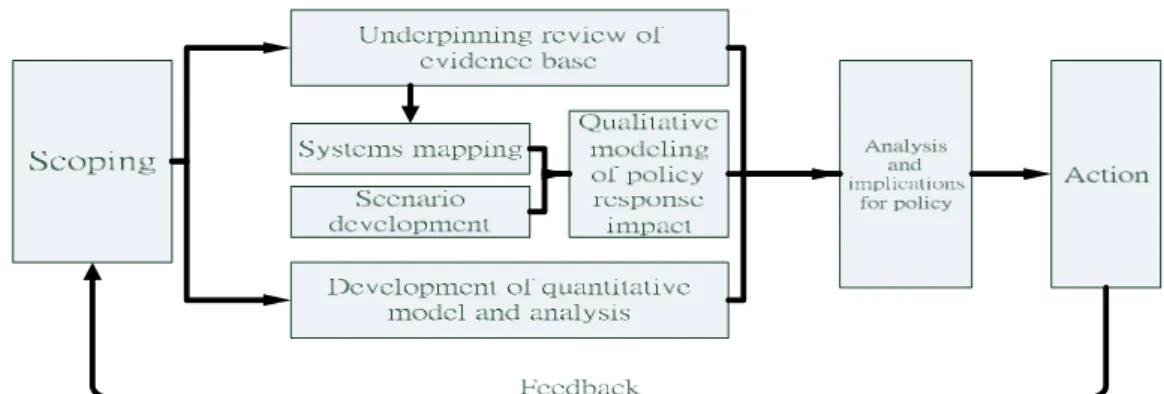
(22) This thesis define foresight as a strategic process which provide support for the decision maker, in order to explore the uncertain future, set the priority, design the innovation system and generate the greatest benefit and competency for the country.. 2.1.2 Foresight in Practice There are two aspects of foresight that should be emphasized. They are “Process” and “Starting Point”. The process of foresight is based on the methods and approaches in foresight, such as trend extrapolation, scenarios, Delphi, focus groups, roadmapping and so on (Andersen & Borup, 2006). However, the process of foresight is not just a set of techniques. It involves consultative procedures to ensure feedback to and from relevant actors. Additionally, the starting point of foresight is referred to which of these futures we will arrive at depends in part on the decisions we take now (Martin, 1995). The first step of typical foresight project was scoping, and it contained qualitative modeling of policy response impact and development of quantitative model and analysis. Then the project would conduct analysis and implications for policy before action. Most importantly, feedback was also necessary in this process, refer to Figure 2- 1.. Figure 2- 1 Typical foresight project structure. 10.
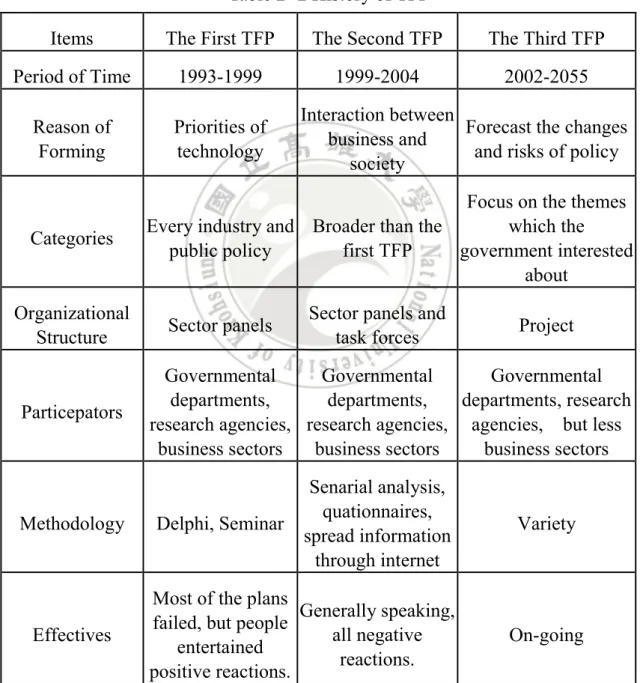
(23) Foresight in UK In 1993 the Office of Science and Technology (OST) White Paper had announced that “Realising our potential, reaffirmed the need for priority setting to make the UK science base more responsive to industry needs. Therefore, the first holistic overview of S&T priorities in the UK was attempted, embarking on the UK Technology Foresight Programme(Brandes, 2009). The first Technology Foresight Programm (TFP) was employed from 1993 to 1999, and the aims of it were 1) to increase UK competitiveness; 2) to create partnerships and long-term networks; 3) to focus attention on market opportunities; 4) to ensure more effective use of the science base(Martin, 1995). However, the most important object was constructing the basic structure among industry, school and governmental department. The programme was directed by a steering group of senior industrialists, scientists and government official. Under it, 15 panels made up of industrialists, scientists and other experts were responsible for different sectors and they would draw upon the advice of large pools of experts(Martin, 1995). The second foresight period of TFP from 1999 to 2004, was called” Focus on Foresight”. It was the main foresight phase. Panels began by holding discussions to set the scene in their sector and to identify strengths and weaknesses. They also consulted with their pool of experts, and engaged in wider consultation through regional and topical workshops. In addition, a major Delphi survey was carried out with questionnaires being sent to some 7000 experts. All these information sources were drawn upon by panels in identifying technological priorities for their sector(Martin & Johnston, 1999). In this phase of TFP, it took a wider aim to exploit the opportunities that arose from the interaction of innovations in S&T with wider social and market trends. Since the goals of the Focus on Foresight were too obscure and nothing new, the panels decided to focus the regine on the “technology foresight” while the former two emphasized on every sectors of the country. 11.
(24) The third TFP was conducted from 2002 and will end in 2055. The third phase refocused on S&T with projects relating either to a key issue where science holds the promise of solutions; or an aspect of S&T that is likely to have wider implications in the future. Additionally, the TFP also set “Horizon Scanning Center” to hadle smaller projects and the entire policy spectrum (social, technical, economic, environmental and political policy), refer toTable 2- 2 . Table 2- 2 History of TFP Items. The First TFP. The Second TFP. The Third TFP. Period of Time. 1993-1999. 1999-2004. 2002-2055. Reason of Forming. Priorities of technology. Categories. Organizational Structure. Particepators. Methodology. Effectives. Interaction between Forecast the changes business and and risks of policy society. Focus on the themes which the Every industry and Broader than the public policy first TFP government interested about Sector panels. Sector panels and task forces. Project. Governmental Governmental Governmental departments, departments, departments, research research agencies, research agencies, agencies, but less business sectors business sectors business sectors. Delphi, Seminar. Senarial analysis, quationnaires, spread information through internet. Most of the plans Generally speaking, failed, but people all negative entertained reactions. positive reactions.. Source: Compiled by the authority.. 12. Variety. On-going.
(25) The foresight process in UK would begin with identifying the need and objectives and gathering information. Hence, the trend of the future would be appeared. The government should follow the trend to collecting “insight” and explore relevance to frame the future options, then, set S&T priorities(Woodroof, 2010). The Horizon Scanning Center took the horizon scanning as “exploring possibilities for the future to ensure that strategies are robust” instead of just “predicting the future”. The UK Foresight Programme proved to be extremely influential, since it represented an exercise that involved priority-setting and networking, and tailored Technology Foresight methods to fit the UK innovation system (Georghiou, Harper, Keenan, Miles and Popper, 2008). Foresight in America The government of the United States does not do foresight. That is to say, the national-level technology foresight studies have not been a prominent in the science and technology landscape of the USA(L. Georghiou, 2008). However, there still exist some “foresight-like” activities in the USA, some reports generated by the President’s Office of Science and Technology Policy (OSTP) and the Congressional Office of Technology Assessment (OTA). The OTA has executed a rich set of technology assessments to inform national policy deliberations. However, it takes a couple of years for the formulation and review processes, so the OTA has been deemed modest for the poor timing fit. What’s more, a strong suspicion holds that the right thing, conservative crew who took control of Congress in the mid-1990s felt that OTA was slanted against their interest. On the other hand, the critical technology reports which generated by the OSTP rely exclusively on expertise. Because the government-sponsored foresight-like activities are affected by the multiple agencies, the private sectors have also employed foresight method for business strategic planning and to set directions for long-term technology 13.
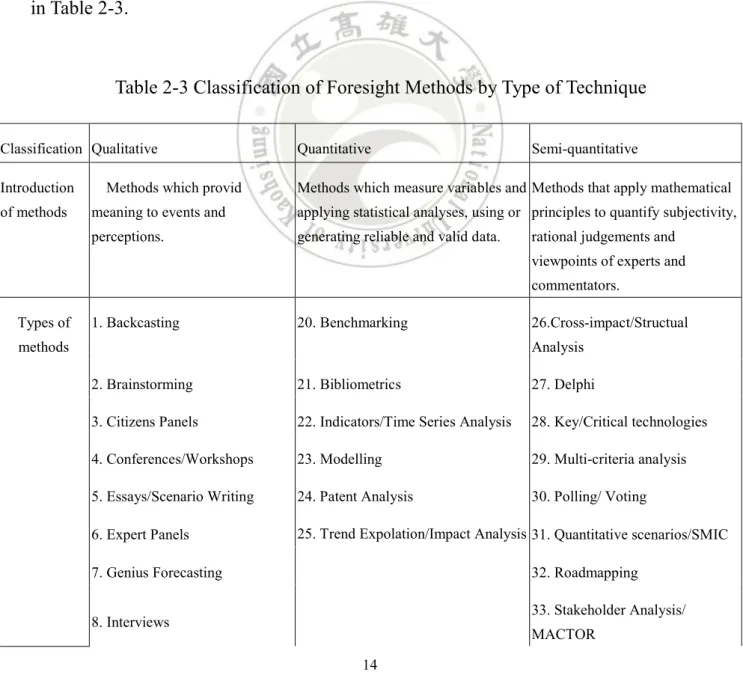
(26) investment(L. Georghiou, 2008). Hence, all the players who interest in the foresight field have made significant contributions to develop and improve the research method and tool for the foresight activities. There are three important foresight methods developed in the USA, scenarios, technology intelligence (scanning and scouting), and technology roadmapping. There are varieties of combinations of foresight method that has been used all over the world. The foresight methods could be divided by type of techniques, they are qualitative, quantitative, and semi-quantitative method. Georghiou et al. (2008) had presented some 33 methods often used in foresight in terms of the typology outlined in Table 2-3.. Table 2-3 Classification of Foresight Methods by Type of Technique Classification Qualitative. Quantitative. Introduction. Methods which measure variables and Methods that apply mathematical. of methods. Methods which provid. Semi-quantitative. meaning to events and. applying statistical analyses, using or principles to quantify subjectivity,. perceptions.. generating reliable and valid data.. rational judgements and viewpoints of experts and commentators.. Types of. 1. Backcasting. 20. Benchmarking. methods. 26.Cross-impact/Structual Analysis. 2. Brainstorming. 21. Bibliometrics. 27. Delphi. 3. Citizens Panels. 22. Indicators/Time Series Analysis. 28. Key/Critical technologies. 4. Conferences/Workshops. 23. Modelling. 29. Multi-criteria analysis. 5. Essays/Scenario Writing. 24. Patent Analysis. 30. Polling/ Voting. 6. Expert Panels. 25. Trend Expolation/Impact Analysis 31. Quantitative scenarios/SMIC. 7. Genius Forecasting. 32. Roadmapping 33. Stakeholder Analysis/. 8. Interviews. MACTOR 14.
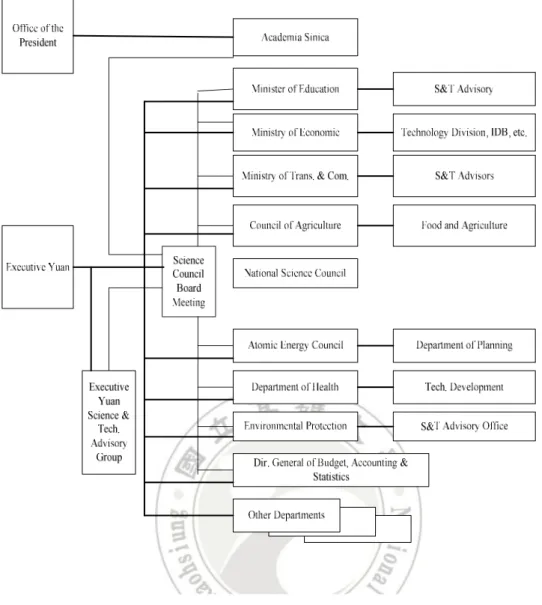
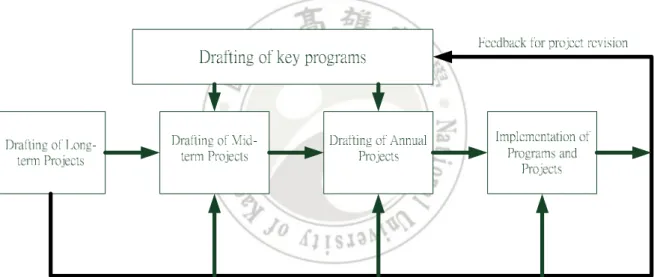
(27) 9. Literature Review 10. Morphhological Analysis 11. Relevance Trees/Logic Charts 12. Role play/Acting 13. Scanning 14. Scenario/Scenario workshops 15. Science Fictioning 16. Simulation Gaming 17. Surveys 18. SWOT analysis 19. Weak Signals/Wild Cards. Source: Georghiou, Harper, Keenan, Miles and Popper( 2008).. 2.2 Policy Planning 2.2.1 The National Technological System in Taiwan Responsibility for implementing the development of science and technology is divided among various government agencies in the R.O.C. Beneath the Office of the President is the Academia Sinica, and beneath the Executive Yuan are the National Science Council (NSC) and various other agencies: Ministry of Education (MOE), Ministry of Economic Affairs (MOEA), Ministry of Transportation and Communications (MOTC), Atomic Energy Council (AEC), Department of Health (DOH), and Environmental Protection Administration (EPA). The Executive Yuan has also established the Science and Technology Advisory Group, which is directed by the Executive Yuan minister responsible for matters pertaining to science and technology. The Science and Technology Advisory Group meet during regular Science and Technology Advisory Conferences. In the case of special tasks that cross 15.
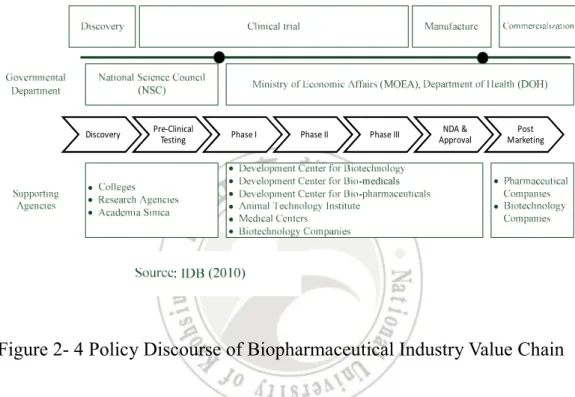
(28) the boundaries of individual agencies, when necessary the Executive Yuan premier may direct the minister in charge of science and technology to coordinate inter-agency implementation through a special project team or task force. The National Science Council Board Meeting is attended by the heads of agencies, whose scope includes scientific and technological matters (including the MOE, MOEA, MOTC, AEC, Council of Agriculture (COA), DOH, and EPA), the Executive Yuan minister in charge of matters pertaining to science and technology, the president of the Academia Sinica, the secretary-general of the Executive Yuan, the director general of the Directorate General of Budget, Accounting, and Statistics, and various scholars and experts (refer to the dotted lines in Figure 2-2.). The Taiwan's science and technology development framework operates according to the principle of comprehensive planning and a division of labour. All agencies are responsible for internal planning; the formulation of inter-agency science-technology policies, the deliberation of major national projects, and the management and allocation of the national budget for science and technology are to be carried out in conjunction with meetings of the National Science Council Board(Lee & von Tunzelmann, 2005). In order to develop science and technology(S&T), the first National S&T Conference was held in 1976 by Applied Technology Research Development Goup. However, the seconed National S&T Conference was reorganized by NSC in 1982, and has been held every four years to plan national science and technology development, review the current state of national science and technology development and provide concrete recommendations that address the future challenges and prospects. Until now, the eighth National S&T Conference was held in 2009 and takes the biopharmaceutical industry as one of the developing industries for the coming years.. 16.
(29) Figure 2- 2 Taiwan's Organizational Framework for the Development of Science and Technology. The concept of policy making as a dynamic process implies that an analysis of official policy content as embodied in laws and other formal texts should be supplemented by an analysis of all the stages of the corresponding policy process including agenda setting, policy formulation, legitimating, adoption, implementation, and evaluation (Cherp and Antypas, 2003). Interaction within policy networks can be regard as a continuous process of transformation in which actors negotiate the 17.
(30) definition and content of each others’ interests, and try to link the interests of other projects they themselves want to carry out (Latour, 1987). Put in another way, each stage of a policy process is seen as a contestation between a variety of actors with disparate conceptions of their own interests and in varying modes of relationship to one another. To make effective use of limited resources during science and technology development, the government has not only established science and development policy and development points but also does assessments of mid to long-term projects under planning and implementation and performance evaluations following the completion of R&D work; refer to Figure 2-3.. Figure 2- 3 Science Planning and Evaluation System of Taiwan The biopharmaceutical industry can be defined as a complex of processes, operations and organizations involved in the discovery, development and manufacture of drugs and medication(Shah, 2004). Acording to the National Science and Technology Program for Biotechnology and Pharmaceuticals (NSTPBP), every stage of the biopharmaceutical industrial value chain accompany with different agencies to cooperate and develop the biopharmaceutical industry. At the stage of Discovery, 18.
(31) except the official authority, NSC, the Academia Sinica, colleages and research agencies would cooperate together at the former stage of the biopharmaceutical value chain. The Ministry of Economic Affairs and the Department of Health are the main authoritative departments for the stages of clinical trial, production and marketing, refer to Figure 2-4.. Discovery. Pre-Clinical Testing. Phase I. Phase II. Phase III. NDA & Approval. Post Marketing. Figure 2- 4 Policy Discourse of Biopharmaceutical Industry Value Chain. As we have mention above, Taiwan listed the biotechnology industry as the country’s key technology in the 1980s, and started to promote development of the biotechnology industry. In order to implement government policy for developing the biotechnology industry and consolidate R&D foundation, the “Strengthening Biotechnology Industry Promotion Program” was formulated in 1995. This program has been used as the principle for promoting development of the biotechnology industry for intergrating resources of various ministries and commissions and draft projects for developing the industry in a planned way. In 2002, the government took the biotechnology industry as one of Two Trillions & Twin Stars industries. In 2004, the Biotechnology Industry Strategy Advisory Committee was established by 19.
(32) Executive Yuan, which would be held every year to discuss the developmental visions of the national biotechnology industry policy council and to make recommendations. Until 2007, the Executive Yuan pointed out tha the prospected investment object in biotechnology field is focused on biopharmaceutical industry.. Until now, the plans of science and technology development of the biopharmaceuticals industry as executed by the various commissions and agencies have exhibited some achievements: Building an international standard biological resources center, providing various biological resources from various sources of Taiwan. information. and. relevant. R&D. technology. platform,. building. biopharmaceutical pioneering factory, integrating domestic optoelectronics and medical technology, building the protein drug biological safety testing system and protein drug biological and chemical properties analysis technology platform. The Bureau of Industry, MOEA, is responsible for the promotion of two projects including the Vaccine Industry Root-Taking Project and Biotechnology Industry Development and Investment Cooperation Promotion Project. The Medium and Small Business division, MOEA, is responsible for the Biotechnology Industry Cluster Incubation Promotion project.. 2.3Biopharmaceutical Industry 2.3.1 Biopharmaceutical Industry in Taiwan The biotechnology industry is one of the emerging industries that have been generally known to have the potential for development and the most significant impact on the quality of human life in the future. The leaing countries of Europe and North America generally consider the emerging biotech industry to be limited to those firms engaged in genetic engineering. Asian countries generally define biotech industry 20.
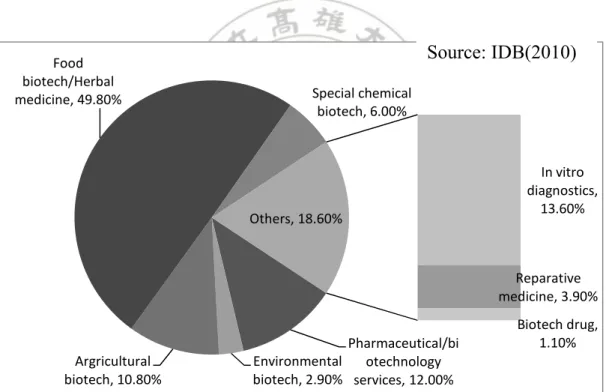
(33) categories more broadly. In view of the fact that the developments of pharmaceuticals and medical devices are closely linked with biotechnology, based on the current state of the industry and industry assistance considerations, apart from the emerging biotech industry, Taiwan also defines the biotech industry as including the pharmaceutical and medical devices industries(IDB, 2010).In terms of data from MOEA ,refer to Figure 2-5, except of the data of 2006, the investment in biotechnology show a gradual increase from 2000 to 2009. The reason why the investment decreased at 2006 is that the combination influences of economic depression, inflation, and the worsen situation in Iraq (IDB, 2010).. , 2009 Total. Figure 2- 5 Investment of Taiwan Biotech Industry Taiwan’s biotechnology industry includes mainly three fields: biotechnology, pharmaceuticals and medical devices. It is worth noting that in 2009, the top 3 production value in biotechnology are respectively food biotech/ hearbal medicine 21.
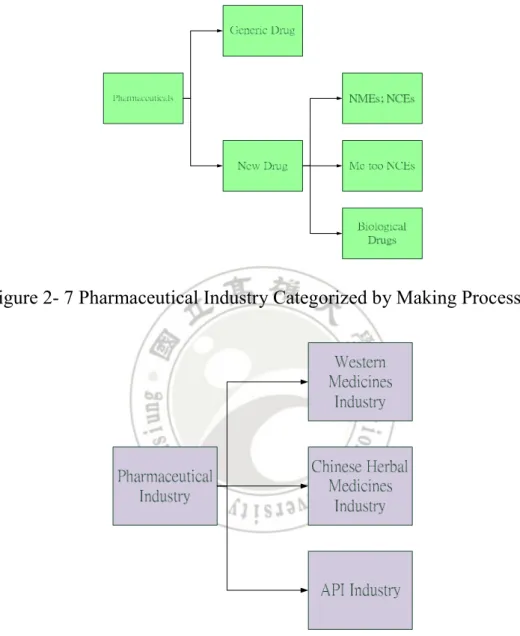
(34) (49.8%), in vitro diagnostics (13.6%) and pharmaceutical/biomedical (12%), refering to Figure 2-6. Today biotech it is the fastest growing sector in the drug industry with annual growth rates almost double that of the overall drug industry average(Bradfield & El-Sayed, 2009). The growth of biopharmaceutical approvals is predicted to grow at a rate of 16% to 30%, compared with about a 4% growth of traditional small-molecule biopharmaceuticals.(Nagle, Nicita, Gerdes, & Schmeichel, 2008) Biopharmaceutical enjoy a relatively high success rate while an average of 34% of biotech products will pass clinical trails and reach the market, only 8% of pharmaceutical products do so(Bradfield & El-Sayed, 2009). Hence, in the last few years, several articles have been devoted to the study of biotechnology and pharmaceutical industry.. Food biotech/Herbal medicine, 49.80%. Source: IDB(2010) Special chemical biotech, 6.00%. In vitro diagnostics, 13.60%. Others, 18.60%. Reparative medicine, 3.90%. Argricultural biotech, 10.80%. Biotech drug, 1.10%. Pharmaceutical/bi Environmental otechnology biotech, 2.90% services, 12.00%. Figure 2- 6 Taiwan Biotechnology Production Value Although the biotechnology and pharmaceutical industry have been objects of study for a long time, there is little research about the combination of these two industries. The conventional. pharmaceutical. formulations. are. relatively. simple. molecules. manufactured mainly through trial and error technique for treating the symptoms of a disease or illness. It could be categorized into generic drug, new molecular entities 22.
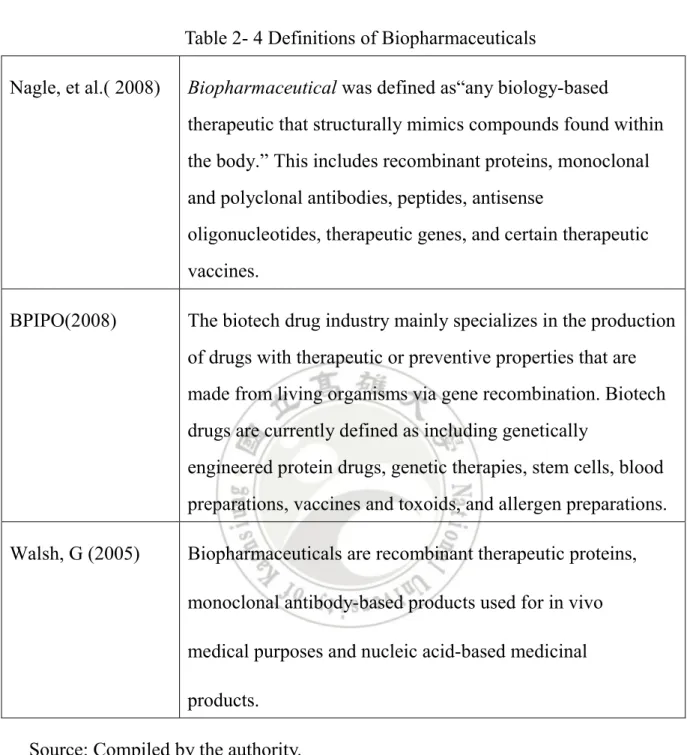
(35) (NMEs) and new chemical entities (NCEs), Me too NCEs, and biological drug. by the. making processes (refer to Figure 2-7), and western medicines, Chinese medicines, and Active Pharmaceutical Ingredients (API) by regulations in Taiwan (refer to Figure 2-8).. Figure 2- 7 Pharmaceutical Industry Categorized by Making Process. Figure 2- 8 Pharmaceutical Industry Categorized by Regulations However, biotechnology is fundamentally reshaping the pharmaceutical industry, that is to say, biopharmaceuticals are complex biological molecules, commonly known as proteins that usually aim at eliminating the underlying mechanisms for treating diseases(PDM, 2010). There are several definitions from different authors and departments in the Table 2-4. 23.
(36) Table 2- 4 Definitions of Biopharmaceuticals Nagle, et al.( 2008). Biopharmaceutical was defined as“any biology-based therapeutic that structurally mimics compounds found within the body.” This includes recombinant proteins, monoclonal and polyclonal antibodies, peptides, antisense oligonucleotides, therapeutic genes, and certain therapeutic vaccines.. BPIPO(2008). The biotech drug industry mainly specializes in the production of drugs with therapeutic or preventive properties that are made from living organisms via gene recombination. Biotech drugs are currently defined as including genetically engineered protein drugs, genetic therapies, stem cells, blood preparations, vaccines and toxoids, and allergen preparations.. Walsh, G (2005). Biopharmaceuticals are recombinant therapeutic proteins, monoclonal antibody-based products used for in vivo medical purposes and nucleic acid-based medicinal products.. Source: Compiled by the authority. Hence, this research defined the biopharmaceutical industry simply as the production process of pharmaceutical industry which applies biotechnology in it. Therefore, the biopharmaceutical industry in this study has the integrated characteristics of the biotechnology and pharmaceutical industry(Chu, 2008; Kesi, 2009; Shyu & Chiu, 2000): 1. Strict regulation to garentee the safty and effectiveness. Increased importance of 24.
(37) regulatory issues (registrations, intellectual property, litigations). 2. The prices were set according to the demands and regulations. 3. It’s a highly professional industry. 4. Huge investments needed for R&D. 5. Highly value added. 6. Increased competitiveness, 7. It should combine with multifield industry. 8. Long innovation time. 9. Brand reliability. 10. It should provide professional service. 11. Low price sencititvity. Taiwan has many of the attributes for a successful biopharmaceutical sector. Importantly, it has existing expertise in advanced technologies such as electronics, which can be easily trasitioned to the life sciences. What’s more, a strong legal framework rewards innovation without prejudice. There is a highly educated workforce, particularly in IT and biology. Facilities including laboratories and manufacturing plants have been constructed to state-of-the art criteria(BMI, 2010). However, Taiwan needs to implement a two-pronged strategy: innovative research-orientation and niche-orientation, in order to be a vital cog in global biotechnology for the coming future. Furthermore, it will look to aggressively develop products that have the most growth potential and which are extremely competitive, laying strong foundations on which future development can build on(MOEA, 2009). In order to know the situation of biopharmaceutical research, the author had 25.
(38) searched (searched in November, 2010) relevant category at the National Digital Library of Theses and Dissertations in Taiwan which is the main digital system for dissertations in Taiwan. There are 18 essays about biopharmaceutical industry after the year 2000. However, most of the issues are about investment evaluation, business strategy, and innovation policy. In this research background in Taiwan, it is worth while conduct a study about biopharmaceutical industry.. 2.3.2 Biopharmaceutical in the USA and the UK Inorder to follow the international trends of biopharmaceutical industry, this study use the biopharmaceutical foresight programs of the USA and the UK which are the leading countries in the biopharmaceutical field. The United States and the European Union are the top two pioneers in the biopharmaceutical industry. Among the European countries, the UK and the Germaney are the leading players for the europen biopharmaceutical industry.. The. author used the UK biopharmaceutical information as representative of the eruope biopharmaceutical situation. The biopharmaceutical industry is free market in the US and the UK. Hence, the major policy issues related to biopharmaceutical industry today are pricing & reimbursement challenges, genetic discrimination, patents and FDA regulations ( Fulda and Wertheimer, 2007). Biopharmaceutical industry in the USA The global pharmaceutical market value is 837.3 billion US dollars in 2009. The top ten pharmaceutical corporations from the USA took the 21.82% market share from the international pharmaceutical market (PhRMA, 2011). The USA pharmaceutical revenue is 760 billion US dollars, and the R&D expenditure is 124.5 billion US dollars in 2009, refer to Table 2-5. Pharmaceutical companies use 26.
(39) biotechnology for manufacturing drugs, pharmacogenomics, gene therapy, and genetic testing, so this research collected the data of pharmaceutical industry in the USA and the UK to compare the biopharmaceutical industry in Taiwan.. Table 2-5 The USA Pharmaceutical Industry Data in 2009 The USA Pharmaceutical Industry Data in 2009 Revenue. 760($bn). R&D Expenditure. 124.5($bn). employment. 109000people. Source: PhRMA (2011). Worldwide healthcare expenditure is increasing annually and in the USA the cost of pharmaceuticals is the fastest growing component of healthcare. The USA is now the only major market in which there are no general government price controls on drugs and prices have continued to rise, whereas in Europe prices have flattened or declined as governments have successively strengthened cost control and containment measure (Brandfield and El-Sayed, 2009). There are several market trends for the US biopharmaceutical industry as followed which collected from the Pharmaceutical Research and Manufacturers of America (PhRMA) and Price Water House Cooperation (PWC). 1. Biopharmaceutical industry should partner with specialized service providers. 2. The CROs will become increasingly important in the development of biomarkers. 3. Form a web of alliances to offer supporting services. 27.
(40) 4. Develop comprehensive plans for marketing and selling specialist therapies. 5. Build marketing and sales functions that are fit for the future. 6. Focus on prevention pharmaceuticals. 7. Greater use of new technologies to “virtualise” the research process and accelerate clinical development. Biopharmaceutical industry in the UK The UK pharmaceutical revenue is 32.4 billion US dollars, and the R&D expenditure is 7.326 billion US dollars in 2009, refer to Table 2-6. Although the revenue and investment are much less than the USA, the UK still worth to be the representative as the Europe, because of the UK is the leader of biopharmaceutical industry in Europe. Table 2-6 The UK Pharmaceutical Industry Data in 2009 The UK Pharmaceutical Industry Data in 2009 Revenue. 32.4($bn). R&D Expenditure. 7.326 ($bn). employment. 72000people. Source:APBI(2011). There are biopharmaceutical market trend for the next 20 years as followed which were collected from the Association of the British Pharmaceutical Industry (ABPI). 1. Prevention and diagnostic medical will be important factors. 2. More personalized treatment. 3. Diversified model for biopharmaceutical industry. 28.
(41) 4. Needs for a wider, more multi-disciplinary skills base. 5. Development of packages of products and service.. 29.
(42) CHAPTER THREE METHODOLOGY The successful implementation of a policy requires the engagement of the research community, it is useful to undertake a thorough study of policy making and implementation processes through detailed interviewing and documentary analysis(Hanney, Henkel, & Walden Laing, 2001). In the early 1990s many Western European countries experienced a “revival” of national “technological forecasting” or “foresight” initiatives in an attempt to focus resource allocation in science and technology (S&T) policy(Brandes, 2009). However, most of the foresight researches were conducted in methodologies such as trend extrapolation, scenarios, Delphi, focus groups, road mapping and so on. This research aimed to find out the Taiwan’s biopharmaceutical foresight through the experiences and foresight reports of the leading countries and then set priorities. Therefore, this research would use Q methodology to combine the functions which had been mentioned in last paragraph. Compare to scenarios, Delphi and focus group, the Q methodology is much cheaper in the limited research fund. What’s more, Q methodology could turn the qualitative descriptions into quantitative data, and it would be helpful in analyzing.. 3.1 Research Structure This paper is intended as an investigation of Taiwan’s biopharmaceutical foresight, so the author had reviewed the foresight literatures about biopharmaceutical industry in the UK and America, in order to identify the trends, development and challenges, and then draft the foresight of Taiwan’s biopharmaceutical industry. After the foresight literature review, this study applied the modified Delphi survey by a structured quenstionnaire in first round of Delphi that is based upon an extensive review of the biopharmaceutical literature(Hsu & Sandford, 2007) of the OECD. In this study, Delphi method has been 30.
(43) employed as a tool to be authorized by the subjects within expertise when forming the Q statements. With a view to analysis these information in apropriate way, this study applied the biopharmaceutical industrial value chain and competitive factors as the factorial design structure of Q statements. The reasons why the study used these two as the factorial design structure are: the biopharmaceutical industrial value chain could be divided into four stages to point out the specific needs of every stage; through the competitive factors allocation, we could find out that what competitiveness should Taiwan has when facing the foresight of leading countries. Finally, after 30 interviews, the author would put these data to the PQ Method software to analysis, and then used the policy instrument to analysis what can the government do for the whole industry; refer to Figure 3- 1.. Figure 3- 1 Research Structure. 3.2 Factorial Design This study aims to find out what competitiveness should Taiwan has to develop the biopharmaceutical industry in the next 20 years. Additionally, foresight aims to close that gap and develop mutual respect for each others’ knowledge and skills(Anderson, 1997) Therefore, the author should set facets and some indicators to generate Q cards and let interviewee to evaluate the priorities for biopharmaceutical industry for the next 20 years. 31.
(44) In Q study, the concourse consists of statements being made to express the concept, idea, or meaning of a subject being studied. The concourse can be gotten in many ways, including interviews, essays, commenyaries from newspapers and talk shows(Fang, 2006). In order to envision desired futures and policy action from identification and monitoring of issues, trends, developments, and changes, the foresight research should generate from assessment and understanding of policy challenges(Habegger, 2009).Since that, this study would base on the way of thinking to expand the structure of Q factorial design. That is to say, with a view to find out the specific future that was suitable for the Taiwan’s biopharmaceutical industry, this study would identify the trends of foresight by reports from the UK and America. The research would turn these information and knowledge into foresight blueprint via the matrix structure of “competitive factors” and “biopharmaceutical industrial value chain” which developed by the author (refer toTable 3- 1), and 130 statements were selected under this factorial design. The author examed each meaing of every statements, reject the same,inappropriate,unsuitable and combine the similar, 24 of tatal 130 were finally selected to find out what specific conditions should Taiwan biopharmaceutical industry have in every stages of the value chain (refer to Appendix A ). Table 3- 1 Factorial Design of This Study. 32.
(45) 3.2.1 The Competitiveness of Biopharmaceutical industry Foresight is about shaping the future through the concerted action of self-sustaining networks of interested group (stakeholders). People in these networks consider various ways in which the future might unfold, and can then take steps to prepare for the longer term(Anderson, 1997). Additionally, foresight is the ability to identify which are the critical factors in external environment, how they will behave in the future and how that will affect planned course of action(Raimond, 1996). That is to say, foresight programmes can help to make explicit what broad priorities should be. The aims is not to prescribe which specific technologies should be developed, but to improve the general understanding of the strengths and weaknesses of a nation’s science and technology base(Anderson, 1997). The UK foresight programme had set five infrastructural bases to distinguish the categories of foresight. Those are the skill base, research in the science base, communications, finance, and policy regulation. However, according to Federal Ministry of Education and Research in Germany, countries which employed foresight programmes hope to be able to identify technologies which will be decisive for their future competitiveness and to gain information for setting future priorities in their research and technology policies(FMER, 2007). In order to combine all the aspects of biopharmaceutical foresight indicators, this research had generated a branch chart to be the part of the selected structure. To identify which are the critical factors in external environment and strengths and weaknesses of a nation’s science and technology base after reviewing the foresight of the UK and America, there are evaluated conditions to distinguish the “Factor conditions, Industrial conditions, and Regulation condition”, refer to Figure 3- 2.. 33.
(46) Figure 3- 2 Competitive Indicators for Factorial Design This study should employ some tools that could help to identify which are the critical factors in external environment and strengths and weaknesses of a nation’s science and technology base. Considering all the goals of foresight which had mentioned above, the Michael E. Porter’s “Diamond Model” and the “12 indexes to measure the competitiveness” of World Economic Forum (WEF) could provide complementary points for the British foresight programmes bases. Additionally, the Association of the British Pharmaceutical Industry (ABPI) had already provided a commentary on the competitiveness and performance indicators, these are: supply factors, demand factors and performance which could reflect the special characteristics of bio-pharmaceutial industry, refer to Table 3- 2.. 34.
(47) Table 3- 2Contents of Indicators. Source: Compiled by the authority. The first level of factorial design structure for setting priorities is “evaluated conditions”. The concept of this level is from the framework of “Diamond Model”, which included factor conditions, demand conditions, related and supporting industries, and firm strategy, Structure and rivalry. The author used the term “condition” owning to that “condition” contains the meaning of coverage. Therefore, the “evaluated conditions” is suitable to be the initial level of the structure. There are several evaluated indicators under every evaluated condition, in order to be more specific, and set the priorities. 1. Facorial conditions Factor conditions are necessary to compete in a given industry(Porter, 1990). This conditions were mentioned in the British foresight program as “skill base, 35.
(48) research in the science base”, and as “factor conditions” in the Diamond Model, and “ Infrastructure, macroeconomic environment, higer education and training, labor market efficiency and innovation” in WEF report, and as “ labor&skills, innovation, macroeconomic” in ABPI indications. We may go on from this to the conclusion that the factorial conditions of this study contained human resource, financial supports and infrastructures. 2. Regulatory conditions Not only had the British foresight program taken the policy regulations into consideration, but also Diamond Model, WEF and ABPI all contained similar indicators: goverment(Porter, 1990), institutions(WEF, 2010), and taxation(APBI, 2009). On these grounds this study has come to the conclusion that the Regulatory conditions contained regulatory environment, investment and taxation, intelligent property and social benefits. 3. Industrialized conditions The remained indicators of the WEF, ABPI, Diamond Model and British foresight program had all revealed the concept of how to commercialize the technology. It included “communications” of the British foresight programs, and “related and support industries” of the Diamond Model, “market size, and business sophistication” of WEF. Therefore, the industrialized conditions may include commercialization and support industry. 3.2.2 Biopharmaceutical Industrial Value Chain The concept of industrial value chain was put forward by Michael E. Porter in the Competitive Advantage in 1985, and has been developed since then, which is still used as effective research tool for competitive advantage research(Wang, Sou, & Wang, 36.
(49) 2009). The reason why this study used the industrial value chain as a tool of factorial design is that it could analisis all aspects of value-added activities of an industry. Another reason is the similar characteristics of biotechnology and traditional pharmaceutical industry; Rasmussen (2008) had combined the the business model of the traditional pharmaceutical industry and characteristics of drug discovery to expand the research of biopharmaceutical business model. Therefore, this study would employ the biopharmaceutical industrial value chain as a part of factorial design. The biopharmaceutical industrial value chain was divided by Food & Drugs Association (FDA) in America into discovery, pre-clinical testing, clinical trail (phase I~phase III), regulatory submission (NDA & approval), manufacture, marketing, and post-marketing(Shyu & Chiu, 2000). However, the core of the biopharmaceutical industrial value chain could be divided into four major stage: drug discovery, drug research, drug manufacture, and drug sales(Wang, et al., 2009). This research intergrated the industrial value chain dividing ways of FDA and core stage into three stages: discovery, clinical trail, and product launch & marketing. 1. Discovery The research and development of product is the core of the biopharmaceutical companies. If enterprises want to maintain competitive advantages in the industry and access to excess profits, it is necessary to continue to initiative to develop new drug(Wang, et al., 2009). The process by which a single new medicine is developed from a research-based concept into a fully marketed product is lengthy and extremely costly. The discovery stage begins with the identification of medical needs. The identification would together with appraisal of the current knowledge about the target disease, would come hypotheses on how to possibly improve therapy in efficient, effective and safe 37.
數據
+7

相關文件
After students have had ample practice with developing characters, describing a setting and writing realistic dialogue, they will need to go back to the Short Story Writing Task
• helps teachers collect learning evidence to provide timely feedback & refine teaching strategies.. AaL • engages students in reflecting on & monitoring their progress
Robinson Crusoe is an Englishman from the 1) t_______ of York in the seventeenth century, the youngest son of a merchant of German origin. This trip is financially successful,
fostering independent application of reading strategies Strategy 7: Provide opportunities for students to track, reflect on, and share their learning progress (destination). •
Strategy 3: Offer descriptive feedback during the learning process (enabling strategy). Where the
How does drama help to develop English language skills.. In Forms 2-6, students develop their self-expression by participating in a wide range of activities
Now, nearly all of the current flows through wire S since it has a much lower resistance than the light bulb. The light bulb does not glow because the current flowing through it
Asymptotic Series and Borel Transforms Revisited Alien Calculus and the Stokes Automorphism Trans–Series and the Bridge Equations Stokes Constants and Asymptotics.. 4 The Airy
