I
Pump-Probe Measurements of Carrier Capture Times in Quantum
Well
Structures
Jian-Jang Huang, Ding-Wei Huang, Chung-Yen Chao, Jiun-Haw Li, and C. C. Yang;
1m445pm
Institute of Electro-Optical Engineering and Department of Electrical Engineering
National Taiwan University Taipei, Taiwan, R 0. C. (phone) 886-2-3635251 ext. 445
(fax) 886-2-3652637 (E-mail) ccy@,cc.ee.ntu.edu.tw
The captures of electrons and holes into semiconductor quantum well structures have received considerable attention in both hndamental and device-oriented research. In quantum1 well lasers, the capture efficiency is expected to influence both the quantum efficiency and
dynamic performance. Two multiple quantum well (MQW) samples (waveguide structures) were used in our experiments. The first one consists of 5 5 quantum wells. The well and barrier
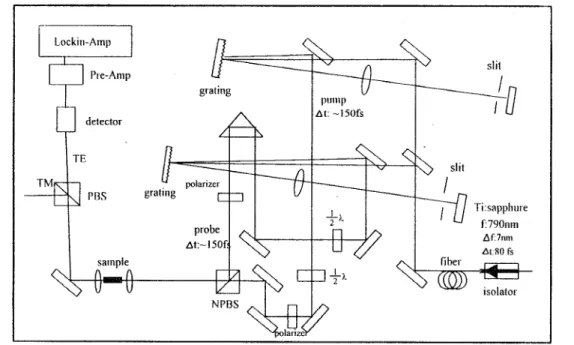
thicknesses are 7 nm and 12 tun, respectively. Because ofthe large barrier thickness, we called it as the uncoupled QW sample. The second one has 110 quantum wells. The well and barrier thicknesses are 3 5 nm and 5 5 nm, respectively. It is actually a supperlattice and we called it as the coupled QW sample In our experiments, we intend to estimate the carrier capture times with subpicosecond pump-probe measurements. The experimental setup is shown in Fig 1. When the input laser pulse (80 fs) passes through the 14 cm fiber, the spectrum is broadened from 7 nm to about 100 nm (FWHM) due to self-phase modulation. We then use a grating in either pump or probe arm to select the required central wavelength and spectral width, and then re-compress the pulse down to 150 fs. With degenerate and nondegenerate pump-probe configurations, we can measure the decay time of carriers in the barrier states and the rise time of carriers in the confined subbands in bot4 uncoupled and coupled quantum well structures. The temporal evolution of the decay of barrier carrier density in the uncoupled QW sample is shown in Fig. 2. The experiment was carried out at a pump laser power of 1.5 mW, corresponding to an excitation carrier density of
3
x10
1 6 ~ m - 3
in the barrier states. The decay of the carrier density has two components. In the first 20 ps (after the excitation of the pump pulse), the decrease of barrier density is slow; after that a sharp decrease occurs Compared to the uncoupled sample, the decrease in the coupled quantum well structure has only one component which is quite sharp. In Fig. 3, the temporal evolution of the subband carrier density is shown. By fitting the experimental data to thenumerical results based on a set of rate equations, we obtain a capture time of about 15 ps in the uncoupled QW structure and 8 ps in the coupled QW well structure. Actually, the slower decay
.
,--r '
of barrier carriers in the uncoupled sample, as shown in Fig. 2, confirms the slower rise of subband carriers, as shown in Fig. 3.
Lockiti-Amp Pie-Amp grating detectoi
i-I
polarizer PRS grating I " slit7
IFig. 1 Schematic diagram of the experimental setup.
1
.oo
'2 0.99 FI%
+ 3 0.98 N%
0.97s
0.96 -20.0 0.0 20.0 40.0 60.0 Probe delay (ps) 1.0.?
0.8 & 0.64
0.4 +P
3
a
g
0.2 0.0 0.0 10.0 20.0 30.0 Probe delay (ps)Fig. 2 Differential transmission in the degenerate experiments with uncoupled
QW (solid curve) and coupled QW (dashed curve) samples.
Fig. 3 Differential transmission in the non- degenerate experiments with uncoupled
QW (solid curve) and coupled QW (dashed curve) samples.