Luminescence and Energy Transfer of Eu- and Mn-Coactivated
CaAl
2Si
2O
8as a Potential Phosphor for White-Light UVLED
Woan-Jen Yang,
†Liyang Luo,
‡Teng-Ming Chen,*
,†and Niann-Shia Wang
‡ Phosphors Research Laboratory, and Institute of Molecular Science, Department of Applied Chemistry,National Chiao Tung UniVersity, Hsinchu 30050, Taiwan ReceiVed March 24, 2005. ReVised Manuscript ReceiVed May 16, 2005
A series of Eu2+- and Mn2+-coactivated CaAl
2Si2O8phosphors have been synthesized at 1400°C under
a reduced atmosphere and their luminescence properties have been investigated as a function of activator and coactivator concentrations. We have discovered that energy transfers from Eu2+to Mn2+by directly
observing significant overlap of the excitation spectrum of Mn2+and the emission spectrum of Eu2+as
well as the systematic relative decline and growth of emission bands of Eu2+ and Mn2+, respectively.
The critical distance and average separation of Eu2+and Mn2+ have also been calculated. By utilizing
the principle of energy transfer, we have also demonstrated that with appropriate tuning of activator content CaAl2Si2O8:Eu2+,Mn2+ phosphors exhibit great potential to act as a phosphor for white-light
ultraviolet light-emitting diodes (UVLEDs).
1. Introduction
It has been well-known that Eu2+may act as an efficient
sensitizer that transfers energy to Mn2+ in several host
lattices.1,2 For instance, Caldino et al. described the
Eu2+
fMn2+ energy transfer process in CaCl2:Eu2+,Mn2+
single crystals under photoexcitation. The authors suggested that the Eu2+ to Mn2+ energy transfer process observed in
CaCl2:Eu,Mn can be rationalized by the formation of small
complexes of Eu-Mn in the lattice.1Similar energy transfer
was also observed by Barry in the BaMg2Si2O7:Eu2+,Mn2+
phosphor.3 Recently, Yao et al. reported the luminescence
and decay behaviors of BaMg2Si2O7:Eu2+,Mn2+as a function
of dopant concentrations and confirmed the presence of Eu2+
fMn2+ energy transfer.4
Rubio et al.5proposed an ionic radius criterion to predict
paring between two impurity dopant ions in alkali halide host matrice, which may provide a reasonable basis for selecting appropriate impurity dopant ions for developing efficient phosphor materials. Furthermore, the Eu2+
fMn2+ energy
transfer mechanism in KBr:Eu2+,Mn2+ phosphor was
de-scribed by Mendez et al.6 who proposed the possible
formation of small Eu2+-Mn2+ clusters in the KBr lattice.
Mendez et al. also indicated that the Eu2+
f Mn2+ energy
transfer can be explained by assuming that a
dipole-quadrupole or exchange (superexchange) interaction mech-anism is active in the Eu2+-Mn2+cluster formation.6
Very recently, Kim et al. reported that Ba3MgSi2O8:Eu,Mn
can be used as a phosphor for fabrication of a warm white-light emitting diode.7 They concluded that with optimal
excitation wavelength at 375 nm Ba3MgSi2O8:Eu,Mn was
observed to show three emission bands centered at 442 nm (from Eu2+and with decay time of 0.32µsec), 505 nm (from
Eu2+and with decay time of 0.64µsec), and 620 nm (from
Mn2+and with a decay time of 750µsec)7, respectively.
Despite the above-mentioned research on the luminescent properties and energy transfer of Eu and Mn-codoped materials, to the best of our knowledge, there have been no investigations regarding the luminescence in CaAl2Si2O8:
Eu,Mn published, nor is the energy transfer between Eu2+
and Mn2+in the host of CaAl
2Si2O8reported in the literature.
Anorthite (CaAl2Si2O8) was reported to be crystallized in a
triclinic crystal system with space group I1h under ambient pressure by Angel in 1988.8In the crystal lattice, there are
six crystallographically independent cation sites, namely, four Ca2+sites, one Al3+site, and one Si4+site. One type of Ca2+
ion occupies an octahedral site with six oxygen atoms and the average Ca-O bond distance is 2.485 Å. Other Ca2+
ions occupy three kinds of polyhedral sites with seven coordinated oxygen atoms and their average bond distances are 2.508, 2.531, and 2.562 Å, respectively. Al and Si atoms both occupy tetrahedral sites with four coordinated oxygen atoms, and the average bond distances for Al-O and Si-O are 1.735 and 1.611 Å, respectively.8
Motivated by the above investigations and the attempt to develop phosphors excitable by ultraviolet radiation for the applications of white-light LED, we have investigated the * Corresponding author. E-mail: [email protected]. Tel: 886+
35731695. Fax: 886+ 35723764. †Phosphors Research Laboratory. ‡Institute of Molecular Science.
(1) Caldino, U. G.; Munoz, A. F.; Rubio, J. O. J. Phys.: Condens. Matter 1990, 2, 6071.
(2) Caldino, U. G.; Munoz, A. F.; Rubio, J. O. J. Phys.: Condens. Matter 1993, 5, 2195.
(3) Barry, T. L. J. Electrochem. Soc. 1970, 117, 381.
(4) Yao, G. Q.; Lin, J. H.; Zhang, L.; Lu, G. X.; Gong, M. L.; Su, M. Z.
J. Mater. Chem. 1998, 8, 585.
(5) Rubio, J. O.; Murrieta, S. H.; Powell, R. C.; Sibley, W. A. Phys. ReV.
B 1985, 31, 59.
(6) Mendez, A.; Ramos, F.; Riceros, H.; Camarillo, E.; Caldino U. G. J.
Mater. Sci. Lett. 1999, 18, 399.
(7) Kim, J. S.; Jeon, P. E.; Choi, J. C.; Park, H. L.; Mho, S. I.; Kim, G. C. Appl. Phys. Lett. 2004, 84, 2931.
(8) Angel, R. J. Am. Mineral. 1988, 73, 1114. 10.1021/cm050638f CCC: $30.25 © 2005 American Chemical Society
luminescence, energy transfer, and color chromaticity prop-erties of CaAl2Si2O8:Eu,Mn phosphor in the present work.
We have also calculated the average separation between Eu2+
and Mn2+ ions (R
Eu-Mn) in the host lattice as well as the
critical distance (Rc) between Eu2+ and Mn2+ ions for the
occurrence of energy transfer based on the model proposed by Blasse.9Our investigation has demonstrated that CaAl
2
-Si2O8:Eu,Mn can emit white-light under ultraviolet excitation
by systematically tuning the relative doping content of Eu2+
relative to that of Mn2+.
2. Experimental Section
2.1 Materials and Synthesis. A series of polycrystalline (Ca1-m-nEumMnn)Al2Si2O8 (abbreviated as CaAl2Si2O8:
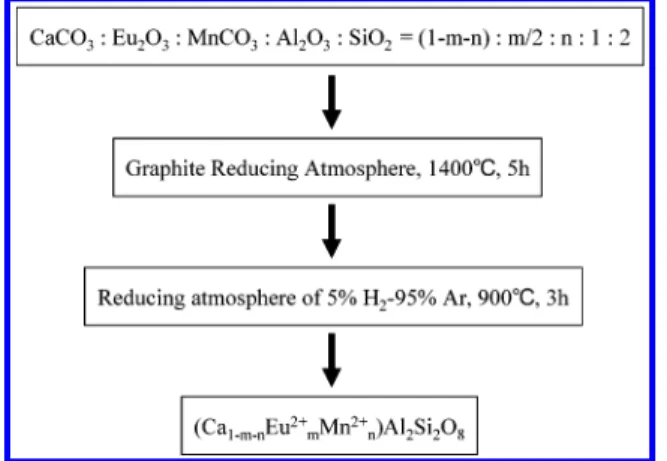
Eu,Mn) samples investigated in this work were prepared by solid-state reactions and the synthetic procedure is sum-marized in Figure 1. Briefly, the constituent oxides or carbonates CaCO3 (99.99%), Eu2O3 (99.99%), MnCO3
(99.99%), Al2O3 (99.99%), and SiO2 (99.99%) (all from
Aldrich Chemicals, Milwaukee, WI) were intimately mixed in the requisite proportions. The mixtures were first calcined and then sintered at 1400°C for 5 h to avoid the inclusion of carbonate impurities. The obtained product was then reduced at 900 °C for 3 h under 5:95 H2/Ar atmosphere.
The Y3Al5O12:Ce (Catalog NP-204) sample used as a
blue-LED convertible phosphor to generate white light in the Commission International de I’Eclairage (CIE) chromaticity investigations was obtained from Nichia Corporation, Japan. 2.2 Characterizations. The phase purity of the as-prepared phosphor samples was checked by powder X-ray diffraction (XRD) analysis with a Bruker AXS D8 advanced automatic diffractometer with Cu KR radiation operating at 40 kV and 20 mA. The XRD profiles were collected in the range of 10°< 2θ < 80°. The measurements of photoluminescence (PL) and photoluminescence excitation (PLE) spectra were performed by using a Spex Fluorolog-3 spectrofluorometer (Instruments S.A., NJ) equipped with a 450-W Xe light source and double excitation monochromators. The powder samples were compacted and excited under 45° incidence and emitted fluorescence was detected by a Hamamatsu Photonics R928 type photomultiplier perpendicular to the excitation beam. The spectral response of the measurement
tralon and R-Al2O3was used as a standard in the
measure-ments. The Commission International de I’Eclairage (CIE) chromaticity coordinates for all samples were determined by a Laiko DT-100 color analyzer equipped with a CCD detector (Laiko Co., Tokyo, Japan).
3. Results and Discussion
Polycrystalline CaAl2Si2O8:Eu,Mn phosphor samples used
in this work have been synthesized at 1400 °C and then annealed under a reduced atmosphere of 5:95 H2/Ar. Samples
not annealed under reduced atmosphere were found to exhibit much weaker luminescence intensity, which may be at-tributed to the absence of Eu2+ and/or Mn2+. The XRD
patterns of CaAl2Si2O8:Eu, Mn phases with different doping
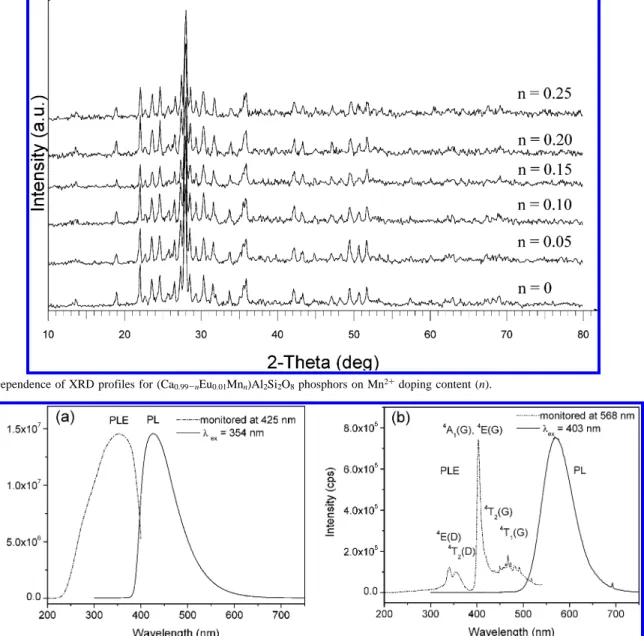
contents are shown in Figure 2 and all of the profiles were found to be in good agreement with that reported in JCPDS file 89-1462 regardless of the content of dopants and this observation indicates that no impurity phase is present.
Refinements of the XRD patterns for (Ca1-m-nEumMnn )-Al2Si2O8 samples with different doping contents of Mn2+
indicated that the refined lattice parameters do not show significant change considering the standard deviations. Therefore, based on the effective ionic radii (r) of cations with different coordination number (CN) reported by Shan-non,11 we have proposed that Eu2+ and Mn2+ ions are
expected to and, in fact, occupy the Ca2+ sites preferably,
because the ionic radii of Eu2+(r ) 1.17 Å when CN ) 6
and r ) 1.20 Å when CN ) 7) and Mn2+(r ) 0.83 Å when
CN ) 6 and r ) 0.90 Å when CN ) 7) are close to that of Ca2+(r ) 1.00 Å when CN ) 6, r ) 1.06 Å when CN )
7).11Since both four-coordinated Al3+(r ) 0.39 Å) and Si4+
(r ) 0.26 Å) sites are too small for Mn2+ to occupy, we
thereby conclude that Mn2+(r ) 0.66 Å when CN ) 4) tends
to prefer the Ca2+ sites due to size consideration.
The PL and PLE spectra for the purely Eu2+-activated
CaAl2Si2O8are shown in Figure 3a. An intense broad band
centered at 425 nm and attributed to the typical 4f65d1(t 2g)f
4f7(8S
7/2) transition of Eu2+ was observed at ambient
tem-perature. Furthermore, the PL and PLE for purely Mn2+
-activated CaAl2Si2O8are represented in Figure 3b. The d-d
transitions of Mn2+are forbidden in spin and parity, so their
excitation transitions are difficult to pump and emission intensity is very weak. The broad emission band centered at 568 nm is attributed to the spin-forbidden4T
1(4G)f6A1(6S)
transition of Mn2+. The excitation spectrum consists of
several bands centering at 340, 355, 403, 418, and 469 nm, (9) Blasse, G. Philips Res. Rep. 1969, 24, 131.
Figure 1. Flowchart diagram for the synthesis of CaAl2Si2O8:Eu,Mn phosphors.
corresponding to the transitions from 6A
1(6S) to 4E(4D), 4T
2(4D), [4A1(4G), 4E(4G)], 4T2(4G), and 4T1(4G) levels,
respectively.
As shown in Figure 3a and b and Figure 4, the comparison of the PL and PLE spectra for CaAl2Si2O8:Eu and CaAl2
-Si2O8:Mn phosphors reveals a significant spectral overlap
between the emission band of Eu2+centered at 425 nm and
the Mn2+excitation transitions of6A
1(6S)f4T1(4G),4T2(4G),
[4A
1(4G), 4E(4G)]. Therefore, the effective resonance-type
energy transfer from Eu2+to Mn2+is expected. This type of
energy transfer is quite common and has been observed in several Eu2+- and Mn2+-coactivated phosphors such as CaCl
2:
Eu,Mn,2KBr:Eu,Mn,6BaMg
2Si2O7:Eu,Mn,4and Ba3MgSi2O8:
Eu,Mn,7respectively.
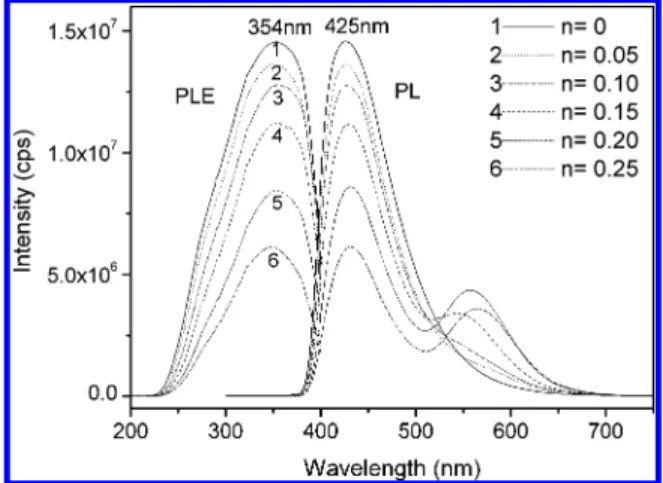
Figure 5 shows the PLE and PL spectra for six Eu2+and
Mn2+-coactivated (Ca
0.99-nEu0.01Mnn)Al2Si2O8phosphors with
different dopant contents n of 0, 0.05, 0.10, 0.15, 0.20, and 0.25, respectively. The PLE spectra monitored at 425 nm (Eu2+emission) show an optimal excitation band centered
at 354 nm, which consists of unresolved bands due to the 4f5d multiplets of the Eu2+excited state. Interestingly and
reasonably, the PL intensity of Mn2+ activator (or energy
acceptor) was observed to increase, whereas that of Eu2+
sensitizer (or energy donor) is simultaneously found to de-crease monotonically with increasing Mn2+dopant content.
The dependence of the relative emission intensity of Eu2+on
different Mn2+dopant content (n) is represented in Figure
Figure 2. Dependence of XRD profiles for (Ca0.99-nEu0.01Mnn)Al2Si2O8phosphors on Mn2+doping content (n).
Figure 3. PLE and PL spectra for phosphors with compositions of CaAl2Si2O8:0.01Eu2+(a) and CaAl2Si2O8:0.25Mn2+(b).
Figure 4. Spectral overlap between the PL spectrum of (Ca0.99Eu0.01)Al2 -Si2O8(solid line) and PLE spectrum of (Ca0.75Mn0.25)Al2Si2O8(dashed line).
6. The PL intensity of Eu2+ emission band was found to
decrease monotonically with increasing doped Mn2+
con-centration. Similar observations reported by Yamashita et al.12and Ruelle et al.13is attributed to the formation of paired
Mn2+centers with faster decay than single Mn2+ centers.
The PL decay curves of Eu2+in (Ca
0.99-nEu2+0.01Mn2+n )-Al2Si2O8 were measured and are represented in Figure 7.
As described by Blasse and Grabmaier,14it is well established
that the decay behavior of Eu2+can be expressed by
, where I and I0 are the luminescence intensities at time t
and 0, andτ is the luminescence lifetime. On the basis of eq 1 and decay curves, the lifetime values were determined to be 0.73, 0.66, 0.57, 0.43, and 0.34µs for (Ca0.99-nEu0.01Mnn )-Al2Si2O8with n ) 0, 0.10, 0.15, 0.20, and 0.25, respectively.
The decay lifetime for Eu2+ was found to decrease with
increasing Mn2+ dopant content, which is strong evidence
for the energy transfer from Eu2+ to Mn2+, as reported by
Ruelle et al.13and Jiao et al.,15respectively.
We are also interested in investigating the energy transfer efficiency (ηT) of Eu2+
fMn2+ and a simple operational
definition as suggested by Paulose et al.,16 ηT can be
expressed by
whereτS0is the intrinsic decay lifetime of the sensitizer (Eu2+)
andτSis the decay lifetime of the sensitizer (Eu2+) in the
pres-ence of the activator (Mn2+). The energy transfer efficiency
for Eu2+
fMn2+in (Ca0.99-nEu2+0.01Mn2+n)Al2Si2O8was
cal-culated and is illustrated in Figure 8. With increasing Mn2+
dopant content, the energy transfer efficiencyηTwas found to increase gradually.
According to Dexter and Schulman, concentration quenching is in many cases due to energy transfer from one activator to another until an energy sink in the lattice is reached.17As
suggested by Blasse,9the average separation R
Eu-Mncan be
expressed by (10) Altermatt, U. D.; Brown, I. D. Acta Crystallogr. 1987, A34, 125.
(11) Shannon, R. D. Acta Crystallogr. 1976, A32, 751.
(12) Yamashita, N.; Maekaewa, S.; Nakamura, K. Jpn. J. Appl. Phys. 1990,
29, 1729.
(13) Ruelle, N.; Pham-Thi, M.; Fouassier, C. Jpn. J. Appl. Phys. 1992, 31, 2786.
(14) Blasse, G.; Grabmarier, B. C. Luminescent Materials; Sprinnger-Verlag: Berlin, Germany, 1994; p 96.
(15) Jiao, H.; Liao, F.; Tian, S.; Jing, X. J. Electrochem. Soc. 2003, 150, H220.
(16) Paulose, P. I.; Jose, G.; Thomas, V.; Unnikrishnan, N. V.; Warrier, M. K. R. J. Phys. Chem. Solids 2003, 64, 841.
Figure 5. PLE and PL spectra for (Ca0.99-nEu0.01Mnn)Al2Si2O8phosphors (PLE monitored at 425 nm and PL excited at 354 nm).
Figure 6. Dependence of the relative emission intensity of Eu2+ in (Ca0.99-nEu2+0.01Mn2+n) Al2Si2O8on Mn2+content n.
I ) I0exp(-t/τ) (1)
Figure 7. Photoluminescence decay curve of Eu2+in (Ca
0.99-nEu2+0.01Mn2+ n)-Al2Si2O8(excited at 355 nm, monitored at 425 nm).
Figure 8. Dependence of the energy transfer efficiency ηT in (Ca0.99-nEu2+0.01Mn2+n)Al2Si2O8on Mn2+content n.
ηT) 1 -τS τS0 (2) REu-Mn) 2
[
3V 4πxN]
1/3 (3)where N is the number of Z ions in the unit cell, and V is the volume of the unit cell. For CaAl2Si2O8host, N ) 8 and
V ) 1337.8 Å3 .8x is the total concentration of Eu2+ and
Mn2+. Thus, R
Eu-Mn(in Å) is determined to be 17.5, 14.3,
12.6, 11.5, and 10.7 for n ) 0.05, 0.10, 0.15, 0.20, and 0.25, respectively, in (Ca0.99-nEu0.01Mnn)Al2Si2O8. The critical
concentration xc, at which the luminescence intensity of Eu2+
is half that in the sample in the absence of Mn2+, is 0.24.
Therefore, the critical distance (Rc) of energy transfer was
calculated to be about 11.0 Å. We have also observed that the radiative emission from Eu2+ prevails when R
Eu-Mn>
Rcand energy transfer from Eu2+to Mn2+dominates when
REu-Mn< Rc.
On the basis of Dexter’s energy transfer formula of multipolar interaction and Reisfeld’s approximation the following relation can be obtained15,18,19
whereη0andη are, respectively, the luminescence quantum efficiency of Eu2+in the absence and presence of Mn2+; C
is the sum of the content of Eu2+and Mn2+; n ) 6, 8, and
10, corresponding to dipole-dipole, dipole-quadrupole, and quadrupole-quadrupole interactions, respectively. The value η0/η is approximately calculated by the ratio of related
luminescence intensities as15,17
, where IS0 is the intrinsic luminescence intensity of Eu2+
and ISis the luminescence intensity of Eu2+in the presence
of the Mn2+. The I
S0/IS- Cn/3plot is represented in Figure
9a and b, and only when n ) 8 does it show linear relation. This clearly indicates that the energy transfer from Eu2+to
Mn2+is the dipole-quadrupole mechanism.
For dipole-quadrupole mechanism, the transfer probability is given by Dexter9,20as
where QA) 4.8 × 10⁻¹⁶fd is the absorption cross-section of Mn2+, f
d) 10-7and fq) 10-10are the oscillator strengths
of dipole and quadrupole electrical absorption transitions for Mn2+;λS(in Å) and E (in eV) are emission wavelength and
emission energy of Eu2+; ∫F
S(E)FA(E)dE represents the spectral overlap between the normalized shapes of the Eu2+
emission FS(E) and Mn2+excitation FA(E), and it is estimated at about 2.39 eV-1.
The critical distance (Rc) of energy transfer from Eu2+to Mn2+is defined as the distance for which the probability of
transfer equals the probability of radiative emission of Eu2+,
i.e., the distance for which PEu-MnτS0) 1. Therefore, Rccan be found from eq 6
In this system, the critical distance of energy transfer was calculated to be about 10.8 Å. This result is in good agreement with that obtained using the concentration quench-ing method.
As we know, the PLE spectrum is comparable to an absorption spectrum, the single excitation band centered at ca. 354 nm in the PLE spectra can be reasonable referred to one absorption process. To investigate the energy absorption of the aluminosilicate phosphors, diffuse reflectance spectra for parent and doped CaAl2Si2O8phosphors were measured
and are shown in Figure 10. As indicated in Figure 10, for parent CaAl2Si2O8 an increase of reflectance from 275 to
345 nm was noted. The middle points at ca. 311 nm may be used to estimate the approximate band gap of host material CaAl2Si2O8. Furthermore, the reflectance spectra for
(Ca0.99-nEu0.01Mnn)Al2Si2O8phases with n ) 0, 0.10, 0.15,
0.20, and 0.25 show extreme resemblance with a decrease of reflectance at 375 nm. On the other hand, reflectance spectra for (Ca0.75Mn0.25)Al2Si2O8 phase exhibit two slight
changes at 275 and 380 nm, respectively, which may be attributed to the energy absorption feature of the host material.
In an attempt to investigate the chromaticity of the phosphors as a function of dopant contents, we have prepared (17) Dexter, D. L.; Schulman, J. A. J. Chem. Phys. 1954, 22, 1063. (18) Reisfeld, R.; Lieblich-sofer, N. J. Solid State Chem. 1979, 28, 391. (19) Biju, P. R.; Jose, G.; Thomas, V.; Nampoori, V. P. N.; Unnikrishnan,
N. V. Opt. Mater. 2004, 24, 671.
(20) Dexter, D. L. J. Chem. Phys. 1953, 21, 836. Figure 9. Dependence of IS0/ISof Eu2+on (a) C6/3and (b) C8/3.
η0 η ∝C n/3 (4) IS0 IS ∝C n/3 (5) PEu-MnDQ ) 0.63 × 1028 fqλS 2 QA τS0fdREu-Mn 8 ES4
∫
FS(E)FA(E)dE (6) Rc8) 0.63 × 1028fqλS 2 QA fdES4∫
FS(E)FA(E)dE (7) 2 2 8a series of (Ca0.99-nEu0.01Mnn)Al2Si2O8phosphors with n )
0, 0.05, 0.10, 0.15, 0.20, and 0.25, respectively. Table 1 summarizes the comparison of CIE chromaticity coordinates for (Ca0.99-nEu0.01Mnn)Al2Si2O8as a function of Mn2+content
(λex) 354 nm), simulated white-light using commercial
Y3Al5O12:Ce phosphors (λex) 467 nm), and Y3Al5O12:Ce
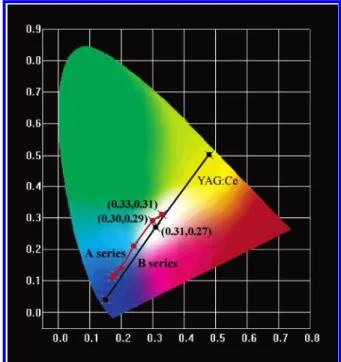
itself. The chromaticity coordinates for (Ca0.99-nEu0.01Mnn )-Al2Si2O8are represented as series A in Figure 11. We have
observed that the (x,y) coordinates vary systematically from (0.17, 0.11) to (0.33, 0.31), and corresponding hue of the samples varied gradually from blue, aqua, and eventually to white, as we vary the dopant contents of Mn2+ from n ) 0
to 0.25, as indicated in the chromaticity diagram. Further-more, to evaluate the potential of our tunable aluminosilicates as white-emitting phosphors, we have investigated and compared the chromaticity characteristics of the simulated white light generated from commercial YAG:Ce (Nichia Co., Japan) that was excited with monochromatic blue light of 467 nm with coordinates of (0.15, 0.04). As represented as series B in Figure 11, the experimentally determined chromaticity coordinates were found to be (0.48, 0.50) for YAG:Ce and (0.31, 0.27) for the simulated white light, the color saturation of which was found to be inferior to that generated from our phosphor. In practice, with increasing the amount of electrical current, the hue of a white-light LED changes from yellow to white and to blue. Therefore, the white-light LED of YAG:Ce excited by blue-light chip tends
to produce color aberration when the LED chip is degrading. In contrast, our CaAl2Si2O8:Eu2+,Mn2+ phosphors excited
with ultraviolet light will not have that problem because the excited light is invisible. The above observations hint the promising application of (Ca0.99-nEu0.01Mnn)Al2Si2O8phases
as a white-emitting phosphor for ultraviolet LEDs. 4. Conclusions
In summary, we have synthesized and investigated the luminescent properties of CaAl2Si2O8phosphors coactivated
with Eu2+ and Mn2+ under photoexcitation. The
spectro-scopic data indicate that the Eu2+
f Mn2+ energy transfer
process takes place in the host matrix of CaAl2Si2O8. The
energy transfer from Eu2+to Mn2+has found to occur via a
dipole-quadrupole mechanism. The critical energy transfer distance has also been calculated by the concentration quenching and spectral overlap methods. The results obtained from the two approaches are in good agreement. Furthermore, we have also demonstrated that the (Ca0.99-nEu0.01Mnn)Al2Si2O8
can be systematically tuned to generate white light under ultraviolet radiation and it has been shown to exhibit the potential to act as a white-emitting phosphor for ultraviolet LEDs.
Acknowledgment. We acknowledge generous financial support from the National Science Council of Taiwan, R.O.C. under contracts NSC92-2113-M009-019 and NSC93-2113-M009-009.
CM050638F Figure 10. Reflectance spectra for Eu2+- and Mn2+-activated and Eu2+/
Mn2+-coactivated CaAl
2Si2O8phosphors.
Table 1. Comparison of CIE Chromaticity Coordinates for (Ca0.99-nEu0.01Mnn)Al2Si2O8(λex) 354 nm) and Simulated White Light Using Commercial Y3Al5O12:Ce Phosphors (λex) 467 nm)
sample (x, y) n ) 0 (0.17, 0.11) n ) 0.05 (0.18, 0.12) n ) 0.10 (0.20, 0.14) n ) 0.15 (0.24, 0.21) n ) 0.20 (0.30, 0.29) n ) 0.25 (0.33, 0.31) simulated white light with Y3Al5O12:Ce (0.31, 0.27)
Figure 11. CIE chromaticity diagram for (Ca0.99-nEu0.01Mnn)Al2Si2O8 phosphors with different Mn2+dopant contents (λ
ex) 354 nm) (series A) and simulated white light generated with YAG:Ce (Nichia Co.) (λex) 467 nm) (series B).