國 立 交 通 大 學
應 用 藝 術 研 究 所
碩 士 論 文
探索永續設計中說服力的影響脈絡
Persuasion in Sustainable Design
研 究 生 吳佳欣
指導教授 鄧怡莘 博士
探索永續設計中說服力的影響脈絡
Persuasion in Sustainable Design
研 究 生 吳佳欣
Student: Chia-Hsin Wu
指導教授 鄧怡莘 博士
Advisor: Dr. Yi-Shin Deng Ph.D.
國 立 交 通 大 學
應 用 藝 術 研 究 所
碩 士 論 文
A Thesis
Submitted to Institute of Applied Arts
College of Humanities and Social Science
National Chiao Tung University
in Partial Fulfillment of the Requirements
For the Degree of Master of Arts in Design
May 2010
Hsinchu, Taiwan, Republic of China
摘 要
全球經濟的快速成長與科技的進步讓生活變得愈來愈方便,同時隨著世界人口的穩定爬升, 消費的日與遽增,然而,大眾需求被滿足的同時,卻也忽略了人和環境之間重要連結,而帶來了 浪費與資源短缺的情形。而這些環境問題到底不是明天就會發生在眼前也造成了消費者無關痛癢 之感。環境的破壞無一不由車輛、工廠等各類明顯或細微的人類活動所造成,即便是生活中購買 食材的習慣都高度相關。食物是生活中不可缺少的一環,而受現代科技所賜,進口食物比以前容 易的多了。「食物里程 (Food Mile)」的概念,指的是我們嘴巴和食物原產地之間的距離。里程高, 表示食物經過漫長的運送過程,一路上交通工具所消耗的汽油,和隨之而生的二氧化碳,破壞了 環境。 近年來,由於環保意識的抬頭,永續設計逐漸為人所重視且慢慢地成為一股未來趨勢。如何 在不可逆的消費型態下讓消費者重視並落實永續觀念則成為首要之務。然而,在設計師試圖以綠 色設計等各類手法來傳遞觀念並影響消費者行為的動機下,消費者如何被影響、又是什麼得以成 功影響等脈絡則為值得探索的領域。因此,本研究便以上述提及與日常生活最息息相關的一個活 動議題作為開端,試圖探索永續設計平台中說服力(勸誘)的影響脈絡。 本研究透過文獻探討,對現有說服力科技(勸誘科技)的相關研究做一深入瞭解,接著運用 理論框架中所選出的五類勸誘影響手法以及使用者為中心的設計方法為基礎,開展出一原型設計 (Mixed-fidelity Prototype),並將此原型作為研究工具,用以探查潛在消費者族群對於永續設計的 觀點。研究中透過受訪者訪談(In-depth Interview)與場域內情境式測試(In-situ Scenario-based user testing)作為資料蒐集的方法,並採用親和圖(Affinity Diagram)與(Means-end Chain)來將使用 者陳述做進一步歸納,整理出勸誘手法的影響層面及對永續觀念所產生的價值觀。 根據研究結果所統整出的三個影響面向以及十二條重要的價值觀,我們可以對於潛在使用者 面對勸誘式永續設計時被影響的脈絡有一全面性的瞭解。此外,本研究從了解受影響的動機與脈 絡做整合,進而提出七個正向與三個負向等十條相關的設計原則,為灌輸永續觀念的勸誘設計上, 提供更多具體的參考方向。關鍵字:
說服力科技、社會影響、行為改變、使用者中心設計、使用者經驗、食物里程、永續設計Keywords.
Persuasive Technology, Social Influence, Behaviour Change, User-Centered Design, User Experience, Food Mileage, Sustainable DesignAbstract
The global economy growth and advancements in novel technologies are rapidly changing our society and lifestyle. In the era of consumption, our demand of ever-growing consumption of goods can be readily sufficed. As the consumers’ need is satisfied, it brings the neglect of the awareness to the vital connections between us and the environmental issues, which are not an immediate urgency to be seen at present. Issues such as pollution and global warming are resulted from vehicles, factories to very subtle human activities; even our food purchasing habit in daily grocery shopping is highly influential. Food is indispensable for our lives. Modern technology had made food imports convenient and easy. The concept of “Food Mileage (Food mile)” is defined as the distance food travels from where it is grown to where it is ultimately purchased by the consumer - higher the food mileage, higher the fossil fuel consumption.
With the growing concerns in recent years, sustainable design has become critical and a future trend. It is a priority to make consumers keep this issue in mind and take eco-friendly actions under this irreversible circumstance. However, when designers attempt to express the right attitude and influence users with sustainable design, little has been discussed that how consumers were influenced and what is successful in changing their behaviours which are the areas worth exploring. Hence, start from this one of the most relative activities in daily life we intended to investigate the persuasion in service platform to change the behaviour for the better.
Through the literature review we have an overall understanding of the research domain on persuasive technology and the psychology of persuasion, and then five main approaches were selected according to the context as the testing fundamentals. On the basis of user-centred design method and persuasive technology framework, we have developed a mixed-fidelity prototype as a research tool to investigate the participants’ perspective on sustainable concept. From the in-depth interviews and the in-situ scenario-based user testing, users’ statements were coded by Affinity Diagram and Means-end Chain methods, three influential dimensions were summarised with a deep understanding of the twelve main values towards persuasive sustainable design.
With the findings we discovered the significant influential factors of sustainable design which mediate the user responses. Ten design guidelines (3 don'ts and 7 do's) for persuasive sustainable design were proposed. Furthermore, we foresee that these findings and a series of design principles can be referenced for future design/research regarding attitudes and behaviour change.
誌謝 Acknowledgements
過了這麼久,論文也該寫完了。 怎麼說,我其實是一個很不務正業的研究生,所以這兩年半來,第一個要感謝的就是鄧怡莘 老師,總是很因材施教並且給我最大的自由去做想做的事情。(雖然我也一直很不好意思沒有跟 到很多案子...老師以後有需要幫忙別客氣!)跟到鄧老是我念研究所最大的收穫,在學業上謝謝 老師總是在我們當局者迷的時候留點時間讓我們自己去思考,真的卡死了才告訴我們答案。在生 活、工作中很迷惘的時候,老師也是每一次都可以很神奇的用一句話就解開迷霧,比風靈珠還靈。 跑去老師家跟老師和師母聊天一直都是很棒的一件事情,希望畢業以後可以一直再去打擾,哈。 我從鄧老身上學到的不僅是真正的 User Experience,還了解到什麼是盡人事、聽天命的踏實。 As a researcher, 老師超有涵養的,也超酷的(膜拜)!再來也要謝謝莊明振老師和李峻德老師, 兩位老師很用心的幫我檢討論文,讓我看到很多沒有注意到的細節,也讓我再繼續琢磨了很多。 謝謝應用藝術研究所 IAA96 的同學,你們是集玩樂靠北與認真到破格於一身的一群最棒的夥 伴(太饒舌了)。謝謝你們在我碩一工作過頭的時候超有義氣的罩我,這個恩情我三十輩子也還 不完。謝謝同梯的秒咪,幫我在新竹一人跑兩人份的碩士口試申請還有離校手續,還有好多熬夜 的討論跟互相打氣,沒有你我大概真的畢不了業,嗚。謝謝芊芊來自日本的好多小禮物,我一定 會趕快把小鹿班比拼起來。謝謝我的新莊市好鄰居小嘉大車隊長達半年的接駁。謝謝溫芊芊跟阿 絲的噗浪尋夢園聊天室,這一整年網友可不是做假的。謝謝課長去年跟我一起拼命、給了很多意 見跟最後的叮嚀幫忙,雖然我半途陣亡延後了,可惜沒有機會跟你一起準備水果。謝謝陳姵常常 陪我聊天、爆八卦和加油,每次講完心情都會變很輕鬆。謝謝采芳、小志的口試順利小禮物、可 薰的加油噗、熊貓人、ㄆㄆ和課長的加油簡訊、還有口試前天+當天情義相挺的蚵腐珂莆、瑞大、 歐佩、阿給和放克腳(IAA96 就交給你收尾了)。嗯,我能夠畢業,真的全都是因為你們。另外也要謝謝拉拔我長大的 ASUS User Experience 辣薩 Team 的同事一路上的陪伴。還有尊 絕不凡台科大的老同學家毓、瑋華、小詩、Xocial 學長,你們在噗浪上的加油和吵鬧,都是我寫 論文不可缺少的零食。
Special thanks go to Roshan Peiris, who has been one of my strongest supports. Thank you for being so nice and tolerating my crankiness and whining when I was stressed out, and always encourage me and share the ups and downs whenever I needed. You are the most caring and patient person I have ever met. It means a lot to me.
My thanks go to Julia Howard, who proofread my 80+ pages thesis in a week, even though you were busy. You have made the sentences much more decent and readable – I really appreciate that.
I am also grateful of having been accompanied along my colleagues and friends in Cute Center & MXR Lab, NUS in Singapore. Thank you for your cheerful words and supports all the way this year.
最後要謝謝我的家人。謝謝爸爸、媽媽和妹妹一直以來都這麼相信我,並給我百分之兩百五 的支持。你們是我最強力的後盾,讓我知道我永遠都有個家可以隨時逃回來,所以才更能放心的 去衝。常常讓你們擔心我的生活作息,真是不好意思。還有謝謝軒豪哥、小金姐、蕙如姐、佳翰 跟佳霖精神上的支持! 兩年半,總算親身證實了一個論述「IAA 太棒了,我考一百次也要念這裡!(溫千慧,2010)」 謝謝謝謝,我準備畢業了。
Once again, my deepest gratitude to everyone, I could not have done it without you.
吳佳欣 Cathie, Chia-Hsin Wu 謹致 中國民國 99 年 4 月
目錄 Contents
摘 要 ...I Abstract ... II 誌謝 Acknowledgements ... III 目錄 Contents ... V Figures ... VIII Tables ... IX Charts ... X Chapter 11.1Background and Motivation ... 1
1.2Thesis Objectives ... 4
1.3Thesis Structure ... 5
1.4 Research Limitation ... 6
Chapter 2 2.1 The research scope of Persuasion... 7
2.2 Captology - Persuasive Technology ... 8
2.2.1 Computer as Persuasive Tools or Instruments ... 8
2.2.2 Computer as Persuasive Media ... 9
2.2.3 Computer as Social Actors ... 10
2.3 The Psychology of Persuasion ... 11
2.4 People, other people and the environment ... 13
2.5.1 Sustainable Design Case Study ... 16
Chapter 3 3.1 Prototype Development ... 20
3.1.1 Sustainability, Food Mileage, and Supermarkets ... 20
3.1.2 Research Subjects ... 21
3.1.3 Mixed-fidelity Prototype ... 24
3.2 In-situ Scenario-based User Testing & In-depth Interview ... 29
3.2.1 Testing Process ... 29
3.3 Debrief and Data Collating ... 30
3.4 Summary ... 31
Chapter 4 4.1 User profile ... 32
4.1.1 Demographic data of the participants ... 32
4.1.2 Attitude and knowledge towards sustainability and the grocery shopping behaviour ... 33
4.2 Data coding of the user testing & the in-depth interviews ... 34
4.2.1 Affinity Diagram (hereafter as A/D) ... 35
4.2.2 Attribute-Consequence-Value Model (hereafter as A-C-V Model) ... 38
4.3 Summary ... 43
Chapter 5 5.1 Similarity comparison with the Behavioural Chain ... 44
5.2 The Persuasive approaches and the corresponding responses ... 47
5.2.1 Users who like spark of freshness but dislike trouble ... 47
5.2.2 Cultivate trusts through learning ... 47
5.2.3 I have done something good! Reinforcement vs. Incentives ... 48
5.3 The Influential Factors among the Community ... 50
5.3.2 The sense of joint participation is necessary ... 51
5.4 Sustainable Design Implications ... 53
5.4.1 Avoid things which are not directly related to sustainability (Don’ts -1) ... 53
5.4.2 Avoid using social actors as “recommender” (Don’ts -2) ... 53
5.4.3 Focusing on “who is the participant” is less necessary (Don’ts -3)... 53
5.4.4 Designing for instant motivation (Do’s -1) ... 54
5.4.5 Designing new experience – what they are going to do (Do’s -2) ... 54
5.4.6 Designing trustworthiness (Do’s -3) ... 54
5.4.7 Designing to educate (Do’s -4) ... 55
5.4.8 Designing mutual influence (Do’s -5) ... 55
5.4.9 Design to encourage their behaviour – Incentives (Do’s -6) ... 55
5.4.10 Designing to make changes without changing lifestyle (Do’s -7) ... 56
Chapter 6 6.1 Achievements ... 57
6.2 Research Deficiencies ... 58
6.3 Outlook & Future Direction ... 58
References ... 59
Appendix ... 64
Appendix A. Interview script ... 64
Appendix B. Prototype images displayed in the user testing ... 66
Appendix C. Affinity Diagram ... 75
Figures
Figure 2-1 The Functional Triad of Persuasive Technology ... 8
Figure 2-2 Bandura’s Model of Triadic Reciprocility ... 14
Figure 2-3 4 Step Model ... 14
Figure 2-4 The Shift to Sustainable Design ... 15
Figure 2-5 Aimulet LA bamboo-made wireless speaker ... 16
Figure 2-6 Temppeliaukio Church, Finland ... 17
Figure 2-7 Shigeru Ban’s Squared Toilet Paper Roll ... 17
Figure 2-8. Piano Staircase (left) & The World's Deepest Bin (right) ... 18
Figure 2-9. Food Mileage Calculator developed by Daichio-Mamoru Kai, Co. ... 18
Tables
Table 1-1. Thesis Structure ... 6
Table 2-1. Primary Types of Social Cues ... 11
Table 3-1. The Three Main Personas ... 22
Table 3-2. The Prototype Design with the Corresponding Theories ... 24
Table 4-1. The Demographic Data of the Participants ... 32
Table 4-2. The Shopping Behaviour of the Participants ... 33
Table 4-3. The Participants’ Attitude & Knowledge Towards Sustainability ... 34
Table 4-4. The Affinity Diagram for the Sustainable Design Service ... 37
Charts
Chart 4-1. The A-C-V Model for the Design Elements as Persuasive Tools ... 38
Chart 4-2. The A-C-V Model for the Design Elements of Persuasive Media ... 39
Chart 4-3. The A-C-V Model for the Design Elements of Persuasive Social Actors ... 40
Chart 4-4. The A-C-V Model for the Design Elements of Social Proof Phenomenon ... 40
Chart 4-5. The A-C-V Model for the Design Elements of Reinforcement Concept ... 41
Chapter 1
Introduction
Everything that has ever happened in all of human history, has happened on that pixel. All the triumphs and all the tragedies, all the wars all the famines, all the major advances... it's our only home.
Al Gore. An Inconvenient Truth, 2006
1.1 Background and Motivation
Since the industrial revolution commenced from the textile factories in England, industrial society has thrived within the last two centuries. The global economic growth and advancements in novel technologies are rapidly changing our society and life to be significantly more convenient and less expensive, as well as the world’s population moving steadily up the ladder of mass consumption simultaneously brings the waste and the shortage of resources.
In the era of consumption, today’s lifestyle readily suffices the demand of ever-growing consumption of goods. While consumers’ satisfaction is measured only in terms of quantities of goods and services consumed, we lack the awareness to the vital connections between us and the environmental issues surround us. Clearly, the environmental implications of the global spread of mass consumption of resources use are staggering. The environmental problems regarding sustainability are indeed the major issue that the world is facing at present. Numerous global environmental implications have compelled us to examine the impact that humans have made on the earth. More than we could imagine, the severe problems such as pollution, ozone depletion and global warming are resulted from not only vehicles or factories but are also from very subtle and oblivious human activities- even our food purchasing habit in daily grocery shopping is highly influential.
Less than half a century ago, carriages or carrying by piggyback were used to transported goods to markets where the distance from the origin to the market was only about 20 kilometres. The advancements in international shipping and refrigeration techniques nowadays have transformed the transport of goods. The massive amounts of food import and export has become
a part of our life that we take for granted along with neglecting the environmental problems it could lead to. In 2005, 86.5% of total worldwide energy consumption was derived from the combustion of fossil fuels, which produce carbon dioxide (Statistical Review of World Energy, 2009). This has led to a significant increase in concern for environmental issues such as global warming, the greenhouse effect, energy use, etc during the past few decades (Pirog, 2004). Long distance food transportation is a major consumer of the fossil fuels, increasing greenhouse gas emissions, which contribute to global climate change.
As a threshold, in 2005, long-time vegetarians and environmentalists Alisa Smith and J.B. MacKinnon practiced a concept called “100 Mile Diet”. They decided to spend a year eating only food grown within a 100-mile radius of where they live after discovering that the food eaten by the average North American travels 1,500 gas-guzzling miles from farm to grocery stores. Thereafter, the concept of “Food Mileage (Food mile)” has become a practical awareness for public. “Food mileage” is defined as the distance food travels from where it is grown to where it is ultimately purchased by the consumer or end-user (Pirog, Pelt & Enshayan, 2001). The higher the food mileage, the higher the fossil fuel consumption, thus, in our day-to-day life, food mileage is one of the vital issues concerning environmental sustainability. Consumption, however, is a necessary evil and thus drives the capitalistic “need lifestyle” to acquire more and more stuff- all of which holds profound implications.
Food is indispensable to our lives. Due to modern technology, food can be even more easily imported than before. Statistics show that approximately 385,000 tons of vegetables, 567,000 tons of fruits and 1,590,000 tons of potatoes have been imported to Taiwan in 2006, which consumed considerable energy (Accounting and Statistics, Executive Yuan, Taiwan, 2000). The supply mode of hypermarkets in Taiwan is also traditional and fixed. Regional agricultural products must be transported either to northern, central, or southern distributors, and redistributed to the supermarkets in each region. Such repeated transportation modes do not only increase the pollution caused by the emission of exhaust fumes, but also reduce the quality and the freshness of food. Thus, under these irreversible circumstances, individuals must consider to take appropriate measures to make the best use of the resources effectively in order to reduce environmental destruction and reach the sustainable prosperity between mankind and the environment.
There is no doubt that individuals play an important role in the local environment. Yet it is likely for people to neglect the severity of environmental implications, as the consequences are not striking or closely related to our life. Situations such as the polar bears extinction due to the sea
level rise, or the ozone depletion resulted from over-using the air conditioning are not desperate enough because honestly, it does not harm us in the coming 30 years. On the other hand, even following the eco-instructions to take actions, for instance, to use less air conditioning, people still do not feel any good impact on the environment. Consequently, even though people have the eco-awareness in their mind, “eco-friendly” is still a beautiful slogan rather than an actual action that they will carry out every day.
Sustainable Design (Eco-Design or Green Design) originated due to the environmental and ecological consequences of modern technology in human society. It also represents the designers’ moral values and social responsibility. For a long time, commercialised industrial design has created a higher quality of lifestyle and a better living environment, as well as become a medium to encourage people’s uncontrolled consuming desires. Not until the rising attention on sustainable awareness in recent years designers cannot avoid the fact that industrial products accelerate the consumption of the resources and energy, which result in tremendous damage to the ecological balance of the earth - they have to face up to the problems and rethink the responsibilities and role of industrial design.
Victor Papanek emphasized designers’ social and ethical values. He addressed that the most valuable effects that design brings about is not creating commercial benefits or highlighting the competition in respect of packaging and design style, but instead an appropriate element in the social changing process, i.e. to deliberately consider the limited resources of the earth and to commit services with the environmental consciousness. Chapman and Gant also mentioned the subjective sense of sustainability in their book Designers, Visionaries and Other Stories- that the same as consumption, sustainability is an issue that should be viewed in both subjective and objective angles, otherwise the trend would be difficult to be well formed. Designers should rack their brains to implant their customers a proper sustainable idea, rather than solely promoting the value of the design itself. Hence, as a current design student and a designer to be in the future, we should not blindly follow the fashionable design style, beautiful shape or novel functions like we used to do.
Sustainability in design is an important trend for the near future; it not only concerns an element in the brand image, but also a social responsibility that designers have to take. We must think carefully, how to use the design contents to change and influence people’s fixed behaviour and lifestyle unobtrusively and imperceptibly under our current situation, in order to make people easily accept the eco-friendly concepts and carry them out in their daily life, in a natural way. Just as
the marketing tactics surround us, sustainable attitudes and actions are also things that need to be persuaded and promoted to ordinary people. Since designers attempt to change the behaviour for the better, it is important for them to adopt effective persuasive approaches in order to successfully mediate consumers’ acceptance.
1.2 Thesis Objectives
In the HCI (human-computer interaction) field, there have been studies regarding changing individual or public behaviour and attitudes through persuasive technology approaches. The overall objective of this thesis is to probe into the context of persuasive methods to influence users’ attitudes towards the sustainable concept. Our research focuses on observing the mental model change under the framework of getting involved in the eco-design and understanding that to what extent the persuasive design acts upon people’s mindsets. The research is conducted with User-Centred Design (UCD) approach ensuring that we build experiences and insights that are firmly rooted in the perspective of the user.
We expect to reveal different outcomes that different approaches bring about at the certain phases – that is, in the genre of the interaction design, in regarding calculating sustainable attitudes, which is the most effective? Which is the most acceptable? Which generates engagement? What mediates not only behaviour, but also the mindset? In addition, this dissertation aims at identifying the properties of sustainable design, which are capable of allowing individuals to easily be conscious of regarding the impact of their own behaviours, to raise the awareness of their surroundings and to effectively cultivate and urge people to practice those actions as well as affect others’ actions over time.
As a result, we believe that such a study may expand and improve the impressions towards sustainability, and hope to draw a conclusion to collect the design directions and principles regarding the susceptibility towards eco-design based on the findings in the research, which can be the reference for designers to facilitate the appropriate design in the future. The following list describes the general objectives of this thesis:
1.3 Thesis Structure
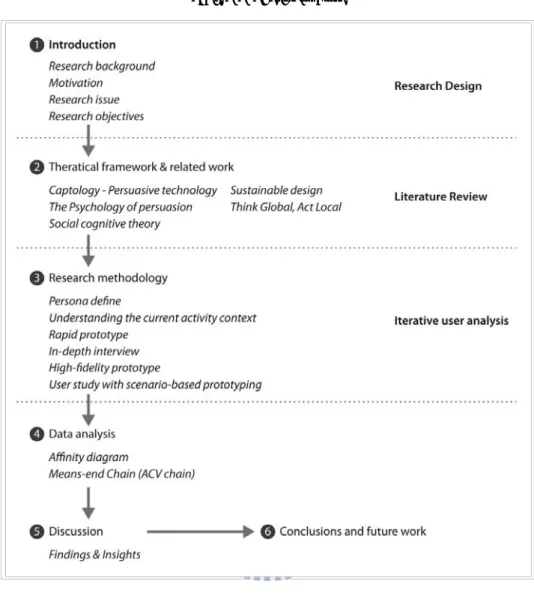
This thesis consists of six chapters. The remainder of the thesis is structured as follows (see Table 1-1).
This chapter introduced the research background and the motivation, the problems and challenges of sustainable design for influencing people’s behaviour and outlined the goals and contributions of this thesis.
Chapter 2 illustrates the scope of this research work and develops the theoretical and technical background. First, the theories central to persuasion techniques and behavioural changing are reviewed independently. Second, the sustainable designs relevant to localization are described. Chapter 3 describes the methodology of the user study and data collecting in qualitative research and analyzes this research in detail. The former study grounded is by the user-centred design method and elaborates the users, activities, context and information flow.
Chapter 4 presents the findings extracted and summed up from data coding.
Chapter 5 summarises insights in terms of persuasive design and delivers the implications and suggestions for influential sustainable design in the future.
Table 1-1. Thesis Structure
1.4 Research Limitation
Everyone in this planet is connected to the environmental protection, from individuals to government organisations, or enterprises in the industries are all responsible. In this study, we may only include the consumers (end-users) as our objects due to the research scope. Also, issues in sustainable design are various. In our study we chose food-mileage to be the design concept in our testing platform so as to link with our potential users’ daily activities.
Chapter 2
Theoretical background
2.1 The research scope of Persuasion
Every day we are confronted by persuasion. Food makers want the consumers to buy their newest products, while movie studios want them to go see the latest blockbusters – the persuasive outside source is such a pervasive component in our lives, and most of this persuasion is very subtle and naturally stimulates our hidden needs, wants and motivations for a better and more fulfilling existence.
The fundamental theory of this study is social science and psychology theories with respect to persuasive technology and the psychology of persuasion. “Persuasion is not simply the product or outcome of a message sent by a source to a receiver. It is a dynamic activity, a process in which both source and receiver, send and receive messages (Perloff, 1993).” Persuasion signifies changing others’ attitudes and behaviours with intent, as Perloff states that the act of “persuasion” must be an intentional act, include a message, and be accepted by free will (Perloff, 1993). Through different media, persuasive techniques attempt to influence one’s intentions, behaviours or the identity toward any issues or other people within the society. Former studies have discussed this theory involved in attitude influence, motivation, behaviour change, which is regularly used in marketing fields such as advertising, sales, diplomacy, politics, public health, and management. Cialdini also introduced the six principles of ethical persuasion, and how marketing tools work on the public with scientific and psychological foundations. With the boom in computing speed and the Internet, various forms of computer technologies have infused into our life. Interactive technology enables the possibilities for people to interact with the contents in digital media, and simultaneously generates the impact on people derived from interaction. Hence, Fogg pointed out that the cross over and the overlapping space between “persuasion in general” and “computing technology” and the studies in the field of “persuasive technology” have been broadly defined as a class of technologies or interactive computing systems that are designed to change attitudes or behaviours of the users in human-computer interaction (HCI) domain ever since (Fogg, 2003; Ijsselsteijn et al., 2006).
2.2 Captology - Persuasive Technology
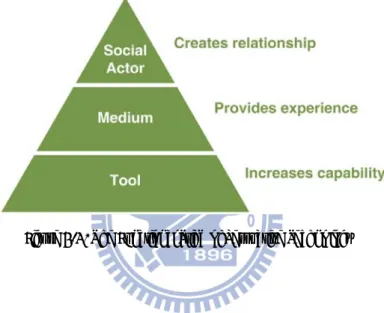
“Captology” is a new term coined by the psychologist BJ Fogg that refers to the study of computers as persuasive technologies and describes the overlap between persuasion and computers (Fogg, 1996). He founded the Persuasive Technology Lab at Stanford University and proposed the classification of three “basic ways that people view or respond to computing technologies” categorised by the dimensions of functional roles - as tools, media, and social actors - or as more than one role at once. (Figure 2-1)
Figure 2-1. The Functional Triad of Persuasive Technology
2.2.1 Computer as Persuasive Tools or Instruments
Most commonly used as a tool, the computer application provides people with new ability or power, allowing people to do things they could not do before, or to perform target behaviour much easier.
There are seven types of tools to increase capabilities (Fogg, 1998). “Reduction” urges people to be more willing to do something through simplifying the procedures, e.g. the “just one click” button on the webpage allows users to have maximum gains with minimum actions. “Tunnelling” guides users to accomplish a specific task via designated steps, e.g. an installation wizard provides clear steps for the whole process with intervening encouraging words to influence task completion. “Tailoring” prompt the action through customization, e.g. recommends certain items to specific type of users, which may make them feel that the information is customised for them. “Suggestion” provides the right information at a right timing, e.g. showing user’s driving
speed on the speed limit board in comparison to the current speed limit effectively tells them to drive safely. “Conditioning” reinforces behaviours with incentives. “Self-monitoring” and “Surveillance” influences people through the observation of others or themselves. In general, persuasive tools increases self-efficiency reduces barriers (time, effort, costs), provides information, advice for better decision-making and changes users’ mental models. An example of a product using the persuasive tool is the Polar Heart Rate Monitor - an exercise device that sounds an alarm when a person's heart rate falls outside a pre-set zone. The device not only can motivate a person to change behaviour during exercise, but it may also increase efficiency about one's ability to exercise effectively, thus increasing the likelihood of attaching it to an exercise program.
2.2.2 Computer as Persuasive Media
As a media, the computer provides first-hand learning, insight, visualization and promotes the understanding of cause/effect relationships and additionally motivates. Persuasive media can use both interactivity and narrative to create persuasive experiences that support formed behaviour, empathy, or the exploration of causal relationships (Fogg, 1998). Three types of persuasive media influence people by different dimensions. “Cause & Effect Stimulations” allow people to access non-available experiences or to be aware of the impact through how they act. For example, “floe” is an interactive website which intends to educate people about how powerful the daily carbon consumption can affect the earth. While users answer a few questions about their actions in current life, it shows a melting iceberg scene by gauging their current carbon consumption. In order to influence player attitudes they are shown the effect caused by the decisions they make during game play. “Environment Stimulations” uses external physical settings to influence people. For instance, some specific kinds of treadmills have a screen on them, where people can see the beach scene or tropical track while jogging as they are pedalling to explore the virtual environment as if you were on a journey. “Objects Simulations” expresses abstract ideas with concrete objects. It usually works effectively on tricky user groups to present ideas, which are difficult to persuade, such as using the Drunk Driving Simulator to allow people to experience how dangerous it is to drive while intoxicated. A computerized exhibit HIV Roulette at the San Francisco Exploratorium allows visitors to make hypothetical choices about sexual behaviour and then vicariously experience how those choices would affect their chances of contracting HIV. This exhibit attempts to motivate people to avoid unsafe sexual contacts. Overall, interactive technology provides experiences.
2.2.3 Computer as Social Actors
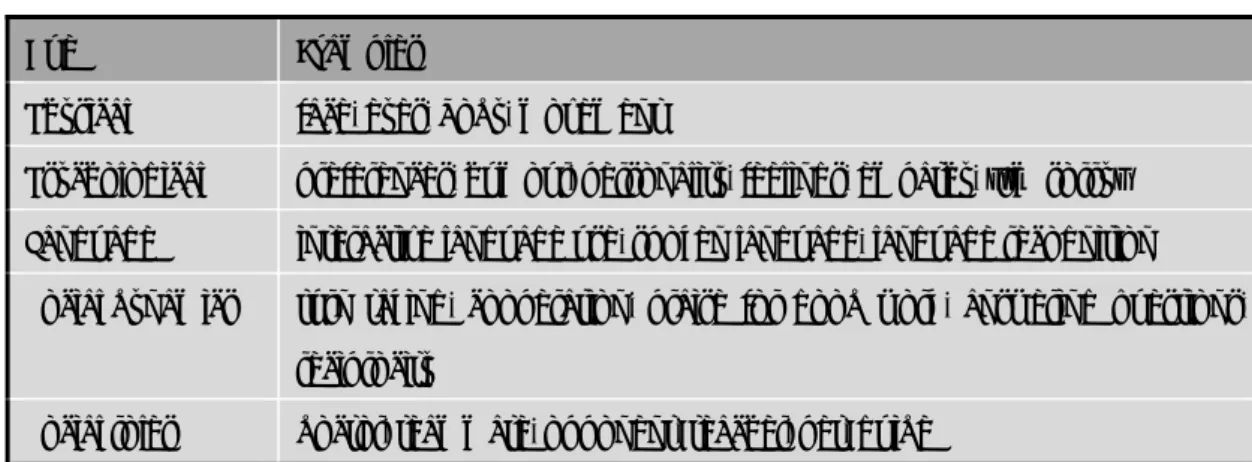
Technologies can also function as social actors to create relationships (Reeves & Nass, 1996). Users seem to respond to computers as social actors when computer technologies adopt animated characteristics (physical features, emotions, voice communication), play animated roles (coach, pet, assistant, opponent), or follow social rules or dynamics (greetings, apologies, turn taking). It establishes social norms; invokes social rules, dynamics, and expectations; provides social support to influence people via five types of social cues (Fogg, 1998). “Physical cues” are the representation of the object. Research confirms that a more attractive technology (interface or hardware) have greater persuasive power than an unattractive one (Berscheid & Walster, 1974; Chaiken, 1979). Besides, it is reasonable that attractiveness produces a “halo effect” which makes computing products physically attractive and more persuasive than unattractive ones. If an interface, device, or onscreen character is considered physically attractive, users may assume the product is also intelligent, capable, reliable, and credible (Dion, Bersheid & Walster, 1972).
“Psychological cues” can imply that the computing products have emotions and personality; it can be as simple as a text message on the website that conveys empathy by presenting “We’re sorry…” Or as complex as the Similarity Studies conducted in Stanford University which evidenced that in the Affiliation Study, participants who worked with a computer labelled as their “teammate” considered the computer to be smarter and more similar to them, and that it was friendlier and offered better information. They also were more likely to choose the solutions recommended by the teammate computers (Fogg, 1996). “Language cues” are also used to motivate users’ behaviour by expressing social presence. Common examples are those dialog boxes which carry spoken languages such as “Welcome!”, “Are you sure you want to cancel it?” “You’ve got a mail!” or congratulating sentences when you complete an installation task, thus to infer to users that the computer is animated in some way. One of the important rules with the potential persuasive power in “Social Dynamic” is reciprocity. This social rule states that after people receive a favour, they tend to pay it back in some way. Computer can also act as “Social Roles”. Such positions may make users feel more convinced and is more influential- for example, a doctor’s image for a tooth paste advertisement, in which a metaphor suggests the dentist to be authoritative and trustworthy; the help link on IKEA’s website “Asking Anna” represents a smart and helpful young lady - more persuasive than just saying “Contact” or “Assistant”.
Table 2-1. Primary Types of Social Cues Cue Examples
Physical face, eyes, body, movement
Psychological preferences, humour, personality, feelings, empathy, “I’m sorry” Language interactive language use, spoken language, language recognition Social dynamics turn taking, cooperation, praise for good work, answering questions,
reciprocity
Social roles doctor, teammate, opponent, teacher, pet, guide
2.3 The Psychology of Persuasion
Persuasion techniques have been studied and observed since ancient times, but social psychologists began formally studying these techniques early in the twentieth century. While there are numerous different persuasive technique, the majority fall within six basic categories according to Cialdini, termed “six weapons of influence” (Cialdini, 2003). Each of these categories is governed by a fundamental psychological principle that directs human behaviour and, in so doing, gives the tactics their power. These tactics include Reciprocation, Commitment and Consistency, Social Proof, Authority, Liking, and Scarcity.
Reciprocation is one of the most significant behaviours in our interpersonal relationship. In general, an individual has to return the favour others have given to them (Gouldner, 1975). Thus in marketing, there is pervasiveness of free sample offerings. This has not only helped maintain the fairness of the social exchange between two parties, but also has become an approach used to influence others. Another study concerns how to affect people, making them take on another’s philosophy. Studies have investigated the environment and strategies that could yield to compliance. It is argued that the skills used to make others more compliant have something to do with our understanding of others, our own social status, and the nature of requests (Feningstein, Scheier & Buss, 1975). Associated factors include: a more likelihood to be compliant in good moods (Isen, 1983), when reciprocity occurs and when given an acceptable reason or cause (Regan, 1979). In public kindness experiments (Fehr & Gächter, 2000), it has also been demonstrated that the potential for reciprocal actions by participants increases the rate of contribution to the public good, providing evidence for the importance of reciprocity in social situations.
Commitment and Consistency describes that once people commit to an idea or goal, they are more likely to honour that commitment, even if the original incentive or motivation is removed after they have already agreed. Cialdini often takes the car sale for example, that suddenly raising the price at the last moment works because the buyer has already decided to buy. While within Social Proof, people tend to do things that they see other people are doing, and believe what other people identify with. It is also called Informational Social Influence. This effect/phenomenon occurs in ambiguous social situations when people are unable to determine the appropriate mode of behaviour. Making the assumption that surrounding people possess more knowledge about the situation, they will deem the behaviour of others as appropriate or better informed. A famous experiment (Milgram, Bickman & Berkowitz, 1969) shows the power of social influence that the experimenters placed groups of people on a street corner looking up at the sky and only 15 gawkers made 45% of bystanders also look up. Asch’s conformity experiments (Asch, 1951) also demonstrated the conformity phenomenon in groups. In the experiments, students were told that they were participating in a “vision test”. Unbeknownst to the subject, the other participants in the experiment were all confederates, or assistants of the experimenter. At first, the confederates answered the questions correctly, but eventually began providing incorrect answers. Nearly 75 percent of the participants went along with the rest of the group at least one time, even the answer was obvious wrong. Authority is that people tend to obey authority figures, even if they are asked to perform objectionable acts. Such as the Milgram experiments in the early 1960s, where he developed an intimidating shock generator with many switches labelled with terms including “slight shock,” “moderate shock” and “danger: severe shock” (Milgram, 1963). Participants took the role of “teacher” to deliver a shock to the “student” (experimenter’s confederate) every time an incorrect answer was produced. The result shows that 65% of the participants in the study delivered the maximum shocks under the instructions, even seeing their “students” acting painful or complaining about their heart condition. In the market, for instance Michael Jordan as an endorsement for sports products or a person in doctor outfit as a recommender for medical products advertisement usually brings high commercial effects. Liking shows that people are easily persuaded by other people that they like. The last, perceived, Scarcity, may generate demand. For example, “limited edition” or “offers this month only” usually encourages sales.
In our study, the context that we intend to investigate is where activities take place in public, hence, we chose Social Proof phenomenon as one of the persuasive design approaches to examine users’ responses toward sustainability.
2.4 People, other people and the environment
Aside from the conformity, compliance and obedience among the above mentioned Social Influence Theories, in terms of influencing by the external surroundings, earlier studies such as Social Learning Studies (Miller & Dollard, 1941) had argued that people perform much learning by watching and copying other people. Miller and Dollard claim that humans have acquired certain behaviours through observation. By imitating the observed behaviours, the observers would fossilize the acquired behaviours and obtain positive reinforcement (Miller & Dollard, 1941). The studies regarding observational learning and vicarious reinforcement have been further expanded and theorized by Bandura and Walters (Bandura, 1977) called Social Learning Theory (SLT). Meanwhile the term “self-efficacy” has been addressed to emphasize the capability of performing certain behaviours, in other words, when one’s own behaviour is rewarded, self motivations and positive feedbacks would then be activated, resulting in the reinforcements of the attitude.
The theory explains how behaviour is transmitted from one person to another; however, it neglects the impact of human intrinsic cognitive abilities. Regarding the oversimplification of the learning and influencing process- Bandura thereafter continued and built up the studies on the basis of SLT, and developed Social Cognitive Theory (SCT; Bandura, 2001). Under this framework he believes that how people motivate and regulate their behaviour is a process of constant interaction between individuals and their unique social environment. People absorb knowledge directly from social interaction as well as the experiences, and they are viewed as self-organizing, proactive, self-reflecting and self-regulating rather than as reactive organisms shaped and shepherded by environmental forces or driven by concealed inner impulses. From this theoretical perspective, human functioning is viewed as the product of a dynamic interplay of personal, behavioural, and environmental influences (Figure 2-2, Bandura, 1977, 1986).
Furthermore, it is also suggested that there is an inseparable identification between the observers and the pattern, claiming that learning would be more likely acquired when the observers could also well handle their self-efficiency (Bandura, 1977). Based on this theory, we intend to observe the pattern of how users interact with others and the external environments.
Figure 2-2. Bandura’s Model of Triadic Reciprocility
2.5 Sustainable Design
Green design originated in the 1960's and it was first proposed in the book Design for the Real World (Papanek, 1971). The book emphasizes that use of the earth’s limited resources should be a great concern in design, and the environment should be protected. With the development of technology and growth of material and spiritual civilization, human beings have been aware of deteriorating surroundings, gradual depletion of available resources and serious constraint of further economic advance. These problems have a direct impact on the progress of civilization and sustainable strategies thus far outlined. In the late 1980's, the new wave of “green consumption” swept the U.S. and later on the whole world. Green refrigerators, environmental-friendly colour televisions and green computers, etc. have been booming on the market. Many consumers have progressively advocated green products. Green design turned into a hotspot issue in modern design technology in the 1990s.
Figure 2-3. 4 Step Model
Personal (cognitive, affective) Behaviour Environment (social, physical) Triadic Reciprocal
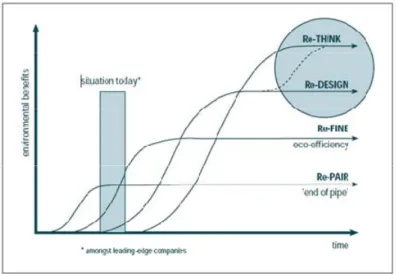
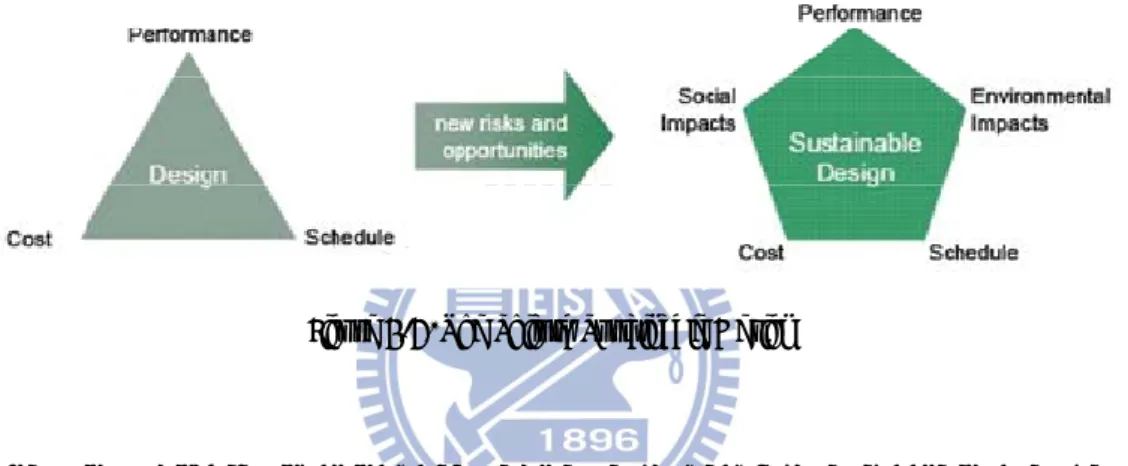
Green design is also called ecological design, design for environment or environment conscious design. Its principles are what have been generally acknowledged as the 3R rule - reduce, reuse and recycle – with the aim to reduce pollution, to reduce fuel consumption, and to recycle or to reuse products and components. It's been spread throughout all over the world since the campaign of 3R's was conducted in the 1970s. “Refuse” and “repair” were thereafter included in 5R's but as far as the current situation is concerned, this concept is no longer flawless. Sustainability will not stay in the level of eco-efficiency1 but achieve the grander scale of eco-effective sustainable life2 (See Figure 2-3.) and traditional viewpoints on design will be perfectly adapted into the perspective on sustainability. (See Figure 2-4.)
Figure 2-4. The Shift to Sustainable Design
“Localness” in sustainability, including politics, is an issue that people have recognized over the years. Mankind takes up efforts to harmonize human systems and industries with their surroundings, to tie local materials to energy flows and to link the local customs, needs and likes, including both the molecular level and the regional level (McDonough & Braungart, 2002). As far as sustainability and effective use of the environment are concerned, no matter whether an item, an interface, a system or service is designed, all utilized and consumed are not supposed to be the resources on the earth but in the region. Locality of sustainability is not constrained to material access but starts from there. It is similar to the concept of “Think Global, Act Local,” which is based on local cultural, historical, technical and natural resources, etc. to enhance sustainable experience sharing and interaction of local livelihood, productivity, ecology and life through discovery and flexible use of resources; even disposal should be handled and sustained by the local environment. This may
1 High efficiency of environmentally-friendly utilization, which is similar to the thought of “re-fine” but
it is just damage reduction in order to seek “value increase” and “lower cost”
establish a sustainable circulation system of locality and each system is supposed to interact with each other. Interactive and mutual benefits among diversified sustainable systems is the point that keeps the influence of sustainability going on.
2.5.1 Sustainable Design Case Study
Over the past decade, many designers and researchers have been working on this prominent issue to put their new skills, experiences and knowledge into practice with the theme being “Think Global, Act Local”. The aim was either to design products or conduct research projects that benefited and enhanced local conservation efforts or intended to raise the consciousness of sustainability. In SmartTrip, a small gadget used in mobile devices was developed, which adopts a simple method to combine multiple trips of transfer to a single route. It aims to lessen the conditions in which people may refuse carpool or take mass transportation services and thus use cars (Johnson et al., 2008). GreenScanner is a mobile device that allows shoppers to examine the effect of the goods on the environment in the store (Tomlinson, 2008). The following are the design cases and research issues concerning sustainable design.
Design Case 1. Aimulet LA – bamboo wireless speaker
The design is one of the winning products of Ecology Design Prize in Japan's Good Design Award 2006. It is a sound communication device of which cover is made of the green material – bamboo – and it is an amplifier to transmit sounds by infrared light without batteries. On the side of the device is a row of spherical solar cells, which can receive signals sent out from the LED floor, and transmit them into the small amplifiers inside. The design can be applied in public places such as museums.
Design Case 2. Finland Temppeliaukio Church
Originally named Temppeliaukio Church, Rock Church in Finland was built in 1969 by architects Timo (1928- ) and Tuomo (1931-88) Suomalainen who utilized a vast rocky highland located in a residential street. In order not to damage the natural landscape, the rock was excavated downwards, where the ingenious design of the church lies. In the initial design, their idea was to retain the original characteristics of the region and on the basis of not changing the surroundings of the rock, so the element of the church was natively added. Besides, the natural scenery of the rock cave provides the musical echoes that the church needs.
Figure 2-6. Temppeliaukio Church, Finland
Design Case 3. Shigeru Ban’s Squared Toilet Paper Roll
Architect Shigeru Ban also turned his attention to re-conceptualizing the roll itself in a 2000 exhibition called Re-Design: Daily Products of the 21st Century. This design took the behaviour as a cue to imply the awareness of resource use. Ban heightened consciousness of use by reducing the amount of paper that rolls off the tube by making it square instead of round, a tug is met with resistance as the roll’s squared corner encounters the edge of the metal dispenser, so that what you take is what you really need.
Design Case 4. The Fun Theory
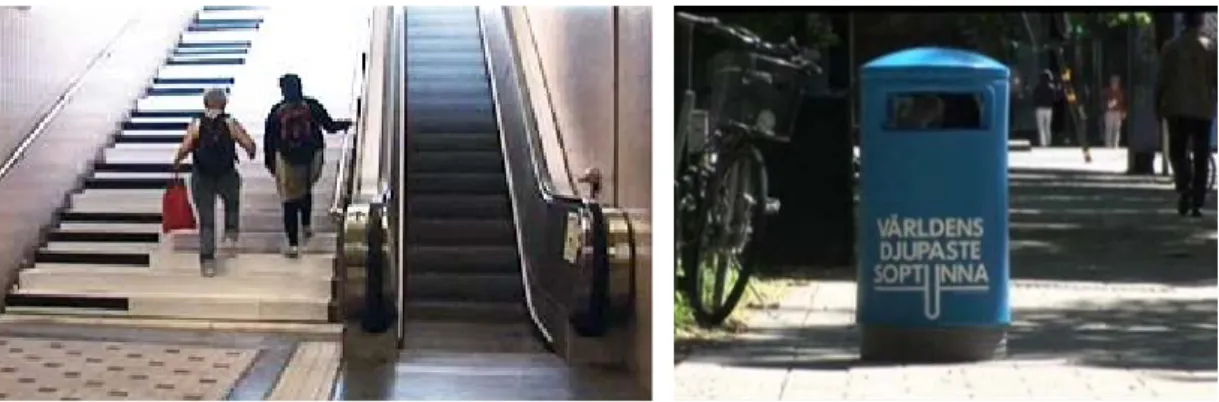
The Fun Theory campaign sponsored by Volkswagen (Sweden) has very clear goal in interaction design that is aiming to change people’s behaviour for the better. Their projects Piano Staircase and The World’s Deepest Bin show the significant effects of influencing people’s fixed behaviours by the idea of making ordinary things more FUN.
Figure 2-8. Piano Staircase (left) & The World's Deepest Bin (right), (2009)
Design Case 5. Food Mileage Calculator
Not only the design field, a Japanese healthy agriculture company Daichio-Mamoru Kai (大地 を守る会, The Association to Preserve the Earth) has also developed a Food Mileage Calculator website with the care of our environment. They invited grocery shops and supermarkets to input the mileage of their products so that by the original source and the weight, users can see the comparison of the CO2 consumption caused by the mode/ distance of transportation.
As referred to the above case studies, numerous studies have explored the possibility of facilitating design platform on influencing people’s behaviour or attitude for sustainable purposes. Yet, little has been widely discussed upon the value, appeal and leverage caused and generated in user experience design fields.
Based on the literature review and case study in this chapter, we had an initial understanding of the recent studies of persuasive technology and social influence theory, as well as the design with intention of changing behaviour and encouraging people to facilitate the environment in a friendly way. In the following chapters, through the user study will investigate susceptibility regarding the persuasive approaches towards sustainable design.
Chapter 3
Methodology
The objective of this study is to explore users’ contextual response to the persuasive and influential factors of sustainable design. The targeted subject is career mother aged 30 to 50. According to the result of the pre-study interview, their concept of sustainable design can be categorised as “willingness to practice but having the lack of a right platform for them to easily work with”. Because they have a motive for “being recruited” (the preliminary study of users recruited is detailed in chapter 3.1.2), they are selected as subjects in this study to investigate their responses to any kind of inductive method. A mixed-fidelity prototype was developed in this research and with the scenario-based method as described in 3.1.3. The in-situ prototyping testing and in-depth interviews were conducted in selected community-based supermarkets near residential areas. In the end, the results obtained of the effected the aspect of this group were analyzed and the objective of this study was achieved. Each step of the detailed research method is elaborated in this chapter.
3.1 Prototype Development
3.1.1 Sustainability, Food Mileage, and Supermarkets
Environmental issues related with sustainability in daily life are extensive, including the greenhouse effect, global warming, sea-level rising, ozone depletion and all kinds of pollutions. These consequences arise from different patterns of human behaviours, the high-level ones of which are plant operation, deforestation or abandoned motor vehicles and the low-level ones of which are unclassified garbage, overuse of air conditioners, or even excessive purchase of imported foodstuffs of high food mileage. The concept of food mileage was summarized in Chapter 1 and was brought in as the concept for the research tool in this study owing to its characteristic of close-relation and importance to our daily life. The influenced aspects of the public to green design were discussed in the platform use focusing on the issue of food mileage.
Moreover, supermarkets were chosen as the context for conducting the in-situ user testing because it is where the food purchasing (high and low food mileage included) behaviour usually happens.
3.1.2 Research Subjects
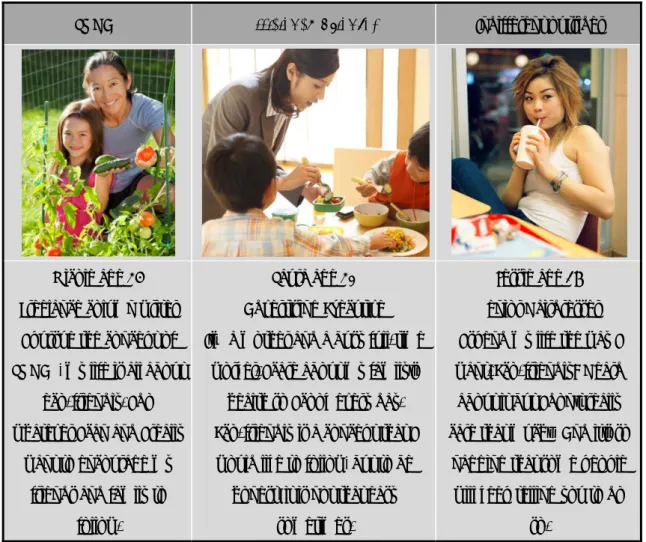
People have different levels of sustainable attitude. In order to understand the potential target user more deeply, we adopted persona - a user-centred approach to create a personality profile during the preliminary study process. As we set up the research direction, well-crafted personas helped us have a clearer understanding of the probable research subjects’ characteristics, thus allowing the research direction to be more accurate. 11 individuals were interviewed at this stage regarding their exposure and value towards sustainable concepts. According to the engagement levels of the value and the attitude toward sustainability, the user groups are classified into three types: the LOHAS3, the Efficiency-oriented, and the Indifferent outsider.
The LOHAS type is a believer of the eco-friendly concept. They are highly aware of it and take practical actions in their everyday life. They do not need other people to teach them how to facilitate; instead they educate their friends, family around them. The Efficiency-oriented type has a basic sense of sustainable knowledge and considers it to be an important issue. However, considering their pragmatic nature, they usually do not do it often, due to a lack of time, and they actually do not know the effective approach to facilitate. The Indifferent outsider type does not care about this issue too much. They are aware of the concept because of the media but they are not interested in caring environment and even tend to avoid it. (See Table 3-1.) In this study, Efficiency-oriented type of users is the potential users that we are interested in exploring so they were chose as our primary user group to participate in the user testing.
Table 3-1. The Three Main Personas
LOHAS Efficiency-oriented Indifferent outsider
Nicole age 35 Freelance column writer
I pursue the concept of LOHAS, my life is all about
eco-friendly. I do whatever I can and I really
want to encourage my friends and family to
follow.
Laura age 31 Advertising Executive I’m a mother and a busy full-time
worker. I care about my family’s health so I cook every day. Eco-friendly is a concept that I
would like to follow, but to be honest, it is not that easy
sometimes.
Jessie age 27 Senior Hairdresser I spend my life the way I want. Eco-friendly? Heard
about it but I don’t really care that much… And it’s so
nagging that some people will keep telling you to do
so.
Through the interviews and observations, we were able to identify the primary user group – working mother – adult female who has a stable job and whose youngest child is under 18. Statistics in a survey of labour participation and status of Taiwanese women that Taipei Association of Wage Earners published in the end of 2000 shows that more than 50% of women aged between 20 and 65 in the society have stable full-time jobs and more than 49.7% of them are working mothers. The role this type of woman plays is not only a busy full-time worker but also a housewife who shoulders two major responsibilities of the workplace and the family. According to the most prominent issues depicted within the primary personas, we were able to understand their characteristics, these users have to take care of both work and family so their life is usually hectic but in order to take care of their family's health, they still cook to prepare food. They don't have much time strolling in supermarkets after work during weekdays or on weekends and their concept of environmental protection is mostly based on rather traditional ones such as “less
driving”, “less use of plastic bags”, “less use of air conditioners” or “resource recycling”. More importantly, they consider environmental protection really essential but do not actually put it into practice at usual due to the following two points:
1. Fossilized lifestyle
It is regarded that environmental protection takes extra time and it is not easy to fully put into effect (e.g. it is impossible to turn on the air conditioner less frequently and it is sometimes troublesome to do resource recycling), and the concept of sustainability is at times far-fetched in daily life (e.g. sea-level rising seems to have nothing to do with me).
The lifestyles and concepts formed throughout the years of accumulation are difficult to change. Habits such as diet, daily schedule, consumption, sports and recreation, could easily become fossilized. Behind all these selfish personal behaviours generally lie the concerns for the future of the individuals as well as the earth and environment. The fossilization of individual concepts and values could make it challenging for individuals to conceive the sustainable concept, which may further cause the rest of living environment be left to gradually disappear. Moreover, in today’s society, people often concentrate merely on their own tiny space, so they may fail to detect their fossilized incorrect sustainable concepts, as well as their selfishness and ignorance.
2. Difficulty in implementing sustainable actions:
It is regarded incomprehensive how environmental protection is implemented and if there will be an effect after it is practiced, and the concept of “Low Food Mile” and “Local Production for Local Consumption” is currently still an unfamiliar and new field to Taiwanese people. Even though it has been introduced and carried out for years in North America or European countries, most people still have sustainable awareness in a traditional way. Most consumers do not understand today’s highly complex global food system. Much of the food production and processing occurs far away from where they are consumed (Pirog, 2004). However, it has become customary that people buy imported goods from overseas in supermarkets for daily consumption. Even if some people are concerned about the environment, there is no a complete service platform for facilitating environmental protection and sustainability on grocery shopping and home cooking.
3.1.3 Mixed-fidelity Prototype
Based on the literature reviews, research domain on persuasive technology and the psychology of persuasion, and then five main approaches were selected according to the context as the testing fundamentals. On the basis of user-centred design method and persuasive technology framework, a mixed-fidelity prototyping system “SuperEco” was developed as a research tool in our study. Catering the supermarket customers, SuperEco is an eco-design based, on-screen platform that is attached on the shopping cart and encourages users to purchase low food mile products, as well as influences people’s attitude towards sustainability. The design approaches were extracted from the insight of the literature review - the Persuasive Technology, the Psychology of Persuasion and the Social Cognitive Theory. Detailed approaches of in the prototype are listed as Table 3-2.
Table 3-2. The Prototype Design with the Corresponding Theories Function Essence Design Contents
Persuasive technology as tool/instrument
increases capabilities
Dynamic map showing the low food mile zone
Recipes (of low food mile ingredients) provided in the low food mile dish
Persuasive technology as medium
provides experiences
Seeing SuperEco shopping bags in different colours
Showing traceability information
Low food mile dishes tryout area Persuasive technology as social actor creates relationships SuperEco avatar
Promoted by a middle-aged woman
Social proof do things that they see other people are doing
Recommending purchasing
Other people using SuperEco shopping bags
Showing the numbers of the participants
Numbers of the amount of people who have bought this item
Reinforcement from [SCT]
Reward one’s behaviour
Discount (if bought the low food mile products)
Experience point
SuperEco avatar’s compliment
3.2 In-situ Scenario-based User Testing & In-depth Interview
After the prototype of persuasive technology framework is established, eight working mothers aged above 30 and below 50 were recruited in the user testing. Participants must have the habit, which has lasted for more than three years, of regular foodstuff purchasing in the community-based supermarket and “in-situ scenario based user testing” adopted in this study had users simulate the scenario directly in the context.
The testing result is the solid basis of analysis and discussion. Besides, to better understand the interaction between users and the persuasive platform, the in-depth interview was adopted in this stage of user study in hopes of an overall understanding of the contextual influence on this group's conception and behaviour. “Semi-structured interview” – pre-prepared scripts – of the in-depth interview was adopted in the whole process in order to maintain the progress and the direction of the interview as well as to modestly adjust to the actual situation. The whole interview was recorded for data debrief and analysis.
3.2.1 Testing Process
The testing was carried out in a community-based supermarket Wellcome. The interviews were conducted according to the process and were audio-recorded. The numbers of the participants were 8 female, targeted users aged between 30 and 50 living near the supermarket. The testing time was about 50 minutes to an hour and NTD$200 cash was given as the reward for each person. The participants were also told to respond to questions by as much how they usually feel shopping in the supermarket as possible. Procedures of the testing are listed as follows:
First, the basic information about the participants and about their activities in foodstuff purchasing were collected, which were used to find out their pattern, frequency and familiarity with purchasing foodstuffs in the context.
After that, in order to guide the participants into the context of the platform use, a scenario was given in the first place: “Today, as usual you go out for foodstuff purchasing to prepare dinner. You noticed a green sign of a newly-open supermarket near the one you usually go to, so you decided to take a look...” Then, the testing session started as the participants were asked to get a trolley in which the prototype was placed onto. The images shown in the prototype are used to demonstrate this
sustainable platform in the context.
In the user testing, the researcher displayed the design of the prototype and at times induced the users to simulate how they themselves feel with scenario-based discourses according to each persuasive sustainable design, for example “When passing the entrance, you noticed everyone carrying a special purchase bag...” and “When coming to the vegetable rack, you saw this kind of sticker on the package of vegetables...”. Meanwhile, questions about the concept of sustainability were brought up
such as “How do you feel about the way environmental protection is promoted?” In this phase, understanding the different extent of the user's positive and negative responses to each persuasive sustainable design is the focus to be aimed.
Finally, the users were asked to explain their motives and reasons based on the different extent to positive and negative responses, so as to have a deep understanding of the whole persuasive context.
3.3 Debrief and Data Collating
Subsequently, the participants’ ideas and their influenced aspects of each persuasive approach were sought out from the recordings of the interview and transferred into accounts which were itemized, assorted by similarities of characteristics and summarized by two methodologies - Affinity Diagram and Means-end Chain Theory. The expected analysis result of these two work modules is as the following:
Affinity Diagram: this diagram is mainly used to discuss the effected factors and the context influenced in the interacting process. By sorting the large clusters into subgroups, we can capture different aspects of the factors that are influential to the users.
Means-end Chain (MECs): this diagram is primarily used to understand user’s perceptual orientation towards sustainable design under persuasive design. It is also used to explain psychological values that the design approaches can respectively lead to. With this method we can build up the Attribute-Consequence-Value Model by hierarchical value matrix to illustrate the relations between the design attributes and users’ value, as well as to understand the elements that the users respect the most.
3.4 Summary
The users’ acceptance and influenced characteristics upon against the method of persuasive sustainable design were identified after Affinity Diagram and Attribute-Consequence-Value Model were established through the qualitative interviews and then analyzed.
Chapter 4
Results
In this chapter we will present the data analysis. The transcripts were read once through to get a general feeling of the participants’ experiences. Thereafter, the Affinity Diagram (AD) and Attribute-Consequence-Value Model (A-C-V Model) methodologies were undertaken as the process of coding whereby the data was coded line by line into a statement and was transformed into diagrams.
4.1 User profile
In this section we will present the user profile that we set for the participant recruitment in the user testing. The demographic data of the participants, their attitude and knowledge towards sustainability and grocery shopping behaviours are described as follows:
4.1.1 Demographic data of the participants
In our study, we recruited the “working mother” type of users (refer to 3.2 Personas), aged 30 to 50, who have had a grocery shopping habit for more than three years. Eight participants in total were included in the study, which took placed on 19th and 22nd of May, and 1st of June in 2009. The demographic data of the participants are summarised as Table 4-1.
Table 4-1. The Demographic Data of the Participants
SN. Gender Age Occupation Locale of Grocery Shopping Duration
U01 F 50 Teacher Supermarket
(Giant, Costco & Wellcome)
10 yrs
U02 F 43 Teacher Supermarket (Wellcome) 7 yrs
U03 F 43 Nurse Supermarket (Wellcome) 8 yrs
U04 F 37 Admin-staff Supermarket (Wellcome) 6 yrs
(Wellcome & Costco)
U06 F 45 Medical Specialist Supermarket (MATSUSEI) 9 yrs U07 F 33 Marketing Assistant Supermarket
(Wellcome & Costco)
4 yrs
U08 F 41 Accountant Supermarket (Giant) 7 yrs
4.1.2 Attitude and knowledge towards sustainability and the grocery shopping behaviour
Participants’ knowledge towards sustainability and their shopping behaviour vary to some extent, although there are some similarities. It can be seen in the interviews that due to their busyness, anything of a time-consuming matter is more likely to discourage action. They tend to be more efficiency-oriented, for instance, they usually do not spend a lot of time strolling in the supermarkets. Yet almost every participant has held quite positive attitude towards sustainability (they are very willing to facilitate) but they seek to do it more conveniently. The detailed statements are organised as follows:
Table 4-2. The Shopping Behaviour of the Participants
SN. Freq. Dwell Time Shopping Behaviour
U01 1/week Approx.1 hr Brings along a shopping list; goes directly to find the products first, then see if there is anything else to buy. Likes to visit the tryout area to see if there is anything new.
U02 1-2/week Approx.1 hr Brings along a shopping list; finds the products she wants first, checks other stuffs on the way too. U03 1/week Approx.1 hr Bring along a shopping list; gets the stuffs for a
whole week but only buys what is needed.
U04 2/week Approx. 30 min Thinking what to buy on the way, goes directly to find the products.
U05 1-2/week Approx. 30-40 min Usually tries to get the stuff as soon as possible. Usually just shops in foodstuffs area but will check if it has any credit (CAS mark). Brings the daughter