COL 12(11), 110607(2014) CHINESE OPTICS LETTERS November 10, 2014
1671-7694/2014/110607(5) 110607-1 © 2014 Chinese Optics Letters
Channel drop filter (CDF) is a communication component in which the optical signal is fed into one of the input ports and then the signal passes through the wavelength multiplexer of the CDF and finally emits at output port with almost no disturbance[1–3]. The CDF is composed of three parts: resonator system, bus waveguide, and drop waveguide. The incident electromagnetic wave propa-gates along the bus waveguide and certain frequencies will be dropped by resonator system to drop waveguide. The most common resonator system generally has a rectangle[4], ring, and disc resonator. In optical commu-nication system, the CDF is useful and essential for tri-plexer filter. The three commonly used wavelengths are 1310, 1490, and 1550 nm, defined by ITU-T G.983 stan-dard. Triplexer filter is widely used in fiber-to-the-home (FTTH) system, where 1310 nm channel is used for uploading data, 1490 nm channel is used for download-ing data and voice, and 1550 nm channel is used for re-ceiving video, respectively. Recently, many researchers have proposed surface plasmonic waveguide structures to design optical triplexers. The metal–insulator– metal (MIM) plasmonic structure consists of a dielectric waveguide and two metallic claddings, which strong-ly confine the incident light in the insulator region[5]. Some devices based on the MIM plasmonic waveguides have been studied numerically and experimentally, for example, the filters based on ring resonators[6], nano-cavity resonators[7,8], tooth-shaped plasmonic wave-guide filters[9–12], nanodisc resonators[13], and Y-shaped combiners[14]. Recently, Liu et al. proposed the plas-monic nanocavities and plasplas-monic arrays for promis-ing applications in highly integrated optoelectronic devices, such as plasmonic biosensors, filters, and electro conductors[15–18]. Wang et al. proposed tun-able multi-channel wavelength demultiplexer (WDM) based on MIM plasmonic nanodisc resonators at
New design of triplexer based on
metal–insulator–metal plasmonic ring resonators
Yaw-Dong Wu (吳曜東)
Electronic Engineering of National Kaohsiung University of Applied Sciences, Kaohsiung 807, China
Corresponding author: [email protected]
Received August 27, 2014; accepted September 11, 2014; posted online October 28, 2014 In this work, we propose a new design of all-optical triplexer based on of metal–insulator–metal (MIM) plasmonic waveguide structures and ring resonators. By adjusting the radii of ring resonators and the gap distance, certain wavelengths can be filtered out and the crosstalk of each channel can also be reduced. The numerical results show that the proposed MIM plasmonic waveguide structure can really function as an optical triplexer with respect to the three wavelengths, that is, 1310, 1490, and 1550 nm, respectively. It can be widely used as the fiber access network element for multiplexer–demultiplexer wavelength selective in fiber-to-the-home communication systems with transmission efficiency higher than 90%. It can also be a potential key component in the applications of the biosensing systems.
OCIS codes: 060.1810, 130.7408, 130.3120, 230.5750. doi: 10.3788/COL201412.110607.
telecommunication regime and nanoplasmonic WDM based on MIM plasmonic waveguides[19,20]. They used nanodisc and rectangular resonators to design WDM structures. The transmission efficiency is about 50%–60%. Traditionally, WDMs have been proposed using the arrayed waveguide grating[21–23]. They have a major dis-advantage, that is, they cannot be further miniaturized. Nowadays, many researchers have proposed using MIM plasmonic waveguides to solve this problem. In this work, the nanoring resonators and the MIM plasmonic waveguide structures are used to design the all-optical triplexer based on CDF. The proposed all-optical tri-plexer can filter out the 1310, 1490, and 1550 nm wave-lengths. Those wavelengths can be used in FTTH with transmission efficiency higher than 90%. It can also be a potential key component in the applications of the biosensing systems.
In general, the interface between semi-infinite mate-rials having positive and negative dielectric constants can effectively guide transverse magnetic (TM) surface waves. Because the width of the MIM plasmonic wave-guide is much smaller than the wavelength, only the fundamental TM (TM0) waveguide mode can propa-gate. The dispersion equation for TM mode in the waveguide is given by[24] e e + = d d m m dtanh 2 0, k k k w (1)
where kd and km are defined as = b2−e 2 21
d ( d 0 )
k k and
b e
= 2− 2 21
m ( m 0 ) .
k k ɛd and ɛm are the dielectric constants of the insulator and the metal, respectively. k0 = 2π/λ is the free-space wave vector. The propagation constant
β is represented as effective index neff = β/k0 of the
waveguide for surface plasmon-polariton (SPP). In the work, the dielectric is assumed to be air with ɛd = 1,
110607-4
COL 12(11), 110607(2014) CHINESE OPTICS LETTERS November 10, 2014
(a)
(b)
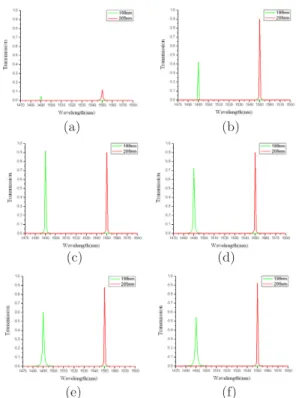
Fig. 7. Transmission spectra for fixed L= 300 nm, R1 = 205 nm, and R2 = 198 nm with different L1: (a) 400, (b) 450, (c) 500, (d) 550, (e) 600, and (f) 650 nm.
to about 19.37%. In Fig. 7(e), the transmission of the first ring resonator is 87.83% and the second ring resonator is 60.43%. In Fig. 7(f), the transmission of the first ring resonator is 92.18% and the second ring resonator is 54.53%. According to the simulation results, the optimal distance is L1 = 500 nm. Next, the same method is used to investigate the influence between each two ring resonators. The optimal parameters of the proposed MIM plasmonic all-optical triplexer are chosen as: R1 = 205 nm, R2 = 198 nm,
R3 = 177 nm, L = 300 nm, L1 = 500 nm, L2 = 650 nm,
w = 50 nm, and d = 45 nm. The transmission
spectrum of the MIM plasmonic all-optical triplexer is shown in Fig. 8(a). The dropped peak wavelengths of ring resonators are λ1 = 1550 nm, λ2 = 1490 nm, and
λ3 = 1310 nm, respectively, and the transmission efficien-cies are 91.48%, 95.42%, and 96.55%, respectively. The field distributions of the proposed all-optical triplex for wavelengths of 1550, 1490, and 1310 nm are shown in Figs. 8(b)–(d).
In conclusion, a new type of MIM plasmonic all-optical triplexer has been proposed. It is composed of three straight waveguides and two different radii of ring resonators. By properly turning the radii of ring resonators and the gap distance, certain wavelengths can be filtered out and the crosstalk of each channel also can be reduced. As the numerical results shown above, it could really function as an optical triplexer with respect to the three wavelengths i.e. 1310, 1490, and 1550 nm, respectively. It would also be a potential key component in the applications of the FTTH com-munication systems and the biosensing systems.
The author thanks Yung-Ta Hsueh for his constructive discussion and help.
References
1. S. S. Xiao, L. Liu, and M. Qiu, Opt. Express 14, 2932 (2006). 2. C. Manolatou, M. J. Khan, S. Fan, P. R. Villenueve, H. A. Haus,
and J. D. Joannopoulos, J. Quant. Electron. 35, 1322 (1999). 3. B. E. Little, S. T. Chu, H. A. Haus, J. Foresi, and J. P. Laine,
J. Lightwave Technol. 15, 998 (1997).
4. A. Hosseini and Y. Massoud, in Proceedings of IEEE Conference
on Nanotechnology 81 (2007).
5. G. Veronis, Z. Yu, S. E. Kocabas, D. A. B. Miller, M. L. Brong-ersma, and S. Fan, Chin. Opt. Lett. 7, 302 (2009).
6. T. Wang, X. Wen, C. Yin, and H. Wang, Opt. Express 17, 24096 (2009). 7. Z. Chen, J. Chen, Y. Li, J. Qian, J. Qi, J. Xu, and Q. Sun, Chin.
Opt. Lett. 11, 112401 (2013).
8. Y. Shen, G. Yu, J. Fu, and L. Zou, Chin. Opt. Lett. 10, 021301 (2012). 9. J. Tao, X. Huang, X. Lin, Q. Zhang, and X. Jin, Opt. Express
17, 13989 (2009).
10. J. Tao, X. Huang, X. Lin, J. Chen, Q. Zhang, and X. Jin, J. Opt. Soc. Am. B 27, 323 (2010).
11. X. Lin and X. Huang, J. Opt. Soc. Am. B 26, 1263 (2009). 12. X. Lin and X. Huang, Opt. Lett. 33, 2874 (2008).
13. H. Lu, X. M. Liu, D. Mao, L. R. Wang, and Y. K. Gong, Opt. Express 18, 17922 (2010).
14. H. Gao, H. Shi, C. Wang, C. Du, X. Luo, Q. Deng, Y. Lv, X. Lin, and H. Yao, Opt. Express 13, 10795 (2005).
15. Z. Q. Liu, G. Q. Liu, H. Q. Zhou, X. S. Liu, K. Huang,
Y. H. Chen, and G. Fu, Nanotechnol. 24, 155203 (2013). 16. Z. Q. Liu, G. Q. Liu, K. Huang, Y. H. Chen, Y. Hu, X. N Zhang,
and Z. J. Cai, IEEE Photon. Technol. Lett. 25, 1157 (2013). 17. G. Q. Liu, Y. Hu, Z. Q. Liu, Y. H. Chen, Z. J. Cai, X. N Zhang,
and K. Huang, Phys. Chem. Chem. Phys. 16, 4320 (2014). 18. Z. Q. Liu, H. B. Shao, G. Q. Liu, X. S. Liu, H. Q. Zhou, Y. Hu,
X. N. Zhang, Z. J. Cai, and G. Qu, Appl. Phys. Lett. 104, 081116 (2014).
19. G. Wang, H. Lu, X. Liu, D. Mao, and L. Duan, Opt. Express 19, 3513 (2011). (c) (e) (d) (f) (a)
Fig. 8 (a) Transmission spectra of the triplexer filter. Field distributions of Hz with incident wavelengths of: (b) 1310, (c) 1490, and (d) 1550 nm.
110607-5
COL 12(11), 110607(2014) CHINESE OPTICS LETTERS November 10, 2014
20. H. Lu, X. Liu, Y. Gong, D. Mao, and G. Wang, J. Opt. Soc. Am. B 28, 1616 (2011).
21. X. Li, G. R. Zhou, N. N. Feng, and W. P. Huang, IEEE Photon. Technol. Lett. 17, 1214 (2005).
22. C. Xu, X. Hong, and W. P. Huang, Opt. Express 14, 4675 (2006).
23. T. Lang, J. J. He, and S. He, IEEE Photon. Technol. Lett. 18, 232 (2006).
24. J. A. Dionne, L. A. Sweatlock, H. A. Atwater, and A. Polman, Phys. Rev. B 73, 035407 (2006).
25. Z. Han, E. Forsberg, and S. He, IEEE Photon. Technol. Lett. 19, 91 (2007).
26. B. Wang and G. P. Wang, Appl. Phys. Lett. 87, 013107
(2005).
27. S. Kim, I. Park, and H. Lim, Opt. Express 12, 5518 (2004). 28. H. Lu, X. Liu, and D. Mao, Phys. Rev. A 85, 053803 (2012).