行政院國家科學委員會專題研究計畫 成果報告
歸納式及演繹式文法教學於不同認知風格大學生之成效比
較
研究成果報告(精簡版)
計 畫 類 別 : 個別型 計 畫 編 號 : NSC 99-2410-H-151-013- 執 行 期 間 : 99 年 08 月 01 日至 100 年 07 月 31 日 執 行 單 位 : 國立高雄應用科技大學應用外語系 計 畫 主 持 人 : 王佩玲 計畫參與人員: -兼任助理人員:方慧娟 報 告 附 件 : 出席國際會議研究心得報告及發表論文 處 理 方 式 : 本計畫涉及專利或其他智慧財產權,2 年後可公開查詢中 華 民 國 100 年 10 月 13 日
Effects of Inductive and Deductive Approaches in Grammar Instruction for College Students of
Different Cognitive Styles
1 Introduction
1.1 Motivation of the Study
According to language scholars (e.g. Ellis, 1999), English language learners must master vernacular style of English so that they could fluently communicate with others in business settings. In addition, they also need to understand careful style of English (i.e. rhetoric), in case they have to do presentations or write business letters with customers. Therefore, English grammar instruction, which helps students understand English structures and the ways of using English effectively, is a vital and necessary unit in the university curriculum.
Recent grammar instruction has paid lots of attentions to the meaningful practices and effective
communication among students. Teaching strategies focus on enhancing the input (Sharwood- Smith, 1981) to raise student consciousness on particular grammar structure (Fotos & Ellis, 1991). By doing so, it might awaken student innate grammar knowledge, help student generalize grammatical rules, and eventually know how to apply those rules into authentic communications.
In the opinion of scholars (e.g. Ellis, 1999; McLaughlin, 1990; Van Patten, 1996), the information processing of the target language could be divided into three parts: input, central processing, and output. For learners who have passed their puberty stage, a manipulated input of the target language (i.e. teachers highlight a particular grammar structure, or slow down their speech speed whenever they mention the target structure) will efficiently help student learning. That is, the teaching activities should enable student to 1) pay attention to the input of the target language, 2) use their innate knowledge to comprehend the input, to examine their hypothesis, and to transfer the information, and 3) produce the target language, modify mistakes, and learn the correct usages.
It has been a controversial issue regarding which teaching approach could most effectively help students notice English grammar rules and internalize the rules. Among those various approaches, deductive approach and inductive approach have been widely discussed. Inductive approach asks students to induce and generalize rules from the discussion with peers; in contrast, deductive approach allows students to learn rules from teacher explanations. Supporters of inductive approach (e.g. Garrett, 1989; Shaffer, 1989) believed that students could retain the rules longer when students discover rules by themselves. In addition, they urged that when the activity is student-centered, students will be more motivated. Moreover, they claimed that deductive approach involves students into various meaningful interchange situations with peers, which coincides with the ideas of
constructivism. According to Vygotsky (1978), learner cognitive development is based on the experiences of social interaction. Peer interaction could stimulate student potentials, construct new knowledge, and achieve the Zone of Proximal Development. On the other hand, proponents of deductive approach (e.g. Higgs, 1985; Scott, 1990)argued that it saves lots of student time and energy when teachers explicitly explain the rules, especially those tough or vague structures. They believed that only advanced learners could generalize rules by their own. When the structures of student first language and second language are different, it is even more difficult for students to induce rules. Take Chinese as an example, there is no verb tense difference in Chinese. To signal the occurrence of a particular time, Chinese uses time phrases such as today, next week, etc. in a sentence. Probably, it explains why studies have shown that English verb tenses errors are the most frequent errors among Chinese learners (Huang, 1994).
In addition to the factors of student level and the different structure between L1 and L2, student cognitive style might influence the effectiveness of deductive and inductive approaches. Among several cognitive styles, field dependent and field independent are the two styles which have been broadly studied. Field independent people have better analytical ability and stronger self-confidence. They prefer to learn independently and also like to compete with others. In contrast, field dependent people prefer to observe others, learn with each other, and to complete the tasks with team-members. They are more socialized, and pay more attention to others
feelings (Witkin et al., 1962). Generally speaking, in the second language learning, field independent learners had better learning outcomes in the inductive approach, and field dependent learners benefited more from the
deductive approach (Abraham, 1985).
In Taiwan, most of the high school and elementary school English teachers put emphasis on student English grammar ability on pencil-and-paper tests. Student English oral communication skills are often neglected. Since many companies in Taiwan demand their staff to have the English proficiency certificates such as GEPT and TOEIC, thus university English teachers still adopt the Grammar Translation Approach to prepare their students for the English proficiency tests. In other words, teachers spend most of the class time explaining grammar, and students are required to do lots of tedious exercises. This approach, however, cannot help students cope with the challenges in the future international workplaces. In order to promote student interests in learning English grammar, this study tries to explore the effect of the communicative grammar approach.
With the advance of the information age, the application of multi-media and internet in teaching is getting popular. The current computer technology has already been able to offer various functions, such as texts, graphs, videos, animated cartoons, music, recording, email, chatting rooms, bulletin boards, and simultaneous video conferencing. With these features, students could communicate with real people and practice their listening, speaking, writing, and reading skills. Studies (e.g. Rinaldo, Tapp, Laverie, 2011) have confirmed that multi-media instruction assists students in promoting their learning interest. Moreover, teachers could easily use different colors, fonts, and the function of underline to highlight their teaching materials. They also could record their instruction in slow speed and put the recording at the internet for student review. As the suggestion of VanPatten (1996), such a manipulated teaching materials is helpful for raising student consciousness.
Although many studies in western countries have shown that the effect of a student-centered language instruction is positive, some studies (e.g. Wang, 2001) revealed that Asian students did not prefer this type of instruction. In Wang’s study, among 707 participating students, only twenty percent of students liked student-centered approach. Eighty percent of students preferred teacher-centered methodology. Therefore, it is worthy to further explore the effect of inductive approach in Taiwan, and what problems students have encountered under the inductive approach.
Considering previous studies had mixed findings, and research examining the relation between the deductive/inductive approaches and different cognitive styles Taiwanese college learners is still scarce, the researcher investigated the effect of these two teaching approaches on her students from two intact classes. In this study, both classes received one year of communicative grammar instruction in the language labs. Four English lessons including verb tenses, noun clauses, adjective clauses, and conditional sentences were chosen as the target structures, due to the fact that their structures in English are different from Chinese ones. The ways of input-processing and conscious-raising in each class is different. Detailed procedures will be described in the later section.
1.2 Purpose of the Study
This study intends to explore the following aspects:
1) student attitudes toward deductive and inductive communicative grammar instruction
2) the effect of deductive and inductive communicative grammar instruction on student learning of verb tenses, noun clauses, adjective clauses, and conditional sentences
3) the factors which influence student learning outcomes
1.3 Research Questions
1) What are student attitudes toward deductive and inductive communicative grammar instruction?
2) What is the effectofinductiveapproach and deductiveapproach on students’English verb tenses, noun clauses, adjective clauses, and conditional sentences learning outcomes? Which group has better performance?
3) What are the learning outcomes of field independent/dependent (FI/FD) students? Do the FI students outperform significantly the FD students?
4) How do inductive/deductive approaches and FI/FD cognitive styles create interactive effect on students learning outcomes? Do FI students outperform FD students in the inductive group? Do FD students outperform FI students in the deductive group?
2 Literature Review
Scholars’Viewson theEffectofCombined Variables:Matching FI/D with Inductive/DeductiveApproach
Many studies have shown that there is a significant effect from matching FI/D cognitive styles to inductive/deductive modes of instruction (Andrews, 1984; Douglass, 1978; Hansen & Stansfield, 1982). However, most of these studies dealt with physics, biology, or mathematics, rather than language learning. And some studies (Abraham, 1985; Horak, 1978) even observed a contradiction in the finding that FD students seemed to perform better with the inductive method.
Anothermixed finding wasindicated in Thomas’sstudy (1987)wherehe reported thattheFIstudentsare capableofachieving “well”with eitherthedeductiveorinductiveteaching method. However,FD students have difficulty with the inductive method. His finding suggested that it is especially important to take FD students into consideration when the teacher presents the lesson inductively.
Among the few studies on the relationship of FD/I and the deductive/inductive teaching method in language classes (Abraham, 1985; Raschio, 1987; Thomas, 1987), there was much mixed and conflicting evidence about thisrelationship. Forexample,Raschio’sstudy showed thattherewasno significantrelationship between the cognitive style of learning and the teaching method, and although FI learners generally scored higher than FD learners on achievement tests, the results did not reach a significant level. Besides, the comparative teaching methodsin Raschio’sstudy wereused in computerinstruction and traditionallanguageinstruction ratherthan the deductiveand inductive approach. Similarly,both ofAbraham’sstudy and Thomas’sstudy finding may notbe generalized for the regular classroom situation, since their studies were conducted in a computer classroom.
achievement might have been affected by other variables such as gender, length of time in studying English, level of education, and cultural traits. The study of Naiman et al. (1978), for example, indicated that the FD/I factor is more important in advanced stages of language learning.
Furthermore, the literature on the teaching and learning styles of Chinese people is rare. Research that investigatesthematch between deductive/inductiveteaching methodsand Chinesestudents’cognitive styles is even more limited, and unfortunately, the results of these studies were also controversial. For example, in Chang’sstudy (2005),two classesof44 Seniorhigh schoolstudentsreceived onesemesterofsubjectiveand indirect questions grammar instruction. The findings show that inductive group performed better in the post-test than deductive group. In addition, the inductive group showed more positive attitude toward their English learning. Nevertheless, in Shih (2008) study, the subjects were 70 junior high school students learning relative clauses. Although there was no significant difference between inductive and deductive group, high-achievers benefited more from deductive approach than from inductive approach. Moreover, high-achievers significantly outperformed their mid- or low-ability counterpartsin inductiveinstruction.Interestingly,anotherstudy’sfinding (Liu,1999)issomehow differentfrom Shih’sstudy.ThesubjectsofLiu’sstudy werealso juniorhigh school students learning English clauses, but an interactive effect of cognitive style and learning approaches were found. FI students outperformed FD students in the inductive group and FD students outperformed FI students in the deductive group on identifying English clauses task.
3 Methodology
3.1 Subjects
A total of 98 English majored freshmen at the researcher’s university were quasi-randomly selected from the researcher’s students as the subjects of the study. These participants came from two Freshman English Grammar classes. Class A consists of 49 students, and Class B has 49 students. The ratio of boys to girls is around 1:6. Each class was randomly assigned to the inductive or the deductive approach respectively by flipping a coin. As a result, Class A received the deductive instruction, and Class B received the inductive instruction.
3.2 Instruments
The first instrument was a self-designed English comprehension test based on the teaching materials in the textbook“Understanding and using English grammar ” . This comprehension test was used as the pre/post/delayed test of the study, and was designed to find out how well students understand the target structures before and after receiving the experimental grammar instruction. Two English professors were invited to evaluate the content validity of the test.
The second instrument was the Group Embedded Figures Test (GEFT), developed by Witkin and his colleagues in 1971. GEFT is currently the most popular instrument used to determine the field dependent/independent (FD/FI) cognitive style (Liao, 2007). This test asks people to find a simple figure hidden in a complex design. It is assumed that FI people are capable of separating an item (e.g., a rod) from an organized field (e.g., a frame). Thus, FI people are expected to easily locate the simple figure in the complex design, while FD people have difficulty separating the simple figure from the complex design. Based on
cognitive theory and empirical evidence, the GEFT test is regarded as a good instrument with good reliability (r = 0.82) and construct validity (Goodstein, 1978).
The third instrument is a self-designed questionnaire, consisting of 22 five-point Likert-scale type questions and one open-ended question. The question was used to understand student preferred teaching method. The reliability of the questionnaire is estimated by Cronbach’s α, which shows that thequestionnaireisreliable(α= 0.88). In addition, a semi-structure interview was conducted to realize student reasons for their preference.
3.3 Procedures of Data Collection
First, the subjects took the pre-test, so the researcher could record students’comprehension about English tenses prior to the experimental instruction. In addition, the subjects also took the GEFT to determine their individual cognitive style. Next, the researcher conducted the deductive/inductive English grammar instruction with the aid of multimedia to Class A/B respectively for two months. Moreover, the subjects took the post-test after the experimental teaching. And then, after another two weeks, students took the delayed-test. Next, the researcher and her colleague scored the tests, and GEFT with the same scoring criterion, in order to enhance the rater reliability. Finally, participants filled out the questionnaire and ten students were randomly chosen to be interviewed.
3.4 Communicative Grammar Instruction through Technology
To prepare students for using English in the real contexts, the teacher-researcher adopted the communicative approach to teach the target structures. Both group students all had to participate in lots of communicative written and oral practice. It was hoped that students would not only be equipped with grammar knowledge but also understand when and how to appropriately apply those learned knowledge in various communicational settings.
Both deductive/inductive instructions were conducted in the same computer lab classroom. Most of the materials presented in class were electronic files such as Word documents, Power Point files, and CD/CD-ROM programs. The teacher utilized different colors, bold type, and underline etc., to emphasize the main points of the lesson. In this way, those various visual and audio inputs could raise students’consciousness and help students to reinforce the language learned in class. The difference of the deductive/inductive instructions lies in the way how the teaching materials (input processing) were arranged and how those materials raised students’ consciousness. Generally speaking, deductive instruction starts with teacher’s clear rule explanation, and then students engage in language practice. In contrast, inductive instruction requires students themselves to generalize and verbalize the rules from grammatical structure used in context
3.5 Data Analysis
After collecting the data t, the researcher used descriptive statistics to answer the first research question. A paired t-test and an independent t-test were applied to answer the second research question. Next, the researcher used a descriptive statistics, an independent t-test, a paired t-test, and ANOVA to answer the third research question. Moreover, an independent t-test, a paired t-test, and ANOVA were used to answer the fourth research question.
To evaluate students’cognitive styles, I used 1/2 stand deviation above or below the mean (mean= 13.82, 0.5SD=2.18) as the cutoff score of FI/D. Besides, I discarded the middle of the distribution of the test, which means I did not count the participants whose test score was within 1/2 stand deviation above or below the mean. I only counted the upper and bottom part of participants, who could be easily identified as either FI or FD persons. In this way, FI persons’GEFT scores were within 17-18, and FD persons’scores were within 0-11. Students whose scores were within 12-16 were regarded as field neutral students and were excluded from the subjects in this analysis
4. Results and Discussion
4.1 Student Attitude toward Deductive and Inductive Grammar Instruction
Seventy-six percent of the students preferred the deductive approach, and only twenty-four students liked the inductive approach. Student who preferred the deductive approach believed that : 1) Teachers understand English grammarbetterthan students. Through ateacher’ssystematicexplanation,they are able to capture English structures more quickly. 2) Save their time and energy. 3) They may make mistakes if they figure out the grammatical rules by themselves. And 4) they are too lazy to explore the English patterns by myself. On the other hand, for those who preferred the inductive approach, their reasons are as follows. 1) When I figure out the grammatical rules by myself, I remember these rules longer. 2) Learning should not be passive. 3) The feeling of being independent and successful stimulates my learning interests. 4) It is more interesting.
4.2 Verb Tense Learning Outcomes
Results show that both approaches were significantly effective in facilitating students’English verb tense learning outcomes and helping students retain the learnt knowledge. The deductive group had higher learning outcome scores than the inductive group, but the score differences between the two groups did not achieve significant level. Next, all cognitive styles of students made significant progress. FD students outperformed FI students, but the difference was not significant. Third, in the both groups, FD students improved more than FI students; however, the differences between FI and FD in both teaching groups were not significant.
4.3 Noun Clauses Learning Outcomes
Results show that both approaches were significantly effective in facilitating students’English noun clause learning outcomes. The inductive group had higher test scores than the deductive group, but the score
differences between the two groups did not achieve significant level. Next, all cognitive styles of students made significant progress. FI students outperformed FD students, but the difference was not significant. Third, in the deductive group, FD students scored higher than FI students. In contrast, in the inductive group, FI students outperformed FD students; however, the differences between FI and FD in both teaching groups were not significant.
4.4 Adjective Clauses Learning Outcomes
Results show that both approaches were significantly effective in facilitating students’English adjective clause learning outcomes. The deductive group had higher test scores than the deductive group, but the score differences between the two groups did not achieve significant level. Next, all cognitive styles of students made significant progress. FD students outperformed FI students, but the difference was not significant. Third, in the
deductive group, FI students scored higher than FD students. In contrast, in the inductive group, FD students outperformed FI students; however, the differences between FI and FD in both teaching groups were not significant.
4.5 Conditional Sentences Learning Outcomes
Results show that both approaches were significantly effective in facilitating students’English conditional sentences learning outcomes. The deductive group had higher test scores than the deductive group, but the score differences between the two groups did not achieve significant level. Next, all cognitive styles of students made significant progress. FI students outperformed FD students, but the difference was not significant. Third, in the both groups, FI students improved more than FD students. As for the difference between the delayed test and the pre-test, in the inductive group, FI students remembered longer than FD students. In the deductive group, FD students retained the knowledge longer ; however, the differences between FI and FD in both teaching groups were not significant.
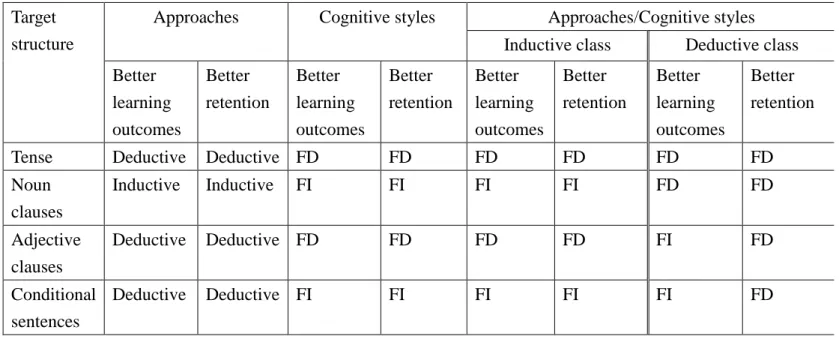
Table 1 is the summary of the learning outcomes of different cognitive style learners under two teaching approaches.
Table 1 Summary of the effect on deductive/inductive approaches on FI/FD learners
Approaches/Cognitive styles Approaches Cognitive styles
Inductive class Deductive class Target structure Better learning outcomes Better retention Better learning outcomes Better retention Better learning outcomes Better retention Better learning outcomes Better retention
Tense Deductive Deductive FD FD FD FD FD FD
Noun clauses Inductive Inductive FI FI FI FI FD FD Adjective clauses Deductive Deductive FD FD FD FD FI FD Conditional sentences Deductive Deductive FI FI FI FI FI FD 5. Conclusions
This study was designed to examine such factors as inductive/deductive teaching strategies, students’ cognitive styles, and the effect of matching inductive/deductive methods with field independent/dependent (FI/FD) styles involved in the grammar instruction within a communicative approach in Taiwan.
The inductive approach is currently more in favor for teaching grammar and widely recommended by western scholars (e.g., Brown, 2007); however, the present study found that most students preferred the deductive approach, and the deductive approach indeed helped student learn better and remember longer than the inductive approach in verb tenses, adjective clauses, and conditional sentences, although the difference did not achieve the significant level. Obviously, to the majority of Chinese learners, learning English under the explicit instruction of grammatical rules is the most efficient way. Two reasons might account for this finding. First of all,
the Confucian tradition of Chinese has trained students to be docile learners in the classroom. Therefore, they may feel insecure or challenging to discover English rules by themselves. Secondly, it is difficult for Chinese learners to distinguish and generalize English grammatical features, since English sentence structures are different from the structures in Chinese.
The second finding of the study is that both FIand FD learners’comprehension ofthe target structures had significant improvement (p<0.001). The FD students’ improvement and memory was better than that of FI students in verb tenses and adjective clauses, and the FI students had better scores in noun clauses and conditional sentences. However, again the difference is not significant (p<0.05).
The third result of this study, regarding the interactive effect of teaching approaches and cognitive styles on students’learning outcomes, is also mixed. More specifically, in the inductive class, FI students learned better and remembered the learned knowledge longer than FD students in the noun clauses and conditional sentences. However, FD students surpassed FI students in the tenses and adjective clauses. On the other hand, in the deductive class, FD students remembered the learned knowledge longer than FI students in all target structures, and FD students also outperformed FI students in tense and noun clause learning. Nevertheless, the interactive effect of inductive/deductive approaches and FI/FD cognitive styles on students learning outcomes did not achieve significant level. This finding suggests that a communicate grammar instruction is beneficial to Chinese students of different cognitive styles, but the effect may be especially evident among FD students. Since FD students are more likely to be interested in interpersonal communication, they may be more accustomed to the communicative approach in which they are required to learn grammar while they are using oral or written discourse in English. Moreover, a match of deductive teaching strategies with FD students is particularly helpful for their retention ability.
Of course, it is possible that additional variables such as the type of achievement tests, or student motivation might have affected therelevanceofthefield dependent/independentcognitivestyleto thestudents’learning achievements. Perhaps future research could examine these variables to determine the impact of cognitive styles to Chinese learners.
References
Abraham, R. G. (1985). Field independence-dependence and the teaching of grammar. TESOL Quarterly, 20 (4), 689-702.
Andrews, J. D. (1984). Discovery and expository learning compared: Their effects on independent and dependent students. Journal of Educational Research, 78 (2), 80-89.
Brown, H. D. (2007). Principles of language learning and teaching(5th). NJ: Pearson Education.
Chang, S. H. (2005). A comparative analysis of two approaches to grammar teaching: Constructive vs. lecturing (Unpublished master’sthesis). National Kaohsiung Normal University, Taiwan.
Douglass, C. B. (1978). Effects of field dependent-independent instructional sequence on high school biology. Paper presented at the annual meeting of the National Association for Research in Science Teaching. Toronto, Canada. (ERIC Document Reproduction Service No. ED 167352).
Ellis, R. (1999). Cognitive approaches to SLA. Annual Review of Applied Linguistics, 19, 22-42.
Fotos, S., & Ellis, R. (1991). Communicating about grammar: A task-based approach. TESOL Quarterly, 25, 605-628.
Garrett, N. (1989). The role of grammar in the development of communicative ability. Applied Language Learning, 1 (1), 15-32.
Goodstein, L. (1978). Group embedded figures test: A review. In Oscar K. Buros (Ed.), the eighth mental measurements yearbook (Vol. 1) (pp. 837-838). Highland Park, NJ: Gryphon.
Hansen, J., & Stansfield, C. (1982). Student-teacher cognitive styles and foreign language achievement: A preliminary study. The Modern Language Journal, 66(3), 263-273.
Higgs, T. V. (1985). Teaching grammar for proficiency. Foreign Language Annals, 18 (4), 289-296.
Horak, V. (1978). The effects of inductive-deductive teaching methods and field-dependence-independence cognitive style on student achievement in mathematics. Paper presented at the annual meeting of the National Council of Teachers of Mathematics. SanDiego, California. (ERCI Document Reproduction Service No. ED 161700).
Huang, H. S. (1994). An analytic study on tense errors committed by Chinese learners of English in southern Taiwan (Unpublished master’sthesis). National Kaohsiung Normal University, Taiwan.
Liao, H. C. (2007). The relationship between student-teacher cognitive styles and students’English performance in junior high school (Unpublished master’sthesis). National Chengchi University, Taiwan.
Liu, P. H. (1999). A study of the effect of cognitive styles learning approaches on identifying English clause tasks (Unpublished master’sthesis). National Kaohsiung Normal University, Taiwan.
McLaughlin, B. (1990). Theories of second language acquisition. London: Edward Arnold.
Naiman, N., Frohlich, M., Stern, H.H. & Todesco, A. (1978). The Good Language Learner. Toronto: Modern Language Centre, Ontario Institute for Studies in Education.
Rinaldo, S. B., Tapp, S., Laverie, D. A. (2011). Learning by tweeting: Using Twitter as a pedagogical tool. Journal of Marketing Education, 33(2), 193-203.
Raschio, R. A. (1987). The effects of the presentation of Spanish CAI lessons on field dependent/independent college students of beginning college students of beginning Spanish (Unpublished doctoral dissertation). University of Minnesota, Minneapolis, MN.
Scott, V. M. (1990). Explicit and implicit grammar teaching strategies: New empirical data. The French Review, 63 (5), 779-789.
Shaffer, C. (1989). A comparison of inductive and deductive approaches to teaching foreign languages. The Modern Language Journal, 73, 395-403.
Sharwood-Smith, M. (1981). Consciousness-raising and the second language learner. Applied Linguistics, 2, 159-169.
Shih, J. Y. (2008). Effects of inductive and deductive approaches in grammar instruction for junior high school students of differing English proficiency (Unpublished master’sthesis). National Pingtung institute of commerce, Taiwan.
Thomas, A. C. (1987). The effects of inductive and deductive teaching strategies in computer-based language lessons on the performance of high school students identified as being field-dependent or independent (Unpublished doctoral dissertation). The Ohio State University. Columbus, OH.
Van Patten, B. (1996). Input processing and grammar instruction in second language acquisition. Norwood, NJ: Ablex.
Vygotsky, L. S. (1978). Mind in society: The development of higher psychological processes. Cambridge, MA: Harvard University Press.
Wang, P. L. (2001). The impact of cognitive styles on technical colleges students’English teaching method preferences. Journal of National Kaohsiung University of Applied Sciences, 31, 479-510.
國科會補助專題研究計畫項下出席國際學術會議心得報告
日期:100 年 02 月 08 日
一、參加會議經過
此次會議舉行日期從 12 月 2 至 12 月 4 日,為期 3 天。主辦單位為國立新加坡大學語文 中心,會議主題為 “Individual Characteristics and Subjective Variables
in Language Learning”本報告人於 12 月 1 日早上出發,傍晚到達新加坡,12 月 2 日參與 開幕式及全天議程,並於當天下午發表論文。12 月 3 日繼續大會議程,並於晚間到新加 坡大學校園參加大會晚宴,和與會學者進行交流。12 月 4 日除參加議程,並參與閉幕式 之午宴。並於當日下午搭機回國,並無參加當天的博物館參觀的行程。
二、與會心得
12 月 2 日下午論文報告,報告完後,一位與會者建議未來研究在測量學生時態能力的研 究工具部份,除選擇題之外,可增加不同類型的時態測驗項目,例如克漏字,或寫作測驗。 報告人亦參與多場報告,以下針對其中四場與研究學生個別差異相關的報告做簡短說明。 第一場“Attention, Awareness, and Individual Differences in Language Learning”,強調了解學生 在語言學習上個別差異的重要性。第二場 ”Individual characteristics in the language classroom:learning strategies and differentiated instruction” 提及針對不同程度的學生所設計的策略教學模
計畫編號
NSC 99-2410-H-151-013計畫名稱
歸納式及演繹式文法教學於不同認知風格大學生之成效比較出國人員
姓名
王佩玲服務機構
及職稱
國立高雄應用科技大學 應用外語系副教授會議時間
2010 年 12 月 2 至 12 月 4 日會議地點
國立新加坡大學會議名稱
(中文) ClaSIC 2010 第四屆 CLS 國際會議(英文) ClaSIC 2010 the Fourth CLS International Conference
發表論文
題目
(中文) 歸納式及演繹式時態教學對不同認知風格大學生的影響
(英文) Effects of inductive and deductive approaches in English verb tenses
式,對教學設計相當幫助。第三場” Examining and exploring the relationship between cognition
and affect: From perspective of multiple intelligences theory” 從多元智能理論探討認知與情感
之間的關係。第四場 Setting goals for low achieving EFL students: The design and effect”探討如 何利用實質獎勵的方式,激勵低成就的學生,達成學習目標。 新加坡大學語言研究中心的教職員相當用心籌辦此次會議,其場地、議程、食物、接待人 員、與娛樂節目皆讓與會者感到賓至如歸及如沐春風。總之,本次研討會讓我學習到主辦單 位的國際化宏觀,另外能與來自二十多國的二百位學者交流也收穫頗多。
三、考察參觀活動(無是項活動者略)
沒有參加博物館參觀活動四、建議
無五、攜回資料名稱及內容
1. Conference Proceeding 2. Conference Handbook 3. Certificate of Presentation六、其他
國科會補助計畫衍生研發成果推廣資料表
日期:2011/10/10國科會補助計畫
計畫名稱: 歸納式及演繹式文法教學於不同認知風格大學生之成效比較 計畫主持人: 王佩玲 計畫編號: 99-2410-H-151-013- 學門領域: 課程與教學無研發成果推廣資料
99 年度專題研究計畫研究成果彙整表
計畫主持人:王佩玲 計畫編號: 99-2410-H-151-013-計畫名稱:歸納式及演繹式文法教學於不同認知風格大學生之成效比較 量化 成果項目 實際已達成 數(被接受 或已發表) 預期總達成 數(含實際已 達成數) 本計畫實 際貢獻百 分比 單位 備 註 ( 質 化 說 明:如 數 個 計 畫 共 同 成 果、成 果 列 為 該 期 刊 之 封 面 故 事 ... 等) 期刊論文 0 4 100% 研究報告/技術報告 0 0 100% 研討會論文 1 0 100% 篇 論文著作 專書 0 0 100% 申請中件數 0 0 100% 專利 已獲得件數 0 0 100% 件 件數 0 0 100% 件 技術移轉 權利金 0 0 100% 千元 碩士生 0 0 100% 博士生 0 0 100% 博士後研究員 0 0 100% 國內 參與計畫人力 (本國籍) 專任助理 0 0 100% 人次 期刊論文 0 0 100% 研究報告/技術報告 0 0 100% 研討會論文 2 0 100% 篇 論文著作 專書 0 0 100% 章/本 申請中件數 0 0 100% 專利 已獲得件數 0 0 100% 件 件數 0 0 100% 件 技術移轉 權利金 0 0 100% 千元 碩士生 0 0 100% 博士生 0 0 100% 博士後研究員 0 0 100% 國外 參與計畫人力 (外國籍) 專任助理 0 0 100% 人次其他成果