Design and Fabrication of Topologically Optimal Miniature Microgripper
Integrated with an Electro-Thermal Microactuator
Wei-Liang Chen, Shyh-Chour Huang Department of Mechanical Engineering National Kaohsiung University of Applied Sciences 415 Chien –Kung Road, Kaohsiung 80778 , Taiwan, R.O.C.
E-mail: [email protected]
Abstract
This paper presents a topological-optimization method which applies the theory of ground structure parameterization to design and analyzes a microgripper device. The study defines the compliant design domain as 2000μm×2000μm with a 200μm thickness, and discusses the effect of different optimization parameters. The driver is an electro-thermal microactuator that can actuate approximately 6000μN of output force to the displacement amplifier. Finally, the microgripper tip deflects up to 18μm when 1.5V is applied.
Keywords: Compliant Mechanism, Topology Optimization, Microgripper.
1. Introduction
In recent years, the Micro-Electro-Mechanical System (MEMS) manufacturing technology is superior to conventional manufacturing technology because MEMS products have superior sensing and actuating capabilities. At the moment, MEMS devices include pressure sensors, accelerometers, and optical switching devices with microdevices, microrelays, microgrippers and micromotors [1- 4] currently under development. The new MEMS products will have a wide variety of applications in medical science, physics, engineering, and other fields.
Precise manipulation of miniature objects is essential in microprocesses. As the trend towards miniaturization continues, microgrippers will become indispensable tools for handling, manipulating, and assembling micro components. Microgripping devices are necessary in different applications, particularly in the assembly process of microscale parts, which may be fashioned from various materials using a number of different micromachining processes. Many efforts have been made in the research and development of a variety of microgrippers and their applications in MEMS, micro-robotic systems [5-8].
Early work with microgrippers employed parallel electrostatic plates to drive the gripper, but this required a relatively large voltage, and the objects which could be grasped were limited [9]. In other early work, electromagnetic grippers employed six plates to obtain a two-dimensional motion [10]. Other devices have used lasers which heat liquid to drive the gripper, albeit their size and complexity [11]. Microgrippers have also been constructed from Shape Memory Alloys (SMA), but here there are some problems which must be overcome, e.g. the thermal-mechanical constituent relationship of SMA [12,13]. Newer grippers are driven pneumatically, but still the mechanism is complex and optimal design is difficult.
In this paper, we hope to overcome these difficulties by using a compliant mechanism driven by an electro-thermal V-shaped micro-beam actuator that causes movement in the compliant mechanism. The problem is formulated as a topological-optimization problem, and is solved by a compliant mechanism. In topology ©2007 National Kaohsiung University of Applied Sciences, ISSN 1813-3851
optimization, we define the design domain firstly, and then divide it into a large number of finite elements. Next, optimization theory is used to determine which elements are retained in the design domain. The compliant mechanism gives optimum shape and size when the objective function is minimized. The exhaustive set structural elements is known as the ground structure.
Some researchers have investigated the application of topology optimization to the design of integrated flextensional actuators. Nishiwaki [14] used the homogenization method to maximize deflection in the design of integrated flextensional actuators. Silva [15] extended this approach to design coupling structures with a specified resonant frequency. In a related paper, Silva [16] developed a topological-optimization procedure for designing composite materials with prescribed piezoelectric and mechanical properties. Additionally, Hetrick and Kota [17] have employed a size and shape optimization technique to a predetermined topology to obtain high-gain, stroke-amplifying compliant mechanisms.
2. Compliant Mechanisms
Mechanisms that contain entire or partial motion from the deflections of their compliant parts are termed compliant mechanisms. The compliant mechanisms are the same as the general mechanisms defined by the transmission of the motion, force, or energy. The differences between them replace the links and hinges by flexible material. According to G. K. Ananthasuresh and Mary I. Frecker [18], compliant mechanisms should be divided into two sorts: lumped compliant mechanism; and distributed compliant mechanisms. This study chooses the distributed compliant mechanism for microgripper device design. The reason for utilizing the compliant mechanism to do this device is because it is just a two dimensional structure, so it is suitable for micro fabrication. Another reason is it can be designed by specific definitions. Compliance is distributed throughout the entire body. There are no hinges and, therefore, no localized fatigue points. Designs can be tailored for specified stiffness or rigidity and yet be flexible enough to allow desired motion. The design procedures are depicted in Figure 1.
The Electro-Thermal Microactuator
Figure 1. The Procedure of Design Methods
Compliant mechanism Topology optimization (Ground Structure Optimization algorithm (Sequential Quadratic Structure analysis (Finite element method)
The microgripper d i
The topological-optimization theory of a compliant mechanism has developed from the topology optimization of structure. The theory of the topology optimization of a compliant mechanism is defined as an unknown design domain. This design domain includes domain scales, boundary conditions, and load location. The ground structure parameterization is a set of elements in a grid of points, where each point is connected to surrounding points. The ground structure parameterization is shown in Figure 2.
Figure 2. Design Domain on the Ground Structure
2.1 Scheme of Topology Optimum
In this paper a topological-optimization method is developed for the design of the main structure of the compliant mechanism. These designs are capable of transmitting the force and motion of the microactuator to another location in any specified direction. This concept is illustrated conceptually in Figure 3, where a general coupling structure is to be designed to transfer and deliver the motion of the elector-thermal microactuator to another location. Using topology optimization, an optimal distribution of material is predicted in the specified design domain.
Figure 3. Design Domain and Problem Specifications
2.2 Theory of Topology Optimizatio
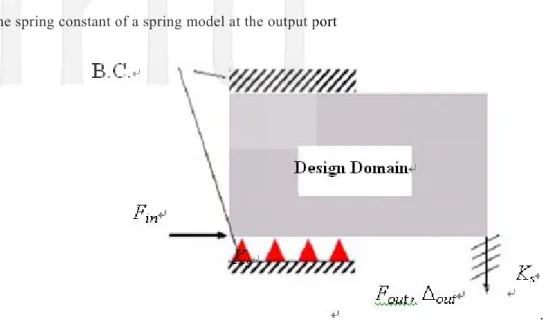
Because of the symmetry of the design domain, only half the design domain is needed for optimization, as shown in Figure 4. Fin is the input force, Fout is the output force, and △out is the expected output deformation.
Ks is the spring constant of a spring model at the output port
.
Figure 4. The Symmetric Half View of the Design Domain and Problem Specifications
Minimum displacement at the points of application of external forces implies that minimum work is done by the external forces on the structure, thus resulting in the less elastic energy is stored in it. Therefore, the strain energy (SE) stored in a structure when it deforms by an applied external force is often used as a measure of the stiffness of a structure, the smaller the strain energy, the stiffer the structure. SE is used as measure of stiffness of a structure. The strain energy of a general three-dimensional continuum system is expressed as in equation (1). The optimization can be expressed as a function SE [19].
1
2
SE
dv
v
σε
= ∫
(1)where the σ is the stress field, ε is the strain field, v is the volume of the structure system. The integrand in equation (1) is called the strain energy density.
For a discretized finite element model of a structure system, SE is given by
{ }
[ ]
{ }
1
2
T
SE
=
U
K
U
(2)where the [K] is the global stiffness matrix and {U} is the global displacement vector.
In the design of compliant mechanisms, we demand one specific port to generate output displacement,
δ
out. The expression for the displacement at the output port,δ
out, in the specified direction under the applied force is given by the mutual strain energy (MSE) [19], defined aswhere
σ
d is the stress field when only a unit virtual load is applied in the direction of the output displacement at the output port, andε
is the strain field when only the actual load is applied at the input port. For a discretized finite element model, MSE is expressed as:{ }
T
[ ]
{ }
MSE
=
V
K
U
(4)where [K] is the global stiffness matrix, {V} is the global displacement vector when a unit virtual load is applied, and {U} is the global displacement vector when only the actual load is applied. SE and MSE are used as measures of stiffness and flexibility, respectively.
In this study, to obtain the gradient of SE and MSE is necessary since the gradient of the object function is needed to resolve the optimization problem. From the stationary conditions, the functional gradients must vanish at an optimal problem. The objectives of (2) and (4) may be differentiated as follows:
{ }
T
K
{ }
SE
SE
1
i
i
=
U
i
U
i
=
x
i
2
x
i
∂
−
∂
⎡ ⎤
⎣ ⎦
xi
−
(5){ }
{ }
UK
MSE
T
MSE
i
i
=
V
i
i
=
x
i
x
i
x
∂
−
∂
⎡ ⎤
⎣ ⎦
i
−
(6)where xi is width variable of the truss element, and SEi and MSEi are the strain energies and mutual strain energies of every element in (5) and (6), respectively.
When the maximum stiffness of the structure to the applied load in desired, the optimization problem is just reduced to the problem to minimize a single object function SE. When the structure must exhibit maximum stiffness and must generate displacement at a specific port, the optimization problem must be a multi-criteria object function of minimum SE and maximum MSE. This study desires the output displacement at one specific port. The objective function that captures the need for (a) compliance to undergo desired deformation, and (b) stiffness to resist external loads once the mechanism assumes the desired configuration. This study combines the criteria of two desired output posts. Alternatively, MSE and SE can be combined in a ratio-type formulation as :
Minimize:
(x )
i
SE
MSE
ϕ
=
(7) Subject to:(x )
x
0
1
g
i
= −
i
≤
(8)(x ) x 1 0 2 g i = i− ≤ (9) (x) L x A 0 1 n h i i C i = ∑ − = ≤ (10)
where Li is the length variable of the truss element, n is the truss number from the design domain, and Ac is the limit area of the truss. The SE is the strain energy while an external force is applied. The MSE is the mutual strain energy, while an unit virtual force is applied at the output ports. In this context, the thickness of the device is fixed, so the only variables are the width and the length. The terms xi and Ac are design variables: xi represents the width of every truss element; Ac represents the limitation of the area of the cross section of each truss element.
The optimization result for the truss width is xi (0< xi <1). When the width, i.e. the cross-section dimensions, of the element goes to zero, it becomes known which elements should be removed. Therefore, the optimal topology configuration appears once the truss width is known. This optimum structure will transform the motion and force at specific input and output ports, so it can be called an optimal mechanism. This optimal mechanism has an optimal design between the flexibility and stiffness.
2.3 The Optimization Problem
The problem, defined by the equations (7) to (10), is nonlinear. This study used the Sequential Quadratic Programming (SQP) to resolve this problem. The optimality property is first verified with a solution obtained using the SQP algorithm, then the nonlinear optimum problem can be solved by linear approximation. The problem can be expanded by [20]:
(
( ) ( 0) ( 0 ) 0.5 1 1 02
n f n f x f x xi x i x x i xi x i ∂ ∑ ∑ = + − + − = ∂ =⎛ ⎞
⎜ ⎟
⎝ ⎠
i 0i)
(11) Subject to: ( )0 ( 0) 0 1 0 g n j g xj xi xi i xi x ∂ ∑ + − ≤ = ∂⎛ ⎞
⎜ ⎟
⎝ ⎠
, j=1, 2, …, m (12)To solve this linear problem, one should give an initial value to x0i, and thus solve the new variable xi. However, the “Move Limit Condition” will be incorporated into the formula by the modified simplex method, so we didn’t consider iterating the above process until the xi was smaller than a limited value, whereupon the series converges or divergences. This method easily defined the variable of the design parameters, and reduced the computer’s calculation time, so that we could obtain the structure more smoothly and more accurately.
2.4 Design and Simulation the Microgripper
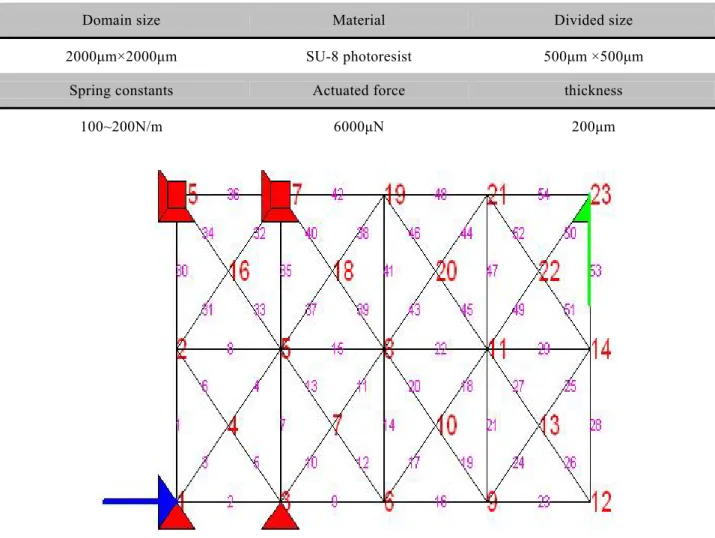
topology optimization means “to define the configuration of a mechanism”. The parameters defined by the design domain include: boundary conditions, domain scale, size of finite elements, force applied at input port, number and direction of output ports, and spring constants Ks. The details of the domain definitions are shown in Table 1. In the process of solving the optimization problem, the ANSYS software package is used to obtain SE and MSE; MATLAB is used to solve the optimization.
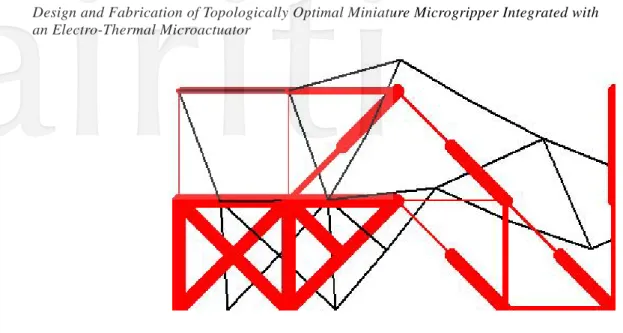
Figure 5 shows the design domain, and the input and output relation of topology optimization for designing a compliant microgripper. Figure 6 shows the result of 252 iterations of topology optimization. The width of every truss element is different, ranging from 0 to 1. The variation in the element sizes shown in the figure actually represents the various truss widths. The object function of optimization is shown in Figure 7. After 252 iterations, the object function slowly converges at -1.04707 at an output spring constant at 100N/m and a thickness of 200μm. After obtaining the topological-optimization profile, we used the ANSYS software to build this resultant model and to simulate it. Figure 8 shows the output displacement of the microgripper, moving in the y-direction at about 36.7μm at an input force of 6000μN, and the maximum stress is 94.56Mpa.
Table 1. Design Domain Specifications
Domain size Material Divided size
2000μm×2000μm SU-8 photoresist 500μm ×500μm
Spring constants Actuated force thickness
100~200N/m 6000μN 200μm
Figure 6. The Result of Topology Optimization (Iteration 252)
Figure 7. The Convergence of Object Function
3. Electro-thermal Microactuator
3.1 Concept of Microactuator
This section introduces the concept of the V-shape beam electro-thermal microactuator. The principle of the electro-thermal microactuator is that giving an electric current to flow through the beam of the V-type, the material can produce Joule heat and a temperature rise because the resistance by itself:
L
R
A
γ
=
(13)where the γ is the resistance coefficient, L is the length of resistance and A is the area of resistance.
When the current passes the resistance, the structure temperature will rise to cause expansion or contraction. Thermal expansion elongation can be explained as:
0
L
α
T L
Δ = Δ
(14)where ∆L is the elongation of the cantilever beam, α is the thermal expansion coefficient of the material, ∆T is the variation temperature, and L0 is the initial length.
According to the control function of the V-shaped bent beam strain sensors, as was found by Gianchandani [21], when the temperature increase does not reach levels that would produce a buckling of the beam, the mutually constrained thermal expansion of the two beams making up the device will result in a linear motion by the combined bending of the beams‚ as suggested in Figure 10, and we can obtain the relationship between the input force and output displacement. The governing equations are as follows:
2
2
2
F x
y
o
EI
M
M
A
Fy
x
∂
=
=
−
−
∂
(15) Subject to:0
0
y
x
=
=
tan
0
2
y
y
L
x
x
A
x
x
θ
∂
∂
=
=
=
=
∂
∂
(16)In Equation (16), E is Young’s modulus, I is the area moment of inertia, F is the force in the horizontal direction, Fo is the output force in the vertical direction, MA is the bending moment of the origin, M is the bending moment of the middle beam, and L is the distance between the two electrodes.
Figure 9. V-shape Bent Beam Strain Sensor
3.2 Design and Simulation of Microactuator
Figure 10 shows the configuration of V-shape beam microactuators. The dimensions of V-shape beam microactuator are described in Table 2.
Figure 10. The V-shape beam microactuator dimension scheme
Table 2. Design dimension of V-shape beam microactuator
V-shape beam microactuator
L1 4.56mm L2 4.84mm L4 2.84mm W1 0.14mm
Although the structures of the microactuator are frequently made of silicon wafer, we have chosen to use nickel because of its higher resistance (6.4×10⁻⁶ohm-cm), smaller thermal conductivity (60.7×10⁶W/mK), and its mechanical properties: Young’s modulus (210Gpa), Poisson’s ratio (0.32), the thermal expansion coefficient (13×10-6 /℃) and the tensile strength (~310Mpa).
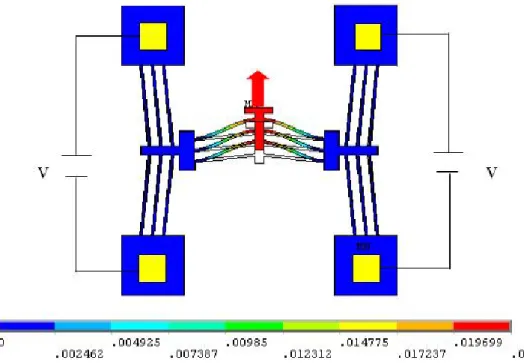
By the above parameters we used the ANSYS software to build this resultant model and to simulate it. Figure 11 shows the result of the ANSYS finite-element simulations of the deformations. The outputs of the microactuator (force, displacement, and temperature) are related to the applied voltage, as shown in Figure 12.
Figure 11. Simulation of V-shape beam microactuator
4. Fabrication and Experimental Results
The principal parts of the microgripper device are: (1) the compliant mechanism and (2) the electro-thermal microactuator. Microgrippers have been successfully fabricated by Photolithography [22] and precise Electroforming [23]. The microgripper is fabricated with an SU-8-thick film photo-resistance, and the microactuator with an all-metal nickel.
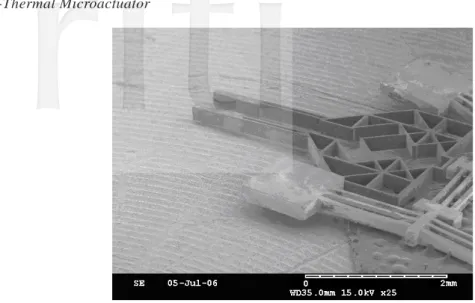
The fabrication of the compliant mechanism is done by finishing the common sequencing steps in a photolithography room. These steps involve: wafer cleaning; spin coating of the photoresist; soft baking; mask alignment; exposure; and development. First, the silicon wafer was sputtered with an intermediary layer (Al) and a spin coat of 200μm thickness, then a SU-8 thick photoresist was put on it. We next used the lithography technique to obtain the structure of the compliant mechanism after removing the intermediary (Al). Figure 13 shows a scanned electron microscope (SEM) photo of the compliant mechanism. The fabrication of the electro-thermal actuator uses the same procedure to develop the electroforming mold.
The nickel is electroformed up to full of mold and the SU-8 is removed using the Remover PG from the MicroChem Company. Figure 14 and Figure 15 show an SEM photo of the electroforming mold. Figure 16 shows the model of the thermal microactuators. After fabrication, we assembled the microgripper and measured the output displacement and performance of the microgripper. Figure 17 shows the SEM photo of the microgripper. Figure 18 shows the photograph of the measuring instrument, which includes a vibrating isolation table, optical microscope, X-Y stage, monitor, and power supply. In addition, we used a scanning white light interferometry to obtain the thickness of structure.
When an input voltage of 1.5V is applied, the gap between microgripper tips is about 18 μm. Figure 19 shows the output displacement with different applied voltages.
Figure 14. The top view of SEM photo of the electroforming mold
Figure 15. The side view of SEM photo of the electroforming mold
Figure 17. The SEM photo of the microgripper
Figure 18. The photograph of the measure instrument
0 5 10 15 20 25 30 35 0.1 0.5 1 1.5 2 Voltage (V) D is p lacem en t (μ m )
5. Conclusions
This study used a truss network distribution to obtain a clear form and integrated a tweezers construction to design the compliant mechanism. The compliant mechanism uses flexibility to replace hinges which in turn reduce the hardness in micro-fabrication. The compliant mechanism uses an SU-8 photoresist element. This micro compliant microgripper could produce about 18μm in output displacement when a 1.5 volt is applied. Fabrication of compliant micromechanisms have the advantage of being built in one piece with very few fabrication steps. The device can be easily designed and fabricated.
Further work to be done includes correcting errors in the simulation, assembly and characterization of the designed gripper, and the expansion of topology optimization algorithms so that they are able to incorporate electro-thermal V-shaped beam microactuator and structure behaviors.
Acknowledgements
The authors acknowledge and thank the National Science Council for finial support of this work under contract Number NSC 94-2212-E-151-006.
Reference
[1] Alison, M. S., James, R. S., Andrew, D. A., William, H. G., Robin, H. C., Ivester, Pascale Ehrenfreund, Frank, J. G., Jeffrey, L. B. and Richard, A. M., ‘‘Development and evaluation of a micro device for amino acid biomarker detection and analysis on Mars, ” PNAS, Vol. 102, pp. 1041-1046, 2005,.
[2] Feng, Z., Zhang, W., Su, B., Harsh, K. F., Gupta, K. C., Bright, V. and Lee, Y. C., ‘‘Design and modeling of RF MEMS tunable capacitors using electro-thermal actuators, ” IEEE MTT-S International Microwave Symposium Digest, Vol. 4, pp. 1507-1510, 1999.
[3] Lee, W. H., Kang, B. H., Young, S. O., Harry, S., Arthur, C. S., George, S. and Matthew, E., ‘‘Micropeg Manipulation with a Compliant Microgripper, ” Pro .of IEEE International Conference on Robotics and Automation, pp. 3213-3218, 2003.
[4] James, Nakamura, K. and Sadayuki U., ‘‘A Piezoelectric Micromotor Using In-Plane Shearing of PZT Elements, ” IEEE/ASME Transactions on Mechatronics, Vol. 9, No. 3, pp. 467-473, 2004.
[5] Chronis, N. and Lee, L. P., “Polymer MEMS-Based Microgripper for single cell manipulation,” 17th IEEE, pp. 17-20, 2004.
[6] Madhab, G. B., Kumar, C. S. and Mishra, P. K., “Design of a Bio-inspired Piezoelectric Compliant Miniature Gripper,” International Conference on Smart Materials Structures and Systems, ISSS 2005, pp. 17-24, 2005.
[7] Mita, M., Kawara, H., Toshiyoshi, H., Ataka, M. and Fujita, H., “An electrostatic 2-Dimensional microgripper for nano structure,” The 12th International conference on Solid States Sensors, Actuators and Microsystems, pp. 272-275, 2003. [8] Keoschkerjan, R. and Wurmus, H., “A novel microgripper with parallel movement of gripper arms,” 8th International
Conference on New Actuators, pp. 321-324, 2004.
[9] Chu, P. B. and Pister, K. S. J., ‘‘Analysis of Closed-loop control of Parallel-Plate Electrostatic microgripper, ” Proceedings of the IEEE International Conference on Robotics and Automation, Vol. 1, No. 8-13, pp.820-825, 1994. [10] Mita, N., Kawara, H., Toshiyoshi, H., Ataka, M. and Fujita H. , ‘‘An electrostatic 2-dimensional micro-gripper for nano
structure, ” Solid-State Sensors, Actuators and Microsystems, 12th International Conference on, Vol. 1, pp.272 – 275. [11] Nogimori, W., Irisa, K., Ando, M. and Naruse Y. , ‘‘A Laser-Powered Microgripper, ” Micro Electro Mechanical Systems
MEMS '1997 IEEE Proceedings, Tenth Annual International Workshop on , 26-30 Jan., pp.267-271.
[12] Lkuta, K., ‘‘Micro/Miniature shape memory alloy actuator, ” Proceedings of the 1990 IEEE International Conference on Robotics and Automatio,. Vol. 3, pp. 2156-2161.
[13] Kohl, M., Krevet, B. and Just E., ‘‘SMA microgripper system, ” Sensors and Actuators, A 97-98, pp.646-652, 2002. [14] Nishiwaki, S., Frecker, MI, Min, S., Kikuchi, N., “ Topology optimization of compliant mechanisms using the
homogenization method,” Int. J. Numer. Meth. Engrg. 42, Vol. 42, No. 3, pp. 535–559, 1998.
[15] Silva, E. C. N., Nishiwaki, S. and Kikuchi, N., ‘‘Design of flextensional transducers using homogenization design method,’’ Proc. SPIE, Vol. 3667, pp. 232-243, 1999.
[16] Silva, E. C. N. and Kikuchi, N., “Design of piezoelectric transducers using topology optimization,” Smart Mater. Struct. 8, Jun, pp. 350-364, 1999.
[17] Hetrick, J. A. and Kota, S., “An energy formulation for parametric size and shape optimization of compliant mechanisms,” ASME J. Mech. Des. 121, pp. 229-234, 1999.
[18] Howell, L.L., Compliant Mechanisms, Wiley, New York, 2001.
[19] Saxena, A. and Ananthasuresh, G. K., ‘‘On an optimal property of compliant topologies, ” Struct Multidisc Opim. 19, pp.36-49, 2000.
[21] Gianchandani, Y. B. and Najafi, K., ‘‘Bent-Beam Strain Sensors, ” IEEE J. of Microelectromechanical System, Vol. 5, No1, pp.52-58, 1996.
[22] Chronis, N. and Lee, L. P., ‘‘Electrothermally Activated SU-8 Microgripper for Single Cell Manipulation in Solution, ” Journal of Microelectromechanical systems, Vol. 14, No. 4, pp. 857-863, 2005.
[23] Yang, H. and Kang, S. W, ‘‘Improvement of thickness uniformity in nickel electroforming for the LIGA process, ” International Journal of Machine Tools and Manufacture, Vol. 40, No. 7, May, pp. 1065-1072, 2000.