Digital Dao-Fa Hui-Yuan: Developing a Digital
Archive of Daoism Documents
數位《道法會元》
:道教文獻數位典藏之
開發研究
Xiao-Xiao Feng
Ph.D. Student, Graduate School of Library, Information and Media Studies,
University of Tsukuba, Japan
Email: [email protected]
Shigeo Sugimoto
Professor, Research Center for Knowledge Communities, Graduate School of Library,
Information and Media Studies, University of Tsukuba, Japan
Email: [email protected]
Koichi Matsumoto
Professor, Graduate School of Library, Information and Media Studies,
University of Tsukuba, Japan
Email: [email protected]
Keywords(關鍵詞)
: Digital Archive(數位典藏);Daoism Fu(道教符號);Dao-Fa
Hui-Yuan(道法會元)
;Analysis of Documents(文獻分析)
【Abstract】
This study aims to build a digital archive for
the Dao-Fa Hui-Yuan, which is composed of
268 volumes and an important compilation of
Fus inherited by Daoism schools over time.
We build the digital archive named Digital
Dao-Fa Hui-Yuan for Daoism researchers, not
only to browse and search the Fus, but also to
analyze the structures and meanings of the
contents. A Fu is an important expression of
prayer and mystical messages used in Daoist
ceremonies. It is represented as a complex
graphical symbol composed of one or more
parts. Despite Fu long being an important
research topic, the study of Fus is not well
developed because of the secrecy of Daoism
and difficulties with understanding the
meanings. A major research issue in this
study was how to organize Fus and their
constituent parts. We analyzed the Fus and
their relationships using the digitalized
contents of Dao-Fa Hui-Yuan. We built a
graph of the volumes of Dao-Fa Hui-Yuan,
Fus and their constituent parts. We found
some relationships in the graph, which were
not well recognized before by Daoism
researchers. This paper shows the digital
archive of Dao-Fa Hui-Yuan and discusses
the results obtained from the archive.
【摘要】
《道法會元》是一本道教資料編纂集合,也
是《正統道藏》中非常重要的一部分。它成書
大約於明代,在此書中的 268 卷中,收錄了宋
代到明代期間存在的道教之重要資料。書中圖
文並存,解說和集合了許多流派所使用的圖
像。其中符是很重要的一部分。符是道教研究
當中非常重要的符號,它是區分道教宗派的重
要標誌,許多道教研究者都致力於符的研究。
《道法會元》中收錄了宋、元朝代的符,但是
由於編纂成書年代久等原因,此書當中存在許
多難以理解,甚至是錯誤的內容。筑波大學從
開始研究建立改善數位《道法會元》的工作已
經有十多年的歷史。從最初將《道法會元》中
的圖文錄入到電腦中的工作,到後來分析其中
內容,逐漸完成了以輔助人文學科研究者的研
究為主要目的之數位《道法會元》的項目。此
文中,在道教研究者的輔助之下,我們嘗試分
析《道法會元》中的符之間的語意,使用頻度
等關聯度,並且以此為基礎,開始嘗試分析包
含有符的卷和卷之間的關聯度,透過提供給研
究者不同的數據,如同一符在不同卷中的使用
頻度,高頻度合併使用的兩個符在不同的卷中
使用頻度等,給研究者以提示,以期發現許多
書中隱藏的線索。我們還將探討未來以分析為
目的之數位典藏未來的發展,以建立完善的數
位典藏。
Introduction
Daoism is a Chinese philosophical and religious tradition and has influenced both China and its surrounding areas for nearly 2000 years. A large
number of Dao documents are inherited and preserved as an important historic, cultural and spiritual heritage. From Ming Dynasty, Zheng-Tong Dao-Zang 《正統道 藏》 a big compilation of Daoism documents are collected and published. The academic and history values for this compilation cannot be overlooked[1].
Dao-Fa Hui-Yuan (abbreviated as DFHY) is one of
the most important compilations concluded in Zheng-Tong Dao-Zang. It contains about 268 volumes, such as the records of Daoism schools from the Song Dynasty to the Ming Dynasty, lasting over 200 years. The surviving version was published during the Yuan or Ming Dynasty. DFHY contains different types of contents, e.g., original documents used by Daoism priests, documents created by Daoism researchers, and so on. DFHY is a very rich resource for Daoism scholars. As narrated by Nikaido (2006, p. 256), DFHY contained classical Fus and rich resources for the Daoism study. Because DFHY has been processed over a long time and by many editors, many contents are misinterpreted or lost. Moreover, many Daoism schools tried to keep their secrets from the outside world. They deliberately made their documents hard to understand and established strict inheritance systems to protect their religious documents from outsiders (Li, 2003, p. 338). Li talked about the constructions for the
Fus and the some meaning of the parts contained in Fus in his manuscripts.
There are several kinds of Daoism graphic symbols in DFHY, particularly Fu (符),Tan (壇), and Gang (罡). Among them, Fu is the most important symbol (Matsumoto, 2001, p. 236). Each of the Daoism schools has its own characteristics, which can be seen as those of Fus. Thus, Fus can be used to distinguish the difference among Daoism schools, one of the important topics studied by Daoism researchers (Li, 2003, p. 247). On the other hand, Fus are generally mysterious and unreadable symbols. A Fu is composed of several parts. In DFHY, some Fus include descriptions of the parts, each of which is followed by
texts to explain their meaning and usage. These texts are written in ancient Chinese, and the meanings are ambiguous and so hard to understand. Li reported that there are more than 2000 Fus contained in DFHY and not all of them are recognized and understood[2] (Li, 2003, p. 247).
Daoism researchers have to compare the shape, and identify and recognize the meaning of each Fu by checking many documents, which is a very time consuming task if it is done only manually. There is now a strong demand from Daoism researchers to use digital archives of DFHY and the like. Furthermore, in Daoism academic circles, there is still considerable controversy regarding the content of DFHY. We think that Digital DFHY helps solve the controversial arguments in the research community. The primary purpose of the Digital DFHY (abbreviated as DDFHY) is to provide researchers with tools to search and browse the content they need. We also aimed to enable Daoism researchers to discover the structures of the contents and the rules not visible on the surface of the contents. Up till now, we have digitalized data for a part of Fus in DFHY. However, the digital DFHY contains a part of the graphics and of DFHY and also a part of Zheng-Tong Dao-Zang. How to bulid a complete digital archive for the whole contents of DFHY, and even for all of the Daoism documents compilations still has some difficult problems.
In this paper, the process of building DDFHY and some analysis studies of Fus are discussed. We want our work to be useful for Daoism researchers. We also want to discuss how to build a digital archive of cultural documents and promote their analysis.
Background and Related Work
Many digital archives in different subject domains have been built to provide cultural resources online. For Daoism, many historic documents have been digitalized. For example, Zhong-Hua Dao-Zang (中華道藏)[3], which is a collection of Daoism documents compiled based on Daoism compilations such as Zheng-Tong Dao-Zang and so on, has been digitalized and its texts are available. However, this is a simple collection of digitized Daoism documents and there is no integration of the digitalized resources with services for users, such as a catalogue to inform users what is available. It plays an important role of a digital archive for information scientists and humanists to provide services to support their research using the humanities resources.
The American Memory of the US Library of Congress[4], Europeana in Europe[5], the National Digital Archive Program[6] in Taiwan and the Digital Library of Meiji Era of the National Diet Library of Japan[7], are projects on a large scale by national or international institutions. All these programs have many different types of resources such as pictures, texts, videos and so on. The digitalized resources are not simply supplied to users as in their original format but they can be used with value-adding services. Therefore, it is important to understand how best to analyze and arrange the contents as digital resources.
Many scholars have discussed issues of digitalized humanities resources usage. Borgman (2010, p. 1) has discussed what the data for the digital humanities should be and the landscape of the digital humanities. In the development of the DDFHY, we examined many various cases and defined the data organization based on the relationships between Fus and their parts.
Every digital archive should be designed in accord with the features of the resources and usage. As DFHY is mainly used by researchers with deep knowledge of Daoism and Fus are important for Daoism research, the DDFHY proposes not only to digitalize the contents of DFHY but also to provide services to help researchers overcome the limitation of traditional manual processing. For classic cultural resources like DFHY, a key aspect in a digital archive is identification of the semantic relationships among the texts and
figures. The Archimedes Palimpsest Digital Project converted the manuscript Archimedes Palimpsest [8](Archimedes Palimpsest project) into a digital form and organized the content of Palimpsest as a dataset to provide authoritative data and derived information such as transcriptions, and also to offer a standardized product for future users.
Fus in DFHY are collected by numerous compilers
and contain multiple content types. To uncover the rules for collection and provide a map of the contents should be helpful to humanity researchers, so we adopted an analysis method to analyze the frequency and co-location of Fus.
In general, the important aspects for digitization projects for humanities research are how to deal with the context of the manuscript, how to preserve the
digitized content for a long period, and how to organize the information resources usefully for content analysis. There is a Chinese saying: “A Fu is too difficult to be read even by gods.” Many researchers who are not gods have tried to study the rules of Fus in Daoism classic documents. Lu Jing-Xiu, a professional Daoism researcher, lived from B.C.406 to B.C.477, considered that Fus are difficult to be understood but they have certain rules. If a person can read the rules of
Fus, he can drive ghosts and master the secrets of
Daoism documents[9].
The goal of our research is to supply Daoism researchers with a digital archive of DFHY and also the relationships among the contents. We have used the relationship data in a several analysis studies.
Digitalization of the Contents of DFHY
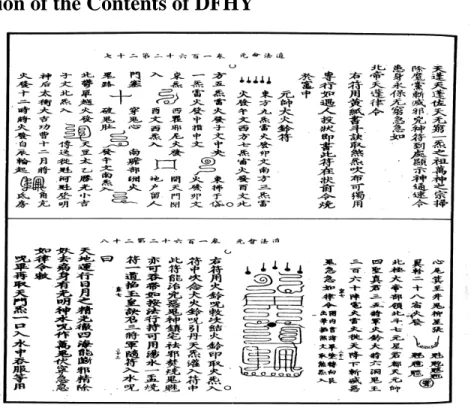
The first issue to be solved for building DDFHY was to split the graphics and texts and organize them into a database, without losing connections among them. We digitized 2651 pages in the DFHY to build the Digital DFHY. We saved each page as a single JPEG file. As shown in Figure 1, a page of the DFHY contains complicated graphics and texts. All of the
texts are written in ancient Chinese and graphics are all written by hand (The texts are written from right to left and top to bottom).
In this page, there is a Fu titled Yuan-Shuai Da
Huo-Ling Fu. Figure 2, shows a Fu titled Fei-Ren Zhuo-Long Fu. Following the title, there are the San-Xing Fu and Ju-XingFu of Fei-Ren Zhuo-Long Fu.
Figure 2 The San-Xing Fu and Ju-Xing Fu for Yuan-Shuai Da Huo-Ling Fu on the Volume 162, page27
As shown in Figure 2, each image of San-Xing Fu can be found in the Ju-Xing Fu on the right of the page. The images in San-Xing Fu can be found in the top of the Ju-Xing Fu, so we call these images parts. That is, the Ju-Xing Fu is a combination of parts. However, it is not clear that every part should be shown in Ju-Xing
Fu. In some cases, the images in Ju-Xing Fu are not
expressed in San-Xing Fu. On the other hand, the graphics in DFHY are drawn by hand and the texts following the graphics are classic Chinese. These problems troubled Daoism researchers and it takes them a long time to interpret each image of Fus. Unfortunately, we could not find any automatic text recognition software to convert scripts in DFHY into text files. All of the original scripts are, therefore,
converted into text files manually under the guidance of Daoism researchers.
To build the database of DDFHY, individual graphic symbols were extracted and saved as JPEG files. Each graphic symbol was associated with the texts attached to it and stored in the database. Every constituent part of a Fu was extracted manually and stored in the database. Each of the graphic symbols and components is given a unique identifier (Yasoda, 2001, p. 25)[10]. To do this task is crucial because some components look very similar but have different meanings. In some cases, we can not give the similar parts an identifier determined only by its shape before we have read and understood its meaning.
We defined an identifier for Fus (FuID) in order to correctly organize the information about the alignment of the graphics and texts in an original Fu. For instance, in the case of the Fus shown in Figure 2, the page number is marked on the top of the page. When Fus occupy more than one page, we will set the identifiers of location for them on the page where the Fu’s title is. For example, as the page image shown in figure 1 is on the 28th page of volume 162, this image file of Yuan-Shuai Da Huo-Ling Fu is named 16228.jpg. The graphic symbol of their the No.1 Fu appearing on this page, so it is saved in a file named after the identifier,
e.g. 1622801.jpg. In other words, we defined the identifier of a Fu by its location decided by the page where it is and the number the Fu owns in the page.
Every graphic in San-Xing Fu is saved in a JPEG file separately. The file is given an identifier, which is a composition of the Fu Identifier and its sequence number. The texts following a part are saved in a plain text file. So the ID for first part in Yuan-Shuai Da Huo-Ling Fu is 162280101. In this way, we can connect the Fus, parts and the texts by these ID numbers in the database. In Table 1, there are examples of Fus and parts and texts for Yuan-Shuai Da Huo-Ling Fu.
Table 1 The digitalized data for Yuan-shuai Da Huo-Ling Fu
Fu_name (Fu_id) The mark for having San-Xing Fu or not
Yuan-Shuai Da Huo-Ling Fu
(元帥大火鈴符) 1622801 1
Table 2 Data for the Fu and each parts contained in the San-Xing Fu
Fu_name Parts_id parts_shape ID[10] Texts for parts
1622801 162280101 Sf010506 東方九炁雷火發卯文南方三炁雷火發午文西方七炁雷火
發酉文北方五炁雷火發子文中央一炁雷火發中指中文
1622801 162280102 Sf011203 東拂于岱火發卯文東炁入
1622801 162280103 Sf011204 西瞿取尼火發酉文西炁入
1622801 162280104 Sf030301 開天門閉地户留人門塞鬼路
Figure 3 shows the framework of the Digital DFHY. In this framework, there are two major components. The left part shows the core database of Digital DFHY – the database of images and texts of the Fus and constituent parts. Images are saved as JPEG files. Texts are taken from the titles of Fus, scripts are attached to the Fus, and other texts are included in the pages. This set of data is used to search Fus and the
constituent parts. The core database is used in several different applications as shown in the right hand side of this figure. For example, Yasoda (2001, p. 27) supposed how to classify the shapes of parts using this dataset and has done some classify on a part of part. And the Daoism researchers has testified that this catalogue and progressed the data for the parts shapes for all of Fus having San-Xing Fu (Hayakawa, 2010, p. 57).
Figure 3 The framework of the Digital DFHY
Analysis of Parts,
Fus and Volumes of the DDFHY
Even Yasoda and Hayakawa have done some analysis of the DFHY and research to determine the rules of graphics of the DFHY is still on going. The Fu’s texts are not easy to work with. Even in a single collection, such as the DFHY, Fus with the same shape can be of different meaning. It is considered but not proved that the shape of Fus often stands for some relationship between Fus, such as their belonging to the same religious school or having the same function. Even explanatory texts are hard to read and process by computer, as parts having the same shape stands for a strong relationship with each other. Thus, a Fu can be imagined as a sentence and the parts can be considered as the “words” in that sentence. The relationship can be studied by consulting their frequency and co-location.Relationship Between Fus
As shown in Figure 4, we can see three parts of
Ju-Xing Fu. We find that Yuan-Shuai Da Huo-Ling Fu
(元帥大火鈴符) has seven shared-parts with Kui-Huo
Fu (虁火符). On the other hand, Kui-Huo Fu (虁火符)
has only one shared part with Fei–Dan Fu (飛丹符).
Even the shared parts have different explanatory texts, the same shape of parts showing they are semantically related to each other somewhere on the graph. So the sharing of parts stands for the semantic relationship between two Fus.
We use the number of shared-parts to measure the connection between two Fus. In the example shown in Figure 4, Yuan-Shuai Da Huo-Ling Fu has a closer relationship to Kui-Huo Fu than Fei–Dan Fu using the number of shared-parts. In other words, the connection between the two Fus is a semantic connection between them (and is supported as such by Daoism researchers). The distance between the Fus, the inter-Fu distance (number of shared-parts), indicates the closeness in meaning between each pair of the Fus.
Using the inter-Fu distance, we can build a network of Fus as shown in Figure 5. In the network, we show the parts contained in the Fus. Fu IDs indicate in what volumes the Fus are contained. In this way, parts, Fus, and volumes are all included in the network. All of the
Fus are connected with each other by the shared-parts.
Using this network, we can learn about Fus. For example, those Fus located at the center of the network stands for that they have most connection with another
Fus. In other words, they are the Fus with parts most
frequently used.
Figure 4 The shape of Ju-Xing Fu for Yuan-Shuai Da Huo-Ling Fu (元帥大火鈴符), Kui-Huo Fu ( 火符), and
Fei-Dan Fu (飛丹符). There are 10 parts contained in Yuan-Shuai Da Huo-Ling Fu, and Kui-Huo Fu and 9 parts in Fei-Dan Fu. All the parts are picked up from the San-Xing Fu for each Fu.
Figure 5 The mapping for the Fus and their parts, showing most of them are connected by sharing-parts. Yuan-Shuai
Da Huo-Ling Fu (元帥大火鈴符) and Fei-Dan Fu (飛丹符) are also included in the network.
In the network of Fus, Fus and parts are represented as graph nodes. Fus, which share an identical constituent part are connected via the part. Thus, we created a graph composed of Fus and their constituent parts, i.e. a network of Fus.
In order to calculate the relationship values for Fus in the network, we defined the algorithm below:
d--- Distance between two parts i, j (dij): the number of the Fus on a path between two parts on the graph.
t---- The shortest path length between two parts i, j
(tij): the minimum distance between the two parts. i.e. min(dij)
w--- Number of shortest paths between two parts i, j (wij): the number of paths whose lengths are equal to tij.
r---- Relationship between parts r (Pi, Pj) is determined by the next expression. here,it is a heuristic value and we have supposed it as 1.2. (Subscripts i, j are omitted.)
(r): (1)
The relationship values are in inverse proportion to the distance of each pair of the parts. The relationship value between two Fus (FA and FB) is defined by the expression below:
In this way, we can get the relationship between Yuan-Shuai Da Huo-Ling Fu (元帥大火鈴符) Kui-Huo Fu ( 火符) and Fei-Dan Fu (飛丹符) in Table 3.
Table 3 The values of relationships for the Yuan-Shuai Da Huo-Ling Fu, Kui-Huo Fu and Fei-Dan Fu
Fu pais (Fu ID) Relationship value
1180201, 2600301 2.23
1180601,2600801 6.25
1180701,2470101 6.84
1180802, 2470101 3.75
Distribution of Fus and Parts
Our study of the distribution of parts was an attempt to analyze the contents of DDFHY. Being distinct from calculating the relationship between Fus, mapping of the distribution of parts is to look for rules for parts and to support researchers with hints about which parts are repeated.
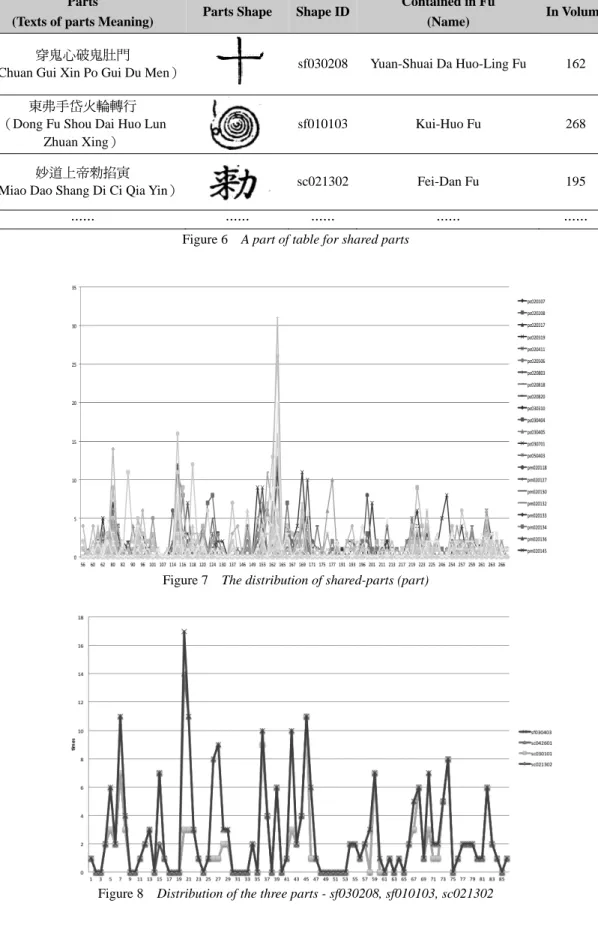
Some examples are shown in Figure 6, which contain attributes and the values for relationships of shared-parts. We counted how many times each
shared-part appears in a single volume. Figure 7 shows distribution graphs of shared-parts over the volumes. In this chart, the x-axis and y-axis show the volumes sorted by the volume number given in DFHY, and the number of occurrences of a part in each volume. Figure 8 shows a few shared-parts from Figure 7 respectively.
Also, the distribution of relationships of parts and
Fus are mapped. Figure 7 shows the sharing parts
occurs most in the range of Volume 162 to Volume 268. We find that one shared-part in Volume 164 is contained in more than 30 Fus from the Figure 8.
Parts
(Texts of parts Meaning) Parts Shape Shape ID
Contained in Fu
(Name) In Volume
穿鬼心破鬼肚門
(Chuan Gui Xin Po Gui Du Men) sf030208 Yuan-Shuai Da Huo-Ling Fu 162 東弗手岱火輪轉行
(Dong Fu Shou Dai Huo Lun Zhuan Xing)
sf010103 Kui-Huo Fu 268
妙道上帝勑掐寅
(Miao Dao Shang Di Ci Qia Yin) sc021302 Fei-Dan Fu 195
…… …… …… …… ……
Figure 6 A part of table for shared parts
Figure 7 The distribution of shared-parts (part)
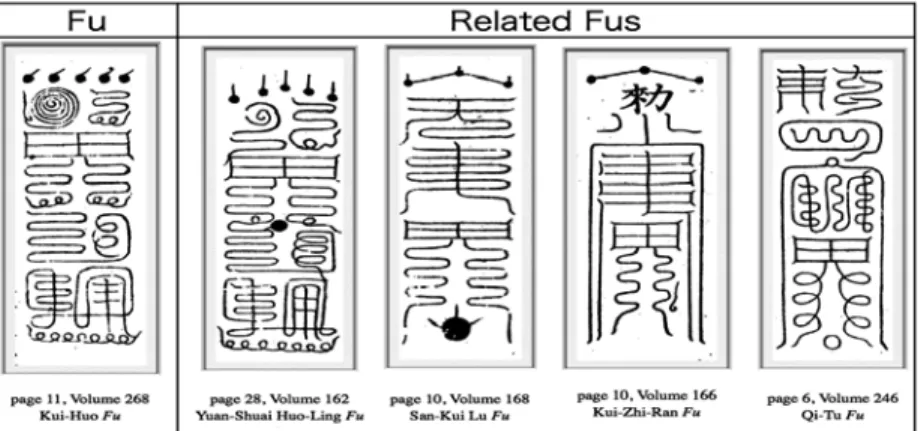
Figure 9 Example for the ranking of Fus relationship: For Kui-Huo Fu there are 4 Fus that have close
relationship with it. We can check out that the Yuan-Shuai Da Huo Ling Fu has not only the most sharing-parts with Kui –Huo Fu but also similar structure.
Seeing the relationship values for each pair of Fus, Daoism researchers can see that a pair of Fus shares the same meaning if the pair contains one or more
shared-parts. Next, we sorted all Fu-pairs by the
relationship value and picked-up Fu pairs whose relationship values are higher than the average.
As shown in Table 3, for the Kui-Huo Fu, the Fus having the closest relationship in the network are
Yuan-Shuai Da Huo-Ling Fu, San-Kui Lu Fu, Qui-Zi Ran Fu, and Qi-Tu Fu. We list all of these Fus in Ju-Xing Fu as shown in Figure 9.
A Fu is an important symbol to identify Daoism schools. The structure of a Fu is a key factor in the identification process. In the list of Fus, we can investigate not only the relationship value of Fu pairs but also relationships between Fus and volumes. By comparing the structure of each Fu in this list, we see the features of the structures of related-Fus. Comparing the related Fu’s meaning with the structure, it is possible to find some hidden relationships, which are not explicitly written in DFHY.
By comparing the index of DDFHY with the list of related-Fus, we find that Kui-Huo Fu and the
Yuan-Shuai Da Huo-Ling Fu have a close relationship
with each other. The close relationship between
Kui-Huo Fu and the Kui-Zhi-Ran Fu (the third Fu of
the list) is a new finding resulting from our research.
Sorting Relationships of Volumes
as Evaluation of the Relationships
of Fus
One of the most important issues in this study is to find the relationships among volumes using DDFHY. The index of DFHY states that some volumes are compiled in accordance with Daoism schools. However, relationships between volumes and schools are not yet clear in the Daoism research community. Assuming that Fus would represent styles of charms and secret terms owned by a Daoism school, we propose to use the Fus-Volumes relationships as a hint to find Volume-School relationships.
About 20% of the volumes of DFHY contain no Fus, we calculated relationships for inter-volumes, which have Fus contained in by the inter-Fus relationships. After getting all the relationships for the parts, Fus and volumes, the relationship network can be built. The distances between parts, Fus and volumes can be shown in this network.
In the next step, we plan to set up a method for analysis of the Daoism resources and also to consider
another compilation of Daoism, containing graphics and texts. To improve the digital archive for humanities resources and to bulid a complete digital archive is challenging.
The Digital DFHY System
We have applied DDFHY to the analysis of Fus as mentioned in the previous sections. DDFHY has functions to help users browse and search the digitized
Fus and other aspects of DFHY.
Using the digital DFHY, researchers not only can search the contents, such as the images for pages, Fus and parts, but also can analyze the relationships between Fus, parts and volumes. Deciding how to arrange such digitalized information for the texts and images is the initial step in building the whole system. For analysis of the parts, Fus and volumes, which is
presented in Section 3, we first made a category to identify the shape of parts (Hayakawa, 2010, p. 68). Based on the shape of parts, we calculated the relationship between the parts and then the relationship between Fus.
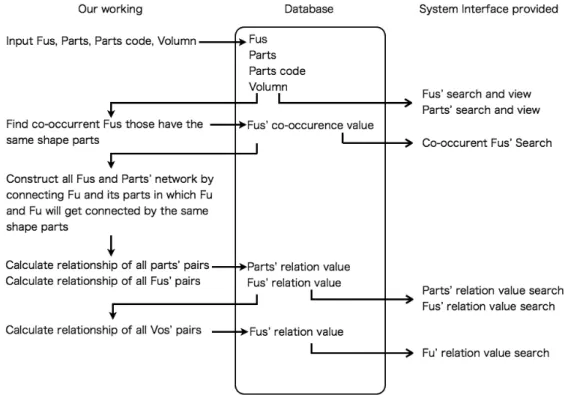
Figure 10 shows how we worked, what kind of data we have put into the database, and what researchers can do with the system. The DDFHY is built step-by-step. Firstly, we input the digitalized contents such as Fus, parts, pages into the database, and the contents in DFHY could be searched. Based on the parts with the same shape, relationships based on the co-location of parts and Fus can be seen in the system. The network of all of the Fus helps us search for the distributions of Fus in the volume, and also gave researchers some new ideas. Then the relationship values of each pair of volumes that contain Fus are calculated and these results are shown in the system.
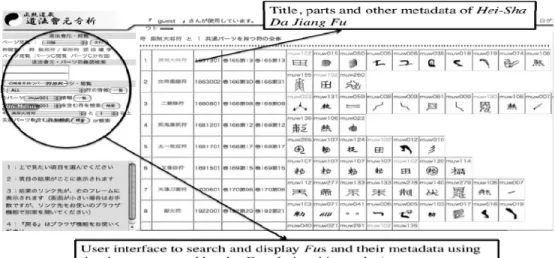
Figure 11 An example of the user interface of DDFHY
Having decided what data to make and use, how to design the system interface of the DDFHY is still to be considered. For example, how to design the interface to show that a Fu is related to multiple Fus among a big amount of Fu’s relationships is not an easy work. Finally, we designed the system to show the relationships between each pair of Fus as Figure 11. Users can select the Fu by their positions, which page the Fu is on, by the name of the Fus or by the parts it contains, and then all of the Fus related with this Fu can be seen on the right part. All of the parts these related Fus contains are also shown. Humanists can do their study by using these analysis results as hints.
Considering that this digitalized system is mainly for humanists, to design a friendly interface is a key element to attract researchers. To improve the user interface to make the DDFHY more convenient to use is still on process.
Conclusion and Discussion
This paper presents the Digital DFHY, a digital archive created from DFHY– a very important resource for Daoism researchers. DDFHY is designed as a tool to support Daoism researchers. In DDFHY, a Fu is expressed as a complex graphical entity composed of
more than one constituent part. The goal of this study is to build an environment based on DDFHY to help the Daoism research community analyze the structure of all
Fus and relationships among Fus. Up till now we have
digitalized all the Fus, which contains San-Xing Fu in them. How to digitalize all of the graphics not only including Fus, but also Tan(壇), and Gang(罡) and so on, is still left to the future work. We are trying to mark the position of each part of Fus to interpret the relationship between position of parts and the meaning of Fus. Thus Fus having no San-Xing Fu can be deconstructed and quantified (Feng, Matsumoto, & Sugimoto, 2010, pp. 23-28)[11].
After digitalization of the original contents of DFHY, we focused on the relationship analysis between Fus and volumes. A network of Fus was built, where all of the Fus are connected by shared-parts. We created a network of volumes, which are connected by relationship values among Fus. This study of the relationships among the volumes helps uncover the secrets of Fus and volumes, which is difficult and complex even for Daoism researchers because of the large number of Fus and that the texts are difficult to understand. The relationship of each parts, Fus, and volumes are presented in various formats. By using the distribution of the relationships of parts, it is possible
to study how the parts are used in the volumes. The co-location of parts shown in our research suggests to researchers, the possibility of the co-location of parts in other places. The relationship of Fus can also help researchers discover semantic connections even where this connection is not written in DFHY directly. In addition, the relationships can be used to verify new hypotheses, which have been proved in some cases (Feng, Matsumoto, & Sugimoto, 2012a, p. 104)[12].
The relationship analysis presented here has revealed a few new facts about the DFHY. The database of Fus does not cover all of the Fus yet, so the first priority for our future work is to extend the coverage. Even the basic database for the DDFHY has been built (Feng, Matsumoto, & Sugimoto, 2011, p. 28), and some analysis results have be presented (Feng, Matsumoto, & Sugimoto, 2012b, pp. 8-9), and helped humanists research on DFHY it is also crucial for us to refine the functions to determine the relationship values between volumes. Nevertheless, this study has clarified the advantages of DDFHY to help research in Daoism and more generally in humanities. It follows the trend to add extra value to a digital archive of historical documents and humanity resources instead of just documents in digital format. We hope to deepen our research and the methods of analysis of the graphics in classic documents to assist humanists even more. In an attempt to build a new digital archive of humanity resources, to investigate what the users of these resources need is necessary. We tried to set up a new analysis method for images contained in Daoism resources and also to develop a new method for building digital archives to support humanists.
Acknowledgements
We thank Prof. Norihiko Uda and Ms. Misa Hayakawa for their support and contributions. We also thank all colleagues who have contributed to the DDFHY and this paper. This study is supported in part by JSPS Grant-in-Aid-for Scientific Research (A) #22240023 and (C) #40154489.
Note
[1] Information searched from: http://zh.wikipedia. org/wiki/%E9%81%93%E8%97%8F
[2] Li considered Fus are not written in just arbitrary as they look. There are some rules for Fus but rules are difficult to discover in this book.
[3] Information searched from http://baike.baidu. com/view/953390.htm
[4] The American Memory contains many archives and can be viewed online. http://memory.loc.gov/ ammem/index.html is the official website of the American Memory.
[5] Europeana enables people to explore the digital resources of Europe's museums, libraries, archives and audio-visual collections. It promotes the discoveries and networking opportunities in a multilingual space http://www.europeana.eu/portal/ is the official website of Europeana.
[6] The National Digital Archive Program is an important project purposing to how to create organize and dissemination knowledge of various national heritages. Details in this program can be view by the website http://teldap.tw/en/.
[7] The digital Library of Meiji Era collects many books of Meiji Era. The library arranges and supplies users books by analysis on the contents. This service can be experienced on the website of http://kindai. ndl.go.jp/.
[8] The Archimedes Palimpsest Digital Project attempts to restore the damaged contents of the maniscript of Archimedes and also try to analyze on it. The achievements of this project can be viewed by the website http://www.archimedespalimpsest.org/.
[9] The maniscript named Tai Shang Dong Xuan
Ling Bao Su Ling Zhen Fu(太上洞玄靈寶素靈真符)
of Lu Jing-Xiu we referenced is published in 2004,as a part of Dao Zang(道藏),volume 6,p344.
[10] Yasoda suggestes to divid the shapes of parts into several catalogues. Hayakawa followed her to study on the shapes and specified them into 4 kinds, as “a part of Chinese Characters”, “a part of graphics”, “combination of Chinese Characters and graphics” and “Unknown”.
[11] In this paper, Feng (the author) try to give each part of Fus a position ID to mark where the parts are. By giving some important positions special ID, the relationship between Fus having the same parts can be more specified and meanwhile Fus having no San-Xing
Fu can be analyzed.
[12] Matsumoto Koichi, a professor at Daoism study, has proved that by the analysis results, Vo,me 118,262,155 ,222 which volumes are not connected in DFHY are found to be the same system named “Bei-DI”(北帝).
References
Borgman, C.L. (2010, January). Introduction of the host of the Humi project. CDLI Cuneiform Digital Library Intiative, University of California, Los Angeles.
Feng, X., Matsumoto, K., & Sugimoto, S. (2010). Analysis of the relationship Charms in “Dao-fao Hui -yuan”. JPST SIG Technical Report, 2010-CH-88, 23-28. [Texts in Japanese].
Feng, X., Matsumoto, K., & Sugimoto, S. (2011, October). Digital archive “Dao Fa Hui Yuan” for Daoism research. In C.H. Yu (Chair), ICADL'2011
Proceedings of the 13th International Conference on Asia-pacific Digital, Beijing: China.
Feng, X., Matsumoto, K., & Sugimoto, S. (2012a). Creating the database and analysis the contents using statistical methods of [Dao-Fa Hui Yuan]. Nippon Dokyo Gakkai: The Journal of Eastern Religions. [Texts in Japanese].
Feng, X., Matsumoto, K., & Sugimoto, S. (2012b, November).Uncovering the secrets of Daoism Fus using Digital Dao Fa Hui-Yuan. In V. Wuwongse (Chair), ICADL'2012 Proceedings of the 14th International Conference on Asia-pacific Digital, Taipei: Taiwan.
Hayakawa, M., Matsumoto, K., & Uda, N. (2010). Classifing terms used in Taoism charms appearing in “Dao-Fa Hui Yuan”. Tsukuba: Digital Libraries Study, 8(1), 57-69. [Texts in Japanese].
Li, Y. (2003). Shen Xiao Lei Fa: The history and thought of Daoism Shen Xiao Lei Fa. Sichuan People's Publishing House, 338-470. [Text in Chinese].
Matsumoto, K. (2001). Dao Fa Hui Yuan-A great compile of magic, reading the classic Daoism book. Tokyo : Taishukan Publishing. [Text in Japanese] Nikaido, Y. (2006). The change of the Marshal God in
the Daoism and Folk Beliefs. Osaka: The Institution of Oriental and Occidental Studies, Kansai University. [Text in Japanese].
Yasoda, Y. (2001) The digitizing of history documents for supporting the research (Unpublished Master’s Thesis). University of Tsukuba, Japan. [Text in Japanese].