
Quantum Identification Protocol with Trusted Author
5
0
0
全文
(2) entities both measure the shared states and get two. i-th entangled states. Otherwise, Bob applies. measured values. The verifier sends his measured to. nothing to the i-th entangled states. Thus, the. the user. According to two measured values and. shared. initial entangled states, the user gets a random. state. is. changed. to. ⎧⎪ X Φ i , if ri = 1 Φ′i = ⎨ . ⎪⎩ Φ i , if ri = 0. number ri′ and sends it to the verifier. Finally, the verifier check ri and ri′ . If ri′ = ri , the quantum Step 3:. identification protocol is success; otherwise it is fail. This paper is arranged as follows. We describe. Bob and Alice measure the shared state Φ′i ,. our quantum identification protocol and give a simple. respectively. Thus, Bob gets the measured. example in Section 2. Section 3 discusses and. values Bi and Alice gets the measured. analyzes our protocol. Finally, conclusions are drawn. values Ai . Then, Bob sends the measured. in Section 4.. value Bi to Alice. Step 4: According to Ai , Bi , and initial entangled. 2. Our quantum identification protocol. state. We assume that two entities, called Alice and Bob.. Alice. {S1 , S 2 , L, Sn } author,. where 1. Φ− =. 2. must. deposit. n. different. numbers ri′ by Rule 1.. sets. of entangled states to the trusted Sj. ∈ { Φ+ =. ( 01 − 10 ) }.. 1 2. ( 00. + 11. ). Φ i , Alice computes the random. Rule 1: 1 If A = B and the initial entangled state ○ i i. ,. is Φ i = Φ + , Alice computes the number. Alice controls the first. ri′ =0. 2 If A = B and the initial entangled state ○ i i. qubits of all entangled states and the trusted author takes care of the second qubits of all entangled states.. is Φ i = Φ - , Alice computes the number. Whenever Bob want to verify Alice’s identity, Bob asks the trusted author to verify Alice’s identity.. ri′ =1.. In the following, our quantum identification protocol. 3 If A ≠ B and the initial entangled state ○ i i. is given.. is Φ i = Φ + , Alice computes the number. Step 1: Bob asks the trusted author to verify Alice’s. ri′ =1.. identity. Then, the trusted author gives the. 4 If A ≠ B and the initial entangled state ○ i i. second qubits of entangled states to Bob.. is Φ i = Φ - , Alice computes the number. Then, Alice and Bob perform the following. ri′ =0.. Step 2 and Step 4 for the i-th entangled states from i=1 to n.. Then, Alice sends the number ri′ to Bob.. Step 2: Bob. selects. a. random. numbers. Step 5:. r = (r1 , r2 , L, rn ) , where ri ∈ {0, 1} . If ri = 1 ,. Bob. ⎛ 0 1⎞ Bob applies an operator X = ⎜⎜ ⎟⎟ to the ⎝1 0 ⎠. identification protocol is success; otherwise,. verifies. the. received. numbers. r ′ = (r1 , r2 , L, rn ) . If ri = ri′ , the quantum. 2.
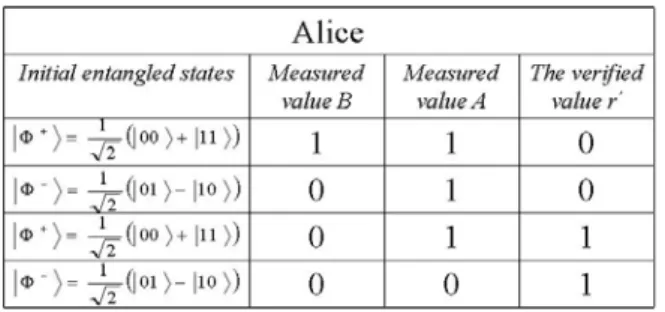
(3) Step 2: (i=3). the protocol is fail.. ⎛ 0 1⎞ According to r3=1, Bob applies X = ⎜⎜ ⎟⎟ ⎝1 0 ⎠. Example:. to the entangled state. Assume that Bob wants to verify Alice’s identity by using our quantum identification with. shared. trusted author. Assume that Alice’s entangled states is. {. S = { Φ1 , Φ 2 , Φ 3 , Φ 4 } = Φ , Φ , Φ , Φ +. −. +. −. state. is 1. Φ′3 = X Φ + =. }.. 2. Φ 3 . Thus, the. changed. to. ( 01 + 10 ) .. Step 3: (i=3). Then, Alice, Bob and the trusted author performs the. Bob and Alice measure the shared state Φ′3 , respectively. Assume that Bob’s. following steps.. measured value B3 is 0 and Alice’s measured. Step 1:. value A3 is 1. Then, Bob sends B3=0 to. The trusted author sends the second qubits of S = { Φ1 , Φ 2 , Φ 3 , Φ 4. }. to Bob. Then,. Alice. Step 2: (i=4). Alice and Bob perform the following Step 2. ⎛ 0 1⎞ According to r4=1, Bob applies X = ⎜⎜ ⎟⎟ ⎝1 0 ⎠. and Step 3 for the i-th entangled states from i=1 to 4.. to the entangled state. Step 2: (i=1) Bob selects a random number r = (0, 0, 1, 1) .. shared. According to r1 = 0 , Bob applies nothing to. state. is 1. Φ′4 = X Φ − =. the entangled state Φ1 . Thus, the shared. 2. Φ 4 . Thus, the. changed. ( 00. to. − 11 ) .. Step 3: (i=4). state is Φ1′ = Φ1 = Φ + .. Bob and Alice measure the shared state Φ′4 , respectively. Assume that Bob’s. Step 3: (i=1) Bob and Alice measure the shared state. measured value B4 is 0 and Alice’s measured. Φ1′ , respectively. Assume that Bob’s. value A4 is 0. Then, Bob sends B4=0 to Alice.. measured value B1 is 1 and Alice’s measured Step 4:. value A1 is 1. Then, Bob sends B1=1 to. According to Table 1, Alice computes the. Alice.. verified value r ′ . When i=1, A1=1, B1=1. Step 2: (i=2) According to r2 = 0 , Bob applies nothing to. and. the entangled state Φ 2 . Thus, the shared. the. initial. Φ1 = Φ + =. state is Φ′2 = Φ 2 = Φ − .. 1 2. entangled. ( 00. state. is. + 11 ) . Then, Alice. guesses that Bob applied nothing to Φ1 . Thus, Alice computes the value r1′ = 0 .. Step 3: (i=2) Bob and Alice measure the shared state. Similarly, Alice computes the values r2′ = 0 ,. Φ′2 , respectively. Assume that Bob’s. r3′ = 1 , and r4′ = 1 . Finally, Alice sends the. verified values r ′ = {0, 0, 1, 1} to Bob.. measured value B2 is 0 and Alice’s measured value A2 is 1. Then, Bob sends B2=0 to Alice. 3.
(4) the measured value Ai=1. Because Ai = Bi , Alice guesses that Bob applied nothing to the entangled state. That is,. ri′ = 0 .. Similarly, if Bob gets the measured value Bi=0 and Alice gets the measured value Ai=0. Alice also gets ri′ = 0 . Table 1 : Computing the verified value. Case 3: If the random number ri = 1 , Bob applies X. Step 5: According. to. Alice’s. verified. values. to Φ i = Φ − . Thus, the entangled state is. r ′ = {0, 0, 1, 1} , Bob verifies r ′ =r. Thus, Bob. verifies Alice’s identity successfully.. 1. changed to Φ′i =. 2. ( 00. − 11 ) . Bob and. Alice measure the shared state Φ′i . If Bob. 3. Discussion and Analysis In this section, we give correctness and security. gets the measured value Bi=0 and Alice gets. analysis of our protocol. First, we describe the. the measured value Ai=0. Because Ai = Bi ,. correctness of our protocol.. Alice guesses that Bob had applied X to the entangled state. That is, ri′ = 1 . Similarly, if. We use four cases to discuss our correctness. Case 1:. Bob gets the measured value Bi=1 and Alice If the random number ri = 1 , Bob applies X. gets the measured value Ai=1. Alice also gets ri′ = 1 .. to Φ i = Φ + . Thus, the entangled state is 1. changed to Φ′i =. 2. Case 4: If the random number ri = 0 , Bob applies. ( 01 + 10 ). Bob and. Alice measure the shared state. nothing to Φ i = Φ − . Thus, the entangled. Φ′i .. Assume that Bob gets the measured value. state is. Bi=0 and Alice gets the measured value Ai=1.. Φ′i =. 1 2. ( 01 − 10 ) .. Bob and. Because Ai ≠ Bi , Alice guesses that Bob. Alice measure the shared state Φ′i . If Bob. applied X to the entangled state. That is,. gets the measured value Bi=0 and Alice gets. ri′ = 1 . Similarly, if Bob gets the measured. the measured value Ai=1. Because Ai ≠ Bi ,. value Bi=1, then Alice gets the verified value. Alice guesses that Bob applied nothing to. Ai=0. Alice also gets ri′ = 1 .. the entangled state. That is,. Case 2:. ri′ = 0 .. Similarly, if Bob gets the measured value If the random number ri = 0 , Bob applies. Bi=1 and Alice gets the measured value Ai=0. Alice also gets ri′ = 0 .. nothing to Φ i = Φ + . Thus, the entangled. state is. Φ′i =. 1 2. ( 00. From Case 1 to Case 4, we describe that our protocol. + 11 ) . Bob and. is correct. Second, we analyze the security of our protocol.. Alice measure the shared state Φ′i . If Bob. Assume that Nancy wants to impersonate Alice.. gets the measured value Bi=1 and Alice gets. Because Alice must deposit quantum entangled states 4.
(5) to the trusted author, Nancy cannot impersonate. [1] C. H. Bennett and G. Brassard, “Quantum. Alice.. cryptography: Public key distribution and coin. If Nancy wants to impersonate Bob, Nancy. tossing,” Proceedings of the IEEE International. steals the contents of entangled states from Alice and. Conference on Computers, Systems and Signal. modifies the contents of entangled states. In our. Processing, p. 175, 1984.. protocol, the set of entangled states S is used once.. [2]C. Crepeau and L. Salvail, “Quantum oblivious. Thus, Nancy gets useless entangled states. Obviously,. mutual identification,” in Advances in Cryptology:. our protocol need deposit quantum qubits to trusted. Proceedings of Eurocrypt ’95 (Springer-Verlag,. author, so it is necessary of quantum computer.. Berlin, 1995), p. 133 [3]M. Dusek, O. Haderka, M. Hendrych, and R.. 4. Conclusions. Myska, ”Quantum identification system,” Phys.. In this paper, we don’t share any secret and. Rev. A, 60, 149, 1999.. achieve identification. In our protocol, at first, Alice. [4] T. Mihara, “Quantum identification schemes with. deposits n different sets of entangled states. {S1 , S 2 , L, Sn } Sj ∈ { Φ + =. to. 1 2. the. ( 00. trusted. + 11 ) , Φ − =. author 1 2. entanglements,” Phys. Rev. A 65, 052326, 2002.. where. [5] Wim van Dam, “Comment on "Quantum. ( 01 − 10 ) }.. identification schemes with entanglements"”, Phys. Rev. A 68, 026301, 2003.. Whenever Bob wants to verify Alice’s identity, the trusted author would give a set of the first qubits of entangled states to Bob. Bob selects a random number r = (r1 , r2 , L, rn ) where ri ∈ {0,1} . If ri = 1 , Bob applies an operator X to the i-th shared entangled state. Otherwise, Bob applies nothing to the i-th shared entangled state. Then, Alice and Bob measure the shared states and get two measured values A = ( A1 , A2 , L, An ) and B = (B1 , B2 , L, Bn ) . Then,. Bob sends B = (B1 , B2 , L, Bn ) to Alice. According to. A = ( A1 , A2 , L, An ) ,. initial entangled state. B = (B1 , B2 , L, Bn ) , and. Φ i , Alice computes the. random numbers r ′ = (r1′, r2′, L, rn′ ) and sends it to Bob. If r = r ′ , the quantum identification protocol is successfully; otherwise, the protocol is fail.. Acknowledgement This work was supported in part by the National Science Council of the Republic of China under contract NSC94-2213-E-214-029.. References 5.
(6)
數據
相關文件
2.1.1 The pre-primary educator must have specialised knowledge about the characteristics of child development before they can be responsive to the needs of children, set
Reading Task 6: Genre Structure and Language Features. • Now let’s look at how language features (e.g. sentence patterns) are connected to the structure
Promote project learning, mathematical modeling, and problem-based learning to strengthen the ability to integrate and apply knowledge and skills, and make. calculated
Now, nearly all of the current flows through wire S since it has a much lower resistance than the light bulb. The light bulb does not glow because the current flowing through it
(1) principle of legality - everything must be done according to law (2) separation of powers - disputes as to legality of law (made by legislature) and government acts (by
Using this formalism we derive an exact differential equation for the partition function of two-dimensional gravity as a function of the string coupling constant that governs the
Shandong Univ., Shanghai Jiao Tong Univ., Shenzhen Univ., Tsinghua Univ., USTC, Zhongshan Univ., Univ. of
This kind of algorithm has also been a powerful tool for solving many other optimization problems, including symmetric cone complementarity problems [15, 16, 20–22], symmetric
