Wavelength-Shifted ASK for Rayleigh
Backscattering Mitigation in TDM-PON
to WDM-PON Migration Scheme
Volume 5, Number 2, April 2013
C. W. Chow, Senior Member, IEEE
C. H. Yeh, Member, IEEE
DOI: 10.1109/JPHOT.2013.2247588
1943-0655/$31.00 Ó2013 IEEE
Using Downstream DPSK and Upstream
Wavelength-Shifted ASK for Rayleigh
Backscattering Mitigation in TDM-PON
to WDM-PON Migration Scheme
C. W. Chow,1Senior Member, IEEE, and C. H. Yeh,2 Member, IEEE
1Department of Photonics and Institute of Electro-Optical Engineering, National Chiao Tung University, Hsinchu 30010, Taiwan
2Information and Communications Research Laboratories, Industrial Technology Research Institute (ITRI), Hsinchu 31040, Taiwan
DOI: 10.1109/JPHOT.2013.2247588 1943-0655/$31.00 Ó2013 IEEE
Manuscript received January 15, 2013; revised February 8, 2013; accepted February 8, 2013. Date of current version February 28, 2013. This work was supported by the National Science Council of Taiwan under Contracts NSC-101-2622-E-009-009-CC2, NSC-101-2628-E-009-007-MY3, and NSC-100-2221-E-009-088-MY3. Corresponding author: C. W. Chow (e-mail: [email protected]).
Abstract:A migration scheme from time-division-multiplex passive optical network (TDM-PON) to wavelength-division-multiplex PON (WDM-(TDM-PON) using differential phase-shift keying (DPSK) for the downstream signal and wavelength-shifted amplitude-shift keying (WS-ASK) for the upstream signal is demonstrated. The migration scheme does not change the existing fiber infrastructure. An optical filter is preinstalled at the optical networking unit (ONU) to select the desirable downstream wavelength for the WDM-PON and simulta-neously demodulate the downstream DPSK signal. Signal remodulation is used to generate the upstream signal by reusing the downstream wavelength. In the ONU, by wavelength shifting the upstream optical spectrum with respect to the downstream optical spectrum, the Rayleigh backscattering (RB) interference beat noise affecting the upstream signal can be significantly mitigated. The optimum bandwidth for the downstream DPSK demodulation is analyzed. The downstream and upstream transmission performances at different split ratios are also discussed.
Index Terms: Optical communications, noise mitigation, wavelength-division-multiplex passive optical network (WDM-PON), differential phase-shift keying (DPSK).
1. Introduction
Passive optical network (PON) has already been deployed in many different countries all over the world to meet the huge bandwidth demand of broadband services. When compared with the copper-based access networks using coaxial cable and digital subscriber line (DSL), these time-division-multiplexed (TDM)-based PONs can offer high bit rate to users. Although these TDM-PONs are cost effective, they suffer from the bandwidth sharing nature [1]. As a result, wavelength-division-multiplexed (WDM) PON has been proposed to increase the bandwidth utilization of the optical fiber [2]–[6]. In WDM-PON, a dedicated pair of wavelengths is assigned to each optical networking unit (ONU); hence, high-bit-rate transmission in both upstream and downstream direc-tions can be easily guaranteed for each ONU. WDM-PON also provides a direct optical point-to-point link between each ONU and the optical line terminal (OLT); hence, there is no need to handle complicated PON-over-Ethernet mapping and network management.
As the WDM-PON could be a future-proof solution, many places that are still using copper-based access solutions are considering deploying the WDM-PON directly (so-called green-field deploy-ment [7]). However, it may be difficult for some places where TDM-PON has already been built. In this so-called brown-field deployment, mitigation solutions from TDM-PON to WDM-PON are re-quired. It is worth to mention that in the next-generation PON stage 2 (NG-PON2) (the expected features include: passive split ratio of at least 64, data rate per ONU of 1 Gb/s downstream, and data rate per ONU of 0.5 to 1 Gb/s upstream) [8], WDM-PON does not need to coexist with the prior TDM-PON; however, the coexistence of TDM-PON and WDM-PON may be desirable [9] since the existing TDM-PON users are unaffected and the past investment on the fiber infrastructure can be protected.
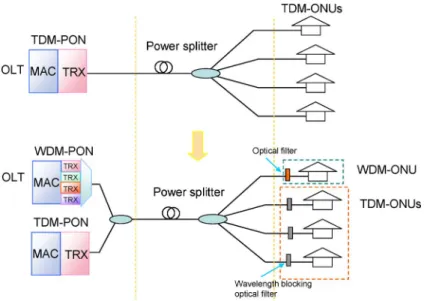
In this paper, we propose a migration scheme from TDM-PON to WDM-PON in which not only the fiber infrastructure is maintained but also the optical multiplexer/demultiplexer (MUX/DEMUX) functionalities are exempted. Previous schemes such as SUCCESS project [10] and PROaccess project [11] require the replacement of the passive fiber splitters. In the proposed migration scheme (shown in Fig. 1), many additional wavelength channels for downstream and upstream (apart from the wavelengths occupied by the original TDM-PON) can be introduced into the system, hence increasing the capacity, scalability, and coverage of the whole network.
In our scheme, differential phase-shift keying (DPSK) and wavelength-shifted amplitude-shift keying (WS-ASK) are used for the downstream signal and upstream signal, respectively. An optical filter can be preinstalled at the ONU for demodulation of the DPSK downstream signal [12] and select the desirable downstream wavelength in the WDM-PON receiver (Rx) simultaneously. Due to the constant amplitude of the undemodulated downstream DPSK signal, upstream ASK signal can be easily encoded into the downstream signal without considering the synchronization issue as reported in [13]. Hence, the downstream signal can be reused to produce the upstream signal, reducing the complexity of wavelength management and the cost of the WDM-PON. However, both the downstream and upstream signals have the same wavelength and share the same fiber; Rayleigh backscattering (RB) [14] generated by the downstream signal will severely affect the upstream signal. Here, we propose and demonstrate using upstream WS-ASK signal to reduce its spectral overlap with the RB noise. Reference [4] proposed and demonstrated a WDM-PON using downstream DPSK and upstream signal remodulated ASK. In their scheme, an intensity modulator (IM) was used to produce the double-sideband carrier-suppressed ASK upstream signal (also called the optical carrier-suppressed subcarrier modulation (OCS-SCM) signal). Then, a narrow
optical interleaver (IL) was required to remove one of the sidebands, producing the upstream signal. In our proposed scheme, the upstream WS-ASK signal was produced by a dual-parallel Mach– Zehnder modulator (DP-MZM); hence, no IL is required. Besides, ref. [15] showed that the WS-ASK signal was produced using an unmodulated continuous-wave (CW) carrier via a DP-MZM. In the proposed scheme, we demonstrate that this upstream WS-ASK signal can also be generated by using downstream DPSK signal via a DP-MZM, achieving signal remodulation.
The paper is organized as follows. The concept of the migration scheme is presented in Section 2. The optimum bandwidth for the downstream DPSK demodulation is analyzed in Section 3. The downstream and upstream experimental transmission performances at different split ratios are discussed in Sections 4 and 5. A conclusion is given in Section 6. Although the employment of an optical modulator and a preinstalled optical filter respectively to produce the wavelength-shift up-stream signal and to demodulate the downup-stream DPSK will complicate the system, we believe that the reuse of downstream optical wavelengths and the significant increase in transmission perfor-mances, together with protecting the existing fiber infrastructure, could justify it.
2. Concept of the Migration Scheme From TDM-PON to WDM-PON
Fig. 1 shows the system concept of migrating from TDM-PON to WDM-PON. In this scheme, an OLT dedicated for the WDM-PON is connected to the existing TDM-PON by using a passive fiber combiner. The downstream WDM wavelengths different from the existing TDM-PON wavelengths can be used to broadcast to different WDM-ONUs. The WDM-ONU can then select the desirable wavelength by means of a tunable filter or preassigned fixed wavelength filter. Optical filters could also be preinstalled to different TDM-ONUs to block the unwanted wavelengths generated by the WDM-PON. In the proposed network, only one optical filter is needed for each WDM-ONU to select the desired wavelength and to demodulate the DPSK downstream signal simultaneously. Hence, it could be cost effective. On the other hand, signal remodulation is used to encode the upstream WS-ASK signal onto the downstream DPSK signal. Hence, no laser source is required in the WDM-ONU for cost minimization. The proposed scheme can provide a migration solution from TDM-PON to WDM-PON with minimum additional cost to the existing TDM-PON users since there is no need of changing the existing fiber infrastructure. It can also allow the coexistence of TDM-PON supporting low bit-rate users and WDM-PON supporting high bit-rate users who can pay more to enjoy these services.
3. Analysis of Using Optical Filter for DPSK Demodulation
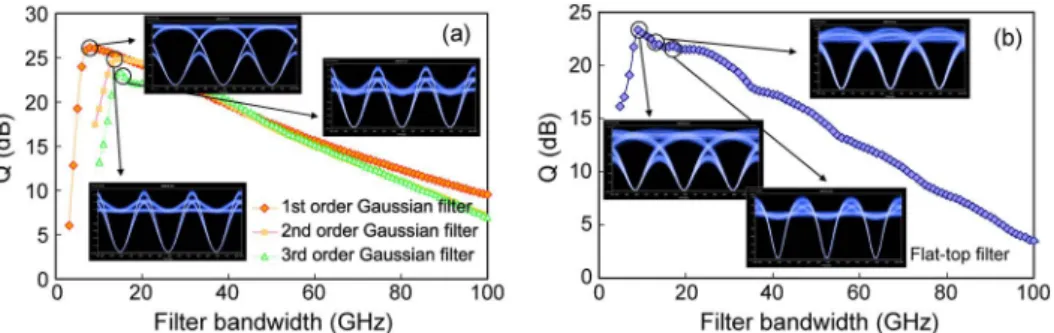
In this section, we numerically analyze the effects of using optical bandpass filter as the optical frequency discriminator to demodulate the DPSK signal. The analysis was performed by using commercial software VPI Transmission Maker V7.5. Fig. 2(a) and (b) shows the Q (dB) values of the demodulated DPSK signal using different 3-dB-bandwidth Gaussian filters and flat-top filters, respectively. As shown in Fig. 2(a), the optimum DPSK demodulated eye diagram can be achieved by using a first-order Gaussian filter with 3-dB bandwidth of 8 GHz. The eye shape is like the
Fig. 2. Simulated performance of the demodulated DPSK signal using (a) Gaussian and (b) flat-top filters. Insets: Simulated eye diagrams at different filter shapes and bandwidths.
demodulation using a conventional 1-bit delay interferometer. By increasing the order of the Gaussian filter, the rolloff factor of the filter increases, producing the inverted triangular-shaped eye diagram. We can also observe that using a higher order Gaussian filter will produce the demo-dulated eye diagram similar to the demodulation using a flat-top filter, as shown in Fig. 2(b).
4. Experiment
Fig. 3 shows the experimental setup of the proposed WDM-PON using downstream DPSK with optical filtering and upstream WS-ASK signals. A CW signal produced by a distributed feedback laser (DFB) at wavelength of 1553.6 nm and power of 5 dBm was launched into a phase modulator (PM) to produce the 10-Gb/s pseudorandom binary sequence (PRBS) 223 1 DPSK downstream
signal. The downstream signal was then launched into the ONU via an optical circulator, a 20-km standard single mode fiber (SMF), and a fiber splitter.
At the WDM-ONU, the power of the downstream signal was divided into two halves by a 3-dB fiber splitter. Half of the downstream signal was demodulated by using an optical bandpass filter and received by a 10-GHz PIN photoreceiver (Rx). In this proof-of-concept demonstration, a bandwidth-variable tunable optical filter (BVTOF) (Alnair Laboratories, BVF-200) was used to de-modulate the DPSK signal. The bandwidth of the BVTOF was set at about 10 GHz to get an optimum demodulated DPSK signal according to Fig. 2(b). The BVTOF has a flat-top response with sharp rolloff 150 dB/nm. The out-of-band suppression was about 50 dB.
Another half of the downstream signal was launched into a commercially available DP-MZM, which is also called differential quadrature phase-shift keying (DQPSK) modulator. It was elec-trically driven by a 10-GHz RF up-converted 2.5-Gb/s NRZ signal at PRBS 223 1 in-phase and
quadrature-phase respectively to the two electrodes in the upper and lower MZMs of the DP-MZM. By proper controlling the time delay and the bias of the third electrode, a single-sideband carrier-suppressed ASK (also called WS-ASK) signal can be generated. The optical spectra of the CW, downstream DPSK, and remodulated upstream WS-ASK signals at different points of the network are included in the insets in Fig. 3. We can observe that the upstream WS-ASK signal can provide a wavelength shift of 10 GHz away from the center wavelength for RB mitigation (suppressing the center wavelength at 1553.6 nm and one of the sidebands at 1553.4 nm). The upstream signal was then launched back through the same fiber path, via the optical circulator, fiber splitter, and 20-km SMF to the 2.5-GHz Rx in the central office (CO).
Fig. 3. Experimental setup of the proposed WDM-PON. Insets: Optical spectra at different points of the network.
5. Results and Discussion
Fig. 4 shows the bit-error-rate (BER) measurements of the 10-Gb/s downstream DPSK signal demodulated using an optical bandpass filter. We can observe that the BER of G 10 9 can be
achieved with negligible power penalty after 20-km SMF transmission without any dispersion com-pensation. The inverted triangular-shaped eye diagram is due to the use of a flat-top optical filter. This also agrees with our simulation results shown in Fig. 2(b).
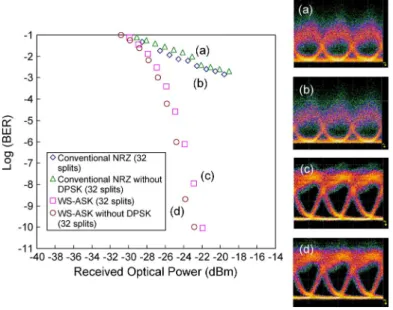
Fig. 5 shows the BER measurements of the upstream conventional NRZ and WS-ASK signals. Both signals were generated from the remodulation of the downstream DPSK signal, which has propagated through the 20-km SMF before the remodulation at the ONU. Then, the upstream signals also transmitted through the same 20-km SMF before being detected by the 2.5-GHz Rx in the CO. As shown in Fig. 5(a), the upstream signal performance of the conventional NRZ is severely degraded by the RB noise, with an error floor at BER of 10 3 at the split ratio of 32. It is
estimated that the signal-to-RB-noise ratio is only 8 dB at this split ratio. We can clearly observe that the WS-ASK can significantly mitigate the RB noise, providing error-free transmission. By increas-ing the split ratio to 64, the performance of the conventional NRZ signal becomes worse, with an error floor at BER of 10 2. However, the proposed WS-ASK signal is still error free with a power
penalty ofG 2 dB when compared with that in the case of 32 split ratio.
Then, we analyzed the effect of the downstream DPSK signal introduced to the upstream signals. We purposely removed the PM, as shown in Fig. 3; hence, the distributed signal was only a CW signal. Fig. 6 shows the BER measurements of the upstream conventional NRZ and WS-ASK signals with and without the downstream DPSK signal. We can observe that the effect of the phase
Fig. 4. BER measurements of 10-Gb/s downstream DPSK signal demodulated using optical bandpass filter. Insets: Corresponding experimental eye diagrams.
Fig. 5. BER measurements of the upstream signal using conventional NRZ and WS-ASK signals at (a) split ratio of 32 and (b) split ratio of 64. Insets: Corresponding experimental eye diagrams.
modulation introduced to the upstream signal is negligible in the conventional NRZ case, whereas it slightly affects the WS-ASK signal by introducingG 1 dB power penalty.
6. Conclusion
We have proposed a migration scheme from TDM-PON to WDM-PON in which not only the fiber infrastructure is maintained but also the optical MUX/DEMUX functionalities are exempted. DPSK and WS-ASK were used for the downstream and upstream signals, respectively. An optical filter was preinstalled at the ONU to select the desirable downstream wavelength for the WDM-PON and simultaneously demodulate the downstream DPSK signal. The performances of using Gaussian and flat-top optical filters with different 3-dB bandwidths were analyzed. In the ONU, a DP-MZM was used to generate the upstream WS-ASK for signal remodulation and RB mitigation. Experimental results showed that the upstream remodulated WS-ASK can provide error-free SMF transmission under 32 splits and up to 64 splits, whereas the conventional NRZ cannot provide error-free transmission. We believe that the proposed scheme can provide a migration solution from TDM-PON to WDM-TDM-PON with minimum additional cost to the existing TDM-TDM-PON users since there is no need of changing the existing fiber infrastructure. We believe that the reuse of optical wavelength, the significant increase in upstream signal transmission performances, and protecting the existing fiber infrastructure may justify the additional cost by using an external modulator and a preinstalled optical filter at the ONU.
References
[1] C. H. Yeh, C. W. Chow, C. H. Wang, F. Y. Shih, Y. F. Wu, and S. Chi, BUsing four wavelength-multiplexed self-seeding Fabry–Perot lasers for 10 Gbps upstream traffic in TDM-PON,[ Opt. Exp., vol. 16, no. 23, pp. 18 857–18 862, Nov. 2008.
[2] T.-T. Pham, X. Yu, T. B. Gibbon, L. Dittmann, and I. T. Monroy,BA WDM-PON-compatible system for simultaneous distribution of gigabit baseband and wireless ultrawideband services with flexible bandwidth allocation,[ IEEE Photon. J., vol. 3, no. 1, pp. 13–19, Feb. 2011.
[3] L. Y. Chan, C. K. Chan, D. T. K. Tong, F. Tong, and L. K. Chen,BUpstream traffic transmitter using injection-locked Fabry–Perot laser diode as modulator for WDM access networks,[ Electron. Lett., vol. 38, no. 1, pp. 43–45, Jan. 2002.
[4] G.-K. Chang, A. Chowdhury, Z. Jia, H.-C. Chien, M.-F. Huang, J. Yu, and G. Ellinas,BKey technologies of WDM-PON for future converged optical broadband access networks,[ IEEE/OSA J. Opt. Commun. Netw., vol. 1, no. 4, pp. C35–C50, Sep. 2009.
Fig. 6. BER measurements of the upstream conventional NRZ and WS-ASK signals with and without the downstream DPSK signal. Insets: Corresponding experimental eye diagrams.
[5] W.-Y. Lin, C.-H. Chang, P.-C. Peng, H.-H. Lu, and C.-H. Huang,BDirect CATV modulation and phase remodulated radio-over-fiber transport system,[ Opt. Exp., vol. 18, no. 10, pp. 10 301–10 307, May 2010.
[6] C. W. Chow, C. H. Yeh, C. H. Wang, F. Y. Shih, C. L. Pan, and S. Chi,BWDM extended reach passive optical networks using OFDM-QAM,[ Opt. Exp., vol. 16, no. 16, pp. 12 096–12 101, Aug. 2008.
[7] Recommendation ITU-T G.987.1 (01/2010), 10-Gigabit-Capable Passive Optical Networks (XG-PON): General Re-quirements, ITU-T G.987.1, 2010.
[8] F. Bourgart,BNGPON2VWhere are the standards going?[ presented at the Proc. NFOEC, Los Angeles, CA, USA, 2012, Paper NTu2F.
[9] P. Vetter,BNext generation optical access technologies,[ presented at the Proc. ECOC, Amsterdam, The Netherlands, 2012, Paper Tu.3.G.
[10] F.-T. An, D. Gutierrez, K. S. Kim, J. W. Lee, and L. G. Kazovsky,BSUCCESS-HPON: A next-generation optical access architecture for smooth migration from TDM-PON to WDM-PON,[ IEEE Comm. Mag., vol. 43, no. 11, pp. S40–S47, Nov. 2005.
[11] N. C. Tran, E. Tangdiongga, and T. Koonen,BPROaccess: A passive-components-based reconfigurable WDM-TDM optical access network,[ in Proc. Future Netw. Mobile Summit, Warsaw, Poland, 2011, Session 4b, paper no. 2. [12] X. Lin, L. Chao, W. Chiyan, and H. K. Tsang,BOptical differential-phase-shift-keying demodulation using a silicon
microring resonator,[ IEEE Photon. Technol. Lett., vol. 21, no. 5, pp. 295–297, Mar. 2009.
[13] C. W. Chow, BWavelength remodulation using DPSK down-and-upstream with high extinction ratio for 10-Gb/s DWDM-passive optical networks,[ IEEE Photon. Technol. Lett., vol. 20, no. 1, pp. 12–14, Jan. 2008.
[14] C. W. Chow, G. Talli, and P. D. Townsend,BRayleigh noise reduction in 10-Gb/s DWDM-PONs by wavelength detuning and phase-modulation-induced spectral broadening,[ IEEE Photon. Technol. Lett., vol. 19, no. 6, pp. 423–425, Mar. 2007.
[15] C. W. Chow and C. H. Yeh,BMitigation of Rayleigh backscattering in 10-Gb/s downstream and 2.5-Gb/s upstream DWDM 100-km long-reach PONs,[ Opt. Exp., vol. 19, no. 6, pp. 4970–4976, Mar. 2011.