行政院國家科學委員會專題研究計畫 成果報告
專屬資產配適度對品牌與通路延伸評價之研究(第 3 年)
研究成果報告(完整版)
計 畫 類 別 : 個別型 計 畫 編 號 : NSC 96-2628-H-004-001-MY3 執 行 期 間 : 98 年 08 月 01 日至 99 年 07 月 31 日 執 行 單 位 : 國立政治大學國際貿易學系 計 畫 主 持 人 : 邱志聖 計畫參與人員: 博士班研究生-兼任助理人員:周思妤 報 告 附 件 : 出席國際會議研究心得報告及發表論文 處 理 方 式 : 本計畫涉及專利或其他智慧財產權,1 年後可公開查詢中 華 民 國 99 年 10 月 25 日
國科會成果報告
專屬資產配適度對品牌與通路延伸評價之研究(第三年): 銷售人員專屬資產對顧客品牌通路延伸態度的影響
The Effect of Sales Clerk Relationship on Consumers’ Attitude toward a Brand’s Channel Extension
計畫主持人:邱志聖 計畫助理:周思妤
摘要 在現今多重通路的購物環境下,越來越多商家利用延伸購物通路來滿足消費者的需求, 但也面臨了通路彼此互相侵蝕的問題,甚至是消費者搭便車(free riding),也就是消費者享 受到該通路的服務卻沒有實際消費的問題。因此,了解消費者的購物模式並增加實體及網 路通路雙方的利益,就成了商家延伸通路的重要考量。本研究旨在了解,一直以來被實體 通路視為優勢的人員關係服務,和現在人們傾向線上購物的態度,分別會造成何種多元通 路購物模式。最重要的是,兩者的交互作用,人員關係服務對於線上購物的傾向會造成何 種影響。本研究以化妝品專櫃的消費者為例,共蒐集了 231 份有效問卷得出以下結果:(1) 人員關係服務和線上購物傾向,對於多元通路購物模式都有顯著影響,並顯現出不同的購 物模式。(2) 兩者有顯著地交互作用,人員關係服務對於沒有線上購物傾向的人,會降低 他們透過網路消費的態度;但是對於有線上購物傾向的人,反而會促使他們更想在網路消 費。(3) 不同於其他多元購物及網路購物的顧客,傾向於在實體搜尋且消費的顧客,對於 商家的總消費額是最少的。 關鍵字:品牌通路延伸、多重通路顧客管理、線上購物傾向、人員關係服務
Abstract
Consumers display complex shopping behaviors in the multichannel environment, which includes traditional retail stores and the Internet. The major purposes of this study are to examine the effects of personal relationship with sales clerks, online store preferences, and their interaction effects on the attitude toward different kinds of multichannel shopping behavior when the firm decides to establish an online store. The impact of customers’ different attitudes toward different types of online and offline multichannel shopping behavior on future total spending in the firm is also examined. Survey data from 231 customers have purchased cosmetics in department stores in the past three months shows that both personal relationship with sales clerks and online store shopping intention have significant effects on customers’ attitude toward different multichannel shopping behavior. Online store shopping intention is also found to moderate the relationship between personal relationship and multichannel shopping behavior. Finally, unlike other types of online and offline multichannel shoppers, those who prefer physical stores for information searching and product purchasing will spend less when the physical store open an online store.
Key words: Channel Extension of a Brand, Multichannel Customer Management, Online Store
How Do Sales Clerk Relationship and Online Store Preference Affect Customers’ Multichannel Shopping Behavior When the Retail Store Opens its Online Store?
Introduction
Consumers display complex shopping behaviors in the multichannel environment, which includes traditional retail stores and the Internet (Alba et al. 1997). Although some consumers use one channel to perform all shopping activities, many others use different channels in different shopping stages. For example, consumers may research the products in one channel (e.g., the store), and then purchase them via another channel (e.g., the Internet store). Consumers utilize multiple channels because the channels are differentially effective at satisfying their shopping needs at different shopping stages (Konus, Verhoef, and Neslin 2008).
The phenomenon of online and offline multichannel purchasing behavior presents both an opportunity and a concern to an online and offline multichannel firm. Regarding the opportunity, the presence of multiple channels can help consumers shape their consideration sets efficiently early in the search process (Alba et al. 1997). By using a combination of channels, retailers can better satisfy their customers' needs by exploiting the benefits and overcoming the deficiencies of each channel. However, the concern is related to the online and offline cannibalization issues (Chavez, Leiter, and Kiely 2000; Morganosky 2000; Biyalogorsky and Naik 2003; Simona and Kadiyalib 2007; Avery et al. 2009; Pentina, Pelton, and Hasty 2009; Sharma, Gassenheimer, and Alford 2010). Even though both offline physical and online store are owned by the same firm, the incentive system will be impacted because of the cross channel cannibalization issues. What worse is that customers may free ride the service provided by the physical store, but purchase the product in the online store (Rangaswamy and van Bruggen 2005). That is, a consumer consult a sales clerk, test and touch the products in the offline retail store, but purchase the same products from the store’s Internet store. The sales clerk provides services, but cannot be rewarded with the final sales. This is one of the reasons that many physical stores hesitate to open their online stores (Stone, Hobbs, and Khaleeli, 2002; Neslin and Shankar 2009).
In order to obtain the benefit of providing offline and online stores together, a firm needs to make sure that its physical stores possess certain kinds of competitive advantage for certain groups of customers. Especially, it should try to reduce the chance for a consumer to free ride the system or at least try to manage the free-ride issues adequately in multichannel system to gain
supports from the employees of physical stores to establish its online stores. The building of strong customer relationships has been suggested as a means for gaining the competitive advantage for a physical retailer (McKenna 1991; Reichheld 1993; Vavra 1992). For retailing businesses, strong personal relationships are particularly important because of their inherently interpersonal focus and the relative lack of objective measures for evaluating service quality (Czepiel 1990). Therefore, how existing personal relationship between customers and sales clerks affect its customers’ online and offline shopping behavior when the retail store decides to open its online store is worthy of further exploration.
Previous research showed that individual differences influence channel choice and distinct customer segments based on preferred channels of shopping exist (Kushwaha and Shankar, 2006). This study will explore the effect of customers’ online store preference on their possible multichannel shopping behaviors when the retail store decides to establish its own online store. It is also proposed that a consumer’s preference of the online store shopping will moderate the effect of personal relationship on the loyalty of the physical store. Past research has shown that low switching cost are factors determining the customers’ adoption of Internet technology (Pikkarainen, Pikkarainen, Karjaluoto, and Pahnila 2004; Shen and Chiou 2010). For those who prefer low switching cost of the Internet store, may dislike the switching cost created by personal relationship with the sales clerks. Therefore, this study will examine the moderating role of online store shopping preference on the relationship between personal relationship and multichannel shopping behavior when the retail store decides to establish an online store.
Finally, although past research found that customers who use a retailer's multiple channels buy more from the retailer (Ansari, Mela, and Neslin 2008) and be more loyal (Neslin and Shankar 2009) than single-channel customers, this study intends to examine further consumers possess different attitude toward different kinds of online and offline multichannel shopping behaviors affect differently the possible future total spending of the consumers on the firm (brand).
In sum, the major purposes of this study are to (1) examine the effects of personal relationship with sales clerks and online store preferences on the attitude toward different kinds of multichannel shopping behavior, (2) explore the interactive effect between personal relationship with sales clerks and online store preference on the attitude toward different kinds of multichannel shopping behavior, (3) investigate how different attitudes of customers toward
different types of online and offline multichannel shopping behavior affect their future total spending on the firm, when the firm decides to establish an online store.
The article is organized as follows: the next section presents the definition and types of multichannel shopping behavior and the research hypotheses of this study. After that, we will describe our methodology and the results of the hypothesis testing. Finally, we conclude with a discussion of results and implications.
Theory and Hypotheses Multichannel customer behavior
Rapid technological advances have increased the number of service delivery options available to firms. In addition to the traditional physical store, firms could better serve their customers through virtual or remote technology (e.g. Internet、mobile phone、kiosk). In this environment, many consumers become multichannel users because they could use different advantages between online and offline channels. Multichannel shoppers are defined as customers who have made a purchase in more than one channel in the observed time period (Kumar and Venkatesan 2005).
Levin, Levin, and Heath (2003) showed that consumers believe it is quicker to shop online than it is to visit a physical retailer, and that they have access to more products with a greater range of features online. In addition, online shopping is perceived to be the source for the best prices. On the contrary, offline shopping sources rated higher for enjoying the shopping experience, being able to see-touch-handle the product, personal service, no-hassle exchange, and receiving speedy delivery. This emphasizes the importance of the physical aspects of the shopping experience and the strengths of offline retailers in providing these services.
On the basis of the above perspectives, customers believe that there is different value among different channels. Therefore, they will take advantages of different channels in different purchasing stages while shopping (Burke 2002; Louvieris 2003; Van Baal and Dach 2005). Schroeder and Zaharia (2008) demonstrated that customers spread the ―information‖ and ―purchase‖ stages over the channels of a multi-channel retailer according to different shopping motives. For example, banks can offer mutual funds, stock-trading facilities, and home mortgages. Customers may conduct transactions for mutual funds and stocks online but prefer to obtain home mortgages through a salesperson. In addition, customers tend to look for
information on complex products online but prefer to purchase them after consulting a company representative in person or by telephone sales. In different circumstances, multichannel customers go from online to offline or from offline to online. On the basis of Van Baal and Dach’s (2005) investigation, 20.4% of offline purchases took place after the customer had consulted the information on the Internet and 24.6% of online purchases took place after the consumer had consulted offline channels.
Although there are many types of multichannel shopping behaviors, we focus on two shopping stages: information search stage and the product purchase stage (Schroeder and Zaharia 2008). In addition, since online store is the most popular and powerful virtual outlet for most retailers, establishing online store channels is chosen as the focus of this study. Therefore, combining the two dimensions: channel (retail stores/online store) and customer shopping stage (information/purchase), forms four types of shopping behavior when a retail store decide to establish its own online store.
1. Customers use the retail store channels to search information, but use online store to make purchases (Store Online).
2. Customers use the online store to search information, but use the retail store to make purchases (Online Store).
3. Customers use the retail stores to search information and make purchases (Store Store). 4. Customers use the online store to search information and make purchases (Online
Online).
The first two types of shopping behavior are multichannel shopping behavior, whereas the last two types of shopping behavior are single channel shopping behavior.
Effect of Personal Relationships on Multichannel Customer Behavior
There are many kinds of competitive advantages, such as see and touch the product, easy product attribute comparisons, personal service relationship, and speedy delivery, for a traditional physical store. However, except the personal service relationship with the retailers, all other advantages of a physical retail store are diminishing because the advances of Internet technology and logistics system. Therefore, this study focuses on effects personal relationship between customers and sales clerks on the customers’ possible shopping behaviors when a firm decides to establish an online store.
There have been frequent discussions in the marketing literature suggesting that personal relationships can influence the evaluation of goods and service (Beatty et al. 1996; Bitner, Booms, and Tetreault 1990). This is thought to be particularly true for services where a high amount of customer-employee interaction is required in the delivery of the service (e.g., File and Prince 1993; Gwinner, Gremler, and Bitner 1998). Through this interaction, consumers can develop a relationship with a particular provider. That is, in addition to the benefits received in the delivery of the core service, a kind of fraternization often occurs between customers and employees (Gwinner, Gremler, and Bitner 1998).
These personal relationships have been presumed to include feelings of familiarity, personal recognition, friendship, rapport, and personal support (Barnes 1994; Berry 1995). Many customers do indeed receive personal relationships as a result of having developed a relationship with a particular provider (Czepiel 1990; Goodwin 1994; Barnes 1994; Berry 1995). This kind of customers will depend on particular consultants in the stores for purchasing decision. Therefore, it is proposed that if customers establish strong relationship with service clerks, they will tend to use the physical store channel both in searching information and making purchases stages, and more importantly, they will be less likely to use the physical store just for information searching purpose and turn to the online store for final purchases.
Hypothesis 1a: The more personal relationships customers have with the sales clerk, the higher the attitude toward using the physical store to both search information and make purchases. (Store Store)
Hypothesis 1b: The more personal relationships customers have with the sales clerks, the lower the attitude toward using the physical stores to search information, but turn to online stores for purchasing. (StoreOnline)
Effect of Online Purchase Preference on Multichannel Customer Behavior
Information-seeking behavior by consumers is characterized by a trade-off between the cost of searching and evaluating more alternative products and the benefit of a better decision when more alternatives are taken into account (Hauser and Wernerfelt 1990). Internet technology has the potential to both decrease the cost of searching and evaluating alternatives and increase the quality of the decision (Haubl and Trifts 2000). Therefore, many traditional brick and mortar retailers complement their store offerings with online channels, to improve their operational
efficiency, and to enhance the benefits provided to customers (Zhang et al. 2010).
However, a greater degree of trust is required in an online shopping environment than in a physical shop. Trust is an important issue for those who engage in electronic commerce (Keen et al. 1999). Trust mitigates the feelings of uncertainty that arise when the shop is unknown, the shop owners are unknown, the quality of the product is unknown, and the settlement performance is unknown (Tan and Thoen 2001). These conditions are more likely to arise in an electronic commerce environment.
For customers with high Internet store shopping intention, they may not totally abandon the physical store immediately when the store opens its online store. It is more likely that the consumers will use online stores and physical store interchangeably. If consumers do not totally trust the Internet store, they may use the Internet store for information searching purpose, but place their order in a physical store. Or, they may explore, touch, feel the product in the physical store to make sure that the product is acceptable and then place the order in the Internet store. In some cases, if the consumers are familiar with the company’s product and have no trust issue at all with the firm, they may both search and purchase the product solely in its Internet store. But in any case, the attitude to toward using the physical store both for information search and product purchase will be significantly reduced for a customer with high online shopping intention when the store opens its online stores.
Hypothesis 2a: The higher online store shopping intention the customers has, the higher the attitude toward using the physical store for information searching, but purchasing in the online stores. (StoreOnline)
Hypothesis 2b: The higher online store shopping intention the customers has, the higher the attitude toward using the online store for information searching, but purchasing the product in the physical stores. (Online Store)
Hypothesis 2c: The higher online store shopping intention the customers has, the higher the attitude toward using the online store for both information searching and product purchasing. (Online Online)
Hypothesis 2d: The higher online store shopping intention the customer has, the lower the attitude toward using the physical store for both information searching and product purchasing. (Store Store)
Interaction between Online store shopping intention and Personal Relationship
Although personal relationship with sales clerks may be an important competitive advantage for a physical store to retain its customer as a whole, certain types of consumers may see the personal relationship as a negative effect on their physical store shopping experience (Kau, Tang, and Ghose 2003). Some customers who have established personal relationship with the sales clerks may find that the presence of sales clerks as a shopping pressure and prefer to go without such help.
In the online shopping environment, consumers can search information and purchase product on their own paces. They don’t need to care about the feeling of the service providers who they are acquainted. On the other, it is very difficult to feel free to leave without adequate reasons after consulting, browsing, and testing by the help from an acquainted sales clerk in a physical store environment. Customers may have more pressure to buy even though they are not really comfortable with the choice if they cannot think of a good reason for not buying the products and the existing personal relationship with the sales clerk is very good. Therefore, for customers with high online store shopping intention, the low switching cost of the online store will be an important relief for them to avoid place order in the physical store with pressure (Pikkarainen, Pikkarainen, Karjaluoto, and Pahnila 2004).
Therefore, it is argued that there are different reactions for customers with different online store shopping intentions when the retailers have established personal relationships with them. Consumers with less online shopping intention will place greater value on the ability to receiving personal services from the sales clerks and thus consider personal relationship with sales clerks as an important asset to them. On the other hand, for customers with high online shopping intention, the personal relationship with sales clerks may reduce their flexibility in using online and offline stores. Therefore, they may search the product information in the physical store, and purchase a part of the product set in the offline store and a part of product set in the online store. In some cases, the strong personal relationships with sales clerk may even push them to use online store for both information searching and product purchasing to regain their shopping freedom when they know that the retail store is going to establish an online store. Thus, we propose that:
personal relationship with sales clerks on customers’ attitude toward searching information in the physical store and purchasing the product online.
Hypothesis 3b: There is an interaction effect between online shopping intention and personal relationship with sales clerks on customers’ attitude toward using online stores for both searching information and purchasing the product online.
The Effects of Multichannel Shopping Behavior on Total Spending on the Company
Dholakia, Zhao, and Dholakia (2005) found that when a retailer adds new channels for interaction, customers add these channels for shopping instead of replacing their existing channels. Similarly, several past research also confirmed that multichannel shoppers produce more sales on average than single-channel shoppers (Yulinsky 2000; Kumar and Venkatesan 2005; Kushwaha and Shankar 2005; Thomas and Sullivan 2005; Ansari, Mela, and Neslin 2008). They may buy more often, more items, and spend more because multichannel customers receive more contacts from the company through a variety of channels (Ansari, Mela, and Neslin 2005; Kumar and Venkatesan 2005).
By using a combination of online and offline channels, retailers can better satisfy their customers' needs by exploiting the benefits and overcoming the deficiencies of each individual channel. For example, the physical store channel provides certain unique benefits, including: the potential to use all five senses when evaluating products, personal service, the cash payment, social experiences, and immediate acquisition. On the other hands, online stores offer the convenience of buying merchandise whenever and wherever consumers want to, broader merchandise selections, and shopping at their own homes, etc. By providing a greater array of benefits through multichannel operations, retailers can increase their share of customers' wallets (Zhang et. al. 2010). Thus, in this study, we argue that customers who possess positive attitude toward using online and offline store channels interchangeably for either information searching or product purchasing will positively contribute the total sales of a company.
However, it should be cautioned that multichannel marketers should not assume that ―more is better‖ and having a presence on Internet would simply attract new customers and drive growth and profits upward. In many situations, online stores of many traditional retailers have not been launched with the same care to detail as the retail stores (Schoenbachler and Gordon, 2002). If a physical retailer moves into online business, for whose purchase solely in the offline stores will worry that whether the service quality and product value in the physical store will be
affected. That is, for those purchase solely offline will doubt the firm’s service quality in its physical store will be impacted by launching online store in the future, and thus reduce consumption for this firm (brand) as a whole. Therefore, it is proposed:
Hypothesis 4a: Customers who possess positive attitude toward using online store channels for both information searching and product purchasing will increase the total spending on the company.
Hypothesis 4b: Customers who possess positive attitude toward using online store channels for information searching, and purchase the product in the physical store will increase the total spending on the company.
Hypothesis 4c: Customers who possess positive attitude toward using the physical store channels for information searching, and purchase the product in the online store will increase the total spending on the company.
Hypothesis 4d: Customers who possess positive attitude toward using offline store channels for both information searching and product purchasing will reduce the total spending on the company.
Method Study object
The object of this study is premium cosmetics. This product market is high-involvement that require personal service in the physical retailer (Bolan 2005; Ellison and Fowler 2004; Prasso 2005; Shen and Chiou 2010). Especially, the premium cosmetics are typically sold by highly trained beauty sales clerks at dedicated counters in high-end department stores. Their job has educational, experiential, and relational aspects. Many interactive relationships develop between consumers and these sales clerks. In addition, all high premium cosmetics brands in the studied country have no online store currently in the market. All brands sell their product via upscale department store. Therefore, they are on the same baseline when we ask the question regarding possible online store extension in the future. Based on these considerations, the product market is suitable for exploring the proposed model in this study.
Sample and Data Collection
To examine the hypotheses, respondents were randomly drawn from customers from a major shopping district in Taipei, the capital and largest city in Taiwan. Respondents were asked by trained interviewers to answer one screening question before filling out the formal
questionnaire: ―Have you ever consumed premium cosmetics in any department stores in the past three months?‖ Their answers are based on their favorite premium cosmetics brand. The respondents are informed that their favorable cosmetics brand is planning to launch an Internet store in the near future. The product assortment and price level are similar to its physical retail store.
A total of 250 questionnaires were collected. The response rate is around 45%. There were 19 invalid questionnaires which didn’t complete all items. Therefore, 231 of all questionnaires were deemed useful. Most respondents were between the ages 25 and 29 (39.3%) and female (96%) composed the majority of the samples. The sampling profile is consistent with the industrial data base provided by EICP (2010). In the study, it found that customers that frequently purchase cosmetics in department stores are 20-34 years women.
Measures
Attitude toward multichannel customer behavior: Respondents evaluated these four
types of shopping behavior when their favorite premium cosmetic brands decide to establish online stores. Three semantic difference scales were anchored by 6-point (good – bad; reasonable – unreasonable; and usable – unusable):
1. I will search information in the retail stores, and then purchase products right there. 2. I will search information in the retail stores, but purchase the products online.
3. I will search product information in the online store, but purchase the products in the retail stores.
4. I will search product information in the online store, and then purchase right there.
Online store shopping intention: Online store shopping intention was a four-item
construct modified from Heijden, Verhagen, and Creemers (2003). These items are: ―How likely is it that you would use this store’s website?‖, ―How likely is it that you would consider purchasing from this online store in the short run?‖, ―How likely is it that you would consider purchasing from this online store in the longer term? ―, and ―For this purchase, how likely is it that you would buy from this online store?‖ The 5-point Likert-type scales were anchored by
very unlikely/very likely.
Personal relationships with sales clerks: Personal relationship was operationalized by
develop friendships with the service clerks of new brands.‖, ―I feel more comfortable to deal with the service clerks of this brand, which is different from the other.‖, and ―I enjoy chatting and doing business with the service clerks of this brand, which is different from the other.‖ The 7-point Likert-type scales were anchored by strongly disagree/strongly agree.
Future total spending on the company: Three items are developed to gauge the customers’
future total spending on the brand when the brand decide to establish an online store. The items are ―If you could buy this brand’s products via its online store, you will consume more amount of money than before‖, ―If you could buy this brand’s products via its online store, you will consume more frequently than before‖, ―I If you could buy this brand’s products via its online store, you will consume more money on the brand than before.‖ The 5-point Likert type scales ranged from very unlikely/very likely.
Data Analysis and Results
Reliability
To examine the reliability and the factor structure of the constructs in the questionnaire, we computed Cronbach’s alphas for all constructs. All alphas were greater than .80 and these values show a high internal consistency in each construct.
Hypotheses Testing
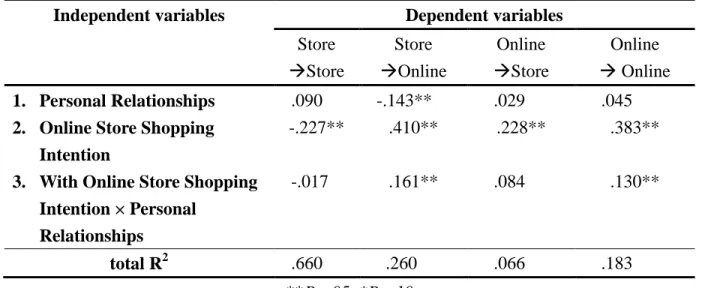
To investigate our proposed hypotheses, we ran a regression model with attitude toward each type of online and offline shopping behavior as the dependent variable, and online store shopping intention and personal relationships with sales clerks as predictors of the overall model. The interaction effect between online store shopping intention and personal relationship on the dependent variable was also included in model.
---Table 1 about here---
The regression results indicate that the personal relationships does not significantly affect the attitude toward using the physical retail store to both search information and make purchases (Store Store) (β = .09, p < .05), but significantly reduce the attitude toward using the retail store to search information, but turn to online channels for purchasing (StoreOnline) (β= -.14,
Consistent with H2, we find that online store shopping intention significantly affect the attitudes toward four types of online and offline shopping behavior. Customers with high online store shopping intention have more positive attitude toward using the physical retail stores to search information, but turn to online stores for purchasing (StoreOnline) (β= .41, p < .05), using the online store to search information, but turn to physical stores for purchasing (OnlineStore) (β= .23, p < .05), and using the online store both for information searching and product purchasing (OnlineOnline) (β= .38, p < .05). In addition, customers with high online store shopping intention have less positive attitude toward using the physical retail store to both search information and purchase products (StoreStore) (β= -.23, p < .05). Thus, H2a, H2b, H2c, and H2d are supported by the data.
The result also show that there are significant interaction effects between personal relationship and online store shopping intention on the attitude toward using the physical retail store for information searching, but turn to online stores for product purchasing. (StoreOnline) (β= .16, p < .05), and the attitude toward using the online store both in the information searching and product purchasing stages (β= .13, p < .05). Therefore, H3a and H3b are supported by the data.
As is illustrated in Figure 1, customers with high online store shopping intention have more positive attitudes toward ―StoreOnline‖ when they have high personal relationship with the sales clerks than when they have low personal relationship with the sales clerks. On the other hand, customers with low online store shopping intention have more positive attitude toward ―StoreOnline‖ when having low personal relationship with the sales clerks than when having high personal relationship with the sales clerks. Similar result is found the interaction effect on the attitude toward using online store both in the information searching and product purchasing stages (Figure 2)..
---Figure 1 & 2 about here---
Furthermore, to test the effects of the attitude toward online and offline shopping behavior on possible future total spending on the brand, we ran a regression with future total spending as the dependent variable and each type of online and offline shopping behavior as the predictors. As shown in Table 2, the effect of attitudes toward Store Online, Online Store, and Online Online on future total consumption are all significant and positive (β= .21, p < .05; β= .22, p < .05; β= .21, p < .05, respectively). However, attitude toward Store Store shopping behavior
has negative and significant effect on future total spending on the brand (β= -.13, p < .05). Accordingly, H4a, H4b, H4c, and H4d are supported by the data.
---Table 2 about here---
Discussion and Managerial implications
The goal of this research was to demonstrate that personal relationships can be either a liability or an asset with respect to multichannel marketer adoption. The effect of personal relationships on multichannel strategy is not uniformly positive, depends on the presence of consumers’ online store shopping intention. To the best of our knowledge, this research is the first empirical demonstration of these associations. This findings advance the understanding of the effect of personal relationships on multichannel customer strategy.
First, we show that personal relationship is an asset for the customers with low online store purchase intention. In other words, customers will decrease their online store switching behavior if consumers engage in personal relationships with their favorite sales clerks. Personal relationship creates dependency because considerable switching costs are involved to replace the service of the physical store (Heide and John 1988; Joshi and Stump 1999). Moreover, a retail store should strongly persuade their employees provide personal recognition and familiar service to their customers. The strategy that promotes their customers to use online store for information searching is suitable because this can improve the selling efficiency in the physical store.
Second, we demonstrate that personal relationship may be a liability for customers with high online store shopping intention. For these customers, multichannel marketers should develop an appropriate multichannel strategy. A well-integrated multichannel can lead to greater impact and encourage desirable customer behaviors (Montoya-Weiss, Voss, and Grewal 2003; Bendoly et al. 2005). For example, well-integrated multichannel allows customers to order online and pick up their order from the nearest store and to return products purchased from the Web at the local outlet. Therefore, it is arguable that the integration of online and conventional offline channels may well prove to be a productive and complementary approach (Harris and Goode 2004).
Finally, it is found that multichannel is not always effective for every customer. There have been a lot of research found that multichannel shoppers buy more often, more items, and spend
more than single-channel shoppers (Kushwaha and Shankar 2005; Similarly, Kumar and Venkatesan 2005; Thomas and Sullivan 2005). However, relatively little is known about how customers with different multichannel shopping behavior affect the total sales differently. This study demonstrates that for those who prefer to stay with the physical stores believe that their total spending will not be increasing when their favorite retail stores decide to open an online store. The results provide some insight into the challenges that marketers face the customers with traditional physical store shopping view. It is also be cautioned that multichannel marketers should not assume that ―more is better.‖
References
Alba, J., Lynch, J., Weitz, B., Janiszewski, C., Lutz, R., Sawyer, A. & Wood, S. (1997). Interactive Home Shopping: Consumer, Retailer, and Manufacturer Incentives to Participate in Electronic Marketplaces. Journal of Marketing, 61, 38-53.
Ansari, A., Mela, C. F., & Neslin, S. A. (2005). Customer Channel Migration. Paper Series No. 13, working paper, Teradata Center, Duke University, Durham, NC.
——— (2008). Customer Channel Migration. Journal of Marketing Research, 45, 60-76.
Avery, J., Steenburgh, T.J., Deighton, J., & Caravella, M. (2009). Adding Bricks to Clicks: The Contingencies Driving Cannibalization and Complementarity in Multichannel Retailing.
Harvard Business School Marketing Research Paper, No. 07-043
Barnes, J. G. (1994). Close to The Customer: But Is It Really a Relationship? Journal of
Marketing Management, 10, 561-570
Beatty, S. E., Mayer, M., Coleman, J. E., Reynolds, K. E. & Lee, J. (1996). Customer-Sales Associate Retail Relationships. Journal of Retailing, 72, 223–247.
Bendoly, E., Blocher, J. D. Bretthauer, K. M. Krishnan, S. & Venkataramanan, M. A. (2005). Online/In-Store Integration and Customer Retention. Journal of Service Research, 7, 313-327. Bitner, M. J., Booms, B. H., & Tetreault, M. S. (1990). The Service Encounter: Diagnosing Favorable and Unfavorable Incidents. Journal of Marketing, 54, 71-84.
Biyalogorsky, E., & Naik, P. (2003). Clicks and Mortar: The Effect of On-line Activities on Off-line Sales. Marketing Letters, 14, 21–32.
Bolan, C. (2005). Not Just Any Luxury Shopper. Global Cosmetic Industry, 173, 28-30.
Burke, R. R. (2002). Technology and the customer interface: What Consumers Want in the Physical and Virtual Store. Journal of the Academy of Marketing Science, 30, 411.
Business Strategy Review, 11, 19–31.
Chiou, J. S. & Droge, C. (2006) Service Quality, Trust, Specific Asset Investment and Expertise: Direct and Indirect Effects in a Satisfaction-Loyalty Framework. Journal of the Academy of
Marketing Science, 34, 613-627.
Czepiel, J. A. (1990). Service Encounters and Service Relationships: Implications for Research.
Journal of Business Research, 20, 13-21.
Dholakia, R. R., Zhao, M., & Dholakia, N. (2005). Multichannel Retailing: A Case Study of Early Experiences. Journal of Interactive, 19, 63-74.
Ellison, S. & Fowler, G. A. (2004). Aisle 9 to Saks: P&G Brings Its $130 Skin Treatment to U.S.
Wall Street Journal, Marketplace Section, March 12, B1.
File, K. M., Judd, B. B. & Prince, R. A. (1993). Interactive Marketing: the Influence of Participation on Positive Word-of-Mouth and Referrals. Journal of Services Marketing, 6, 5-14 Goodwin, C. (1994). Between Friendship and Business: Communal Relationships in Service Exchanges. working paper. University of Manitoba.
Gwinner, K. P., Gremler, D. D., & Bitner, M. J. (1998). Relational Benefits in Services Industries: The Customer's Perspective. Journal of the Academy of Marketing Science, 26, 101-114.
Haubl, G. & Trifts, V. (2000) Consumer Decision Making in Online Shopping Environments: The Effects of Interactive Decision Aids. Marketing Science, 19, 4–21.
Hauser, J. R. & Wernerfelt, B. (1990). An Evaluation Cost Model of Consideration Sets. Journal
of Consumer Research, 16, 393-408.
Heijden, H. V., Verhagen, D., T. & Creemers,M. (2003) Understanding Online Purchase Intentions: Contributions from Technology and Trust Perspectives. European Journal of
Information Systems, 12, 41.
Kau, A. K., Tang, Y. E. & Ghose, S. (2003). Typology of Online Shoppers. Journal of Consumer
Marketing, 20, 139-156.
Keen, P., Ballance, G., Chan, S., & Schrump, S. (1999). Electronic Commerce Relationships:
Trust By Design. Prentice-Hall, Englewood Cliffs, NJ.
Konus, U., Verhoef, P. C., & Neslin, S. A. (2008). Multichannel Shopper Segments and Their Covariates. Journal of Retailing, 84, 398-413
Kumar, V. & Venkatesan, R. (2005). Who Are Multichannel Shoppers and How Do They Perform? Correlates of Multichannel Shopping Behavior. Journal of Interactive Marketing, 19, 44–61.
Kushwaha, T. L. & Venkatesh, S. (2005). Multichannel Shopping Behavior: Antecedents and Implications for Channel and Customer Equity. working paper, Texas A&M University, College Station.
——— and ——— (2006). Optimal Multichannel Allocation of Marketing Efforts. working paper, Texas A&M University, College Station.
Levin, A. M., Levin, I. P., & Heath, C. E. (2003). Product Category Dependent Consumer Preferences for Online and Offline Shopping Features and Their Influence on Multi-channel Retail Alliances. Journal of Electronic Commerce Research, 4, 85-92.
Louvieris, P., J. Driver, & J. Powell-Perry (2003). Managing Customer Behaviour Dynamics in The Multi-Channel E-Business Environment: Enhancing Customer Relationship Capital in the Global Hotel Industry. Journal of Vacation Marketing, 9, 164
McKenna, R. (1991). Marketing is Everything. Harvard Business Review, 69, 65-79.
Montoya-Weiss, M. M., Voss, G. B., & Grewal,D. (2003). Determinants of Online Channel Use and Overall Satisfaction with a Relational, Multichannel Service Provider. Journal of the
Academy of Marketing Science, 31, 448.
Morganosky, W. (2000). Does Online Retailing Cannibalize Other Marketing Channels? eCommerce Research Forum, MIT
Myers, J., Van Metre, E., & Pickersgill, A. (2004). Steering Customers to the Right Channels.
McKinsey Quarterly: McKinsey on Marketing, 4, 36-47.
Neslin, S. A., Grewal, D., Leghorn, R., Shankar, V., Teerling, M. L., Thomas, J. S., & Verhoef, P. C. (2006). Challenges and Opportunities in Multichannel Customer Management. Journal of
Service Research, 9, 95-113.
——— and Shankar, V. (2009). Key Issues in Multichannel Customer Management: Current Knowledge and Future Directions. Journal of Interactive Marketing, 23, 70-81.
Pentina, I., Pelton, L. E., & Hasty, R.W. (2009). Performance Implications of Online Entry Timing by Store-Based Retailers: A Longitudinal Investigation. Journal of Retailing, 85, 177-193.
Pikkarainen, T., Pikkarainen, K., Karjaluoto, H., & Pahnila, S. (2004). Consumer Acceptance of Online Banking: An Extension of the Technology Acceptance Model. Internet Research, 14, 224-235.
Prasso, S. (2005). Battle for the Face of China. Fortune, December 12, 156-178.
Rangaswamy, A. & Van Bruggen, G. H. (2005). Opportunities and Challenges in Multichannel Marketing: An Introduction to the Special Issue. Journal of Interactive Marketing, 19, 5-11. Reichheld, F. F. (1993). Loyalty-Based Management. Harvard Business Review, 11, 64-73.
Schoenbachler, D. D. & Gordon, G. L. (2002). Multi-channel Sopping: Understanding What Drivers Channel Choice. Journal of Consumer Marketing, 19, 42-53.
Schroeder, H. & Zaharia, S. (2008). Linking Multi-Channel Customer Behavior with Shopping Motives: An Empirical Investigation of a German Retailer. Journal of Retailing and Consumer
Services, 15, 452–468.
Sharma, D., Gassenheimer, J. B., & Alford, B. L. (2010). Internet Channel and Cannibalization: An Empirical Assessment of Sales Agents' Perspective. Journal of Personal Selling and Sales
Management, 30, 209 – 222.
Shen, C. C. & Chiou, J. S. (2010). The Impact of Perceived Ease of Use on Internet Service Adoption: The Moderating Effects of Temporal Distance and Perceived Risk. Computers in
Human Behavior, 26, 42–50.
Simona, D. H. & Kadiyalib, V. (2007). The Effect of a Magazine’s Free Digital Content on its Print Circulation: Cannibalization or Complementarity? Information Economics and Policy, 19, 344-361.
Stone, M., Hobbs, M., & Khaleeli, M. (2002). Multichannel Customer Management: The Benefits and Challenges. The Journal of Database Marketing, 10, 39-52
Tan, Y. H. & Thoen, W. (2001). Toward a Generic Model of Trust for Electronic Commerce.
International Journal of Electronic Markets, 5, 61–74.
Thomas, J. S. & Sullivan, U. Y. (2005). Managing Marketing Communications with Multichannel Customers. Journal of Marketing, 69, 239–51.
Van Baal, S. & Dach, C. (2005). Free Riding and Customer Retention across Retailers' Channels.
Journal of Interactive Marketing, 19, 75-85.
Vavra, T. (1992). How to Keep Customers for Life Through Relatioriship Marketing. Burr Ridge. IL: Business One Irwin.
Wu, J. W., Chen, Y. C., & Lin, L. M. (2007). Empirical Evaluation of the Revised end User Computer Acceptance Model. Computer in Human Behavior, 23, 162-174.
Yulinsky, C. (2000). Multi-Channel Marketing. McKinsey Marketing Practice, 8, 1–9.
Zhang, J., P. Farris, T. Kushwaha, J. Irvin, T. Steenburgh, & B. Weitz, (2010), Crafting Integrated Multichannel Strategies. Journal of Interactive Marketing, 24, 168-180
Table 1 Regression analysis for multichannel customer behavior
Independent variables Dependent variables
Store Store Store Online Online Store Online Online 1. Personal Relationships .090 -.143** .029 .045
2. Online Store Shopping Intention
-.227** .410** .228** .383**
3. With Online Store Shopping Intention × Personal
Relationships
-.017 .161** .084 .130**
total R2 .660 .260 .066 .183
**P<.05, *P<.10
Table 2 β coefficients of the regression analyses on future total spending
Types of multichannel customer behavior β coefficients Store Store -.132** Store Online .209** Online Store Online Online .223** .213** R2 .275 Adjusted R2 .262 F ratio 21.073** **P<.05, *P<.10
Figure1. Interactions between ―personal relationships‖ and ―online store shopping intention‖ on attitude toward searching in retails but purchasing online
Figure2. Interactions between ―personal relationships‖ and ―online store shopping intention‖ on attitude toward searching online and purchasing online
4.77
4.37
4.81
3.76
Online store shopping intention Attitudes toward searching in retails but purchasing online 5.0 0 4.8 0 4.6 0 4.0 0 4.4 0 4.2 0 3.8 0 Personal relationships Low High High Low
Online store shopping intention High Low Attitudes toward searching online and purchasing online 4.2 0 4.0 0 3.8 0 3.2 0 3.6 0 3.4 0 3.0 0 Personal relationships Low High 3.98 3.47 4.10 3.33
國科會補助專題研究計畫項下出席國際學術會議心得報告
日期:99 年 08 月 02 日
一、參加會議經過與心得
本屆 European Association for Conference Research Conference(European ACR)於
英國倫敦大學舉行,時間安排在 6 月 30 到 7 月 3 日,共歷時三天。因為是歐洲消
費者年度最主要的研討會,所以有許多歐洲國家的文章發表,也讓來自美洲或其他
國家的學者對目前歐洲學者的研究有更多了解。大會一共安排了 10 個 session,每
天分四個 session,同時段至少有 6 個場次的論文發表。此次的消費者研究主題,
除了常見的網路消費行為、品牌行銷、消費者購買決策、認知資訊過程、消費者道
德,還訂出許多特殊議題,包括 progressive consumption、nomadic consumption、目
標消費(Goal consumption) 、數位音樂消費、食物及性別消費、消費相關的社會議
題,其中有許多主題就是探討現在歐洲國家的消費者現況。
本人在此次研討會中發表了一篇文章,「Dose Snobbish Service Generate Better
Sales?The Case of Luxury Goods」
,被分類在奢侈品與忠誠度的主題,在第三天最
後一場報告。主要探討奢侈品店家的銷售方式,服務人員的何種服務態度(自視甚
計畫編號
NSC 96-2628-H-004-001-MY3
計畫名稱
專屬資產配適度對品牌與通路延伸評價之研究(第 3 年)
出國人員
姓名
邱志聖
服務機構
及職稱
國立政治大學國際貿易系教授
會議時間
99 年 6 月 30 日至
99 年 7 月 3 日
會議地點
Royal Holloway University of
London, Surrey, UK
會議名稱
European Association for Conference Research Conference 2010
發表論文
高/一般)會為店家帶來更好的銷售業績。當時報告有多位學者在場聆聽,並參與討
論給予許多建議,對該篇文章在日後的投稿上有相當大的幫助。
二、建議
整體而言,本屆 European ACR 涵蓋的議題非常廣泛且新穎,與會者所發表的
文章皆具有相當水準,主辦單會在 program 的設計及行程的安排上也非常用心,年
會中精細區分且多元,讓與會人士可以聆聽不同的研究主題,吸納更多樣的意見並
激盪新的想法。
三、攜回資料名稱及內容
European ACR 大會手冊一本
96 年度專題研究計畫研究成果彙整表
計畫主持人:邱志聖 計畫編號:96-2628-H-004-001-MY3 計畫名稱:專屬資產配適度對品牌與通路延伸評價之研究 量化 成果項目 實際已達成 數(被接受 或已發表) 預期總達成 數(含實際已 達成數) 本計畫實 際貢獻百 分比 單位 備 註 ( 質 化 說 明:如 數 個 計 畫 共 同 成 果、成 果 列 為 該 期 刊 之 封 面 故 事 ... 等) 期刊論文 0 0 100% 研究報告/技術報告 3 3 100% 研討會論文 0 0 100% 篇 論文著作 專書 0 0 100% 申請中件數 0 0 100% 專利 已獲得件數 0 0 100% 件 件數 0 0 100% 件 技術移轉 權利金 0 0 100% 千元 碩士生 4 4 100% 博士生 1 1 100% 博士後研究員 0 0 100% 國內 參與計畫人力 (本國籍) 專任助理 0 0 100% 人次 期刊論文 0 0 100% 研究報告/技術報告 0 0 100% 研討會論文 0 0 100% 篇 論文著作 專書 0 0 100% 章/本 申請中件數 0 0 100% 專利 已獲得件數 0 0 100% 件 件數 0 0 100% 件 技術移轉 權利金 0 0 100% 千元 碩士生 0 0 100% 博士生 0 0 100% 博士後研究員 0 0 100% 國外 參與計畫人力 (外國籍) 專任助理 0 0 100% 人次其他成果
(
無法以量化表達之成 果如辦理學術活動、獲 得獎項、重要國際合 作、研究成果國際影響 力及其他協助產業技 術發展之具體效益事 項等,請以文字敘述填 列。) 本計畫撰寫成兩篇學術論文投稿中。前兩年的研究成果間接促成台灣品牌建立 的個案研究,成果已由天下文化出版發表,該書銷售優良,成為許多台灣有至 自創品牌的企業所參考的重要書籍。另外,本計畫的成果有協助釐清品牌與通 路間的關係,因此促成 Journal of Business Research (SSCI)與 Jorunal of Service Management (SSCI)文章的順利發表。成果項目 量化 名稱或內容性質簡述 測驗工具(含質性與量性) 0 課程/模組 0 電腦及網路系統或工具 0 教材 0 舉辦之活動/競賽 0 研討會/工作坊 0 電子報、網站 0 科 教 處 計 畫 加 填 項 目 計畫成果推廣之參與(閱聽)人數 0