
J O U R N A L O F M A T E R I A L S S C I E N C E 3 4 (1 9 9 9 ) 5899 – 5906
Interfacial reactions between Ti-6Al-4V
alloy and zirconia mold during casting
KUN-FUNG LIN, CHIEN-CHENG LINDepartment of Materials Science and Engineering, National Chiao Tung University, Hsinchu, Taiwan 300
E-mail: [email protected]
The interface of Ti-6Al-4V casting and ZrO2 mold with silica binder was investigated by
using electron probe microanalyses (EPMA), X-ray diffraction (XRD), and analytical transmission electron microscope (TEM). The interfacial reactions were proceeded by the penetration of liquid titanium through open pores near the mold surface. The metal side consisted of anα-phase layer on the top of the typical α + β two-phase substrate. In the ceramic side, zirconia was reduced by titanium to form oxygen-deficient zirconia ZrO2−x
and evolved a gaseous phase (presumably oxygen). The SiO2binder, dissolved in the ZrO2
mold, could react with titanium to form Ti5Si3in the metal side. Meanwhile, titanium could
transform to titanium suboxides TiyO (y ≥ 2) and the lower phase boundary of cubic
ZrO2−x was shifted to ZrO1.76. Some amount of the stabilizer CaO, dissolved in Ti along with
ZrO2, could react with Ti(O) to form Ca3Ti2O7 and CaAl4O7in the reaction zone. °C 1999
Kluwer Academic Publishers
1. Introduction
Titanium alloys are widely used in the aerospace and microelectronics applications, because they have excel-lent properties such as high specific strength and good corrosion resistance. However, they are extremely re-active to ceramics at high temperatures, resulting in chemical reaction affected-surface [1]. The interfacial reactions between titanium and ceramics play an im-portant role in the titanium precision casting. The in-terstitial elements (e.g., C, N, O, H) from the ceramic mold have a great tendency to enter into the titanium alloys during casting and cause the deterioration of me-chanical properties [2]. In practice, titanium was melted in a copper crucible (water cooled) by the consumable electrode vacuum arc melting instead of vacuum induc-tion melting (VIM) which melted titanium in a ceramic crucible. Furthermore, the casting parts of titanium al-loys must be chemically milled in order to remove the reaction-affected surface.
The interfacial reactions between Ti and some dense ceramic specimens have been subjected to intensive studies. Ji et al. [3] showed that titanium would re-duce Al2O3and thus Ti3Al precipitated in the interface
of Ti and Al2O3in a crucible test at 1740◦C. Koyama et al. [4] reported that the sputtered Ti film would react
with theα-Al2O3substrate, and thus formed Ti2O, TiO,
and Ti3Al at 900◦C. In an experiment of diffusion
cou-ple, Misra [5] found that titanium reacted withα-Al2O3
to form TiAl and Ti3Al at 1100◦C. Wang and Oki [6]
found that titanium reacted with O from the zirconia substrate to form TiO. Ruh [7] found that zirconium entered the titanium lattice substitutionally and oxygen went to interstitial positions during the reactions
be-tween zirconia and titanium at elevated temperatures. Ruh and Garrett [8] indicated that zirconia was reduced to oxygen deficient zirconia and some zirconium ex-isted in the grain boundary after reaction with titanium at 2000◦C/3 h.
Many researchers [9–14] have been working on the reactions of the titanium with various ceramic molds or crucibles during casting. The X-ray diffraction (XRD) analyses revealed that the reaction products of a ti-tanium casting and the ZrSiO4 mold with Na2Si2O5
binder were TiO2, TiO, Ti4O7, Ti5Si3, and Na0.23TiO2
[9]. Lyon et al. [10] demonstrated that a small amount of flower-like Y2O3precipitated at the grain boundaries
of the Ti matrix, while Y2O3was reduced to Y2O3−x
by judging from the darkened color of yttria. ZrO2was
usually applied as an inert crucible or a mold face coat material in precision casting. Economos and Kingery [11] showed a considerable reaction of the zirconia cru-cible with titanium melt. Weber et al. [12] presented an unspecified feather-like eutectic phase in the reaction zone of Ti/Mg-ZrO2. Other studies [13, 14] investigated
the interfacial reactions between Ti and ceramic molds by measuring the microhardness of the alloys. The sur-face hardening of the titanium casting was attributed to the dissolution of oxygen that was originated from ceramic molds. However, the microhardness variation is only an indicator, not a direct observation, of the changes in the microstructure due to the interfacial re-actions. While previous studies had been focused on the reactions taking place in the metal side, the transforma-tion in the ceramic side had not been well attended.
At present study, the Ti-6Al-4V alloy was melt through a consumable electrode vacuum arc and cast
centrifugally into a porous ZrO2 mold. After
cast-ing, thin specimens for the observation of transmission electron microscope (TEM) were prepared and the in-terface of titanium alloy and zirconia mold would be directly observed and characterized by an analytical TEM. The microstructural characterization was also aided by scanning electron microscopy (SEM), X-ray diffraction (XRD), and electron probe microanalyses (EPMA). Finally, we would attempt to elucidate the mechanism of the interfacial reactions between tita-nium and zirconia mold during casting.
2. Experimental procedures
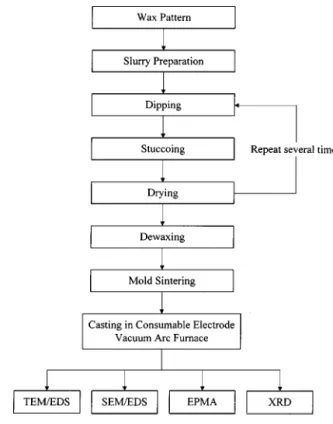
The experimental procedures were displayed by the flow chart in Fig. 1. The wax patterns were prepared by injecting wax into a metal die, and then assembled into a wax tree. The wax tree was then dipped in the primary ceramic slurry which was mixed from 80 wt % fine zirconia filler (325 mesh, 4%CaO partial stabilized ZrO2), 20 wt % colloidal silica (15 nm, 30% SiO2), a
wetting agent (Vitawet 12), and an antifoaming agent. It was then stuccoed with coarse zirconia particles (100 mesh, 98%ZrO2) after draining the excess slurry. The
mold was dried in air at a properly controlled tempera-ture (22–24◦C) and 50% relative humidity. These pro-cesses were repeated twice and thus the so-called face coats were obtained. On the top of face coats, the mold was built up to 10 mm in thickness by alternating with mullite slurry and stucco. The mold was dewaxed in an autoclave at 8 bar for 12 min after final drying over 24 h, and then sintered at 1050◦C for 2 h. It was set up at a centrifugal table and preheated at 350◦C for 1 h. A Ti-6Al-4V electrode was melt and cast into the zir-conia mold with 300 rpm in the consumable electrode vacuum arc furnace at 10−2torr.
As-cast specimens were analyzed by TEM (JOEL JEM 2010) as well as SEM (JXA-6400), XRD (Rigaku
Figure 1 The flow chart of experimental procedures.
D), and EPMA (JXA-8621MX). Cross-sectional TEM specimens perpendicular to the interface of ceramics and metal were prepared by standard procedures of cut-ting, grinding, polishing, and ion milling. The quanti-tative composition analyses were carried out based on the principle of Cliffs-Lorimer method by an energy dispersive spectroscope (EDS, D-Link) attached to the TEM.
3. Results
An SEM micrograph of the as-sintered ceramic mold is shown in Fig. 2a. The large angular particles (about 90 µm) are ZrO2 stucco, while the smaller particles
(≈30 µm) are ZrO2fillers. The as-sintered mold dis-plays a porous structure with fine particles dispersed near the mold surface. The EDS of finer ceramic par-ticles at the face coat is shown in Fig. 2b, indicating that the silica binder could be dissolved into the calcia-partially-stabilized ZrO2during sintering.
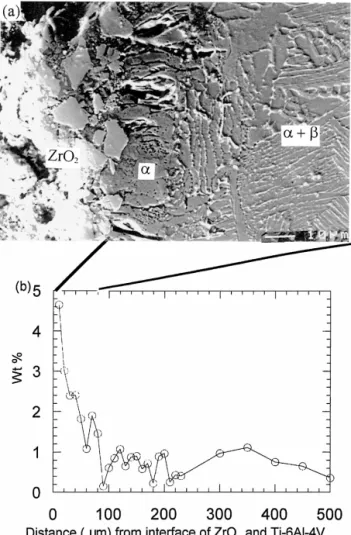
Fig. 3a is an SEM micrograph showing the interface of a thin (≈2 mm thick) Ti-6Al-4V and the zirconia mold. In the right of this micrograph, there exists a two phase (α + β) region, a typical structure of the com-mercial Ti-6Al-4V alloy. Theα-phase is located at the center of the micrograph, the zirconia mold in the left of the micrograph. EPMA results indicated that in addition to Ti, Al, and V, theα-phase contained O and Zr which came from the zirconia mold. During casting, the liq-uid titanium infiltrated into the zirconia mold through the open pores in the mold surface by both capillary and centrifugal forces. ZrO2 particles surrounded by
the molten alloy were gradually dissolved with the for-mation of small bubbles in theα-phase. Fig. 3b is the concentration profile of oxygen, indicating a diffusion depth of about 100µm in the casting. The oxygen was rich in the α-case layer, resulting in hardening at the surface of the casts.
The oxygen atom is a stabilizer ofα-phase, while zirconium is a stabilizer ofβ-phase [15]. Both of two stabilizing elements could affect the microstructure of the as-cast specimens. Since the diffusivity of oxygen inα-Ti is much faster than that of zirconium [14] and titanium has a great affinity with oxygen, a single α-Ti(O) layer was thus formed at the interface, leaving a solid solution of ZrO2−x behind in the ceramic mold.
This is consistent with the results reported by Saha et
al. [16]. This layer ofα-Ti(O) was the so-called α-case,
which was very hard and brittle due to oxygen intersti-tial effects [17]. There also existed some cracks in the
α-case. It was easily delaminated due to the collapse of
shell mold, blast off, and cut off after cast. The reaction layer appeared as a dark gray color, an indication of the formation of oxygen deficit zirconia [18, 19].
The chipped off reaction layer was powdered and investigated by XRD. The XRD spectrum in Fig. 4 in-dicates the formation of Ti2O phase after reaction. Ti2O
is a solid solution ofα-Ti(O) with an ordered structure at low temperatures. Since the solubility of oxygen in titanium at high temperatures is higher than that at low temperatures, the oxygen would precipitate during so-lidification.
Figure 2 (a) An SEM micrograph of the as-sintered ceramic mold showing a porous structure; (b) An EDS indicates that the silica binder was
dissolved into fine zirconia particles at the face coat.
Figure 3 (a) An SEM micrograph showing the reaction zone of a thin
(≈2 mm) Ti-6Al-4V and the ZrO2 mold; (b) An oxygen concentra-tion profile. The lines connecting (a) and (b) indicate the corresponding depths.
Fig. 5a shows a SEM micrograph of the reaction layer of a thick (≈70 mm) Ti-6Al-4V and the zirconia mold. The distributions of Ti, Si, O, Ca, and Zr elements in the reaction layer were demonstrated by X-ray mappings
in Fig. 5b–f, respectively. The phase designated as “A” in Fig. 5a isα-Ti(O) which dissolved some Zr and O. The fact that a compound of Ti-Si, designated as “B” in Fig. 5a, was formed during casting indicates that silica in the ceramic mold could react with titanium. The fine zirconia particles with pores, designated as “C” in Fig. 5a, were embedded in the metal and their surfaces became irregular after being severely dissolved by titanium. The fine zirconia was rich of Ca and Zr elements as shown in Fig. 5e and f. During casting, a significant amount of oxygen was leached from zirconia by titanium. While part of these leached oxygen was accumulated as bubbles, the remaining was dissolved in the melt, which could precipitate from supersaturated
α-Ti(O) during solidification.
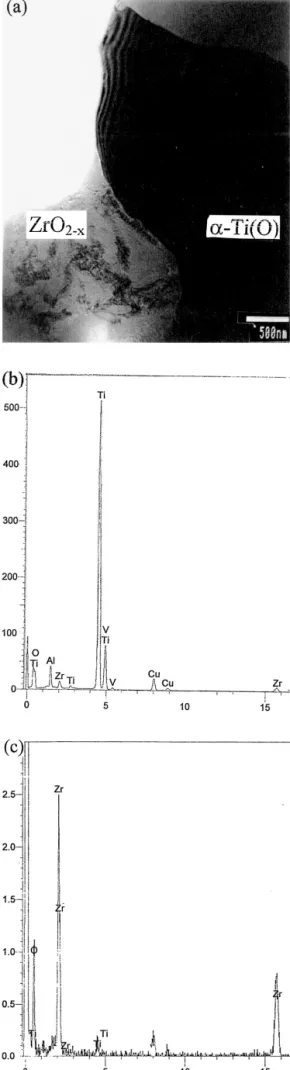
Fig. 6a is a bright field image ofα-Ti(O) and ZrO2−x
in the reaction layer. The EDS in Fig. 6b demonstrated that theα-Ti(O) contained 7.89 at % O as well as a small amount of zirconium element (1.84 at % Zr). On the other hand, the zirconia mold was reduced by titanium into an oxygen deficient zirconia with O/Zr ratio being 1.76 (Fig. 6c). The EDS result also indicates that this oxygen deficit zirconia dissolved a small amount of Ti (≈2.58 at %).
As mentioned in Fig. 2, the silica binder could be dis-solved in the zirconia mold. During casting, the silica along with zirconia was dissolved into titanium. Since the solubility of Si inα-Ti was limited at low tempera-ture [20], the Ti-Si compound precipitated on cooling, leaving a limited Si in theα-Ti (Fig. 6b). Fig. 7a and b are the bright field image and dark field image of a titanium silicide compound in the titanium, respec-tively. The titanium silicide compound is identified to be hexagonal Ti5Si3from its SADP (Fig. 7c). The EDS
result, as shown in Fig. 7d, reveals that Ti5Si3dissolved
6.10 at % Al, 4.31 at % V, and 7.61 at % Zr.
Fig. 8a and 8b are the bright field image and the selected area diffraction pattern (SADP), respectively, of Ti3O that was found in the reaction layer. The
Figure 4 An XRD spectrum of the reaction layer of a thick (≈70 mm) Ti-6Al-4V and the ZrO2mold after slow cooling.
Figure 5 (a) An SEM micrograph showing the reaction layer of a thick (≈70 mm) Ti-6Al-4V and the ZrO2 mold after slow cooling; the X-ray mappings, respectively, of (b) Ti; (c) Si; (d) O; (e) Ca; (f) Zr.
Figure 6 (a) A TEM micrograph showingα-Ti(O) and ZrO2−x; (b) EDS ofα-Ti(O); (c) EDS of ZrO2−x.
superlattice reflections (00·1), (00·2), (11·1), and (11·2) indicate that this phase is an ordered structure of Ti3O.
The superlatice reflections of (00·2) belonged to the type I (h= 3n, k = 3n, l = 8n0+ 2, l = 8n0+ 6) [21]. However, other superlatice reflections (hk·1) such as (00·1) (11·1) (11·2), where h − k = 3n, l 6= 3n, showed a discrepancy with the type I. The reflection (00·1) was observed by Andersson et al. [22], while the reflection (11·2) might be caused by the displacement of titanium from the ideal position of the h.c.p. lattice [21]. Since the reflection of (11·1) was forbidden from the calcu-lation of structure factor [21], its appearance could be caused by double diffraction.
There also existed Ca3Ti2O7 and CaAl4O7 in the
reaction layer. The bright field image and SADP of Ca3Ti2O7are displayed in Fig. 9a and 9b respectively,
while those of CaAl4O7are in Fig. 9c and 9d. This result
indicated that the CaO stabilizer was extensively dis-solved along with ZrO2into titanium during reaction,
causing the formation of Ca3Ti2O7and CaAl4O7.
4. Discussions
(1) Thermodynamics consideration
The following interfacial reactions between Ti and ZrO2 are not thermodynamic favorable, because the
Gibbs free energies of following equations are positive or slightly negative at 1727◦C [23]. Ti+ ZrO2→ TiO + Zr + 1/2 O2 1G◦ 1= 157.15 kcal/mol Ti+ ZrO2→ TiO2+ Zr 1G◦2= 33.14 kcal/mol
2Ti+ 3/2 ZrO2→ Ti2O3+ 3/2 Zr 1G◦
3= −0.42 kcal/mol
3Ti+ 5/2 ZrO2→ Ti3O5+ 5/2 Zr 1G◦
4= 26.82 kcal/mol
It is inferred titanium can not be a reducing agent for zirconia. However, it was found in this study that ZrO2
was transformed to ZrO2−x and some gaseous phase
was evolved. Domagala et al. [24] indicated that more than 20 at % of ZrO2could be dissolved in Ti at high
temperatures. Lyon et al. [10] stated that the formation energy of Ti-10 at % O solution at 1400◦C was more negative than that of ZrO2. In the present study, Ti
re-duce the zirconia at high temperatures. The existence of the titanium sub-oxides (Ti2O, Ti3O) and
oxygen-deficient zirconia (ZrO2−x) showed that the zirconia
was partially reduced by titanium during solidification. It implied that the interfacial reactions between titanium alloy and zirconia could not be predicted solely by ther-modynamic calculation of the formation energy differ-ence between titanium oxide and zirconia, because the activity of Ti in solid solution was unknown in this complex system.
Figure 7 (a) The bright field image of Ti5Si3in Ti6Al4V; (b) The dark field image of the Ti5Si3; (c) SADP, Z= [1 ¯1 0]; (d) EDS of Ti5Si3.
(2) Ti→ TixO transition
Titanium reacted with zirconia and transformed to
α-Ti(O) solid solution as a result of precision
cast-ing. The Ti-O phase diagram shows O has a large solubility in α-Ti at high temperatures, and some ti-tanium sub-oxides exist at low temperatures. The or-dered cph phases, Ti2O, Ti3O and possibly Ti6O, are
formed within an extended range [25]. Present results displayed that the ordered titanium suboxides Ti3O and
Ti2O were found in the reaction layer, in addition that
a significant amount of oxygen was dissolved in the surface of titanium. Accompanying theα-phase in the reaction layer were many gas bubbles. It indicated that the titanium suboxides could form via an order and dis-order transformation. Since Ti2O was more stable than
TiO [26], the ordered titanium suboxides formed in the reaction layer was Ti2O rather than TiO.
(3) ZrO2→ ZrO2−x transition
ZrO2 was reduced to ZrO2−x and dissolved some α-Ti(O) during precision casting. The composition
of cubic ZrO2−x in the reaction layers was
approx-imated to be ZrO1.76. The Zr-O system,
particu-larly the ZrO2 rich portions, shows a broad range
of O loss down to 1200◦C owing to thermal ef-fects. Such a loss significantly lowers the cubic-tetragonal phase transformation temperature from 2400–1500◦C at 13% O loss, and may have a sim-ilar effect on the monoclinic-tetragonal transforma-tion [27]. From the lower phase boundary of ZrO2−x
at high temperatures (1956–2404◦C), the oxygen contents extends from 63.5 at % to 60.8 at %, or 1.55 < O/Zr < 1.74, respectively [28]. However, the O/Zr ratio for ZrO2−x at 1300◦C is between 1.925 and
Figure 8 The Ti3O phase with an ordered structure was found in the reaction layer: (a) The bright field image; (b) SADP, Z= [¯1 100].
Figure 9 The existence of Ca3Ti2O7and CaAl4O7in the reaction layer: (a) The bright field of Ca3Ti2O7; (b) The SADP of Ca3Ti2O7, Z= [0 ¯1 0]; (c) The bright field image of CaAl4O7; (d) The SADP of CaAl4O7, Z= [¯1 1 0].
In the reaction layer, the titanium was transformed to α-Ti(O) and the ordered titanium suboxides TiyO
formed at low temperatures. The dissolution of Ti(O) in ZrO2−x (Fig. 6(c)) could induce a large concentration
of point defects ionized oxygen vacancy and cation
interstitial due to the valence effects, causing the variation of the lattice structure. The oxygen vacancy associated with Zr could provide stabilization for tetragonal and cubic zirconia [30]. It is believed that the substitution of titanium ion for Zr+4could retard the
transformation of cubic oxygen deficient zirconia, even though CaO was expelled from some ZrO2(Fig. 9).
(4) Mechanism of interfacial reactions
The interfacial reactions between Ti-6Al-4V and ZrO2 can be summarized as follows. During casting,
the liquid titanium penetrated into the ceramic mold through the interconnected pores near the mold surface, and thus zirconia particles were embedded in the Ti melt. Titanium would dissolute zirconia and then the surface of ZrO2was gradually rounded. Interdiffusion
of Zr, O and Ti took place at the interface and the solid solution of ZrO2 in Ti(O) was formed at high
temperatures. Subsequently, ZrO2 was reduced into
ZrO2−x and oxygen was evolved at high temperatures.
Part of the oxygen was accumulated as bubbles, while the remaining was dissolved in the melt that could precipitate from supersaturated α-Ti(O) during solidification. Meanwhile, α-Ti(O) transformed to TiyO ordered structures such as Ti2O and Ti3O during
cooling. The titanium could also react with CaO, the stabilizer of ZrO2, giving rise to the formation of the
compounds Ca3Ti2O7and/or CaAl4O7.
5. Conclusions
1. Interfacial reactions between Ti-6Al-4V and ZrO2
mold during casting were proceeded by the penetration of liquid titanium due to capillary and centrifugal forces through the interconnected pores near the mold surface. Ti reduced ZrO2 and leached oxygen to form the
α-Ti(O) solid solution, which could exist as the ordered structure of TiyO (y≥ 2) at low temperatures. The solid
solution of Zr inα-Ti(O) was also found.
2. ZrO2 was reduced to c-ZrO2−x by titanium and
oxygen was simultaneously evolved during casting. Part of the evolved oxygen from zirconia was accu-mulated as bubbles at high temperatures, while the re-maining was dissolved in melt that could precipitate during solidification.
3. The SiO2binder in ZrO2mold would react with
titanium to form Ti5Si3in the titanium. Some amount
of the stabilizer CaO, dissolved in Ti along with ZrO2,
could react with Ti(O) to form Ca3Ti2O7and CaAl4O7
in the reaction zone.
Acknowledgements
This research was sponsored by the National Science Council, Taiwan, under the Contract No. NSC 87-2216-E009-014.
References
1. R. L. S A H AandK. T. J A C O B, Def. Sci. J. 36(2) (1986) 121– 141.
2. M. J. D O N A C H I E, J R. “Titanium: A Technical Guide” (ASM International, Metals Park, Ohio, 1988) p. 40.
3. H.J I,S.J O N E SandP.M.M A R Q U I S, J. Mater. Sci. 30 (1995) 5617–5620.
4. M. K O Y A M A, S. A R A I, S. S U E N A G A and M. N A K A H A S H I, ibid. 28 (1993) 830–834.
5. A. K. M I S R A, Metall. Trans. 22A (1991) 715–721.
6. L. D. W A N GandT. O K I, J. Ceram. Soc. Japan. 103(7) (1995) 671–674.
7. R. R U H, ibid. 46(7) (1963) 301–306.
8. R. R U HandH. J. G A R R E T T, ibid. 50(5) (1967) 257–261. 9. R. L. S A H AandR. D. K. M I S R A, J. Mater. Sci. Lett. 10
(1991) 1318–1319.
10. S. R. L Y O N,S. I N O U Y E,C. A. A L E X A N D E R andD. E. N I E S Z, in Fourth World Conference of Titanium, Japan, 1980, pp. 271–284.
11. G. E C O N O M O SandW. D. K I N G E R Y, J. Am. Ceram. Soc.
36(12) (1953) 403–409.
12. B.C.W E B E R,W.M.T H O M P S O N,H.O.B I E L S T E I Nand M.A. S C H W A R T Z, J. Am. Ceram. Soc. 40(11) (1957) 363–373. 13. K. I. S U Z U K I, S. W A T A K A B E and K. N I S H I K A W A,
J. Japan. Inst. 60(8) (1996) 734–743.
14. R. L. S A H A,T. K. N A N D Y,R. D. K. M I S R AandK. T. J A C O B, Bull. Mater. Sci. 12(5) (1989) 481–493.
15. J. L. W A K T E R,M. R. J A C K S O NandC. T. S I M S “Alloy-ing” (ASM International, Metals Park, Ohio, 1988) p. 258. 16. R. L. S A H A,T. K. N A N D Y,R. D. K. M I S R AandK. T.
J A C O B, Metall. Trans. 21B(6) (1990) 559–566.
17. A. I. K A H V E C I andG. E. W E L S C H, Scripta. Metall. 20 (1986) 1287–1290.
18. R. R U H,N. M. T A L L A NandH.A. L I P S I T T, J. Am. Ceram.
Soc. 47(12) (1964) 632–635.
19. J. S. M O Y A,R. M O R E N OandJ. R E Q U E N A, ibid. 71(11) (1988) 479–480.
20. J. L. M U R R Y in “Phase Diagrams of Binary Titanium alloy” (ASM International, Metal Park, Ohio, 1987) p. 289.
21. S. Y A M A G U C H I, J. of Phy. Soc. Japan. 27(1) July (1969) 155– 163.
22. S. A N D E R S S O N,B. C O L L E N,U. K U Y K E N S T I E R N Aand A. M A G N E L I, Acta Chem. Scand. 11(10) (1957) 1641–1652. 23. U.S. Department of Commerce, JANAF thermochemical tables,
Na-tional Bureau of Standards, U.S. Department of Commerce, Michi-gan, 1971.
24. R. F.D O M A G A L A,S.R.L Y O NandR.R U H, J. Am. Ceram.
Soc. 56(11) (1973) 584–587.
25. J. L. M U R R Y in “Phase Diagrams of Binary Titanium alloy” (ASM International, Metal Park, Ohio, 1987) p. 211.
26. J. J.P A K,M.L. S A N T E L L AandR. J.F R U E H A N, Metall.
Trans. 21B(4) (1990) 349–355.
27. R. W. R I C E, J. Am. Ceram. Soc. 74(7) (1991) 1745–1746. 28. R. J. A C K E R M A N N,S. P. G A R GandE. G. R A U H, ibid. 60(7–8) (1977) 341–345. 29. Idem., ibid. 61(5–6) (1978) 275–276. 30. P. L I,I. W. C H E NandJ. E. P E N N E R-H A H N, ibid. 77(1) (1994) 118–128. Received 23 December 1997 and accepted 27 April 1999

![Figure 7 (a) The bright field image of Ti 5 Si 3 in Ti6Al4V; (b) The dark field image of the Ti 5 Si 3 ; (c) SADP, Z = [1 ¯1 0]; (d) EDS of Ti 5 Si 3 .](https://thumb-ap.123doks.com/thumbv2/9libinfo/7655759.139813/6.918.146.779.55.854/figure-bright-field-image-field-image-sadp-eds.webp)
![Figure 8 The Ti 3 O phase with an ordered structure was found in the reaction layer: (a) The bright field image; (b) SADP, Z = [¯1 100].](https://thumb-ap.123doks.com/thumbv2/9libinfo/7655759.139813/7.918.143.770.65.356/figure-phase-ordered-structure-reaction-layer-bright-field.webp)
