Thin Solid Films 270 ( 1995) 148-153
Effect of nitrogen on diamond growth using unconventional gas mixtures
Tsao-Ming Hong *, Sheng-Hsiung Chen, Yih-Song Chiou, Chia-Fu Chen
Imrirtt~e
of Materials Science and Engineering, National Chiao Tung University, Hsinchu 30050, TaiwunAbstract
The influence of nitrogen on the growth of diamond using unconventional gas mixtures of CH4-CO, by microwave plasma chemical vapor deposition was investigated. A clear improvement in the surface morphology and quality of the diamond films indicates the beneficial effect of adding nitrogen to CH,-CO, gas mixtures. However, most interestingly, for lower methane concentration, the addition of small amounts of nitrogen resulted in the formation of isolated diamond particles possessing a vacant “cage-like” structure with completed ( 100) facets. This result indicates that the continued addition of nitrogen gives rise to the deterioration of [ 1 1 1 } facets and the retention of ( 100) facets. Analysis using Auger electron spectroscopy and secondary ion mass spectroscopy shows very low and uniform levels of nitrogen in the diamond films, Although the amount of atomic hydrogen in the ground state decreased and CN radicals increased with increasing amounts of added nitrogen, good-quality diamond films were deposited resulting from a larger amount of atomic oxygen and the decrease in the C2 emissions in the gas phase under optimum conditions.
Keywords: Nitrogen; Diamond; Growth mechanism; Chemical vapour deposition
1. Introduction
The growth of diamond by low-pressure chemical vapor deposition (CVD) has attracted increasing interest in recent years, because of the outstanding mechanical, thermal, opti- cal, electrical, and chemical properties of diamond [ 1.21. The chemical vapor deposition of diamond has the potential to expand the applications of diamond, e.g. doping impurities for semiconducting devices. Nitrogen is the most important commonly occurring impurity in both natural and synthetic high-pressure, high-temperature (HPHT) diamond. It affects the growth of CVD diamond films and the physical properties of diamond [3]. Recently, the effect of nitrogen on the growth of CVD diamond films using CH,-H, gas mixtures has been studied by several authors [3-6]. These effects include deterioration of the diamond film quality, namely the graphitic codeposits and non-diamond phase increased in the resultant films, at larger nitrogen concentrations in the reac- tant gases, and the formation of (lOO)-oriented diamond films when small amounts of nitrogen are added to the reac- tant gases.
In our previous report [ 71, we found that by substituting carbon dioxide for hydrogen in a CH,-CO2 gas mixture, diamond films could not only be synthesized but were also of good quality. Moreover, adding hydrogen to the CH,-C02
* Corresponding author.
0040-6090/9.5/$09.50 0 1995 Elsevier Science S.A. All rights reserved SSDIOO40-6090(95)06885-6
gas mixtures had a negative effect on diamond growth, whereas adding oxygen had a beneficial effect [ 81. In other words, the addition of hydrogen decreased the quality of diamond films created in a CH,-CO? gas mixture, however, the quality of diamond films were improved due to the addi- tion of oxygen.
In this article, we examine the effects of adding nitrogen to CH,-C02 gas mixtures, not previously reported by other authors, on the growth of diamond films. The reactant gases of CH,-CO,-N, (i.e. a C/H/O/N gas system) used in the present experiment were different from those of CH,-HZ-N, and CHJ-N, (i.e. a C/H/N gas system) used by others. Film characterization and plasma emission spectroscopy are used to investigate the relationship between film features and plasma species.
2. Experimental details
The experimental apparatus used was the same as that used in our earlier report [ 71: a 1.3 kW (2.45 GHz) microwave generator with a vertical water-cooled cavity 62 mm in diam- eter set in the end of the waveguide. A quartz reactant tube 55 mm in diameter was placed inside the cavity. There was a quartz substrate holder (diameter 20 mm) inside the reac- tant tube, on which p-type Si (100) substrate was placed. The microwave power was set at 400 W and the reactant gas
pressure was set at 3.3 kPa (25 Torr) The reaction duration was 2 h, and the flow rate of CO2 was fixed at 30 seem. The flow rate of the CH, was varied from 23 to 24 seem and that of the nitrogen was varied from 0 to 20 seem. An optical pyrometer was used to monitor the substrate temperature, which was maintained at about 820 “C. The p-type Si (100) substrate was scratched using diamond powder (approxi- mately 4-6 pm) in order to enhance the nucleation density of the deposits. Scanning electron microscopy (SEM) was used to observe the morphology of the films. The quality of the films was then determined using Raman spectroscopy with a He-Ne laser (632.8 nm). The nitrogen concentrations in the films were investigated by Auger electron spectroscopy ( AES) and secondary ion mass spectroscopy (SIMS).
Optical emission spectroscopy (OES) was used to exam- ine the species in the plasma during the diamond deposition process. Species were identified in this study according to the methods used in Ref. [ 91. Plasma emission actinometry (Ar, 4 seem) [ 8,10,11] was used as an actinomer. The relative concentrations of atomic hydrogen in the ground state were noted using the ratio of H, (656.3 nm) to the Ar line (750.4
nm) .
The system used for the OES experiments was a SOFIE instrument SD 20 system. The monochromator consisted of a Jobin-Yvon H 20 spectrometer equipped with a 1200 groove mm- ’ grating (focal length, 20 cm; slit width, 0.125 mm) and a dispersion of 4 nm mm- ‘. The resolution was 0.5nm and the available spectral range was 200-800 nm. The spectrometer was connected by a silica optical fiber to a viewport of the deposition chamber equipped with a focusing lens (focal length, 100 mm). Optical emissions from the plasma center and near the deposition surface ( 1 mm above the substrates) were focused into an optical fiber and trans- ferred to the monochromator.
3. Results and discussion
3.1. Effects of adding N2 on diamond growth
Fig. 1 shows the influence of adding nitrogen on the surface morphology of diamond films deposited at CH, concentration of 80% (i.e. CHJCO, = 24 seem/30 seem) in a CH4C02 gas mixture. We found that the morphology of diamond films changed from cauliflower structures to well-defined facets. However, a discontinuous diamond film with well-faceted crystallites formed when more nitrogen was added. No carbon of any kind was deposited when the flow rate of added nitro- gen reached 20 seem. This implies that the effect of etching
non-diamond and diamond components increased, and
simply there was a dilution effect on reactant species in the plasma because of the larger addition of nitrogen. A clear improvement in the surface morphology of the diamond
Fig. 1. Effects of adding nitrogen on the morphology of diamond films deposited in a C&-CO2 gas mixture, Cl&/CO2 = 24 seem/30 seem= 80% (fixed):
150 T.-M. Hong et ul. /Thin Sohd Films 270 (19951 148-153
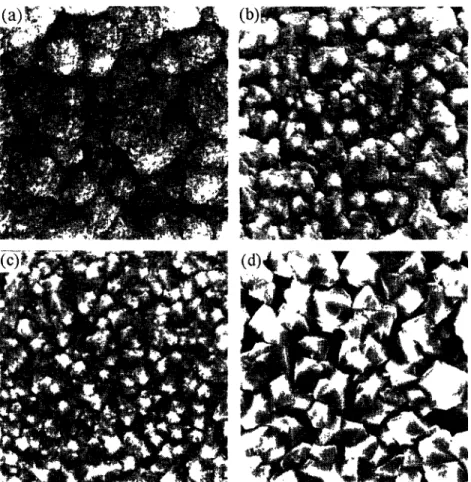
Fig. 2. Effects of adding nitrogen on the morphology of diamond films deposited in a C&-COI gas mixture, CH,/CO? = 23 seem/30 seem = 76.7% (fixed): flow rates of NZ (seem) are (a) 0, (b) 1.4, (c) 2.8, and (d) 4.
films, shown in Fig. 2( a)-2( c), also indicated the beneficial effects of adding nitrogen to the CH,-COp gas mixtures. Nevertheless, most interestingly, for lower methane concen- trations (i.e. CH,/COI? = 23 seem/30 seem = 76.7%) the
I I
1100 1300 1500 1700
Reman shifl (I/cm)
Fig. 3. Effects of adding nitrogen on the Raman spectra of diamond films deposited in a C&-CO2 gas mixture, CH,/COZ = 24 seem/30 seem = 80% (fixed): flow rates of N, (seem) are (a) 0, (b) 4, (c) 7, and (d) 13.
addition of nitrogen at a flow rate of 4 seem resulted in the formation of isolated diamond particles possessing a vacant “cage-like” structure with completed { 100) facets, as shown in Fig. 2(d) . This result indicates that the continued addition of nitrogen gives rise to the deterioration of { Ill} facets and the retention of { 100) facets. It has been demonstrated that the incorporation of nitrogen is determined by growth sector in single-crystal polyhedrons of CVD diamond [ 121, result- ing in significantly larger nitrogen concentrations in { 111) growth sectors as compared with ( 100) sectors, The consid- erable distortion along the ( 111) direction of the C-N bond [ 31, due to the incorporation of nitrogen, may also be respon- sible for the observed growth habit of diamond crystallites. Moreover, the formation of the observed crystal structures may be related to particular gas-phase reactions instigated by nitrogen in the plasma. However, it remains unclear how the addition of nitrogen to the gas mixtures with various CH4/ CO, ratios influences the crystal growth. The crystal mor- phology and surface morphology during growth are highly sensitive to growth conditions and reflect the growth mech- anism. Therefore, more detailed studies are needed to clarify the mechanisms affected by the addition of nitrogen in the CH4-C02 gas mixtures.
The effects of nitrogen addition on the Raman spectra of diamond films deposited in CH4-C02 gas mixtures for CH, concentration of 80% are shown in Fig. 3. The Raman spectra present three main features: (i) a sharp peak at 1332 cm-r,
100 200 300 400 500 600
Kinetic energy (ev)
Fig. 4. Auger spectrum of the film shown in Fig. 1 (d).
0 200 400 600 800 IOW 1200 1400 1609 Time (SW)
Fig. 5. SIMS depth profile of nitrogen in the film shown in Fig. 1 (d) which is the characteristic line of crystalline diamond; (ii) a broad peak centered at about 1550 cm-‘, which is character- istic of diamond-like carbon; and (iii) peak at approximately 1580 cm- ’ which is characteristic of polycrystalline graphite or amorphous carbon with graphitic bonding [ 131. In Fig. 3 the Raman spectra exhibit an increase in the sp”/sp’ ratio, a decrease in the FWHM (full width at half maximum) value of diamond peaks at about 1332 cm-‘, and a lower lumines- cence background. This means that the quality of the diamond film increased as the amount of added nitrogen increased.
No nitrogen was detected in the Auger spectrum of Fig. 4 except for a small oxygen contamination, although the sen- sitivity for nitrogen detection by AES is about 0.5%. This means that the investigated diamond film was found to be below the detection limit of AES, 0.5% (8.5 X 10” cmP3), which suggest very low nitrogen-doping efficiency. SIMS analysis, which is much more sensitive than AES, was con- ducted to identify the nitrogen content in the films. The SIMS depth profile (Fig. 5) of the film indicated that the nitrogen concentration was uniform in the diamond film bulk. Unfor- tunately, accurate quantification of SIMS data is not possible without standards. Since such standards were not available for our experiment, accurate amounts of the nitrogen concen- tration in the films are not yet known. We found the amount of nitrogen incorporated into the diamond films to be very low, consistent with a model of film growth involving simul- taneous deposition and etching processes [ 31.
3.2. Relationship between Jilm features and plasma species
The results of the film characterization discussed in Section 1 showed that the diamond films were of good quality but
contained a small amount of amorphous hydrogenated car- bon, which is attributable to the increased amounts of added nitrogen.
Species identified in this study include CO (the third pos- itive and 5B bands system and the angstrom system), OH (3064 A system, 308.9 nm), Nz (the first positive system and the second positive system), NH (3360 A system, 336 nm), NO (p system, 421.5 and 420 nm, degraded to longer wavelengths and double-headed), CN (the violet system), CH (431.4nm),C, (Swan band,516.5 and563.5 nm),02+
(the first negative system), atomic oxygen (777.2
nm) ,
and atomic hydrogen (Balmer series: H,, 656.3 nm; H,, 486.1 nm) 191.The effect of adding nitrogen on the relative intensity of the H, (656.3 nm) to Ar (750.4 nm) is shown in Fig. 6. This intensity ratio is proportional to the concentration of atomic hydrogen in the ground state. We found that the amount of atomic hydrogen in the ground state decreased relative to the increase of nitrogen. This may result from the fact that atomic hydrogen was depleted by the addition of nitrogen, since the nitrogen formed N-H bonds in the gas phase (see Fig. 7). It is generally believed that atomic hydrogen plays a significant role both in the gas phase and on the growing diamond sur- face. Moreover, an excess atomic hydrogen atmosphere is suitable for the growth of highly purified diamond films with good quality. Diamond film of good quality was formed under optimum conditions without an excess atomic hydrogen atmosphere, so we may assume that other species, such as atomic nitrogen [ 51 and oxygen-containing species (OH, 0, and O?), could influence the chemical reactions occurring in the gas phase and on the surface.
o-
0 10 20Flow rate of added I$ (scan)
Fig. 6. The relative concentration of atomic hydrogen as a function of nitro- gen flow rate.
Oj I
0 10 20
Flow rate of added Nz(sccm)
152 T.-M. Hong et ul. /Thin Solid Films 270 (19951 148-153
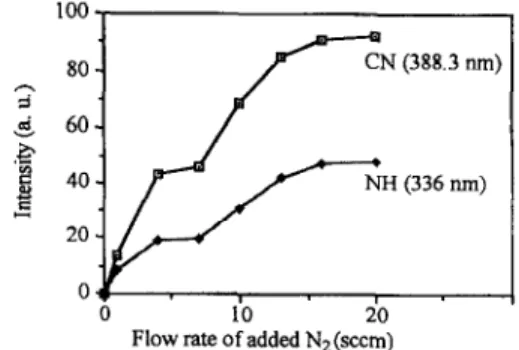
Fig. 7 shows the emission intensities of the observed lines as a function of the added nitrogen. We here discuss the larger change in the emission intensity of species in the plasma qualitatively. NH and CN radicals tended to be increased by adding nitrogen to the reactant gases. This is attributable to the reactions of nitrogen with methane and carbon atoms in the gas phase, which probably formed HCN (not detected in our emission spectra), C,N, and CN radicals. Alternatively, atomic nitrogen may remove carbon atoms from the growing surface and thus produce CN radicals. Badzian et al. [5] proposed that abstraction of hydrogen from the surface could occur via formation of NH, and HCN, resulting from the presence of atomic nitrogen and CN radicals, which allowed diamond to grow from the CH4-NZ gas mixtures. However, the crystal structure of the grown diamond was distorted, namely, the sequence of the tetrahedral layers was mixed (cubic and hexagonal) and the stacking suffered from tur- bostatic disorder. It is necessary to clarify the reaction behav- iors of HCN and CN radicals occurring in our case. Once CN was formed in the gas phase, this molecule was extraordinar- ily stable, having one of the highest bond dissociation ener- gies
(D,
=
180 kcal mol- ‘). The dimerization energy, however, was very large (2CN(g) = C2N2(g) AH= - 134 kcal mol-i) and would finally favor the formation of the C2N2 species [ 141. HCN and C2N2, which were triple- bonded compounds, were not known to be diamond precur- sors. Because the covalent carbon-nitrogen triple bond was extremely stable, the remaining nitrogen was expected in the film and resulted in a higher fraction of non-diamond phase, which was also demonstrated in other reports [ 15,161.It is important to note that the reactant gases of CH,-CO?-- NZ (i.e. a C/H/O/N gas system) used in the present exper- iment were different from those of CH,-HZ-N2 and CH,-N,
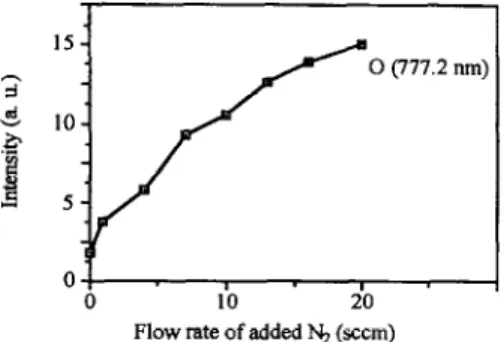
(i.e. a C/H/N gas system) used by others. Carbon dioxide in the reactant gases was considered to be decomposed into CO and atomic oxygen. This would affect the gas phase reactions and surface processes. Fig. 8 shows that the amount of atomic oxygen increased with increasing nitrogen. The possible reasons are discussed as follows. The reaction lead- ing to the formation of NO was generally endothermic ( 1 / 2N,+1/202+NOAH298= 21.6 kcal mol-
’
) , and therefore is favored at high temperature. As NO was formed in the gas phase, a reaction with active nitrogen species resulted in a15
‘3‘
0 (777.2 NII)
Flow rate of added I$ @cm)
Fig. 8. Variation of the emission intensity of the atomic oxygen with the flow rate of added nitrogen.
signilicant density of nitrogen atoms being present in the gas phase to engage in the titration reaction (a high-rate reaction) N + NO + N2 + 0 [ 171. This may give rise to the increase in the amount of oxygen atoms in the plasma. Therefore, we suggest that atomic nitrogen plays a dominant role in the C/
H/O/N plasmas chemical vapor deposition processes
because the amount of oxygen atoms increased via the titra- tion reaction of nitrogen atoms. This would have a significant influence on diamond synthesis in a CH,COZ-N, gas mix- ture.
Oxygen had several effects other than the increase of atomic hydrogen concentration (not found in our experi- ment), such as acetylene reduction in the gas phase, etching of polyacetylene and graphitic carbon deposits on the grow- ing surface [ 181. According to the combustion process described in Ref. [ 191, oxygen had the effect of converting cyanogen (C2N2) into CO and N?. Therefore, oxygen may reduce the concentration of gaseous CzN2, which was sug- gested to be responsible for the deposition of paracyanogen component [ 141. A variety of etchants (OH, atomic oxygen and 0,) seem to remove hydrogen cyanide (HCN) and cyan- ogen on the growing surface, except for the effect of etching amorphous and graphitic carbon. This contributes to repro- ducing diamond-growing sites and then promoting the dep- osition of diamond growth precursor.
The emission intensities of the observed lines are shown in Fig. 9 as a function of the added nitrogen. We found that the CH emission and C2 radicals tended to be suppressed by the addition of nitrogen. On the basis of our results, we infer that more intensely excited C, emissions result in amorphous carbon and/or graphite that is deposited in a C/H/O/N sys- tem. This conclusion was evidenced by the Raman spectra (Fig. 3). The net growth rates are a result of the competition between the deposition and etching reactions. In the present experiment, there was simply a dilution effect on reactant species in the plasma and the effect of etching amorphous and graphitic carbon because of the addition of nitrogen. However, the more important influence is that the plasma species interact with each other and with the matrix gas through various chemical reactions and are directly involved in the deposition process. The lower growth rates (total, i.e. diamond + non-diamond components), resulting from the addition of nitrogen, were probably due to etching of carbon from the surface and depletion of the growth precursors of
22 16 20 14 2 18 + CH (431.4nm) 12 3 5 16 1 B 3 14 10 .$ .5 12 8 B 10 6 0 10 20
Flow rate of added N2 (seem)
diamond and non-diamond components such as CH and C2, respectively, in the gas phase. Furthermore, no deposition was observed in the CH,-CO,-N, system when a larger amount of nitrogen was added. This may be due to the high concentrations of etchants in the plasma removing diamond, amorphous deposits, and paracyanogen components faster than their growth rates.
We are currently preparing to analyze the stable species in the reactor using a differentially pumped quadrupole mass spectrometer, and thereby hope to obtain a more complete understanding of diamond growth mechanisms when nitro- gen is added to the gas mixtures.
4. Conclusion
The effects of added nitrogen on the diamond growth using a CH,-C02 gas mixture were examined. We found that the morphology of diamond films changed from cauliflower structures to well-defined facets due to the nitrogen addition. However, a discontinuous diamond film with well-faceted crystallites was formed resulting from the further addition of nitrogen. No carbon of any kind was deposited when the flow rate of nitrogen reached 20 seem. Simply there was a dilution effect on reactant species in the plasma and the effect of etching amorphous and graphitic carbon because of the addi- tion of nitrogen. However, the more important influence is that the plasma species interact with each other and with the matrix gas through various chemical reactions and are directly involved in the deposition process. The nitrogen incorporated into the diamond films was found to be very low, consistent with a model of film growth involving simul- taneous deposition and etching processes [ 31. Although the amount of atomic hydrogen in the ground state decreased and CN radicals increased with increasing amount of added nitro- gen, a larger amount of atomic oxygen and the decrease in the C, emissions in the gas phase resulted in the deposition of good-quality diamond films under optimum conditions.
Acknowledgements
The authors would like to express their appreciation to the National Science Council of the Republic of China for finan- cial support under contract number NSC 84-2221-E009-36.
References
[ 1] R.C. DeVries, Annu. Rev. Mater. Sci.. 17 (1987) 161.
[2] J.C. Angus and C.C. Hayman, Science, 242 (1988) 913.
[3] S. Jin and T.D. Moustakas, Appl. Phys. Left., 65 (1994) 403.
[4] S. Jin and T.D. Moustakas, Appl. Phys. Lett.. 63 ( 1993) 2354. [5] A. Badzian, T. Badzian, and ST. Lee, Appl. Phys. Lett., 62 (1993)
3432.
[6] R. Lecher, C. Wild, N. Herres, D. Behr, and P. Koidl, Appl. Phys. Lett., 65 (1994) 34.
[7] C.F. Chen, CL. Lin and T.M. Hong, &I-$ Coat. Technol., 52 (1992) 205.
[ 81 CF. Chen, T.M. Hong and S.H. Chen, J. Appl. Phys., 74 ( 1993) 4483. [9] R.W.B. Pearse and A.G. Gaydon, The Identification of Molecular
Spectra, Chapman and Hall, London, 1976.
[ 101 J.A. Mucha. D.L. FJamm and D.E. Ibbotson, J. Appl. Phys., 65 ( 1989)
3448.
[ 111 Y. Muranaka, H. Yamashita, K. Sato and H. Miyadera, J. Appl. Phys., 67 (1990) 6247.
[ 121 Y. Yokota, H. Kawarada and A. Hi&i, Muter. Res. Sot. Symp. Proc. 162 (1990) 231.
[ 131 D.S. Knight and W.B. White, J. Muter. Res., 4 (1989) 385.
[ 141 J.J. Cuomo, P.A. Leary, D. Yu, W. Reuter and M. Frisch, J. Vat. Sci. Technol., 16 (1979) 299.
[ 151 P. Kania, G. Francz and P. Oelhafen, Diamond Related Mater., 3 (1994) 696.
[ 161 S. Jou, H.J. Doerr and R.F. Bunshah, Thin Solid Films, 253 (1994) 95.
[ 171 H.V. Boenig, Fundamentals of Plasma Chemistry and Technology,
Technomic, Lancaster, 1st edn., 1988, p. 65.
[ 181 Y. Muranaka, H. Yamashita and H. Miyadera, Thin Solid Films. 195 (1991) 257.
[ 191 W.L. Jolly, in W.A. Benjamin (ed.), The Inorganic Chemistry of