
Hola Baby 幼稚園企業計劃 - 政大學術集成
63
0
0
全文
(2) Hola Baby 幼稚園企業計劃 Hola Baby Kindergarten Business Plan. 研究生:蕭少晟. Student: Albert Iglesias Nabau. 指導教授:吳文傑. Advisor: Professor Jack Wu. 政 治 大. 學. ‧ 國. 立. 國立政治大學. ‧. 商學院國際經營管理英語碩士學位學程 碩士論文. sit. y. Nat. er. io. A Thesis. n. a l to International MBA Program Submitted iv n. C. i U e n g c hUniversity NationalhChengchi. in partial fulfillment of the Requirements for the degree of Master in Business Administration. 中華民國一○一年七月 July 2012.
(3) Dedication. To my family for being supporting every day, To my wife for helping me and for being next to me all the time, To my little Marc for giving me 治 his cute smile every morning.. 立. 政. 大. ‧. ‧ 國. 學. n. er. io. sit. y. Nat. al. Ch. engchi. i. i Un. v.
(4) Table of Contents 1.. EXECUTIVE SUMMARY ............................................................................................... 1. 2.. COMPANY DESCRIPTION............................................................................................. 3 2.1.. Company Overview ............................................................................................... 3. 2.2.. Vision and Mission ................................................................................................ 3 Vision ......................................................................................................... 3. 2.2.2.. Mission....................................................................................................... 3. Values .................................................................................................................... 3 2.3.1.. Happiness ................................................................................................... 3. 2.3.2.. Learning ..................................................................................................... 3. 2.3.3.. Creativity.................................................................................................... 4. 2.3.6.. Trust ........................................................................................................... 4. 2.3.7.. Respect ....................................................................................................... 4. 2.3.4.. Management ........................................................................................................... 5 2.4.1.. Albert Iglesias ............................................................................................ 5. 2.4.2.. Katrena Hsiao............................................................................................. 5. 2.4.3.. John Vatougios........................................................................................... 5. er. io. sit. y. Nat. al. iv n C PEST ANALYSIS ................................................................................................. 6 hengchi U n. 3.. ‧. 2.4.. 學. 2.3.5.. 政 治 大 Multicultural .............................................................................................. 4 立 Safety ......................................................................................................... 4. ‧ 國. 2.3.. 2.2.1.. MARKET ANALYSIS ...................................................................................................... 6 3.1.. 3.2.. 3.3.. 3.1.1.. Political Factors ......................................................................................... 6. 3.1.2.. Economic Factors....................................................................................... 7. 3.1.3.. Sociocultural Factors ................................................................................. 8. 3.1.4.. Technological Factors ................................................................................ 9. PORTER 5 FORCES ............................................................................................. 9 3.2.1.. Bargaining Power of Suppliers .................................................................. 9. 3.2.2.. Threat of New Entrants .............................................................................. 9. 3.2.3.. Threat of Substitutes .................................................................................. 9. 3.2.4.. Bargaining Power of Customers .............................................................. 10. 3.2.5.. Competitive Rivalry within Industry ....................................................... 10. BLUE OCEAN STRATEGY .............................................................................. 13. ii.
(5) 3.4.. Weaknesses .............................................................................................. 14. 3.4.3.. Opportunities............................................................................................ 14. 3.4.4.. Threats...................................................................................................... 14. 4.1.. PRODUCT ........................................................................................................... 16. 4.2.. PRICE .................................................................................................................. 16. 4.3.. PLACE ................................................................................................................. 16. 4.4.. PROMOTION ...................................................................................................... 16. BUSINESS MODEL ....................................................................................................... 17. 政 治 大. 5.1.. GENERAL OVERVIEW..................................................................................... 17. 5.2.. KEY ACTIVITIES .............................................................................................. 18. 立. Weekly Schedule ..................................................................................... 19. 5.2.2.. Special Activities ..................................................................................... 21. 學. 5.2.1.. KEY RESOURCES ............................................................................................. 22 Premises ................................................................................................... 22. 5.3.2.. Furniture and Facilities ............................................................................ 24. 5.3.3.. Personnel: ................................................................................................. 26. ‧. 5.3.1.. sit. y. Nat. REVENUE GENERATION ................................................................................ 27. io. 5.4.. al. v. 5.4.1.. Pricing ...................................................................................................... 27. 5.4.2.. Revenues Forecast ................................................................................... 29. n. 7.. 3.4.2.. MARKETING PLAN ...................................................................................................... 16. 5.3.. 6.. Strengths .................................................................................................. 14. er. 5.. 3.4.1.. ‧ 國. 4.. SWOT ANALYSIS ............................................................................................. 14. Ch. engchi. i Un. FINANCIAL ANALYSIS ............................................................................................... 38 6.1.. Capital Financing and Investment ....................................................................... 38. 6.2.. Costs Detail .......................................................................................................... 39 6.2.1.. Monthly Expenses .................................................................................... 39. 6.2.2.. Personnel Expenses.................................................................................. 39. 6.3.. Pro-forma Income Statement (Based on Expected Scenario) .............................. 40. 6.4.. Pro-forma Balance Sheet (Based in Expected Scenario) ..................................... 44. 6.5.. Pro-forma Cash-Flow Statement (Based in Expected Scenario) ......................... 48. 6.6.. Scenario Analysis................................................................................................. 52. 6.7.. Break-even Analysis ............................................................................................ 55. REFERENCES ................................................................................................................ 56. iii.
(6) Figures Figure 1: Taiwan Current Education System ............................................................................. 6 Figure 2: Impact of the ECEC Act ............................................................................................. 7 Figure 3: Population Structure ................................................................................................... 8 Figure 4: Number of Kindergarten .......................................................................................... 10 Figure 5: SWISS Tuition Fee Structure (in US dollars) .......................................................... 12 Figure 6: Red Ocean vs. Blue Ocean Strategy ......................................................................... 13. 立. 政 治 大. ‧. ‧ 國. 學. n. er. io. sit. y. Nat. al. Ch. engchi. iv. i Un. v.
(7) 1. EXECUTIVE SUMMARY There is no doubt that the world is more flat and people are more multicultural and movable than 10 or 20 years ago. If you take a look at my case, I am a Spanish who meet a Taiwanese in New York and now I am forming a family in Taipei. During my childhood I didn’t learn any other language than my two natives’ languages (Catalan and Spanish), I started to study English with 20 years and since then I am still struggling trying to improve my language skills (English and Chinese). However, there is a way to avoid my long learning journey. As thousands of studies demonstrated, learning a language as a kid is a lot easier and faster than as adult, the main reason is because the brain’s. 政 治 大. cognitive flexibility decreases with age.. 立. Living in Taiwan for more than 2 years, I realized the importance that the Taiwanese parents. ‧ 國. 學. give to the early education of their children and specially to learn languages, mainly English. For example, last April I went to the Toddlers Fair in the World Trade Center in Taipei, it. ‧. was astonishing see that 70% of the Area was focused on books’ subscriptions with a lot of. y. Nat. bilingual books. Another fact is that in almost any street you can find an English cram school. er. io. sit. or an English kindergarten.. al. n. iv n C also found that there is no competition h eregarding i Ulanguages kindergarten besides the n g c hother. During my research I found that there is a lot of competition about English kindergarten, but I. French and German section of the Taipei European School, with a prohibitive price. The lack. of competition for trilingual kindergarten, plus the recent inflow of people with Spanish background that came to Taipei recently due to the ICDF program, makes me believe that there is a profitable niche to exploit in a trilingual kindergarten.. Based in my estimation and the information obtained through the contact with the Spanish Speaking Countries’ embassies the approximate number of children between 0 and 6 years with one Spanish Speaking parent is around 100 (around 20 Embassies in Taiwan with an average of 5 children per embassy). Our target would be acquire around 40% of this market and use it as a hook to attract Taiwanese families interested in a multicultural experience for. 1.
(8) their children and other foreign families (targeting North American) interested in helping their children to boost their language skills.. Hola Baby Kindergarten is a local Taiwanese company with 34 employees, 9 of them foreigners, created to help Taiwanese children to understand and learn from other cultures and to arouse interest to learning languages. The school is planned to be located in Tianmu neighborhood in Taipei with three different departments (Chinese, English and Spanish), each one in a different floor with different cultural decoration and motives to create three different worlds. Furthermore, each Department works independently in deciding their own individual activities under a general curriculum and monitored by a Committee formed by all the departmental heads and the Director.. 政 治 大. The parents are given a wide range of flexible plans to choose for their children, part-time or. 立. full-time. They may choose just one language plan for their children (Chinese, English or. ‧ 國. 學. Spanish) or they may choose bilingual or trilingual schedule. However, even if the parents choose the one language schedule their children will also have a daily involvement in. ‧. activities with other departments and cultures with the activity “Explore New Cultures”. Other factors we consider important in our school are the involvement of the parents in the. Nat. sit. y. children education, through the “Saturday Family Activities”; and to build up confidence to. al. er. io. have an outgoing and sociable child through the “Monthly Theater Activities” and a. n. curriculum full of fun and sharing activities.. Ch. engchi. 2. i Un. v.
(9) 2. COMPANY DESCRIPTION 2.1.. Company Overview Hola Baby is a Trilingual Kindergarten (Spanish, English and Chinese) situated in Taipei. It was founded by Mr. Albert Iglesias, Mrs. Katrena Hsiao and Mr. John Vatougios with the goal to provide a fun and multicultural learning experience for children between 2 and 6 years.. 2.2.. Vision and Mission. 政 治 大. 2.2.1. Vision. 立. To provide a life-lasting multicultural experience; to open the child’s mind to explore,. ‧ 國. 學. understand and appreciate the worldwide cultural differences; and to make learning different languages a fun and enjoyable process.. ‧. 2.2.2. Mission. Nat. sit. y. To create a fun, safe and stimulating environment where the children can be exploring. io. n. al. er. different ways to educate through three different environments, Spanish, English and Chinese.. 2.3.. Values. Ch. 2.3.1. Happiness. engchi. i Un. v. We believe that the most important factor to raise a smart and healthy baby is happiness. We believe that happiness is inherent in a baby and it only changes over life due to disappointments, we want to teach a baby to be thankful for what they have and to appreciate even the smallest achievement. As Aristotle said “Happiness depends upon ourselves”. 2.3.2. Learning Our main goal is to keep learning and fun together in an interactive and multicultural environment. We want to build the pillars of happy learning in the baby as a foundation of a long and enjoyable education journey.. 3.
(10) “Education is what remains after one has forgotten what one has learned in school” Albert Einstein.. 2.3.3. Creativity We want to provide the tools and the attitude to self-learning and curious mind for the children to have the motivation to explore for new ideas and new ways to solve their daily problems. “Inspiration exists but has to find you working” Pablo Picasso. “Creativity is just connecting things” Steve Jobs. 2.3.4. Multicultural. 治 政 大 We believe that understanding. We believe that the exposure to a multicultural environment boost creativity and respect to different opinions and manners.. 立. different cultures and. different ways of thinking helps to be an open-minded person.. ‧ 國. 學. “Everything that we see is a shadow cast by that which we do not see”. Martin Luther King Jr.. ‧ y. Nat. 2.3.5. Safety. sit. We carefully create a safe environment to create confidence in the children and willingness to. er. io. explore and learn. The protection of all the facilities and the alertness of our teachers are. al. n. iv n C “Don’t handicap your children making their life easy”. Robert A. Heinlein. h e nby gchi U. basic to give freedom to the children to have a monitored learning experience.. 2.3.6. Trust Trust in the environment, trust in your friends and trust in yourself are part of owns confidence, and we believe that confidence boost creativity and happiness. “The best way to find out if you can trust somebody is to trust them” Ernest Hemingway.. 2.3.7. Respect Learn how to respect and love yourself, your parents, others and the environment is a basic purpose of life. “Respect yourself and others will respect you” Confucius.. 4.
(11) 2.4.. Management. 2.4.1. Albert Iglesias CEO, CFO and Chief of the Spanish Section, he is an IMBA Candidate at National Chengchi University, with 4 years of experience in accounting. He is going to be in charge of the strategic and long-term planning together with the daily accounting, budgeting and financing operations.. 2.4.2. Katrena Hsiao COO and Chief of Chinese Section, she has a Degree in Airline Management from the Kaohsiung University, a Chinese teacher certificate and more than 8 years of experience in. 政 治 大 strategic plan for the curriculum and education in the Chinese Section. 立. Facility Management. She is going to be in charge of the daily general operations and the. ‧ 國. 學. 2.4.3. John Vatougios. Chief of the English Section, he is an IMBA Candidate at National Chengchi University, he. ‧. has a Bachelor of Applied Physics and a Master in Education from Simon Fraser University. y. Nat. in Vancouver. He has more than 8 years of experience teaching, 4 of them in Taiwan. He is. io. sit. going to be in charge of the daily operations and the strategic plan for the curriculum and. n. al. er. education in the English Section.. Ch. engchi. 5. i Un. v.
(12) 3. MARKET ANALYSIS 3.1.. PEST ANALYSIS. 3.1.1. Political Factors . Compulsory education in Taiwan is from 6 to 15 years old (9 years), and is expected to extend to 18 years old by 2014. So, Preschool education, from 2 to 6 years is not considered compulsory in Taiwan.. 立. 政 治 大. ‧. ‧ 國. 學. n. er. io. sit. y. Nat. al. Ch. engchi. i Un. v. Figure 1: Taiwan Current Education System Source: 2011-2012 Education in Taiwan Report – Ministry of Education (MOE) . Since 1981 the field of early education and childhood was regulated by the Preschool Education Act, however, on June 2011 the Executive Yuan passed the “Early Education and Care Act”, which started to take effect on January 2012. The following are the main changes in the Act:. 6.
(13) 立. 政 治 大. ‧ 國. 學. ‧. Figure 2: Impact of the ECEC Act Source: Child Care Friendly Policies and Integration of ECEC in Taiwan - International Journal of Child Care and Education Policy 2011, Vol.5, No.2, 1-19. y. Nat. al. er. Taiwan’s economic situation has been stable in the recent years (GDP growth of. io. . sit. 3.1.2. Economic Factors. v. n. 10.72% in 2010, 4.04% in 2011 and forecasted growth of 3.85% in 2012).. Ch. i Un. However, the unstable situation in Europe, the not complete recovery of the. engchi. United States and the negative data about the perspectives in China may affect the export oriented Taiwanese economy. . The Inflation is expected to rise in 2012, the Consumer Price Index (CPI) is forecasted to grow at 1.46% in 2012, mainly in food and clothing products, however, the expenses in education may decrease during the same period.. . The interest rates are low in Taiwan (TAIBOR around 0.9%), a good indication to obtain cheap funding for our venture if needed.. . The unemployment rate in Taiwan is decreasing from a peak of more than 6% in 2009; in January 2012 was around 4.18%. Furthermore, the labor force participation is also increasing; in January 2012 was 58.12%. This data may. 7.
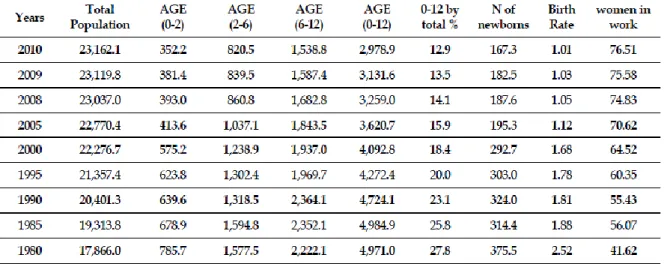
(14) indicate a growing number of families with both parent working and a need to send the children to kindergarten.. 3.1.3. Sociocultural Factors . With a birth rate of 1.01, Taiwan has one of the lowest in the world, if this trend continues for the following years this may be a threat for the company future growth.. . In the bright side from the statistics we observed that the women aged between 25 and 44 are increasingly joining the labor force, around 76.5% in 2010. The dual income families may be one of the reasons of the high percentage of preschool kids registered in kindergarten (93.77% in 2010).. 立. 政 治 大. ‧. ‧ 國. 學. n. er. io. sit. y. Nat. al. Ch. engchi. i Un. v. Figure 3: Population Structure Source: Child Care Friendly Policies and Integration of ECEC in Taiwan - International Journal of Child Care and Education Policy 2011, Vol.5, No.2, 1-19 . One of the cultural characteristics of Taiwanese parents is the concern and the dedication (time and money) that they put into their children’s education since inception, and one of their main concerns is learning languages, mainly English.. . As a concern we have the attraction of qualified staff, regarding Chinese teachers it won’t be a major problem, the major concern is attracting Spanish and English speaking teachers with patience to educate children between 2 and 6 years and the willingness to have a mid or long-term career in Taiwan.. 8.
(15) 3.1.4. Technological Factors . With the technology advancing so fast and with the children toys every day more and more sophisticated, nowadays is really important to carefully select the toys than can enhance the children learning experience without harming their social skills.. . The advertisement and promotion of the school and its activities is also affected by the technology. It is really important take advantage of the Social Networks and the help that may provide to add additional services for the families.. . The technology investment and requirements will be one of the main drivers of our initial investments (a/c, computers, TVs and other facilities, IT systems, software, etc.), so it is important to carefully select the best quality/price provider.. 3.2.. PORTER 5 FORCES. 立. 政 治 大. 3.2.1. Bargaining Power of Suppliers. ‧ 國. 學. Within the kindergarten industry, there are numerous suppliers of a variety of products (toys, books, etc.) and services (cleaning, maintenance, food, etc.) fragmented across the industry.. ‧. These suppliers sell generic products in a high competitive market, so the bargaining power. sit. y. Nat. of the suppliers is considered low.. er. io. 3.2.2. Threat of New Entrants. al. n. iv n C h eECEC with the regulation (safety regulation and h i orUthe ability to raise money to adapt n g cAct). The main barriers of entry into the market are to obtain the license and permits and comply. the facilities to a child friendly environment. Based in the mentioned prerequisites we consider that the barriers of entry are also considered low.. 3.2.3. Threat of Substitutes Other options than sending your son to a kindergarten are that the parents stay in home taking care of the child, hire a maid, hire a nanny to come home, or send your child to a house of a nanny which take care of more than one child. Each one of the options mentioned has its own disadvantages (price, safety, trust, etc.), so we would consider the threat of substitutes also low.. 9.
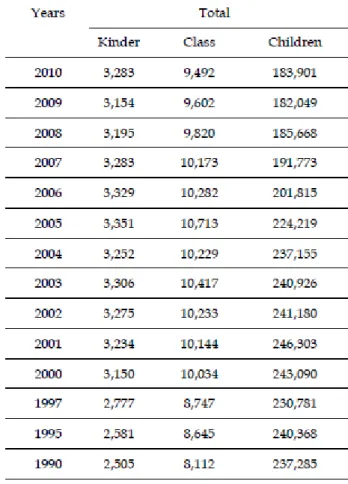
(16) 3.2.4. Bargaining Power of Customers The importance to select a good kindergarten for the children is one of the most important decisions that a family does, so they take good care about selecting the best kindergarten for their children. They acquire as much as information they can, from visiting various facilities, interviewing the owners, to asking for recommendations from relatives and friends. So, we would consider that the customer has high bargaining power.. 3.2.5. Competitive Rivalry within Industry The Taiwanese kindergarten industry includes around 3,283 different kindergarten, some of them are grouped as franchises; but we still can consider that the market is quite segregated. Furthermore we observe that since 2000 the number of kindergarten didn’t grow and the. 治 政 大 kindergarten market is highly competitive in Taiwan. 立. number of students decreased around 25%. With this data we can confirm that the. ‧. ‧ 國. 學. n. er. io. sit. y. Nat. al. Ch. engchi. i Un. v. Figure 4: Number of Kindergarten Source: Child Care Friendly Policies and Integration of ECEC in Taiwan - International Journal of Child Care and Education Policy 2011, Vol.5, No.2, 1-19 10.
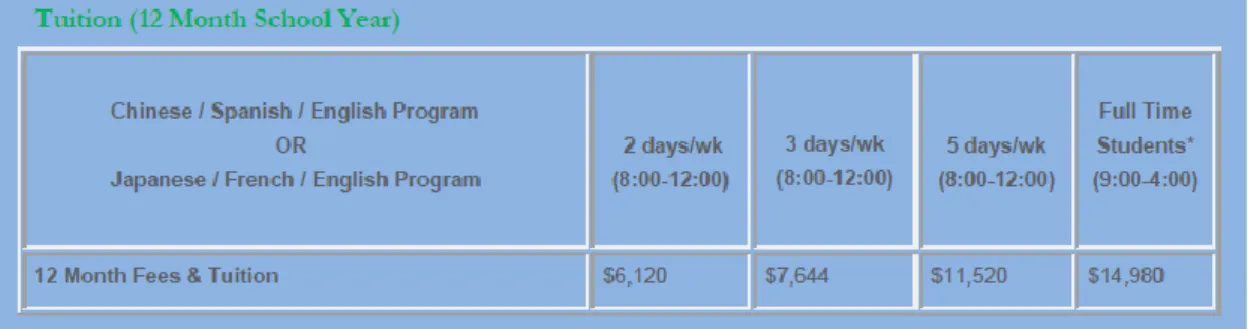
(17) To understand more the market and the competition we decided to do a mystery shopping analysis, reviewing 4 competitors in the industry with different characteristics:. TAIPEI EUROPEAN SCHOOL The Taipei European School is one of the most renowned and recognized schools in Taipei, its courses range from kindergarten to high school. The School is divided in three separate sections (British, French and German). The school offers classes in any of the languages mentioned plus Chinese. Each of the three sections offer Kindergarten services from 3 to 6 years old with focus on motor skills activities and language acquisition activities. Its. 政 治 大. curriculum and facilities are outstanding; however, the cost is higher than other private kindergarten. See the fee structure:. 立. ‧. ‧ 國. 學. n. al. er. io. sit. y. Nat SWISS TRILINGUAL. Ch. i Un. v. The Swiss (Small World International Students System) Trilingual. engchi. school is an international private school with franchises in whole over the world. Swiss was founded in 2004 in New York with the values of compassion, love in a trilingual environment. The school has two types of curriculum, one based on Chinese, Spanish and English languages and another one based in Japanese, French and English. However, this school looks a direct competitor the problem is its location (located in Hsinchu) and that only accepts children over 5 years old. Furthermore, the price offered by the school is also prohibitive. See the fee structure:. 11.
(18) Figure 5: SWISS Tuition Fee Structure (in US dollars) Source: SWISS Trilingual School, Taiwan Branch. CHOCOLATE EDUCATION INSTITUTE The Chocolate Education Institute is a group of 7 kindergartens around Taipei and Taipei County. They accept babies. 治 between 2 and 6 years and they divide政 them in 4 classes (Baby Class, Primary Class, Junior 大 Class and Senior Class). Its curriculum and materials are Chinese-English bilingual with 立 ‧ 國. 學. focus on enhance the intellectual ability (mathematical, language, intrapersonal, etc.) of the children. One of the weaknesses of this school is that is too focus on learning and not in the. ‧. idea of joy. The Fee structure is the following:. n. al. n U i e h NJIAMEEI KINDERGARTEN (佳美) n g c. Ch. 9,800. er. io. Additional fee per month (food, clothes, etc.). y. Nat. Miscellaneous Fee Tuition Fee per month. 22,800. sit. CHOCOLATE. 3,950. iv. Njiameei is a local kindergarten really famous in Yonghe County with 6 months waiting list to register the child. It is a only Chinese kindergarten focused on enhance the interpersonal skills and motor abilities of the children. Its facilities contain gardens, small farm with rabbits and swimming pool, and its teachers are lively. All together makes an amazing and unforgettable experience for the children. The disadvantages of this school are its only Chinese curriculum and its lack of structured curriculum. The fees structure is the following: 佳美 Miscellaneous Fee. 16,000. Tuition Fee per month. 9,000. Additional fee per month (food, clothes, etc.). 12. n/a.
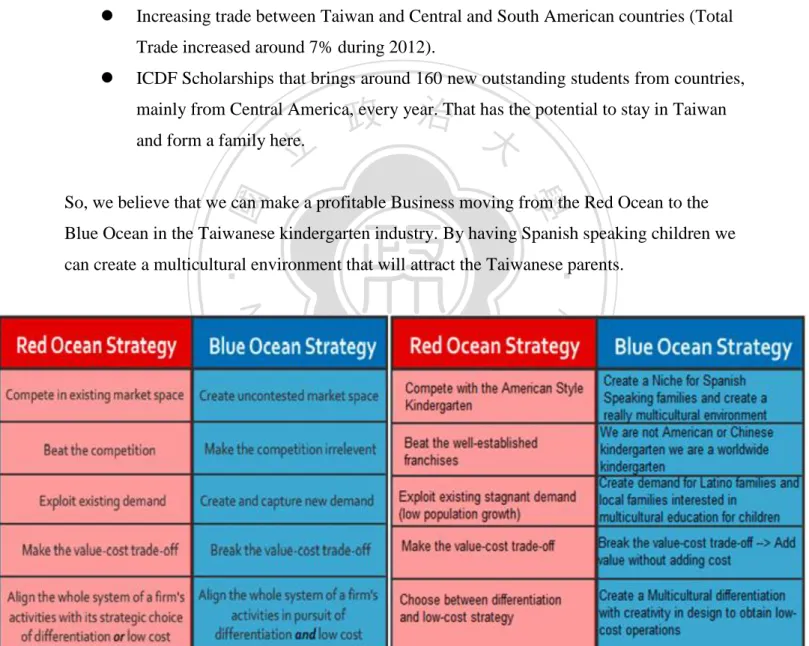
(19) 3.3.. BLUE OCEAN STRATEGY. As we observed in our Five Forces analysis, the kindergarten industry is quite competitive, if we add to the fact that the customers rely on the experience and brand name of the school. It makes really difficult for new entrants to come into the market. So our aim is to find our Blue Ocean in the industry, we believe there is a niche for children that at least one of the parents is Spanish speaking. Our reasons are the following: . Good political relations between Taiwan and Latin American countries.. . Increasing trade between Taiwan and Central and South American countries (Total Trade increased around 7% during 2012).. . ICDF Scholarships that brings around 160 new outstanding students from countries,. 政 治 大. mainly from Central America, every year. That has the potential to stay in Taiwan and form a family here.. 立. ‧ 國. 學. So, we believe that we can make a profitable Business moving from the Red Ocean to the Blue Ocean in the Taiwanese kindergarten industry. By having Spanish speaking children we. ‧. can create a multicultural environment that will attract the Taiwanese parents.. n. er. io. sit. y. Nat. al. Ch. engchi. i Un. v. Figure 6: Red Ocean vs. Blue Ocean Strategy. 13.
(20) 3.4.. SWOT ANALYSIS. 3.4.1. Strengths . All our teachers are completely bilingual (Chinese-English, English-Spanish or Chinese- Spanish).. . Flexibility in choosing plan, you can choose a one language plan (Chinese, English or Spanish), bilingual plan (Chinese-Spanish, Spanish-English or Chinese-English), or trilingual plan... . We enhance the creativity of the children by monitored fun activities.. . We have daily mixed activities between the children of the 3 sections, to enhance their understanding of the different cultures.. . Every Saturday we offer a gathering with parents and children to have fun activities. . 政 治 大 We have monthly gathering where the kids and the parents are invited to mingling 立 and understand the environment in our school.. . Competitive price compared with other Multilanguage schools.. together.. ‧. ‧ 國. 學. 3.4.2. Weaknesses. We don’t have the reputation of other school.. . Besides the Chief of the English Section, we don’t have experience in the education. sit. n. al. er. io. industry.. y. Nat. . 3.4.3. Opportunities. Ch. engchi. i Un. v. . No competitors offer trilingual school at a reasonable price.. . Motivation of Taiwanese parents to educate children since inception.. . It is easy in Taiwan to find good quality at a reasonable price toys and books, lowering the cost of the initial investment.. 3.4.4. Threats . Established market with established competitors will make difficult to switch school for students.. . Low birth rate in Taiwan and high kindergarten registration rate, the only way to increase revenues is by gaining market share.. 14.
(21) Our school is a new concept in the market and there is the risk of misunderstanding and lack of marketability.. 立. 政 治 大. 學 ‧. ‧ 國 io. sit. y. Nat. n. al. er. . Ch. engchi. 15. i Un. v.
(22) 4. MARKETING PLAN 4.1.. PRODUCT. We will have a 3 floors facility; each floor will represent a different culture (Spanish, American and Chinese). In each floor we will have three classrooms (2-3 years, 3-4 years and 5-6 years) a playing area and an activities area. The parents can choose between different plans to register their children, see Section 5 -Business Model- below for more detail in the product and activities.. 4.2.. PRICE. Our pricing strategy will be market oriented; we will try to keep the market price of. 政 治 大. competition for the basic package (only Chinese environment), adding mark-ups for. 立. additional services (different languages, bilingual education, etc.). See section 5.4.2 –Pricing-. ‧ 國. PLACE. ‧. 4.3.. 學. for more detail on pricing.. We will locate our kindergarten in the neighborhood of Tianmu, even though it is the area. Nat. sit. y. with more international kindergarten competition, it is also the area with more Spanish. io. er. speaking residents due to the location of the embassies and the convenience of the neighborhood. Furthermore, the area is more internationally open.. n. al. 4.4.. PROMOTION. Ch. engchi. i Un. v. We will promote our school first by advertising in South and Central American embassies and promoting it to the personnel working in the embassies and the Chambers of Commerce to obtain a word of mouth promotion. Furthermore, we will make use of the Social Networks (Facebook mainly) to promote our school and activities. The promotion of the Chinese and English section will be by handing pamphlets around the neighborhood. We will also have one Saturday per month open to prospect customers to show them the activities we do in the school and to let them interact with parents to give them better information about the greatness of our school and services.. 16.
(23) 5. BUSINESS MODEL 5.1.. GENERAL OVERVIEW. We offer to our customer the option to register in a truly multicultural school, with 3 different departments (Chinese, English and Spanish), located in three different floors. Each Department works independently in deciding their own individual activities under a general curriculum and monitored by a Committee formed by all the departmental heads and the Director.. The parents can choose different options to register their children: . Full-time One language program: The child will be registered in one of the three. 政 治 大 one of the three languages, however, the child will have the opportunity for an hour 立. departments (Chinese, English or Spanish) and the curriculum will be held in only. a day to explore and understand the other cultures (See more details in section 5.2 -. ‧ 國. 學. Key activities-). . Part-time One language program: As the full-time program, the child will be. ‧. registered in one of the three departments and he will stay in the school in the. io. y. Full-time Two languages program: The child will be registered in one of the. n. al. er. . sit. up.. Nat. morning from 8.00 to 12.30 and after lunch the parents will come to pick the child. i Un. v. departments as a main language and the parents will choose which language they. Ch. engchi. want as a second language. The child in the morning will be part of the main language class and in the afternoon he will be part of the second language class. . Part-time Two languages program: The child will be registered in one language as a main language and will take the core classes in that language (classes from 9.00 to 10.15, see more detail below in section 5.2 -Key activities-), the second morning class will be held in the chosen language by the parents. Then after lunch the parents will come to pick up the child.. . Full-time Trilingual program: The child will be registered in one main language and will take the core classes in that language (classes from 9.00 to 10.15, see more detail below in section 5.2 -key activities-). For the two other languages, the child will be distributed to the morning or afternoon class depending on availability.. 17.
(24) Our classes will be divided in three levels in each of the three departments: -. Freshman: For 2 and 3 year old children.. -. Sophomore: For children between 3 and 4 years old.. -. Senior: For children between 5 and 6 years old.. To provide a high class education and to comply with the governmental regulation (see section 3.1 –Political Factors- above for more detail) the number of students and teachers per class will be as follow: Number Students Teachers Students per teacher Freshman Class. 16. Sophomore Class Senior Class. 立. 2. 8. 24 治3 政 24 3 大. 8 8. ‧ 國. 學. Our teachers will be advanced or fully bilingual in any pair of languages taught in the school (Chinese-English, English-Spanish and Chinese-Spanish). In every class will be at least one. ‧. native speaker of the language taught plus one bilingual Taiwanese teacher for the English. sit. y. Nat. and Spanish class.. er. io. Furthermore, our kindergarten gives an important role to the family values, providing a full. al. n. iv n C every month, which includes a theater h eperformance n g c h i byUthe children. range of family activities every Saturday morning, with an special party the last weekend of (See more detail in. section 5.2 -Key Activities- section below).. 5.2.. KEY ACTIVITIES. As we mentioned before we have a standard weekly schedule for all the levels and departments (Chinese, English and Spanish) which gives us the flexibility to offer our customers a wide range of plans to register their children.. Furthermore, in our kindergarten we are planning to have a monthly theme in every department that will serve to guide our classes and lessons to a structured and fun learning experience and to gain cultural knowledge.. 18.
(25) 5.2.1. Weekly Schedule Our weekly schedule for all the Departments is as follows:. 立. 政 治 大. ‧ 國. 學. From our typical weekly schedule we would like to highlight that we have 3 different classes per day (two in the morning and one in the afternoon). The first morning class is considered. ‧. the core class and has the objective to create the basic knowledge for the next steps of the. er. io. sit. Nat. want as a main language and have the core classes.. y. children. This is the main class for the children and the parents should choose which language. al. n. iv n C personality, social skills and confidence. with bilingual and trilingual plan h eForn gthecchildren hi U these classes are conducted in another floor with different language and culture.. The other two daily classes are considered more fun and are created to build the children. For example a weekly schedule for a child with trilingual plan and Chinese as a main language would be as follow:. 19.
(26) 政 治 大. 立. A weekly schedule for a bilingual plan with Chinese as a main language and Spanish as. ‧ 國. 學. second language would be as follow:. ‧. n. er. io. sit. y. Nat. al. Ch. engchi. i Un. v. For a part time bilingual plan with Chinese as a main language and English as second language the plan would be as follow:. 20.
(27) 5.2.2. Special Activities The special activities that may differentiate our kindergarten from the others are: . Explore New Cultures:. 政 治 大. We consider multiculturalism one of the main values of our kindergarten and we. 立. want to enhance it by the exposure to different cultures. So the idea of this. ‧ 國. 學. afternoon activity is to completely mix kids from different departments to play fun and traditional activities (crafts, dance, music, sports, etc.) in a different cultural. ‧. environment. For example, we will mix one third of the Chinese Department class with one third of the Spanish class and with one third of the English class. All. Nat. sit. y. together they will rotate to the different cultural environments. For example, we. io. er. will explore the English world with teachers that can help to communicate in the three languages and they will be able to explain the American traditions and to do. n. al. Ch. some typical American activities. . engchi. i Un. v. Saturday with Family: Saturday with Family comes from our belief that family and education should be always linked, and parents should be all the time acknowledgeable of the children’s education. With the Saturday with family our goals are to provide free and fun activities where the parents can enjoy with the kids; to introduce the parents between them to increase relations and friendship and establish long-term relationships; and to have an informal way to communicate the children’s performance and concerns that may surge during the week. During Saturday with family we will do the following 3 main activities: o. Family Theater: This activity consists in giving the opportunity to parents to have fun with their children while practicing the monthly theater performance. 21.
(28) and if they are willing they can also participate with a secondary role in the monthly performance. o. Family activities: Games and music in a collaborative environment between children and parents.. o. Lunch time: Informal lunch for everyone to boost parental relations and teacher-parents relations.. . Theater Performance: The last Saturday of each month will be a performance to play by the children in front of their parents. Every week the children have two theater classes (Tuesday and Thursday) in which they will practice the monthly performance and the. 政 治 大. optional Saturday practice with the parents. Following we can find a table from the English Department as example of the monthly departmental themes and the. 立. scheduled performance’s tittle.. ‧ 國. Snow White and the Seven Dwarfs. Love and Feelings. Cinderella. Animals. Three Little Pigs. y. Spring is coming. Pinocchio. May. Mothers month. Little Red Riding Hood. June. Let's go to the beach. July. America. August. Picnic. September. Autumm is coming. The Ant and the Grasshopper. October. Halloween. The Boy Who Cried Wolf. November. Thanksgiving. The Ugly Duckling. December. Christmas. Dear Santa Claus. Ch. er. n. al. sit. April. io. 5.3.. New Year's. ‧. March. 學. February. Theater Play. Nat. January. Theme. iv n U of Independence day i story e n g cThe h The Hare and the Tortoise Jack and the Beanstalk. KEY RESOURCES. 5.3.1. Premises We are planning to locate our Kindergarten in Tianmu (天母) neighborhood, due to its proximity to the Latin-American Embassies and its international environment. However, we will consider other locations if the right opportunity comes along. We will look for renting a. 22.
(29) 4 storey house for around 5 years with an option to buy it in the future. The total area of our facilities will be 1,320 square meters (330 square meters per floor).. The 4 floors will be arranged in the following way: 1st FLOOR (SPANISH FLOOR): . 3 classes. . 1 teacher’s room. . 1 playground common area. . 1 reception office. 2nd FLOOR (CHINESE FLOOR):. 政 治 大. . 3 classes. . 1 teacher’s room. . 1 playground common area. 立. ‧ 國. 學. 3rd FLOOR (ENGLISH FLOOR): 3 classes. . 1 teacher’s room. . 1 playground common area. ‧. . er. io. sit. y. Nat. al. n. 4th FLOOR (SUPPLIES FLOOR):. Ch. . 1 kitchen. . 1 Director’s office. . 1 Theater and big common area. engchi. 23. i Un. v.
(30) 5.3.2. Furniture and Facilities We divided the furniture and facilities needs depending on the rooms: Classroom: As we mentioned before we will have 3 classrooms per department and 3 departments, so 9 classes in total. The detail of the investment per classroom is:. Reference 1 2 3 4 5 6. Classroom Description No. of products Price/unit Useful Life Total Student Desk & Chair 24 3,000 5 72,000 Black Board 2 1,000 5 2,000 Teacher Desk & Chair 2 6,000 5 12,000 Book Shelf 3 1,000 5 3,000 Various Toys 1 20,000 3 20,000 Decoration 1 20,000 10 20,000. TOTAL. 立. 129,000. ‧ 國. 學. Teacher room:. 政 治 大. One teacher’s room per Department for a total of 3 Teachers room with the following detail. ‧. y. sit. io. al. n. TOTAL. Nat. Reference 101 102 103 104. Teacher room Description No. of products Price/unit Useful Life Total Computer 1 30,000 4 30,000 Conference Table 1 8,000 5 8,000 Book Shelf 3 1,500 5 4,500 Chair 6 2,000 5 12,000. er. of assets:. Ch. engchi. i Un. v. 54,500. Common Area and Playground: One per floor for a total of 3 with the following detail of assets: Reference 201 202 203 204 205 206 207. Playground and common area Description No. of products Price/unit Useful Life Total Air Condition 1 60,000 5 60,000 Playground Set 1 80,000 7 80,000 Flat Panel TV 1 40,000 7 40,000 Decoration 1 30,000 10 30,000 Sports Sets 1 10,000 3 10,000 Various Toys 1 20,000 3 20,000 AID Count, extinguisher, etc. 1 10,000 4 10,000 250,000. TOTAL. 24.
(31) Reception: One reception office in the first floor to attend the customers: Reference 301 302 303 304 305. Reception Office Description No. of products Price/unit Useful Life Computer 1 30,000 4 BookShelf 1 1,500 5 Reception Desk 1 10,000 5 Chairs 4 2,000 5 Book's set 1 20,000 3. Total 30,000 1,500 10,000 8,000 20,000 69,500. TOTAL. Kitchen: One kitchen in the 4th floor:. ‧ 國. 302,500. y. sit. al. v C hDirector's Office U n i e n g c h iPrice/unit No. of products. n. One Director’s office in the 4th floor to hold meetings: Reference 501 502 503 504. 30,000 350 40,000 10,000 30,000 35,000. Useful Life Total 7 60,000 4 87,500 7 80,000 4 10,000 7 30,000 7 35,000. Description Executive Desk Executive Chair Book Shelf Computer. er. io. Director’s Office:. 2 250 2 1 1 1. Nat. TOTAL. 立. ‧. Description Cooker & oven Cutlery Dishwasher Pan and other cooking utilities Washing Machine Dryer. 學. Reference 401 402 403 404 405 406. Kitchen 治 Price/unit 政No. of products大. 1 3 1 1. 10,000 3,000 2,000 30,000. Useful Life Total 5 10,000 5 9,000 5 2,000 4 30,000 51,000. TOTAL. 25.
(32) Theater Area: One Theater Area in the 4th floor: Theater Reference Description No. of products Price/unit Useful Life Total 1 56,000 10 56,000 601 Stage 1 20,000 10 20,000 602 Backstage 1 10,000 5 10,000 603 Curtain 50 1,000 5 50,000 604 Chairs 136,000. TOTAL. Other Investments:. 立. 政 治 大. TOTAL. ‧. ‧ 國. 學. Reference 701 702 703 704 705 706 707. General Investment Description No. of products Price/unit Useful Life Total Billboard 1 20,000 10 20,000 Front School Construction 1 30,000 10 30,000 Webpage 1 30,000 10 30,000 Establishment Costs 1 7,000 10 7,000 Logo 1 5,000 10 5,000 School Van 1 200,000 10 200,000 Other Constructions 1 50,000 10 50,000. Nat. y. 342,000. sit. Total Initial Investment Summary:. n. al. er. io. Summary Description Cost per Area Number of areas Total Investment Classroom 129,000 9 1,161,000 Teacher Room 54,500 3 163,500 Common Area & Playground 250,000 3 750,000 Reception Office 69,500 1 69,500 Kitchen 302,500 1 302,500 Director's Office 51,000 1 51,000 Theater Area 136,000 1 136,000 General Investment. Ch. engchi. i Un. v. 342,000. TOTAL. 1. 342,000 2,975,500. 5.3.3. Personnel: The detail of the needed personnel for our venture is the following:. 26.
(33) Position. Amount. Salary. Total Cost. Tasks. Characteristics. Oversee and Managers. 3. 60,000. - Experienced in manage people. manage each. 180,000. - Good interpersonal skills. Department. - Master Degree. Operations. - Bilingual Chinese and Spanish or Taiwanese Teachers. 18. 30,000. 540,000. Teach and take care. English. of the children. - Patience to deal with children - Bachelor Degree - Bilingual in Chinese, Spanish or. Housekeeper. 3. 45,000. 25,000. 立. School Bus. Cook. 3. - Patience to deal with children. 治 政 大 75,000 Clean facilities. - Bachelor Degree - Good attitude. Drive the kids to 20,000 school. 20,000. 60,000. REVENUE GENERATION. Nat. 5.4.1. Pricing. of the children. Prepare daily meals. - Driver’s license - Good attitude. ‧. 5.4.. English. 20,000. ‧ 國. 1. Teach and take care. 學. Driver. 270,000. y. Teacher. 6. sit. International. er. io. Our fee structure is composed by 4 items that we divided between monthly payments and. al. n. iv n C books, clothes, etc.). The fees per semester fee and the optional fee for h e naregthec miscellaneous hi U transportation.. semester payments. The monthly fees are the tuition fees and the additional fees (cost of food,. As we mentioned in the section pricing our prices are set based in our study of the competitive market price regarding Chinese Kindergarten. Our observation indicates that an average price for Chinese Kindergarten is around 9,000 NTD, since our school offers additional services to the only Chinese curriculum; we believe that we may be able to charge a premium of 1,000 NTD, so the price for the Chinese Department would be set at 10,000 NTD. Regarding only English and only Spanish curriculum we would like to keep a reasonable price so we would add a mark-up of 2,000 NTD per month for those classes. For the bilingual and trilingual options we would just add another mark-up of 2,000 NTD per. 27.
(34) language to the core language chosen by the parents (Chinese, English or Spanish). See following the table summarizing our prices: MONTHLY FEES Food, Books, Tuition etc.. ‧ 國. 立. 10,000 12,000 12,000. 3,000 3,000 3,000. 3,000 3,000 3,000. 15,000 15,000 15,000. 12,000 12,000 14,000 14,000 14,000 14,000. 3,000 3,000 3,000 3,000 3,000 3,000. 3,000 3,000 3,000 3,000 3,000 3,000. 15,000 15,000 15,000 15,000 15,000 15,000. 14,000 16,000 16,000. 3,000 3,000 3,000. 3,000 3,000 3,000. 15,000 15,000 15,000. 政 治 大. 學. Plan Full-time Chinese English Spanish Bilingual Chinese-English Chinese-Spanish English-Chinese English-Spanish Spanish-Chinese Spanish-English Trilingual Chinese-English-Spanish English-Chinese-Spanish Spanish-Chinese- English. SEMESTER FEE Transportatio Miscellaneous n Fee. ‧. The part-time plan is similar to the full-time plan, with a basic monthly tuition fee for the Chinese department of 6,000 NTD and added mark-up of 1,000 NTD if we change the. y. Nat. n. al. Plan Part-time Chinese English Spanish Bilingual Chinese-English Chinese-Spanish English-Chinese English-Spanish Spanish-Chinese Spanish-English. MONTHLY FEES Food, Books, Tuition etc.. Ch. engchi. er. io. summarizing the prices:. sit. language in the basic curriculum or we add a language in the curriculum. See the table. i Un. v. SEMESTER FEES Transportatio Miscellaneous n Fee. 6,000 7,000 7,000. 2,000 2,000 2,000. 3,000 3,000 3,000. 10,000 10,000 10,000. 7,000 7,000 8,000 8,000 8,000 8,000. 2,000 2,000 2,000 2,000 2,000 2,000. 3,000 3,000 3,000 3,000 3,000 3,000. 10,000 10,000 10,000 10,000 10,000 10,000. 28.
(35) 5.4.2. Revenues Forecast We consider the kindergarten market in Taiwan a competitive market with no growth expectation. So our revenues forecast will be more focused in the capacity of our school than in external factors, the capacity of the school is a maximum of 192 students (64 per department). So based in the maximum capacity of the school we will forecast our Optimistic Scenario (192 students), then we will decrease the capacity to 75% for the expected scenario (144 students) and to 50% for the pessimistic scenario (96 students). See more detail of the revenues in the three scenarios below:. EXPECTED SCENARIO:. 立. 政 治 大. ‧. ‧ 國. 學. n. er. io. sit. y. Nat. al. Ch. engchi. 29. i Un. v.
(36) 立. 政 治 大. ‧. ‧ 國. 學. n. er. io. sit. y. Nat. al. Ch. engchi. 30. i Un. v.
(37) 立. 政 治 大. ‧. ‧ 國. 學. n. er. io. sit. y. Nat. al. Ch. engchi. i Un. v. No. Students MONTHLY REVENUES SEMESTER REVENUES FRESHMAN. 36. 533,000. 519,000. SOPHOMORE. 54. 813,000. 801,000. SENIOR. 54. 813,000. 801,000. TOTAL. 144. 2,159,000. 2,121,000. 31.
(38) PESSIMISTIC SCENARIO:. 立. 政 治 大. ‧. ‧ 國. 學. n. er. io. sit. y. Nat. al. Ch. engchi. 32. i Un. v.
(39) 立. 政 治 大. ‧. ‧ 國. 學. n. er. io. sit. y. Nat. al. Ch. engchi. 33. i Un. v.
(40) 立. 政 治 大. ‧. ‧ 國. 學. n. er. io. sit. y. Nat. al. Ch. engchi. i Un. v. No. Students MONTHLY REVENUES SEMESTER REVENUES FRESHMAN. 24. 337,000. 339,000. SOPHOMORE. 36. 533,000. 519,000. SENIOR. 36. 533,000. 519,000. TOTAL. 96. 1,403,000. 1,377,000. 34.
(41) OPTIMISTIC SCENARIO:. 立. 政 治 大. ‧. ‧ 國. 學. n. er. io. sit. y. Nat. al. Ch. engchi. 35. i Un. v.
(42) 立. 政 治 大. ‧. ‧ 國. 學. n. er. io. sit. y. Nat. al. Ch. engchi. 36. i Un. v.
(43) 立. 政 治 大. ‧. ‧ 國. 學. n. er. io. sit. y. Nat. al. Ch. engchi. i Un. v. No. Students MONTHLY REVENUES SEMESTER REVENUES FRESHMAN. 48. 729,000. 726,000. SOPHOMORE. 72. 1,078,000. 1,056,000. SENIOR. 72. 1,078,000. 1,056,000. TOTAL. 192. 2,885,000. 2,838,000. 37.
(44) 6. FINANCIAL ANALYSIS 6.1.. Capital Financing and Investment. To finance our initial investment we plan to raise 4 million NTD. Each of the 3 partners will have a participation of 750,000 NTD, furthermore, we will ask for a bank loan of 1,750,000 NTD (2.5% of interest rate) to repay in 5 years. The Bank loan amortization schedule will be as follows: Date Payment Interest Principal Balance Year 1 Month 1 0 0 0 1,750,000 Year 1 Month 7 187,255 21,875 165,380 1,584,620 Year 2 Month 1 187,255 19,808 167,448 1,417,172 Year 2 Month 7 187,255 17,715 169,541 1,247,631 Year 3 Month 1 187,255 15,595 171,660 1,075,971 Year 3 Month 7 187,255 13,450 173,806 902,166 Year 4 Month 1 187,255 11,277 175,978 726,187 Year 4 Month 7 187,255 9,077 178,178 548,009 Year 5 Month 1 187,255 6,850 180,405 367,604 Year 5 Month 7 187,255 4,595 182,660 184,944 Year 6 Month 1 187,255 2,312 184,944 0. 立. 政 治 大. ‧. ‧ 國. 學. y. Nat. sit. The 4 million will be invested in Working Capital and in long-term assets. In section 5.3.2 –. er. io. Furniture and Facilities- we detailed the initial investment regarding long-term assets. The. al. iv n C Useful Life Yearly Depreciation h e nCost gchi U. n. summary of our initial investment by concept and detail of depreciation is as follows: Concept Computers Computers Equipment Equipment Equipment Equipment Furniture Machinery Other assets Other assets Other assets Software Vehicle TOTAL. 4 7 4 5 7 10 5 7 3 4 10 10 10. 150,000 120,000 30,000 180,000 240,000 451,000 975,000 205,000 290,000 97,500 7,000 30,000 200,000 2,975,500. 38. 37,500 17,143 7,500 36,000 34,286 45,100 195,000 29,286 96,667 24,375 700 3,000 20,000 546,556.
(45) 6.2.. Costs Detail. The detail of the monthly expenses for the first year are detailed below, the following years they will increase with an expected inflation of 3%, except the rent:. 6.2.1. Monthly Expenses Operating Costs Concept Monthly Expense Yearly Expense Stationery 14,400 172,800 Rent 600,000 7,200,000 Books 144,000 1,728,000 Food 144,000 1,728,000 Electricity 20,000 240,000 Water 5,000 60,000 Internet 3,000 36,000 Telephone 2,000 24,000 Insurance 2,500 30,000 TOTAL 934,900 11,218,800. 立. 政 治 大. ‧. ‧ 國. 學. 6.2.2. Personnel Expenses. y. Nat. sit. n. al. er. io. Personnel Cost Position Amount Salary Monthly Cost Yearly Cost Managers 3 60,000 180,000 2,160,000 Taiwanese Teachers 18 30,000 540,000 6,480,000 International Teacher 6 45,000 270,000 3,240,000 Housekeeper 3 25,000 75,000 900,000 School Bus Driver 1 20,000 20,000 240,000 Cook 3 20,000 60,000 720,000 TOTAL 1,145,000 13,740,000. Ch. engchi. 39. i Un. v.
(46) 6.3.. Pro-forma Income Statement (Based on Expected Scenario) -. We consider that the first 6 months period the kindergarten is going to be at 70% of the expected demand.. -. We consider that the revenues will increase at 1% per year.. 立. 政 治 大. ‧. ‧ 國. 學. n. er. io. sit. y. Nat. al. Ch. engchi. 40. i n U. v.
(47) YEAR 2:. 立. 政 治 大. ‧. ‧ 國. 學. n. er. io. sit. y. Nat. al. Ch. engchi. 41. i n U. v.
(48) YEAR 3:. 立. 政 治 大. ‧. ‧ 國. 學. n. er. io. sit. y. Nat. al. Ch. engchi. 42. i n U. v.
(49) 5 YEARS SUMMARY:. 立. 政 治 大. ‧. ‧ 國. 學. n. er. io. sit. y. Nat. al. Ch. engchi. 43. i n U. v.
(50) Pro-forma Balance Sheet (Based in Expected Scenario). 立. 政 治 大. 學 ‧. ‧ 國 io. sit. y. Nat. n. al. er. 6.4.. Ch. engchi. 44. i n U. v.
(51) YEAR 2:. 立. 政 治 大. ‧. ‧ 國. 學. n. er. io. sit. y. Nat. al. Ch. engchi. 45. i n U. v.
(52) YEAR 3:. 立. 政 治 大. ‧. ‧ 國. 學. n. er. io. sit. y. Nat. al. Ch. engchi. 46. i n U. v.
(53) 5 YEARS SUMMARY:. 立. 政 治 大. ‧. ‧ 國. 學. n. er. io. sit. y. Nat. al. Ch. engchi. 47. i Un. v.
(54) Pro-forma Cash-Flow Statement (Based in Expected Scenario). 立. 政 治 大. 學 ‧. ‧ 國 io. sit. y. Nat. n. al. er. 6.5.. Ch. engchi. 48. i n U. v.
(55) YEAR 2:. 立. 政 治 大. ‧. ‧ 國. 學. n. er. io. sit. y. Nat. al. Ch. engchi. 49. i n U. v.
(56) YEAR 3:. 立. 政 治 大. ‧. ‧ 國. 學. n. er. io. sit. y. Nat. al. Ch. engchi. 50. i n U. v.
(57) 5 YEARS SUMMARY:. 立. 政 治 大. ‧. ‧ 國. 學. n. er. io. sit. y. Nat. al. Ch. engchi. 51. i n U. v.
(58) 6.6.. Scenario Analysis. NORMAL SCENARIO: Year 0. Year 1. Year 2. Year 3. Year 4. Year 5. Revenues. $25,627,500 $30,451,500 $30,756,015 $31,063,575 $31,374,211. Operating Cost. 政 治 大 $24,958,800 $25,491,564 $26,040,311 立$546,556 $546,556 $546,556. Depreciation. ‧ 國. Cash Flow NPV. -$4,000,000. $4,169,148. $3,902,535. $3,622,298. $20,764. $750,275. $708,755. $663,431. $615,791. $101,380. $3,663,105. $3,460,393. $3,239,104. $3,006,508. -$326,398. -$312,329. $3,468,226. $3,258,406. al. n. CASH FLOW. -$4,000,000. $4,413,380. sit. er. io. Investment. $122,144. y. Nat. Profit After TAX. $564,227. ‧. TAX (17%). $555,520. 學. Operating Income. $26,605,520 $27,187,686. Ch. engchi. $647,936. $4,209,661. $7,470,630.10. 52. i n U. v. $4,006,949.
(59) PESSIMISTIC SCENARIO: Year 0. Year 1. Year 2. Year 3. Year 4. Year 5. Revenues. $19,590,000 $19,785,900 $19,983,759 $20,183,597 $20,385,433. Operating Cost. $20,329,200 $20,939,076 $21,567,248 $22,214,266 $22,880,694. 治 政 $546,556 $546,556 大 $546,556 立. -$2,586,189. -$3,059,488. -$218,579. -$288,954. -$362,108. -$439,652. -$520,113. -$1,067,177. -$1,410,778. -$1,767,938. -$2,146,537. -$2,539,375. -$326,398. -$312,329. -$1,917,415. -$2,287,477. y. sit. -$4,000,000. Cash Flow NPV. -$4,000,000. ‧. -$2,130,045. al. n. CASH FLOW. $564,227. -$1,699,732. io. Investment. Nat. Profit After TAX. $555,520. -$1,285,756. er. TAX (17%). 學. Operating Income. ‧ 國. Depreciation. iv n C -$520,621 h e n g-$864,222 c h i U -$1,221,382. ($8,835,130.19). 53.
(60) OPTIMISTIC SCENARIO: Year 0. Year 1. Year 2. Year 3. Year 4. Year 5. Revenues. $30,222,000 $40,698,960 $41,105,950 $41,517,009 $41,932,179. Operating Cost. $26,168,400 $26,953,452 $27,762,056 $28,594,917 $29,452,765. 治 政 $546,556 $546,556 大 $546,556 立. Depreciation. $596,197. $2,243,822. $2,025,582. $2,910,847 $10,955,130 $10,621,791 $10,264,255. $9,889,606. y. sit er. al. iv n C $3,457,403 h e n$11,501,686 g c h i U $11,168,347. n. CASH FLOW Cash Flow NPV. -$4,000,000. $2,175,547. ‧. $2,102,317. -$4,000,000. io. Investment. $3,507,044 $13,198,952 $12,797,338 $12,366,572 $11,915,188. Nat. Profit After TAX. ‧ 國. TAX (17%). $564,227. 學. Operating Income. $555,520. $30,503,756.69. 54. -$326,398. -$312,329. $10,493,377 $10,141,504.
(61) 6.7.. Break-even Analysis. From our Break-even Analysis we obtained that the minimum number of students to have a profitable Business should 136. See the table below: No. Students MONTHLY REVENUES SEMESTER REVENUES FRESHMAN. 34. 503,880. 489,600. SOPHOMORE. 51. 766,020. 754,800. SENIOR. 51. 766,020. 754,800. TOTAL. 136. 2,035,920. 1,999,200. 立. 政 治 大. ‧. ‧ 國. 學. n. er. io. sit. y. Nat. al. Ch. engchi. 55. i Un. v.
(62) 7. REFERENCES 1. The Kindergarten Program “Ontario Ministry of Education” Online Available: http://edu.gov.on.ca/eng/curriculum/elementary/kindercurrb.pdf [accessed May 2012]. 2. I-Fang Lee, Global and Local Problematics of Vouchers: An example of educational Reform Discourse toward Education for all, “Hong Kong Institute of Education”, Available: http://journals.sfu.ca/iccps/index.php/childhoods/article/viewFile/15/19 [accessed May 2012]. 3. Chi-Peng Chiu and SueChun Wei, Child Care Friendly Policies and Integration of. 政 治 大. ECEC in Taiwan, International Journal of Child Care and Education Policy, 2011,. 立. Vol.5, No.2, 1-19, Available:. http://www.kicce.re.kr/upload/bbs_journal/2011121609400700660_01.pdf [accessed. ‧. ‧ 國. 學. May 2012]. 4. 2011-2012 Education in Taiwan Report “Taiwan Ministry of Education” Online. y. Nat. Available: http://english.moe.gov.tw/public/Attachment/1113011175371.pdf. n. al. er. io. sit. [accessed May 2012]. i Un. v. 5. http://www.theswissschool.com/TrilingualEducation.html. Ch. engchi. 6. http://www.chicagoparent.com/magazines/chicago-parent/2011-august/back-toschool-special-section/trilingual-toddlers. 7. http://www.moea.gov.tw/Mns/english/content/ContentLink2.aspx?menu_id=213. 8. http://www.cepd.gov.tw/encontent/m1.aspx?sNo=0012353. 9. http://english.moe.gov.tw/mp.asp?mp=2. 10. http://www.taipeieuropeanschool.com/. 56.
(63) 11. http://www.chocolates.com.tw/. 立. 政 治 大. ‧. ‧ 國. 學. n. er. io. sit. y. Nat. al. Ch. engchi. 57. i Un. v.
(64)
數據


+3
Outline
相關文件
• The Java programming language is based on the virtual machine concept. • A program written in the Java language is translated by a Java compiler into Java
Television companies sell time in their commercial slots to people and companies who want to advertise their products.. If a program is really popular, it will be more expensive to
Including special schools and a small number of special classes in ordinary schools (primarily outside the public sector), but excluding special child care centres registered under
• To introduce the use of the LPF as a tool for planning the school English Language curriculum; and
Understanding and inferring information, ideas, feelings and opinions in a range of texts with some degree of complexity, using and integrating a small range of reading
Passage: In social institutions, members typically give certain people special powers and duties; they create roles like president or teacher with special powers and duties
• helps teachers collect learning evidence to provide timely feedback & refine teaching strategies.. AaL • engages students in reflecting on & monitoring their progress
(d) While essential learning is provided in the core subjects of Chinese Language, English Language, Mathematics and Liberal Studies, a wide spectrum of elective subjects and COS
Including special schools and a small number of special classes in ordinary schools (primarily outside the public sector), but excluding special child care centres registered under
