Ž .
Journal of Power Sources 81–82 1999 696–699
www.elsevier.comrlocaterjpowsour
Hydrothermal synthesis of LiNiVO cathode material for lithium ion
4batteries
Chung-Hsin Lu
a,), Wei-Cheng Lee
a, Shaw-Jang Liou
a, George Ting-Kuo Fey
ba
Department of Chemical Engineering, National Taiwan UniÕersity, Taipei, Taiwan 106, Taiwan
b
Department of Chemical Engineering, National Central UniÕersity, Chung-Li, Taiwan 320, Taiwan
Abstract
A newly-developed hydrothermal process has been used to prepare LiNiVO by reacting nickel acetate, LiOH P H O, and NH VO in4 2 4 3 isopropanol. LiNiVO powders with particle size ranging from 0.2 to 0.3 mm were successfully prepared at as low as 2008C in 2 h.4 Compared to the solid state reaction processes, the hydrothermal process greatly reduced the temperature for preparing LiNiVO . The4 subsequent calcination at above 5008C significantly enhanced the crystallinity of LiNiVO powder. q 1999 Elsevier Science S.A. All4 rights reserved.
Keywords: Lithium ion batteries; Hydrothermal synthesis; Crystallinity
1. Introduction
In recent years, the demand for portable power sources with high energy density has greatly increased due to the development and popularity of portable electronic devices such as camcorders, cellular phones, and notebook com-puters. The use of high voltage cathode materials is one way to achieve high energy density. Currently, three major structural systems of high voltage cathode materials are
Ž .
available for lithium-ion batteries: 1 layered LiCoO ,2
Ž . Ž .
LiCo Niy 1yyO , or LiNiO ; 2 spinel LiMn O ; and 32 2 2 4 inverse spinel LiNiVO .4
Interest in newly developed LiNiVO has arisen due to4
w x
its high cell voltage of 4.8 V 1–6 . LiNiVO was first4
w x
synthesized by Bernier et al. 7 in 1961. LiVO3 and NiCO3 were used as starting materials with a reaction temperature of 5008C for 7 days. This method took so
w x
much time and energy so that it was not economic. Ito 8 prepared LiNiVO by reacting LiVO and NiO at 10008C4 3 for 4 days. This process was also disadvantageous due to the high reaction temperature and long reaction time. Fey
w x
et al. 1,3 developed a new preparation method for LiNi-VO by reacting LiNiO and V O or V O at 7008C for 24 2 2 3 2 5
w x
h in air. Prabaharan et al. 9 synthesized LiNiVO4 at
)
Corresponding author. Tel.: q886-2-3635230; Fax: q886-2-3623040
temperatures as low as 3208C using the aqueous glycine– nitrate combustion process.
In order to reduce the reaction temperature and time for preparing LiNiVO powder, the hydrothermal process was4 adopted in this study. In the basic hydrothermal process, starting chemicals are dissolved in water or other solvents with a proper mineralizer added. Then, the solution is placed in a high pressure reactor and heated at an elevated temperature to induce chemical reactions. Since high pres-sure is applied in the hydrothermal process, the solubility of reactants is thereby increased and the desired com-pounds can be synthesized at lower temperatures. The low reaction temperature is advantageous for suppressing parti-cle grain growth and reducing energy consumption.
This work investigated the formation and microstructure of LiNiVO powder prepared by the hydrothermal process4 in isopropanol. The effects of calcination on the crys-tallinity and grain size of the hydrothermally derived LiNi-VO powder were also studied.4
2. Experimental
Ž .
Appropriate amounts of LiOH P H O, Ni CH COO P2 3 2 4H O, and NH VO were dissolved in isopropanol. The2 4 3 precursor solution was poured into a high pressure stain-less steel reactor. The temperature was elevated at a rate of 0378-7753r99r$ - see front matter q 1999 Elsevier Science S.A. All rights reserved.
Ž .
( )
C.-H. Lu et al.r Journal of Power Sources 81–82 1999 696–699 697
48Crmin with an agitation rate of 200 rpm. The precursor solution was then heated isothermally at 2008C for 2 h. The powder was obtained by a membrane separation pro-cess and subsequent drying. The dried powder was charac-terized by a Mac Science, MXP3, X-ray diffractometer. A Hitachi, S-800 scanning electron microscope was used to observe the microstructure. The powder obtained from the precursor solution was further calcined in an electrical furnace to increase crystallinity. Infrared spectra of these samples were recorded on a Hitachi, 270-30, infrared spectrophotometer for detecting the presence of any or-ganic remnants.
3. Results and discussion
The XRD pattern of the LiNiVO powder prepared by4 the hydrothermal processing of 0.3 M precursor solution at
Ž .
2008C is shown in Fig. 1 A , which exhibits the character-istic diffraction lines of LiNiVO without any miscella-4 neous phases. The XRD pattern of the obtained LiNiVO4 powder completely matched that of an inverse spinel
struc-w x
ture listed in a JCPDS file 10 . The results demonstrate that LiNiVO4 was successfully prepared at as low as 2008C by a hydrothermal process. However, the intensity
Ž .
of the XRD pattern in Fig. 1 A is fairly weak. In order to increase the crystallinity of the powder, the concentration of the precursor solution was then increased to 0.6 M and the experiment was re-performed. The XRD pattern of the
Ž .
resultant powder is presented in Fig. 1 B . As deduced
Ž . Ž .
from Fig. 1 A and B , it seems that crystallinity cannot
Fig. 1. X-ray diffraction patterns of LiNiVO powders prepared by the4 hydrothermal processing at 2008C. The concentrations of the precursor
Ž . Ž .
solution for A and B are 0.3 M and 0.6 M, respectively.
Fig. 2. Scanning electron micrographs of LiNiVO powder prepared by4 the hydrothermal processing at 2008C. The concentrations of the
precur-Ž . Ž .
sor solution for A and B are 0.3 M and 0.6 M, respectively.
be increased by increasing the concentration of the precur-sor solution from 0.3 M to 0.6 M. The scanning electron micrographs of these LiNiVO products are shown in Fig.4 2. The particles had submicron dimensions, ranging from 0.2 to 0.3 mm. The sticky-looking substance adsorbed onto the surface of these particles was most likely organic remnants.
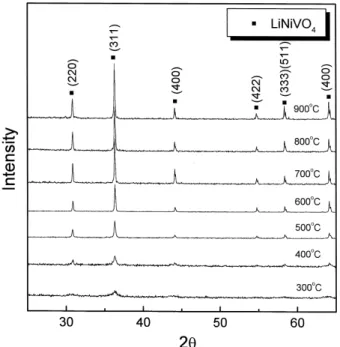
The powders prepared from the hydrothermal process were further calcined at 300, 400, 500, 600, 700, 800, and 9008C isothermally for 2 h. The XRD patterns of the hydrothermally derived LiNiVO powders calcined at vari-4 ous temperatures are shown in Fig. 3. The intensity of XRD peaks increased with increasing calcining tempera-ture. At 5008C or above, the crystallinity of LiNiVO4 became satisfactory and their XRD patterns manifested an inverse spinel structure. In contrast, a temperature above 7008C was necessary to obtain satisfactory crystalline
LiNi-( ) C.-H. Lu et al.r Journal of Power Sources 81–82 1999 696–699
698
Fig. 3. X-ray diffraction patterns of the hydrothermally derived LiNiVO4 powders calcined at various temperatures for 2 h.
VO4 powder by a conventional solid-state reaction pro-cess.
Fig. 4 shows the infrared spectra of hydrothermally derived LiNiVO powder calcined at various temperatures4 for 2 h. The band at 3500 cmy1
is characteristic of the O–H group, and the bands at 1600 and 1450 cmy1
result
w x
from the absorption of the C5O group 11 . The band at 1000–600 cmy1 is caused by the V–O bonds of VO
4
Fig. 4. Infrared spectra of the hydrothermally derived LiNiVO powders4 calcined at various temperatures for 2 h.
w x
tetrahedron 12,13 . As seen from Fig. 4, the absorption intensity of the CO group and O–H group decreased with an increase in calcining temperature, indicating a reduction in the amount of organic remnants. After heating to 7008C,
Fig. 5. Scanning electron micrographs of the hydrothermally derived
Ž . Ž . Ž .
LiNiVO powders calcined at A 3008C, B 4008C, and C 5008C for4 2 h.
( )
C.-H. Lu et al.r Journal of Power Sources 81–82 1999 696–699 699
the OH group completely disappeared. These organic rem-nants might originate from nickel acetate, the starting reagent.
The microstructures of the LiNiVO products calcined4
Ž . Ž .
at 3008C, 4008C, and 5008C are shown in Fig. 5 A , B ,
Ž .
and C , respectively. These micrographs reveal that the amount of sticky-looking organic remnants decreased with an increase in calcining temperature. After calcination at 5008C, the powder showed a particulate appearance and no significant grain growth was observed.
4. Conclusions
Ž .i Monophasic LiNiVO powder was successfully pre-4 pared by the developed hydrothermal method at as low as 2008C.
Ž .ii To increase the crystallinity of LiNiVO prepared by4 the hydrothermal process, subsequent calcination is nec-essary. After calcination at 5008C or above, crystallinity of LiNiVO increased significantly.4
Žiii The hydrothermal process can greatly lower the.
temperature required to synthesize highly crystalline LiNiVO4 compared to traditional solid state reaction processes.
Acknowledgements
Financial supports from the National Science Council of
w
the Republic of China NSC87-2214-E008-015 and
x
NSC86-2214-E002-022 are gratefully acknowledged.
References
w x1 G.T.K. Fey, W. Li, J.R. Dahn, J. Electrochem. Soc. 141 1994Ž .
2279.
w x2 G.T.K. Fey, J. Active Passive Electronic Components 18 1995 11.Ž . w x3 G.T.K. Fey, W.B. Perng, Mater. Chem. Phys. 47 1997 279.Ž . w x4 G.T.K. Fey, K.S. Wang, S.M. Yang, J. Power Sources 68 1997Ž .
159.
w x5 G.T.K. Fey, J.R. Dahn, W. Li, M.J. Zhang, J. Power Sources 68 Ž1997 549..
w x6 G.T.K. Fey, C.S. Wu, J. Pure Appl. Chem. 69 1997 2329.Ž . w x7 J.C. Bernier, P. Poix, A. Michel, Comp. Rend. Acad. Sci. 253
Ž1961 1578..
w x8 Y. Ito, Technology 11 1986 11.Ž .
w x9 R.S. Prabaharan, M.S. Michael, S. Radhakrishna, C. Julien, J. Mater. Ž .
Chem. 7 1997 1791.
w10 Powder diffraction file, Card No. 38-1395, Joint Committee onx
Powder Diffraction Standards, Swarthmore, PA.
w11 P. Barboux, J.M. Tarascon, F.K. Shokoohi, J. Solid State Chem. 94x Ž1991 185..
w12 J. Preudhomme, P. Tarte, Spectrochimica Acta 28A 1972 69.x Ž . w13 A.F. Corsmit, G. Blasse, Chem. Phys. Lett. 20 1973 347.x Ž .