Metallic percolation in La 0.67 Ca 0.33 MnO 3 thin films
S. F. Chen, P. I. Lin, J. Y. Juang, T. M. Uen, K. H. Wu, Y. S. Gou, and J. Y. Lin
Citation: Applied Physics Letters 82, 1242 (2003); doi: 10.1063/1.1554768
View online: http://dx.doi.org/10.1063/1.1554768
View Table of Contents: http://scitation.aip.org/content/aip/journal/apl/82/8?ver=pdfcov
Published by the AIP Publishing
Articles you may be interested in
Nonbolometric photoresponse in ( La , Pr ) 0.67 Ca 0.33 MnO 3 thin films
Appl. Phys. Lett. 88, 052504 (2006); 10.1063/1.2168687
Thickness dependent phase separation in La 0.7 Ca 0.3 MnO 3 films
Appl. Phys. Lett. 81, 3777 (2002); 10.1063/1.1520705
Percolative metal–insulator transition in layered manganites La 1.4 Sr 1.6y Ba y Mn 2 O 7 (y0.50)
Appl. Phys. Lett. 80, 3778 (2002); 10.1063/1.1480101
Enhanced metal–insulator transition and magnetoresistance in melt-processed La 0.67 Ca 0.33 MnO 3 and Ho-doped manganites
Appl. Phys. Lett. 78, 1598 (2001); 10.1063/1.1354659
Enhanced room-temperature magnetoresistance in partially melted La 0.67 Ca 0.33 MnO 3 manganites
Appl. Phys. Lett. 76, 763 (2000); 10.1063/1.125887
This article is copyrighted as indicated in the article. Reuse of AIP content is subject to the terms at: http://scitation.aip.org/termsconditions. Downloaded to IP: 140.113.38.11 On: Thu, 01 May 2014 05:39:15
Metallic percolation in La
0.67Ca
0.33MnO
3thin films
S. F. Chen,a)P. I. Lin, J. Y. Juang, T. M. Uen, K. H. Wu, and Y. S. Gou Department of Electrophysics, National Chiao Tung University, Hsinchu 300, Taiwan J. Y. LinInstitute of Physics, National Chiao Tung University, Hsinchu 300, Taiwan 共Received 3 September 2002; accepted 31 December 2002兲
Phase separation in La0.67Ca0.33MnO3thin films was investigated by scanning tunneling microscopy. The correlation between the grain structure and the spatial distribution of the coexisting metallic and insulating phases was evidently established. At temperatures not far below the metal–insulator transition, the spatial variation of the coexisting metallic and insulating phases is susceptible to magnetic field in an irreversible manner. The irreversibility suggests that the metallic percolation paths can be affected randomly by magnetic field. However, the variation becomes insensitive to magnetic field at lower temperatures. © 2003 American Institute of Physics.
关DOI: 10.1063/1.1554768兴
Recently, the doped rare-earth manganites (R1⫺xAxMnO3with R being a trivalent rare-earth ion and A being a divalent dopant兲 have become the focus of attention owing to the colossal magnetoresistance共CMR兲 and a wealth of phase states exhibited in this class of materials.1The un-doped LaMnO3, for example, is an antiferromagnetic insu-lator over all temperature ranges. Partial substitution of La ions with divalent alkali earth ions, however, leads to a fer-romagnetic metal transition at an ordering temperature TC.
For La1⫺xCaxMnO3, this ferromagnetic transition is usually accompanied by a metal–insulator transition 共MIT兲 in the nominal range of 0.2⬍x⬍0.5. The transition temperature is approximately 250 K for x⫽0.375. The double exchange mechanism, describing the hopping of electrons between Mn3⫹ and Mn4⫹ sites through O2⫺ ions, qualitatively ex-plains the coincidence of metallic behavior and ferromag-netic ordering commonly observed in CMR materials.2It has been pointed out, however, that the double exchange mecha-nism alone is insufficient to explain the high-temperature transport properties of most manganites.3,4
Recent studies, moreover, have revealed that CMR is intimately associated with spatial inhomogeneity of charge and is suggestive of multiphase coexistence.5In order to un-derstand the transport properties of manganites, scanning tunneling microscopy 共STM兲 has been ubiquitously adopted to probe the electronic properties of manganites.6 –11 Fa¨th
et al.10 have utilized STM spectroscopic images taken just below TC to demonstrate the coexistence of insulating and metallic phases in La0.7Ca0.3MnO3 thin films. In addition, by observing the spatial variations of phase separation modu-lated by magnetic fields, the authors have proposed that the MIT and the magnetoresistance are originated from the per-colated metallic ferromagnetic domains. On the other hand, Gre´vin et al.11have utilized a technique of scanning tunnel-ing potentiometry to measure the potential distribution at the surface of La0.7Sr0.3MnO3thin films. Even though the results support the general idea of percolation paths, the nature of
percolation paths, however, is claimed to be different from that proposed by Fa¨th et al.10In the latter case, grain bound-aries, which characterize the connection of adjacent grains, are the key to determine the low resistance percolation paths. We noted that the discrepancy may be due to different mate-rials being studied.
In this study, the local electronic properties affected by a magnetic field in La0.67Ca0.33MnO3 thin films were investi-gated by STM. At temperatures below TC, phase separation
was observed. Near TC, the spatial variation of the separated
phases is susceptible to the external magnetic field in an irreversible manner. Moreover, the distribution of coexisting phases and, hence, the percolation paths, appears to be cor-related with the grain structure in La0.67Ca0.33MnO3 thin films.
La0.67Ca0.33MnO3 samples were grown on single crystal
共100兲 SrTiO3 substrates using pulsed laser deposition. The substrate temperature was held at 700 °C and oxygen pres-sure was kept at 0.4 Torr during deposition. After deposition was completed, the samples were annealed in situ at the same temperature in 600 Torr of pure oxygen for 30 min and then cooled down to room temperature at a cooling rate of 15 °C/min. The film thickness was estimated to be approxi-mately 300 nm from the number of laser pulses delivered. The resistance peak temperature denoted as metal-insulator transition (TMI) is 260 K. The Curie temperature of La1⫺xCaxMnO3 thin films has been found to coincide with
TMI within 10 K. 12,13
The x-ray diffraction results showing only (00l) peaks confirm that the samples were epitaxially grown with well-aligned crystalline orientation.
The surface topographic and spectroscopic images were measured by STM operated at constant-current mode with a metallic Pt0.8:Ir0.2 tip. The tunneling current was set to 500 pA and the sample was biased at 0.3 V relative to tip poten-tial. A standard lock-in technique was used for the measure-ment of spectroscopic images. All images were measured at a very slow scanning rate by recording both the z-axis signal of the piezoscanner and the differential conductance (dI/dV兩0.3 V) signal from the lock-in amplifier. The lock-in amplifier sensed the modulated tunneling current signal and
a兲Electronic mail: [email protected]
APPLIED PHYSICS LETTERS VOLUME 82, NUMBER 8 24 FEBRUARY 2003
1242
0003-6951/2003/82(8)/1242/3/$20.00 © 2003 American Institute of Physics
This article is copyrighted as indicated in the article. Reuse of AIP content is subject to the terms at: http://scitation.aip.org/termsconditions. Downloaded to IP: 140.113.38.11 On: Thu, 01 May 2014 05:39:15
generated dI/dV signal simultaneously to form spatial spec-troscopic images during scanning.
Figure 1 shows the tunneling spectra obtained by record-ing the tunnelrecord-ing current as a function of bias voltage with the feedback loop turned off. The inset shows the dI/dV curves obtained from the tunneling spectra. The highly non-linear current–voltage characteristic 关curve 共a兲兴 reflects the signature of an insulating state whereas the nearly linear current–voltage characteristic 关curve 共b兲兴 depicts a metallic behavior. The difference in dI/dV兩0.3V forming the spatial spectroscopic images thus reveals the insulating and metallic phase distribution over the scanning area.
In Fig. 2, the topographic and spectroscopic images are
illustrated for the same scanning region taken at a tempera-ture 共200 K兲 not far below TMI(⬃260 K). The lighter gray regions in the spectroscopic images represent regions with higher dI/dV and, hence, are more insulating. By the same token, the darker regions are more metallic. It is noted, how-ever, that the gray scale in each image is displayed in the highest contrast and does not correspond to the same dI/dV value. Figure 2共a兲 shows a surface topographic image over the same region the other spectroscopic images were mea-sured. As can be seen, when no external magnetic field was applied, most of the area关Fig. 2共b兲兴 exhibits insulating phase with a small fraction of metallic regions. When an external field of 0.35 T was applied parallel to the film surface, the distribution of the respective phases changes dramatically
关Fig. 2共c兲兴. For instance, two of the metallic regions
关indi-cated by the arrows in Fig. 2共b兲兴 appear to convert into in-sulating state. When the external field was removed, the spectroscopic image, shown in Fig. 2共d兲, surprisingly does not recover to that shown in Fig. 2共b兲. It appears that the phase distribution is irreversible and is dependent on the his-tory of the applied magnetic field.
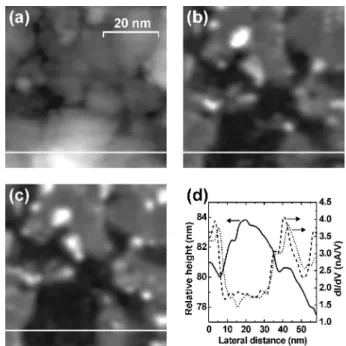
For comparison, we have made another set of topo-graphic and spectroscopic images taken at a much lower temperature 共100 K兲. The results are shown in Fig. 3. As is evident from Fig. 3共b兲, the metallic region has occupied a much larger fraction at this temperature. Moreover, it shows an intimate correlation with the grain structure shown in a topographic image关Fig. 3共a兲兴. This is not surprising because as the sample becomes more magnetically ordered at lower temperatures, more metallic regions are expected to form. Furthermore, as shown in Fig. 3共c兲, the spectroscopic image taken at an applied magnetic field of 0.35 T is essentially the same as that obtained in zero field关Fig. 3共b兲兴, indicating that the phase distribution is more stable and insensitive to exter-FIG. 1. Typical current–voltage characteristics of共a兲 insulating phase and
共b兲 metallic phase. The inset shows the differential tunneling spectra (dI/dV) obtained from the respective current–voltage characteristics.
FIG. 2. 共a兲 The zero-field topographic image at 200 K. The scale bar is 40
nm.共b兲 to 共d兲 are spectroscopic images taken over the same scanning region,
with共b兲 at initial zero field, 共c兲 in an external magnetic field of 0.35 T and
共d兲 after removal of the external magnetic field, respectively. The arrows in 共b兲 indicate regions with metallic characteristic.
FIG. 3. 共a兲 The topographic image at 100 K. 共b兲 and 共c兲 are spectroscopic images taken over the same scanning region with zero and an external magnetic field of 0.35 T, respectively. 共d兲 The sectional curves scanned along the white lines in the images of surface topography共solid curve兲 and spectroscopic images at H⫽0 T 共dotted curve兲 and H⫽0.35 T 共dashed curve兲, respectively. The results indicate intimate correlation between the grain structure and the corresponding phases.
1243
Appl. Phys. Lett., Vol. 82, No. 8, 24 February 2003 Chenet al.
This article is copyrighted as indicated in the article. Reuse of AIP content is subject to the terms at: http://scitation.aip.org/termsconditions. Downloaded to IP: 140.113.38.11 On: Thu, 01 May 2014 05:39:15
nal perturbation at lower temperatures. In Fig. 3共d兲, the mor-phology and dI/dV curves scanned along the white lines in Figs. 3共a兲–3共c兲 show an intimate correlation between the grain structure and the respective phases.
In La1⫺xCaxMnO3 (0.2⬍x⬍0.5), it is generally be-lieved that the MIT is governed by the hopping of electrons in egorbital between neighboring Mn3⫹and Mn4⫹sites with
strong on-site Hund’s coupling by an O2⫺ion.5In the cross-over regime around TC, the transformation from disordered
random spin into ordered ferromagnetic phase can occur only gradually. This, in turn, results in a state of coexisting multiphase. In this state, evidence has shown that the volume fraction of metallic phase could be modulated by either ex-ternal electric field14or external magnetic field.10This natu-rally explains the current results. The fact, that not only the volume fraction but also the distribution of the respective phases are dependent on the history of applied magnetic field, is indicative of short-range magnetic ordering at tem-peratures not far below TC. When the temperature is well
below the transition temperature, the phase separation evolves to a more ordered and stable state.
Although our observations agree mostly with that re-ported by Fa¨th et al.,10 some subtle differences are noted. Namely, the percolated metallic phase in La1⫺xCaxMnO3 thin films appears to be intimately correlated with the grain structure in this study, in contrast to the uncorrelated scenario suggested by Fa¨th et al.10 In addition, the metallic regions observed in this study are within a few tens of nanometers. This length scale is about an order of magnitude smaller than that reported in Ref. 10. The discrepancy may be due to the temperature range and field strength studied in respective investigations. On the other hand, both results are in sharp contrast to the conclusions drawn by Gre´vin et al.,11in that the percolation paths are believed to follow electronically connected crystallites with ‘‘better’’ grain boundaries.
In summary, we have evidently observed the phase sepa-ration in La0.67Ca0.33MnO3 thin films at temperatures below
TC. In particular, when the temperature is not far below TC,
the distribution of the percolated metallic paths can be sus-ceptible to external fields. This is believed to arise from the short-range ordering in the crossover regime. Indeed, as the temperature is further lowered, the morphology of phase separation is much more robust and insensitive to external perturbations. The phase separation is also found to correlate closely with the underlying grain structure.
This work was supported by the National Science Council of Taiwan, ROC under Grant No. NSC90-2112-M-009-027.
1C. N. R. Rao, J. Phys. Chem. B 104, 5877共2000兲. 2
C. Zener, Phys. Rev. 82, 403共1951兲.
3A. J. Millis, P. B. Littlewood, and B. I. Shraiman, Phys. Rev. Lett. 74,
5144共1995兲.
4R. Maezono, S. Ishihara, and N. Nagaosa, Phys. Rev. B 58, 11583共1998兲. 5
For a review, see E. Dagotto, T. Hotta, and A. Moreo, Phys. Rep. 344, 1
共2001兲, and references therein.
6J. Y. T. Wei, N.-C. Yeh, and R. P. Vasquez, Phys. Rev. Lett. 79, 5150 共1997兲.
7R. Akiyama, H. Tanaka, T. Masumote, and T. Kawai, Appl. Phys. Lett. 79,
4378共2001兲.
8A. K. Kar, A. Dhar, S. K. Ray, B. K. Mathur, D. Bhattacharya, and K. L.
Chopra, J. Phys.: Condens. Matter 10, 10795共1998兲.
9A. Biswas, S. Elizabeth, A. K. Raychaudhuri, and H. L. Bhat, Phys. Rev.
B 59, 5368共1999兲.
10
M. Fa¨th, S. Freisem, A. A. Menovsky, Y. Tomioka, J. Aarts, and J. A. Mydosh, Science 285, 1540共1999兲.
11B. Gre´vin, I. Maggio-Aprile, A. Bentzen, L. Ranno, A. Llobet, and Ø.
Fischer, Phys. Rev. B 62, 8596共2000兲.
12
K. Do¨rr, J. M. De Teresa, K. H. Mu¨ller, D. Eckert, T. Walter, E. Vlakhov, K. Nenkov, and L. Schultz, J. Phys.: Condens. Matter 12, 7099共2000兲.
13S. J. Liu, J. Y. Juang, K. H. Wu, T. M. Uen, and Y. S. Gou共unpublished兲. 14T. Wu, S. B. Ogale, J. E. Garrison, B. Nagaraj, A. Biswas, Z. Chen, R. L.
Greene, R. Ramesh, and T. Venkatesan, Phys. Rev. Lett. 86, 5998共2001兲.
1244 Appl. Phys. Lett., Vol. 82, No. 8, 24 February 2003 Chenet al.
This article is copyrighted as indicated in the article. Reuse of AIP content is subject to the terms at: http://scitation.aip.org/termsconditions. Downloaded to IP: 140.113.38.11 On: Thu, 01 May 2014 05:39:15