Smart Mater. Struct. 14 (2005) 1075–1082 doi:10.1088/0964-1726/14/5/046
Online monitoring of highway bridge
construction using fiber Bragg grating
sensors
Yung Bin Lin
1, Chih Liang Pan
2, Yuan Hung Kuo
2,
Kuo Chun Chang
2and Jenn Chuan Chern
21National Center for Research on Earthquake Engineering, 200, Section 3, Xinhai Road, Taipei, 10617, Taiwan
2Department of Civil Engineering, National Taiwan University, Taipei, 10617, Taiwan
E-mail: [email protected],[email protected](C L Pan),[email protected]
Received 8 June 2004, in final form 8 June 2005 Published 12 September 2005
Online atstacks.iop.org/SMS/14/1075
Abstract
The civil engineering community is becoming increasingly interested in monitoring structural behavior and in assessing its corresponding
integration. In this paper, fiber Bragg grating (FBG) sensors were installed to investigate the in situ characteristics of the hydration progress period and the curing process of highway bridge construction. Moreover, the security and serviceability of a bridge can be changed by material proprieties such as shrinkage and creep, which is correlated with the prestressing strain and settlement during the support frame removal. The response and effectiveness of the schedule at every step during the prestressing process, and during the support frame removal, were also examined. It appeared that an FBG sensor was clearly shown to be a smart sensor candidate for function integration and response of a highway bridge during both its construction and service life. (Some figures in this article are in colour only in the electronic version)
1. Introduction
The civil engineering community is becoming increasingly interested in monitoring structural behavior and in assessing its corresponding integration [1–17]. In general, bridges must be inspected and evaluated regularly, in order to ensure both safety and function. The current health evaluation and damage detection methods used are visual inspection or localized non-destructive evaluation (NDE) technologies [18–21], such as acoustics, ultrasonics, impact-echoes, radar, infrared, magnetics, eddy-currents and ambient/forced vibration tests. NDE methods can be very expensive and inconvenient, however, as in situ implementation is required for on-line structural monitoring of highway bridges, which must be done frequently. Thus, we have targeted the progress, in sensing technology, of a long-term monitoring system that is easier to install, use and maintain. Long-term monitoring increases the knowledge of real time structural behavior and assists in the planning of maintenance intervention. The challenge is
to develop techniques which can perform on-line structural health assessments, beginning at the construction of these highway bridges, in the field [1–21]. The construction of a new bridge provided a unique chance to install sensors and data processing that would be useful for long term evaluation of its condition of service. It is known that monitoring bridge behavior, especially in the initial construction stages of the structure, is extremely important. Furthermore, in addition to the performance of the bridge itself, the safety of the structure, when support frames are removed, is also of concern; occasional incidents of collapse during the construction period have occurred. An early warning system, such as a reliable and stable monitoring system, provides time to undertake remedial work on bridges before a catastrophe happens. In addition, long-term monitoring can provide comprehensive information about the nature and extent of deterioration, so that informed management decisions can be made.
Since 1988, self-compacting concrete (SCC) has been commonly used in many fields of construction, such
Figure 1. The Wu-Zi highway bridge.
as high-rise buildings, long-span bridges and marine structures [22–25]. Consolidation, without significant external vibration, is particularly challenging for today’s high-performance concretes (HPCs), which have a low water-to-cementitious materials ratio. SCC can be compacted into every corner of a formwork, purely by its own weight and without the need for vibrating compaction [22–25]. The advantages of SCC are many: it is labor and time saving, which can shorten the construction period; it has consistent quality placement; it can be placed in inaccessible or highly reinforced and congested areas and it also has long-term durability [22–25]. SCC optimizes process qualities, such as high strength, low permeability, good workability and excellent long-term durability. The hydration progress effects of in situ temperature conditions, and the hardening shrinkage on strength development, are important. This provides a means for estimating the real strength of concrete in structures.
1m 1m 1m 4m FBG RSG Rebar Vertical view Lateral view 1m 1m 1m 4m FBG RSG Rebar Vertical view Lateral view
Figure 2. Plan view of Wu-Zi highway bridge and sensors location.
Conventionally, this shrinkage characteristic was tested with a standard cylinder specimen in a laboratory. However, we are more concerned with the accuracy, inconvenience and real behavior in situ.
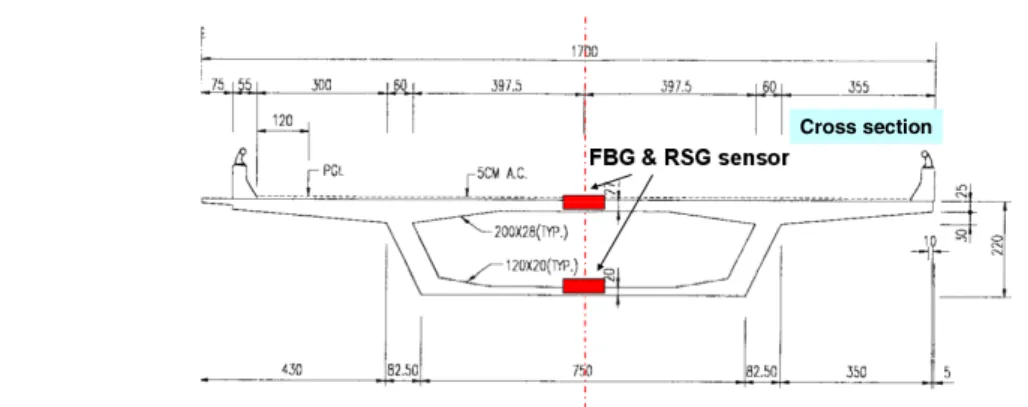
The Wu-Zi highway bridge (figure 1) located near Taichung, Taiwan, is a 90 m prestressed concrete bridge, consisting of three spans: 25 m for both right and left spans and 45 m for the center span. This highway bridge, with three lanes, built in 2001, is composed of ordinary concrete at the southbound box-girder and SCC at the northbound box-girder. Figures 2 and 3 show the plan view, and its cross section, respectively. Many series of experiments were performed on this SCC material, before it had settled in situ, in order to test its mixing ratio, hydration effect, corresponding shrinkage, compressive strength and workability in the laboratory. The strength requirement for the SCC girder was 560 kg cm−2at 28 days. The Wu-Zi bridge was the first bridge in Taiwan to use SCC, therefore its in situ characteristics had to be examined to provide construction information for long-term service. The performance of the SCC beam is being evaluated, via long-time monitoring. The monitoring began at the time of fabrication, and continues now that the bridge is in service.
Optical fiber sensors, especially fiber Bragg grating (FBG) sensors, have shown the potential to provide a practical method for implementing and providing a cost effective and real time health monitoring of the structures [1–17]. These FBG sensors are easy to handle, can be easily embedded or attached to the structures and are immune to EM disturbance. They also have the advantages of small sensor size and high sensitivity. These advantages offer potential solutions for the sensor systems of smart structures. Being durable and stable, FBG sensors were selected for the long-term health monitoring, over conventional sensors, with lower long-term performance records, since they potentially have a long service life and can be easy embedded in the structures. The monitoring system delivers early warnings and predicts potential problems; this helps in the planning of necessary maintenance interventions.
Cross section Cross section
Figure 3. Cross section of the box girder and sensors location.
This bridge is symmetrical in design; only half of the bridge was instrumented with sensors (figure2). In this study, FBG sensors and comparative conventional resistance strain gauges were built into this SCC highway bridge (figures 2
and 3). A total of 60 FBG sensors were attached on the rebar, which was labeled no 1–11 and placed on the top slab; the comparative resistance strain gauges (RSGs) and thermocouples were installed in parallel pairs along the box girder in the top and bottom, as shown in figures2and3. The FBG strain was compensated for by subtracting its thermal strain from an adjacent FBG temperature sensor, which was placed in a free-strain tube. These sensors collected data during the casting and curing progress of the concrete, as well as during its service time.
In this paper, we have investigated the in situ characteristics of the hydration progress period and the curing process of the SCC, in order to get a better understanding of its properties and behavior. Moreover, the security and serviceability of a bridge can be changed by material proprieties such as shrinkage and creep, which is correlated with the prestressing strain and settlement during the support frame removal. The response and effectiveness of the schedule at every step during the prestressing process, and during the support frame removal, were also examined.
2. SCC hydration progress
The setting and hardening process, especially in the early age of concrete, is considered to be the most critical period during the service life of a concrete structure. Concrete hydration is a complex physico-chemical exothermic process. The duration of the hydration deformation varies from a couple of days to several weeks, depending on the thermal properties of the concrete components, the additives, the environmental conditions, the cure and the geometry of the structural element. Generally there are two approaches to studying hydration deformation: numerical simulation and monitoring. Numerical simulations are very complicated because of the problem complexity. Data collected by early age monitoring therefore, represent a unique technique for understanding real structural behavior. Conventionally, this is conducted via non-destructive evaluation (NDE) methods, such as ultrasonic wave reflection that utilizes steel plates, embedded in the concrete, to measure the reflection loss of shear waves at the steel– concrete interface, during construction [22–25]. The reflection
loss shows a linear relationship with compressive strength at the early ages. However, due to technical considerations, this measurement could not be carried out during night-time. Since we required continuous real-time monitoring, this method was not used.
High hydration temperatures may significantly influence the progress of hydration or cause damage to the concrete, such as cracking, during the SCC curing period. This can affect the long-term mechanical characteristics of SCC in situ. This is of special concern, as earthquakes frequently occur in Taiwan, and could disturb the bonding effects between the material and the reinforcement during the hardening process. Knowledge of in situ hydration processes and bonding characteristics is required as hardening develops to ensure the safe utilization of this material.
In general, monitoring is recommended to start from the moment the concrete is poured. In this way, the whole deformation history is measured. This includes the early-age deformation that is generated while the concrete is still hardening. Furthermore, since this bridge is located in a seismic area, online construction monitoring is important in order to avoid interference with the bonding force between the reinforcement and the concrete.
As shown in figures 1 and 2, this highway bridge is curved and has a 3% inclined plane on the top slab to fit the in situ transportation conditions. SCC has good flowing capability as it works to form a smooth and flat surface, without requiring pressure. The upper plate forms were used to cast the inclined plane shape. The FBG sensors and conventional sensors were installed and functioning on the north bottom slab in December of 2000. Due to some of the construction problems that required examination, the construction data for the pouring of SCC on the bottom slab was postponed for about six months. During this period, these instrumented sensors were exposed to an ambient climate. It should be noted that all of these FBG and RSG sensors were installed with the same careful procedures and waterproof packaging for protection from humidity. However, December through May is the rainy season in Taiwan, and rainwater accumulated on this bottom slab. There were times when these sensors were exposed and immersed in rainwater. No useful information was obtained from the conventional RSG that was installed on the bottom slab (figure4). The FBG sensors, made of a non-metallic material which, unlike the RSG sensors, has no
0 5 10 15 20 25 30 35 40 45 Time (hours-05/29/2001) -400 -200 0 200 400 600 800 Strain( µ ) Hydration process
Upper form demolding
0 5 10 15 20 25 30 35 40 45 Time (hours-05/29/2001) -400 -200 0 200 400 600 800 Strain( µ ) Hydration process
Upper form demolding
Figure 4. Hydration strain measurement by FBG sensors in the northbound bottom slab.
corrosion problems, revealed and demonstrated good survival capabilities in resisting harsh circumstances.
The FBG sensors were attached to the rebar and placed on the bottom slab to measure the response between the hydration period and its corresponding hardening progress. The online measurements of the hydration effects, and the bonding strain versus time between the rebar and the SCC during fabrication, are shown in figure 5. This presents the progress of the SCC hydration strains, measured by the FBG sensors. It is well known that during concrete hydration, both materials deform: the concrete due to hydration; the rebar due to heat transfer from the concrete. Before hardening, the deformations of the fresh concrete and the rebar were different, since the mechanical interaction between them was weak; fresh concrete is viscous and the thermal expansion coefficients of the two materials are different. With concrete hardening, as the interaction strain between the concrete and the rebar begins, their deformation rates become more and more interdependent, until they reach a constant value. When this constant value is established, both materials deform equally. This creates a good interaction between the two, which is possible only if the concrete has hardened. In the initial phases, as expected, 4 h after the concrete had been poured; the increment of the hydration temperature was estimated to be about 40◦C, which induced a 480 microstrain thermal strain on the rebar (12×10−6/◦C, thermal expansion of steel). The early strength development of the SCC took about 15 h, which met the hardening time for the laboratory results of between 5 and 20 h. It was observed that the SCC paste became solid and the bonding strain between rebar and concrete formed gradually.
The load bearing capacity of a reinforced concrete struc-ture is considerably influenced by the bonding characteristics between the rebar and the concrete. In addition, this bonding strain was far more critical, since seismic vibrations occurred frequently in this district. These vibrations could interfere with the bonding strength during the hardening progress, which in turn could influence the performance and integrity of the struc-ture. Conventionally, the bonding strength influenced by the bond stresses and the corresponding slip displacements had only been performed by the slip-pull-out test in the laboratory. Online monitoring of this bonding progress, and evaluation
0 5 10 15 20 25 30 35 40 Time (hours-05/29/2001) -400 -200 0 200 400 St ra in ( µ ) RSG
Figure 5. Hydration strain measurement by RSG in the northbound bottom slab.
of its corresponding strength, was difficult with conventional sensors. The stability and reliability of the FBG sensors was verified with electromagnetic immersion, when compared to conventional sensors. As shown in figure5, this implies that FBG sensors would be useful in measuring seismic vibrations and their corresponding effects.
After the first 20 h, the concrete began to shrink. The shrinkage strain was continuously generated from the 19th to the 23rd hour. A noise-like signal was seen during this period. This contraction resulted from the summation of two contrary deformations: chemical shrinkage caused by cement hydration and thermal expansion caused by a rise in the temperature of the concrete. The upper form of the cover plate was removed around the 24th to the 25th hour. The FBG sensors also responded to this working process event, as shown in figure5. At the same time, chemical shrinkage continued and the concrete contracted.
In summary, based on the results of the hydration and hardening progress, the FBG sensors responded well to the history of the hydration process. It was also possible to monitor online the corresponding removal of the upper form. In general, when the strength of concrete was tested by the standard cylinder/cube specimen in the laboratory, it may not have translated to an accurate measurement of the in-place strength. However, in situ hydration can significantly affect in-place strength; herein, the FBG sensor provides a means for online monitoring as well as an estimation of the early strength of concrete in structures. This collected information will be further analyzed, in conjunction with laboratory results, in the future. Ultimately, such data allow estimates of the relationship between in situ and conventional standard cube or cylinder strength, thereby enabling safe and efficient structural design.
3. Monitoring curing online
The long-term safety, durability and performance of bridge structures mainly depend upon good design details, the quality of materials used and the standard of workmanship achieved on site. As mentioned, the concrete setting and hardening
07/03 07/ 04 07/05 07/06 07/07 07/08 07/09 07/10 Time (day-2001) St rain ( µ ) Rebar_#2, FBG -600 -500 -400 -300 -200 -100 0 100 200 300
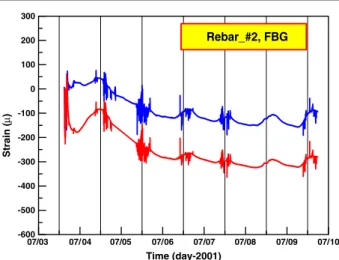
Figure 6. Curing process measurement by FBG in the northbound top slab.
process is considered to be the most critical time period during the life of a concrete bridge. The grouting data on the top northbound bridge slab took place on 3 July 2001. To ensure certain SCC strength, a daily curing process of spraying water on this material was required. Figures 6 and 7present the monitoring results obtained from the number 2 rebar. This information was useful for estimating the in situ SCC progress of hydration and shrinkage behaviors, in order to evaluate SCC quality. This curing progress took 7 days. Instruments with an uninterruptible power supply (UPS) system were settled at an
in situ monitoring house for the online record. It is well known
that FBG sensors are made from glass, a dielectric material, which is immune to EM interference; they can be placed under a strong electromagnetic field and still function normally. This means that these FBG sensors only responded to variations in strain/temperature, during the monitoring period. As the spraying car traveled on the bridge, the FBG sensors emitted a noise-like signal at noon, every day, according to the curing schedule (figure 6). The sensors also revealed that this job was not executed on the sixth day. In general, the SCC curing progress should be executed on schedule, in order to guarantee its performance. The FBG online monitoring system demonstrated superior functioning in its capacity to measure structural strain/temperature response, as well as being useful for in situ construction schedule re-checks. The variation in SCC thermal strain, induced by daytime and night-time service, was 50 microstrains, as shown in figures 6 and 7. This thermal strain was within the resolution error of the
in situ RSG instrument. Curing information from the RSG
sensors is shown in figure 7 and revealed a similar trend, when compared to the FBGs, during this curing progress. Too much noise made it difficult to interpret the spike incident during the curing progress. In summary, these sensors were successful in monitoring a highway bridge during fabrication and construction.
4. Prestressing progress
The long-term serviceability of a highway bridge requires realistic evaluation of internal forces, support reactions and stress and strain, together with creep response and
07/03 07/04 07/05 07/06 07/07 07/08 07/09 07/10 Time (day-2001) Strain ( µ ) Rebar_#2, RSG -600 -500 -400 -300 -200 -100 0 100 200 300
Figure 7. Curing process measurement by RSG in the northbound top slab.
displacement. Prestressed concrete suffers from a time-dependent strain, due to shrinkage and creep; its mechanical characteristics evolve with time.
The construction progress of the prestressing force is generally segmented. The applied loading strain, support conditions and connections between elements may change during construction. These changes, including strand relaxation, friction, slip, and temperature variations, lead to unloading and reloading of stresses, to deflections and cambering, so that when the construction process is complete the stress state of a bridge may be different, depending on the construction process considered. In addition, in long-span bridges, changes in the structural scheme can lead to time-dependent redistributions of internal forces and stresses, and increments of deflections. A number of models and analytic formulae been developed to simulate structural behavior under construction, especially for the prestressed progress [13,20]. However, applying structural interaction at every process is excessively complex, and it is difficult to generalize with the wide array of construction schemes implemented nowadays.
In general, the prestressing force was measured with load cells to determine the response of the prestressing strain, using embedded sensors. In this paper, FBG and RSG sensors were attached to the rebar and embedded in the box girder; they were used to study how construction progress influenced service behavior, as well as measuring the effectiveness of the prestressing process. There was online monitoring of corresponding strain variations, during every period of the different prestressing forces gradually applied to the bridge. In addition, a steel strand occasionally split during the prestressing process, resulting in either serious damage to the structure or a worker. These accidents must be taken into account. The FBG monitoring system, built for this study, was also used to respond to accident occurrences.
Meanwhile, the strength of the specimen taken from the top slab, in the field, was tested in the laboratory after 28 days. The strength was 728 kg cm−2, which was higher than the design requirement. Prestressing was then introduced. The strength was required for the prestressing work to ensure its characteristics would minimize the long-term shrinkage and creep effects of the SCC. The progress of the prestressed
Time(2001-Aug/03-05) -120 -100 -80 -60 -40 -20 0 20 St ra in ( µ ) 0 5 10 15 20 25 30 35 40 Te m p e ra ture ( oC)
Prestrain_right end Prestrain_left end
Rebar_#3
Temperature FBG_strain FBG_strain FBG_strain
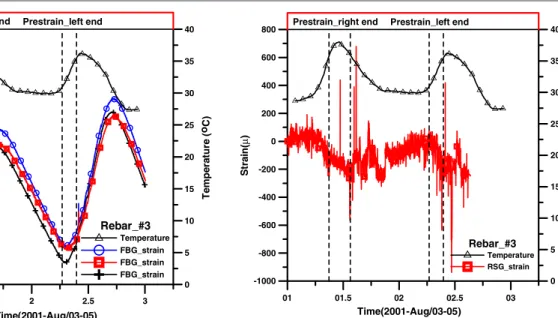
Figure 8. Prestressing process measurement by FBG in the northbound top slab.
segment of this highway bridge consisted of two parts. Stress was first introduced at the right side of the bridge, from 08:30 am to 01:30 pm on 3 August 2001; stress was applied at the other side, the next morning, from 08:30 to 10:30 am. As mentioned, time dependent losses in prestressed concrete members consist of losses due to concrete shrinkage, concrete creep and tendon relaxation. Shrinkage and creep are associated with deformation and strains in the material, while tendon relaxation results from the loss of force from the anchorage. When this anchorage sets, the relaxation of the tendon will be a constant strain and will not affect the time dependent strain. As a result, most of the strain data collected indicated combined prestress losses, due to shrinkage and creep. Figure 8presents the combined response of the daytime thermal strain and the prestressing strain induced in the rebar during the progress. As the temperature rose from 28 to 38◦C, an upward slope thermal strain was induced in the box girder. However, a significant interference strain was observed as the prestressing was initially introduced at the right side of the bridge. A period of drift in the measurements was observed. This drift strain was induced by the anchorage process. The initial progress of prestressing strain at no 3 was 40 microstrains, as expected (figure 8). An opposite effect was observed during the night. The decreasing temperatures brought the bridge into compression strain after the first prestressing process. The second prestressing, introduced at the left side of the bridge, was concealed within the thermal expansion strain. Similarly, as mentioned, results from the RSG sensors demonstrate a similar trend, when compared to the FBG sensors, as shown in figure 9. However, the corresponding noise made the data difficult to comprehend and analyze during the prestressing period. The long-term prestressed loss from shrinkage and creep effects has been omitted in this paper, due to limited space; this will be analyzed using the American Association of State Highway and Transportation Officials (AASHTO) methods in the future. Figures 8and 9show the responses during the process of applying the prestress at ambient temperatures. Since the
01 01.5 02 02.5 03 Time(2001-Aug/03-05) St ra in ( µ ) 0 5 10 15 20 25 30 35 40 Te m p e rat u re ( oC)
Prestrain_right end Prestrain_left end
Rebar_#3 Temperature RSG_strain -1000 -800 -600 -400 -200 0 200 400 600 800
Figure 9. Prestressing process measurement by RSG in the northbound top slab.
temporary supporting frame of the bridge was not removed, the FBG strain shown in figures8and 9contained both the axial strain due to prestress and thermal strain induced by the ambient temperatures at the rebar. The axial strain in the rebar will take place immediately upon the action of the prestress. The temperature distribution in the concrete, however, depends on the interaction of solar radiation and re-radiation, wind speed, and of heat conduction and convection, which take some time to affect the strain in the rebar and will not affect the change of strain due to the prestressing process. This ambient-temperature effect can be deduced by the bridge gradient temperature distribution effects from the recommendations of the Guide Specification for Thermal Effects in Concrete Bridge Superstructures (American Association of State Highway and Transportation Officials, AASHTO 1989b) [12] and the AASHTO (1999) Guide Specification for Design and Construction of Segmental Concrete Bridges [13]. In this paper, figures 8and 9 show that the combined response of the prestressed axial strain and thermal strain induced by the ambient temperatures at the rebar were used to identify the safety monitoring merits during the prestressing progress of a highway bridge by FBG sensors.
5. Removing support frames
Online monitoring is very important during the removal of support frames. During this period, the bridge can be damaged, and accidents may occasionally occur, if the concrete has not reached its designed hardening strength. The longitudinal scheme and its cross section, as well as the connections between elements, may change during the removal process, which can lead to unpredictable damage. These changes can lead to unloading and reloading of strain/stress, and to deflections and cambering, so that when the construction process is finished, the stress state in the bridge may be totally different, depending on the construction process used. These changes, which can lead to time dependent redistributions of
0.4 0.6 0.8 1 1.2 1.4 1.6 Time (2001-Aug/09-10) St rain ( µ ) 0 5 10 15 20 25 30 35 40 Temperature( oC) middle-span_40m right span_25m left span_25m Rebar_#3 Temperature FBG_strain FBG_strain FBG_strain FBG_strain -100 -50 0 50 100 150
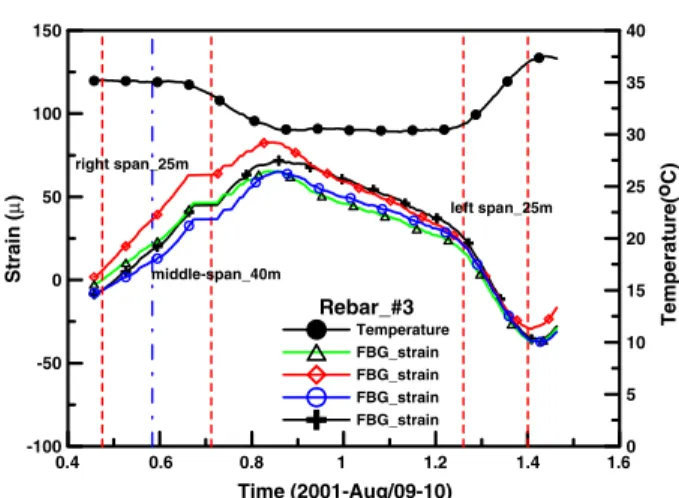
Figure 10. Support frame removal process measurement by FBG in the northbound top slab.
internal strains and stresses, and increments of inappropriate deflection, are especially important for a continuous, long-span bridge. Unlike temporary loads, such as live loads, impact loads and seismic forces, the dead load and prestressing force bear a strong relationship to the long-term behavior of a concrete bridge, governing the time-dependent characteristics of a structure. Moreover, knowledge of strain transfer and its corresponding stress redistribution in the bridge for long-term creep and deflection evaluation is required after the supports have been removed.
The support frame removal progress of the Wu-Zi bridge was segmented into three parts: the right span, middle span and left span. The removal of the right span support frame began in the morning of 9 August 2001, while the removal of the middle span supports began in the afternoon of the same day. The FBG sensors located on no 3 rebar (figure10) continued to monitor data from the left span during these two periods; this left span was still supported by the frame. An upward slope thermal strain, induced by the ambient temperature, still influenced and dominated the behavior of the left span of the bridge during this progress (figure10). As the final supporting frame of the left span was removed the next morning, the prestressing strain and the dead load of the left span were successfully transferred and, as expected, resulted in a significant compression strain to the rebar (figure10), at the top slab of the box girder. This strain response is important, as it is set as the initial deflection stage of the highway bridge for long-term measurements.
The real-time strain responses shown in figure 10 just revealed change of rebar strain during the progress of removing the supporting frame. As mentioned, the strain distribution and redistribution of a highway bridge will take some time to complete during and after the progress of the supporting frame removed subject to the ambient temperature change. The major change of strain in the rebar is due to the removal of the supporting frame and the change of thermal strain in the rebar during this stage is minimal.
6. Summary
The results of this study indicate the superiority of fiber Bragg grating (FBG) sensors installed in a highway bridge
under construction, as a health monitoring system to record the hydration effects, curing periods, prestressing response, and removal of support frames. It appeared that SCC was successfully implemented, as expected, during the progress of this highway bridge construction. Data collected from conventional RSGs were unreliable, while the FBG sensor was clearly shown to be a smart sensor candidate for function integration and response of a highway bridge during both its construction and service life.
Acknowledgments
The authors gratefully acknowledge funding during the last four years of our project, sponsored by the Ministry of Transportation and Communications, ROC and China Engineering Consultants, Inc. We would also like to thank Mr L S Li, National Center for Research on Earthquake Engineering (NCREE), Taiwan, for his kind help in data collection.
References
[1] Lynch J P, Sundararajan A, Law K H, Kiremidjian A S and Carryer E 2004 Embedding damage detection algorithms in a wireless sensing unit for operational power efficiency
Smart Mater. Struct. 13 800–10
[2] Lin Y B, Chang K C, Chern J C and Wang L A 2004 The health monitoring of a prestressed concrete beam by using fiber Bragg grating sensors Smart Mater. Struct. 13 712–8 [3] Guo H Y, Zhang L, Zhang L L and Zhou J X 2004 Optimal
placement of sensors for structural health monitoring using improved genetic algorithms Smart Mater. Struct. 13 528–34
[4] Wang C H, Rose J T and Chang F K 2004 A synthetic time-reversal imaging method for structural health monitoring Smart Mater. Struct. 13 415–23 [5] Staszewski W J, Lee B C, Mallet L and Scarpa F 2004
Structural health monitoring using scanning laser vibrometry: I. Lamb wave sensing Smart Mater. Struct. 13 251–60
[6] Mallet L, Lee B C, Staszewski W J and Scarpa F 2004 Structural health monitoring using scanning laser vibrometry: II. Lamb waves for damage detection Smart
Mater. Struct. 13 261–9
[7] Ritdumrongkul S, Abe M, Fujino Y and Miyashita T 2004 Quantitative health monitoring of bolted joints using a piezoceramic actuator–sensor Smart Mater. Struct. 13 20–9 [8] Hag-Elsafi O, Alampalli S and Kunin J 2004 In-service
evaluation of a reinforced concrete T-beam bridge FRP strengthening system Compos. Struct. 64 179–88 [9] Mook G, Pohl J and Michel F 2003 Non-destructive
characterization of smart CFRP structures Smart Mater.
Struct. 12 997–1004
[10] Tierang L, Veidt M and Kitipornchai S 2003 Modelling the input–output behaviour of piezoelectric structural health monitoring systems for composite plates Smart Mater.
Struct. 12 836–44
[11] Lee B C and Staszewski W J 2003 Modelling of Lamb waves for damage detection in metallic structures: Part II. Wave interactions with damage Smart Mater. Struct. 12 815–24 [12] American Association of State Highway and Transporation
Officials 1989 AASHTO Guide Specification for Thermal
Effects in Concrete Bridge Superstructures (Washington,
[13] American Association of State Highway and Transporation Officials 1999 AASHTO Guide Specification for Design and
Construction of Segmental Concrete Bridges 2nd edn
(Washington, DC: AASHTO)
[14] Tennyson R C, Mufti A A, Rizkalla S and Benmokrane B 2001 Structural health monitoring of innovative bridges in Canada with fiber optic sensors Smart Mater. Struct. 10 560–73
[15] Soh C K, Tseng K K H, Bhalla S and Gupta A 2000 Performance of smart piezoceramic patches in health monitoring of a RC bridge Smart Mater. Struct. 9 533–42 [16] Gliˇsic B and Simon N 2000 Monitoring of concrete at very
early age using stiff SOFO sensor Cem. Concr. Compos. 22 115–9
[17] Clark M R, McCann D M and Forde M C 2003 Application of infrared thermography to the non-destructive testing of concrete and masonry bridges NDT & E Int. 36 265–75
[18] Burgue˜no R, Karbhari V M, Seible F and Kolozs R T 2001 Experimental dynamic characterization of an FRP composite bridge superstructure assembly Compos. Struct. 54 427–44
[19] Washer G A 1998 Developments for the non-destructive evaluation of highway bridges in the USA NDT & E Int. 31 245–49
[20] Martin J, Hardy M S A, Usmani A S and Forde M C 1998 Accuracy of NDE in bridge assessment Eng. Struct. 20 979–84
[21] Lachemi M, Hossain K M A, Lambros V, Nkinamubanzi P C and Bouzoubaˆa N 2004 Self-consolidating concrete incorporating new viscosity modifying admixtures Cem.
Concr. Res. 34 917–26
[22] Lin Y B, Chern J C, Chang K C, Chan Y W and Wang L A 2004 The utilization of fiber Bragg grating sensors to monitor high performance concrete at elevated temperature
Smart Mater. Struct. 13 784–90
[23] Persson B 2003 Internal frost resistance and salt frost scaling of self-compacting concrete Cem. Concr. Res. 33 373–9 [24] Zhu W, Gibbs J C and Bartos P J M 2001 Uniformity of in situ
properties of self-compacting concrete in full-scale structural elements Cem. Concr. Compos. 23 57–64 [25] Gr¨unewald S and Walraven J C 2001 Parameter-study on the
influence of steel fibers and coarse aggregate content on the fresh properties of self-compacting concrete Cem. Concr.