http://doi.org/10.6251/BEP.202009_52(1).0001
性雜亂的形成與對性侵害的影響
*
黃軍義
林耀盛
李嘉豐
玄奘大學 國立臺灣大學 國立清華大學 應用心理學系 心理學系 教育心理與諮商學系 國內在性雜亂形成與影響方面的研究甚少。本研究提出性雜亂形成與影響的模型。此一模型指 出:早年性經驗與追求感官刺激特質相關,皆影響性雜亂的形成;而早年性經驗、追求感官刺激 特質、與性雜亂,皆影響性侵害行為與次數。本研究以無記名自陳式問卷在線上蒐集資料,透過 網路平台宣傳,調查年滿二十歲的男性,共計有998 位參與,平均年齡 23.01 歲,教育程度以大 學居多。研究結果顯示,早年性經驗與追求感官刺激特質相關,皆可預測性雜亂;而早年性經驗、 追求感官刺激特質、與性雜亂皆可預測性侵害行為;早年性經驗與性雜亂可預測性侵害行為次 數。研究結果支持本研究模型。此外,13%的參與者自陳在近一年內曾從事性侵害行為。文末就 研究結果的意涵、實務應用、研究限制與後續研究方向進行討論。 關鍵詞:早年性經驗、性雜亂、追求感官刺激特質、性侵害*本文通訊作者:黃軍義,通訊方式:[email protected]。
男性性侵害女性在全球各地有著不低的盛行率(Axinn et al., 2018; Carey et al., 2015; Kamdar et al., 2017; Koss et al., 1987; Walsh et al., 2014),帶給被害人心理、生理與性關係上的不良影響 (Dworkin et al., 2017; Rothman et al., 2019),是備受重視與探討的社會議題(Kuo et al., 2018)。
性雜亂(promiscuous-impersonal sex)是男性做出性侵害行為的重要預測因子(Abbey et al., 2011; Casey et al., 2017; Malamuth et al., 1995; Widman et al., 2013),無論是判決確定有罪的性罪犯樣本 (convicted sex offenders),或是社區樣本(community men),皆支持上述論述(Davis et al., 2018; Widman et al., 2013)。性雜亂意指不需情感、不給承諾、遊戲心態的性行為(Malamuth et al., 1995), 具有這類傾向者常有性行為頻繁、性伴侶眾多、性行為出軌、物化交易等行為(Blanc et al., 2018; Casey et al., 2017)。 性雜亂是性侵害行為的重要預測因子,而性侵害又是社會重視的議題,故性雜亂形成的探討 是重要課題。然而目前台灣對於性雜亂的探討極少。性雜亂形成與對性侵害影響的研究更是付之 闕如。此外,國際上建立性雜亂形成與影響模型的研究亦很少見。 鑑於上述,本研究探討男性性雜亂的形成,以及對性侵害行為的影響,一方面彌補國內研究 缺口,另一方面對此一領域的知識累積做出國際貢獻。 由於台灣目前最常見的性侵害類型是男性性侵害女性,占全體性侵害嫌疑犯百分之九十以上 (內政部警政署,2017),故本研究以男性性雜亂的形成,與對性侵害的影響為探討主題。 以下首先說明性雜亂的形成觀點,其次在這樣的觀點反思下,說明本研究理論架構與研究目 的。 一、性雜亂的形成 (一)合流模型的觀點
Malamuth 等人(1995)提出合流模型(confluence model)闡釋男性對女性的性侵害行為。此 一模型有兩項主要架構,一是性雜亂,一是具敵意的大男人主義。Malamuth 等人認為性雜亂的形 成受到童年遭遇性虐待、家庭暴力、與青少年時期的非行經驗(adolescent delinquency)的影響。
其後Abbey 等人(2011)指出性雜亂的形成除上述因素外,還有心理病態性格、劇烈飲酒(heavy
alcohol consumption)、與對女性性意圖的錯誤知覺等風險因子。 (二)生態分析觀點(ecological analysis)
Dishion 等人(2012)以生命經歷(life history)的觀點,探討青少年性雜亂與偏差行為的形成。 Dishion 等人認為家庭社經地位低落、被同儕拒絕或邊緣化(peer marginalization)、以及薄弱的家 庭聯結(attenuated family ties),使得青少年與偏差同儕聚集(deviant peer clustering)。這使其荒廢 學業、破壞傳統價值觀、缺乏奉獻與致力的方向,遂往尋求刺激的方向獲得滿足;尤其是青少年, 對性刺激甚為好奇與感興趣,因而易因此形成性雜亂。同時學習到偏差價值觀,做出偏差行為。 青少年的性雜亂與偏差行為有關。上述如圖1 所示。 家庭 社經 地位 被同 儕拒 絕或邊 緣化 薄弱 的家 庭聯結 與 偏差 同儕 聚集 青少 年性 雜亂 青少 年行 為問 題 圖1 青少年性雜亂的形成
資料來源:From “An ecological analysis of the effects of deviant peer clustering on sexual promiscuity, problem behavior, and childbearing from early adolescence to adulthood: An enhancement of the life history framework,” by T. J. Dishion, T. Ha, and M. H. Véronneau, 2012, Developmental Psychology, 48, p.707
(三)性格特質觀點 1980 年代起,美國愛滋病(AIDS)盛行,研究者進行原因探討,發現與性雜亂及不安全的性 行為有關。接著探討何種性格特質較易產生性雜亂。Schmitt 與 Buss(2000)發現高外向性 (extraversion)、低嚴謹性(conscientiousness)、低愉悅性(agreeableness)等性格特質在性關係上 較不排他,而易雜交(Schmitt, 2004)。Eysenck(1976)指出外向性格者較早發生性行為、有較多 的性伴侶、喜歡變換性姿勢,因其中樞神經系統的活化門檻較高需大量刺激,以維持腦部活化的 適量水準。Hoyle 等人(2000)、及Zuckerman 與 Kuhlman(2000)指出,追求感官刺激特質(sensation seeking)是預測風險性行為的最佳特質因子;此一特質與大五特質(big-five personality factors) 中的低嚴謹性與低愉悅性有關。低嚴謹性與低愉悅性又與功利主義(Machiavellianism)、精神病質 (psychoticism)、及反社會性格特質(antisocial personality)有關,這些特質皆證實可預測高風險 的性行為(Paulhus & Williams, 2002)。
(四)生物因素觀點
從遠端的演化觀點而言,性雜亂行為有利於物種繁殖與子代基因變異,因此在各物種間頗具 普遍性(Anderson, 2006; Griffith et al., 2002)。不過性雜亂亦帶來疾病(如性病、愛滋病)、不預期 懷孕、與社會譴責等,使演化的機制受到壓抑。再從近端的多巴胺酬賞系統而言,不穩定的性雜 亂行為激起生理興奮酬賞,而穩定的性伴侶關係具有情感依附酬賞,兩者應屬不同的酬賞系統。
腦部的多巴胺酬賞系統具有基因基礎,有研究顯示性雜亂與多巴胺受體D4 基因變異(dopamine D4
receptor gene variation)有關(Garcia et al., 2010);尋奇性格(approach-related personality traits)亦 與此類基因有關(Munafo et al., 2008)。此外,有研究認為身體特質(body traits)與性雜亂有關:
具有典型的身體特質者(例如男性具有壯碩身材),較吸引異性,故性交機會高,而易性雜亂;不 過這方面的研究結果並不一致(Varella et al., 2014) 綜合以上文獻可知,性雜亂的形成受到早年經驗的影響,例如,合流模型所指出的童年遭遇 性虐待、家庭暴力、青少年期的非行經驗;生態分析理論所指出的家庭弱勢、青少年期與偏差同 儕聚集。此外,性格特質、演化與基因亦有影響。性雜亂可說是生物與生態環境因素綜合影響下 的產物。 建基上述文獻,本研究從早年經驗與性格特質兩方面,探索性雜亂的形成。前者偏向於生態 生命經驗的影響,後者從特質論與生物因素理論的觀點而言,較偏向於生物因素的影響(Barenbaum & Winter, 2008; McCrae & Costa, 2008);綜合這兩方面,本研究認為或可找到性雜亂形成的若干解 答。 其中早年經驗,本研究聚焦於早年性經驗,因為性雜亂在眾多的早年經驗中更對應到性經驗; 性格特質則聚焦於追求感官刺激特質,這是過去研究所指出的預測風險性行為的最佳特質因子 (Hoyle et al., 2000)。此外,早年性經驗包含合流模型中所提出的遭遇性虐待,而合流模型中所提 出的家庭暴力的影響,亦將討論(見下文);早年性經驗涉及生態觀點中家庭生態因素,即涉及暴 露於具有性意涵的不良家庭生態。而生物因素主要在於基因的影響,本研究無法處理此一問題, 故依特質論與生物因素理論的觀點而就性格特質進行探討,因為性格特質具有基因遺傳基礎;其 中追求感官刺激是預測風險性行為的最佳特質因子,已如前述,故選為探討變項。 二、本研究模型與目的 以上說明了本研究為何選取追求感官刺激特質與早年性經驗做為預測性雜亂形成的因子,故 有必要將這兩變項的概念加以說明。 (一)追求感官刺激特質
追求感官刺激特質具有四個構面(Zuckerman et al., 1964):(1)冒險尋求(thrill and adventure seeking),即想要參與高速危險活動的慾望;(2)缺乏抑制(disinhibition),對社交活動與性行為
的慾望難以節制;(3)經驗尋求(experience seeking),尋求新奇經驗,透過心靈與感官探索、旅
易厭煩。以台灣的大學生為參與者的一項研究指出,性刺激尋求與網路性愛、多重性伴侶、及一 夜情接受度有關(Lu et al., 2014)。一項文獻回顧(literature review)亦指出,追求感官刺激特質 與風險性行為(sexual risk‐taking behaviors,包括性伴侶數目、未戴保險套的不安全性行為、與陌 生人發生性行為等)具有關聯(Hoyle et al., 2000)。
(二)早年性經驗
早年性經驗包括以下:(1)早年遭遇性虐待的經驗:針對早年遭遇性虐待影響的整合性分析 (meta-analysis),顯示此一經驗影響日後性雜亂行為(Paolucci et al., 2001)。Malamuth 等人(1995) 亦指出早年遭遇性虐待對性雜亂形成的影響,且對性功能障礙、性生活滿意度亦具影響。這是一 項破壞人際信任的經驗,尤其是發生在家庭內的性侵害(Dawes & Higson-Smith, 2004)。(2)早年 在聲色場所待過的經驗:這項經驗可能因為父母或家族經營聲色場所,或是青少年時期至色情場 所工作而發生。因為早年在聲色場所待過,經常接觸特種行業女性與情色刺激,使年輕男子在此 特殊環境影響下,對女性及性的看法產生扭曲情況(黃軍義,2000),而形成性雜亂行為。(3)目 睹父母或家族長輩性行為(或裸露)的經驗:這類行為導致孩子對性好奇,模仿而提早發生性行 為,亦可能導致「性是隨便的」錯誤知覺,而從事風險性行為(O’Hara et al., 2012)。(4)早年與 親友共同觀看色情影片的經驗:產生社會學習效應,汲取色情影片中物化女性的觀點(色情影片 常由男性拍攝,具有物化女性、搏取男性觀者喜好的特徵),而認同男性應具有多重性伴侶,影響 性雜亂行為發生(Brown et al., 2006);與親友一起觀賞,會認為親友支持影片內容,擴增主觀規 範認可的知覺。上述構面彼此關聯,潛在變項為「早年性經驗」。 具有先天基礎的追求感官刺激特質可能導致個人在追求感官刺激的驅力下,提早暴露於性刺 激;而早年暴露於性刺激又可能透過神經突觸的學習改變而形塑或強化個人追求感官刺激的特 質,因此,本研究預測追求感官刺激特質與早年性經驗有關。 (三)對性侵害行為的影響 追求感官刺激特質與早年性經驗除了可預測性雜亂行為,本研究認為兩者亦可預測性侵害行 為。 性侵害行為是在個人發展過程中各種中性的(neutral)、風險的(risk)、與保護的(protective) 因子共同作用的結果;當風險因子多過於保護因子,從事性侵害行為的風險增加(Rich, 2011)。各 種早年風險因子如:遭遇性虐待、遭遇身體虐待、其他不利的早年創傷經驗(adverse childhood experiences and traumagenic events)、社會能力與社會支持薄弱、藥物使用等(Rich, 2011)。不過早 年性經驗的影響似乎更為強烈,例如,Seto 與 Lalumiere(2010)依據 59 個少年性侵害研究的整 合分析指出,男性少年性侵害犯(male adolescent sex offenders)在遭遇性虐待經驗、暴露於性暴
力(exposure to sexual violence)、遭遇其他類型的虐待與忽視、社會孤立、較早接觸性或色情影刊、
偏差性興趣(atypical sexual interests)方面,皆顯著高於非性侵害少年犯。Groth 與 Birnbaum(1979) 亦指出男性強制性交行為的出現,與個人早年性經驗密切相關。黃軍義(2000)發現早年接觸到 的各種性刺激,例如,色情影刊、色情場所、親人的性行為、同儕對性侵害行為認可的態度等, 與後續性侵害行為的發展有著關聯。因此,早年性經驗不僅影響後續性雜亂,亦可能影響性侵害 行為。 追求感官刺激的特質亦是如此,除透過性雜亂影響,亦有直接影響力。追求感官刺激特質與 衝動性(impulsivity)及心理病態性格(psychopathy)有關(Zuckerman et al., 1964),這兩項特質 是影響性犯罪再犯的因子(Mann et al., 2010)。追求感官刺激的特質既與一般偏差行為(general deviance)有關(Newcomb & McGee, 1991),又可能影響性侵害再犯,故本研究預測它對性侵害 行為的發生具有影響。
(四)對性侵害次數的影響
追求感官刺激特質與一般偏差行為有關,顯示偏差行為有可能滿足其追求感官刺激的需求(例 如,犯罪過程的刺激感)。而滿足具有獎勵性質,工具制約(operant conditioning)指出,增強 (reinforcement)是行為出現與持續的主因(Skinner, 1953)。Gottfredson 與 Hirschi(1990)亦指 出低自我克制力是影響犯罪的一般性因子(general factor of crime);由於自我克制力愈低,愈難抵
擋犯罪的誘惑(犯罪帶來的各種酬賞),故愈易陷於犯罪,使得犯罪次數較多。同樣,當早年性經
性雜亂情形愈嚴重者,愈會追求性刺激滿足,亦愈有機會從事性侵害行為(Malamuth et al., 1995),故預測性雜亂愈嚴重者性侵害次數愈多。 綜上所述,本研究預測:追求感官刺激特質、早年性經驗、與性雜亂,不僅可預測性侵害行 為,亦可預測性侵害行為次數。 (五)家庭暴力的影響 家庭暴力並不在本研究模型中,但將探討其影響,原因如下:Malamuth 等人(1995)指出早 年遭遇性虐待與家庭暴力的經驗,皆對性雜亂的形成具有影響。不過,由於多元被害現象普遍 (Finkelhor et al., 2005),早年遭遇性虐待與家庭暴力應有關;而早年遭遇性虐待與性雜亂行為皆 是與性有關的變項,故早年遭遇性虐待較之家庭暴力(指身體暴力)與性雜亂的相關性可能更高, 而影響應更強;兼之早年遭遇性虐待對心理健康的影響更甚於家庭暴力(楊思芬、丁原郁,2007; Fergusson et al., 2008),故本研究預測,在早年性經驗的影響下,家庭暴力對性雜亂的影響因重疊 而趨微或消失。 綜合以上分析,本研究提出圖2 模型,並據模型提出以下假設: 1. 早年性經驗與追求感官刺激特質彼此有關,且皆可預測性雜亂。 2. 早年性經驗、追求感官刺激特質、與性雜亂皆可預測性侵害行為與次數。 3. 早年性經驗與家庭暴力彼此有關,但由於早年性經驗與性雜亂具有較高的對應性,使得共 同預測時,家庭暴力的影響被排除,故家庭暴力末列於圖2 模型中。 研究目的在檢證上述假設。 早年 性經 驗 性 雜 亂 性 侵害 行為 與次 數 追 求感 官刺 激特 質 圖2 性雜亂的形成與對性侵害行為的影響
方法
問卷調查較其他方法在保障參與者的隱私上略勝一籌(Koss et al., 1987),即使自陳之犯罪資 料亦具有可接受的信度與效度(Farrington, 1983; Loza & Green, 2003)。而網路問卷調查所得到的 結果與傳統紙筆測驗所得到的結果相較,具有均等的因素架構與測量效果,並且具有均等的信度 與效度(游森期、余民寧,2006)。由於網路的匿名性可充分保障參與者的隱私且與傳統紙筆測 驗大致具有相同的信、效度,故本研究採取無記名自陳式網路問卷蒐集資料。 一、研究對象 本研究調查對象為年滿二十歲的男性,共計有 998 位參與者在網路上填答問卷。由於所有題 目必須填答完成才能送出,故並無遺漏值。參與者的基本資料經統計分析如下:(1)年齡:範圍 在20 至 55 歲之間;平均年齡為 23.01 歲,標準差 4.38 歲。(2)教育程度:國小與國中程度者占 1.00%,高中(職)程度者占 3.50%,大學(專)程度者占 84.20%,研究所程度者占 11.30%。(3) 主要撫養者:由雙親撫養者占87.10%,由父親一人撫養者占 2.30%,由母親一人撫養者占 6.10%, 由(外)祖父母撫養者占3.30%,由其他親人撫養者占 0.40%,由其他人撫養者占 0.90%。二、研究程序
本研究問卷架設於網路平台,透過各網站公開招募參與者。由於大學生的性侵害行為受到關 注且具有高盛行率(Hatch, 2017; Koss et al., 1987),故本研究問卷主要張貼於國內各大學學生網 站。問卷首頁說明研究目的、風險利益、以及其他研究倫理事項。參與者在知情之下決定是否參 與。問卷的內容無法聯結到個人資料,參與者的隱私獲得充分保障。本研究經研究倫理審查核可 (REC 編號:10503ES009)。
三、研究工具
問卷填答時有的參與者可能會因社會讚許傾向(social desirability tendency)而未誠實填答。 然而國內大樣本的問卷調查結果顯示,控制與未控制社會讚許反應的研究結果並無顯著差異(黃 軍義,2013,2015),故本研究不再測量與控制社會讚許反應。 本研究問卷經三位作者(兩位為大學教授一位為相關領域研究生)檢視,並委請一位心理計 量領域的學者審查,以自編或採用已建立信效度的量表進行各變項的測量。測量工具內容與心理 計量品質說明如下。 (一)性雜亂
本研究依據性雜亂的定義並參考相關文獻(Malamuth et al., 1995; Thompson et al., 2013),撰寫
以下 5 個測量題目:(1)過去一年內與人發生性行為(包括性交、口交、肛交、異物插入)的頻 率(從「無」編碼為1,兩三周一次編碼為 2,一周一次編碼為 3,四、五天一次編碼為 4,兩三 天一次編碼為 5,到每天一次(含)以上編碼為 6);(2)過去一年內發生一夜情的經驗(從無編 碼為1,一兩次編碼為 2,三至五次編碼為 3,六至十次編碼為 4,十至二十次編碼為 5,二十次以 上編碼為6);(3)過去一年內色情交易的經驗(從無編碼為 1,一兩次編碼為 2,三至五次編碼為 3,六至十次編碼為 4,十至二十次編碼為 5,二十次以上編碼為 6);(4)過去一年內的性伴侶數 (從無編碼為1,一兩位編碼為 2,三至五位編碼為 3,六至十位編碼為 4,十至二十位編碼為 5, 二十位以上編碼為6);(5)過去一年內外遇或劈腿的經驗(從無編碼為 1,一兩次編碼為 2,三至 五次編碼為3,六至十次編碼為 4,十至二十次編碼為 5,二十次以上編碼為 6)。上述各題目皆採 六點順序量尺(ordinal scale),並在頻率或數量上,由少至多排列,以期每一個題目對整體量表的 影響具有均等性;不過量尺各選項之間並非等距,例如選1 與選 2 的距離,未必等於選 2 與選 3 者的距離;在非等距量尺且第1 與第 4 題的選項為數量而非次數,以致在量尺測量單位不一致的 情況下,是否仍可因題目的內容具有一致性,而顯示具有構念效度(construct validity),本研究以 驗證性因素分析(confirmatory factor analysis, CFA)加以檢證。結果發現:量表各題目的因素負荷 量介於 .58~ .86,皆大於 .50,且皆達顯著水準(p < .001),顯示具有聚歛效度(convergent validity) (Hair et al., 2006)。整體模式的適配度:GFI = .93,RMSEA = .18,CFI = .91,IFI = .91,TLI = .82, SRMR = .06,多數適配,顯示量表具有構念效度。內部一致性係數(Cronbach’s α)為 .80。 (二)早年性經驗
本研究參考相關文獻(黃軍義,2000;Groth & Birnbaum, 1979),撰寫以下5 個測量題目:(1) 小時候常會看到父母親或家族長輩的性行為;(2)小時候曾跟隨家人(例如父親、叔叔、舅舅、 女性親戚)一起觀看色情影片;(3)小時候曾經在特種營業場所待過;(4)小時候曾經接觸到特 種營業場所女子;(5)小時候曾經發生自己不想要的性接觸或性行為。參與者在李克 6 點量尺(非 常不符合1 到非常符合 6)上進行圈選。本研究以「小時候」指稱早年,而未特定的指出在幾歲(例 如14 歲)以前,因為此類回溯式記憶,參與者恐怕很難清楚記得事件是在幾歲時發生。這種詢問 方式可能犯下不同參與者對早年界定不同的風險,但「早年」本身就是一個模糊概念,由參與者 自行主觀判定,或許是解決方案之一。針對上述題目進行驗證性因素分析,顯示各題目的因素負 荷量介於 .57~ .91,皆大於 .50,且皆達於顯著水準(p < .001),顯示具有聚歛效度。整體模式的
適配情形:GFI = .93,RMSEA = .17,CFI = .93,IFI = .93,TLI = .86,SRMR = .06,多數適配, 顯示量表具有構念效度。Cronbach’s α 為 .84。
(三)追求感官刺激特質
參考Zuckerman 等人(1964)所編製的追求感官刺激量表(Sensation-Seeking Scale),而編製
成中文版的量表。Zuckerman 等人編製的量表分為男生版 26 題,女生版 30 題,男女生皆適用版 22 題,經檢證具有效度;此外,男生版(以男性大學生為參與者)的折半信度為 .68,女生版(以 女性大學生為參與者)的折半信度為 .74。該量表共有四個構面,本研究選擇較符合本地(台灣) 情況的題目如下:經驗尋求方面,包括:我喜歡嘗試一些新鮮有趣的事物、我會嘗試上網結交一 些不認識的朋友、婚前應當有相當的性經驗、我希望有機會能嘗試會讓我感到刺激或興奮的藥物; 缺乏抑制方面,包括:我通常喜歡讓自己達到亢奮的狀態、我喜歡追求新奇刺激的經驗或感覺而 不管做這些事是否驚險或違法、我能接受聚會時痛快縱情的喝酒;追求冒險方面,包括:我喜歡 從高的跳板上跳水、我希望嘗試飆車行為);易感厭煩方面,包括:我覺得每天過規律的生活真無 聊、老是看到熟面孔我會覺得厭煩、我比較喜歡有趣的不按牌理出牌的朋友。各題目皆有兩個選 項,其一為追求刺激,另一相反,參與者在兩項中進行選擇;例如:(1)婚前應當有相當的性經 驗;(2)兩個人結婚後才開始有性行為比較好。由於中文版量表的四個構面符應 Zuckerman 等人 所編製量表,故應具有內容效度,但可能因選項只有兩項,而非順序或等距量表,以及中文版量 表僅12 題(經題項篩選、配合台灣社會情況如高空跳傘等題目的刪除、與避免題目過多增加填答 者答題負荷),故量表的Cronbach’s α 較低,為 .66,但仍屬可接受(Goforth, 2015)。 (四)家庭暴力 本研究假設早年性經驗與家庭暴力有關,但由於早年性經驗與性雜亂的關聯較強,故在重疊 效應排擠下,家庭暴力對性雜亂的形成的影響將趨微或消失。為檢證上述看法,本研究採用鄭瑞 隆(2001)所編製的「家庭暴力被害經驗自陳量表」中的題目,測量家庭暴力。包括以下各題: 親子間暴力,包括:父親或母親曾經用拳頭或木棍毆打我、父親或母親經常對我大聲吼叫,並用 髒話辱罵我、父親或母親曾經用手掌摑打我的臉部;雙親間暴力,包括:父親或母親曾經互相丟 東西,而使對方受傷、父母親會侮辱或是詛咒對方、父親或母親曾經打過對方耳光、父母親曾經 因為打架而使對方骨折。參與者在李克6 點量尺(非常不符合 1 到非常符合 6)上回答問題。經驗 證性因素分析,各題目的因素負荷量介於 .60~ .88,皆大於 .50,且達於顯著水準(p < .001),顯 示具有聚歛效度。整體模式的適配情形:GFI = .96,RMSEA = .10,CFI = .96,IFI = .96,TLI = .94, SRMR = .04,多數適配,顯示具構念效度。Cronbach’s α 為 .85。
(五)性侵害
本研究採用Koss 等人(2007)建立的修訂版「性經驗調查」(revised Sexual Experiences Survey)
為測量工具(翻譯為中文)。中文版量表詢問參與者以下經驗:以說謊威脅(要結束關係、散佈她 的謠言、做不實的承諾、或持續使用語言壓力)、顯示生氣(顯示出不高興、批評她的性或吸引力、 變得生氣但未使用身體暴力)、飲酒機會(在她飲酒之後占她便宜,或使得整個事情無法停止下 來)、威脅傷害(威脅要傷害她或她的親人)、與身體暴力(用身體壓住她、按住她的手臂,或以 武器要脅)等手段,與女性發生性接觸(撫摸、親吻、或摩擦她的身體私密處,例如嘴唇、胸部、 股溝、臀部,或脫去她的衣服)或性行為(包括口交、性交、肛交),以及這些行為的次數。依上 述手段與發生性接觸或性行為,將性侵害劃分為由輕至重的五種類型:強迫性接觸(forced sexual contact)、企圖性脅迫(attempted sexual coercion)、性脅迫(sexual coercion)、企圖強暴(attempted rape)、與強暴(rape)。這五個分量表的 Cronbach’s α 分別為:.89、.92、.91、.96、.96;全量表的 Cronbach’s α 為 .98,顯示信度良好。量表各題目依據性侵害的要件「未經同意」而撰寫,且經專 家審定,故具有內容效度。經統計分析,參與者自陳近一年內性侵害行為的類型與人次百分比如 表 1 所列。有些參與者做過多種類型的性侵害行為,故不只勾選一項,而使得各類型人次加總超 過130。表 1 分別列出未排除重疊(多重勾選)與排除重疊的統計結果。所謂排除重疊是指參與者 若做過輕重不等的性侵害行為,僅計算其中較重者,例如,分別做過性脅迫與強暴,僅計算做過 強暴,而排除性脅迫此項較輕的性侵害。從表 1 可知,近一年內參與者做過任何一種性侵害行為 者計130 位,視為性侵害者,在本研究 998 位參與者中占 13.0%。未排除重疊與排除重疊總人數相 同(皆是130 位),只不過未排除重疊顯示多重勾選的情形。
表1 近一年內各類型性侵害的人次與所占百分比(N = 998) 各類性侵害 未排除重疊 排除重疊 性接觸 103(10.3%) 28(02.8%) 企圖性脅迫 53(05.3%) 6(00.6%) 性脅迫 71(07.1%) 21(02.1%) 企圖強暴 51(05.1%) 12(01.2%) 強暴 63(06.3%) 63(06.3%) 性侵害 130(13.0%) 130(13.0%) 四、資料分析 本研究目的在檢證圖 2 中各項假設。由於依變項中性侵害行為與次數,分別為類別變項(有 或無),與連續變項,故採取不同分析策略。在性侵害行為方面,因係類別變項,以適合類別變項
的二元邏輯迴歸分析(binary logistic regression analysis)檢證,檢視早年性經驗、追求感官刺激特 質、與性雜亂,對性侵害行為的影響。在性雜亂方面,以結構方程模型(structural equation modeling)
檢證早年性經驗、追求感官刺激特質對性雜亂的影響(這些變項皆為連續變項)。在性侵害次數方 面,因係連續變項,故分別以逐步迴歸分析與結構方程模型檢證,以資比較兩種統計技術結果上 的異同。
結果
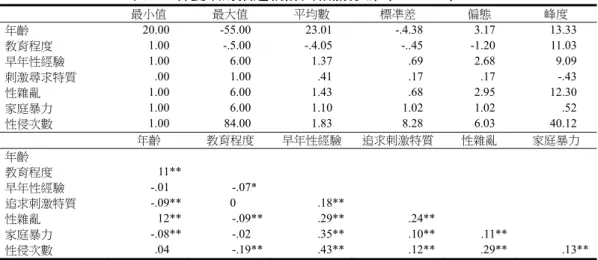
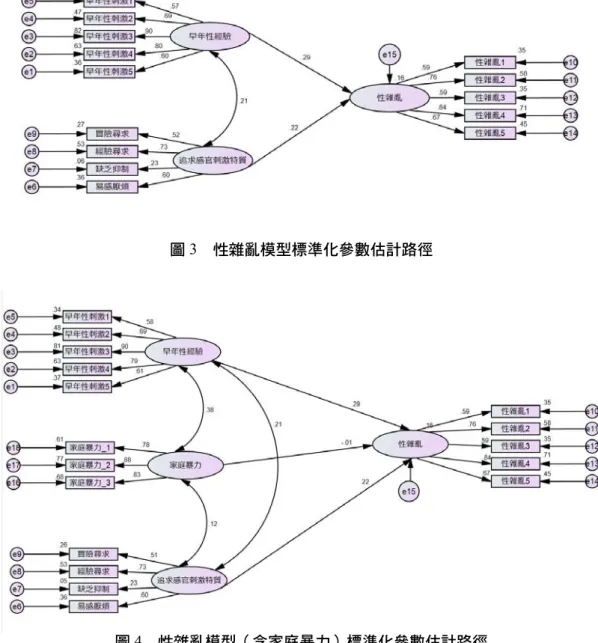
本研究首先就各變項的描述統計與相關(Spearman correlation)進行分析,再分別檢證早年性 經驗、追求感官刺激特質、與性雜亂對性侵害行為與次數的影響。 一、各變項的描述統計與相關分析 本研究中人口變項與探討變項(包括:早年性經驗、追求感官刺激特質、性雜亂、家庭暴力、 性侵害次數)的最小值、最大值、平均數、標準差、偏態、與峰度等描述統計資料如表2。可看出: 年齡、早年性經驗、性雜亂、性侵害次數皆呈現明顯正偏態分配,而教育程度呈負偏態分配。 在相關方面,早年性經驗、追求感官刺激特質、性雜亂、家庭暴力、與性侵害次數皆具顯著 正相關(表2),而早年性經驗與性雜亂的相關(r = .29)較家庭暴力(r = .11)高,符合本研究預 測。 此外,人口變項方面,年齡與性侵害次數無關,但與教育程度、性雜亂具有正相關(年齡愈 大因就讀研究所者愈多故教育程度較高、性雜亂情形愈少),與追求感官刺激特質、家庭暴力具負 相關(年齡愈大愈不追求感官刺激、教育程度高者較少發生家庭暴力);教育程度與早年性經驗、 性雜亂、性侵害次數皆具負相關;由誰撫養(雙親撫養編碼為1,其餘編碼為 0)顯示由雙親撫養 者性侵害次數低於由其他撫養者(單親、隔代撫養等)。以上人口變項與探討變項的關係具有可理 解性,說明測量結果具有一定的可靠性。 由各變項與性侵害行為(有或無)的t 檢定結果可知,性侵害者在早年性經驗、追求感官刺激 特質、與性雜亂上,皆顯著高於非性侵害者(表3),此一結果與本研究預測相符。人口變項方面, 性侵害者的教育程度低於非性侵害者,而年齡與性侵害行為無關。此外,由雙親撫養者性侵害發 生的比例低於其他撫養者(Cramer’s V = .08, p < .05)。表2 各變項的描述統計與相關分析(N = 998) 最小值 最大值 平均數 標凖差 偏態 峰度 年齡 20.00** -55.00** 23.01** -.4.38** 3.17** 13.33** 教育程度 1.00** -.5.00** -.4.05** -..45** -1.20** 11.03** 早年性經驗 1.00** 6.00** 1.37** .69** 2.68** 9.09** 刺激尋求特質 .00** 1.00** .41** .17** .17** -.43** 性雜亂 1.00** 6.00** 1.43** .68** 2.95** 12.30** 家庭暴力 1.00** 6.00** 1.10** 1.02** 1.02** .52** 性侵次數 1.00** 84.00** 1.83** 8.28** 6.03** 40.12** 年齡 教育程度 早年性經驗 追求刺激特質 性雜亂 家庭暴力 年齡 教育程度 -.11** 早年性經驗 -.01** -.07** 追求刺激特質 -.09** 0.**** .18** 性雜亂 -.12** -.09** .29** .24** 家庭暴力 -.08** -.02** .35** .10** .11** 性侵次數 .04** -.19** .43** .12** .29** .13** *p < .05. **p < .01. 表3 性侵害與未性侵害者在各變項上平均數差異的 t 檢定(N = 998) 變項 性侵害 個數 平均數 標準差 t 值 年齡 有 130 23.22 4.26 59.00** 無 868 22.98 4.39 教育程度 有 130 3.92 .77 -2.33** 無 868 4.07 .38 由誰撫養 有 130 1.20 .40 2.21** 無 868 1.12 .32 早年性經驗 有 130 2.03 1.16 7.33** 無 868 1.28 .52 追求感官刺激 有 130 .49 .21 4.97** 無 868 .40 .21 性雜亂 有 130 1.95 1.05 6.41** 無 868 1.35 .57 *p < .05. **p < .01. 二、早年性經驗、追求感官刺激特質、與性雜亂對性侵害行為的影響 如資料分析所述,這部分的分析分為兩方面,其一是早年性經驗、追求感官刺激特質對性雜 亂的影響,其二是早年性經驗、追求感官刺激特質、與性雜亂對性侵害行為的影響。 首先以結構方程模型檢視早年性經驗與追求感官刺激特質對性雜亂的影響。結果顯示模型的 基本適配度指標方面:所有誤差變異皆為正值,且達顯著水準;潛在變項與其觀察指標間的因素 負荷量除追求感官刺激特質有一項小於 .50,其餘介於 .52~ .90 之間,符合介於 .50~ .95 的標準; t 值介於 5.73~19.42 之間,皆大於 1.96,達到 .01 顯著水準;標準誤介於 0.04 與 0.10 間,沒有很 大的標準誤。估計參數之統計量彼此間的相關的絕對值沒有太接近1;以上顯示模型符合基本適配 而無辨認問題存在。整體適配度指標方面:11 項適配指標中有 9 項指標適配(表 4),顯示適配情 形良好。標準化參數估計路徑如圖 3 所示,顯示早年性經驗與追求感官刺激特質有關,且皆對性 雜亂具有預測力(p < .01),共可解釋性雜亂 16%的變異量。
表4 性雜亂、性侵害次數與其平方根模型的各項適配指標與檢定結果 性雜亂 性侵次數 性侵次數平方根 適配指標 適配 標準 檢定 結果 適配 判斷 檢定 結果 適配 判斷 檢定 結果 適配 判斷 絕對指標 WLSχ2/df < 3.00 6.42 否 6.64 否 6.65 否 SRMR < .08 .05 是 .05 是 .05 是 RMSEA < .08 .07 是 .07 是 .07 是 GFI > .90 .93 是 .92 是 .92 是 相對指標 NFI > .90 .90 是 .89 否 .89 否 TLI > 90 .89 否 .88 否 .88 否 IFI > .90 .91 是 .90 是 .90 是 CFI > .90 .91 是 .90 是 .90 是 精簡指標 PNFI > .50 .73 是 .72 是 .72 是 PGFI > .50 .66 是 .66 是 .66 是 PCFI > .50 .74 是 .73 是 .73 是 本研究假設在早年性經驗的影響下,家庭暴力對性雜亂的影響將趨微或消失。經結構方程模 型分析(圖4)顯示,家庭暴力對性雜亂的影響,確實在早年性經驗的排擠效應下變得不顯著,符 合預測。 此外,本研究以二元邏輯迴歸分析檢視早年性經驗、追求感官刺激特質、與性雜亂對性侵害 行為的影響。由於教育程度與主要撫養者與性侵害行為有關,故將這兩項亦納入模式。結果發現: 排除各變項彼此間重疊的影響後,早年性經驗、追求感官刺激特質、與性雜亂,皆對性侵害行為 具有影響(表5),符合預測。且Hosmer-Lemeshow 適配度檢定顯示,模式適配(χ2 = 2.61, df = 8, p = .96)。整體模型可解釋性侵害行為 25%的變異量(Nagelkerke R2 )。 表5 二元邏輯迴歸分析:性侵害行為為依變項(N = 998)
自變項 B S.E. Wald df Exp(B)
教育程度 -.52 .22 5.81** 1 0.59 由誰撫養 .03 .29 .01** 1 1.04 早年性經驗 .96 .13 56.24** 1 2.61 感官刺激 1.18 .52 5.27** 1 3.26 性雜亂 .66 .13 24.21** 1 1.94 *p < .05. **p < .01.
圖3 性雜亂模型標準化參數估計路徑 圖4 性雜亂模型(含家庭暴力)標準化參數估計路徑 註:家庭暴力的觀察指標較多,故隨機打為三包。 三、早年性經驗、追求感官刺激特質、與性雜亂對性侵害次數的影響 本研究首先以逐步迴歸分析檢證早年性經驗、追求感官刺激特質與性雜亂對性侵害次數的影 響。由於教育程度與性侵害次數有關(表2),故亦納入模式。結果顯示(表 6):首先進入迴歸模 式的是早年性經驗(可解釋性侵害次數18.4%的變異量),其次為性雜亂(與早年性經驗共可解釋 性侵害次數21.3%的變異量),再其次為教育程度(與早年性經驗、性雜亂三者共可解釋性侵害次 數23.3%的變異量),排除各變項彼此的影響後,追求感官刺激特質不再具有顯著預測力(單獨預
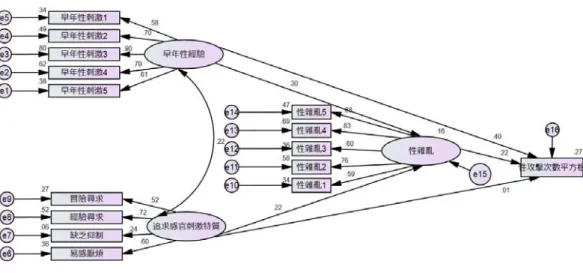
測時仍具顯著預測力,β = .12, t = 3.64, p < .01);迴歸模式的允差(tolerance)接近 1,故自變項間 共線性問題不嚴重。 其次,再以結構方程模型檢驗模型。由於性侵害次數的偏態與峰度的絕對值偏高(表2),故 以平方根進行轉換,使其較接近於常態分配,再進行數值轉換與不轉換的分析與比較。結果發現: 在性侵害次數未轉換時,模型的基本適配度指標方面,所有誤差變異皆為正值,且達顯著水準; 潛在變項與其觀察指標間的因素負荷量除追求感官刺激特質有一項小於 .50,其餘介於 .52~ .90 之間,符合 .50~ .95 的標準;t 值介於 5.72~19.70 之間,皆大於 1.96,達到 .01 顯著水準;標準誤 介於0.04 與 0.10 間,沒有很大的標準誤。估計參數之統計量彼此間相關的絕對值沒有太接近 1; 顯示模型符合基本適配而無辨認問題。整體模型的適配度指標方面,11 項適配指標中有 8 項指標 適配(表4),顯示適配尚稱良好。標準化參數估計路徑如圖 5 所示,除追求感官刺激特質對性侵 害次數不具顯著預測力外,其餘各潛在變項皆對性侵害次數具顯著預測力(p < .01)。整體模型可 解釋性侵害次數23%的變異量。 在性侵害次數轉換為平方根時,模型的基本適配度與整體適配度指標與未轉換為平方根時相 近(表4);標準化參數估計路徑如圖 6 所示,除追求感官刺激特質對性侵害次數不具顯著預測力 外,其餘各潛在變項皆對性侵害次數平方根具顯著預測力(p < .01)。整體模型可解釋性侵害次數 的變異量為27%。 表6 逐步迴歸分析:性侵害次數為依變項 模式 Beta T 允差 調整的R2(%) 1 早年性經驗 .43 15.04** 1.00 18.4 2 早年性經驗 .38 12.86** .92 21.3 性雜亂 .18 6.15** .92 3 早年性經驗 .37 12.76** .91 23.3 性雜亂 .17 5.86** .91 教育程度 -.14 -5.17** .99 *p < .05. **p < .01. 圖5 性侵害次數模型標準化參數估計路徑(圖中性攻擊即為性侵害)
圖6 性侵害次數平方根模型標準化參數估計路徑(圖中性攻擊即為性侵害)
討論
一、研究結果與過去研究對話 (一)呼應過去研究 本研究指出扭曲的早年性經驗導致男性形成對性與女性偏差的想法,進而衍生出性雜亂與性 侵害行為。本研究提出的早年性經驗,主要發生於家庭相關情境,顯示家庭環境在性侵害形成歷 程上扮演的角色。此一觀點與 Marshall 與 Barbaree(1990)所論述的性侵害行為源於施虐家庭(abusive family)有某種程度呼應。Marshall 與 Barbaree 強調,在施虐家庭裡,男孩學到一套剝削 他人的交往模式,應用在其家庭中是適應行為,然而應用在家庭以外,卻會遭人排斥,而產生自 卑心理,後續以控制或剝削他人的方式(例如,性侵害女性或孩童),以增進自尊。
追求感官刺激特質與衝動性、心理病態性格、及偏差行為有關(Newcomb & McGee, 1991;
Zuckerman et al., 1964)。本研究證實此一性格特質影響性雜亂與性侵害兩種偏差行為,與過去文獻
一致(Mann et al., 2010)。
本研究如過去許多研究(Davis et al., 2018; Widman et al., 2013)的發現一般,證實性雜亂影響 性侵害行為。此處補充說明原因如下:(1)性雜亂者常頻繁的發生非人性化而不帶有情感的性行
為,因而容易忽略對方的感受,進而做出未經對方同意的性行為(性侵害);(2)性雜亂者常頻繁
出軌,易導致與伴侶(女性)發生衝突,衝突帶來負面情緒,而形成敵視女性心態(Malamuth et al., 1995),此一心態影響性侵害行為發生(Abbey & Mcauslan, 2004; Anderson & Anderson, 2008);(3) 性雜亂者頻繁的與人發生性行為,造就性侵害的機會(Malamuth et al., 1995)。
(二)與過去研究的差異
Malamuth 等人(1995)將早年性虐待與家庭暴力合併而稱為「早年風險因素」(early risk factors),並認為早年風險因素透過青少年非行影響性雜亂。
本研究提出「早年性經驗」,較之早年性虐待範疇更廣,與Malamuth 等人(1995)所提早年
性虐待意義已然不同。本研究指出早年性經驗與性雜亂的對應性較高,故與家庭暴力共同預測性 雜亂時,家庭暴力的影響趨微或消失,釐清了早年性經驗與家庭暴力對性雜亂的影響。此外,
Malamuth 等人認為「早年風險因素」透過青少年非行影響性雜亂,本研究證實早年性經驗可直接 影響性雜亂。 本研究除探討早年性經驗、追求感官刺激特質、與性雜亂對性侵害行為的影響,亦證實這些 變項對性侵害次數的影響,這是過去研究較少觸及者。性侵害次數有行為持續的意涵,因此上述 因素與性侵害行為的持續發生有關。 二、實務應用 本研究在實務應用上有一項重要意涵:早年性經驗不僅影響性雜亂,且可預測性侵害行為及 次數,甚至較之追求感官刺激特質更具影響力,顯示它可能是形成性侵害傾向的一項因子(黃軍 義,2000;Groth & Birnbaum, 1979; Seto & Lalumiere, 2010),因此值得從這方面思考性侵害的防制
策略。早年性經驗是一項早年的生態環境因素(尤其是家庭生態),包括:小時候常會看到父母親 或家族長輩的性行為、跟隨家人(例如父親、叔叔、舅舅、女性親戚)一起觀看色情影片等等。 從操作定義可知,它涉及暴露於具有性意涵的不良環境,使得孩子從中學習到一套偏差的關於性 與女性的想法(Su, 2018)。從當代發展心理病理學角度思考,並非直接界定早年的偏差行為,而 是回到發展脈絡反思在什麼樣的成長階段,需提供何種環境以促發個人適應性學習與常態發展。 早年經驗與後續人格發展及社會化歷程的關係,具關鍵性影響(Hooley et al., 2017)。因此,早期 介入具有風險的家庭(無論是社工、心理師、觀護人、檢警、教師、輔導老師、或研究人員),以 及專業人員的協力合作(Tien et al., 2017),是預防個人性侵害行為發展形成的一項重要因素。此 外,正念(mindfulness)對學習正確性知識的效果已有研究證實(Hong et al., 2016),可嘗試以此 減少或避免早年不當性經驗的影響。 三、研究方法的探討與未來方向 本研究比較性侵害次數及其平方根的模型,發現在結構方程模型中兩者的適配度相近,但早 年性經驗、性雜亂、與追求感官刺激特質對性侵害次數平方根的變異解釋量較高,可能因性侵害 次數轉換為平方根後較接近常態分配,使參數估計較為穩定(邱皓政,2004)而提升解釋量。 本研究在統計技術上,分別以逐步迴歸與結構方程模型分析早年性經驗、性雜亂、與追求感 官刺激特質對性侵害次數的影響。結果發現迴歸分析與結構方程模型兩種統計方法所得到的結果 一致。不過迴歸分析中各自變項對性侵害次數的解釋量(21.3%)略低於結構方程模型(23%), 應是迴歸分析中各自變項對依變項的影響僅計算直接影響,但在結構方程模型中各自變項的直、 間接影響皆計算在內。 本研究以網絡問卷調查敏感的性侵害行為,是否會有參與者不實回答的情形?關於這項問 題,本研究除於方法中陳明問卷調查法參與者自陳的犯罪資料具有信度與效度外(Farrington, 1983;
Loza & Green, 2003),亦說明網路問卷調查所得到的結果與傳統紙筆測驗所得到的結果相較,具有
均等的因素架構與測量效果(游森期、余民寧,2006)。此外,Lisak 與 Miller(2002)詳述以量 表測量性侵害經驗的效度,其研究結果為美國政府所採用,並據以呼籲大學校園重視性侵害案件 的發生與防制(Swartout et al., 2015)。 網路問卷樣本是否具有代表性亦是受到關注與質疑的問題。代表性不足將導致研究外部效度 的限制。不過,本研究主要目的在理論模型的檢證,而非盛行率的調查,故樣本代表性的影響較 小。國外有不少發表在優良期刊的研究,以某學系的大學生為參與者,代表性受限然而並不影響 其理論檢證。無論網路或紙本問卷調查,在取樣上皆有其限制性,而本研究樣本人數達 998 位, 此一較大樣本或可使樣本代表性不足的問題減輕。 在本研究限制與未來研究方向上,由於早年性經驗與追求感官刺激特質對性雜亂的解釋量並 不高,因此青少年非行經驗、心理病態性格、劇烈飲酒、對女性性意圖的錯誤知覺等變項(Abbey
et al., 2011; Dishion et al., 2012; Malamuth et al., 1995),在後續研究可納入模式予以檢證。Malamuth 等人(1995)的合流模型指出,早年風險因素透過青少年非行影響性雜亂,後續研究可針對此一 論述,與本研究結果(即早年性經驗可直接預測性雜亂)加以比較,並予檢證。此外,社區性侵 害者與被逮捕入獄的性侵害者,在生活適應、自尊、與性侵害成因上具有差異(Smithyman, 1978), 故後續研究可針對逮捕入獄的性侵害受刑人進行本研究各項假設的檢證。
參考文獻
內政部警政署(2017):警察機關受(處)理性侵害案件分析 100–103 年。引自網站:https://www.npa. gov.tw/NPAGip/wSite/public/Attachment/f1448013253979.doc,2017 年 9 月 10 日。[National Police Agency, Ministry of the Interior. (2017). Police agency’s analysis of sexual assault casesfrom 2011 to 2014. Retrieved September 10, 2017, from National Police Agency, Ministry of the
Interior Web site: https://www.npa.gov.tw/NPAGip/wSite/public/Attachment/f1448013253979.doc] 邱皓政(2004):結構方程模式:LISREL 的理論、技術與應用。雙葉。[Chiou, H.-J. (2004). Principles
and practice of structural equation modeling with LISREL. Yeh-Yeh Book Gallery.]
黃軍義(2000):強姦行為之心理歷程的動態分析(未發表)。國立台灣大學心理學研究所博士論 文。[Huang, J.-Y. (2000). A dynamic analysis of the psychological processes of rape (Unpublished doctoral dissertation). National Taiwan University, Taipei, Taiwan.]
黃軍義(2013):少年縱火行為形成的理論模型。中華心理學刊,55,217–236。http://doi.org/10.6129/ CJP.20130410[Huang, J.-Y. (2013). A theoretical model of the causes of juvenile fire-setting.
Chinese Journal of Psychology, 55, 217-236. http://doi.org/10.6129/CJP.20130410]
黃軍義(2015):男性性侵害循環的發生機制。教育心理學報,46,471–489。http://doi.org/10.6251/BEP. 20140709[Huang, J.-Y. (2015). An investigation of the causal mechanisms of male sexual victim-perpetrator cycle. Bulletin of Educational Psychology, 46, 393–412. http://doi.org/10.6251/ BEP.20140709]
游森期、余民寧(2006):網路問卷與傳統問卷之比較:多樣本均等性方法學之應用。測驗學刊,
53,103–127。http://doi.org/10.7108/PT.200606.0103[Yu, S.-C., & Yu, M.-N. (2006). Comparison
of internet and paper-and-pencil questionnaires in Taiwan using multi-sample invariance approach.
Psychological Testing, 53, 103–127. http://doi.org/10.7108/PT.200606.0103]
楊思芳、丁原郁(2017):兒少性虐待受害者與身體虐待受害者在心理創傷與生理健康之比較研究。
教育心理學報,49,321–343。http://doi.org/10.6251/BEP.20171201[Yang, S.-F., & Ting, Y.-Y. (2017). A comparative study of the victims of child sexual abuse and physical abuse in the psychological trauma and physical health. Bulletin of Educational Psychology, 49, 321–343. http://doi.org/10.6251/BEP.20171201]
鄭瑞隆(2001):家庭暴力被害經驗與青少年偏差行為關係之研究。犯罪學期刊,8,215–246。[Cheng, J.-L. (2001). Family Violence Victimization as an Influential Cause to Juvenile Deviance. Journal
of Criminology, 8, 215–246.]
Abbey, A., Jacques-Tiura, A. J., & LeBreton, J. M. (2011). Risk factors for sexual aggression in young men: An expansion of the confluence model. Aggressive Behavior, 37, 450–464. http://doi.org/10. 1002/ab.20399
Abbey, A., & Mcauslan, P. (2004). A longitudinal examination of male college students’ perpetration of sexual assault. Journal of Consulting & Clinical Psychology, 72, 747–756. http://doi.org/10.1037/ 0022-006X.72.5.747
Anderson, C. A., & Anderson, K. B. (2008). Men who target women: Specificity of target, generality of aggressive behavior. Aggressive Behavior, 34, 605–622. https://doi.org/10.1002/ab.20274
Anderson, K. G. (2006). How well does paternity confidence match actual paternity? Evidence from worldwide nonpaternity rates. Current Anthropology, 47, 513–520. https://doi.org/10.1086/504167 Axinn, W. G., Bardos, M. E., & West, B. T. (2018). General population estimates of the association
between college experience and the odds of forced intercourse. Social Science Research, 70, 131–141. http://doi.org/10.1016/j.ssresearch.2017.10.006
Barenbaum, N. B., & Winter, D. G. (2008). History of modern personality theory and research. In O. P. John, R. W. Robins, & L. A. Pervin (Eds.), Handbook of personality: Theory and research (pp. 29–60). Guilford.
Blanc, A., Byers, E. S., & Rojas, A. J. (2018). Evidence for the validity of the attitudes toward sexual behaviours scale (ASBS) with Canadian young people. The Canadian Journal of Human
Sexuality, 27, 1–11. https://doi.org/10.3138/cjhs. 2017-0024
Brown, J. D., L’Engle, K. L., Pardun, C. J., Guo, G., Kenneavy, K., & Jackson, C. (2006). Sexy media matter: Exposure to sexual content in music, movies, television, and magazines predicts black and white adolescents’ sexual behavior. Pediatrics, 117, 1018–1027. http://doi.org/10.1542/peds.2005-1 406
Carey, K. B., Durney, S. E., Shepardson, R. L., & Carey, M. P. (2015). Incapacitated and forcible rape of college women: Prevalence across the first year. Journal of Adolescent Health, 56, 678–680. http://doi.org/10.1016/j.jadohealth.2015.02.018
Casey, E. A., Masters, N. T., Beadnell, B., Hoppe, M. J., Morrison, D. M., & Wells, E. A. (2017). Predicting sexual assault perpetration among heterosexually active young men. Violence Against
Davis, K. C., Neilson, E. C., Wegner, R., & Danube, C. L. (2018). The intersection of men’s sexual violence perpetration and sexual risk behavior: A literature review. Aggression and Violence
Behavior, 40, 83–90. https://doi.org/10.1016/ j.avb.2018.04.001
Dawes, A., & Higson-Smith, C. (2004). The socio-cultural context of child abuse: A betrayal of trust. In L. M. Richter, L. Richter, A. Dawes, & C. Higson-Smith (Eds.), Sexual abuse of young children in
Southern Africa (pp. 94–108). HSRC.
Dishion, T. J., Ha, T., & Véronneau, M. H. (2012). An ecological analysis of the effects of deviant peer clustering on sexual promiscuity, problem behavior, and childbearing from early adolescence to adulthood: An enhancement of the life history framework. Developmental Psychology, 48, 703–717. http://doi.org/10.1016/j.chiabu.2006.12.018
Dworkin, E R., Menon, S. V., Bystuynski, J., & Allen, N. E. (2017). Sexual assault victimization and psychopathology: A review and meta-analysis. Clinical Psychology Review, 56, 65–81. http://doi. org/10.1016/j.cpr.2017.06.002
Eysenck, H. J. (1976). Sex and personality. Open Books.
Farrington, D. P. (1983). Offending from 10 to 25 years of age. In K. T. Van Dusen & S.A. Mednick (Eds.), Crime and justice: An annual review of research (Vo1. 9). University of Chicago Press. Fergusson, D. M., Boden, J. M., & Horwood, L. J. (2008). Exposure to childhood sexual and physical
abuse and adjustment in early adulthood. Child Abuse & Neglect, 32, 607–619. http://doi.org/10.1 016/j.chiabu.2006.12.018
Finkelhor, D., Ormrod, R. K., Turner, H. A., & Hamby, S. L. (2005). Measuring poly-victimization using the juvenile victimization questionnaire. Child Abuse & Neglect, 29, 1297–1312. http://doi.org/10. 1016/j.chiabu.2005.06.005
Garcia, J. R., MacKillop, J., Aller, E. L., Merriwether, A. M., Wilson, D. S., & Lum, J. K. (2010). Associations between dopamine D4 receptor gene variation with both infidelity and sexual promiscuity. PLoS ONE, 5(11), Article e14162. https://doi.org/10.1371/ journal. pone.0014162 Goforth, C. (2015). Using and interpreting Cronbach’s α. University of Virginia Library: Research data
services + Sciences. https://data.library.virginia.edu/ using-and-interpreting-cronbachs-alpha/
Gottfredson, M., & Hirschi, T. (1990). A general theory of crime. Stanford University Press.
Griffith, S. C., Owens, I. P. F., & Thuman, K. A. (2002). Extra pair paternity in birds: A review of interspecific variation and adaptive function. Molecular Ecology, 11, 2195–2212. https://doi.org/ 10.1046/j.1365-294X.2002.01613.x
Hair, J. F., Black, W. C., Babin, B. J., Anderson, R. E., & Tatham, R. L. (2006). Multivariate data
analysis. Pearson Prentice Hall.
Hatch, A. (2017). Campus sexual assault. ABC-CLIO, LLC.
Hong, J.-C., Tsai, C.-R., Chi, H.-C. & Hwang, M.-Y. (2016). Mindfulness in learning safe sex via social media: Perspectives of personality and experiential value. Computers in Human Behavior, 64, 337–346. http://doi.org/10.1016/j.chb. 2016.06.033
Hooley, J. M., Butcher, J. N., Nock, M., & Mineka, S. (2017). Abnormal psychology (17th ed.). Pearson. Hoyle, R. H., Fejfar, M. C., & Miller, J. D. (2000). Personality and sexual risk taking: A quantitative
review. International Journal of Psychology, 68, 1203–1231. https://doi.org/10.1111/1467-6494.0 0132
Kamdar, Z. N., Kosambiya, J. K., Chawada, B. L., Verma, M., & Kadia, A. (2017). Rape: Is it a lifestyle or behavioral problem? Indian Journal of Psychiatry, 59, 77–82. http://doi.org/10.4103/psychiatry. IndianJPsychiatry_78_16
Koss, M. P., Abbey, A., Campbell, R., Cook, S., Norris, J., Testa, M., Ullman, S., West, C., & White, J. (2007). Revising the SES: A collaborative process to improve assessment of sexual aggression and victimization. Psychology of Women Quarterly, 31, 357–370. https://doi.org/10.1111/j.1471-6 402.2007.00385.x
Koss, M. P., Gidycz, C. A., & Wisniewski, N. (1987). The scope of rape: Incidence and prevalence of sexual victimization in a national sample of higher education students. Journal of Consulting and
Clinical Psychology, 55, 162–170. http://doi.org/10.1037/0022-006X.55.2.162
Kuo, C., Mathews, C., & Abrahams, N. (2018). Sexual violence as a global health problem: Current evidence and future directions. In L. M. Orchowski & C. A. Gidycz (Eds.), Sexual assault risk
reduction and resistance: Theory, research, and practice (pp. 291–308). Academic Press. https://
doi.org/10.1016/B978-0-12-805389-8.00012-8
Lisak, D., & Miller, P. M. (2002). Repeat rape and multiple offending among undetected rapists. Violence
and Victims, 17, 73–84. http://doi.org/10.1891/vivi.1 7.1.73.33638
Loza, W., & Green, K. (2003). The self-appraisal questionnaire- A self-report measure for predicting recidivism versus clinician-administered measures: A five-year follow-up study. Journal of
interpersonal violence, 18, 781–797.
Lu, H.-Y., Ma, L.-C., Lee, T.-S., Hou, H.-Y., & Liao, H.-Y., (2014). The link of sexual sensation seeking to acceptance of cybersex, multiple sexual partners, and one-night stands among Taiwanese college students. The Journal of Nursing Research, 22, 208–215. http://doi.org/10.1097/jnr.00000 00000000043
Malamuth, N. M., Linz, D., Heavey, C. L., Barnes, G., & Acker, M. (1995). Using the confluence model of sexual aggression to predict men’s conflict with women: A 10-year follow-up study. Journal of
Personality and Social Psychology, 69, 353–369. http://doi.org/10.1037//0022-3514.69.2.353
Mann, R. E., Hanson, R. K., & Thornton, D. (2010). Assessing risk for sexual recidivism: Some proposals on the nature of psychologically meaningful risk factors. Sexual Abuse: A Journal of
Research and Treatment, 22, 191–217. http://doi.org/10.1177/1079063210366039
Marshall, W. L., & Barbaree, H. E. (1990). An integrated theory of the etiology of sexual offending. In W. L. Marshall, D. R. Laws, & H. E. Barbaree (Eds.), Handbook of sexual assault: Issues, theories
and treatment of the offender (pp. 257–275). Plenum.
McCrae, R. R., & Costa, P. T. Jr. (2008). The five-factor theory of personality. In O. P. John, R. W. Robins, & L. A. Pervin (Eds.), Handbook of personality: Theory and research (pp. 159–181). Guilford.
Munafo, M. R., Yalcin, B., Willis-Owen, S. A., & Flint, J. (2008). Association of the dopamine D4 receptor (DRD4) gene and approach-related personality traits: meta-analysis and new data.
Biological Psychiatry, 63, 197–206. http://doi.org/10.1016/j.biopsych.2007.04.006
Newcomb, M. D., & McGee, L. (1991). Influence of sensation seeking on general deviance and specific problem behaviors from adolescence to young adulthood. Journal of Personality and Social
Psychology, 61, 614–628. https://doi.org/10.1037/0022-3514.61.4.614
O’Hara, R. E., Gibbons, F. X., Gerrard, M., Li, Z., & Sargent, J. D. (2012). Greater exposure to sexual content in movies predicts earlier sexual debut and increased sexual risk taking. Psychological
Science, 23, 984–993. http://doi.org/10.1177/0956797611435529
Paolucci, E. O., Genuis, M. L., & Violato, C. (2001). A meta-analysis of the published research on the effects of child sexual abuse. Journal of Psychology: Interdisciplinary and Applied, 135, 17–36. https://doi.org/10.1080/00223980109603677
Paulhus, D. L., & Williams, K. M. (2002). The ‘Dark Triad’ of personality: Narcissism, Machiavellianism and psychopathy. Journal of Research in Personality, 36, 556–563. https://doi.org/10.1016/S0092 -6566(02)00505-6
Rich, P. (2011). Understanding, assessing, and rehabilitating juvenile sexual offenders (2nd ed.). Wiley. Rothman, K., Georgia, S. E., Roddy, M. K., Hatch, S. G., & Doss, B. D. (2019). Sexual assault among
women in college: Immediate and long-term associations with mental health, psychosocial functioning, and romantic relationships. Journal of Interpersonal Violence. Advance online published. http://doi.org/10.1177/0886260519870158
Schmitt, D. P. (2004). The big five related to risky sexual behaviour across 10 world regions: Differential personality associations of sexual promiscuity and relationship infidelity. European Journal of
Personality, 18, 301–319. http://doi.org/10.1002/per.520
Schmitt, D. P., & Buss, D. M. (2000). Sexual dimensions of person description: Beyond or subsumed by the Big Five? Journal of Research in Personality, 34, 141–177. https://doi.org/10.1006/jrpe.1999. 2267
Seto, M. C., & Lalumiere, M. L. (2010). What is so special about male adolescent sexual offending? A review and test of explanations through meta-analysis. Psychological Bulletin, 136, 526–575. http://doi.org/10.1037/a0019700
Skinner, B. F. (1953). Science and human behavior. Macmillan.
Smithyman, S. D. (1978). The Undetected rapist (Unpublished doctoral dissertation). Claremont Graduate School, Claremont, CA, USA.
Su, H.-Y. (2018). Contested words, gender norms and language ideologies: The gendered meaning of tai.
Gender and Language, 12(1), 27–60. http://doi.org/10.1558/genl.28954
Swartout, K., Koss, M., White, J., Thompson, M., Abbey, A., & Bellis, A. (2015). Trajectory analysis of the campus serial rapist assumption. AJMA Pediatrics, 169, 1148–1154. http://doi.org/10.1001/ jamapediatrics.2015.0707
Thompson, M. P., Swartout, K. M., & Koss, M. P. (2013). Trajectories and predictors of sexually aggressive behaviors during emerging adulthood. Psychology of Violence, 3, 247–259. http://doi. org/10.1037/a0030624
Tien, L.-C., Wu, Y.-L., Lin, T.-W., & Wang, S. S.-C. (2017). Different perceptions of interprofessional collaboration and factors influencing the one-stop service for sexual assault victims in Taiwan. Journal of Interprofessional Care, 31(1), 98–104. http://doi.org/10.1080/13561820.2016.124 8816 Varella, M. A. C., Valentova, J. V., Pereirac, K. J., & Bussab, V. S. R. (2014). Promiscuity is related to
masculine and feminine body traits in both men and women: Evidence from Brazilian and Czech samples. Behavioral Process, 109, 34–39. https://doi.org/10.1016/j.beproc.2014.07.010
Walsh, K., Koenen, K. C., Aiello, A. E., Uddin, M., & Galea, S. (2014). Prevalence of sexual violence and posttraumatic stress disorder in an urban African-American population. Journal of Immigrant
and Minority Health, 16, 1307–1310. http://doi.org/10.1007/s10903-013-9840-6
Widman, L., Olson, M. A., & Bolen, R. M. (2013). Self-reported sexual assault in convicted sex offenders and community men. Journal of Interpersonal Violence, 28, 1519–1536. http://doi.org/ 10.1177/0886260512468237
Zuckerman, M., Kolin, E. A., Price, L., & Zoob, I. (1964). Development of a sensation-seeking scale.
Journal of Consulting Psychology, 28, 477–482. https://doi.org/10.1037/h0040995
Zuckerman, M., & Kuhlman, D. M. (2000). Personality and risk-taking: Common biosocial factors.
Journal of Personality, 68, 999–1029. http://doi.org/10.1111/1467-6494.00124
收 稿 日 期:2019 年 05 月 24 日 一稿修訂日期:2019 年 05 月 30 日 二稿修訂日期:2019 年 09 月 07 日 三稿修訂日期:2019 年 09 月 30 日 四稿修訂日期:2019 年 10 月 24 日 接受刊登日期:2019 年 10 月 24 日
Bulletin of Educational Psychology, 2020, 52(1), 1–24 National Taiwan Normal University, Taipei, Taiwan, R.O.C.
Development of Promiscuous and Impersonal Sex and
its Consequences on Sexual Assault
Jiun-Yih Huang
Yaw-Sheng Lin
Ka-Fong Lei
Department of AppliedPsychology Hsuan Chuang University
Department of Psychology National Taiwan University
Department of Education Psychology and Counseling National Tsing Hua University The prevalence of male sexual assault on women is alarmingly high worldwide (Axinn et al., 2018; Carey et al., 2015; Kamdar et al., 2017; Koss et al., 1987; Walsh et al., 2014). Researchers have critically and widely discussed the social issue (Kuo et al., 2018) concerning the adverse effects of sexual assault on the psychological, physiological, and sexual well-being of victims (Dworkin et al., 2017; Rothman et al., 2019).
Samples of convicted sex offenders and nonoffenders (Davis et al., 2018; Widman et al., 2013) have confirmed that promiscuous and impersonal sex is a major predictor of male sexual assault (Abbey et al., 2011; Casey et al., 2017; Malamuth, et al., 1995; Widman et al., 2013). Considering that sexual assault is a pertinent social issue, the causal factors of promiscuous and impersonal sex should be essentially explored. However, only a few studies have focused on promiscuous and impersonal sex in Taiwan. Particularly, studies focusing on the effect of promiscuous and impersonal sex on sexual assault have been inadequate.
Male sexual assault on women constitutes more than 90% of all sexual assault cases in Taiwan (National Police Agency, Ministry of the Interior, 2017). This study bridges a critical research gap concerning male sexual assault in Taiwan and contributes to the international literature on this topic.
This study particularly focuses on two aspects. Early sexual experiences pertain to one’s surroundings and life experiences (Dishion et al., 2012). Sensation seeking (a personality trait) pertains to biological factors from the perspective of trait theory and biological theory (Barenbaum & Winter, 2008; McCrae & Costa, 2008). These two aspects can help understand mechanisms underlying the development of promiscuous and impersonal sex.
Accordingly, this study establishes a model to explain the development of promiscuous and impersonal sex and its effect on sexual assault. The following assumptions are made: (a) Early sexual experiences relate to sensation seeking, and both aspects predict promiscuous and impersonal sex. (b) Early sexual experiences, sensation seeking, and promiscuous and impersonal sex can predict sexual assault behavior and frequency. (c) Early sexual experiences and domestic violence relate to each other and can predict promiscuous and impersonal sex. However, the effect of domestic violence as a predictor of promiscuous and impersonal sex is often overlooked due to the high correspondence between early sexual experiences and promiscuous and impersonal sex. This study has verified the preceding assumptions.
An anonymous self-report online questionnaire was used for data collection. The surveyed population comprised 998 men aged >20 years. The participants were aged between 20 and 55 years, with the average age and standard deviation being 23.01 and 4.38 years, respectively. Furthermore, 1.00%, 3.50%, 84.20%, and 11.30% of the participants had elementary school and junior high school, high school (vocational), university (college), and postgraduate education, respectively. With regard to caregivers, 87.10%, 2.30%, 6.10%, 3.30%, 0.40%, and 0.90% of the participants were raised by their parents, fathers, mothers, grandparents, relatives, and without family support, respectively.
Participants were recruited through websites, and research questionnaires were administered through online platforms. Participants provided consent, and this study was approved by a research ethics review committee (REC number: 10503ES009).
Variables were measured using self-developed tools or established scales with reliability and validity. The measurement tools were verified as having acceptable reliability and validity.
This study used structural equation modeling to examine the effects of early sexual experiences, family violence, and sensation seeking on promiscuous and impersonal sex. In addition, binary logistic regression analysis was performed to examine the effects of early sexual experiences, sensation seeking, and promiscuous and impersonal sex on sexual assault. A structural equation model was used to examine the effects of early sexual experiences, sensation seeking, and promiscuous and impersonal sex on the sexual assault frequency. The results revealed that early sexual experiences were associated with sensation seeking. Furthermore, both the aspects predicted 16% of the variance of promiscuous and impersonal sex. Under the influence of early sexual experiences, the effect of family violence on promiscuous and impersonal sex became nonsignificant. In addition, the results indicated the following: (1) Early sexual experiences, sensation seeking, and promiscuous and impersonal sex significantly predicted sexual assault. (2) Early sexual experiences and promiscuous and impersonal sex had significant predictive effects on the sexual assault frequency. (3) Sensation seeking no longer had significant predictive power under the overlapping influence of the aforementioned variables.
The study findings confirm the results of previous studies concerning the effect of early sexual experiences on sexual assault. The family environment plays a major role in sexual assault. This finding is consistent with Marshall and Barbaree’s (1990) assertion that sexual assault behaviors originate from abusive families. In addition, this study confirmed the effect of promiscuous and impersonal sex on sexual assault, consistent with the findings in the literature (Davis et al., 2018; Mann et al., 2010; Widman et al., 2013). Malamuth et al. (1995) asserted that early risk factors affect promiscuous and impersonal sex through the mediation of adolescent delinquency. However, this study demonstrated the direct relationship between early sexual experiences and promiscuous and impersonal sex. The study confirmed the effect of early sexual experiences, sensation seeking, and promiscuous and impersonal sex on the sexual assault frequency, which has been rarely discussed in previous studies. Additionally, this study clarified the role of early sexual experiences and family violence in promiscuous and impersonal sex.
Early sexual experiences influence promiscuous and impersonal sex as well as predict the sexual assault behavior and frequency. As observed, early sexual experiences have more explanatory power than sensation seeking, thereby contributing to the development of sexual assault tendencies (Huang, 2000; Groth & Birnbaum, 1979; Seto & Lalumiere, 2010). Accordingly, early intervention in high-risk families (social workers, psychologists, probation officers, prosecutors, teachers, or researchers) and cooperation of professionals (Tien et al., 2017) can effectively prevent sexual assault behaviors.
Factors such as adolescent delinquency, psychopathy, severe drinking, and false perception of women’s sexual intention (Abbey et al., 2011; Dishion et al., 2012; Malamuth et al., 1995) can be incorporated into the model of promiscuous and impersonal sex in future studies. This is because early sexual experiences and sensation seeking explain only 16% of the variance of promiscuous and impersonal sex. The confluence model proposed by Malamuth et al. (1995) indicates that early
risk factors influence promiscuous and impersonal sex through adolescent delinquency. Subsequent studies can address this association and compare it with the results of this study (i.e., early sexual experiences directly predicts promiscuous and impersonal sex). In addition, sex offenders who are arrested and those who escape arrest demonstrate differences in terms of life adjustment, self-esteem, and causes of sexual assault (Smithyman, 1978). Accordingly, future research should focus on incarcerated sex offenders to explore and verify the hypotheses presented herein.
Keywords: early sexual experiences, promiscuous and impersonal sex, sensation seeking,