行政院國家科學委員會專題研究計畫 成果報告
癌症篩檢效益評估---芬蘭-瑞典-台灣三國合作計畫
計畫類別: 個別型計畫 計畫編號: NSC91-2320-B-002-215- 執行期間: 91 年 08 月 01 日至 93 年 07 月 31 日 執行單位: 國立臺灣大學公共衛生學院預防醫學研究所 計畫主持人: 陳秀熙 報告類型: 精簡報告 報告附件: 國際合作計畫研究心得報告 處理方式: 本計畫可公開查詢中 華 民 國 93 年 11 月 1 日
行政院國家科學委員會補助專題研究計畫成果報告
計畫名稱: 癌症篩檢效益評估---芬蘭—瑞典—台灣三國合作計畫
計畫編號:NSC 91-2320-B-002-215
執行期限:91 年月 08 月 1 日至 93 年 07 月 31 日
主持人:陳秀熙 國立台灣大學公共衛生學院預防醫學研究所
共同主持人:陳建仁
計畫參與人員:吳慧敏
中文摘要 篩檢被視為防治子宮頸癌、乳癌、大腸 直腸癌、及(或許)攝護腺癌最重要的防治方 式,且其自然病史在篩檢活動的成效扮演了 相當重要的角色。疾病的自然病史不只有助 於我們在癌症的早期將其發現,也產出好的 感度度與特異度。 本計畫隸屬於中芬瑞國際合作計畫中, 而中芬瑞國際合作計畫目的在於找出三國共 同有興趣的研究主題並發展與流行病學相關 的共同合作研究計畫。本計畫即屬於該國際 合作計畫下的其中一個主題—癌症篩檢,希 望透過本計畫的執行,以實證醫學為基礎的 癌症篩檢評量來促進中芬瑞三國之間在研究 上的合作關係。本計畫的主要目的為: 1. 評估以族群為基礎攝護腺癌篩檢隨機試 驗。 2. 評估芬蘭乳癌篩檢資料 3. 評估芬蘭子宮頸癌篩檢資料 材料與方法:我們首先發展疾病自然病史模 式,從正常到臨床症前期、臨床期再到死亡, 並用芬蘭的實證資料來對每個階段進行估 計,再根據這些估計值來進行 100,000 位虛 擬族群的電腦模擬,以比較在不同的篩檢策 略下的篩檢效益。 結果: 1. 攝護腺癌:在調整前導期偏差後,篩檢偵 測個案相對於臨床偵測個案之死亡相對 危險性為0.13 至 0.73 之間。結果顯示前 導期偏差的調整對於篩檢偵測個案及臨 床偵測個案在存活率的比較上影響頗大。 2. 乳癌及子宮頸癌篩檢評估部份已完成資 料處理及準備等部份,我們發現完整的自 然病史探討尚需要更為詳細的資料(如不 同轉移模式的資料、腫瘤特徵及篩檢間隔 個案等)來建構。 結論 總結來說,我們透過此中芬瑞國際合作計劃 將臺灣博士班交換學生送往芬蘭,並且參與 該國癌症篩檢研究計畫,並已完成該國攝護 腺癌篩檢計畫下篩檢偵測個案及臨床偵測個 案其存活率之比較。此外,該生亦活躍於該 國乳癌及子宮頸癌篩檢評估計畫當中的資料 處理及準備等部份,並且預備在不久的將來 針對這兩種癌症進行更進一步的分析。 關鍵詞:子宮頸癌篩檢、乳癌篩檢、攝護腺 癌篩檢、前導期校正 AbstractScreening has been regarded as the most important prevention method for cervical cancer, breast cancer, colorectal cancer, and perhaps prostate cancer, and the disease natural history plays an important role in the
effectiveness of screening. The long disease natural history not only enables one to detect cancers at early stage but also produces good program sensitivity and specificity if the inter-screening interval is adequate.
This project is a part of Finnish-Swedish- Taiwanese Cooperation Project which is based on the collaboration between Academy of Finland, Sweden and the National Science Council in Taiwan to find out common areas of interest and to develop plans for collaborative research in epidemiology. This present project which belongs to the first topic, cancer screening, was proposed to facilitate Finnish-Swedish-Taiwanese cooperative research on the formulation of evidence-based method for evaluation of cancer screening. The specific aims of the present study are to: 1. to evaluate the effectiveness of population-
based prostatic cancer screening trial with PSA measurement in Finland.
2. evaluate breast cancer screening using data from Finland
3. continue evaluation cervical cancer screening using data from Finland.
Materials and Methods: We first develop the disease natural history from normal via preclinical state, clinical state, to cancer death, and estimate each transition parameters of the model. Based on these empirical estimates, A hypothetical cohort of 100,000 subjects with identical make-up of demographic characteristics is simulated.
Results: 1. Prostate cancer screening: The hazard ratio comparing screen-detected cancers with clinically-detected cancers inflates from 0.13 to 0.73 after lead-time adjustment. The results show that lead-time bias plays an important role on prostate cancer survival when comparing screen-detected cases with clinically- detected cases.
More detailed data on screening for both breast cancer and cervical cancer are needed to build up a comprehensive natural history model.
Conclusions
In conclusion, bilateral cooperation projects has been feasibly demonstrated by exchanging PhD student who has actively participated in cancer screening project in Finland. The comparison of cumulative survival between screen-detected cases and clinically-detected cases for prostate cancer screening project has been made. Preparation of data on breast cancer screening and cervical cancer screening has been implemented. Future analysis on two screening regimes should be done.
Keywords: Cervical Cancer Screening; Breast Cancer screening; Prostate Cancer Screening; Lead-time Adjustment;
I. Introduction
Screening has been regarded as the most important prevention method for cervical cancer, breast cancer, colorectal cancer, and perhaps prostate cancer, and the disease natural history plays an important role in the
effectiveness of screening. The long disease natural history not only enables one to detect cancers at early stage but also produces good program sensitivity and specificity if the inter-screening interval is adequate. From the aspect of logistic of follow-up, a long disease natural history may also suggest that evaluation of primary endpoint such as mortality may require long-term follow-up. Therefore, surrogate endpoints with the incorporation of tumour attributes (such as tumour size, nodal involvement, and histological type) into the disease natural history model may provide an alternative approach.
The nation-wide population-based
mass-screening programs for cervical cancer in Finland has been started from 1963 onwards. The organised Pap smear screening has
demonstrated a large decrease of morbidity and mortality (Hakama 1985). Although the
efficacy of Pap smear screening in reducing incidence and mortality of cervical cancer has been demonstrated, the disease natural history of cervical intraepithelial neoplasm (CIN) and its relationship related to Human
Papillomavirus (HPV) have not been precisely estimated. Management of pre- cancerous lesion was therefore on the debate about repeated cytological surveillance or direct treatment.
Breast cancer screening with
mammography was started in Finland in 1982. Results of coverage rate, participation rate, and screening process indicators have shown that the program was rather successfully
implemented (Hakama et al 1991, 1997). Preliminary results showed a reduction of 24% in breast cancer mortality among those invited, compared with the non-invited controls. The result was consistent with those from the previous randomized trials. While evaluation of primary endpoint i.e. mortality requires
long-term follow-up early assessment should be performed including prevalence/incidence ratio, interval cancer as a percentage of expected incidence estimated from the underlying population, estimation of sojourn time and lead time distribution, and program sensitivity and specificity. In addition, the long-term effectiveness of breast cancer
screening in reducing mortality had better be predicted on the basis of surrogate endpoints such as tumour size, nodal involvement, and histological type as indicated above.
The Finnish Prostate Cancer Screening using serum prostate-specific antigen (PSA), a part of the European Randomized Study of Screening for Prostate Cancer, has been conducted for men at age 55-67 years from 1996 onwards. Preliminary results have indicated approximately 70% attendance rate, adequate performance of screening test and reasonable detection rate (Auvinen et al
1996;Maattanen et al 2001). However, whether these intermediate indicators can lead to a significant reduction of mortality from prostate cancer can be evaluated in early period using the Markov models with the incorporation of sensitivity and specificity of PSA. Doing so not only enables one to project mortality reduction due to PSA screening but also ascertain the optimal cut-off point of PSA in relation to mortality reduction.
This project is a part of Finnish- Swedish- Taiwanese Cooperation Project which is based on the collaboration between Academy of Finland, Sweden and the National Science Council in Taiwan. A workshop on
Epidemiology was held in Finland in 2001. The purpose of the workshop was to find out
common areas of interest and to develop plans for collaborative research in epidemiology. The workshop covered three specific areas within epidemiology includeing cancer screening, molecular epidemiology & biomarker, and environmental epidemiology. This present project which belongs to the first topic, cancer screening, was proposed to facilitate Finnish- Swedish-Taiwanese cooperative research on the formulation of evidence-based method for evaluation of cancer screening.
The specific aims of the present study are to: 1. evaluate breast cancer screening using data from Finland
(1) to estimate transition parameters from normal to carcinoma in situ (CIS) to the PCDP and finally to clinical phase taking stage of invasive carcinoma into account;
(2) to estimate transition parameters as in (1) but taking tumour size or histological type into
account;
(3) to project a long-term effectiveness of Finnish breast cancer screening in reducing mortality using surrogate endpoint evaluation based on (1) and (2);
(4) to conduct sub-group analysis to assess whether the efficacy of breast cancer screening with mammography for women aged under 50 years is different from that for women aged over 50 years, respectively;
(5) to compare the results from (3) and (4) with the previous findings from the Swedish
randomized trials;
2. continue evaluation cervical cancer screening using data from Finland to implement the following specific aims to (1) estimate parameters pertaining to the disease natural history of cervical cancer from intraepithelial neoplasm to invasive carcinoma taking stage of invasive carcinoma into
account;
(2) project the effectiveness of
population-based Pap smear screening in reducing mortality by age groups and different inter-screening intervals;
(3) perform health economic evaluation for different screening regimes by age groups and different frequencies of screening. 3. to evaluate the effectiveness of population-
based prostatic cancer screening trial with PSA measurement in Finland. Specific aims are
(1) to evaluate the efficacy of prostate cancer screening from the aspect of survival by adjusting for lead-time bias and length-bias; (2) to develop the disease natural history model for prostate cancer and estimate the transition parameters from normal to the PCDP
(Pre-clinical Detectable Phase), to clinical phase, and finally to prostate cancer death or surrogate endpoint taking staging and grading of cancer and also sensitivity and specificity of PSA screening into account;
(3) to project a long-term effectiveness of Finnish prostate cancer screening in reducing mortality using surrogate endpoint evaluation based on (2);
(4) to perform the Markov decision model to evaluate alternative screening regimes and them find the optimal screening strategy in
terms of starting age of screening, interval of screening, and cutoff value of PSA. II. Methods and Materials
1. Data resources
(1) Breast cancer: Data used in this project are derived from the mammographically screened women in Tampere and its surroundings (about 400,000 inhabitants) in the period 1987-1992. Women were individually identified by personal identification number and invited for screening at 2-year intervals. A craniocaudal and medio-lateral oblique two-view
mammogram one of them carried out further examinations. Assessment involved a
combination of further imaging, physical examination and fine needle aspiration biopsy. The study included 64,000 invitations of women with 88% attendance. 276 women had histologically verified breast cancer. Among them were 77 cancers diagnosed in the second or third screening rounds and 54 between two screening rounds (interval cancers).
(2) Cervical cancer: The nation-wide
population-based mass-screening programme in Finland had been started gradually from 1963 onwards. A centralized organization
administers the programme. At present, women between 30-60 years (population 1.05 million) are personally invited for the screening every 5 years. More than 70% of the invited women participate the organized programme. More than 150,000 cervical smears are thus obtained per year.
(3) Prostate cancer: The Finnish prostate cancer screening is a population-based randomized trial. The target population of the Finnish prostate cancer screening trial consists of men born during the period from 1929 through 1944 who resided in the metropolitan areas of
Helsinki or Tampere, Finland. During the first 3 years of the study (1996-1998), 58,705 eligible men aged 55-67 years were identified from the Population Registry of Finland. 22,732 men were randomly assigned to the screening arm, and 35,973 men remaining in the target population were randomly assigned to the control arm.
The concentration of PSA in serum was determined with the Tandem-E assay
(Hybritech, San Diego, CA) or, in case of
equipment malfunction, with another assay calibrated to the Tandem-E assay. Men with a serum PSA concentration of 4.0 ng/mL or
higher were referred to diagnostic examinations. These examinations consisted of digital rectal examination (DRE), transrectal ultrasound, and transrectal prostate biopsy examination. Men with a PSA concentration of 3.0-3.9 ng/mL were offered a DRE by a urologist.
Of the 22,732 eligible men in the screening arm, 69% (15,685 men) participated. The serum PSA concentration was 3.0 ng/mL or greater in 14% (2,143 men) of the participants in the screening arm.
2. Develop the Markov decision model: (1) Breast Cancer
(A) Alternative screening regimes
A Markov decision model is constructed to compare the efficacy or effectiveness among a variety of screening regimes including no screening, annual, biennial, and triennial mammography screening.
(B) Develop the disease natural history model: A four-state illness-and-death Markov model
We use a four-state illness-and-death model for depicting the disease natural history as shown in Figure 1.
Figure 1 A four-state Markov model for BC. Figure 1 shows a four-state Markov model for the disease natural history of breast cancer and the progression from clinical phase to death from BC. Transition parameters λ1S represent
annual pre-clinical rate of BC, annual transition rate from the PCDP to clinical phase, and annual death rate from clinical phase to death from BC. The inverse of λ2 gives an estimate of mean sojourn time (MST) that play an important role in the determination of lead-time distribution and inter-screening interval. (2) Cervical Cancer
(A) The alternative screening regimes
We are going to compare the efficacy or effectiveness among a variety of screening regimes including no screening, Pap smear screening, and HPV DNA testing combine Pap smear screening.
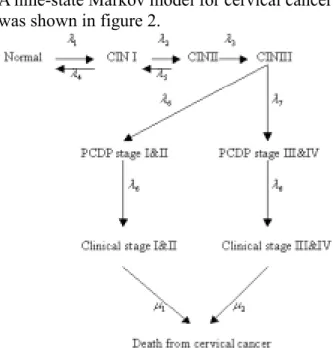
A nine-state Markov model for cervical cancer was shown in figure 2.
Figure 2 shows a nine-state Markov model for the disease natural history model and progression to death in relation to cervix of carcinoma. The regressions from CIN I to normal or CINII to CIN I are taken into account in this model. It should be noted that HPV is added into the model by the use of the proportional hazard model that model HPV as function of transition parameters.
(3) Prostate Cancer
(A) The alternative screening regimes
We are going to compare the efficacy or effectiveness among a variety of screening regimes including no screening and serum prostate-specific antigen screening.
(B) Develop the disease natural history model: A six-state Markov model for prostate cancer was shown in figure 3.
Figure 3 A six-state Markov model for prostate cancer.
3. Collect and estimate the parameters in the Markov decision analysis model based on empirical data
To implement the Markov decision analysis, the parameters are listed below:
(1) Invitation rate, attendance rate, and compliance rate
In order to calculate the proportion of people who actually received the screening and confirmed, invitation rate, attendance rate, and compliance rate to referral of comfirmation are all needed. Take breast cancer screening as an example, about 200,000 women are invited each year and 180,000 attend. The invitational coverage is very close to 100% and the
attendance rate is varying between 88%-90%. (2) Sensitivity and specificity of screening tools The effectiveness of a screening is highly depends on the sensitivity and specificity of the screening tools. These parameter also are needed.
(3) Estimate transition parameters and death rate based on empirical data
(A) Intensity matrix
To estimate transition parameters in Figures 2,4,6,9, and 12, these parameters can be written by the use of transition matrix.
Take a four-state model for example, the transition matrix, Q, is expressed as:
− − − = 0 0 0 0 0 0 0 0 0 0 4 3 2 1 4 3 2 1 3 3 2 2 1 1
λ
λ
λ
λ
λ
λ
Death Clinical PCDP Normal Q (B) Transition probabilitiesEach transition matrix has its transition probabilities. The derivation of transition probabilities (P(t)) follows forward
Kolomogorov equation that is expressed as: 1 ) exp( ) (t = A⋅ d ⋅A− P
A is eigenvector of Q, exp(d) represents exponential of diagonal matix of eigenvalue of Q. The details of technique follows Chen et al (2000).
(C) Data and Likelihood (a) Data resources:
Data for estimating transition parameters are derived from Finnish population-based cancer screening data. These include breast cancer screening, cervical cancer screening and
prostate cancer screening. Both the invitations and screening visits are recorded in the
nation-wide mass screening registry on an individual basis. Mass screening registry can be linked with the cancer incidence and mortality records. We expect to have therefore powerful tools in assessing developments in the
effectiveness of these screening programs. Information collected from these three data is described as follows.
(i) Breast Cancer:
Variables for estimating transition parameters include county, date of birth, date of screen, detection mode of screen (prevalent screen cases, subsequent screen cases, interval cancers, refuser cases and the control group), age at diagnosis of BC, nodal involvement, tumour size, histological type and date of death. Variables for assessing the impact of
reproductive factors and menstrual factors on multi-state transition using proportional hazard model include age at menarche, age at
menopause, age at first full-term pregnancy, and number of birth.
(ii) Cervical cancer: variables for estimating transition parameters include county, date of birth, date of screen, pre-cancerous lesion states, including CIN I, CINII, and CINIII, detection mode of screen (prevalent screen cases, subsequent screen cases, interval cancers, refuser cases and the control group), age at diagnosis of cervix of neoplasm, nodal
involvement, tumour size, histological type and date of death. Information on HPV was also collected.
(iii) Prostate cancer: variables for estimating transition parameters include county, date of birth, date of screen, detection mode of screen (prevalent screen cases, subsequent screen cases, interval cancers, refuser cases and the control group), age at diagnosis of prostate cancer, nodal involvement, tumour size,
histological type and date of death. The level of PSA is also recorded to provide the basis of estimating sensitivity and specificity. (b) Likelihood function:
Transition probabilities together with data on prevalent screen, subsequent screen, interval cancer and refuser are used to from the likelihood function so as to estimate
parameters.
4. Perform Markov decision analysis by different screening regimes using the Monte Carol Computer Simulation model based on parameters in 3 and project mortality reduction due to different screening regimes
A hypothetical cohort of 10,0000 subjects with identical make-up of demographic
characteristics is simulated and relevant risk factors are assigned to each individual using random generator with uniform distribution between 0 and 1. Progression of disease for each individual is simulated to obey the corresponding transition probability
underpinning the disease natural history model using random number generator. A total of 1000 cycles are simulated to yield different states. Screening regimes by different
frequencies and age groups are incorporated to assess how the outcomes spawned by the disease natural history model are altered due to screening regimes. Evaluation of effectiveness in reducing morbidity or mortality by different screening regimes can be performed. III. Results
According to the agreement between Taiwan and Finland, one doctoral student from Taiwan, Hui-Min Wu, stayed in Finland between August 2003 and May 2004. Finnish cancer screening and prepare evaluation of effectiveness of cancer screening regimes, including breast cancer, cervical cancer, and prostate cancer. The results were described below.
(1) Analysis of Prostate Cancer Screening Regime:
In this project, as data on prostate cancer screening project were available the benefit of early detection in terms of cumulative survival has been quantified. The detailed description are as follows.
Backgroud—Before the formal interim analysis for the efficacy of PSA screening, making comparison of survival between screen- detected and clinical detected prostate cancer cases is an alternative choice. But the
comparison is subject to various biases including lead-time bias, length-bias,
overdetection, and so on. In 1987, Walter and Stitt developed a method to deal with these
issues; however, they modeled survival time as an exponential distribution which assumes constant hazard. Here we develop another method by using Markov model to adjust lead time bias, and model survival as a Weibull distribution which allows hazard function to change over time, and making comparison of the survival between screen-detected and clinically-detected cancer cases adjusted for lead-time bias.
Study Aims—The study aims are to develop another lead-time adjustment method which employ Weibull distribution to model survival by using Markov model, to compare the survival between screen-detected and clinically-detected cancer, and to investigate the impact of lead-time bias on prostate cancer survival.
Patients and Methods—Patients were obtained from Finnish prostate cancer screening trial between 1996 and 2002 and were followed since diagnosis until death, migration, or until end of 2002. Cancers from refusers were excluded from the study. Cause-specific
survival and Cox’s regression model were used to compare the survival between
screen-detected and clinically-detected cases. A three-state Markov model including preclinical stage, clinical stage, and prostate cancer death, was constructed to describe the observed survival for screen-detected cases. We assumed that the transition rate from preclinical stage to clinical stage is constant, which is denoted as λ1, and the survival time from clinical stage to prostate cancer death follows Weibull
distribution with hazards 1 20 2( )=λ γ γ−
λ t t ,
where λ20 and γ are the scale and shape parameters of Weibull distribution, respectively. Then the corrected survival adjusted for
lead-time bias can be calculated by S(t)= −
∫
t s ds 0 2( ) exp λ .Results—There were 1,135 prostate cancer cases derived from intervention arm and 615 cases derived from control arm in 1996 to 2002. The average follow-up time was 3.02
(±1.90)ar. The estimated mean lead-time for screen-detected cancers is 11.3 (10.5-12.1) years, and the estimates for scale and shape
parameters in Weibull distribution are 0.0085 and 1.5684. Before lead-time adjustment, the 7-year cumulative survival for screen-detected and clinically-detected prostate cancer cases are 0.97 and 0.79, and the hazard ratio is 0.13 (0.07-0.24) comparing screen-detected cancers with clinically-detected cancers. However, the 7-year cumulative survival decreases to 0.84 and hazard ratio inflates to 0.73 (0.49-1.09) after lead-time adjustment.
Summary—The results show that lead-time bias plays an important role on prostate cancer survival when comparing screen-detected cases with clinically-detected cases. Further
adjustments for overdetection and length-bias are needed and are under way.
(2) Breast Cancer Screening in Finland: The Mass Screening Registry, which is part of the Finnish Cancer Registry, is
responsible for both nationwide breast cancer screening and cervical cancer screening. However, the data linkages between database of Mass Screening Registry, Finnish Cancer Registry, and Population Registry have not been routinely done for breast cancer screening. Therefore, information on interval cancers was not available while this project started at the inception of this project. Moreover, data linkage of mass screening Registry with Finnish Cancer Registry a population Registry should be approved on the ground of ethics. Mass Screening Registry had to apply for the permission of data linkage from Finnish Cancer Registry and Population Registry. This process took several months.
The individual data of mass screening on breast cancer from Pirkanmaa Center were available during this project. However, the data from Turku Center has not been available by the end of this project. Data from Pirkanmaa Center cover the invitations between 1988 and 2000, and the target population was mainly women who aged 50-59 years (including some women aged 60-64 years). The format of the data set are described in table 1. Preliminary analysis have done, however, more analyses are needed after this project.
(C) Cervical Cancer Screening in Finland The nation-wide population-based
started gradually from 1963 onwards, however, most of the screening records were stored as documentations. Therefore, only tabular data were available, including cervical cancers diagnosed in each year and number of women by calendar year, also included data from literatures published in the previous study. The above data can be used for estimation of
transition rates using three-state model. Interval cancers can be only imputed by five-year regular interval. The refuser can only be
imputed with approximate attendance rate from the previous study. Further detailed information including data on interval cancers and
attendants, and individual data on pre-invasive lesions, are needed in order to build up a comprehensive natural history model. In conclusion, bilateral cooperation projects has been feasibly demonstrated by exchanging PhD student who has actively participated in cancer screening project in Finland. The comparison of cumulative survival between screen-detected cases and clinically-detected cases for prostate cancer screening project has been made. Preparation of data on breast cancer screening and cervical cancer screening has been implemented. Future analysis on two screening regimes should be
done.
IV. Reference
Auvinen A, Tammela T, Stenman UH, Uusi-Erkkilä I, Leinonen J, Schröder, Hakama M. Screening for prostate cancer using serum prostate-specific antigen: a randomized, population-based pilot study in Finland. Br J Cancer 1996;74:568-72.
Hakama M, Chamberlain J, Day NE, Miller AB, Prorok PC. Evaluation of screening programmes for gynaecological cancer. Br J Cancer 1985; 52: 669-73.
Hakama M, Elovainio L, Kajantie R, Louhivuori K. Breast cancer screening as public health policy in Finland. Br J Cancer 1991;64:962-4.
Hakama M, Pukkala E, Heikkilä M, Kallio M. Effectiveness of the public health policy for breast cancer screening in Finland: population based cohort study. Br Med J 1997;314:864-7.
Määttänen L,Auvinen A, Stenman UH, Tammela T, Rannikko S, Aro J, Juusela H, Hakama M. Three-year results of the Finnish prostate cancer screening trial. J Natl Cancer Int 2001;93:552-3.
Table 1 Format of the individual data of mass screening on breast cancer from Pirkanmaa Center between 1988 and 2000.
No. of
participant Screening history BC/FCR Follow-up “by” → age 8 times
Including year and month of invitation, (pathology (ICD-O), PTNM, stage, size in mammo histo.) → only for screen- detected cancer
Obtain from Cancer Registry Including malignancy (in situ or invasive…), histology (stage, TN only, incomplete), death
Information about death and immigration…