Yue-Jheng Lin, Yi Chiu, Hsi-Fu Shih, and Jin-Chern Chiou, Member, IEEE
Abstract—A small-form-factor (SFF) blue-light optical pickup head (OPH) with holographic optical element (HOE) has been fabricated and assembled. The assembly and alignment of various components in the pickup head were facilitated by using a flip chip bonder. Experimental results indicated that the focusing error signal (FES) of the assembled OPH with the wavelength of 405 nm could be successfully detected. The linear range of the FES was about than 4 m. The gauge repeatability and reproducibility (GR&R) of the assembly process was tested and found to be acceptable.
Index Terms—Blu-ray, gauge repeatability and reproducibility (GR&R), holographic optical element, optical pickup head, small-form-factor (SFF), virtual image method.
I. INTRODUCTION
I
N recent years, small-form-factor (SFF) and high recording capacity is the basic requirement for the information-tech-nology products. A major concern in the optical pickup head (OPH) today is to continuously reduce the form factor and in-crease the recording density. Previous studies, such as [1]–[9], indicated that the size of OPH was determined by the light path and could be reduced by using micro optical elements. Shih [10], [11] designed a novel SFF OPH but did not implement the device. Our previous studies [12], [13] successfully realized Shih’s design with a red laser. Nevertheless, blue laser is used in the Blu-ray format in the next-generation optical storage toManuscript received July 19, 2011; revised October 10, 2011; accepted November 12, 2011. Date of publication November 30, 2011; date of current version January 11, 2012. This work was supported in part by the Ministry of Economic Affairs, Taiwan, under Contract 98-EC-17-A-07-S1-011, by the National Science Council, Taiwan, under Contract 100-2220-E-009-032, 100-2220-E-009-019, by Taiwan Department of Health Clinical Trial and Research Center of Excellence under Contract DOH99-TD-B-111-004 and Contract DOH99-TD-C-111-005, by the UST-UCSD International Center of Excellence in Advanced Bio-Engineering sponsored by the Taiwan National Science Council I-RiCE Program under Grant NSC-99-2911-I-009-101, and by “Aim for the Top University Plan” of the National Chiao Tung University and Ministry of Education, Taiwan.
Y.-J. Lin and Y. Chiu are with the Department of Electrical Engineering, National Chiao Tung University, Hsinchu 300, Taiwan (e-mail: [email protected]. edu.tw; [email protected]).
H.-F. Shih is with the Department of Mechanical Engineering, National Chung Hsin University, Taichung 402, Taiwan (e-mail: [email protected]).
J.-C. Chiou is with the Department of Electrical Engineering, National Chiao Tung University, Hsinchu 300, Taiwan, and also with China Medical School of Medicine, China Medical University, Taichung 402, Taiwan (e-mail: [email protected]).
Color versions of one or more of the figures in this paper are available online at http://ieeexplore.ieee.org.
Digital Object Identifier 10.1109/JLT.2011.2177639
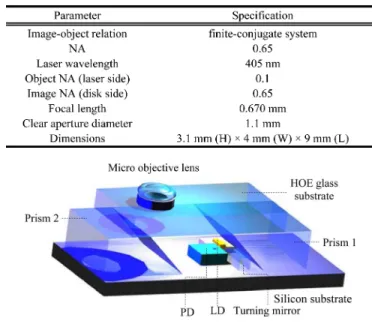
TABLE I SPECIFICATION OF THEOPH
Fig. 1. OPH system.
increase the recording density. Therefore this paper reports the fabrication and verification of a SFF OPH in the 405 nm wave-length based on the design in [11].
The specification of the current SFF OPH is listed in Table I. Compared to the red OPH in [12], [13], the objective lens was redesigned in the blue wavelength. In addition, the dimensions of the OPH were adjusted according to the chip size of available blue laser diodes. The OPH was assembled by using a flip chip bonder. To ensure the accuracy and precision of the assembly process for mass production, the gauge repeatability and repro-ducibility (GR&R) was tested and found to be acceptable.
II. FABRICATION OFINTEGRATEDOPTICALPICKUPHEAD
Fig. 1 shows the schematic of the OPH. The optical power source is a P-side-up edge-emitting laser diode (LD) with a wavelength of 405 nm. A quad photodetector (PD) (see Fig. 2) is used to detect the reflected data and servo signals. The size of the PD segments is 50 50 m and the spacing between segments is 5 m. The specification of the PD is shown in Table II. A 45 micro turning mirror and two 45 prisms are used to reflect and fold the optical path for a compact optical design. The holo-graphic optical element (HOE) (Fig. 3) plays a key role to reduce the complexity and dimensions of the OPH module. When the
Fig. 2. Quad photodetector.
Fig. 3. Structure of HOE.
Fig. 4. (a) Incident beam from LD. (b) Reflected beam from disk.
Fig. 5. Optical path of OPH.
TABLE II
SPECIFICATION OFPHOTODETECTOR
incident light passes through the HOE, the zeroth-order beam is focused on the disk by the micro objective lens to detect the signal [Fig. 4(a)]. In the return path, the first-order beam is dif-fracted by 7.5 and incident on the PD [Fig. 4(b)]. Therefore the
Fig. 6. Fabrication process of the OPH.
Fig. 7. Virtual image method for the optical path alignment.
PD and LD can be separated by a small displacement to keep the optical system compact. The optical path is shown in Fig. 5.
The simplified assembly process of the OPH is shown in Fig. 6 and described as follows. A flip-chip bonder was used to place and align the optical components. 1) The LD, PD and micro turning mirror were assembled onto the silicon substrate. 2) Prism 1 and Prism 2 were attached on the silicon substrate. The prisms and mirrors all had anti-reflection coating for 405 nm. 3) The HOE was first fabricated on a 0.7-mm Corning E2K glass substrate which had a transmission of 92% at 405 nm to reduce the absorption loss. The glass substrate was then bonded upon the two prisms. The virtual image method [14] was used to align the optical path by observing the virtual image of the first-order diffracted laser spot overlapped with the image of PD at the angle of diffraction (7.5 ) (see Fig. 7). The position of the HOE was adjusted to compensate for the alignment and assembly errors until the first-order light was in the center of PD. Fig. 8 shows the overlapped images before
Fig. 8. Adjusting the HOE position to compensate for the alignment error. (a) Before alignment. (b) After alignment.
Fig. 9. Virtual images in various focal conditions.
Fig. 10. Micro lens accurately aligned with the diffracted optical beams and bonded on the surface of HOE.
and after adjusting the HOE. This method can be used to compensate for the assembly error if the initial laser spot is within 200 m from the center of PD. Fig. 9 shows the virtual astigmatic images of the correctly aligned spot in various focus conditions. 4) Finally, the micro lens was bonded on the surface of the HOE glass substrate with the laser spots aligned to the center of the lens (see Fig. 10).
III. EXPERIMENTALRESULT
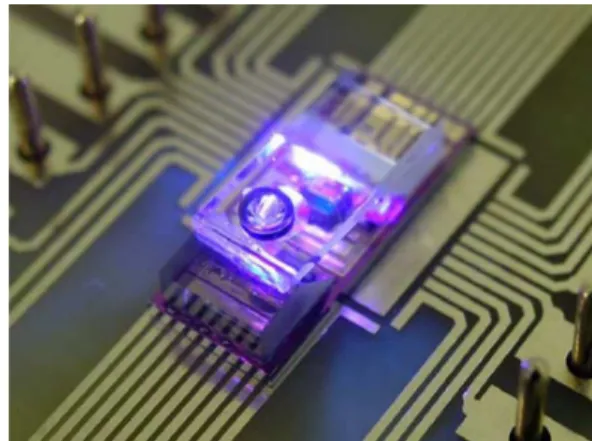
The final assembled blue-light OPH with holographic optical element is shown in Fig. 11. The dimensions of the complete OPH are 3.1 mm (H) 4 mm (W) 9 mm (L). The OPH uses the HOE to split the return beam from the incident beam to re-duce the dimensions of the module. The measured diffraction ef-ficiency of the zeroth- and first-order beams is 66% and 9%, re-spectively. The efficiency of the diffraction orders are designed
Fig. 11. Assembled SFF blue-light OPH with HOE.
Fig. 12. FES (S-curve) measurement platform.
to maximize the reflected optical power on the PD. In the ex-periments, the minimum power of the 405-nm laser diode was about 10 mW in order to have enough signal-to-noise ratio in the detected signal. The fabrication errors of the HOE affect the signal power and diffraction angle. From the simulation, the signal power reduction caused by the error in grating depth and linewidth can be compensated for by increasing the amplifier gain if the error is within 10% of the design values. The error in the grating period causes erroneous diffraction angle. It is esti-mated that a 2% period error causes a shift of the laser spot on the PD by about 13 m, which can be recovered by adjusting the position of the HOE, as shown in Fig. 8.
Fig. 12 is a platform used to measure the focus error signal (FES) (S-curve). It has a voice coil motor (VCM) and a signal processing and amplification board. The VCM was driven by a 5-Hz sine signal with amplitude of 140 mV. A micro mirror was attached to the VCM to reflect focused light of the OPH back into the quad PD to measure the S-curve by calculating the FES as . The measured S-curve is shown in Fig. 13. The linear range of the FES is about 4 m. The S-curve in Fig. 13 is not entirely symmetric due to a tiny shift of the re-flected laser spot with respect to the center of PD. If an automatic pick-and-place bonding system with accurate robotic arms and
TABLE III GR&R MEASUREMENT
Fig. 13. Measured S-curve.
active alignment and tracking control system is available to as-semble the optical module, the reduction of assembly and align-ment errors and improvealign-ment of the S-curve symmetry can be expected. Nevertheless, the optical design and fabrication pro-cesses of the blue SFF OPH have been verified experimentally in this work.
To further investigate the quality and stability of the assembly processes of the OPH, a methodology was developed to mea-sure the alignment errors of the assembled components in the module. The flip chip bonder used to assemble the module has a swing arm and a translation stage. The objects on the arm and the stage can be viewed simultaneously by using a beam splitter, as shown in Fig. 14. A reference pattern with keys showing the ideal positions of components can be designed so that the ac-tual assembled module can be compared with the reference pat-tern in this apparatus to measure the assembly error. In Fig. 14, for example, the component Chip 1 in the assembled module is
Fig. 14. Measuring the alignment error using the flip chip bonder.
compared to the corresponding Key 1 in the reference pattern. The assembly errors in both directions can thus be measured from the mismatch of the overlapped images. Table III shows the detailed measurement data of the assembly error of a test component. Ten samples were given to three operators; each sample was measured three times according to standard oper-ation procedures (SOP). The mean of the measurement and range can be calculated as shown in Table III. From and , the equipment variation (“Repeatability”) is 6.365 m and the operator variation (“Reproducibility”) is 1.407 m based on three operators and three trials. For a 20 m tolerance for this particular component, the percentage GR&R is 16.3%, which is acceptable from the mass production viewpoint. Therefore, by using the systematic assembly processes, we have verified the functionality of the SFF OPH and demonstrated the robustness of the fabrication and assembly processes.
signal. The linear range of the S-curve was about 4 m. The robustness of the assembly process was tested; the percentage gauge repeatability and reproducibility was 16.3%, which was acceptable for mass production. This work can be applied to the batch fabrication of SFF OPH using MEMS techniques [15] to reduce cost and enhance yield and reliability in the next-generation optical storage systems.
ACKNOWLEDGMENT
The authors would like to thank Topray Technology, Inc., C.-A. Chen, Y.-T. Wu, C.-C. Lee, T.-C. Liu, Y.-P. Lin for tech-nical support, inspiring discussion and generous support of this work.
REFERENCES
[1] S. Ura, T. Suhara, H. Nishihara, and J. Koyama, “An integrated-optic disk pickup device,” J. Lightw. Technol., vol. 4, no. 7, pp. 913–918, Jul. 1986.
[2] T. Shiono and H. Ogawa, “Planar-optic-disk pickup with diffractive micro-optics,” Appl. Opt., vol. 33, pp. 7350–7355, 1994.
[3] L.-Y. Lin, J.-L. Shen, S.-S. Lee, and M.-C. Wu, “Realization of novel monolithic free-space optical disk pickup heads by surface microma-chining,” Opt. Lett., vol. 21, pp. 155–157, 1996.
[4] Y.-C. Chang, C.-M. Wang, and J.-Y. Chang, “Silicon-based transmis-sive diffractive optical element,” Opt. Exp., vol. 28, pp. 1260–1262, 2003.
[5] J.-Y. Chang, C.-M. Wang, C.-C. Lee, H.-F. Shih, and M.-L. Wu, “Real-ization of free-space optical pickup head with stacked Si-based phase elements,” IEEE Photon. Technol. Lett., vol. 17, no. 1, pp. 214–216, Jan. 2005.
[6] D.-L. Blankenbeckler, B.-W. Bell, Jr., K. Ramadurai, and R.-L. Ma-hajan, “Recent advancements in dataplay’s small form-factor optical disc and drive,” Jpn. J. Appl. Phys., vol. 45, pp. 1181–1186, 2006. [7] J.-S. Sohn, S.-H. Lee, M.-S. Jung, T.-S. Song, N.-C. Park, and Y.-P.
Park, “Design of an integrated optical pickup with NA of 0.85 for small form factor optical disk drives,” Microsyst. Technol., vol. 11, pp. 457–463, 2005.
[8] K.-S. Jung, H.-M. Kim, S.-J. Lee, N.-C. Park, S.-I. Kang, and Y.-P. Park, “Design of optical path of pickup for small form factor optical disk drive,” Microsyst. Technol., vol. 11, pp. 1041–1047, 2005. [9] S.-M. Kang, J.-E. Lee, W.-C. Kim, N.-C. Park, Y.-P. Park, E.-H. Cho,
J.-S. Sohn, and S.-D. Suh, “Development of integrated small-form factor optical pickup with Blu-ray disc specification,” Jpn. J. Appl. Phys., vol. 45, pp. 6723–6729, 2006.
[10] H.-F. Shih, C.-L. Chang, K.-J. Lee, and C.-S. Chang, “Design of op-tical head with holographic opop-tical element for small form factor drive systems,” IEEE Trans. Magn., vol. 41, no. 2, pp. 1058–1060, Feb. 2005. [11] H.-F. Shih, Y.-C. Lee, Y. Chiu, D. W.-C. Chao, G.-D. Lin, C.-S. Lu, and J.-C. Chiou, “Micro objective lens with NA 0.65 for the blue-light small-form-factor optical pickup head,” Opt. Exp., vol. 16, pp. 13150–13157, 2008.
Tseng, and W. Fang, “Design and fabrication of a small-form-factor optical pickup head,” IEEE Trans. Magn., vol. 45, no. 5, pp. 2194–2197, May 2009.
Yue-Jheng Lin received the B.S. degree in material engineering from National
Taipei University of Technology, Taiwan, in 2005, and the M.S. degree in electro-mechanical science from Tamkang University, Taiwan, in 2007.
He is currently a Research Assistant in the Micro System Control Lab-oratory at the Department of Electrical Engineering, National Chiao-Tung University, Hsinchu, Taiwan. His research interests are in the areas of MEMS, optical system, bioelectronics, brain-machine interface system and biomedical engineering.
Yi Chiu received the B.S. degree in electrical engineering from National Taiwan
University, Taipei, in 1988, and the M.S. and Ph.D. degrees in electrical and computer engineering from Carnegie Mellon University, Pittsburgh, PA, in 1991 and 1996, respectively.
He is currently an Associate Professor in the Department of Electrical Engi-neering, National Chiao Tung University, Taiwan. His research interests include optical data storage, electro-optics, micro-optics, optical MEMS, and power MEMS.
Hsi-Fu Shih received the B.S. degree from the Physics Department, National
Taiwan University, Taipei, in 1988, and the M.S. and Ph.D. degrees from the Institute of Optical Science at National Central University, Taoyuan County, Taiwan, in 1994 and 1999, respectively.
He started his career with the Opto-Electronics & Systems Laboratories of the Industrial Technology Research Institute, Taiwan, working on optical pickup head development for more than seven years. He joined the faculty in 2001 and now serves as a Professor in the Department of Mechanical Engineering at Na-tional ChungHsing University. In recent years, his research interests cover the technologies of optical information storage, micro-opto-electro-mechanical sys-tems, and optical devices.
Jin-Chern Chiou (M’07) received the M.S. and Ph.D. degrees in aerospace
en-gineering science from the University of Colorado, Boulder, in 1986 and 1990, respectively.
Before joining Department of Electrical Engineering, National Chiao Tung University, Taiwan, in 1992, he worked at the Center for Space Structure and Control, University of Colorado as a Research Associate. Currently, he is the Professor of the Department of Electrical Engineering, National Chiao Tung University, the director of Biomedical Engineering Research and Development Center of China Medical University and the program leader of National Program on Nano Technology. He coauthored advanced reference books on CD-ROM system technology and Mechanics and Control of Large Flexible Structures. He also possesses 18 U.S. patents (8 pending), and 12 R.O.C. patents (5 pending). His research interests include micro-electro-mechanical systems (MEMS), bio-sensors, servo control, and modeling and control of multi-body dynamic systems (MBD).
Dr. Chiou received awards from Acer Foundation, Y. Z. Hsu Foundation, Taiwan Information Storage Association (TISA), NCTU, National Science Council, Taiwan and Chinese Institute of Engineers (Distinguished Engineering Professor Award) for his outstanding MEMS and bio-technology research.