General method to solution-process multilayer polymer light-emitting diodes
Shin-Rong Tseng, Shi-Chang Lin, Hsin-Fei Meng, Hua-Hsien Liao, Chi-Hung Yeh, Huan-Chung Lai, Sheng-Fu Horng, and Chain-Shu Hsu
Citation: Applied Physics Letters 88, 163501 (2006); doi: 10.1063/1.2192574
View online: http://dx.doi.org/10.1063/1.2192574
View Table of Contents: http://scitation.aip.org/content/aip/journal/apl/88/16?ver=pdfcov Published by the AIP Publishing
Articles you may be interested in
Solution-processed conjugated polymer organic p - i - n light-emitting diodes with high built-in potential by solution- and solid-state doping
Appl. Phys. Lett. 95, 213303 (2009); 10.1063/1.3257979
High-efficiency blue multilayer polymer light-emitting diode based on poly(9,9-dioctylfluorene) J. Appl. Phys. 101, 084510 (2007); 10.1063/1.2721830
Improved performances of organic light-emitting diodes with metal oxide as anode buffer J. Appl. Phys. 101, 026105 (2007); 10.1063/1.2430511
High-efficiency light-emitting diodes using neutral surfactants and aluminum cathode Appl. Phys. Lett. 86, 083504 (2005); 10.1063/1.1865327
Color-tunable multilayer light-emitting diodes based on conjugated polymers Appl. Phys. Lett. 84, 1195 (2004); 10.1063/1.1645983
This article is copyrighted as indicated in the article. Reuse of AIP content is subject to the terms at: http://scitation.aip.org/termsconditions. Downloaded to IP: 140.113.38.11 On: Thu, 01 May 2014 02:03:35
General method to solution-process multilayer polymer
light-emitting diodes
Shin-Rong Tseng, Shi-Chang Lin, and Hsin-Fei Menga兲
Institute of Physics, National Chiao Tung University, Hsinchu 300, Taiwan, Republic of China Hua-Hsien Liao, Chi-Hung Yeh, Huan-Chung Lai, and Sheng-Fu Horng Department of Electric Engineering, National Tsing Hua University, Hsinchu 300, Taiwan, Republic of China
Chain-Shu Hsu
Department of Applied Chemistry, National Chiao Tung University, Hsinchu 300, Taiwan, Republic of China
共Received 31 August 2005; accepted 13 March 2006; published online 17 April 2006兲
An intermediate liquid buffer layer is introduced to overcome the dissolution problem of solution-processed multilayer conjugated polymer light-emitting diodes. This method can be applied to arbitrary combinations of polymers with no restriction on solvents. As an example, a hole-blocking layer is successfully spin coated on the common p-type emissive polymer layers. One green- and two blue-emitting polymers are chosen as the emissive layers. The electron-hole balance and efficiency are significantly improved by the addition of hole-blocking layer. The electroluminescence efficiency can be increased up to nine times, while the luminance up to seven times. In particular, 1.5 cd/ A is obtained for deep blue emission from poly共9,9-dioctyl-fluorene兲 with 1,3,5-tris共N-phenylbenzimidazol-2-yl兲benzene spin coated as the hole-blocking material. © 2006 American Institute of Physics.关DOI:10.1063/1.2192574兴
Recently organic light-emitting diodes 共OLED兲 have been demonstrated to reach nearly 100% internal quantum efficiency by employing triplet emitters and multilayer structures,1,2 which usually include emissive, carrier trans-port, and carrier blocking layers. In general, a multilayer structure is required in order to balance the electron and hole currents. Although there have been impressive improvements in the carrier balance of polymer light-emitting diodes 共PLED兲 by molecular design,3,4
the efficiency is still far be-low OLEDs. The main reason for this problem is that the solution process itself causes dissolution between spin-coated or ink-jetted polymer layers.5–8 This unfortunately means that the advantage of separating different functions such as charge injection, charge transport, and light emission into different layers cannot be used to improve PLED effi-ciency. Some efforts have been devoted to fabricate multilayer PLEDs by developing new materials such as cross-linkable polymers9 and water/methanol-soluble copolymers.10 But these methods are only restricted to spe-cific polymers combined with spespe-cific solvents. Until now, there is no general and reliable method to fabricate arbitrary all-solution-processed multilayer PLED. In this letter, we re-port a new liquid buffer layer共BL兲 method which success-fully prevents the dissolution between solution-processed polymer layers and completely removes the material and sol-vent restrictions.
The material of the BL must be a viscous nondissolvent liquid with relatively low boiling point. The viscosity is di-rectly related to the protection capability. Before depositing the next polymer layer over an existing soluble polymer sur-face, the BL is first spin coated. The next layer is then spun on top of the liquid surface of the BL. Because the viscosity
of the BL is much higher than the usual solvent, the next layer will initially float over the BL instead of mixing with it. The polymer underneath is therefore protected by the BL against the solvent of the next layer. During the spinning most of the solvent of the next layer and part of the liquid BL are evaporated, resulting in a double-layer structure with possibly some residue of the BL in between. The residual BL is removed in the following baking in vacuum. Therefore, besides the high viscosity, low boiling point and small mol-ecule weight of BL are also important for easy removal by baking. If the boiling point is much higher than the poly-mer’s melting temperature, the required high baking tem-perature could damage the emissive polymer. The protection capability of many kinds of BL materials against various typical solvents such as xylene, toluene, and chloroform are studied as follows. Figure 1共a兲 shows the steps. First, a poly-mer layer 1共L1兲 is spin coated on the substrate and baked in
a兲Author to whom correspondence should be addressed; electronic mail:
FIG. 1. 共a兲 Test of BL protection capability by pure solvent. The viscous buffer layer and solvent are consecutively spin coated on layer 1共A and B兲. Baking共C兲 moves both liquids. 共b兲 Double-layer fabrication flow using BL. 共A兲 The liquid BL is spin coated on L1, 共B兲 L2 is quickly spin on the liquid BL, and共C兲 BL is removed by baking the device in vacuum.
APPLIED PHYSICS LETTERS 88, 163501共2006兲
0003-6951/2006/88共16兲/163501/3/$23.00 88, 163501-1 © 2006 American Institute of Physics
This article is copyrighted as indicated in the article. Reuse of AIP content is subject to the terms at: http://scitation.aip.org/termsconditions. Downloaded to IP: 140.113.38.11 On: Thu, 01 May 2014 02:03:35
vacuum at 120 ° C for 40 min. After spinning the BL on L1, we spin the pure solvent on the liquid surface immediately. The temporary layer structure is substrate/L1/BL/solvent. Af-ter the evaporation of solvent and BL in air, we compare the L1 film thickness before and after the BL/solvent process. BL protection capability can be measured as the smallness of L1 thickness reduction. LUMATION*BP105 from the Dow Chemical Company light-emitting polymer共LEP兲 is chosen to be the test L1 material due to its high solubility in all common solvents. The dissolution for any other polymer un-der the same situation can only be less than BP105. The film thicknesses are measured by a Kosaka ET4000 surface pro-filer. Table I summarizes the results. Due to the high viscos-ity derived from hydrogen bonding, glycerol and 1,2-propylene glycol both have excellent protection capability. Even for the strong solvents such as chloroform, they can perfectly protect L1 from the dissolution. On the contrary, n-octane has poor viscosity and the protection capability is not so good. Interestingly 1,2-propylene glycol combines the unique properties of high viscosity at 0 ° C 共248/ mPa s兲 and low boiling point 共188 °C兲, which are crucial for the protection and subsequent removal of BL as stated above. Because the viscosity of 1,2-propylene glycol decreases with temperature dramatically, it is applied as buffer before cool-ing to 0 ° C.
The next step is to see whether the next polymer layer L2 can be spin coated on L1 using the BL method. Below 1,2-propylene glycol is always used as the BL and BP105 is chosen to be both L1 and L2. The process flow is shown in Fig. 1共b兲. Ideally the final total thickness is the sum of the thicknesses of L1 and L2 as they are individually spin coated on the substrate. Under the protection of the BL, the thick-ness difference between the double layer and the sum of L1 and L2 is less than 7 nm. The BL is therefore proved suc-cessful to fabricate a polymer multilayer structure without dissolution. Obviously this can be applied to arbitrary L1 and L2 in any solvent. Using this new method it becomes pos-sible to make many kinds of multilayer PLEDs, which in-clude not only poly- 共3,4–ethylenedioxythiophene兲:poly-共styrenesulfonate兲 共PEDOT:PSS兲 hole-transport layer 共HTL兲, and emission layer 共EML兲 but also other functional layers such as hole-blocking layer 共HBL兲, electron-blocking layer 共EBL兲, as well as electron transport layer 共ETL兲 in order to optimize device efficiency.
Below we demonstrate some multilayer PLEDs with im-proved efficiency using this buffer layer method. Many emis-sive conjugated polymers are p type, and the hole mobility is two or three orders larger than electron mobility. We there-fore consider the device structure indium tin oxide 共ITO兲/ PEDOT:PSS/EML/HBL/cathode to block the hole current
and improve the device efficiency. Three typical p-type poly-mers are used as EML, including poly共9,9-dioctyl-fluorene兲 共PFO, EA/IP=3/5.8 eV兲 共purchased from American Dye Source兲, poly关共9,9-dioctylfluorenyl-2,7-diyl兲-co-共4,4
⬘
- 共N-共4-sec-butylphenyl兲兲diphenylamine兲兴 共TFB,EA/IP⫽2.3/5.3 eV兲 共purchased from American Dye Source兲, and poly关共2-共4-共3, 7-dimethyloctoxy兲phenyl兲-3-phenyl-1,4-phenylenevinylene兲-co-共2,5-dimethoxy-1,4-phenylenevinylene兲兴 共DPOC10-DOMe-PPV, EA/ IP= 3.2/ 5.6 eV兲 共synthesized in our labora-tory兲. EA and IP are electron affinity and ionization potential respectively. For HBL, we choose 1,3,5–tris共N-phenyl-benzimidazol-2–yl兲 benzene 共TPBI, EA/IP⫽2.7/6.7 eV兲 with good electron transport characteristic and large IP to block holes. With the unusually large IP, TPBI is commonly used as the HBL in OLEDs by evaporation.11The structure of the device without HBL is glass/ ITO/ PEDOT:PSS/ EML/ LiF / Ca/ Al, and the baking condition of EML is 180 ° C for TFB and 120 ° C for the other EML for 40 min in vacuum. The structure of the device with HBL is glass/ITO/ PEDOT:PSS/EML/HBL/LiF/Ca/Al, and the baking conditionFIG. 2. The performances of DPOC10-DOMe-PPV LED共solid circle兲 and DPOC10-DOMe-PPV/TPBI LED共open circle兲. The chemical structure of DPOC10-DOMe-PPV is shown.
TABLE I. The BL protection capability test. The test flow is shown in Fig. 1共a兲. The viscosity and boiling point of each BL material are shown. Although the viscosity of 1,2-propylene glycol is low at room temperature, it increases rapidly when cooled down to 0 ° C. Glycerol has good protection capability as 1,2-propylene glycol, but its high boiling point is unfavorable for removal by baking.
Layer 1 thickness共nm兲a 200 200 180 106 103共PFO兲
Buffer materialb B1 B2 B3 No buffer B3
Boiling point共°C兲 290 188 128 ¯ 128
Viscosity共/ mPa s兲 934共25 °C兲 248共0 °C兲 0.508共25 °C兲 ¯ 0.508共25 °C兲
Solventc A B C A B C A B C A A
Final thickness共nm兲 200 200 200 200 200 200 60 60 70 20 22
aL1 is BP105 except the last column.
bB1: glycerol, B2: 1,2-propylene glycol, and B3: n-octane. cA: xylene, B: toluene, and C: chloroform.
163501-2 Tseng et al. Appl. Phys. Lett. 88, 163501共2006兲
This article is copyrighted as indicated in the article. Reuse of AIP content is subject to the terms at: http://scitation.aip.org/termsconditions. Downloaded to IP: 140.113.38.11 On: Thu, 01 May 2014 02:03:35
of EML is the same as the devices without HBL. After the HBL is spin coated on the EML using BL method, the de-vices are baked in vacuum for 60 min at 200 ° C for DPOC10-DOMe-PPV and 120 ° C for the other EML. Then the devices are coated with LiF / Ca/ Al cathodes and pack-aged in the glove box. The electroluminescence共EL兲 spectra and current-luminance-voltage 共I-L-V兲 characteristics are measured by a Photo Research PR650 spectrophotometer in-tegrated with Keithley 2400 multimeter.
The first example is green DPOC10-DOMe-PPV as EML and TPBI as HBL, both dissolved in toluene. The DPOC10-DOMe-PPV thickness is 120 nm without TPBI and 80 nm with TPBI共30 nm兲. The maximum luminance is in-creased from 6367 to 14820 cd/ m2, which is shown in Fig.
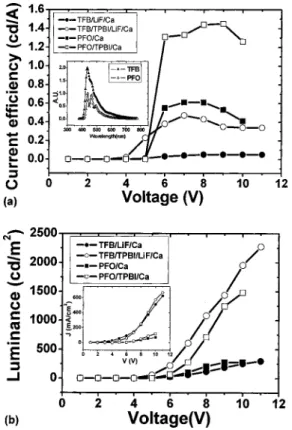
2. The device efficiency is enhanced from 3.89 to 6.11 cd/ A. For blue polymers, the I-L-V curves of PFO PLED with and without TPBI HBL are shown in Fig. 3. Both PFO and TPBI are dissolved in toluene. The PFO thick-ness is 130 nm without TPBI and 60 nm with TPBI共45 nm兲. The maximum luminance is again significantly improved from 278 to 1483 cd/ m2, and the current does not become
smaller. The current efficiency is enhanced from 0.61 to 1.45 cd/ A. It is the highest record in the literature for unfiltered PFO.10,12,13An even more dramatic case is TFB, also shown in Fig. 3. TFB is dissolved in xylene and TPBI is dissolved in chloroform. The TFB thickness is 86 nm and the TPBI thickness is 35 nm. The maximum luminance is
en-hanced from 298 to 2271 cd/ m2, and the current efficiency from 0.05 to 0.47 cd/ A. The general feature of all the de-vices is that the HBL significantly improves the efficiency and luminance while the current remains about the same. The turn-on voltage is also remarkably reduced for all devices with HBL. The lifetime and uniformity of the bilayer devices are not degraded relative to the single-layer ones, indicating complete removal of the buffer liquid by annealing. The above results not only open the possibility of all-solution-processed multilayer PLEDs through buffer layer method but also show that the LED thus made indeed significantly ex-ceeds the conventional single-layer device for three typical green and blue emissive polymers. This method is very easy to apply and does not involve any process other than spin coating and baking. There is no need to design and synthe-size new functional materials. One can simply choose the combinations of existing materials with desired properties as long as they can be dissolved in some solvent.
In conclusion we develop a buffer layer method to fab-ricate all-solution-processed multilayer polymer devices and use this method to improve the efficiency of PLED as an example. To serve as a buffer layer, the material must be a nondissolvent liquid with high viscosity in order to protect the underneath layer. On the other hand it must have low boiling point and small molecular weight for easy removal by baking. 1,2-propylene glycol appears to be the best choice. This method can be applied to not only multilayer PLEDs but also other solution-process multilayer polymer devices such as solar cells which also need multilayer struc-ture to increase the efficiency.
This work is supported by the National Science Council of the Republic of China and the Excellence Project of the ROC Ministry of Education.
1C. Adachi, M. A. Baldo, S. R. Forrest, and M. E. Thompson, Appl. Phys.
Lett. 77, 904共2000兲.
2M. Ikai, S. Tokito, Y. Sakamoto, T. Suzuki, and Y. Taga, Appl. Phys. Lett.
79, 156共1996兲.
3X. Gong, W. Ma, J. C. Ostrowski, G. C. Bazan, D. Moses, and A. J.
Heeger, Adv. Mater.共Weinheim, Ger.兲 16, 615 共2004兲.
4W. Sotoyama, T. Satoh, N. Sawatari, and H. Inoue, Appl. Phys. Lett. 86,
153505共2005兲.
5S. R. Forrest, Nature共London兲 428, 911 共2004兲.
6C. C. Huang, H. F. Meng, G. K. Ho, C. H. Chen, C. S. Hsu, J. H. Huang,
S. F. Horng, B. X. Chen, and L. C. Chen, Appl. Phys. Lett. 84, 1195 共2004兲.
7Z. L. Li, H. F. Meng, S. F. Horng, C. S. Hsu, L. C. Chen, and S. M. Chang,
Appl. Phys. Lett. 84, 4944共2004兲.
8G. K. Ho, H. F. Meng, S. C. Lin, S. F. Horng, C. S. Hsu, L. C. Chen, and
S. M. Chang, Appl. Phys. Lett. 8, 4576共2004兲.
9Z. Liang and O. M. Cabarcos, Adv. Mater. 共Weinheim, Ger.兲 16, 823
共2004兲.
10W. Ma, P. K. Iyer, X. Gong, B. Liu, D. Moses, G. C. Bazan, and A. J.
Heeger, Adv. Mater.共Weinheim, Ger.兲 17, 274 共2005兲.
11T. D. Anthopoulos, J. P. J. Markham, E. B. Namdas, I. D. W. Samuel, S. C.
Lo, and P. L. Burn, Appl. Phys. Lett. 82, 4824共2003兲.
12K. H. Weinfurtner, H. Fujikawa, S. Tokito, and Y. Taga, Appl. Phys. Lett.
76, 2502共2000兲.
13D. Neher, Adv. Mater.共Weinheim, Ger.兲 22, 1022 共2001兲.
FIG. 3. The performances of PFO LED共solid circle兲, PFO/TPBI LED 共open square兲, TFB LED 共solid circle兲, and TFB/TPBI LED 共open circle兲. The EL spectra are normalized to 2 for TFB device共solid traingle兲 and 1 for PFO 共open triangle兲 for clarity.
163501-3 Tseng et al. Appl. Phys. Lett. 88, 163501共2006兲
This article is copyrighted as indicated in the article. Reuse of AIP content is subject to the terms at: http://scitation.aip.org/termsconditions. Downloaded to IP: 140.113.38.11 On: Thu, 01 May 2014 02:03:35