A Heteroscedastic Hazards Regression Model with Cure
Fraction
Hong-Dar Isaac Wu,
School of Public Health, China Medical College,
91 Hsueh-Shih Rd., Taichung 40443, Taiwan.
e-mail: [email protected]
and
Chen-Hsin Chen,
Institute of Statistical Science, Academia Sinica,
Taipei 11529, Taiwan.
e-mail: [email protected]
Oct. 30, 2001
A Heteroscedastic Hazards Regression Model with Cure
Fraction
Report
Under the framework of heteroscedastic hazards regression (HHR) model (Hsieh, 2001; Wu, Hsieh, and Wu, 2001), we consider the possibility of existence of "cure fraction", or "nonsus-ceptibility", with which a complete data full likelihood is derived as well as the associated estimating equations for three components of parameters: the expotent component, the het-eroscedasticity component, and the nonsusceptibility component.
Firstly, the complete data full likelihood can be derived as Sy and Taylor (2000);
LC(b; ¯; °; ¤0; y) = ¦n1p yi
i (1¡ pi)1¡ yi¦n1f¸i(tijY = 1; ¯; °; ¤0)g±iYie¡ yi¤i(tijY =1;¯ ;°;¤0);
where ±iis an indicator of censor-noncensored status, Yian indicator of susceptible-nonsusceptible
status, and ¸i(or ¤i) be the hazard (or cumulative hazard) function de¯ned by the HHR model:
¤ (tijZ1i; Z2i; X) = ¤0(t)exp(° Z2)exp(¯ Z1);
and, moreover, pi = P r(Y = 1jX) can be further modelled by a set of variable X as
pi =
exp(b0X)
1 + exp(b0X):
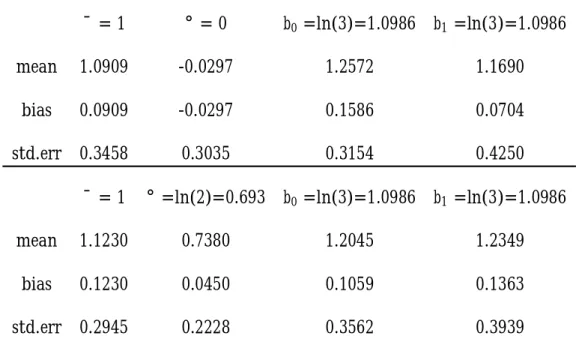
Under rather mild conditions, we derived a set of estimating equations for the parameters ¯,°, and b, along with the baseline estimate approximated by a sieve method.. However, to make our derivation applicable in practice, an EM-algorithm is needed to implement the anal-ysis of actual data. We have some satisfactory simulation results (see Table 1 below), which will be presented in more detail in our second-year project (NSC 90-2118-M-039-001-) report. Moreover, some actual data anlysis is also pursuited.
References
F. Hsieh, "On heteroscedastic hazards Regression models: theory and application," Journal of the Royal Statistical Society, Series B vol. 63 pp.63-79, 2001.
J. P. Sy and J. M. G. Taylor, "Estimation in a Cox Proportional Hazards Cure Model," Journal of the Royal Statistical Society, Series Bvol. 63 pp.63-79, 2001.
H.-D I. Wu, F. Hsieh, and C.-H. Chen, " Validation of A Heteroscedastic Hazards Regression Model," Lifetime Data Analysis, to appear.
Table 1: The expotent and heteroscedasticity components are both taken to be univariate. The logistic regression of the nonsusceptibility component is also univariate, but with intercept. Sample size=100, censoring proportion=25%, with 500 independent replications.
¯ = 1 ° = 0 b0 =ln(3)=1.0986 b1 =ln(3)=1.0986 mean 1.0909 -0.0297 1.2572 1.1690 bias 0.0909 -0.0297 0.1586 0.0704 std.err 0.3458 0.3035 0.3154 0.4250 ¯ = 1 ° =ln(2)=0.693 b0 =ln(3)=1.0986 b1 =ln(3)=1.0986 mean 1.1230 0.7380 1.2045 1.2349 bias 0.1230 0.0450 0.1059 0.1363 std.err 0.2945 0.2228 0.3562 0.3939 3