© 2003 World Scientific Publishing Company
& Institute for Advanced Research in Asian Science and Medicine
Correspondence to: Professor Chun-Ching Lin, College of Pharmacy, Kaohsiung Medical University, 100 Shih-Chuan 1st Road, Kaohsiung 807, Taiwan. Tel: (+886) 07-312-1101 (ext. 2122), Fax: (+886) 07-313-5215, E-mail: [email protected]
Anti-Herpes Simplex Virus Activity of
Bidens pilosa and Houttuynia cordata
Lien-Chai Chiang,* Jung-San Chang,† Chi-Chain Chen,†Lean-Teik Ng§ and Chun-Ching Lin‡
*Department of Microbiology, College of Medicine, †Graduate Institute of Medicine, College of Medicine and ‡Graduate Institute of Natural Products, College of Pharmacy
Kaohsiung Medical University, Kaohsiung 807, Taiwan
§Department of Food Sanitation, Tajen Institute of Technology, Ping-Tung 907, Taiwan
Abstract: The present study evaluated the antiviral activity of Bidens pilosa L. var. minor (Blume) Sherff and Houttuynia cordata Thunb., using cytotoxicity test with XTT-based colorimetric assay. BCC-1/KMC cells were infected with herpes simplex virus (HSV) and then were cultured with hot water extract of B. pilosa (HWBP) or H. cordata (HWHC). Results showed that HWBP significantly inhibited the replication of HSV at a concentration of 100 µg/ml (11.9% for HSV-1, p < 0.01; 19.2% for HSV-2, p < 0.005), whereas HWHC had the same effect at a concentration of 250 µg/ml (10.2% for HSV-1, p < 0.05; 32.9% for HSV-2, p < 0.005). The ED50 of HSV type 1 (HSV-1) and HSV type 2 (HSV-2) for HWBP
was 655.4 µg/ml and 960 µg/ml respectively, for HWHC it was 822.4 µg/ml and 362.5 µg/ml respectively. Both drugs had selective indexes above 1.04. H. cordata had better effect against HSV-2 than HSV-1, and had a low ED50 against HSV-2. We suggest that H. cordata might be
a useful medicinal plant against infection of HSV-2.
Keywords: Bidens pilosa; Houttuynia cordata; Herpes Simplex Virus.
Introduction
During the past 50 years, a great deal of interest had been initiated in screening therapeutic agents from plants. Bidens pilosa L. was widely used as a traditional remedy for treating influenza, diabetes and gastroenteritis worldwide. Houttuynia cordata Thunb. was used in traditional Chinese medicine for treating infectious disease, refractory hemoptysis, malignant pleural effusion, nephrotic syndrome (Zheng et al., 1998). Studies had shown that B. pilosa possessed antihyperglycemic (Ubillas et al., 2000), antiulcerogenic (Alvarez et al., 1999),
immunosuppressive (Pereira et al., 1999), anti-inflammatory (Pereira et al., 1999; Jager et al., 1996; Chih et al., 1995; Geissberger and Sequin, 1991), vasodilative (Dimo et al., 1998), antimalarial (Brandao et al., 1997), antibacterial (Geissberger and Sequin, 1991; Rabe and van Staden, 1997), and hepatoprotective activities (Chin et al., 1996). However, there was no previous report of antiviral activity. Also co-carcinogenesis (Mirvish et al., 1979; Mirvish et al., 1985) and photocytotoxicity (Arnason et al., 1980; Wat et al., 1979) were reported with different species of B. pilosa.
H. cordata was reported to possess antimicrobial (Zheng et al., 1998), antiviral (Zheng et al., 1998; Hayashi et al., 1995), immunostimulatory (Zheng et al., 1998), diuretic (Zheng et al., 1998), anticancer (Zheng et al., 1998), sedative (Zheng et al., 1998), anti-inflammatory (Zheng et al., 1998) and antitussive effects (Zheng et al., 1998). Although H. cordata was found to have activity against herpes simplex virus type 1 (HSV-1) (Hayashi et al., 1995), no effect against herpes simplex virus type 2 (HSV-2) was reported (Zheng et al., 1998). In searching natural crude drugs for potential anti-HSV activity, hot water extracts of whole plant of B. pilosa (HWBP) and H. cordata (HWHC) were tested.
Materials and Methods
Preparation of Tested Drugs
Hot water extracts of B. pilosa (HWBP) and H. cordata (HWHC) were prepared as follows: 100 g of dried whole plant of B. pilosa or H. cordata were added with 1000 ml reverse-osmotic water in a flask. They were boiled for 1 hour and then supernatant were collected. Three repetitions of these procedures were done. All these supernatants were mixed for filtration by a filter and for dryness in a vacuum. Dissolution and dilution of the powder with di-distilled water to concentrations of 100 µg/ml, 250 µg/ml and 500 µg/ml were done before experiments (Chang and Yeung, 1988). Acyclovir and dimethyl sulfoxide (DMSO) were purchased from Sigma Chemical Co. (USA). Acyclovir was suspended in DMSO and diluted with di-distilled water to concentrations of 0.1 µg/ml, 0.5 µg/ml and 1 µg/ml before use.
Cells
BCC-1/KMC cell line (Chiang et al., 1994) was used for viral culture and antiviral screening. Cells were cultured with RPMI 1640 medium supplemented with 10% fetal bovine serum and 1% antibiotics (10000 u/ml penicillin, 10 mg/ml streptomycin, 25 µg/ml amphotericin B; Sigma, USA) at 37°C in a humidified atmosphere containing 5% CO2.
Cytoprotective Activity Against HSV with XTT-based Colorimetric Assay
BCC-1/KMC cells, treated by trypsin, were seeded into 96-well plates with a concentration of l × 105 cells/ml and a volume of 70 µl per well. After incubation for 6 hours at 37°C with 5% CO2, 20 µl HSV-1 containing 25 TCID50 or 20 µl HSV-2 containing 20 TCID50 was
added. The mixtures were incubated for another 2 hours, followed by adding different concentrations of hot water extracts to the triplicate culture wells. DMSO was used as a negative control while acyclovir solution was used as a positive control. After incubation at 37°C with 5% CO2 for three days, a mixture of 0.l ml PMS (electron-coupling reagent) and 5 ml XTT (Sigma, USA) was added to each well in a volume of 50 µl. The trays were re-incubated for another 2 hours to allow XTT formazan production. The content of each plate was mixed and the optical density was determined with the ELISA reader (Multiskan EX, Labsystems) at 450 nm as test wavelength and 690 nm as reference wavelength.
Cytoprotection rate was calculated as (ODtv−ODcv)/(ODcd−ODcv) × 100%. ODtv represents the absorbance of the test compounds with virus-infected cells. ODcv represents the absorbance of viral control. ODcd was the absorbance of the cell control only. The antiviral dose of 50% effectiveness (ED50) was defined as the concentration which achieved 50% cytoprotection against viral infection. The concentration of 50% cytotoxicity (CC50) of normal human lymphocytes (3 × 10⁶ Cells/ml) was assayed and calculated by the above methods. The selective index was determined by the ratio of CC50 to ED50.
Statistical Analysis
Means and standard errors were calculated with the Excel software for Windows. Chi-square test with Yate’s correction was used to calculate p value between control and samples by the SPSS Base 8.0 software for Windows. Difference with p < 0.05 was considered as statistically significant.
Results
Both HWBP and HWHC showed a significant inhibitory activity against infection of HSV (Tables 1 and 2). The inhibitory effects were dose-dependent (Figs. 1 and 2). At a concentration of 100 µg/ml HWBP, 11.9% (p < 0.01) of cells were protected from infection of HSV-1 and 19.2% (p < 0.005) from infection of HSV-2 (Fig. 1 and Table 1). In the case of HWHC, at a concentration of 250 µg/ml, 10.2% (p < 0.05) of cells were protected from infection of HSV-1 and 32.9% (p < 0.005) from infection of HSV-2 (Fig. 2 and Table 2). The inhibitory effect of HWHC against HSV-2 was comparable to that of acyclovir (0.5 µg/ml) and was better than that against HSV-1.
Table 1. Cytoprotection Rates of B. pilosa Against HSV Infection HWBP (µg/ml)
Solvent Control 100 250 500 Acyclovir 0.5 HSV-1 (%) 1.52 11.92* 23.82† 39.02† 45.07
HSV-2 (%) 0.26 19.21† 26.72† 33.07† 33.29 Data represented an average of three tests.
Table 2. Cytoprotection Rates of H. cordata Against HSV Infection HWHC (µg/ml)
Solvent Control 100 250 500 Acyclovir 0.5 HSV-1 (%) 1.52 4.71 10.23* 27.6† 45.07
HSV-2 (%) 0.26 5.37 32.86† 70.96† 33.29 Data represented an average of three tests.
*p < 0.05; †p < 0.005 (chi-square test with Yate’s correction).
Figure 1. Cytoprotection rate of B. pilosa against HSV infection. Solvent was used as negative control. Acyclovir (0.5 µg/ml) was used as positive control (**p < 0.01; ***p < 0.005).
Figure 2. Cytoprotection rate of H. cordata against HSV infection. Solvent was used as negative control. Acyclovir (0.5 µg/ml) was used as positive control (*p < 0.05; ***p < 0.005).
0 10 20 30 40 50 solvent control 100 250 500 acyclovir 0.5 Concentration (µg/ml) Cytoprotection rate (%) HSV-1(%) HSV-2(%) ** *** *** *** *** *** 0 10 20 30 40 50 60 70 80 solvent control 100 250 500 acyclovir 0.5 Concentration (µg/ml) Cytoprotection rate (%) HSV-1(%) HSV-2(%) * *** *** ***
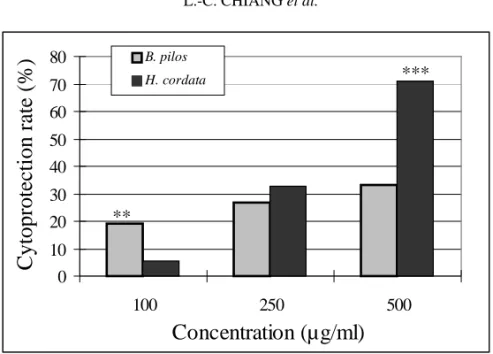
HWBP had a better effect than that of HWHC in protecting cells from infection by HSV-1 (p < 0.025, Fig. 3 and Table 3) at concentration of 250 µg/ml. The same result was also found in preventing infection from HSV-2 (p < 0.01, Fig. 4 and Table 3) at a lower concentration (100 µg/ml). However, HWBP exhibited less effect than that of HWHC in protecting cells from infection of HSV-2 (p < 0.005, Fig. 4 and Table 3) at a higher concentration (500 µg/ml). The cytoprotection rate of HWHC against infection of HSV-2 rapidly increased as the concentration rose (5.4% at a concentration of 100 µg/ml to 71.0% at a concentration of 500 µg/ml, Table 2). The ED50 of HWHC was 362.5 µg/ml (Table 4).
Table 3. Cytoprotection Rates of B. pilosa and H. cordata Against HSV Infection HWBP and HWHC (µg/ml) 100 250 500 HSV-1 (%) B. pilosa 11.92 23.82* 39.02 H. cordata 4.71 10.23 27.6 HSV-2 (%) B. pilosa 19.21† 26.72 33.07 H. cordata 5.37 32.86 70.96‡ Data represented an average of three tests.
*p < 0.025; †p < 0.01; ‡p < 0.005 (chi-square test with Yate’s correction).
Figure 3. Comparison of cytoprotection rate between B. pilosa and H. cordata against HSV-1 infection. B. pilosa had better effect than that of H. cordata at a concentration of 250 µg/ml (*p < 0.025). There was no difference between other concentrations (p > 0.05).
0 10 20 30 40 50 100 250 500
Concentration (µg/ml)
Cytoprotection rate (%)
B. pilosa H. cordata*
Discussion
Much effort had been made to search for new antiviral therapeutic agents during the past 50 years. This had led to numerous studies of medicinal plants for clinical applications (Carter and Livingston, 1976; Marsoni and Wittes, 1984). B. pilosa and H. cordata had been widely used in the traditional medicine of different ethnic groups in the world. H. cordata was reported to have activity against HSV-1 (Hayashi et al.,1995), but not HSV-2 (Zheng et al., 1998). In this study, we demonstrated that both HWBP and HWHC possessed antiviral activity and the activity was dose-dependent (Figs. 1 and 2). In contrast to the findings of Zheng et al. (1998), H. cordata did have activity against HSV-1 and HSV-2. The activity against HSV-2 was better than that against HSV-1 (Fig. 2 and Table 2).
The ED50 of B. pilosa and that of H. cordata were much higher than ED50 of acyclovir (Table 4). We still believed that both plants had value for clinical application. Several reasons could explain the higher ED50 of B. pilosa and H. cordata. The first, concentration of active
Table 4. Antiviral Activity of B. pilosa and H. cordata
B. pilosa H. cordata Acyclovir
ED50 (µg/ml) SI ED50 (µg/ml) SI ED50 (µg/ml) SI
HSV-1 655.44 >1.53 822.39 >1.22 0.61 17.26
HSV-2 960 >1.04 362.46 >2.76 0.81 12.9 ED50: Concentration of 50% cytoprotection.
SI: Selective index = CC50/ED50.
CC50: Concentration of 50% cytotoxicity. CC50 of B. pilosa and H. cordata were > 1000 µg/ml. CC50 of acyclovir was 10.44 µg/ml.
Figure 4. Comparison of cytoprotection rate between B. pilosa and H. cordata against HSV-2 infection. The effect of H. cordata had rapidly increased when drug concentration rose (**p < 0.01; ***p < 0.005).
0 10 20 30 40 50 60 70 80 100 250 500
Concentration (µg/ml)
Cytoprotection rate (%)
B. pilos H. cordata ** ***compounds of the plant materials might be too low or active components might be reduced during extraction. The second, they might become more active after transformation in vivo (Marsoni and Wittes, 1984; Double, 1992). Therefore, purification of the effective components from these crude drugs might be necessary.
High CC50 (>1000 µg/ml) of HWBP and HWHC indicated a good tolerability by human cells. It will be possible to use these plants against infection of HSV in the future (Table 4). According to our results, it is worthy to study B. pilosa and H. cordata further. The fractionation, separation of active components and clarification of their mechanism of action are currently under investigation.
Conclusion
Hot water extracts of B. pilosa and H. cordata showed activity against HSV. The present study has demonstrated the potential clinical implication of B. pilosa and H. cordata. Hence, they are worthy of further investigation.
References
Alvarez, A., F. Pomar, M.A. Sevilla and M.J. Montero. Gastric antisecretory and antiulcer activities of an ethanolic extract of Bidens pilosa L. var. radiata Schult. Bip. J. Ethnopharmacol. 67: 333–340, 1999.
Arnason, T., C.K. Wat, K. Downum, E. Yamamoto, E. Graham and G.H. Towers. Photosensitization of Escherichia coli and Saccharomyces cerevisiae by phenylheptatriyne from Bidens pilosa.
Can. J. Microbiol. 26: 698–705, 1980.
Brandão, M.G.L., A.U. Krettli, L.S.R. Soares, C.G.C. Nery and H.C. Marinuzzi. Antimalarial activity of extracts and fractions from Bidens and other Bidens species (Asteraceae) correlated with the presence of acetylene and flavonoid compounds. J. Ethnopharmacol. 57: 131–138, 1997. Carter, S.K. and R.B. Livingston. Plant products in cancer chemotherapy. Cancer Treat. Rep.
60: 1141–1156, 1976.
Chang, R.S. and H.W. Yeung. Inhibition of growth of human immuno-deficiency virus in vitro by crude extracts of Chinese medical herbs. Antiviral Res. 9: 163–175, 1988.
Chiang, L.C, W. Chiang, H.S. Yu, H.M. Sheu and H.Y. Chen. Establishment and characterization of continuous human basal cell carcinoma cell line from facial skin. (I) Cytological behavior of early passages. Kaohsiung J. Med. Sci. 4: 170–176, 1994.
Chih, H.W., C.C. Lin and K.S. Tang. Anti-inflammatory activity of Taiwan folk medicine “ham-hong-chho” in rats. Am. J. Chin. Med. 23: 273–278, 1995.
Chin, H.W., C.C. Lin and K.S. Tang. Hepatoprotective effects of Taiwan folk medicine ham-hong-chho in rats. Am. J. Chin. Med. 24: 231–240, 1996.
Dimo, T., S. Rakotonirina, R. Kamgang, P.V. Tan, A. Kamanyi and M. Bopelet. Effects of leaf aqueous extract of Bidens pilosa (Asteraceae) KCl- and norepinephrine-induced contractions of rat aorta.
J. Ethnopharmacol. 60: 179–182, 1998.
Double, J.A. Selectivity and potency: are we doing the right things to find anti-cancer agents with these properties? Br. J. Cancer 65: 143–144, 1992.
Geissberger, P. and U. Sequin. Constituents of Bidens pilosa L.: do the components found should explain the use of this plant in traditional medicine? Acta Trop. 48: 251–261, 1991.
Hayashi, K., M. Kamiya and T. Hayashi. Virucidal effects of the steam distillate from Houttuynai
cordata and its components on HSV-I, influenza virus and HIV. Planta Med. 61: 237–241,
1995.
Jager, A.K., A. Hutchings and J. van Staden. Screening of Zulu medicinal plants for prostaglandin-synthesis inhibitors. J. Ethnopharmacol. 52: 95–100, 1996.
Marsoni, S. and R. Wittes. Clinical development of anticancer agents — a National Cancer Institute perspective. Cancer Treat. Rep. 68: 77–84, 1984.
Mirvish, S.S., E.F. Rose and D.M. Sutherland. Studies on the esophagus. II. Enhancement of [H3]
thymidine incorporation in the rat esophagus by Bidens pilosa (a plant in South Africa) and by croton oil. Cancer Lett. 6: 159– 165, 1979.
Mirvish, S.S., S. Salmasi, T.A. Lawson, P. Pour and D. Sutherland. Test of catechol, tannic acid,
Bidens pilosa, croton oil, and phorbol for cocarcinogenesis of esophageal tumors induced by
methyl-n-amylnitrosamine. J. Natl. Cancer Inst. 74: 1283– 1290, 1985.
Pereira, R.L.C., T. Ibrahim, L. Lucchetti, A.J.R. da Silva and V.L.G. de Moraes. Immunosuppressive and anti-inflammatory effects of methanolic extract and the polyacetylene isolated from Bidens
pilosa L. Immuno-pharmacology 43: 31–37, 1999.
Rabe, T. and J. van Staden. Antibacterial activity of South African plants used for medicinal purposes.
J. Ethnopharmacol. 56: 81–87, 1997.
Ubillas, R.P., C.D. Mendez, S.D. Jolad, J. Luo, S.R. King, T.J. Carlson and D.M. Fort. Antihyperglycemic acetylenic glucosides from Bidens pilosa. Planta Med. 66: 82–83, 2000. Wat, C.K., R.K. Biswas, E.A. Graham, L. Bohm, G.H. Towers and E.R. Waygood. Ultraviolet-mediated
cytotoxic activity of phenylheptatriyne from Bidens pilosa L. J. Nat. Prod. 42: 103–111, 1979. Zheng, H.Z., Z.H. Dong and J. She (eds.). Houttuynia cordata. In: Modern Study of Traditional