I-Shou University
Master Thesis
Relationships among Motivation, Perception and
Re-Visitation Intention for Domestic Tourists: The Case of
Heritage Sites in Hanoi, Vietnam
Advisor:
Dr. Jiin-Ling Lin
Co-Advisor: Dr. Nguyen Quang Vinh
Graduate Student:
Tang Thi Ngoc Mai
Acknowledgements
This thesis is the result of nearly one year that I thought about tourism and heritage tourism in Hanoi- where I was born and grew up and more than one month. I did research, wrote and edited with the assistance of professors, family and friends. No one is a lonely island and I have many appreciations that I want to say.
Firstly, I would like to express my great appreciation to Dr. Jiin Ling Lin, my advisor, for her guidance and support during the process of completing my thesis. Her instruction during the Master course provides me with many precious and useful experiences as well as practical lessons about how to do a scientific research. She has read the draft of my thesis and gives me many comments and suggestions for completing my thesis. Besides, she is also my close friend who inspires me to overcome many difficulties in my life. This thesis cannot be finished without her assistance.
Secondly, I would like to send my sincere gratitude to Dr. Nguyen QuangVinh, my co-advisor, for his knowledges which he offers to me as well as his support during my study. Special thanks to him because he always gives me wise consultancy and suggestions for my thesis topic relating to tourism in general and heritage tourism in particular. Many thanks for always reminding me to accelerate the tempo of finishing my thesis and the assistance in using English when writing my thesis.
I also really appreciate Dr. Yang, Dr. Chang and all the Vietnamese professors for their kind help during my study. The knowledges which they give me is not only the basis of research process but also precious property for my life in the future.
My deep gratitude is extended to my family and all students in my class, who always stand by me, encourage me and support me during my study. They play an important part in my heart. Without their physical and material support, I won’t be able to finish my Master course with the best result.
ii
Abstract
In a busy and modern society, people always tent to be nostalgic and experience ancient values. That is the reason why heritage tourism attracts a lot of concerns from tourism scholars in the world. Regarding to Vietnam in general and Hanoi in particular, total number of domestic tourists who traveling heritage sites are always higher than international tourists. This study attempts to examine the relationships among motivation, perception and re-visitation intention for domestic tourists who traveling to Hanoi heritage sites and also try to find out motivation factors which effect on tourists’ perception. Data were collected from ten heritage sites between May and June 2015 with 150 usable questionnaires obtained from the survey. The findings show that both push and pull motivations have effect on tourists’ perception and pull motivations have more effect than perception than push motivations. Besides, there are also relationships among motivation, perception and re-visitation intention. In general, these findings aligned with the previous researches. The results of this study also express that the factor that attracts domestic tourists most is the heritage core attraction. It will be suggestion for destination marketing organizations (DMO) so that they can make a long-term plan for the development of heritage tourism in Hanoi. Implications and suggestions for further study are also provided at the end of this study.
Keywords: Motivation, push and pull motivations, perception, re-visitation intention, heritage sites, domestic tourists.
Table of contents
Acknowledgements ... i
Abstract ... ii
List of Tables ... vi
List of Figures ... vii
Chapter 1.INTRODUCTION ... 1
1.1. Reseach Background ... 1
1.2. Overview of Hanoi Heritage Tourism ... 2
1.3. Research Objectives ... 4
1.4. Research Questions ... 4
1.5. Reseach Scope ... 5
1.6. Research Contributions ... 5
1.6.1. Theoretical contributions: ... 5 1.6.2. Practical contributions: ... 6Chapter 2.LITERATURE REVIEW ... 7
2.1. Heritage tourism ... 7
2.1.2. Type of heritage tourisms ... 10
2.1.3. Who are “heritage tourists”? ... 11
iv
2.2. Theory of Motivation ... 13
2.2.1. Introduction ... 13
2.2.2. Definition of motivation ... 13
2.2.3. Definition of Travel Motivation ... 15
2.3. The relationship between Motivation and Perception ... 19
2.3.1. Theory of Perception ... 19
2.3.2. The relationship between Motivation and Perception ... 22
2.4. The relationshop between Perception and Re-Visitation Intention ... 22
Chapter 3 METHODOLOGY ... 24
3.1. Research Design ... 24
3.2. Instrument Design ... 25
3.3. Sample Design ... 26
3.4. Data Collection: ... 27
3.5. Measures: ... 27
3.6. Data analysis: ... 28
Chapter 4. RESULTS AND DISCUSSION ... 30
4.1. Descriptive Analysis ... 30
4.1.1. Respondents’ Demographic Characteristics ... 30
4.1.2. Descriptive Statistic for Variables ... 33
4.3. Regression Analysis ... 37
4.3.1. Hypotheisis ... 37
4.3.2. Regression Analysis Results ... 37
4.4. Analysis of Variance (ANOVA) and T-test ... 41
4.4.1. Hypothesis ... 41
4.4.2. Results of T- test and Anova ... 41
Chapter 5 CONCLUSION AND SUGGESTION ... 43
5.1. Research Summary ... 43
5.1.1. Research Process ... 43
5.1.2. Discussion of Research Results ... 44
5.2. Theoretical and Practical Implications ... 46
5.2.1 Theoretical Implications ... 46
5.2.3 Practical Implications ... 47
5.3. Research Limitations ... 48
5.4. Suggestions for Future Research ... 49
References ... 50
vi
List of Tables
Table 1: Maslow’s hierarchy of human need and tourist needs (Sutithee Guha, 2009) ... 16
Table 2: Respondents’ profile ... 31
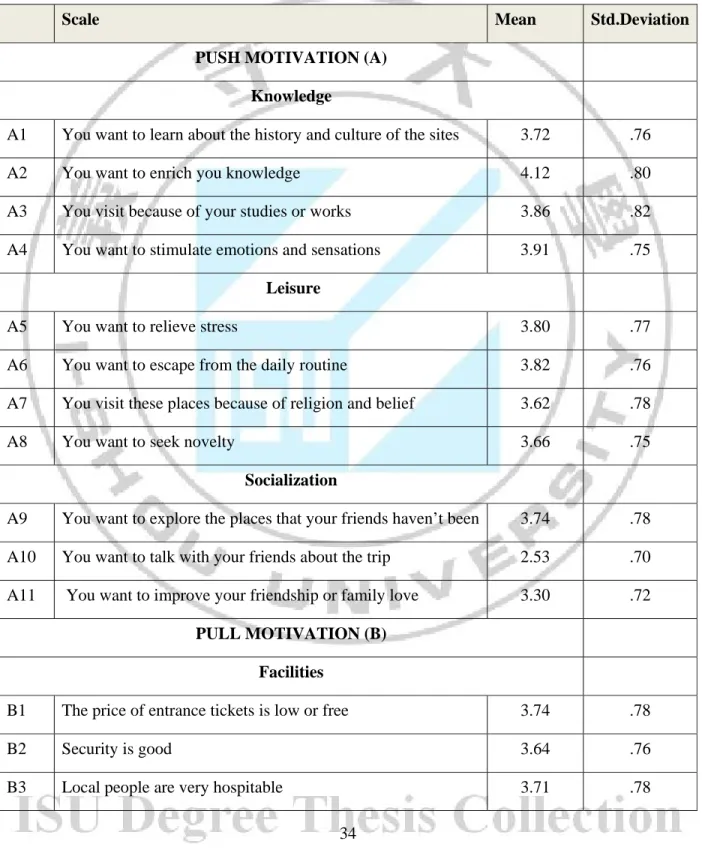
Table 3: Mean and Std.Deviation ... 34
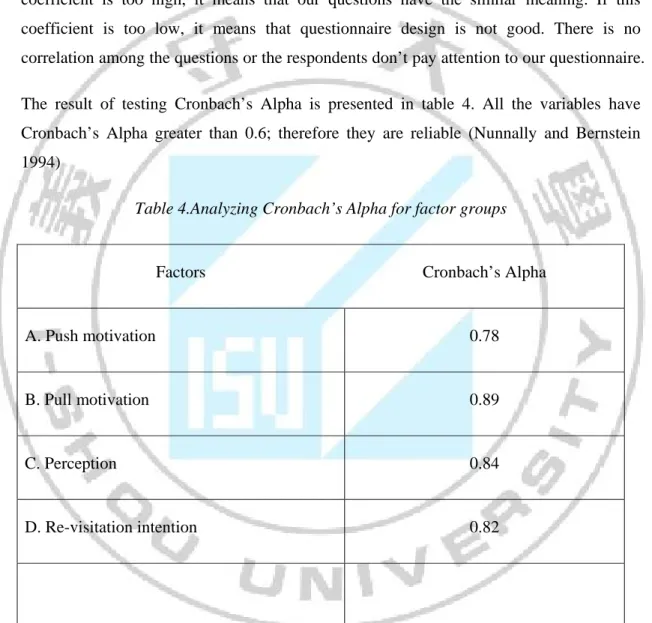
Table 4.Analyzing Cronbach’s Alpha for factor groups ... 36
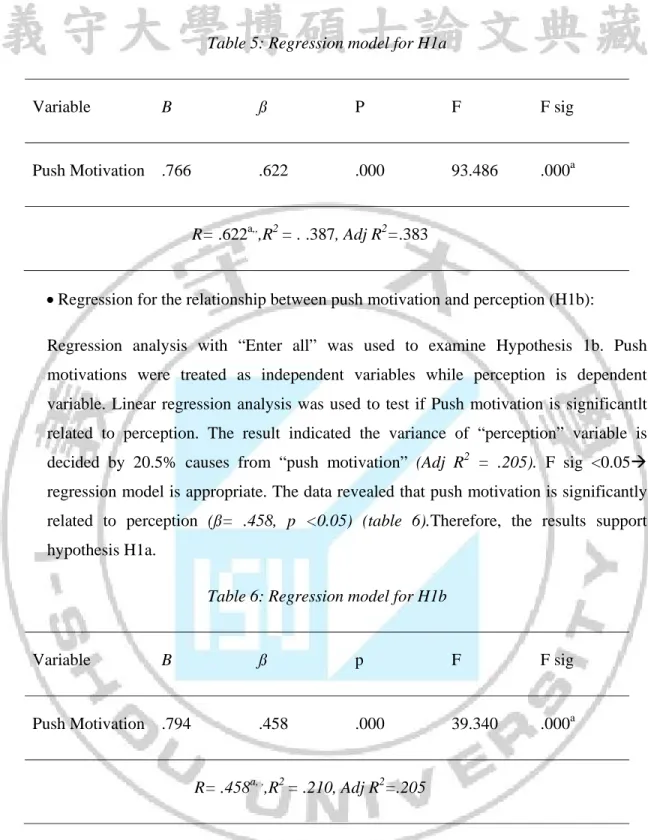
Table 5: Regression model for H1a ... 38
Table 6: Regression model for H1b ... 38
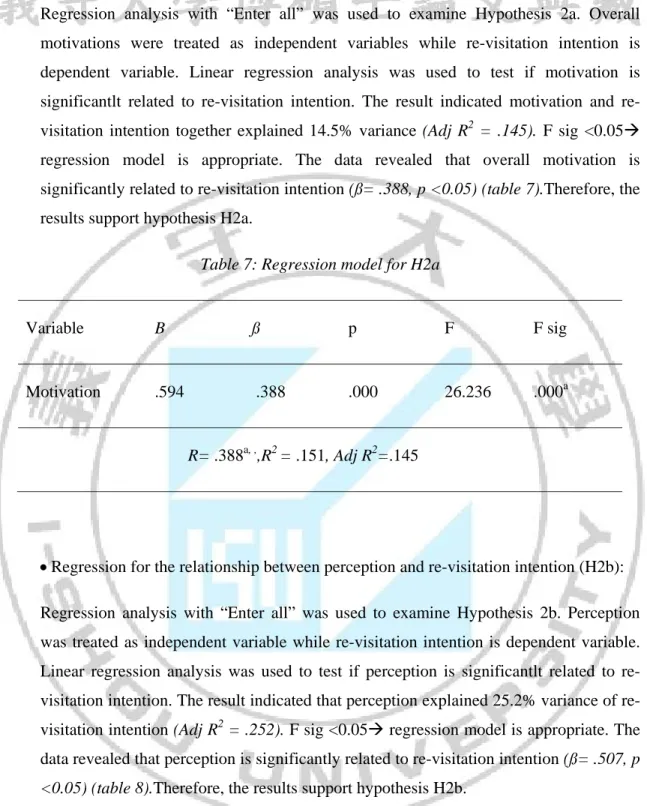
Table 7: Regression model for H2a ... 39
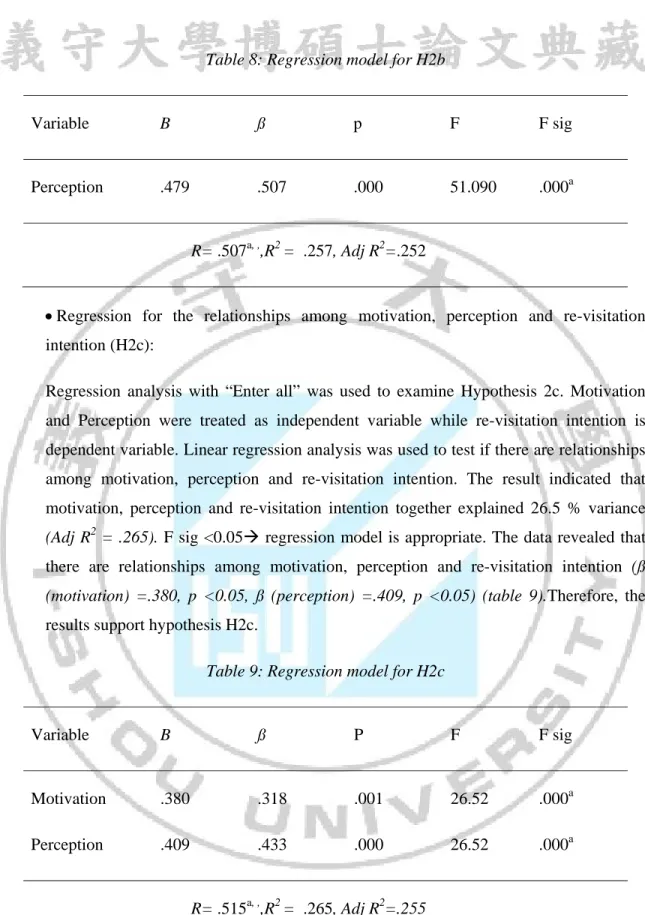
Table 8: Regression model for H2b ... 40
Table 9: Regression model for H2c ... 40
Table 10: T- test for gender and re-visitation intention ... 42
Table 11: One way Anova between demographic and re-visitation intention ... 42
Table 12:Result of regression ananlysis for whole research ... 45
List of Figures
Figure1. Maslow’s Need Hierarchy ... 14 Figure 2.Path from motivation to action (Heckhausen, 1980) ... 15 Figure 3. Research Framework ... 24
Chapter 1.INTRODUCTION
1.1. Reseach Background
Tourism is one of the biggest industries in the world. The World tourism and Travel Council (WTTC) estimates that 12% of the world total GNP is generated by tourism industry (Arthur Pedersen, 2002. Managing Tourism at World Heritage sites). When hearing the world “tourism”, most of us immediately think of recreation and relaxation trips. Rarely do we think of “tourism” as an important part of a country. Tourism is now a vital smokeless industry of most countries. It creates thousands of employment opportunities and property values for a country. The development of tourism not only improves the life quality of people but also is the national pride in the world.
From the end of 1990s, traveling taste has been gradually changed. Tourists’ destination choices have gone beyond three traditional S: Sea, Sand and Sun (Boyd, 2002). Tourists tend to be nostalgic. They want to explore the traditional values in the past. Historic attraction leads to the appearance of niche tourism market which is heritage tourism. Actually, travelling to cultural and natural sites has been existed for a long time, at least from the ancient Greek period with the invention of seven natural wonders of the world. In 1972, 157 nations ratified the conventions to preserve cultural and natural heritage sites of the world and 582 heritage sites are ranked in the list of world heritage sites. According to the UNESCO's Director General F. Mayor (1999), these heritage sites contain enormous potential with big attraction to the tourists as well as play a vital role in tourism industry. Although there are no official statistics, ranking a site in the heritage list coincides with rapid growth rate of tourists visiting there. World Tourism Organization (UNWTO) estimated that 37% of travel tours is traveling to heritage sites such as museums, monuments, nature reserves etc.
Heritage tourism is one of the fastest growth segments in tourism industry. Many countries in the world take available advantages of heritage sites to strongly develop heritage tourism. One of the countries which is successful in enhancing this type of tourism is the USA. Heritage tourism is backbone of national tourism industry. As reported by The National Trust for Historic Preservation, visiting activities to historic sites, museums are popular activities which ranks 3rd after daily shopping and outdoor activities in this country. Travel Industry Association of America (TIA) estimated that 81% of 146.4
million adults in the USA is heritage tourists (based on their participation in at least one in fifteen heritage events and activities).
With its importance, there no surprise that heritage tourism becomes major topic of many studies about tourism worldwide. There are some researches on heritage tourism’s characteristics, success principles of heritage tourism such as: “Heritage tourism overview” (Jascha M. Zeitlin and Steven W. Burr 2011), some other studies are about heritage site management for example: “Heritage sites management” (Poria, Reichel and Biran 2006). Although researches are done on different aspects, motivation and perception are key factors to be discussed. To know more about tourist behavior, we need to get better understanding of tourists’ motivation and perception. That is one critical way to know how to attract more tourists to visit as well as promote potential economic benefits of those heritage sites. Besides, to keep the tourists re-visiting the heritage sites is also get much attention from many researchers and managers. If the tourists are not willing to re-visit, it means that those heritage sites are not attractive and it can reduce some economic benefit of those heritage sites. Domestic heritage tourists always account for the larger percentage than international tourists according to the statistics of Vietnam National Administration of Tourism and some Vietnamese tourism articles (2015). Besides, with patriotism and national pride, domestic tourists are often attracted by the heritage sites in their country. Overall, doing research on motivation, perception and re-visitation intention of the tourists also can provide some information for government and heritage managers to think better tourists’ management in order to design better solutions for the protention of precious treasure conservation of humanity.
1.2. Overview of Hanoi Heritage Tourism
Being blessed with many natural resources and possessing rich historical tradition, Vietnam has a great potential to develop smokeless industry. With 16 heritage sites is ranked in the list of world heritage by UNESCO, more than 40.000 various cultural and natural sites, Vietnam looks at exploring heritage values as a major objective in tourism strategy.
Being the capital of Vietnam as well as the biggest socio-economic and culture center in the North, Hanoi has been attractive destination of domestic and foreign tourists by ancient
beauty and graciousness. Whoever lives in Vietnam or comes to Vietnam for the first time want to visit Hanoi because they desire to experience unique cultural and historic values of thousand year culture land. Thanks to geographical location and being the antique dynamic capital which has been gone 1000 years and witnessed all the ups and downs of Vietnam history, Hanoi preserves many historic and cultural sites. For the diversity of heritage sites in Hanoi, Journalist Truong Quoc Binh said that: “More than 1915 historical cultural sites and beauty spots are scientific inventory in Hanoi, 518 sites are ranked as national heritage sites.” Heritage sites in Hanoi attract many tourists because of their distinctive features which help tourist distinguish Hanoi from other places.
Despite Hanoi has potential opportunity to develop heritage tourism, Hanoi still lacks attractive tourism products. Hanoi Heritage Tourism has only focused on few nature factors, exploited available resources without more reinvestment. Whenever referring to Hanoi tourism, people immediately only refer to Ho Chi Minh monument, the Temple of Literature. Those sites were built thousand years ago and now are preserved and exploited for tourism. Government or heritage tourism managers just upgrade and renovate those sites with limited capital. The travel tours connecting different or far heritage sites and some tourism services such as interpretation, cuisine or souvenirs are not got much concern. Because of these reasons, the number of revisiting tourists is still lower than expectation. Moreover, tourists’ expense on traveling to heritage sites in Hanoi is not high and they don’t stay long there. Besides some historic sites are preserved, many others are being destroyed by nature and human.
Along with the nonstop development of society, People’s material lives are constantly improved. It leads to the diversity of spirit lives. Over time, Hanoi people’s perception to heritage sites has many changes. They tend to look back toward the past and desire to experience traditional and historic values through visiting religious, cultural or historic sites and enjoy peaceful and quite atmosphere contrary to a busy and noisy capital. According to the annual statistics of Vietnam National Administration Tourism (2014), the annual growth rate of tourists to Hanoi is more than 10%. The number of foreign tourists reaches to 3 million people while 15.5 million arrivals is the number of domestic tourists. Domestic Arrivals are always higher than international arrivals. With background knowledge for history, patriotism in coordinate with religious beliefs, domestic tourists are potential of heritage sites. Therefore, attracting these potential tourists is one of the best strategies to gain economic benefits from heritage sites as well as promote heritage
advertisement and contribute to heritage conservation. How to attract more domestic heritage tourists and keep them stay long is not an easy question. Which motivate them to choose heritage sites in Hanoi as their destination and their perceptions to these sites are key factors in understanding the tourists’ behaviors? Due to the importance of motivation and perception factors as well as the changes in Vietnamese people’s perception to Hanoi heritage sites, the purpose of this study is do the research on the motivation, perception, and re-visitation intention to visit for domestic heritage tourists.
1.3. Research Objectives
•
To examine the relationships among motivation, perception, and re-visitation intention to visit for the domestic heritage tourists.•
To examine the differences between the types of tourists’ demographic information (genders, ages, occupations and regions) and re-visitation intention.1.4. Research Questions
•
Q1: What is the relationship between motivation and the perception of tourists whovisit Hanoi heritage sites?
Î H1a: Pull motivation is significantly related the perception of tourists who visit Hanoi
Heritage sites
Î H1b: Push motivation is significantly related the perception of tourists who visit
Hanoi heritage sites
•
Q2: What are the relationships among motivation, perception and re-visitationintention?
Î H2a: Motivation is significantly related to the re-visitation intention of tourist who
visits Hanoi heritage sites.
Î H2b: Perception is significantly related to the re-visitation intention of tourist who
Î H2c: Motivation and perception are significantly related to the re-visitation intention
of tourist who visit Hanoi heritage sites
•
Q3: Are there any difference between demographic variables (genders, ages andoccupations, regions) and re-visitation intention of tourists who visit Hanoi heritage sites?
Î H3a: There are differences between genders and re-visitation intention of tourists who
visit Hanoi heritage sites.
Î H3b: There are differences between ages and re-visitation intention of tourists who
visit Hanoi heritage sites.
Î H3c: There are differences between occupations and re-visitation intention of tourists
who visit Hanoi heritage sites.
Î H3d: There are differences between regions and re-visitation intention of tourists who
visit Hanoi heritage sites.
1.5. Reseach Scope
This research is conducted in Hanoi heritage sites. All Vietnamese tourists, who visit Hanoi heritage sites, are chosen to do research
.
1.6. Research Contributions
1.6.1. Theoretical contributions:
There are some studies in Vietnam about tourism; however, most of them focus on study about tourists’ satisfaction or perception. There are few researches focusing on the relationship between tourist’s behavior factors. Therefore, the research framework and result of this study will provide some literature for further research in the future.
1.6.2. Practical contributions:
The findings of this study will be the basis on which tourism managers can overcome the bad sites and make long- term tourism strategy to increase the heritage tourist’ arrivals and explore thoroughly Hanoi’s potential. It is also reference document for tourists in deciding their destination and for further tourism studies.
Chapter 2.LITERATURE REVIEW
2.1. Heritage tourism
Heritage tourism literature has been discussed for several decades. Previous articles have discussed some important themes such as the role of heritage in modern society; heritage tourism markets, heritage tourism development plans, and community’s role in heritage conservation, etc are conducted. Although there are many heritage tourism researches, building a complete and precise definition of heritage tourism is not easy. It is a major matter of arguments.
In macro level, the meaning of “heritage and culture” is formed by ethnic and social structures while in micro level, it has effect from family, school, neighbors and daily experience. Notions such as “development, education, intellectual, aesthetic training, social actualization are what “heritage” includes” (O’Leary et al, 1998).Many efforts are made in building or explaining what heritage tourism is. Information collected from many studies shows that there are three different viewpoints of heritage tourism which are discussed in those studies
:
The first approach to understand what the heritage tourism is according to the study, “Heeding the call for heritage tourism” (Nicholls, Vogt and So, 2004), it issued a general definition of heritage tourism: “Heritage tourism involves travel to sites that in some way
represent of celebrate and area, community or people’s history, identity or inheritance. Heritage attractions are typically divided into three categories: natural, cultural and built”. According to this study, heritage tourism can take place in individual sites or in
some “heritage areas” such as heritage cities, districts. The definition discussed in this study is relatively simple and general. It refers to the appearance of individual in space which has cultural and historic attractions or the sited classified into: “heritage sites”. This definition focus on heritage sites ‘attributes, explaining what heritage sites are.
Partners in Tourism, a cultural heritage based coalition of U.S. federal agencies and NGOs gave similar definition: “cultural heritage tourism is based on the mosaic of places,
traditions, art forms, celebrations and experiences that define this nation and its people, reflecting the diversity and character of the United States.” The definition given by The
experience the places and activities that authentically represent the stories and people of the past and present. It includes historic, cultural and natural attractions”.
Those definitions show the diversity of factors and approaches in term of demand and supply sides. The heritage sites need to have historic and traditional attributes which motivate tourists to visit (Garrod and Fyall, 2001). Another definition which is considered to be clearer and make the starting point for further researches on heritage tourism phenomena is provided by the National Trust for Historic Preservation: “traveling to
experience the places, artifacts and activities that authentically represents the stories and people of the past and the present” (Hargrove, 2002). Most aforesaid definitions are
formed by the first approach that focuses on the individual appearance in heritage space, as well as emphasize the attributes of those sites. In these definitions, we pay attention to a new concept that is “authenticity”. Authenticity plays an important role in this type of tourism as it “links the genuine characteristics of a site to the longing of heritage tourists
for the real past” (Hargrove, 2002).
The second approach to understand what heritage tourism is from the cognition psychology perspective which stresses on the relationship between individual and the heritage sites. This approach originated from demographics and physical environment researches which considered motivation and perception as key factors in understanding tourists’ behavior in heritage places. With this approach, some definitions are formed and mention individual involvement in places having heritage attributes as well as their perception and intention. People who are heritage tourists with their identity, tradition, experience and other social and emotion aspects perceive the heritage sites as their personal heritage. That stimulates them to choose heritage sites as their destinations to enrich their knowledge and experience in order to satisfy their own heritage need.
In “a conceptual Framework for heritage tourism”, heritage tourism defined as a “representation of tourists’ desires to directly experience cultural and traditional local sites (Byunggook Kim, 2010). Poria et al (2001) provided a definition which mainly focuses on motivation of tourists rather than heritage products. It is the difference between two first approaches. According to Poria et al (2001, p.1048): ‘Heritage tourism is a phenomenon
based on tourists’ motivations and perceptions rather than on specific site attributes. Heritage tourism is a subgroup of tourism, in which the main motivation for visiting a site
is based on the place’s heritage characteristics according to the tourists’ perception of their own heritage’.
The definitions which have existed under the second approach express that heritage tourism concept is used for describing not only the consumption of arts, monuments, folklore in other words culture heritage evidences but also the tourists’ motivation and experience that they purse at their destination. It is difficult to assess thoroughly heritage tourism phenomena because of its normal nature. As a result, Association for Leisure and Tourism Education (ATLAS) provided a dual definition of heritage tourism. The first part is conceptual definition which defined heritage tourism as “the movement of persons to
cultural attractions away from their normal place of residence, with the intention to gather new information and experiences to satisfy their cultural needs.” This consists of the
components relating to heritage tourist’s attitude, experience, feeling aspects. The second part is technical definition which considered heritage tourism as: “all movements of
persons to specific cultural attractions, such as heritage sites, artistic and cultural manifestations, arts and drama outside their normal place of residence” (1996a, p. 24).
The difference between two parts of this definition is behavioral approach, make operationalisation of heritage tourism research easier. Combine two parts of this definition will form a relatively complete definition of heritage tourism.
The third approach to understand heritage tourism is based on scholar’s research interest. This was used widely in many studies.This approach is relatively similar to the first approach when mentions to destination’s heritage attributes. Nevertheless, this approach is prone to heritage tourism’s characteristics which relating to the past and nostalgia.
According to this view, heritage tourism is defined as “a form off special tourism that
offers opportunities to portray the past in the presents” (Christou, 2005). Nuryanti (1996,
p.257) proposed that heritage tourism “is characterized by two seemingly contradictory
phenomena: the unique and the universal. Each heritage site has unique attributes; but heritage, although its meaning and significance may be contested, reinterpreted and even recreated, is shared by all”. With the same point of view, Peterson (1994, p.121)
suggested that: “we think of heritage tourism as visiting or areas, which make the visitor, think of an earlier time”. The concepts of “nostalgia” and “special form of tourism” are also approved by two scholars Zepple and Hall (1992, p.78). Accoring to them, heritage toursim is : “a broad field of speciality travel, based on nostalgia for the past and the
desire to experience diverse cultural landscapes and forms”. Ashworth and Goodall
(1990,p.162) noted that : “heritage tourism is an idea compounded of many different
emotions, including nostalgia, romanticism, aesthetic pleasure and a sense of belonging in time and space”. Another earlier but broader definition of heritage toursim was provided
by Sharpley (1993,p.132): “heritage is literally defined as what we have inherited from our
past. Over the last decade, however, it has become more broadly applied and now the term is used to describe virtually everything associated with a nation’s history, culture, wildlife and landscape”. Inheriting this approach, in 1991, Yale provided another definition: “heritage tourism is tourism centered on what we have inherited, which can mean anything from historic buildings, to art works, to beautiful scenery”.
Therefore, in conclusion, there are some explainations of heritage tourism which based on heritage sites’ attributes, heritage products, individual appearance in heritage spaces while some definitions which focused on heritage tourism’s characteristics, “inheritance” factors in heritage activities were suggested. Others use the relationship between individual and presented heritage sites, motivation and perception factors to explain what heritage tourism is. Whatever the approaches are, it’s very hard to clearly distinguish and form an extensive and complete definition of heritage tourism. Choosing which type of approaches depends on the heritage research objectives.
For heritage tourism reseach in Hanoi, the second approach which focuses on the relationship between individual and heritage spaces is prefered to use. The second approach considers heritage tourism as a group of tourists whose their main motivations are based on their perceptions to heritage attributes, in other words, phrase: “heritage tourism” represents tourists’ desire to directly experience cultural and traditional values.Therefore, using this approach will be a good choice in studing about the relationship between motivation, perception and repeat visitation intention of tourists.
2.1.2. Type of heritage tourisms
Ph. D Sarah Nicholls, Christine Vogt, and Soo Hyun Jun (2004) classified heritage tourism into five types listed as follow :
• Literary tourism: Traveling to the places relating to a great personality such as famous poet, writer, historic heroes etc.
• Legacy tourism: Visiting the sites which relating to ancestors
• Historaunts/ eatertainment: Restaurants have heritage attractions,provide not only food, beverage but also heritage experiences
• Dark tourism: Visiting places relating to death,catastrosphic, horror events and tragedy
• Industrial heritage tourism: Traveling to industrial zones which have been no longer used such as factories, old mines.
This classification maily based on destination’s attributes. However, it is not a good way to use this classification in Hanoi because of the different charateristics between Hanoi heritage sites and Western heritage sites.
For the case of Hanoi, two classifications have been used. Firstly, based on destination’s characteristics, we have four type of heritage tourisms:
• Travelling to religious heritage sites such as temples, pagodas… • Traveling to cultural and historic sites
• Traveling to heritage mansions
• Traveling to heritage sites that relating to great personality such as famous poet, historic heroes (literary tourism).
Beside afore said classification, some researchers divided heritage tourism into two types: intangible heritage tourism and tangible heritage tourism. In Hanoi, tangible heritage tourism means visiting religious monuments, cultural and historic sites while intangible heritage tourism refers to enjoy heritage products such as “ca trù” or some traditional festivals. Sometimes, it’s not easy to distinguish clearly two these types of heritage tourism because some heritage activities are the combination of many types.
2.1.3. Who are “heritage tourists”?
The number of tourists who seek heritage experience continuously increases. According to many researches in the world, such as America, India, typical heritage tourists are often middle- aged or older with income and education level over average. Heritage tourists tent to expect more from heritage experience benefits than others. They “usually seek an informed visitor experience rather than merely gazing” (Prentice, Witt and Hamer, 1998, p.7).Heritage tourists also expect to get more knowledge about the destination and insights of the past. Besides enjoying the landscape is the main purpose of almost tourists, heritage tourists look forward to participate or be immersed in those
heritage sites with solid knowledge background. They can be described as “thoughtful consumers” who are above- average level of culture capabilities and always be “wary of the dumbing down so prevalent in today’s culture” (PhD Sarah Nicholls, Christine Vogt, Soo Hyun Jun, 2004).
Some researches such as “Heeding the call for heritage tourism” show that heritage tourists often stay longer in their destination and their expenditures on tourism services are higher than other types of tourist. TIA estimated that heritage tourists spend averagely 623$ per trip while the expenditure of a typical tourist in USA iss 457$ per trip. Tourists have trips lasted 3 or 4 nights but heritage tourists take longer trips which are about 5.2 nights at their destination. From those statistics, heritage tourists are considered as potential tourist who can stimulate tourism development, create large amount of revenue for tourism industry if there are right- direction plans of exploitation and investment.
2.1.4. The benefits of heritage tourism
Heritage tourism, like other segment of tourism industry, provides great economic benefits for destinations. Attractions from a place not only increase tourists’ expenditure but also create job opportunities and new business, directly or indirectly stimulate local economy. Tax from tourism industry will be benefits of all members in communities. Besides economic benefits which are generated from heritage site’s attraction, recognition of a heritage place also takes many advantages. Recognizing historic, cultural and natural importance can raise people’s awareness and gratitude to heritage sites. It contributes to conservation opportunities in the future. Local people’s awareness of unique resources’ values or importance can enhance communities and ethnic pride as well as strengthen identity.
Heritage places are also real education environment where either children or adults, local people or tourist are be able to learn about history, culture, nature. In addition to the education opportunities relating to destination or around, heritage sides play a vital role in raising awareness and knowledge of heritage conservation. Pretes (2003) described deep impact of heritage sites in building and maintaining domestic tourists’ national identity. Nostalgic images of ancient life style as well as country’s advancements can be seen at heritage sites. Heritage- based on tourism is in association with the concept of “sustainability”. Using available resources whatever it is nature,
culture or built to create attraction is negate the need for building new facilities which allow communities: “look to the past for a sustainable future” (Hargrow, 2002, p.10).
2.2. Theory of Motivation
2.2.1. Introduction
Motivation, perception and tourist behavior is a common research framework in many studies about tourism in general and heritage tourism in particular. We can mention some studies which use this model such as: “Indian tourists’ motivation, perception and
satisfaction of Bangkok, Thailand” (Raktida Siri, 2012), or “Motivational push factors for visiting reenactment sites” in the case of North California. Most of those researches
make effort to study which factors affect tourists’ traveling decision and repeat their visitation intention. Whether motivation and perception has effect on tourist’s behavior get much attention of many researchers. This chapter will review the contemporary literatures, articles relating to heritage tourism and my research topic.
In Vietnam, particularly in Hanoi, there are some studies about tourists’ perception to their destination such as the research of Ph. D Bui Hoang Son. He has conducted research on how Hanoi people perceive the heritage sites. This study focuses on the different effect of gender, age and occupation variables on tourists’ perception. More than 3000 people are chosen to conduct the survey. The scope of this research is very large. However, the relationship between motivations, perceptions and tourists’ behavior is ignored. Therefore, this chapter will review some literatures and relating research frameworks which are successfully applied worldwide and then build a research framework that is suitable for Hanoi heritage tourism.
2.2.2. Definition of motivation
To study about tourists’ motivation, at first, we need to have basic understanding of motivation theory and how it is applied in explaining tourist’ motivation. Referring to motivation theory, not to mention Abraham Maslow’s theory. He was a famous scholar whose theory is applied widely in different researches in the world. Maslow defined objective and basic need as major factors of behavior motivation, rather than sense of instigation. His motivation theory has been based on the notion of “need hierarchy”. He
classified human needs into two kinds: lower need and higher need. Lower need is deficiency of need while higher need is growth need. Need hierarchy ranges from survival need, physical need to self esteem and the last is self- actualization. According to this theory, self actualization is a key factor in creating motivation when other needs are satisfied. If there are any conflicts between different levels of need, lower need will govern. We can take an easy example: if you are hungry or poor, you only need to have enough food. Higher need such as go shopping, traveling is not in your mind. In contrast, if you are rich or have an abundant life, it means that your physical demands are satisfied, you will think of spiritual needs. Your need levels more and more increase. What you have and make you satisfied will stimulate you to develop and express yourself.
Maslow theory of “need hierarchy” is studied more carefully by Pearce (1996). He not only divided “need hierarchy” into better classifications but also defined the relationship among different levels of need. However, whatever it is categorized, the theories of Maslow and Pearce stress that self- actualization is key factor in deciding motivation.
Figure1. Maslow’s Need Hierarchy
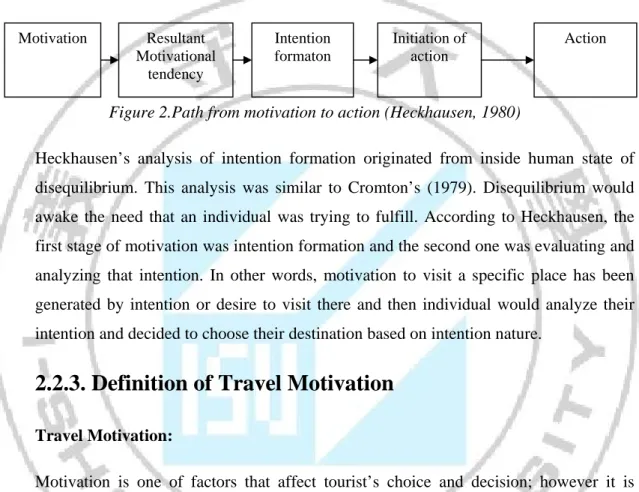
Besides Maslow and Pearce’s theories, Heckhausen studied about motivation in term of another aspect. Heckhausen’s theory was prone to action process in which motivation was considered as key and basic element. Heckhausen explained that motivation was
generated from “expectations, wants and energy coalesce” (Heckhausen, 1980). He described two alternative stages of a complete action: intention formation and volition. Only motivation tendency by itself is not enough to motivate a person to try for specific action objectives. A specific need or a state of disequilibrium inside will drive people to form their intention. That is intrinsic characteristic. The transformation of intention to action depends on meticulous analysis and the evaluation of perceived objectives.
Figure 2.Path from motivation to action (Heckhausen, 1980)
Heckhausen’s analysis of intention formation originated from inside human state of disequilibrium. This analysis was similar to Cromton’s (1979). Disequilibrium would awake the need that an individual was trying to fulfill. According to Heckhausen, the first stage of motivation was intention formation and the second one was evaluating and analyzing that intention. In other words, motivation to visit a specific place has been generated by intention or desire to visit there and then individual would analyze their intention and decided to choose their destination based on intention nature.
2.2.3. Definition of Travel Motivation
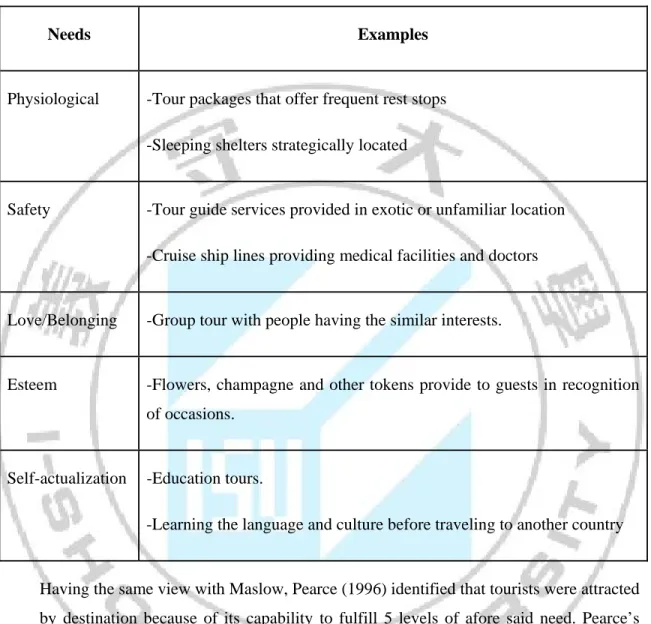
Travel Motivation:Motivation is one of factors that affect tourist’s choice and decision; however it is consider as a key element because it is impelling and compelling of tourists’ behavior. Maslow used “need hierarchy” theory to analysis tourists’ motivation. He proposed an example model of human and tourists’ need:
Motivation Resultant Motivational tendency Intention formaton Initiation of action Action
Table Maslow’s hierarchy of human need and tourist needs
Table 1: Maslow’s hierarchy of human need and tourist needs (Sutithee Guha, 2009)
Needs Examples
Physiological -Tour packages that offer frequent rest stops -Sleeping shelters strategically located
Safety -Tour guide services provided in exotic or unfamiliar location -Cruise ship lines providing medical facilities and doctors
Love/Belonging -Group tour with people having the similar interests.
Esteem -Flowers, champagne and other tokens provide to guests in recognition of occasions.
Self-actualization -Education tours.
-Learning the language and culture before traveling to another country
Having the same view with Maslow, Pearce (1996) identified that tourists were attracted by destination because of its capability to fulfill 5 levels of afore said need. Pearce’s research is similar to the first concept of tourism motivation based on need arousal which is proposed by Crompton and Heckhausen. Pearce suggested a travel career ladder with 5 levelS. Its purpose is distinguishing intrinsic and extrinsic motivation. It also relates to Maslow need hierarchy. The notion of hierarchical motivation proposed by Pearce was need hierarchy where each level of needs had relationship with the previous or the next level of need. Each of need levels in this system is push motivation which affected decision process.
Push and Pull Motivation:
If Maslow and Pearce, when doing research on tourism motivation, focused on answering the question what intrinsic motivation was, Crompt had multiple perspectives when suggesting theory of push and pull motivations. He divided tourism markets into 4 segments: Business travel, government or corporate business travel, travel to visit friends and relatives and pleasure vacation travel (Crompton, 1979). His research objectives focused on the last segment, identified motivation of pleasure travel, destination choices and development of theoretical framework which can integrate such motivations.
According to Crompton’s theory, there are two socio-psychological motivation layers: The first layer leads to decide travelling and the next layer affect destination choices. The first level of motivation generates desire to travel while the second one has effect on choosing destination. When a person decide to travel, there are some motivation factors affected the second stage. The first layer is call push motivations and the second layer is called pull motivation. This theory will create interests in explaining why many people choose these places as their destination instead of other entertaining trips to beach, or luxury resorts.
Besides Crompt, Botha and Kim also did research on tourism motivation. They try to learn about tourist’s behavior and how tourists narrow their choices for the last decisions. According to Botha (1999), there were three criteria contributing to choose destination. Intrinsic motivations (push motivation) is the first, second is destination’s attributes (pull motivation) and situational inhibitors. Motivation to a place specifically originated from two- step process (Dann, 1981). Firtly, it is push motivations. Push motivations relate to other needs and pressures which force an individual to desire travelling. The second is pull motivations. These ones relate to destinations’ attributes and capability to fulfill those needs and pressures. Studying about the relationship between push and pull motivation, Kim and Lee describe the formation of supply and demand relations. Push motivation is a approach in term of demand aspect while pull factors are researched from supply aspect.
Also studying about motivation; however Gnoth stressed on situational parameters where motivation was expressed (cognitive approach). For example, the death of one’s
relatives can motivate them desire travelling to heal. According to Gnoth, tourism is the respond of demand in temporal, spatial, social and economic situations. Push motivations are more important in generating tendency of seeking tourism places. A destination is unlikely satisfying the tourists; therefore, pull factors are not as important as push factors in creating tourism motivation. This view of Gnoth is similar to Dann’s point of view. When studying about push factors, Dann suggested that state of disequilibrium in an individual can be adjusted by tourism experiences. Many researches of tourism motivation based on concept of psychological need which was formed inside of a person and driven them to consider and choose to travel. Therefore, psychological need is inside lever and basic factor of tourism motivation (Gnoth, 1997). Referring to the difference between two factors, Gnoth showed that pull factors are formed by knowledge background of destination which is very necessary for tourism experience. They depend on clear perception while push factors create multidimensional response to different external situations and decide potential destination. Push factors relate to the changeable of demand either increase or abeyance. When many preferences of pull factors are issued, specific attributes of destinations will be carefully consider for identify psychological needs. Each of destinations has unique push factor, even though, it is perceived in different ways by different tourists. Moreover, push factor originates from specific psychological characteristic and relates to feelings and demands.
In conclusion, there are many researches tourism motivation on pull and push factors aspects. According to traditional approaches, push factors are to explain the desire to go on a vacation, whereas pull factors have effect on choosing destination decisions. Uysal and Jurowski (1994) had the same view; however, they gave more detail explanation of those factors. They said that most push factors are intrinsic factors such as desire for “escape, rest and relaxation, prestige, health and fitness, adventure and novelty and social interaction” (Sutithee Guha, 2009). Destination attraction produces the qualities of pull factors and they are perceived by people being prone to travel. Push factors can be antecedent of pull factors (Dann, 1997).
Based on reviewing the literature of motivation and tourism motivation, we can see that the theory “need hierarchy” of Maslow is core in Pearce’s studies about travel career ladder. Maslow’s theory is also synchronized with Dann and Crompton’s researches in considering tourism as a way to meet psychological need.
Although there are many other researches on tourism motivation, my study about Hanoi heritage tourism used the theory of push and pull factor motivations. Therefore, this chapter only provides some contemporary literature and previous researches relating to my theme.
2.3. The relationship between Motivation and Perception
2.3.1. Theory of Perception
To explain what perception is, the researchers at first suggested some explanations of perception’s sources. Many studies classified sources of perception into two basic groups. The first group is piece of available knowledge existed in each individual and perception is the exploration and development of those knowledges. Who share this view are Decartes and Plato. This view can assist us in explaining inside perception and intuition; however, it can’t clearly explain when knowledge and ideas are in our mind, where they are from or why they appear in our mind as well as why different people don’t have same perception and we couldn’t perceive it from our born. On contrary to this point of view, another approach affirmed that knowledge we have is from outside, in other word that is experience. The researchers pursuing this view confirmed that our mind like a white paper and all what we have are from external reality. This approach explained that how external facts were perceived and put on mind. Two both these approached face to a problem. They find difficult to explain the perception of unconscious people and how we respond to outside world.
Most of the perception theories consider “perception” as analyzing and receiving information process. Depending on the direction of information flow, researchers categorize theory of perception into two different groups:
• The first group of perception theory:
This group of theory uses “bottom-up process” for information processing. This process begins at the lowest sensory level of cognitive apparatus and the gradually transform to more complicated process which is implemented in higher level and takes responsibility for abstract and broad thinking. Regarding to this group of perception theory, the content and quality of data input play a vital role in deciding the last perception.
Sensory input data, according to this theory, represents for cognitive background and its nature will decide further sensory data process.
We can take the following case as an example: when we see a tree, our senses will collect basic data such as point, horizon, and vertical as well as the characteristics of object and then connect all data we get to build the image of shape, surface. With information about the object we get, we can have more complicated perception of object which we identify “tree”.
In this theory group, Gibson with his direct- perception theory is very popular and applied in many studies all over the world. He believed that our cognitive apparatus is created and formed by impact of evolution from external environment which shows clearly its structure and ability. We learn how to extract exactly necessary information of our survival. Darwin assumed that pressure from environment make our receptor be created and formed so that it is more sensitive with relating stimulation from environment and it can be adapted to external environment. This explanation of perception has ecological characteristic because external environment decides and affect all perception process.
• The second group of perception theory:
This group of theory uses “top-down process” for information processing. On contrary to the bottom- up theory, group of this theory supposed that during discrimination and evaluation process of sensory stimulations, we feel sensory data in our receptor and data processing implemented from higher cognitive apparatus to lower one. This is top-down effect. The core of this approach is that this sensory processing is conducted only when a person have knowledge background or other effects which play an important role in forming and organizing content of perception.
A key feature to distinguish bottom-up theory and top- down theory is the participation of higher cognitive apparatus in classifying and explaining contents perceived. Top-down theory prefers direct-perception without the participation of previous knowledge and experience, whereas indirect-perception theory considers “perception” is spirit symbol, computation or drawing a picture of reality. Sensory data must be caught and organized by cognitive apparatus and explained by basic knowledge background.
Philosophical foundation of this approach is the research document: “The critique of Pure Reason”. According to this research, thinking without contents is empty, intuitions without concepts is blind. Only by using concept to understand an image, a person realizes what he is experiencing and then we call it perception.
One of the most popular constructive perception theories is Gregory’s. “While Gibson integrated the phylogenetic flow of time (the influence of evolution on cognitive apparatus) into the process of perception, Gregory used also the flow of ontogenetic time. He claims that sensory data found on receptors are just some sort of energy samples, but they are of no great importance themselves. Their importance is based on our previous experience. Data have the past and the future; they change themselves and they influence each other. They have some hidden aspects that emerge only if influenced by various conditions”( Perception theories, Doc. PhDr. Ján Rybár,PhDr.
Marián Špajdel). Gregory was making efforts to provide ambiguity of sensory data.
Similar to Gibson, he didn’t suspect the importance of receptors in receiving data; however he didn’t agree with the idea that receptors had capability of reading specific data meaning. He believed that this process needed higher brain activity. Perception is a problem of receptors as well as brain organism.
It is very difficult to propose an exact definition of perception. Simply, according to philosophical perspective, perception is the reflection of objective reality in human consciousness. There are two type of perception: sensible perception and reason perception. They have dialectical relationship. Foundation, objectives and standards of perception are social reality.
According to afore said literature, perception is a process in which people regenerate reality in their thought. It is affected by social development rules. In term of tourism aspect, tourists’ perception is destination’s image and reality which is formed in tourists’ thinking. This formation of perception is thanked to available knowledge background as well as external impacts such as destination attributes, word-mouth factor etc. Gnoth (1997) noted that: “perceptions about a destination can be reduced to a behavioral or cognitive perspective. The cognitive structures constitute the point at which the forming of the image represents the integration of the internal and external stimuli into the “awareness set” (Woodside and Lysonski, 1989; Crompton, 1979). There are individual perception which was formed before traveling to a site based on
available knowledge background and perception to destination which is created after traveling to this site, based on perceived values as well as satisfaction with destination. Whatever it is individual perception of perception based on destination attributes, it is also affected by motivation, specifically push and pull motivation.
2.3.2. The relationship between Motivation and Perception
Motivation and perception play an important role in deciding tourists’ behavior. Therefore, linking tourists’ perception to their motivation is really necessary. If a place is perceived to be able to meet many motivations, it will have more chances to choose as destination. And if a tourist has high motivation to a site, its image will be more attractive in tourist’s perception and make tourist feel sense of belonging to there. With those analyses, we can see the relationship between motivation and perception. It’s hard to isolate two these concepts. According to McCabe (200), tourist’s motivation should be recognized in term of multidimensional aspect in order that we can get different knowledge of its effect on tourist’s perception and behavior. In general, according to Crompton, perception to destination can be governed by personal, interpersonal motivation (push motivations) and destination’s attributes (pull motivations).
2.4. The relationshop between Perception and
Re-Visitation Intention
Revisitation intention is consider as an important research topic in analyzing competitive advantage of tourism market. Despite many studies about it, the questions why people revisit a tourism site and which attributes can make tourist stay longer aren’t answered clearly. Many tourism scholars focus on repeat visit intention as a premise of destination loyalty. Some studies affirmed that the development of a site depends on the number of revisit tourists (Darnell and Johnson, 2001). In term of this aspect, the previous research examined the factors affected tourists’ behavior and measured the degree of influence to revisitation intention.
In toursim, the premises of revisitation intention such as “ satisfaction” ( Baker and Crompton 2000), Frochot and Hughes,2000, Kozak 2001…), novelty ( Jang and Feng,2007), perceived value ( Petrik,2003), previous tourism experience ( Chen and
Gursoy,2001), safe( Chan and Gursoy), cultural difference (Reisinger and Turner), perception ( Ross,1993,Milman and Pizam 1995), motivation and satisfaction ( Yoon and Uysal,2005), destination attributes ( Akama,2003, Zabkar,2010) are indentified by many researchers.
Creating attractive factors to make tourists stay longer will increase destination’s revenue. From aspect of tourism consumer, tourists’ behavior is divided into three stages: Before going on vacation, during vacation and after vacation (Rayan, 2002; William and Buswell 2003). Chan and Tssai noted that tourists’ behavior consists of choosing destination, evaluating it and behavior intention in the future. The stage of evaluating destination is tourism experience, perceived value or tourists’ satisfaction while behavior intention in the future relates to if tourist prefer to return or not, of if they are willing to introduce destination to others or not?.
Referring to the factors which repeat visitation intention, not mention to motivation and perception factors. These are two key factors. Motivation, including push and pull motivation will have effect on repeating visitation intention through perception. Taking a specific and researching example: Novelty is a push factor which stimulates tourist’s desire to new places, new things, cultural and historic characteristics at destination. Regarding to the tourists who visit a site for the first time to explore and experience new things, this push motivation affect their perception to destination and they wonder if this destination can make them satisfied and feel sense of belonging to here? If the destination can answer that question with a good result, tourist will have high perception to there. They can be able to revisit in the future or introduce to others. For other tourists who visit a site two or more, novelty is different level between present perception and previous experience. When tourists find more new things at present destination than in the past, they will be stimulated to revisit more times. Therefore, whatever aspects, novelty is also considered as motivation deciding tourists’ perception to their destination. That perception will have effect on their satisfaction, loyalty and motivate tourist to repeat their visitation intention (G. Assaker, V. E. Vinzi, and P. O’Connor, 2011).
Based on the previous research on factors affect revisitation intention of tourists, my study will focus on researching how motivation affect tourist’s revisitation intention through their perception and apply this research framework in the case of Hanoi heritage sites.
Chapter 3 METHODOLOGY
3.1. Research Design
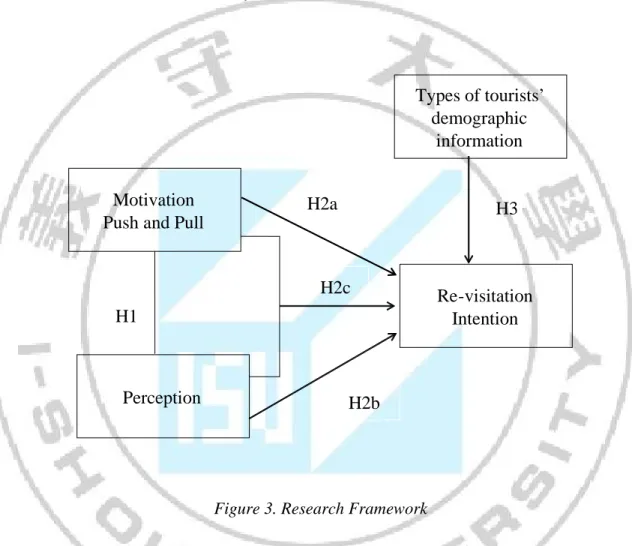
Based on the situation of Hanoi heritage tourism as well as the afore said literature review, a framework is offered in this study:
Figure 3. Research Framework
This study uses the framework which is modified from Kim (2010). This framework may provide overview to understand about Hanoi heritage tourists’ travel behaviors. It was also conducted successfully in researching heritage tourism in Amish town, Midwestern city. According to Kim (2010), push and pull motivations have positive effects on tourists’ perception. Besides, there is close relationship between tourist’s perception and re-visitation intention. Kim’s study also showed that pull motivations played more important role and have more effects on tourists’ perception than push motivations. Is this true for the case of Hanoi heritage tourism? How are the effects of push and pull motivations on Hanoi heritage tourists? Do the government and manager need to
Motivation
Push and Pull
Perception
Re-visitation
Intention
Types of tourists’
demographic
information
H2a
H2b
H1
H3
H2c
make plan for stimulating tourists’ intrinsic motivations or investing in facilities, tourism products and heritage conservation to enhance heritage attractions. Researches andnhypothesis were provided in below for Hanoi tourists.
Kim (2010) classified push motivations into 3 groups: Novelty, Curiosity, Desire; classified pull motivations into 3 groups: Historic, Nature, and Attributes. Further, Kim tested the hypothesisfor the differences among those group with their motivations. Although this study adopted similar framework, it concludes more suitable push and pull motivations for Hanoi toursts. Based on the classification of study: “Modeling motivations and perceptions of Portuguese tourist” which were written by three researchers: Antónia Correia, Patricia Oom do Valle, Cláudia Moço (Algarve University), push motivations were divided into Knowledge, Leisure and Socialization while pull motivations were classified into Facilities of heritage sites and Heritage core attractions. This classification is proper for domestic heritage tourists’ psychology and purpose when travelling. Consdiering these factors chosen based on the literature review for testing Hanoi heritage tourists travel behaviors may provide helpful information for destination marketing organization to design more effective tourists’ management.
3.2. Instrument Design
The questionnaire has two parts includes questions asking tourists’ general information such as gender, age, occupation, regions. There are also two questions asking tourists travel behaviors such as the total times that domestic heritage tourists visit Hanoi and how long they have stayed in Hanoi. Heritage sites was classified into two types, one is the heritage places in Hanoi center, and another one is the heritage places Hanoi suburb. This classification may help to provide information on what the perferrances sites for domestics tourists are. The second parts of questionnaries included 30 questions divided into three testing constructs, motivation, perception, and revisition intention. Motivations were divided into two factors which are Push motivations (knowledge, leisure, and socialization) and Pull motivations (Facilities, heritage core attractions). Five point Likert scale was used to evaluate how much respondents agree and disagree with each question.
3.3. Sample Design
The process of sample design has the following stages:
Stage 1: Identify the population of this study: This study is conducted on domestic tourists
who visiting Hanoi heritage sites,so the population is all Vietnamese tourists who are living in Hanoi or in other cities.
Stage 2: Identify the method of choosing sample: What is sample choosing?
Sample choosing is a process of selecting the participants who represent the population in the study. A sample is considered as good sample if it is representative and large enough. In researches, there are often two methods of sample choosing. They are Probability Sampling and Non-Probability Sampling.
Sampling Methods
For the study of Hanoi heritage toursim, sampling method which is chosen is probability sampling. Probability sampling is sampling method that individuals in overall population have equal chances to be chosen into sample. This is a best method which helps us choose a representative sample. We can calculate the erro when choosing sample, so we can apply statistical estimation methods and test hypothesis in data processing whereby we can infer the results from sample to population.
In Hanoi, there are many heritage sites; however, it wastes time if conducting survey in all those sites. Because of time limitation, this study chooses 10 heritage sites which often attract the largest number of tourists (based on the statistics of Vietnam National Administration of Toursim as well as some Vietnamese toursim articles). In each sites, the participants will be chosen randomly for the survey.
Stage 3: Compute sample size
Sample size in a research is based on the requirements of Exploratory Factor Analysis and Regression:
• For Exploratory Factor Analysis: According to Hair, Anderson, Tatham and Black (1998), sample size is at least 5 times as many as total number of variables. In this study, the questionnaire includes 27 questions. It means that there are 27 variables in this research, so the sample size is 27x5=135
• For regression: sample size is computed as the formula: 50+ 8*m (m is the number of independent variables) (Tabachnick and Fidell, 1996). In this study, there are 2 independent variables; therefore the sample size is 50+ 8x2= 76.
Æ Based on two above theories, sample is expected to include 170 participants.
3.4. Data Collection:
Data collection was conducted through a survey research. 10 heritage sites which have the largest number of domestic tourists are selected. Those places are listed as Ho Chi Minh monument, The Temple of Literature, Hoan Kiem Lake, Tran Quoc Pagoda, Tay Ho Pagoda, The Imperial Citadel of Thang Long, Hanoi Opera House, Tran Vu Pagoda, Hanoi Old Quarter, and Vietnam Museum of Ethnology. In each sites, Seventeen participants were randomly chosen fro each sites to do the questionnaire. This process lasts for two weeks (from May 25th to June 7th 2015). The interviewer standed at the entrances in heritage sites for conducting the survey. If tourists refused to participate in sutyd, the next person near the interviewer was be approached to ask if willing to participate in study. About 170 questionnaires were collected and only 150 useable questionnaires were obtained. Data was typed into Excell for further SPSS data processing
.
3.5. Measures:
Scales used in this study
:
- Nominal scale: Nominal scale is used for labeling variables such as gender, age, address,
total times visiting Hanoi heritage sites, the time tourists stay in Hanoi and the open questions.
-
Likert scale: This study uses Likert scale 5 points. This scale was introduced by apsychologist Renis Likert. It is used widely in scientific research. It has 5 points from strongly disagree to strongly agree.
3.6. Data analysis:
Data analysis process has the following steps:
Step 1:
Descriptive analysis is implemented to find out the characteristics of sample. This process will be nessary in calculating the number of men and women who participate in the survey, the number of respondents in different groups of ages, occupations and regions. Descriptive analysis is also helpful in evaluating and comparing the frequency of visitors to heritage sites in Hanoi center or suburb as well as considering how long domestic heritage tourists have stayed in Hanoi when travelling to heritage sites.
Step 2:
Analysis Cronbach’s Alpha to test the reliability and validity of scale used in this study. Coefficent Cronbach’s Alpha is used for eliminating the variables which are not suitable for research framework.
- Standard for accepted variables (Peterson,1994)
+ Corrected Item- Total correlation is over 0.3
+ Coefficent Cronbach’s Alpha is from 0.6.
Step 3:
Linear Regression is used for test the appropriateness of research framework and test hypothesis to see if there is relationship between motivation, perception and re-visitation intention of domestic heritage tourists. Besides, it is used for identify which motivation factors have more effect on perception: pull factors or push factors. The criteria for an appropriate linear regression framework is that F value has sig <0.05. For accepted variables, Tolerance value must be over 0.0001. In this research, when studying about the relationship between motivation and perception, and which motivation factors have more effect on domestic heritage tourists’ perception, motivation factors are independent variables and perception is dependent variable. However, in the relationship between
perception and visitation intention, perception variable is independent variable while re-visitation intention is dependent variable.
Regression equation:
Y= A+ BX (Y: dependent variable, A: constant, B: Partal regression coefficient (Beta), X: independent variable)
Step 4:
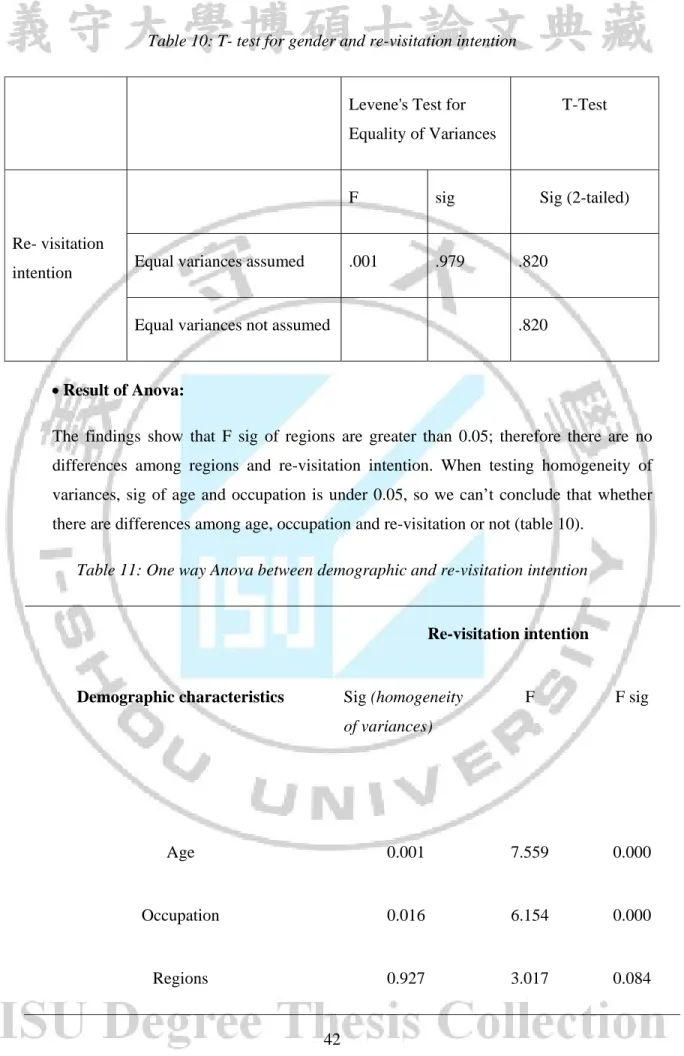
The next step in this stage is analysis of variance (ANOVA) and T-test to see if there are differences between demographic variables such as gender, age, occupation, regions and re-visitation intention.
Chapter 4. RESULTS AND DISCUSSION
This chapter analyzes the collected data from 150 usable questionnaires about “Relationships
among Motivation, Perception, and Re-Visitation Intention for Domestic Tourists: The Case of Heritage Sites in Hanoi, Vietnam”. The statistical analysis includes:
* Descriptive Analysis * Test Cronbach’s Alpha * Regression Analysis * Anova
4.1. Descriptive Analysis
4.1.1. Respondents’ Demographic Characteristics
SPSS is used to analyze the data which were collected through survey research.Demographic characteristics of participants include: gender, age, occupation, region, frequency to Hanoi heritage sites and residence. These findings are presented in table 2:
A total of 150 respondents who have usable questionnaire, there is slightly more male (52%) than female (48%).
Regarding to age distribution of respondents, the number of respondents who have the age from 25 to 45 years old account for the largest percentage with 36%. The second is group of tourists under 25 years old which account for 22.7%.The third is group of the middle-aged and the old which account for the same part of 20.7%.
Doing survey on tourists’ occupation, the findings show that the percentage of government employees and group of student and pupil is highest with 22%. The second is group of freelances which accounts for 20.7%. The retired- people account for 20 % while employees who work in private or foreign company account for the smallest part with 15.3%.
In this sample, there is 48.7% of respondenst living in Hanoi city. The rest come from other places in Vietnam
A total of the participants, most of them visit more than 2 times with 44%. The number of domestic tourists visits 1 and 2 times account for 16.6% and 39.3%.There are no respondents who never visit heritage sites in Hanoi center. However, this rate for heritage sites in Hanoi suburb such as Soc temple, Co Loa temple is lower. There is 14% of the respondents who never visit those sites. Most respondents visit those sites 1 or 2 times. The percentage of respondents who visit more than 2 times only is 18%. In term of residence, most of respondents often stay about 1 day or 2 days. These percentages are 58% and 32.7%. Only 8% of respondents stay in Hanoi 3 days and the number of respondents staying in Hanoi more than 3 days only accounts for 1.3%.
Table 2: Respondents’ profile
Characteristics Frequency Valid percent
Gender Male 78 52%
Female 72 48%
Age Under 25 years old
34 22.7% From 25 to 45 years old 54 36.0%
From 45 to 60 years old 31 20.7%
Over 60 years old 31 20.7%
Occupation Government employee 33 22% Private or foreign company
employee 23
Freelance 31 20.7% Student and pupil 33 22%
Retired 30 20% Regions Hanoi 73 48.7% Others 77 51.3% Frequency to heritage sites in Hanoi Center Not yet 0% 1 time 25 16.6% 2 times 59 39.3%
More than 2 times 66 44%
Frequency to heritage sites in Hanoi Suburb Not yet 21 14% 1 times 50 33.3% 2 times 52 34.7%
More than 2 times 27 18%
Residence 1 day 87 58.0 %
2 days 49 32.7 %
3 days 12 8.0 %