Observations of multipass transverse modes
in an axially pumped solid-state
laser with different fractionally
degenerate resonator configurations
Hsiao-Hua Wu
Department of Physics, Tunghai University, 181 Sec. 3 Chung Kang Road, Taichung 407, Taiwan Wen-Feng Hsieh
Institute of Electro-Optical Engineering, National Chiao Tung University, 1001 Ta-Hsueh Road, Hsinchu 300, Taiwan
Received November 29, 1999; revised manuscript received May 15, 2000
We experimentally show, for the first time to our knowledge, that a diode-pumped Nd:YVO4laser can operate
with multipass transverse (MPT) modes that self-reproduce after several round trips in a plano–concave cavity that has fractionally degenerate resonator configurations when the pump beam waist is sufficiently smaller than that of the fundamental cavity mode. The MPT mode is found to exhibit multiple beam waists located at different positions and to experience a lower pumping threshold than the single-pass transverse mode. With off-axis pumping, the N-pass transverse mode forms a symmetric pattern for even N and an asymmetric pat-tern for odd N. This result can be explained as being due to the introduction of MPT modes but not to su-perposition of the standard cavity modes. © 2001 Optical Society of America
OCIS codes: 140.0140, 140.3410, 140.3480, 140.3580.
1. INTRODUCTION
Lasers with various geometrically stable resonators can usually support definite transverse modes, such as
Hermite–Gaussian and Laguerre–Gaussian modes,
which reproduce themselves after a round trip and hence are also referred to as single-pass transverse (SPT) modes. However, the round-trip ray matrix T of a confo-cal resonator is easily determined to be T ⫽ ⫺I, and T2 ⫽ I is the identity matrix. Thus any starting field dis-tribution that has inverse symmetry with respect to the optic axis of the resonator will be exactly reproduced after a round trip and any arbitrary ray will return to its initial position and direction after two round trips. This reso-nator is referred to as a self-imaging, 1/2-degenerate system1and is capable of supporting a more-or-less arbi-trary transverse beam pattern even if it significantly de-viates from the standard Gaussian profile. This property has been applied for optically synthesizing various laser waveforms2–5and for optimizing the extraction efficiency of solid-state lasers.6,7
By ray analysis of the resonators, however, a paraxial resonance equation8 yields the mirror separations of a two-mirror cavity in which any arbitrary rays repeat themselves after an integer number (say N) of return transits. It has been argued that a set of paraxial closed ray paths that is complete in N round trips might also be regarded as a mode of the resonator. We describe in this paper how an axially pumped solid-state laser that con-sists of a two-mirror cavity with fractionally (K/N) degen-erate resonator configurations in which the paraxial
reso-nance equation is satisfied may select an unusual transverse mode rather than the standard cavity mode observed at a slightly different mirror separation. By in-vestigating the effects of off-axis pump on the laser with these degenerate resonator configurations, we found that a symmetric pattern forms for even N and an asymmetric pattern forms for odd N. These results may be accounted for simply by the introduction of multipass transverse (MPT) modes9 that self-reproduce after several round trips in terms of the ray matrix analysis but not by the superposition of standard cavity modes. To demonstrate the MPT modes in a straightforward way, we observed the output laser beam after it propagated through a lens by translating a beam profiler along the optical axis. We found as usual a single beam waist for the SPT mode but multiple waists for the MPT modes. Inasmuch as the MPT mode is capable of adjusting itself for better overlap with the pump beam, a lower pump threshold can be at-tained when the waist size of the pump beam is suffi-ciently smaller than that of the fundamental cavity mode. We demonstrated this theoretically, based on spatially de-pendent rate equation analysis, and experimentally with a diode-pumped Nd:YVO4laser that has a plano–concave cavity.
2. FRACTIONALLY DEGENERATE
RESONATOR CONFIGURATIONS
Consider a resonator formed by two mirrors with radii of curvature R1 and R2 separated by some lossless optical elements with the transfer matrix
冋
a b c d册
,and let the reference plane be the optical ray just leaving mirror 1. The round-trip ray matrix T is
with cos ⫽ (A ⫹ D)/2 ⫽ 2G1G2⫺ 1. If the condition ⫽ 2K/N is satisfied, where N and K are integers with 0 ⭐ K ⭐ N/2 to prevent duplicate values for cos, then we obtain TN⫽ I. A resonator with G1G2 parameters satisfying this condition will be referred to as the cavity with the fractionally (K/N) degenerate resonator configu-ration. MPT modes that self-reproduce after N round trips may therefore exist in addition to the SPT modes in this resonator. When N is an even number, the MPT mode forms an inverse symmetry beam pattern with re-spect to the optic axis in the resonator, as asserted by the relation TN/2⫽ ⫺I, which follows from Eq. (2). In a plano–concave cavity with R1⫽ ⬁, the K/N-degenerate resonator configurations have cavity lengths L given by
L⫽ (R2/2)关1 ⫺ cos(2K/N)兴, which was referred to in Ref. 8 as a paraxial resonance equation for the case of a
plano–concave cavity. In addition, the resonant
frequency of the TEMqmn mode can be given
by qmn⫽ (c/2L)关q ⫹ (1 ⫹ m ⫹ n)(1/)cos⫺1(G1G2)1/2兴 ⫽ q(c/2L) ⫹ (1 ⫹ m ⫹ n)(/2)(c/2L) ⫽ q(⌬l) ⫹ (n ⫹ m ⫹ 1)(⌬t), where m and n are transverse mode in-dices, q is the axial mode index, ⌬l is the axial mode spacing, and⌬tis the transverse mode spacing. It is in-teresting to note that, for the fractionally degenerate resonator configurations,⌬l/⌬t⫽ 2/ ⫽ N/K, this is also referred to the transverse mode degeneracy at which the cavity mode comprises N sets of degenerate trans-verse modes.
3. EXPERIMENTAL SETUP
A schematic of the experimental setup is shown in Fig. 1, where a diode-pumped Nd:YVO4 laser with a plano– concave cavity is used. A 1-mm-thick Nd:YVO4 laser
crystal that was coated at its surface facing the pumping beam for less than 5% reflection at 808 nm and greater than 99.8% reflection at 1064 nm was used as a flat end mirror. The second surface of the crystal was antireflec-tion coated at 1064 nm. The output coupler (OC) is a concave mirror with radius of curvature R⫽ 80 mm and 90% reflection at 1064 nm. It was mounted upon a trans-latable stage to facilitate continuous adjustment of the cavity length and consequently determination of the reso-nator configuration. The pump beam from a commer-cially available laser diode (LD) with a microlens to re-duce perpendicular divergence was collimated by an objective lens (CL) with a numerical aperture of 0.47 and focused onto the Nd:YVO4 crystal by another objective lens (FL) with a focal length of 12 mm. This arrange-ment yielded a pump beam waist located close to the flat end mirror with a diameter of⬃14m in the vertical
di-rection and ⬃25 m in the horizontal direction.
Throughout the experiments the waist size of the pump beam was much less than that of the fundamental cavity beam. We kept the laser diode operating at a constant current and temperature by a using a current source (CS) and a temperature controller (TC) to ensure stable pump-ing wavelength and power. Because the wavelength of the laser diode is 806.62 nm at an operating power of 1 W, higher output power will lead to a shift of pumping wave-length toward the absorption peak of the Nd:YVO4 crys-tal, and more pump power will be absorbed by the Nd:YVO4 crystal. Approximately 74–89% of the pump beam is absorbed by the Nd:YVO4crystal when the pump power increases from 10 to 800 mW. We used a pair of lenses (L1 and L2) to image the laser beam waist to an optical powermeter (PM) to measure the total output power.
4. TRANSVERSE MODES IN DIFFERENT
RESONATOR CONFIGURATIONS
To observe the transverse modes of the laser we magni-fied and imaged the waist patterns with an objective lens (FL; Fig. 1), a dichromatic beam splitter (BS) inserted be-tween the focusing and collimating lenses, and a 1064-nm filter (F), onto a screen (S), then recorded them with a CCD camera. In general, a fundamental cavity mode
Fig. 1. Schematic diagram of the experimental setup. The no-tation is defined in the text.
T ⫽
冋
A BC D
册
⫽冋
2aG2⫺ 1 2bG2
2共2aG1G2⫺ G1⫺ a2G2兲/b 4G1G2⫺ 2aG2⫺ 1
册
, (1)
with G parameters G1⫽ a ⫺ b/R1and G2⫽ d ⫺ b/R2. The ray matrix after N round trips is obtained from Sylvester’s
theorem8: TN⫽
冋
A B C D册
N ⫽ 1 sin冋
A sin N ⫺ sin共N ⫺ 1兲 B sin
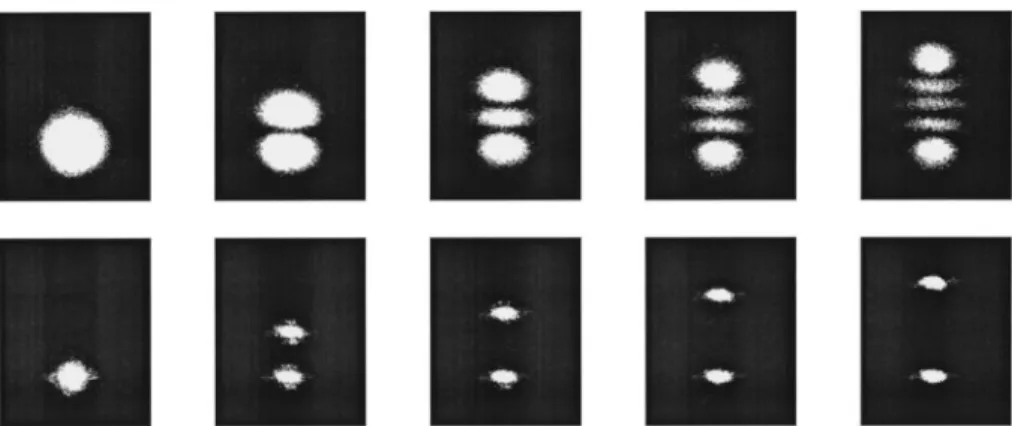
with a Gaussian profile could be observed when an on-axis pump beam was applied to the laser crystal. Never-theless, we found that when the cavity length was ad-justed near 40 mm, corresponding to a semiconfocal cavity or a 1/4-degenerate cavity configuration, the waist pattern suddenly shrank several times to a small ellipti-cal spot similar to the pattern of the pump beam observed on the Nd:YVO4 crystal. To study the effect of off-axis pumping on the cavity mode, we transversely moved the concave mirror and hence the optic axis of the resonator with respect to the pump beam such that the higher-order spatial modes could be excited without breaking the reso-nator eigenmodes. We found that when the cavity length was adjusted away from the 1/4-degenerate resonator configuration the higher-order Hermite–Gaussian modes would oscillate in succession, as shown in the upper row of Fig. 2. We can see that from left to right the mode pat-tern successively changes from TEM00with on-axis pump-ing, to TEM01, TEM02, and then TEM04as the offset be-tween the optic axis and the pump beam increases. In contrast, the effect of off-axis pumping on the semiconfo-cal cavity, shown in the lower row of Fig. 2, is to cause an inverse image of the shrinking transverse mode spot to be formed at the other side of the optic axis. The first figure at the bottom left shows that the mode pattern has a spot size smaller than the TEM00pattern for on-axis pumping. With increasing offset, the mode pattern consists of two shrinking spots, whose separation increases rather than changes to higher-order transverse modes. In addition, by inserting a knife-edge into the resonator to block the cavity modes slightly and introduce excess loss, we found that the higher-order Hermite–Gaussian mode changed into a lower-order mode but the semiconfocal resonator mode was elongated along the direction in which the knife-edge moved. We can conveniently explain these re-sults by introducing MPT modes that are capable of sup-porting arbitrary beam patterns, even those that deviate significantly from standard Gaussian profiles, or by the superposition of various sets of degenerate cavity eigen-modes.
To discover whether any one of the fractionally degen-erate resonator configurations other than a semiconfocal cavity would also support MPT modes, we investigated the waist pattern as a function of the cavity length. We found that the phenomenon of a shrinking laser beam waist10did indeed occur at those cavity lengths specified
by the K/N-degenerate resonator configurations with low values of N. The transverse mode with fractionally de-generate resonator configurations under off-axis pumping is again quite different in behavior from a standard cavity mode. Figure 3 shows a sequence of waist patterns ob-served for the concave mirror moving perpendicularly to the optical axis and found at the 1/N-degenerate resona-tor configurations with some low values of N (N ⫽ 3 ,..., 6). For 1/N-degenerate resonator configura-tions with even N, the pattern looks like that which
oc-curs at the semiconfocal cavity. In the case of
1/N-degenerate resonator configurations with odd N, however, the inverse image of the original shrinking spot as observed in the semiconfocal cavity is replaced by a di-vergent pattern with concentric rings. These rings may result from the diffraction of the laser beam in the cavity off the gain volume that has a smaller diameter than the cavity mode. Patterns that show no rotation symmetries and occur in fractionally degenerate resonator configura-tions with odd N can no longer be constructed from any superposition of the standard cavity modes that match the curvature of end mirror and have a certain rotational symmetry with respect to the optic axis of the resonator. We again can easily account for these results by introduc-ing the MPT modes and takintroduc-ing into account the fact that
a negative identity matrix does not exist in
1/N-degenerate cavities with odd N.
5. OBSERVATIONS OF MULTIPASS
TRANSVERSE MODES
To demonstrate the MPT modes in a straightforward way, we used an experimental arrangement such as that shown in Fig. 4. We placed a transform lens with a focal
Fig. 2. Sequence of transverse mode patterns for a Nd:YVO4laser observed at the semiconfocal cavity (bottom row) and away from it (upper row) with on-axis pumping and the offset between the optic axis and the pump beam increasing from left to right.
Fig. 3. Sequence of transverse mode patterns for an off-axis pumped Nd:YVO4 laser observed at 1/N-degenerate resonator
configurations with some low values of N (N⫽ 3, 4, 5, 6 from left to right).
length of 52 mm at a distance d0⫽ 105 mm behind the output mirror. We employed a beam profiler at a dis-tance di from the lens to observe the transformed beam distribution. We observed as usual a single beam waist for the SPT modes away from the fractionally degenerate resonator configurations. In exceptional cases we found multiple beam waists when the cavity length was ad-justed near fractionally degenerate resonator
configura-tions. In general, we found N beam waists for
1/N-degenerate resonator configurations with odd N and
N/2 waists with even N. Figure 5(a) illustrates how the
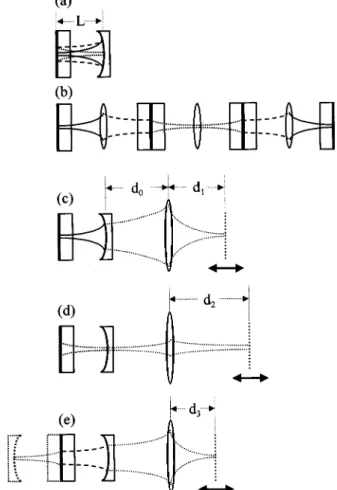
MPT mode propagates within a cavity for a 1/3-degenerate resonator configuration, corresponding to a cavity length L ⫽ 60 mm and G1G2⫽ 1/4. An equiva-lent lens guide cavity is shown in Fig. 5(b). In Figs. 5(c), 5(d), and 5(e) we depict the forward propagation of the MPT mode within a cavity and the transformation of its output through the transform lens for the first, second, and third passes, respectively. The beam waist for the first pass located at the crystal face (the flat mirror) was imaged at a distance d1from the lens [see Fig. 5(c)]; that of the second pass at the curved mirror was transformed to d2, as shown in Fig. 5(d). Figure 5(e) shows that the beam waist of the third pass at the curved mirror directed toward and then reflected by the flat mirror (dotted por-tion at the left in this figure) was transformed to d3. Figure 6 shows the experimental observation of beam spots at distances of d3[Figs. 6(a) and 6(d)], d1[Figs. 6(b) and 6(e)], and d2[Figs. 6(c) and 6(f)] behind the lens when the cavity length is adjusted as 61 mm for the SPT mode and 60 mm for the MPT mode, respectively, with N⫽ 3. A single beam waist at d2⫽ 103 mm for a cavity length of 61 mm (the SPT mode) and three beam waists, at d1 ⫽ 76 mm, d2⫽ 103 mm, and d3⫽ 68 mm for a cavity length of 60 mm (the MPT mode with N⫽ 3) can be found. The locations of the beam waists observed in this experiment are consistent with the positions expected ac-cording to the resonator calculations as well as the lens formula.
6. THRESHOLD ESTIMATION FOR
MULTIPASS TRANSVERSE MODES
The following questions may be raised now: Why does the laser have to choose the MPT modes instead of the
standard cavity modes? How would the MPT modes
have lower lasing thresholds than the standard cavity modes that are available even at fractionally degenerate resonator configurations? By use of a rate-equation analysis in which the spatial variations of both the pump
Fig. 4. Experimental arrangement used for measuring the
transformation of the laser output through a lens.
Fig. 5. Schematic illustrating the MPT mode for a cavity with the 1/3-degenerate resonator configuration. Beam propagation (a) within a plano–concave cavity and (b) along an equivalent
lens-guide cavity. Forward propagation of the MPT mode
within a cavity and transformation of its output through the transform lens for (c) the first pass, (d) the second pass, and (e) the third pass.
Fig. 6. Transformed beam spots observed at distances of (a) d3, (b) d1, and (c) d2after the lens for the SPT mode and (d) d3, (e) d1, and (f) d2for the MPT (N⫽ 3) mode. Because the original
beam spot of (c) is too dark to be seen, we nonlinearly adjusted its gamma value to make it visible.
beam and the cavity field were taken into account, the threshold pump power Pthof an axially pumped laser was derived11to be Pth⫽ Ae␥Isat/pJ1, where Aeis the effec-tive area of the mode, ␥ is the total logarithmic loss per pass, Isatis the saturation intensity,pis the pumping ef-ficiency, and J1⫽ 兰a ⑀gdV takes into account the spatial overlap of pump and mode distribution.11 Assuming a Gaussian distribution for both the pump beam and the fundamental cavity mode with effective spot sizes of wp and w inside the laser crystal, we can calculate J1 as J1 ⫽ 2Ae/(w2⫹ wp2). For a semiconfocal cavity, corre-sponding to 1/4-degenerate resonator configuration, its ray matrices after one, two, and four round trips are
T⫽
冋
0 R/2⫺ 2/R 0
册
,T2⫽ ⫺I, and T4⫽ I, respectively. This resonator is also referred to as a Fourier-transform system,1 in which beam patterns in the consecutive round trips form Fourier-transform pairs. The spot sizes of the MPT mode at the laser crystal in the semicon-focal cavity can accordingly be expressed as w1⫽ aw (at beam waist) and w2⫽ w/a for the alternate round trips, where a is a proportional constant of less than 1. The threshold pump power Pth of the MPT mode is there-fore given by Pth(a)⫽ ␥Isat关wp
4⫹ (a2⫹ 1/a2)w2w p 2 ⫹ w4兴/
p关2wp2⫹ (a2⫹ 1/a2)w2兴, which reduces in the case of a SPT mode to a⫽ 1. The difference in the threshold pump powers for the MPT mode and for the SPT mode is Pth(a)⫺ Pth(1)⫽␥Isat关(a2⫹ 1/a2 ⫺ 2)w2(w
p
2⫺ w2)兴/2
p关2wp2⫹ (a2⫹ 1/a2)w2兴. We can see that if the waist size of pump beam is less than that of fundamental cavity mode the MPT modes will then have a lower laser threshold than the SPT mode. The depen-dence of output power on the pump power for equivalent cavity lengths both to and 1 mm longer than the 1/4-degenerate resonator configuration was measured and is shown in Fig. 7. As was theoretically expected, the laser with a semiconfocal cavity has a lower (approximately a factor of 5) pump power at threshold than away from it. It is worth mentioning that if the MPT mode were not taken into account, the difference in spot size and hence in laser threshold between the laser with semiconfocal and 1-mm-longer cavities would be negligible. Similarly,
we can estimate the threshold pump power of the MPT modes for the laser with other fractionally degenerate resonator configurations. We obtain conclusions similar to those for the semiconfocal cavity, except that we have to reduce pump spot size wp further to a smaller value, for instance, (1/
冑
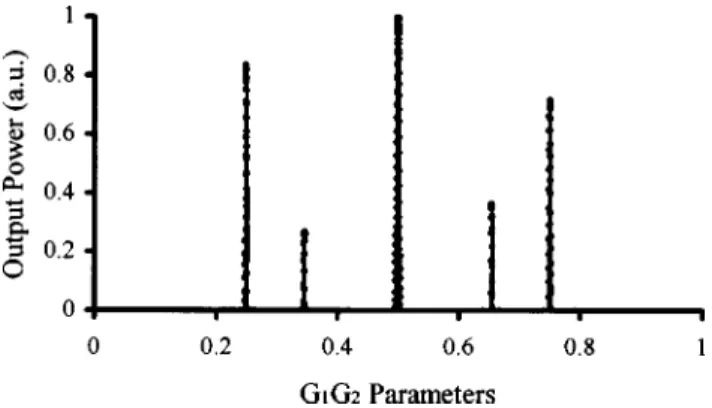
3)w for N⫽ 3 (or 6) and even smaller for N ⫽ 5 (or 10), with the factor of the wave-front match neglected. By measuring the output power as a function of the G1G2 parameters under on-axis pump power slightly above threshold of the MPT mode of the semicon-focal cavity, we observed an increase in the output power when the cavity length approached fractionally degener-ate resonator configurations. Figure 8 shows that some narrow power peaks occur at the fractionally degenerate resonator configurations that correspond to K/N ⫽ 1/3, 3/10, 1/4, 1/5, and 1/6 from left to right. When the pump power increases further, more discrete power peaks were found at the fractionally degenerate resonator configura-tions involving higher values of N. The lower pump threshold that occurs at the cavity length corresponding to fractionally degenerate resonator configurations is in good agreement with the theoretical expectation when we take into account the property of the MPT modes that permits the selection of a laser beam distribution that better fits the pump profile.7. CONCLUSIONS
We have shown that multipass transverse modes that self-reproduce after several round trips may exist in a simple two-mirror laser that has cavity lengths that cor-respond to fractionally degenerate resonator configura-tions. MPT modes with the ability to adjust themselves for a better fit with the pump beams could then be excited in a diode-pumped Nd:YVO4laser by virtue of a relatively low pump threshold if the waist size of the pump beam were much less than that of the fundamental cavity mode. With off-axis pumping, these MPT modes form symmetric mode patterns for even N and asymmetric ones for odd N, which can be explained in terms of ray matrix analysis but not by the superposition of standard cavity modes. Moreover, we used a lens to transform the output laser beam and found multiple beam waists for the MPT modes
Fig. 7. Output power as a function of absorbed pump power
measured for cavity lengths (a) equivalent to a 1/4-degenerate resonator configuration and (b) 1 mm longer than it.
Fig. 8. Dependence of the output power on the resonator G1G2
parameters with pump power slightly above the threshold of the
MPT mode in a semiconfocal cavity. Some narrow power peaks
occur at the cavity with G1G2parameters corresponding to
dis-crete fractionally degenerate resonator configurations (K/N ⫽ 1/3, 3/10, 1/4, 1/5, and 1/6 from left to right).
and a single waist for the SPT modes. As a result, we suggest that the factor of MPT modes should be taken into account in the design and application of axially pumped solid-state lasers, particularly for those that have fractionally degenerate resonator configurations charac-terized by low values of N.
ACKNOWLEDGMENTS
This research was partially supported by the National Science Council of the Republic of China under Grants NSC87-2112-M029-002 and NSC89-2112-M009-026.
H.-H. Wu’s e-mail address is [email protected].
REFERENCES
1. A. E. Siegman, Lasers (University Science, Mill Valley, Ca-lif., 1986), p. 845.
2. V. Kermene, A. Saviot, M. Vampouille, B. Colombeau, C. Froehly, and T. Dohnalik, ‘‘Flattening of the spatial laser beam profile with low losses and minimal beam diver-gence,’’ Opt. Lett. 17, 859–861 (1992).
3. F. Saviot, E. Mottay, M. Vampouille, and B. Colombeau, ‘‘Optical synthesis of a high-energy uniform and uniphase laser emission,’’ Opt. Lett. 18, 2117–2119 (1993).
4. V. Kermene, M. Vampouille, C. Froehly, and B. Colombeau, ‘‘Temporal laser beam construction under controlled mode filtering,’’ Opt. Commun. 97, 319–326 (1993).
5. B. Colombeau, M. Vampouille, V. Kermene, A. Desfarges, and C. Froehly, ‘‘Spatial shaping of coherent waves inside a confocal laser,’’ Pure Appl. Opt. 3, 757–773 (1994). 6. N. Hodgson, B. Ozygus, F. Schabert, and H. Weber,
‘‘Degen-erated confocal resonator,’’ Appl. Opt. 32, 3190–3200 (1993).
7. V. Couderc, O. Guy, A. Barthelemy, C. Froehly, and F. Lourador, ‘‘Self-optimized resonator for optical pumping of solid-state lasers,’’ Opt. Lett. 19, 1134–1136 (1994). 8. A. Ramsay and J. J. Degnan, ‘‘A ray analysis of optical
reso-nators formed by two spherical mirrors,’’ Appl. Opt. 9, 385– 398 (1970).
9. Ref. 1, p. 580.
10. H. H. Wu, C. C. Sheu, T. W. Chen, M. D. Wei, and W. F. Hsieh, ‘‘Observation of power drop and low threshold due to beam waist shrinkage around critical configurations in an end-pumped Nd:YVO4laser,’’ Opt. Commun. 165, 225–229 (1999).
11. P. Laporta and M. Brussard, ‘‘Design criteria for mode size optimization in diode-pumped solid-state lasers,’’ IEEE J. Quantum Electron. 27, 2319–2326 (1991).