Thermal fluctuations and disorder effects in vortex lattices
Dingping Li*
National Center for Theoretical Sciences, P. O. Box 2-131, Hsinchu, Taiwan, Republic of China
Baruch Rosenstein†
National Center for Theoretical Sciences, P. O. Box 2-131, Hsinchu, Taiwan, Republic of China and Department of Electrophysics, National Chiao Tung University, Hsinchu 30050, Taiwan, Republic of China
共Received 30 March 1999兲
We calculate using loop expansion the effect of fluctuations on the structure function and magnetization of the vortex lattice and compare it with existing Monte Carlo results. In addition to renormalization of the height of the Bragg peaks of the structure function, there appear characteristic saddle shape ‘‘halos’’ around the peaks. The effect of disorder on magnetization is also calculated. All the infrared divergencies related to soft shear cancel.关S0163-1829共99兲11837-X兴
I. INTRODUCTION
Decoration,1 neutron scattering,2 and scanning tunneling microscopy3 have clearly demonstrated the Abrikosov flux line lattice in low- and high-Tc type-II superconductors. There are, however, important differences between the two classes of materials. The Ginzburg parameter Gi characteriz-ing the importance of thermal fluctuations is much larger in high-Tc superconductors than in the low temperature ones. Moreover, in the presence of magnetic field the importance of fluctuations in high-Tc superconductors is further en-hanced. The lattice melts and becomes a vortex liquid over large portions of the phase diagram.4–6 In ‘‘strongly fluctu-ating’’ superconductors, even far below the melting line, cor-rections to various physical quantities such as magnetization or specific heat are not negligible. The vortex lattice be-comes distorted. It is quite straightforward to systematically account for the fluctuation effect on magnetization, specific heat, or conductivity perturbatively above the mean field transition line using a Ginzburg-Landau 共GL兲 description.7 However, in the interesting region below this line it turned out to be extremely difficult to develop a quantitative theory. A direct approach to the low temperature fluctuations physics is to start from the mean field solution and then take fluctuations around this inhomogeneous solution into ac-count perturbatively. Experimentally it is reasonable since, for example, specific heat at low temperatures is a smooth function and the fluctuation contribution is quite small. For some time this was in disagreement with theoretical expec-tations. Eilenberger calculated the spectrum of harmonic ex-citations of the triangular vortex lattice8 and noted that the gapless mode is softer than the usual Goldstone mode ex-pected as a result of spontaneous breaking of translational invariance. The inverse propagator for the ‘‘phase’’ excita-tions behaves as kz2⫹const(kx2⫹ky2).2 It was shown9,10 that the constant in front of (kx
2⫹k y 2
)2 is directly related to the shear modulus c66 and is in agreement with numerous ex-periments. An interesting question is whether the (kx2⫹ky2)2 behavior disappears nonperturbatively. We point out that Monte Carlo simulation of the structure function11 provides direct evidence that it is not so.
The influence of this additional ‘‘softness’’ goes beyond
enhancement of the contribution of fluctuations at leading order. It apparently leads to disastrous infrared divergencies at higher orders rendering the perturbation theory around the vortex state doubtful. One therefore tends to think that non-perturbative effects are so important that such a perturbation theory should be abandoned.12 However, it was shown in Ref. 13 that a closer look at the diagrams reveals that in fact one encounters actually only logarithmic divergencies. This makes the divergencies similar to so-called ‘‘spurious’’ di-vergencies in the theory of critical phenomena with broken continuous symmetry and they exactly cancel at each order provided we are calculating a symmetric quantity. One can effectively use properly modified perturbation theory to quantitatively study various properties of the vortex liquid phase. Magnetization calculated using this perturbative ap-proach agrees very well with the direct Monte Carlo 共MC兲 simulation of Ref. 11. The method was then extended be-yond the lowest Landau level 共LLL兲.14
In this paper we calculate the effect of fluctuations on the magnetic field distribution and structure function of the vor-tex lattice and compare with existing MC results. Fluctua-tions cause the spread of the peaks in the diffraction pattern in a very specific way, while the height of the peaks is slightly corrected. Effects of fluctuation and disorder on magnetization and specific heat are computed. The paper is organized as follows. In Sec. II the model and the fluctuation spectrum approximation are briefly reviewed. In Sec. III the calculation of the structure function is presented. Section IV contains analysis of the result, comparison with MC simula-tion, and some generalizations. In Sec. V the distribution of magnetic field is calculated, while effects of weak disorder on magnetization and specific heat are treated in Sec. VI. A summary is given in Sec. VII.
II. MODEL, MEAN FIELD SOLUTION, AND THE PERTURBATION THEORY
A. Model
Our starting point is the GL free energy:
F⫽
冕
d3x ប 2 2mab冏
冉
“⫺ ie* បc A冊
冏
2 ⫹ ប 2 2mc兩z兩 2⫹a兩兩2⫹b⬘
2 兩兩 4. 共1兲 PRB 60Here A⫽(By,0) describes a nonfluctuating constant mag-netic field. For strongly type-II superconductors (⬃100) far from Hc1共this is the range of interest in this paper兲 mag-netic field is homogeneous to a high degree due to superpo-sition from many vortices. For simplicity we assume a ⫽␣(1⫺t)Tc, t⬅T/Tc, although this dependence can be easily modified to better describe the experimental coherence length.
Throughout most of the paper will use the following units. The unit of length is ⫽
冑
ប2/(2mab␣Tc) and the unit of magnetic field is Hc2, so that the dimensionless magnetic field is b⬅B/Hc2. The dimensionless free energy in these units is „the order parameter field is rescaled as 2 →(2␣Tc/b⬘
)2… F T⫽ 1 冕
d3x冋
1 2兩D兩 2⫹1 2兩z兩 2⫺1⫺t 2 兩兩 2⫹1 2兩兩 4册
. 共2兲 The dimensionless coefficient is⫽
冑
2 Gi2t, 共3兲 where the Ginzburg number is defined by Gi ⬅12(32e
22T
c␥1/2/c2h2)2 and ␥⬅mc/mab is an anisot-ropy parameter. This coefficient determines the strength of fluctuations, but is irrelevant as far as mean field solutions are concerned.
The second expansion parameter is共see Refs. 9 and 14 for details兲
ah⬅
1⫺t⫺b
2 . 共4兲
B. Mean field solution
If ah is sufficiently small GL equations can be solved perturbatively:
⫽⌽⫽共ah兲1/2关⌽0⫹ah⌽1⫹•••兴. 共5兲 It is convenient to represent ⌽0,⌽1, . . . in the basis of eigenfunctions of operator H⬅1
2(⫺D
2⫺b), Hn⫽nbn, normalized to unit ‘‘Cooper pairs density’’
具兩
n兩2典
⬅兰celld2x兩n兩2(b/2)⫽1, where ‘‘cell’’ is a primitive cell of the vortex lattice. Assuming hexagonal lattice symmetry one explicitly has:n⫽
冑
2冑
2nn!al⫽⫺⬁兺
⬁ Hn冉
y冑
b⫺ 2 a l冊
⫻exp再
i冋
l共l⫺1兲 2 ⫹ 2冑
b a lx册
⫺ 1 2冉
y冑
b⫺ 2 a l冊
2冎
, 共6兲 where a/冑
b⫽冑
4/冑
3b is the lattice spacing. One finds⌽0⫽ 1
冑
A . 共7兲 To order ahi , we expand ⌽i⫽gi⫹兺
n⫽1 ⬁ ginn. 共8兲 These coefficients can be found in Ref. 14.C. Fluctuation spectrum
To find an excitation spectrum one expands a free energy functional around the solution. The fluctuating order param-eter fieldis divided into a nonfluctuating共mean field兲 part and a small fluctuation
共x兲⫽⌽共x兲⫹共x兲. 共9兲 We expand field in a basis of quasimomentum eigenfunc-tions: k n⫽
冑
2冑
2nn!al⫽⫺⬁兺
⬁ Hn冉
y冑
b⫹ kx冑
b⫺ 2 a l冊
⫻exp再
i冋
l共l⫺1兲 2 ⫹ 2冉
冑
bx⫺ky冑
b冊
a l⫺xkx册
⫺1 2冉
y冑
b⫹ kx冑
b⫺ 2 a l冊
2冎
. 共10兲Then we diagonalize the quadratic term to obtain the spec-trum. The details can be found in Ref. 14. Instead of com-plex field kn we will use two ‘‘real’’ fields Okn and Akn sat-isfying Okn⫽O⫺k*n, A k n⫽A ⫺k *n: 共x兲⫽
冑
1 2冕
k e⫺ik3x3冑
2 n兺
⫽0 ⬁ d k n k n共x兲 共冑
2兲2共Ok n⫹iA k n兲, 共11兲 *共x兲⫽ 1冑
2冕
k eik3x3冑
2 n兺
⫽0 ⬁ d k n* k* n共x兲 共冑
2兲2 共O⫺k n ⫺iA ⫺k n 兲,where dk⫽exp关⫺ik/2兴 where ␥k⫽兩␥k兩exp关ik兴 when n⫽0 共all definitions and notations can be found in Ref. 14兲. Within the LLL, at order ah, the eigenstates are Ak,Ok, while the eigenvalues 共in two dimensions; in three dimen-sions simply plus k32/2) are
⑀A⫽ah⑀A 1⫽a h
冉
⫺1⫹ 2  k⫺ 1 兩␥k兩冊
, 共12兲 ⑀O⫽ah⑀O 1⫽a h冉
⫺1⫹ 2  k⫹ 1 兩␥k兩冊
,where⑀A,⑀Oare dependent on two-dimensional vector k and
k,␥kis defined by the following equations:14
k n⫽
具
兩兩2 kជkជ* n典
, k n ¯⫽具
*n kជ *kជ典
, ␥k n⫽具共
*兲2 ⫺kជkជ n典
,␥k n
¯⫽
具
**nkជ⫺kជ
典
, 共13兲where the bracket
具 典
means averaging over the function in-side the bracket. k⫽kn,␥ k⫽␥k n when n⫽0. In particular, when k→0, ⑀A⬇ x22 4A ah兩k兩4⬇0.1ah兩k兩4, 共14兲 where x22⬅(2/a)4兺l,ml2m2(⫺)lm exp兵⫺(2)2/2a2(l2 ⫹m)2其⯝0.47.⑀
Ohas a finite gap instead.
Higher order corrections and higher Landau level eigen-states and eigenvalues can be found in Ref. 14. With spec-trum of excitations and expansion of solutions of GL equa-tions in ah, one can start the calculation of correlators to any order in .
III. STRUCTURE FUNCTION OF THE VORTEX LATTICE
In this section the structure function is calculated to order
共harmonic approximation兲 within the LLL, namely, ne-glecting higher ah corrections. We discuss these corrections in the next section. First we calculate the density correlator defined by
S ˜共z,z
3兲⫽具共x,x3兲共x⫹z,x3⫹z3兲典x⫽具共x兲共y兲典x,
共15兲 where
具 典
xindicates average over x共which means here overthe unit cell兲 and⬅兩兩2. The correlator is calculated using the Wick expansion:
S
˜⫽S˜m f⫹˜Sf luct. 共16兲
The first term is the mean field part, while the second term is the fluctuation part.
A. Mean field contribution
The mean field part is simply
S ˜
m f⫽
具兩⌽共x兲兩
2兩⌽共y兲兩2典
x. 共17兲The structure function is the Fourier transform S(q,0) ⫽兰dzeiq•zS˜ (z,z
3⫽0). Within the LLL, ⌽(x) ⫽(ah/A)1/2(x) and the mean field part of the structure function becomes Sm f共q,0兲⬅
冕
dzeiq•z具
兩⌽共x兲兩2兩⌽共y兲兩2典
x ⫽冉
ah A冊
2 b 2冕
cell兩共x兲兩 2e⫺iq•x冕
z兩共z兲兩 2eiq•z ⫽冉
ah A冊
2 42␦n共q兲exp冋
⫺ q2 2b册
, 共18兲where we made use of formulas and function␦n(q) defined in the Appendix. This is just the sum of␦ functions of vari-ous heights at reciprocal lattice points.
B. Fluctuation contribution
The fluctuation part contains four terms 共diagrams兲 S
˜1, . . . ,S˜4. The first term is
S ˜1共z,z3兲⫽ 1 4•2
冓
⌽共x兲⌽共y兲n兺
⫽0 ⬁冕
k,l dkn*dln*k*n 共x兲l* n 共y兲冔
x 共具Ok*n Ol*n⫺A k *n Al*n典兲e
ik3(y⫺x)3⫹c.c. 共19兲具
OknOln典
and具
AknAln典
are propagators:具
Ok n Ol n典⫽
⑀O n共k兲⫹k3 2 2 ␦共k⫹l兲, 共20兲具
AknAln典
⫽ ⑀A n共k兲⫹k3 2 2 ␦共k⫹l兲. To calculate structure functions we will need only the z3⫽0 correlator:S ˜1共z,0兲⫽ 1 4共2兲2
冓
⌽共x兲⌽共y兲n兺
⫽0 ⬁冕
k共dk n*兲2 k *n共x兲 ⫺k *n共y兲冔
x冋
冑
2 ⑀O n 共k兲⫺冑
2 ⑀A n 共k兲册
⫹c.c. 共21兲 Within the LLL approximation it simplified toS ˜1共z,0兲⫽ 1 4共2兲2 ah A
冓
共x兲共y兲冕
k共dk *兲2 k *共x兲⫺k* 共y兲冔
x冋
冑
2 ⑀O共k兲 ⫺冑
⑀ 2 A共k兲册
⫹c.c. 共22兲S1共q,0兲⫽ 1 4共2兲2 ah A
冕
k b 2冕
cell共x兲k *共x兲e⫺iq•x冕
z共z兲⫺k * 共z兲eiq•z共d k *兲2冋
冑
2 ⑀O共k兲⫺冑
2 ⑀A共k兲册
⫹c.c. ⫽ ah 2A cos冉
kxky⫹k⫻Q b ⫹k冊
exp冋
⫺ q2 2b册
冋
冑
2 ⑀O共k兲⫺冑
2 ⑀A共k兲册
, 共23兲where formulas of the Appendix were used. Q is the integer part of q, k is the fractional part of q: q⫽k⫹n1˜d1⫹n2d˜2⫽k ⫹Q 共see the Appendix for the definitions of d˜1,d˜2). The second fluctuation correction term is
S ˜ 2共z,z3兲⫽ 1 4•共2兲2
冓
⌽共x兲⌽*共y兲n兺
⫽0 ⬁冕
k,l dkn*dlnk*n共x兲 l n共y兲冔
x 共具Ok*nO l n⫹A k *nA l *n典
兲eik3(y⫺x)3⫹c.c. 共24兲 S ˜2(z,z3⫽0) is equal to 共in the LLL approximation兲 S ˜2共z,0兲⫽ 1 4共2兲2 ah A
冓
共x兲*共y兲冕
kk *共x兲k共y兲冔
x冋
冑
2 ⑀O共k兲 ⫹冑
⑀ 2 A共k兲册
⫹c.c. 共25兲 and S2共q,0兲⫽ 1 4共2兲2 ah A冕
k b 2冕
cell共x兲k *共x兲e⫺iq•x冕
z*共z兲k共z兲e iq•z冋
冑
2 ⑀O共k兲 ⫹冑
⑀ 2 A共k兲册
⫹c.c. ⫽ ah 2A exp冋
⫺q 2 2b册
冋
冑
2 ⑀O共k兲 ⫹冑
⑀ 2 A共k兲册
. 共26兲The third term is
S ˜3共z,z3兲⫽ 1 4•共2兲2
冓
兩⌽共x兲兩 2兺
n⫽0 ⬁冕
k,l dkndln*kn共y兲 l *n共y兲冔
x 共具Ok*nO l *n⫹A k *nA l *n典兲⫹x↔y
共27兲 and within the LLL at z3⫽0 is equal toS ˜ 3共z,0兲⫽ 1 4共2兲2
冓
冏
⌽共x兲冏
2冕
kk共y兲k *共y兲冔
x冋
冑
2 ⑀O共k兲⫹冑
2 ⑀A共k兲册
⫹共x↔y兲. 共28兲 Consequently the correction to the structure function isS3共q,0兲⫽ ah 4A
冕
k b 2冕
cell兩共x兲兩 2e⫺iq•x冕
z兩k共z兲兩 2eiq•z⫻冋
冑
2 ⑀O共k兲⫹冑
2 ⑀A共k兲册
⫹共q→⫺q兲 ⫽ ah 2A␦n共q兲exp冋
⫺ q 2 2b册
冕
k cos冉
k⫻Q b冊
冋
冑
2 ⑀O共k兲 ⫹冑
⑀ 2 A共k兲册
. 共29兲The final term is from the vacuum renormalization contribution. The shiftv in (x)⫽v(x)⫹(x) is renormalized, that is, to one loop order,v2⫽v
0 2⫹
v12, wherev02⫽ah/A. One can findv1 2
by minimizing the effective one loop free energy LxLyLz
冋
⫺ahv2⫹ 1 2v 4册
⫹1 2兵Tr ln关2⑀O共k,v兲⫹kz 2兴⫹Tr ln关2⑀ A共k,v兲⫹kz 2兴其 , 共30兲 where Tr ln关2⑀O共k,v兲⫹kz 2 兴⫹Tr ln关2⑀A共k,v兲⫹kz 2 兴 共31兲 ⫽LxLyLz冕
dk3 共2兲3兵ln关2⑀O共k,v兲⫹kz 2兴 ⫹ln关2⑀A共k,v兲⫹kz 2兴其, and ⑀A共k,v兲⫽⫺ah⫹2v2k⫺v2兩␥k兩, 共32兲 ⑀O共k,v兲⫽⫺ah⫹2v2k⫹v2兩␥k兩.Minimizing the effective one loop free energy with respect to v, the straightforward calculation gives
v1 2⫽⫺ 1 162
冕
k冋
冉
2k⫹兩␥k兩 冊
冑
2 ⑀O共k兲 ⫹冉
2k⫺兩␥k兩 冊
冑
2 ⑀A共k兲册
. 共33兲The last contribution to the one loop correction to the correlator is therefore S4共z,z3兲⫽2 ah A
具
兩共x兲兩2兩共y兲兩2典
x共v1兲2, S4共q,0兲⫽ 2ah A b 2冕
cell兩共x兲兩 2e⫺iq•x冕
z兩共z兲兩 2eiq•zv 1 2 ⫽⫺ ah 2A␦n共q兲exp冋
⫺ q2 2b册
冕
k冋
冉
2k⫹兩␥k兩 冊
⫻冑
⑀ 2 O共k兲 ⫹冉
2k⫺兩␥k兩 冊
冑
2 ⑀A共k兲册
. 共34兲 The sum of all the four terms can be cast in the following form: S共q,0兲⫽冉
ah A冊
2 42␦n共q兲exp冋
⫺ q2 2b册
⫹ 2 ah1/2 A exp冋
⫺q 2 2b册
⫻关 f1共q兲⫹␦n共q兲f2共Q兲⫹␦n共q兲f3兴, f1共q兲⫽冋
1⫹cos冉
kxky⫹k⫻Q b ⫹k冊册
冑
2 ⑀O 1共k兲 ⫹冋
1⫺cos冉
kxky⫹k⫻Q b ⫹k冊册
冑
2 ⑀A 1共k兲, 共35兲 f2共Q兲⫽冕
k冋
⫺1⫹cos冉
k⫻Q b冊册
冋
冑
2 ⑀O 1共k兲⫹冑
2 ⑀A 1共k兲册
, f3⫽⫺冕
k关冑
2⑀O1共k兲⫹冑
2⑀A1共k兲兴⫽⫺28.5275b.C. Cancelation of the infrared divergency
Although all of the four terms S1, S2, S3, and S4 are divergent as any of the peaks is approached, k→0, the sums S1,S2 and S3,S4 are not. We start with the first two:
S1共q,0兲⫹S2共q,0兲⫽ 2 ah A exp
冋
⫺q 2 2b册
f1共q兲, 共36兲 where f1(q) defined in Eq. 共35兲 contains a function (1/b)(kxky⫹k⫻Q…⫹k. When k→0 it can be shown that kxky/b⫹k⫽O(k2•2); thus (1/b)(kxky⫹k⫻Q…⫹k→k⫻Q, and 1⫺cos(kxky⫹k⫻Q/b⫹k)→(k⫻Q)2. Hence it will cancel the 1/k2 singularity coming from
冑
1/⑀A1(k). Thus f1(q) approaches const⫹const•(k⫻Q)2/k2 when Q⫽0, and approaches const⫹const•k6 when Q⫽0.Similarly the sum of S4(q,0) and S3(q,0) is not divergent, although separately they are. Their sum is
S3共q,0兲⫹S4共q,0兲⫽ 2 ah 1/2 A ␦n共q兲exp
冋
⫺ q2 2b册
关 f2共Q兲⫹ f3兴. 共37兲IV. COMPARISON WITH MC SIMULATIONS A. Shape of the peaks in the structure function
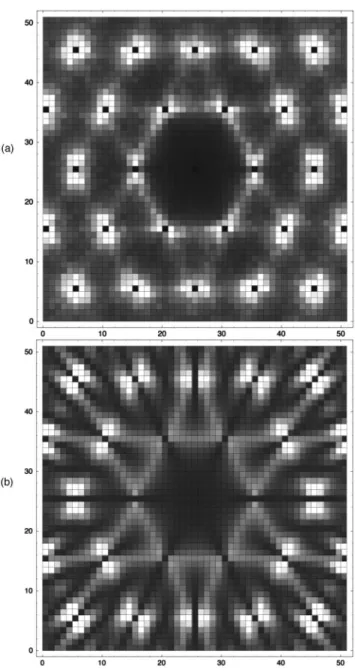
Now we compare our results with numerical simulation of the LLL system in Ref. 11. The general shape of the struc-ture function in the vicinity of a peak关see Fig. 1共b兲兴 and the data near the origin according to a MC simulation of the same system within the same LLL approximation in Ref. 11 关Fig. 1共a兲兴 are qualitatively the same pattern. It is easier to compare using rescaled quasimomenta, q→q
冑
b, k→k冑
b. We get S共q,0兲⫽冉
ah A冊
2 42␦n共q兲 b exp冋
⫺ q2 2册
⫹ 2 ah1/2 A exp冋
⫺q 2 2册
⫻关 f1共q兲⫹␦n共q兲f2共Q兲⫹␦n共q兲f3兴, 共38兲 where f1(q), f2(Q), and f3are defined in Eq.共35兲, but with b⫽1 共for example, f3⫽⫺28.5275) and the region of inte-gration in the formula rescaled to the cell with d˜1,d˜2 being the reciprocal lattice basis vectorsd ˜1⫽2 a
冉
1,⫺ 1冑
3冊
; d ˜2⫽冉
0,4 a冑
3冊
.Furthermore we define s(q) which is used also in Ref. 11:
S共q,0兲⫽
冉
ah A冊
242 b exp冋
⫺ q2 2册
s共q兲, 共39兲 s共q兲⬅␦n共q兲⫹ Ab共ah兲⫺3/2 82 ⫻关 f1共q兲⫹␦n共q兲f2共Q兲⫹␦n共q兲f3兴.For reciprocal lattice vectors close to origin the values of f2(Q) are found in Table I.
In Ref. 11, the material parameters describe YBCO: Tc ⫽93 K, dHc2(T)/dT⫽⫺1.8⫻104 Oe/K, ␥⫽5, and⫽52. At T⫽82.8 K, H⫽50 kOe. This leads to the following di-mensionless parameters Gi⫽2.04⫻10⫺5, ⫽0.056, ah ⫽0.039 904. However, as discussed in Ref. 14 effective ex-pansion parameters are ah/6b⫽0. 222 68 and b(ah)⫺3/2/2
冑
2⫽2.36⫻10⫺2, both less than 1. ah/6b is the parameter for the expansion of the classical solution. The factor 6 comes from the fact that due to hexagonal, only 6th, 12th, etc. Landau levels appear in perturbation expansion. b(ah)⫺3/2/2冑
2is the parameter for the fluctuation共loop兲 expansion and is much less than 1 here. It justifies the quan-tum correction of the formula using perturbation expansion. The numerical factor in front of the fluctuation correction in this case isc1⫽
Ab共ah兲⫺3/2
82 ⫽3.0932⫻10
In a finite size sample,␦n(q) is equal to LxLy/(2)2when q lies on the reciprocal lattice m1d˜1⫹m2˜d2; otherwise it is zero. Because LxLy⫽N2 (N is the number of vortices of order 100 only in the MC simulation兲, it is equal to N/2. The normalized structure function sn(0)⫽1, as it was used in Ref. 11兲 is
sn共q兲⫽⌬共q兲⫹ 1 共1⫹c1f3兲 关 c2f1共q兲⫹c1⌬共q兲f2共Q兲兴 共41兲 and c2⫽c1 2 N⫽1.9435⫻10 ⫺4, 1⫹c1f3⫽0.91315. 共42兲 The correction to the height of the peak at Q, c1⌬(q)/关1 ⫹c1f3兴 f2(Q), is quite small. We find the height of the peaks away from the origin found in the MC simulation11are typi-cally smaller than ours, while around the peaks they are larger than analytical. It may be due to the finite size effect or finite samplings of the MC calculation. In the MC calcu-lation part of the peak might ‘‘belong’’ to a neighboring pixel. We plot the correction to the nonpeak region in Fig. 1共b兲 and find that the theoretical prediction has roughly the same characteristic saddle shape ‘‘halos’’ around the peaks as in Ref. 11, Fig. 1共a兲, in which all the peaks were removed 共so it is different from Fig. 2共a兲 in Ref. 11 in which only the central peak was removed兲.
We can extend our formula to higher orders which will include also the HLLs共higher Landau levels兲. To next order of ah, we should include ⌽1 in ⌽, ⌽⫽(ah)1/2关⌽0 ⫹ah⌽1兴, consider ⑀O(k),⑀A(k) to next order ah
2, and
⑀O n
(k),⑀An(k) to order ah. It is straightforward to do it.
B. Nonperturbative evidence of⑀A1„k…˜円k円4
for asymptotic small kx,ky
Conversely, the MC simulation result provides the non-perturbative evidence ⑀A1(k)→兩k兩4 for asymptotic small kx,ky. In Eq.共36兲, if⑀A
1(k)→兩k兩2, we will get a contribution from the most singular term const⫹const•(k⫻Q)2/k. This term will become constant when k→0, and we will not get the same characteristic saddle shape ‘‘halos’’ around the peaks as in Ref. 11. So ⑀A1(k)→兩k兩4 for k→0 is crucial for such characteristic shape. Thus the MC simulation result pro-vides a nonperturbative evidence that ⑀A1(k)→兩k兩4 for k →0.
V. FLUCTUATION OF MAGNETIC FIELD
Another quantity which can be measured is the magnetic field distribution. In addition to the constant magnetic field background there are 1/ magnetization corrections due to field produced by supercurrent. To leading order in ah it is given by m(x)⬀
具
(x)典
/ 共for example, see Ref. 15兲.具
(x)典
can be calculated using the following equation:具
共x兲典⫽具
兩⌽共x兲⫹共x兲兩2典⫽兩⌽共x兲兩
2⫹具⌽
*共x兲共x兲典 ⫹具⌽共x兲
*共x兲典⫹
具
共x兲*共x兲典⫽ah
A兩共x兲兩
2⫹
具
共x兲*共x兲典. 共43兲 FIG. 1. 共a兲 Structure factor from the MC simulation of Ref. 11.The peaks at reciprocal lattice points are removed.共b兲 Fluctuation correction to structure factor of the Abrikosov vortex lattice, Eq. 共41兲. The peaks at reciprocal lattice points are removed.
TABLE I. Values of f2(Q) with small n1,n2.
n1,n2 0,1 1,0 1,1 1,2 0,2 2,2 1,3
Using Eq. 共20兲 and Eq. 共11兲, and considering only x3⫽0, one obtains
具
共x兲*共x兲典⫽ 163冕
k兩k共x兲兩 2冋
1 ⑀O共k兲⫹ k32 2 ⫹ 1 ⑀A共k兲⫹ k32 2册
⫽ 162冕
k兩k共x兲兩 2冋
冑
2 ⑀O共k兲⫹冑
2 ⑀A共k兲册
.However, as pointed out in Sec. III the coefficient in
(x)⫽v(x)⫹(x) is renormalized to one loop order, v2 ⫽vo
2⫹
v12, withv1 given in Eq.共33兲. Thus we need to add a term,v1 2关(x)兴2, to Eq.共43兲.
具
共x,0兲典⫽ah A 兩共x兲兩2⫹ 162冕
k兩k共x兲兩 2 ⫻冋
冑
⑀ 2 O共k兲 ⫹冑
⑀ 2 A共k兲册
⫺兩共x兲兩 2 162冕
k冋
冉
2k⫹兩␥k兩 冊
冑
2 ⑀O共k兲 ⫹冉
2k⫺兩␥k兩 冊
冑
2 ⑀A共k兲册
. 共44兲Its Fourier transform (q)⬅兰dzeiq•z
具
(z,0)典
can be easily calculated: 共q兲⫽42␦ n共q兲exp冋
⫺ q2 4b⫹ iqxqy 2b ⫹ i 2 共n1 2⫺n 1兲册
⫻再
ah A⫹ 162冕
k冋
冉
exp冉
ik⫻q b冊
⫺冉
2k⫹兩␥k兩 冊冊
⫻冑
⑀ 2 O共k兲⫹冉
exp冉
ik⫻q b冊
⫺冉
2k⫺兩␥k兩 冊冊
冑
2 ⑀A共k兲册
冎
. 共45兲Performing integrals and rescaling the quasimomenta again, one obtains 共q兲⫽42␦n共q兲 b exp
冋
⫺ q2 4 ⫹ iqxqy 2 ⫹ i 2 共n1 2⫺n 1兲册
⫻再
ah A ⫹bah⫺1/2 162 [⫺28.5275⫹ f2(Q)]冎
. 共46兲 The function f2(Q… appeared in Eq. 共36兲.VI. DISORDER EFFECT ON MAGNETIZATION AND SPECIFIC HEAT
One can introduce weak disorder by adding a quadratic term in Eq. 共2兲,6
⌬ f ⬅
冕
d3x␣共x兲兩兩2. 共47兲 Loosely speaking it represents a local variation of tempera-ture. For pointlike defects one can assume that the correla-tion of␣(x) is具具
␣(x)␣( y )典典
⫽W␦(x⫺y),具具
␣(x)典典
⫽0. Be-fore the disorder average we calculate the free energy ⫺T ln Z withZ⫽
冕
D*Dexp再
⫺ 1
冋
f关*,兴⫺冕
d3x␣共x兲兩兩2册
冎
.共48兲 If W is very small, we can calculate Z by perturbation theory in W. To the second order Z is given as
Z⫽Z0
冋
1⫺ 1
冕
x␣共x兲具共x兲典 ⫹ 122
冕
x冕
y具
共x兲共y兲典␣共x兲␣共y兲册
, 共49兲 where Z0 is the free energy without disorder and it had been obtained in Ref. 14. Thus the free energy with disorder isF⫽⫺T ln Z⫽F0⫹⌬F ⫽F0⫹T
冕
x ␣共x兲 具
共x兲典
⫺ T 22冕
x冕
y关具共x兲共y兲典 ⫺具
共x兲典具共y兲典兴␣共x兲␣共y兲, 共50兲 where F0⫽⫺T ln Z0. Averaging free energy over disorder one obtains F⫽F0⫺ TW 22冕
x关具
共x兲共x兲典⫺具
共x兲典具共x兲典兴
⫽F0⫺ TWV 22 S ˜f luct共0兲. 共51兲From Eq. 共35兲, one finds that ˜Sf luct(0)⫽ ⫺0.186 19(ah
1/2b/
A). Hence the energy density difference due to disorder is F⫽⌬F/V⫽⫺0.0931(TWah1/2b/A). Since ⫽
冑
2 Gi2t,F⫽cah1/2b with c⫽ ⫺0.0931TcW/冑
2 Gi2A. The disorder effect on magneti-zation and specific heat are⌬m⫽⫺⌬ fb ⫽⫺c
冉
ah1/2⫺b 4ah⫺1/2冊
, 共52兲 ⌬c⫽⫺t 2 t2⌬ f ⫽ c 16tbah⫺3/2, respectively. VII. CONCLUSIONSTo conclude, we have calculated the effect of fluctuations on the structure function of the vortex lattice and compared it to existing MC results. In addition to renormalization of the height of the Bragg peaks, there appear characteristic saddle
shape ‘‘halos’’ around the peaks as found in Ref. 11. The MC simulation result provides the nonperturbative evidence
⑀A 1
(k)→兩k兩4 for asymptotic small k. The calculated fluctua-tion contribufluctua-tion to the magnetic field can be more easily observed in low temperature strongly type-II superconduct-ors. Finally, the predicted dependence of magnetization and specific heat on disorder via fluctuations also can be experi-mentally studied.
Correlations in flux lattices can be experimentally mea-sured using neutron scattering as well as some other more exotic methods such as muon spin relaxation, electron to-mography, scanning SQUID microscopy, etc.1–3,16,17 It would be interesting to detect the effect of fluctuations given in the present paper directly from experiments by subtracting the ‘‘background’’ of the well-known mean field correlator. The calculations show that infrared divergencies naively ex-pected in all of the physical quantities calculated above due to ‘‘supersoft’’ shear modes in the large limit cancel. This strengthens the view that the loop expansion is a reliable theoretical tool to study the fluctuations effects in vortex lattice below the melting point.
ACKNOWLEDGMENTS
We are grateful to our colleagues A. Knigavko, B. Bako, and V. Yang. One of us 共B.R.兲 is especially grateful to R. Sasik and D. Stroud for providing raw numerical data which was essential for the present comparison with the MC data. The work is part of the NCTS topical program on vortices in high Tc and was supported by NSC of Taiwan.
APPENDIX A
In this appendix, we present some basic formulas used in the calculations. The basic matrix element is
b 2
冕
cell dx共x兲k*共x兲exp关⫺ix•q兴 ⫽⌬q,kexp冋
i 2 共n1 2⫺n 1兲⫺ q2 4b⫺ iqxqy 2b ⫹ ikxqy b册
. 共A1兲 The Kronecker delta is defined by⌬q,k⫽⌬共q⫺k兲⫽
再
1, if q⫽k⫹n1d˜1⫹n2d˜2
0, otherwise, 共A2兲 where integers n1⫽(1/2)d1•(q⫺k) and
n2⫽共1/2兲d2•共q⫺k兲.
Here d˜1,d˜2 are the reciprocal lattice basis vectors
d ˜1⫽2
冑
b a冉
1,⫺ 1冑
3冊
; d ˜2⫽冉
0,4冑
b a冑
3冊
, 共A3兲 which are dual to d1⫽(a/冑
b,0), d2⫽(a/2冑
b,a冑
3/2冑
b), and a⫽冑
4/冑
3. Integrating over the sample area A, one obtains冕
A dx共x兲k*共x兲exp关⫺ix•q兴 ⫽42␦ n共q⫺k兲exp冋
i 2 共n1 2⫺n 1兲册
⫻exp冋
⫺ q 2 4b⫺ iqxqy 2b ⫹ ikxqy b册
, 共A4兲 where ␦n(q⫺k) is defined as ␦n(q⫺k)⫽兺m1,m2␦(q⫺k ⫺m1d˜1⫺m2d˜2). *Electronic address:[email protected]†Electronic address: [email protected]
1P. L. Gammel et al., Phys. Rev. Lett. 68, 3343共1992兲. 2B. Keimer et al., Phys. Rev. Lett. 73, 3459共1994兲. 3I. Maggio-Aprile et al., Phys. Rev. Lett. 75, 2754共1995兲. 4
E. Zeldov, D. Majer, M. Konczykowski, V. B. Geshkenbein, V. M. Vinokur, and H. Shtrikman, Nature 共London兲 375, 373 共1995兲.
5D. R. Nelson, Phys. Rev. Lett. 60, 1973共1988兲.
6G. Blatter, M. V. Feigel’man, V. B. Geshkenbein, A. I. Larkin,
and V. M. Vinokur, Rev. Mod. Phys. 66, 1125共1994兲.
7M. Tinkham, Introduction to Superconductivity 共McGraw-Hill,
New York, 1996兲.
8G. Eilenberger, Phys. Rev. 164, 628 共1967兲; K. Maki and H.
Takayama, Prog. Theor. Phys. 46, 1651共1971兲.
9A. Ikeda, T. Ohmi, and T. Tsuneto, J. Phys. Soc. Jpn. 59, 1740
共1990兲; 61, 254 共1992兲; A. Ikeda, ibid. 64, 1683 共1994兲; 64, 3925共1995兲.
10M. A. Moore, Phys. Rev. B 39, 136共1989兲; 45, 7336 共1992兲. 11R. Sasik and D. Stroud, Phys. Rev. Lett. 75, 2582共1995兲. 12G. J. Ruggeri, Phys. Rev. B 20, 3626共1978兲.
13B. Rosenstein, Phys. Rev. B 60, 4268共1999兲.
14D. Li and B. Rosenstein, Phys. Rev. B 60, 9704共1999兲. 15I. Affleck and E. Brezin, Nucl. Phys. B 257, 451共1985兲. 16R. Cubitt et al., Nature共London兲 365, 407 共1993兲.
17L. N. Vu, M. S. Vistrom, and D. J. Van Harlingen, Appl. Phys.