‧
國
立
政 治 大
學
‧
N
a
tio
na
l C
h engchi U
ni
ve
rs
it
y
國立政治大學國際傳播英語碩士學程
International Master’s Program in International
Communication Studies
College of Communication
National Chengchi University
碩士論文
Master’s Thesis
北京奧運與中國大陸在
《時代》週刊與《經濟學人》雜誌所呈現之形象
Beijing Olympics and the Images of China
in Time and The Economist
Student: Grace, Meng-lin Kuo (郭孟霖)
Advisor: Professor Leonard L. Chu (朱立教授)
中華民國 99 年 5 月
May 2010
‧
國
立
政 治 大
學
‧
N
a
tio
na
l C
h engchi U
ni
ve
rs
it
y
北京奧運與中國大陸在
《時代》週刊與《經濟學人》雜誌所呈現之形象
Beijing Olympics and the Images of China
in Time and The Economist
研究生:郭孟霖 Student: Grace, Meng-lin Kuo
指導教授:朱立教授 Advisor: Professor Leonard L. Chu
國立政治大學
國際傳播英語碩士學程
碩士論文
A Thesis
Submitted to International Master’s Program in International
Communication Studies
National Chengchi University
In partial fulfillment of the Requirement
For the degree of Master in International Communication Studies
中華民國 99 年 5 月
May 2010
‧
國
立
政 治 大
學
‧
N
a
tio
na
l C
h engchi U
ni
ve
rs
it
y
Beijing Olympics and the Images of China
in Time and The Economist
A Master Thesis
National Chengchi University
In Partial Fulfillment
of the Requirements for the Degree of Master of Arts
by
Grace, Meng-lin Kuo
‧
國
立
政 治 大
學
‧
N
a
tio
na
l C
h engchi U
ni
ve
rs
it
y
iAcknowledgement
First and foremost, I would like to express my sincerest gratitude to my advisor Professor Leonard L. Chu for his support, care, encouragement, and guidance. He never hesitates to share his insight and useful references for me to consult. He is as much an academic advisor as a mentor, always generous with his life experiences and information about job opportunities that may add some points to my resume. It was a great honor to have an advisor and mentor like him. I would also like to thank Professor Yi-Ning Chen and Professor Wen-Ying Liu for their inspiring suggestions in improving the thesis.
Viktorija Laurinaityte’s assistance in coding the articles for the intercoder reliability test was much appreciated, especially when she was also busy with her own thesis. To the other folks in the IMICS program, it was nice knowing you all and to have your company during the past three years.
My friends back at National Cheng Kung University, my Alma Mater, also deserve some space, especially Betty Liang, who helped me access a few articles and theses at the NCKU library.
To the people at Wenshan Residence, where I stayed for two years during graduate school life, you gals were always there whenever I needed company or a chat to unload my pressure.
Rina and Gloria, thank you both for being there whenever I needed to talk about or seek advice upon matters troubling me. Tom, thank you for your encouragement, and help in photocopying the articles for my analysis.
Lastly, I would like to thank my dearest parents and brother for their encouragement and support all along, especially my dad, who during his free time,
‧
國
立
政 治 大
學
‧
N
a
tio
na
l C
h engchi U
ni
ve
rs
it
y
iihas helped me with the photocopying of the hundreds of articles for analysis. Were it not for my parents, I would not have the experience of growing up in the Middle East and attending the American International School there, which laid the foundation of my English abilities, and made possible the completion of this thesis in English!
Grace, Meng-lin Kuo May 2010 at NCCU
‧
國
立
政 治 大
學
‧
N
a
tio
na
l C
h engchi U
ni
ve
rs
it
y
iii謝 辭
近三年的研究所生涯即近尾聲。首先,最要感謝的是指導教授朱立老師。在 撰寫論文的過程中,老師不厭其煩的耐心教導、提點學生怎麼樣做會使論文更加 完善,幫助學生解決學習過程中遇到的困難,並提供學生ㄧ些有助益的文獻。此 外,老師也不吝於分享人生經驗,得知好的工作機會也會跟學生分享、鼓勵學生 去申請,我很高興也很榮幸在研究所生涯能跟到如此關懷學生的教授。同時也要 感謝陳憶寧教授及劉文英教授在兩次口試時的不吝指導與建議,使本論文更加完 善。 政大國傳的好同學們,我會永遠記得從碩一開始,大家一起並肩作戰、一起 相約出遊聚餐,到寫論文時,彼此間的加油打氣。尤其是 Viktorija 在忙於自己 論文的同時,還空出時間幫我做相互同意度及信度檢驗。真的非常感謝妳! 成大時期的好友筱筑,感謝妳幫我下載列印只有在成大圖書館才能取得的期 刊文章及論文。 「文杉」的大家,很高興認識妳們這群好姐妹,也感謝妳們在我遇到壓力或 不如意時,陪我聊天抒發內心情感,並給予我鼓勵及建議,尤其是 Rina 及冠冠。 至中,感謝你在這過程中的鼓勵、督促、協助及溫馨接送情,也包容我推掉 許多可以一起出去遊玩的機會。 最後,要感謝我最親愛的家人,尤其是父親在空閒時還特地到學校圖書館幫 我ㄧ起影印要分析的上百篇文章。如果當初不是父親因工作需要外派,我也不會 有機會在沙漠綠洲度過快樂的國小時光、就讀當地的美國學校、穩固英文底子, 並以英文撰寫此論文了! 再次感謝所有在求學過程中幫助過我的師長、朋友及家人,謝謝! 孟 霖 2010 年 5 月於政大‧
國
立
政 治 大
學
‧
N
a
tio
na
l C
h engchi U
ni
ve
rs
it
y
ivAbstract
Beijing Olympics and the Images of China
in Time and The Economist
Grace, Meng-lin Kuo
This thesis explores whether hosting the Beijing Olympic Games has helped promote China’s images as measured by quantitative and qualitative analysis of news coverage on China in Time and The Economist.
Content analysis showed that coverage on China in both magazines increased as the Beijing Olympic Games neared. Both Time and The Economist paid the most attention to China’s “politics,” “economics,” and “society,” while “education” and “health” received the least coverage. The newsmagazines covered China more negatively than positively; however, Time demonstrated a friendlier stance towards China than The Economist. In terms of length of article, both magazines spent the most number of pages covering “general,” or articles that cover more than one subject, followed by “health” and “economics” in Time and “environment” and “economics” in The Economist.
Discourse analysis showed the frames used to cover China in the newsmagazines were, China as a country that suppresses its people’s rights, China as a country full of chances yet beware of risks and uncertainties, China as a country working on environmental protection, China as a country short of resources, the Internet as a medium changing Chinese youth’s way of living, China as an unstable and unequal developing country, China as a country with flowering creativity amid low acceptance, China’s problematic education system yet willing to make changes, China lags in healthcare, disease surveillance and control.
‧
國
立
政 治 大
學
‧
N
a
tio
na
l C
h engchi U
ni
ve
rs
it
y
vpositive coverage increases, while negative coverage decreases. This study found that hosting the Olympic Games helped promote China’s images in Time more significantly than in The Economist, particularly in “economics,” “environment,” “technology,” and “culture and leisure”.
‧
國
立
政 治 大
學
‧
N
a
tio
na
l C
h engchi U
ni
ve
rs
it
y
viTABLE OF CONTENTS
1 Introduction………..11.1 Mega-Events as Image Makers……….1
1.2 China Images and the Beijing Olympic Games………3
1.2.1 Environmental Pollutions………..………3
1.2.2 Human Rights Abuses……….4
1.2.3 Food Product Safety………6
1.3 The Beijing Olympics and China’s Image Building……….7
1.4 Significance of Study………...……….10
2 Images and Framing: Conceptualization and Literature Review…………..12
2.1 Theories on Images and Framing……….13
2.1.1 Images of a Nation………..13
2.1.2 Framing………...16
2.2 Research on Images and Framing of China………..21
2.3 Sports, Media and National Images………..29
2.4 Research Questions……….………..31
3 Research Methods………..33
3.1 Content Analysis………...33
3.2 Choices of Newsmagazines for Study………...35
3.2.1 Choices of Time and The Economist……….….….37
3.3 Research Periods………...…39
3.4 Units of Analysis………..……….41
‧
國
立
政 治 大
學
‧
N
a
tio
na
l C
h engchi U
ni
ve
rs
it
y
vii 3.5.1 Subject Categories..……….43 3.5.2 Tone Categories………..57 3.5.3 News Framing……….593.6 Measurements for Research Questions………..61
3.7 Reliability Test………..63
3.8 Statistical Tests………..65
4 Findings……….66
4.1 The Samples from Time and The Economist……….66
4.2 Coverage of China in Time and The Economist by Number of Pages……..70
4.3 Profiles of China in Time and The Economist by Subjects………...75
4.4 Trend of China Coverage in Time and The Economist……….…….84
4.5 Tones of China Coverage in Time and The Economist………..85
4.6 China Coverage in Time and The Economist by Subject Tone……….……88
4.7 Tone of Coverage in Time and The Economist by Trend………...…...94
4.8 Framing of China in Time and The Economist………..96
4.9 Images of China..………....130
5 Conclusions and Discussion………...151
5.1 Coverage Difference Regarding Subject, Tone, Length of Article………..151
5.2 Coverage Trend Regarding Subject, Tone Length of Article………..154
5.3 Images of China………..155
5.4 Discussion………...162
5.5 Limitations and Suggestions………...168
‧
國
立
政 治 大
學
‧
N
a
tio
na
l C
h engchi U
ni
ve
rs
it
y
viiiLIST OF TABLES
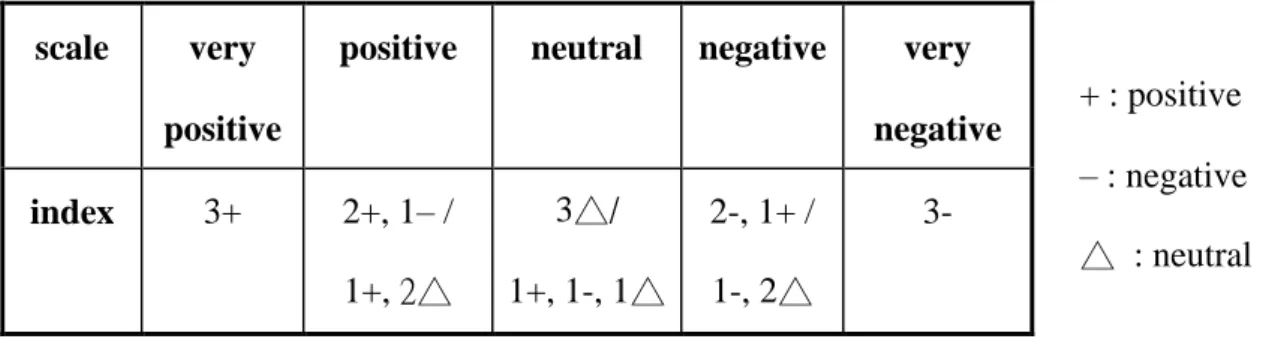
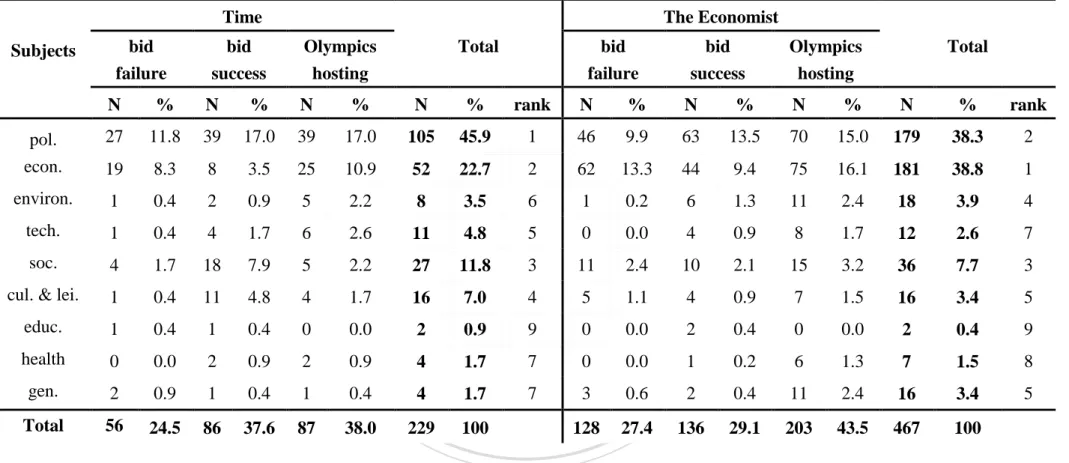
Table 3.1 Index and Scale………..59 Table 4.1 China Coverage in Time and The Economist by Subjects
during Bid Failure, Bid Success, and Olympics Hosting..….…………..69 Table 4.2 Coverage of China in Time and The Economist by Number of Pages…..73 Table 4.3 Coverage of China in Time and The Economist
by Number of Pages throughout the Three Periods………….…………74 Table 4.4 3 Most Covered Topics in Top 5 Subjects in Time and The Economist…83 Table 4.5 Tone of Coverage in Time and The Economist in the Three Periods…….87 Table 4.6 Tone of Coverage in Time and The Economist by Subjects………...95 Table 4.7 Lexical Descriptions of China……….131 Table 5.1 Tones of Favorable, Neutral, Unfavorable
throughout the Three Periods……….166 Table 5.2 Tones of Favorable, Neutral, Unfavorable by Subjects……….167
‧
國
立
政 治 大
學
‧
N
a
tio
na
l C
h engchi U
ni
ve
rs
it
y
ixLIST OF FIGURES
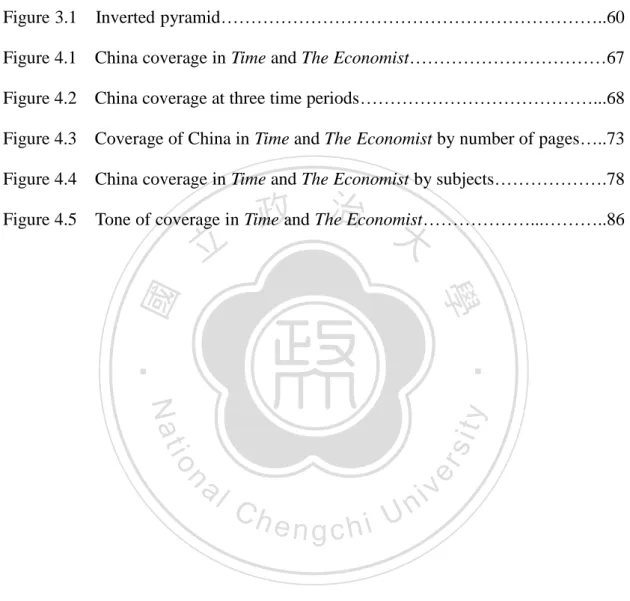
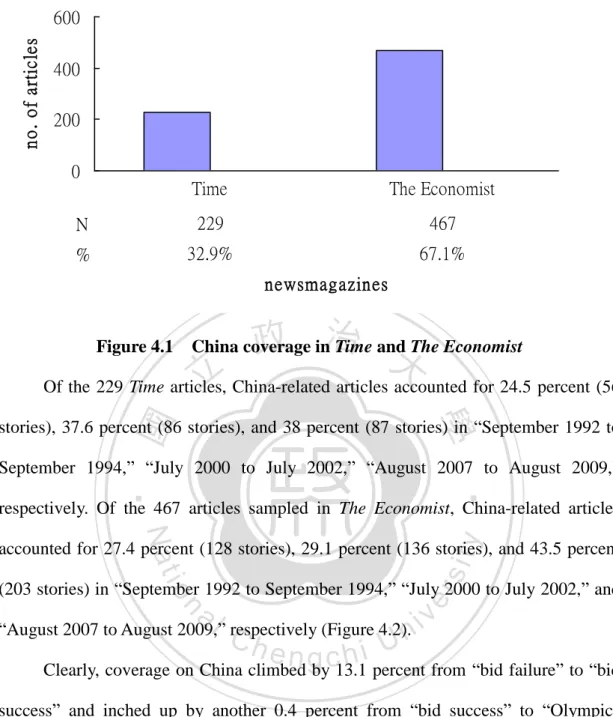
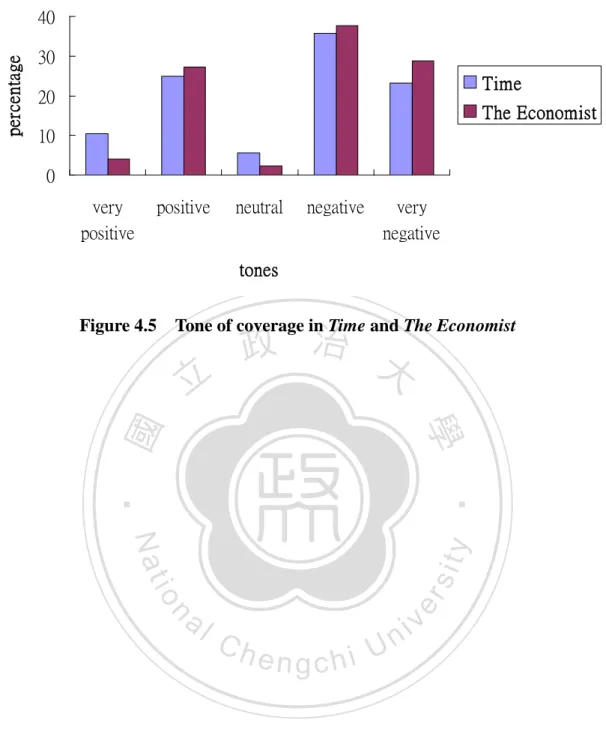
Figure 3.1 Inverted pyramid………..60 Figure 4.1 China coverage in Time and The Economist………67 Figure 4.2 China coverage at three time periods………...68 Figure 4.3 Coverage of China in Time and The Economist by number of pages…..73 Figure 4.4 China coverage in Time and The Economist by subjects……….78 Figure 4.5 Tone of coverage in Time and The Economist………...………..86
‧
國
立
政 治 大
學
‧
N
a
tio
na
l C
h engchi U
ni
ve
rs
it
y
Chapter I
INTRODUCTION
1.1 Mega-Events as Image Makers
On August 24, 2008, the 29th Olympiad in Beijing ended as the last of the fireworks faded away, concluding the 17-day long, once in four years mega-event. Mega-events, such as the Olympic Games, are ―large scale cultural (including commercial and sporting) events which have a dramatic character, mass popular appeal and international significance‖ (Roche, 2000; Horne & Manzenreiter, 2006). Kenneth Roberts in 2004 (Horne & Manzenreiter, 2006) defined mega-events as ―discontinuous, out of the ordinary, international and simply big in composition‖. Bluntly put, ―megas‖ have ―the ability to transmit promotional messages to billions of people via television and other developments in telecommunication‖ (Horne & Manzenreiter, 2006).
Two central features of contemporary mega-events, according to Horne and Manzenteiter (2006), are that they are thought to have significant consequences for the host city, region or nation in which they occur, and that they will attract large amounts of media coverage. Indeed, previous Olympic Games have transformed the host countries one way or another. The 18th Tokyo Olympiad in 1964 brought a great change to Japan‘s transportation system with the introduction of the Shinkansen bullet train, one of the fastest trains in the world (Web Japan, 2008); the 1988 Seoul Olympics brought a political reform in South Korea, in which the military government leader, former South Korean president Chun Doo Hwan, agreed to step down and hold direct elections in December 1987, which paved way for democracy in the country (Pound, 2008); the 1992 Barcelona Olympiad transformed the once rundown city into a famous tourist site with beautiful beaches (Eaude, 2007; Slot, 2008); the 2000 Sydney Olympics was regarded as the ―world-first Green Games‖
‧
國
立
政 治 大
學
‧
N
a
tio
na
l C
h engchi U
ni
ve
rs
it
y
(Maguire, Jarvie, Mansfield, & Bradley, 2002) with the utilization of solar power as primary energy source and recycled timber as building construction materials. Further, public transportation employment was promoted as well (Maguire et al., 2002). Hence, since mega-events act as a stage for host countries to showcase their developments and promote their image in the world, many nations compete with each other for the hosting of such events.
China, one of the world‘s oldest and closed countries, was not an exception. The country has emerged as one of the world‘s most powerful countries. In 1978, Deng Xiaoping‘s economic reform, which opened up China to the world in terms of foreign trade and investment (CIA, 2009), boosted the country‘s economy. As of year 2007, the gross domestic product rate in China has grown at an average rate of 10 percent annually for the past 30 years (MOEA, 2008), ranking as the second-largest economy in the world after the United States in 2008 (CIA, 2009). With its economy rapidly growing, the world is starting to recognize this uprising country and has become more and more interested in its culture and language. Moreover, China has started to become active in participating in international organizations, which could be manifested by its joining the World Trade Organization (WTO) in 2001 and signing Free Trade Agreements (FTAs) with various countries, for example, its cooperation with the Association of Southeast Asia Nations and becoming a participant of the ASEAN Free Trade Area (AFTA), which aims to eliminate tariffs between contract parties (ASEAN, 2009). China‘s rapid economic growth is not without high costs, among which environmental pollution, human rights abuses, and food safety issues seem to have stood out and have tarnished China‘s images overseas. If mega-events like the Olympic Games can help to bring about changes and reform images of host countries, will it do the same for China? If so, in what aspects? This is what this thesis intends to address. However, to answer these questions, an understanding of the
‧
國
立
政 治 大
學
‧
N
a
tio
na
l C
h engchi U
ni
ve
rs
it
y
world‘s contemporary images of environmental pollution, human rights abuses, and food safety in China shall help to background the research problem this thesis attempts to address.
1.2 China Images and the Beijing Olympic Games
People around the world have long held negative images of China‘s environment, human rights, and food product safety, and China has always been on the lookout for platforms to showcase itself and improve its images. The following presents how negative images of the mentioned issues were formed.
1.2.1 Environmental Pollutions
Aforementioned, environmental pollution is one main outcome of the country‘s rapid economic growth in the past decades, and one of the images that flashes into people‘s mind when talking about China. Increased demands of energy, water, and land in the country led not only to a depletion of natural resources and desertification (Beyer, 2006) but also to pollution. Coal, an abundant source energy in China (Goffman, 2007), has long been an important resource that has powered the country‘s economic growth (Economy, 2007). It provides about 70 percent of China‘s energy needs (Economy, 2007; Kim, 2007), with more than half of it used to generate over three quarters of the country‘s electricity supply (Creedy, Wang, Zhou, Liu, & Campbell, 2006; Goffman, 2007). Studies have found that the reliance on coal, one of the dirtiest energy sources (Goffman, 2007), has done great damage to China‘s environment and its people‘s health. According to Economy (2007), 90 percent of China‘s sulfur dioxide emissions and 50 percent of its particulate emissions are the result of coal usage, which are responsible for acid rain and respiratory problems, respectively.
‧
國
立
政 治 大
學
‧
N
a
tio
na
l C
h engchi U
ni
ve
rs
it
y
Aside from coal usage, transportation vehicles contribute a lot to China‘s polluted air as well for they emit carbon monoxide and particulate matters such as lead and sulfur (Beyer, 2006). For Beijing, there was an estimated 2.87 million vehicles at the end of 2006, an increase of 370,000 from 2005 (Li, 2007). The reason is that ―as the city continues to expand and increasingly fewer people report to a local work unit, more and more city residents live and work in different parts of the city…the lack of consideration of integrating land use and transportation systems are causing deteriorated urban transport conditions‖ (Goffman, 2007).
1.2.2 Human Rights Abuses
Given China‘s ideological system and political structure, one other image people have about the country is its human rights records. The Universal Declaration of Human Rights (1948) defines the term ―human rights‖ as an individual having the right and freedom to move and reside within a state, to leave and return to a country; the right to freedom of thought, conscience, religion, opinion and expression, assembly and association; the right to vote, work, and participate in cultural life. All these seem to be wanting in China.
Being ruled by the Communist Party, China is a tightly controlled country that controls freedom of its people and silences dissent. Perhaps, one of the world‘s most implanted images of China‘s human rights abuse is the Tiananmen Square crackdown in 1989, which resulted in casualties among the demonstrators and, consequently, the imposition of economic sanctions by the West.
Suppression of human rights in China has been conspicuously manifested by the jailing of journalists as well. For example, both Shi Tao and Hu Jia, were imprisoned respectively in 2004 and 2007. Hu was sentenced to three-and-a-half years in jail under the name of ―incitement to subvert state power‖ after criticizing China‘s
‧
國
立
政 治 大
學
‧
N
a
tio
na
l C
h engchi U
ni
ve
rs
it
y
social system (Committee to Protect Journalists, 2008). Shi was arrested and charged with ―providing state secrets to foreigners,‖ after Yahoo disclosed his information to the Chinese government for he had forwarded a Chinese governmental document warning journalists not to cover anything related to the Tiananmen Square Incident on the eve of its 15th anniversary in 1994 via Yahoo onto a U.S.-based website
Democracy Forum (Committee to Protect Journalists, 2008). Shi‘s case was
particularly controversial because Yahoo, a U.S.-based company founded in a land known for its freedom of speech and human rights should have connived with a foreign authoritarian government in repressing its user‘s freedom of speech.
The repression of minority groups in Tibet and Xinjiang are also issues brought up often by the international community when talking about human rights in China. The two regions resemble each other in that each, with its own religion and language, has fought to become independent. However, afraid that religious leaders will preach against the Chinese Communist Party and promote independence, temples, mosques, and religious schools are tightly controlled (Human Rights Watch, 2001). Enforced are ―patriotic education‖ courses in which the Chinese authorities require religious figures, such as monks and imams, to study government propaganda (Yardley, 2008; Human Rights Watch, 2001). With such tight control, riots and demonstrations have occasionally broken out, but often resulting to the crackdown and tighter control by the Chinese authorities. For example, in March 2008, five months before the Olympic Games started, Tibetan monks went on the street to commemorate the 49th anniversary of Tibet‘s failed independence uprising in 1959 and to demand for independence again. However, the riot developed into a bloody clash with the Chinese police, who further closed down the region, detained or expelled journalists in the area (Economy & Segal, 2008), and blocked Youtube videos about the protest.
‧
國
立
政 治 大
學
‧
N
a
tio
na
l C
h engchi U
ni
ve
rs
it
y
1.2.3 Food Product SafetyBesides environmental pollution and human rights records, product safety has been an issue both the Chinese people and the government are working to cope with. The safety of products such as food has been a challenge the Chinese government has been facing in the past few years due to its weak enforcement of food and drug regulations, corruption, bribery, and a counterfeiting business culture (Barboza, 2007). From contaminated pet food, toothpaste, toys, seafood, eggs, dumplings, to the recently discovered milk powder for babies, pets and human beings have been affected by the chemicals used in these products.
Melamine, a chemical used to make plastic products, was found in pet foods and milk powder for babies, causing renal problems such as renal failures in pets and kidney stones in children. Diethylene glycol, a poisonous chemical commonly used in antifreeze and brake fluid (the Associated Press, 2007), was found in Chinese-made toothpastes exported to Panama, Haiti, Costa Rica, Australia, the United States, the Dominican Republic, Honduras, and Nicaragua (Bogdanich, 2007). The toxic toothpastes killed nearly 200 people in Haiti and Panama (Barboza, 2007).
Diethylene glycol, a chemical cousin of glycerin, which is a syrup commonly found in food, drugs and household products and usually more expensive (Bogdanich, 2007), was mislabeled as glycerin and imported from China to Panama in 2006 (Barboza & Bogdanich, 2007). Under the circumstances, the Panamanian government accidentally mixed the poisonous chemical into cold medicines and distributed them to its people, killing at least 100 people that year (Barboza & Bogdanich, 2007). Thus, ―Made in China‖ has been a ―warning label‖ (Barboza, 2007) that scares off consumers while purchasing goods.
‧
國
立
政 治 大
學
‧
N
a
tio
na
l C
h engchi U
ni
ve
rs
it
y
1.3 The Beijing Olympics and China‟s Image Building
Against such battered image, China has been actively trying to present itself as a developed and harmonious country to the world by vying to host global events such as the Olympic Games. However, the process was full of twists and turns. In September 23, 1993, Beijing failed the bid for the 2000 Olympic Games to Sydney by a margin of only 2 votes: 45 to 43 (Ching, 2008; Berkowitz, Gjermano, Gomez, & Schafer, 2007). It was widely believed that human rights (Ching, 2008; Berkowitz et al., 2007) and environmental issues (Beyer, 2006) were the reasons why Beijing lost to Sydney for the 2000 Games. In April 1999, Beijing bade for the hosting of the 2008 Olympic Games again, and beat Toronto by 56 votes to 22 votes on July 13, 2001 (Ching, 2008), with the promise of improving human rights situation and environmental problems in the country.
Determined to hold a successful Olympic Games and to change the world‘s image of the country, the Chinese government prepared a ―Beijing Olympics Action Plan‖ and announced that the goals of the 29th Olympiad are ―Green Olympics,‖ ―High-tech Olympics,‖ and the ―People‘s Olympics‖ (BOCOG, 2002).
For ―Green Olympics,‖ priorities will be given to environmental protection in the planning, design, and construction of Olympic venues and facilities, with strict environmental standards. Controls for environmental pollution will focus on the prevention of air pollution and the protection of drinking water sources through the means of increased use of cleaner high-quality energies (e.g. natural gas, solar and wind energy). Bus and taxi drivers will be encouraged to use cleaner gaseous fuel. Further, the Chinese government will push forward urban afforestation as well as raise the public‘s environmental awareness and encourage them to make ―green‖ consumption choices (e.g. commute via public transportations), and to actively participate in activities aiming to improve the environment (BOCOG, 2002; Wei & Yu,
‧
國
立
政 治 大
學
‧
N
a
tio
na
l C
h engchi U
ni
ve
rs
it
y
2006).―High-tech Olympics‖ refers to the application of science and technology in the preparation for the Games. It is proposed that high technology will be used in the designing of the Olympic venues and facilities, transportation management, environmental protection, information and telecommunications, security, and the opening and closing ceremonies of the Olympic Games (BOCOG, 2002). As one Chinese research institution notes (Beijing Development Research Center of the State Council, 2001), the status of a country in the world is often determined by the level of its technology. The Olympic Games is a great opportunity for China to showcase to the world its rapid technological development, and further to promote and establish a new image of China (Beijing Development Research Center of the State Council, 2001).
―People‘s Olympics‖ refers to the promotion of Chinese culture and its people‘s involvement. The Chinese government hopes to introduce the world to the history and development of Beijing as well as the friendliness and hospitality of its people during the Olympic Games. It is hoped that through the understanding of cultures between East and West, trust and friendship among people will stem (BOCOG, 2002).
According to the ―Beijing Olympics Action Plan‖ (BOCOG, 2002), the Chinese Government proposes to be open in every aspect within the country and to the whole world. Their aim is ―to upgrade the opening-up of Beijing to a new level, through the hosting of the Olympic Games, and display to the world a new image of China‖ (BOCOG, 2002). As Beijing‘s Deputy Mayor and a top Olympic official Liu Jingmin has declared, ―By applying for the Olympics, we want to promote not just the city‘s development, but the development of society, including democracy and human rights‖ (Hom, 2008). Pound (2008), a former member of the International Olympic Committee for nearly thirty years, states that ―No host country of the Olympic Games
‧
國
立
政 治 大
學
‧
N
a
tio
na
l C
h engchi U
ni
ve
rs
it
y
has ever been the same after the Games as it had been before, especially countries that had been closed or particularly authoritarian.‖ Similar to the official expectations, a Chinese pro-democracy journalist Li Datong, who was fired after publishing a letter condemning the Chinese government for violating freedom of the press, contends that ―A successful application…would heal a lot of the damage done to the regime‖ (Worden, 2008). By the same token, Wang Dan, a Chinese advocate for democracy and leading student organizer of the 1989 Tiananmen Square incident, publicly supported China‘s Olympic bids because he believed that having ―the international community come to China and engage with our [their] people‖ can help China ―develop a strong civil society‖ (Wang, 2008). Furthermore, Wang (2008) believed that ―the Olympics provide us [them] with a rare opportunity to secure the release of the many dissidents still under detention‖ (p. 102).
Despite supporting voices for China‘s hosting the Olympic Games in hope that the international sporting event could bring about a human rights change to the country, there were others who showed no enthusiasm or desire for China to host the Games, not to mention their optimism for the Games making a change to the country. One such notable voice came from Bao Tong, a former Director of the Office of Political Reform of the Chinese Communist Party Central Committee and Political Secretary to Zhao Ziyang, the highest-ranking official who supported the Tiananmen Square movement, and one who was arrested for his support of the Tiananmen Square protesters. He said:
So far, what we have witnessed are the low wages paid to migrant
construction laborers who work on the infrastructure projects that will serve the Olympics and the continued acquisition of land for new construction projects through administrative means without consultation or adequate compensation to the displaced…There is no doubt…that any good fortune brought by the forthcoming international sporting gala has fallen only into the hands of China‘s ever-richer urban elites…The
‧
國
立
政 治 大
學
‧
N
a
tio
na
l C
h engchi U
ni
ve
rs
it
y
Olympic Games are the ultimate example of the kind of policies that end up serving only a small group of the population (Bao, 2008;
p. 250-251).
Bao (2008) lamented that ―there is sadly little hope that the Beijing Olympic Games will push China any closer to an open society‖ (p. 251). Likewise, Liu Xiaobo, a Chinese writer honored by Reporters Without Borders as a ―defender of press freedom‖ (Liu, 2008), contended that the Olympic Games would benefit both the government and the elite class. Liu (2008) asserts that ―unless the Chinese government can be persuaded to undertake meaningful human rights reforms, the flickering hope for a truly better China could vanish once the flame of the Olympic Torch has been extinguished‖ (p. 272).
Through the ―Beijing Olympic Action Plan‖ and the words of China‘s top officials, it is obvious that China has the ambition of wanting the world to perceive a new China, an open and developed China. However, there have also been opposing voices to China hosting the Olympic Games for they believe that the less privileged are ever more exploited while the elite class gets all the benefits and doubt that the Games will bring about human rights changes to the country. Thus, the purpose of this study is to explore whether hosting the Olympic Games has really made a change in China and helped promote the country‘s images.
1.4 Significance of Study
Perceptions or images of China held in the United States and the United Kingdom have long been given much more attention by the Chinese elites and people. For China, these two countries are the two world powers that have impacted the country‘s development most in modern history. Hosting the Olympic Games thus represents an opportune occasion to publicize China‘s intention and efforts to adapt to
‧
國
立
政 治 大
學
‧
N
a
tio
na
l C
h engchi U
ni
ve
rs
it
y
improve, and even to adapt within the framework implicit in the criticisms by people and media in China‘s two big diplomatic powers. While it is beyond this researcher‘s financial reach to sample people in the United States or the United Kingdom, least the people around the world, for their post-Games images of China, studying the news media in the two countries has become the natural choice. Toward this goal, this thesis will examine the coverage of China in Time and The Economist, the two leading general interest newsmagazines. It is believed that by analyzing the articles relating to China in general and the Beijing Games in particular before and after the Beijing Games, a succinct understanding of the issues at hand can be achieved. The in-depth analysis shall enable us to gain insight into how the two news weeklies ―construct‖ China and the Beijing Games by way of their respective editorial routines and news frames. A comparison of these two news weeklies should also help to reveal the degree to which the United States and the United Kingdom resemble or differ in looking at China now.
Though there have been studies about the images of China in American and British media, as far as the author of this thesis knows, little research has focused on Beijing Olympics and China‘s images in the media, particularly in newsmagazines. By studying Time and The Economist, insights can be gained about the ―image‖ issue at hand and news making as well. Reasons for analyzing these two newsweeklies and the concepts or theories relevant to the analysis will be discussed in the following chapters.
‧
國
立
政 治 大
學
‧
N
a
tio
na
l C
h engchi U
ni
ve
rs
it
y
Chapter II
Images and Framing:
Conceptualization and Literature Review
In his Public Opinion, Walter Lippmann (1956) observes that the real environment is altogether too big, too complex and forever changing for people to obtain knowledge via direct experience. We are not equipped to deal with so much variety and so many combinations. The more we lack direct experience in issues like foreign affairs, the more we must rely on the mass media for information and interpretation of this issue (Hsu, 1990). Thus, the media becomes an important channel for us to understand the world outside. Their coverage and analyses of international news can not only construct social reality for the audience but also shape our images about the international community, as well as affecting the way we think and behave (Chang, 2003).
To the billions of people who have not visited China, their images of the country come from the media‘s news coverage of China (Ciao, 2006), whose coverage shape ―pictures in our heads‖ (Lippmann, 1956). Though the coverage may be incomplete or distorted, it nevertheless forms the basis for people acquainting the outside world (Ciao, 2006). Citing Galtung and Ruge in 1965, Kunczik (1997) argues that the world is comprised of individual and collective actors whose actions are determined by their images of reality. Although images are not shaped solely by the news media, the media‘s ubiquity and perseverance make them in the number-one position as international imageformer.
Scholars (Dong, Li, Shi, Yu, Chen, & Ma, 2005) have argued that the Olympic Games is a great opportunity for nations to construct and promote their images. Especially nowadays the Games can be disseminated to every corner of the world via satellite telecasting and the Internet. This is especially important for China, for as
‧
國
立
政 治 大
學
‧
N
a
tio
na
l C
h engchi U
ni
ve
rs
it
y
discussed in the previous Chapter, the international community commonly holds a battered image of China. They argue that through showcasing China‘s development in aspects like technology, people‘s images of China could be reshaped (Dong et al., 2005).
So, how does the media shape people‘s images and affect their thinking of other nations? What are the other factors that shape people‘s images of each other besides the media? In the following sections, these questions will be delved into by reviewing the pertinent theorizing and research on images and framing.
2.1 Theories on Images and Framing
2.1.1 Images of a Nation
The term image comes from the Latin word imago, which is related to imitari, meaning ―to imitate‖ (Boorstin, 1971; Nimmo & Savage, 1976). Thus, Boorstin (1971) defines image as ―an artificial imitation or representation of the external form of any object, especially of a person‖ (p. 197). In other words, image is ―a physical likeness or representation of a person, animal, or thing, photographed, painted, sculptured, or otherwise made visible‖ (Random House Webster‘s College Dictionary, 2000). They are ―pictures in our heads‖ (Lippmann, 1956), constructed via what we see, the experiences we have encountered and the knowledge we have obtained. Similarly, Boulding (1956) contends that images are built up of an individual‘s past experiences, which govern that person‘s behavior. Merrill (1962) asserts that the term image is a composite of impressions, opinions, and attitudes, and a characterization of the people and government of a country.
National image, then, refers to the international community‘s overall assessment of the stability of a particular country (Bu, 2009), including politics, economy, and society (Zheng, 2003). It is the images of a nation‘s political regime,
‧
國
立
政 治 大
學
‧
N
a
tio
na
l C
h engchi U
ni
ve
rs
it
y
diplomacy, leader, governmental officials, citizens, culture and history (Fu, 2004). According to Boulding (1959), nations‘ images of each other can be described in terms of a set of ―relevant variables,‖ which are: geographical space, ordinary and powerful people, hostility or friendliness, and the strength or weakness of a nation-state.
Geographical space is the territory of a state, which is often the result of conquering the other nation. Powerful people refer to the decision-makers in a nation, whose power may be measured by the number of people their decisions potentially affect. These people include the head of state, the prime minister, the secretary of state, minister of foreign affairs, and chiefs of the armed forces. The hostility or friendliness of a state on the whole refers to the idea that if nation A pictures itself as hostile toward B, it usually also pictures B as hostile toward itself. Moreover, Boulding (1959) contends that most nations seem to deem that their enemies are more hostile toward them than they are toward their enemies.
One important sub-dimension of this hostile-friendliness image is the stability of the relationship. Friendly relationships are usually formalized as an alliance, which changes as the world kaleidoscope changes, as new enemies rise, or as governments change (Boulding, 1959). For example, the relationship between China and the United States changed greatly after the September 11 attack of the World Trade Center and the Pentagon in America. Former President of the United States, George W. Bush Jr., even called China an ally in fighting against terrorism. Lastly, the strength or weakness of a nation-state is usually thought of as whether the military forces of the state have the ability to protect its country or not. Economic resources and productivity, political organizations, and morale of the people are all elements to assess the strengths and weaknesses of a nation.
‧
國
立
政 治 大
學
‧
N
a
tio
na
l C
h engchi U
ni
ve
rs
it
y
eight years, the image of America was manifested by Bushism, an ―-ism‖ that was formed under the Bush administration during 2000-2008. Bushism had the characteristics of pursuing after the four absolutes—absolute homeland security, absolute military superiority, absolute dominant power of the world, and absolute hegemony, ignoring international laws and agreements on arms control and the environment, applying the ―forestalling the enemy‖ tactic, establishing the anti-terrorism standards as the U.S. wish. Thus, the image of America was ―arrogant‖ and ―peremptory‖ (Zakaria, 2009) during the Bush years.
As for the image making of China, the greatest contribution to China‘s images could be attributed to Deng Xiaoping, who was most concerned with the development of China during his last twenty years (Zheng, 2003). His ―four modernizations‖ and ―open door policy‖ shaped China into a developing country. The ―Open door policy,‖ in particular, has brought about the rapid growth of economy, which is one of the world‘s images of China these days (Goodman, 1994). A year before the Games took place, a member of the Politburo Standing committee noted that ―the successful reform policies had brought ‗rapid economic and social development‘ which had given China the ‗capability and conditions‘ to host the Games and display China‘s ‗splendid accomplishments‘‖ (deLisle, 2009). While former President Jiang Zemin worked to portray China as a peace-loving and anti-hegemonic country (Zheng, 2003), the incumbent Hu Jintao strived to form friendly ties with its neighboring countries, increase the possibilities of cooperating with all countries, and promote China‘s influential role in the world (Zheng, 2003).
Many incidents occurred before the 2008 Beijing Olympic Games, such as unsafe food products, Tibetan demonstration, and the Sichuan earthquake, with each forming the images of China as a country that produces low quality products including food and buildings as well as a country that suppresses minority and human
‧
國
立
政 治 大
學
‧
N
a
tio
na
l C
h engchi U
ni
ve
rs
it
y
rights. Though most of the images of China are negative, there are still positive and touching images of China disseminated via TV channels, especially images of the Sichuan earthquake on May 12, 2008. Perhaps one of its most touching images was the one showing Chinese Premier Wen Jiabao comforting a little girl who lost contact with her parents after the earthquake. With a choked voice, he said to the crying little girl that ―there is still the government to look after you‖. Here, Wen was portrayed as a leader caring for his people and feeling what his people were feeling.
Whether the image of a nation presented to the audience is positive or negative is determined by how news media frame the events, issues, figures, or place of the country. So, what is a frame? How do journalists frame events and figures? What are the effects of frames? These are some of the questions further explored in the next section.
2.1.2 Framing
The concept of framing was first brought up by Bateson, who defines ―frame‖ as the psychological principles and subjective process in which individuals understand and organize events (Tsang, 1999). However, it was not until Goffman published
Frame Analysis in 1974 did scholars further delve into this concept. Following
Bateson‘s psychological definition, Goffman (1974) defines ―frame‖ as ―the principles of organization which govern events—at least social ones—and our subjective involvement in them.‖ He further asserts that frame is a schema originated from people‘s past experience, through which individuals interpret and understand the real world, answering the question of ―what is it that‘s going on here‖ (Goffman, 1974)? It enables users ―to locate, perceive, identify, and label‖ occurrences in this world.
‧
國
立
政 治 大
學
‧
N
a
tio
na
l C
h engchi U
ni
ve
rs
it
y
definitions of ―frame‖ and ―news frame‖. Gamson (1989) defines news frame as ―a central organizing idea for making sense of relevant events and suggesting what is at issue‖ through the use of selection, emphasis, exclusion, and elaboration (Tankard, 2001; Zaharopoulos, 2007). They are constructed from and embodied in the metaphors, keywords, concepts, symbols, and visual images (Entman, 1991). Parson and Xu (2001) define framing as a cognitive process journalists engage in when they seek to organize and make sense of what happens. Entman (1993) contends that to frame is ―to select some aspects of a perceived reality and make them more salient in a communicating context, in such a way as to promote a particular problem definition, causal interpretation, moral evaluation, and/or treatment recommendation for the item described‖ (p. 52). Thus, the functions of framing are those of defining problems, diagnosing causes, making moral judgments, and suggesting remedies (Entman, 1993).
The process of framing is often conceptualized as an active process for it involves selection (Zaharopoulos, 2007). Goffman (1974) conceptualizes that journalists package news stories and give stories meanings in the process. They decide which elements to include or to exclude in a story; hence, events can be framed in various ways, producing different versions containing different attributes (Tankard, 2001). Parson and Xu (2001) argue that these frames, or ‗internal structures of the mind‘ are often based on external values such as social norms, organizational constraints, and interest-group pressures. In their analysis of ―News Framing of the Chinese Embassy Bombing by the People’s Daily and the New York Times,‖ they examine how the two most prominent newspapers of China and the U.S. frame the bombing of the Chinese Embassy by the U.S. military in Belgrade and the aftermaths of the event. Their textual analysis of key words in the two newspapers, particularly adjectives that reflect ideological frames found that the New York Times repeatedly
‧
國
立
政 治 大
學
‧
N
a
tio
na
l C
h engchi U
ni
ve
rs
it
y
called the Chinese Embassy bombing as ―the accidental bombing‖ (p. 57), whereas
People’s Daily called it ―the brutal attack‖ (p. 57). As for the aftermaths of this event,
of which the Chinese protested outside the U.S. embassy in Beijing, The New York
Times framed the student protests as ―choreographed‖ (p. 59), while the People’s Daily referred to them as ―spontaneous expression of indignation‖.
Kobland, Du and Kwon (1992) argue that news is a channel for which ideology is conveyed through the choice of words used to describe characters and events, the way in which events are framed, the tone and emphasis of the news story as well as the way it is organized, and the selection and omission of events. Akhavan-Majid and Ramaprasad (1998) argue that framing is an important mechanism by which ideology is transmitted via the news, and identify three types of ideology that influence the framing of news: dominant ideology, elite ideology, and journalistic ideology or occupational ideology. They see capitalism, anti-communism and male world views and values are examples of dominant ideology within the American society. Elite ideology refers to the particular ideology or policy orientation of the government or administration in office at a particular point in time. Occupational ideology functions as a major source of influence on how news is framed. For example, journalists‘ preferences for official actors and sources can affect how characters and contents in news stories are shaped (Akhavan-Majid & Ramaprasad, 1998).
Akhavan-Majid and Ramaprasad (1998) state that U.S. newspaper stories covering China has reflected the dominant ideology. One predominant frame used when covering China has been that of the ―anti-communism‖ (Kobland et al., 1992; Akhavan-Majid & Ramaprasad, 1998), and the ―deceitfulness of communists‖ (Kobland et al., 1992) has been often used as a narrative in the American press. Further, the press‘s coverage of the communist countries has ―almost entirely focused on the problems and failures of Marxist governments (Kobland et al., 1992;
‧
國
立
政 治 大
學
‧
N
a
tio
na
l C
h engchi U
ni
ve
rs
it
y
Akhavan-Majid & Ramaprasad, 1998). The influence of anti-communist frame on the news can be manifested by Entman‘s (1991) study of how the American media cover the Korean Airlines and Iran Air incidents, of which the former was shot down by a Soviet fighter plane in 1983, and the latter was shot down by the U.S. Navy ship in 1988. Entman (1991) found that in the Korean Airlines case, the frame stressed on the moral bankruptcy and guilt of the perpetrating nation—the Soviet Union, whereas in the Iran Air case, the frame de-emphasized guilt and focused on the complex problems of military technology operation.
Xie (2007) in ―Framing China: A Comparative Study of U.S. Elite Newspaper‘s Coverage of Nixon‘s Visit to China and the Chinese President‘s Visit to the U.S.‖ found that the dominant ideology –the anti-communist frame—was used by the New
York Times and the Wall Street Journal when covering the Presidents‘ visits.
Media framing is important because it can have powerful effects on the audience (Tankard, 2001; Zaharopoulos, 2007). It can shape their opinions about topics which they are ignorant (Tuchman, 1978). Kahneman and Tversky‘s experiment of the power of framing in 1984 is the most widely cited example (Entman, 1993). In ―experiment one‖ of their study, they asked participants:
Imagine that the U.S. is preparing for the outbreak of an unusual Asian disease, which is expected to kill 600 people. Two alternative programs to combat the disease have been proposed. Assume that the exact scientific estimates of the consequences of the programs are as follows:
If Program A is adopted, 200 people will be saved. (chosen by 72%)
If Program B is adopted, there is a one-third probability that 600 people will be saved and a two-thirds probability that no people will be saved. (chosen by 28%)
In ―experiment two,‖ the statements were phrased as follows:
If Program A is adopted, 400 people will die. (chosen by 22%)
‧
國
立
政 治 大
學
‧
N
a
tio
na
l C
h engchi U
ni
ve
rs
it
y
and a two-thirds probability that 600 people will die. (chosen by 78%)
The importance of this study is that it illustrates that frames determine whether people notice and how they understand and remember a problem, as well as how they assess and choose to act upon it (Entman, 1993).
Price and Tewksbury (1997) also note that framing is important because it has the potential to influence public opinion about a covered event and the people involved in it. Price, Tewksbury, and Powers‘s (1997) study found that news frames can affect audience's perceptions of issues and people in the news by stressing specific values and facts. Similarly, Kensicki (2004) asserts that frames influence how the public thinks about an issue by defining the issue, stating who or what is the cause, and suggesting what should be done. Tankard cited Lang and Lang‘s (1983) study of the formation of public opinion on the Watergate scandal during Nixon‘s presidency in early 1970s, which found an important shift away from support for President Nixon when the media changed their framing. The press originally used the frame of ―Watergate caper.‖ Public opinion began to change only after the frame changed to a national political scandal (Tankard, 2001).
Ghanem (1997) identifies four dimensions of media frames: the topic of a news item (what content is included in the frame), presentation (size and placement), cognitive attributes (details of what is included in the frame), and affective attributes (tone). The affective dimension deals with the public‘s emotional response that may result from how a journalist covered a story, and the narrative structure of the news is one way the media exerts this response (Ghanem, 1997). Ghanem (1997) further argues that one of the weaknesses of most framing studies is that the attributes of an issue are not generalizable to other issues, thus, these four dimensions could act as the basis of comparisons across different issues.
‧
國
立
政 治 大
學
‧
N
a
tio
na
l C
h engchi U
ni
ve
rs
it
y
According to Zaharopoulos (2007), the importance of framing research is reinforced via media effects studies. For example, De Vreese (2004) found that ―frames in television news have the ability to direct viewer‘s thoughts when conceiving of a contemporary public issue.‖ Thus, as framing has the power to shape how one perceives an issue and can affect one‘s thoughts, one of the aims of this study is to find out how Time and the Economist frame the Beijing Olympics.
2.2 Research on Images and Framing of China
Many scholars have conducted studies on the images of China, on how the Western newsmagazines perceive China, how American newspapers cover the Fourth UN Conference on Women and the NGO Forum in Beijing, how hosting the Olympics will affect China‘s image, and the Olympics bidding experiences of China, etc.
A study by Wang (2003) found that the Chinese government has been quite attentive to China‘s national image for the past few years, from establishing an Overseas Propaganda Department under the Party Central Committee in 1990 and a new Information Office under the State Council in 1991, to hiring international media expertise to polish China‘s image. For example after the Tiananmen Square crackdown in 1989, Beijing hired an American firm ―Hill and Knowlton‖ to help deal with the country‘s public relations image problem (Hom, 2008). The same firm was employed again in 2006 by the Chinese government to act as its ―communications consultant‖ (Hom, 2008). Further, Beijing either sponsored or organized cultural events in other countries to help promote the country‘s image (Wang, 2003). Wang conducted content analysis of the Peking Review and the Government Work Reports from 1954-2002 and found that for the past forty-some years, the Chinese government has tried to build images of China as ―a peace-loving country, victim of foreign
‧
國
立
政 治 大
學
‧
N
a
tio
na
l C
h engchi U
ni
ve
rs
it
y
aggression, socialist country, bastion of revolution, anti-hegemonic force, developing country, major power, international cooperator, and autonomous actor‖ (Wang, 2003). The findings of Wang‘s research indicated that the Americans‘ perceptions of China correspond with some of the images the country projected (Wang, 2003). Americans share the view that China is a socialist country, a developing country, and a major power. They sometimes view China as opposing to hegemonic behaviors, but more often as engaging in hegemonic behaviors. Likewise, they sometimes see China as a victim of foreign aggression, but more often view China as victimizing her own neighbors. Lastly, Americans view China as militant and an obstructive force, which greatly contrasts to China‘s projected images of being peace-loving and an international cooperator.
―On Shaping China‘s National Image,‖ Zheng (2003) notes that the national images China has established are images of actively participating in international affairs such as Asia-Pacific Economic Cooperation (APEC) and ASEAN Regional Forum (ARF), maintaining world peace, respecting the diversity of cultures and civilizations, and a developing and stable country. However, Zheng (2003) did not provide empirical evidences.
Ono and Jiao (2008) in their study ―China in the US Imaginary: Tibet, the Olympics, and the 2008 Earthquake‖ found that articles related to the Olympics in the
New York Times emphasized protests of the travel of the Olympic torch to 135 cities
around the world and then to Mount Everest; news coverage about Tibet suggested that China treats Tibet as its colonized nation; articles covering the Sichuan earthquake praised the Chinese government and military‘s responsiveness to the disaster, while at the same time criticized the government‘s failure to construct quake-proof buildings. Ono and Jiao (2008) analyzed 89 articles covering China in the New York Times from July 1, 2007 to July 1, 2008. Basing on their findings, it is
‧
國
立
政 治 大
學
‧
N
a
tio
na
l C
h engchi U
ni
ve
rs
it
y
obvious that a year before the Olympics started, the world‘s leading newspaper still holds a negative view regarding some of the greatest issues in China.
In ―How Americans See Us,‖ Zhang, a resident correspondent in Washington, D.C. notes his experience of interacting with many Americans, and found that Americans have distorted images of China. The most common phrases they used to describe China were ―dictatorship,‖ ―totalitarian,‖ ―authoritarian,‖ ―communism,‖ ―violation of human rights,‖ ―persecution of Falun Kung,‖ and ―threatens to take Taiwan by force‖ (Zhang, 2003). Zhang (2003) further argues that American perceptions of the Chinese can be generalized by describing the views of four groups: the ―parrot group,‖ the ―thoughtful group,‖ the ―pragmatists,‖ and the ―marble-headed group,‖ with each group having its own characteristics and source of information about China (p. 115).
The ―parrot group‖ reflects the views of the majority of Americans. People‘s knowledge of China in this group is limited, and their views of China are shaped largely by the media. Like parrots, people in this group echo others‘ views about China. Hence, the American media play a very influential role here (Zhang, 2003). People in the ―thoughtful group‖ are intellectuals, particularly academic professionals who pay visits to China regularly and have conducted research on Chinese culture, history, and society, for they are greatly interested in the differences between China and the United States and in how to build bridges between the people (Zhang, 2003). Thus, people in this group take the analytical approach to viewing China, rather than the political approach.
The ―pragmatist group‖ consists of business people and diplomats who work to advocate healthy ties between China and the United States (Zhang, 2003). Lastly, people in the ―marble-headed group‖ oppose to almost anything related to China (Zhang, 2003). According to Zhang (2003), this group is small but vocal, and their
‧
國
立
政 治 大
學
‧
N
a
tio
na
l C
h engchi U
ni
ve
rs
it
y
anti-China stand is a result of ignorance.The State Council of the People‘s Republic of China analyzed three American newspapers‘ coverage of China during the year 2005—the New York Times,
Washington Post, and USA Today (Jing & Yuan, 2007). Their research demonstrated
that out of 243 coverage in all, 26% of them were objective, 40% were biased, and 40% were neither objective nor biased. This was a great difference compared to that of the news coverage of China in the 1990s, where biased coverage accounted for 60%-70%.
Xiang (2006) analyzed how The Times covered China‘s economics, politics, society and culture in year 2005. The scholar‘s findings showed that China was portrayed as an emerging economic superpower, the government stereotyped as a dictator, the society depicted as dirty, disordered and backwards, and its culture presented as mysterious and fascinating.
Similarly, Si and Su (2007) studied how The New York Times covered China‘s economics, politics, society, culture and technology in year 2006. Their findings indicated that though coverage of China increased over time, negative articles still account for most of the coverage, especially in articles on politics and society, while coverage on economics were mainly positive. Relatively, coverage on culture and technology were more objective.
Guo, Wang, Yu, Tang, Chen, and Li (2009) content analyzed the reports of China from 2004 to 2008 in The New York Times and The Times. They found coverage of China in both newspapers increased significantly over the years and that China‘s economy was portrayed as rapidly developing. However, the country‘s politics was depicted as closed, whereas its society was described as a society with clashes and conflicts frequently occurring. Further, The New York Times became friendlier towards China, in which its attitude changed to a positive direction, while The Times showed a
‧
國
立
政 治 大
學
‧
N
a
tio
na
l C
h engchi U
ni
ve
rs
it
y
trend of ―depoliticizing‖ on China-related reports, meaning coverage on China‘s politics reduced more than half in the period of 2007 to 2008 as compared to that of 2000 to 2003. Though images of China changed, the western media‘s prejudice against China still remains.
Ciao (2006) argues that if China‘s corruption and coal mining disasters were framed as follows for example, different images of the country will be generated: Frame 1.
Corruption and coalmining disasters are particular phenomena in China. The coalmining disasters imply a corruption of the officials, which the Chinese government has managed in vain. Complaints are heard everywhere. The
Chinese media are afraid to cover these kinds of stories [in fear that they will be revenged]…Unless the Chinese government made a change to the current political systems, the problem of corruption will remain.
* Brackets added by the author of this thesis.
Frame 2.
Corruption and coalmining disasters are common problems in developing countries. Due to unsound systems and lack of official surveillance, many
societal problems have surfaced one by one during China‘s societal
transformation, a result of its economical uprise. There have been comments from the citizens…The Government has been constantly fighting corruption, and the situation has improved. However, problems continue to surface, and the media will continue to do a follow up.
In ―frame 1,‖ the Chinese government is portrayed as incompetent and one who suppresses freedom of the press. In ―frame 2,‖ the Chinese government is portrayed as