
從普通,常態到有創造力之多文化團隊的分合概念模型
94
0
0
全文
(2) From Convention To Creative A Conceptual Model Of Multicultural Teams’ Divergence and Convergence. A THESIS SUBMITTED TO THE DEPARTMENT OF MANAGEMENT ON GRADUATE STUDIES OF NATIONAL SUN YAT SEN UNIVERISY IN PARTIAL FULFILLMENT OF THE REQUIREMENTS FOR THE DEGREE OF BUSINESS ADMINISTRATION. Chengyu Wu December 2005. Advisor: Prof. Gary Hu. 2.
(3) Abstract When a multicultural team is formed of say six individuals of different cultural backgrounds, there will be potential conflicts and greater varieties. However, there will be a “normal” curve forms the range and permissible boundaries of a team. In concept, this normal distribution is the “calm” state when the team is not active (norms). The potential is the range of team members’ abilities/differences (divergences). To be able to reach the potential and perform is part of the team’s goal (convergences & attributions). But to expect something more than expected is cultural synergy (break the original boundaries). The factors that will be considered as diverging forces are the differences that are born (already exists) when the team is formed. In order to model these cultural factors and estimate these cultural differences, Hofstede cultural dimensions are used. The factors that will be considered as converging forces are what each individual believe in such as perspective taking and self-leadership. These values are projected from the assessments of team individuals. The factors that will be considered as supporting forces (attribution factors) are how each member interacts with one another during the process. These are each individual behavior and personality. Therefore, from the perspective of divergence and convergence to see how cultural differences influence the teams and talk about their possible behaviors and reasons behind them is a conceptual way to look at the team. Based on the concept described above, the analysis of these different forces on multicultural teams is conducted. Using these factors, the paper explains/examines: Cultural and individual values differences Wish to base on the findings from the research to make helpful inferences on the learning and performance of multicultural teams. Cultural divergent factors Individual convergent factors Individual attribution factors Cultural synergy. 3.
(4) Acknowledgement First and foremost, I would like to thank Professor Gary Hu, for his kindly support and friendship. Without his classes, my life will be missing out important chapters; and without him, I will be much less of who I am today. I would also like to express my appreciation for Professor Robert Chen and Professor William Chao for the help on my research. My appreciation also extends to my classmates at International Organizational Behavior Class, who had provided me with valuable questionnaires and wonderful memories. Many thanks go to my IMBA classmates at National Sat Yat-Sen University. It is from them, I found some equally blessings besides my family.. 4.
(5) Contents. I II. Abstract Acknowledgements Introduction Literature Review & Points of Departure i. ii. iii. iv. v. vi. vii. viii. ix.. III. IV. V. VI. 8 10. What is Culture? Why Multicultural Team? Norming: Convention & Convergence Performing: Creativity & Divergence Divergence Factors Convergence Factors Attribution Factors Public vs. Private Cultural Synergy: Divergence & Convergence Again. 11 12 13 15 20 23 25 26. Objective and Approach. 28. i. ii. iii.. 29. Objectives Approach Steps. Observations & Discussion. 35. i. ii. iii. iv.. 36 60. Case Observations The Apollo Syndrome Language Barrier Evolution Changes of Team Members. 61. Modeling. 63. i. ii.. 67. Propositions Conceptual modeling. Conclusion References Appendix A Appendix B Appendix C. 76. 5.
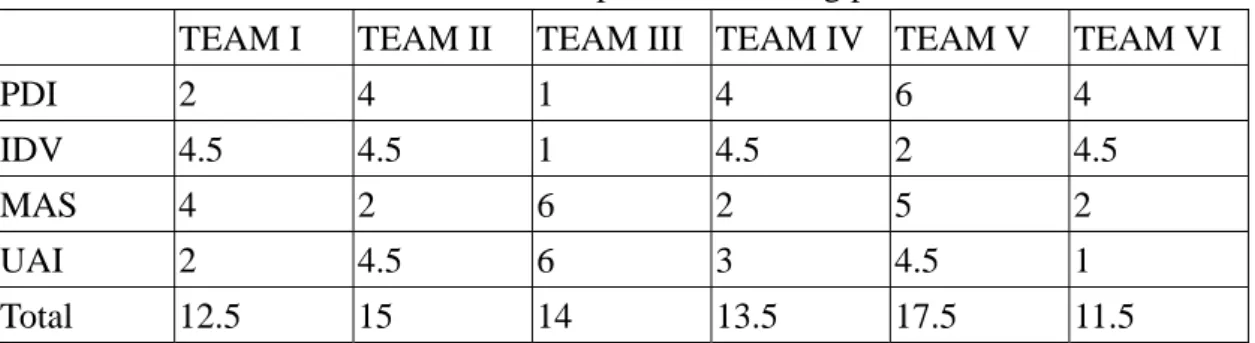
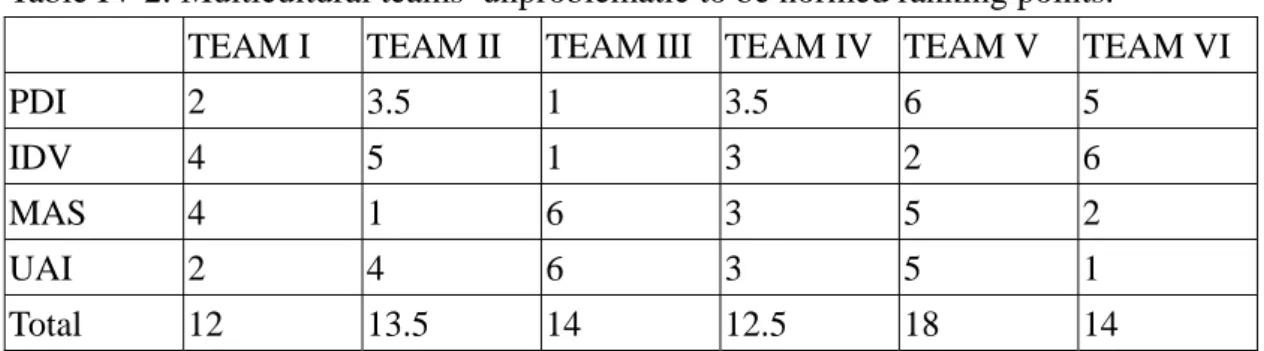
(6) List of Tables Table II-1: Comparison between high and low self-efficacy. 21 Table IV-1: Multicultural teams’ creative potential ranking points. 44 Table IV-2: Multicultural teams’ unproblematic to be normed ranking points. 45 Table IV-3: Convergence factors ranking points. 54. 6.
(7) List of Figures Figure IV-1: PDI Ranges & Norms 36 Figure IV-2: IDV Ranges & Norms 38 Figure IV-3: MAS Ranges & Norms 40 Figure IV-4: UAI Ranges & Norms 42 Figure IV-5: IND Ranges & Norms 46 Figure IV-6: COL Ranges & Norms 47 Figure IV-7: LC Ranges & Norms 50 Figure IV-8: EFF Ranges & Norms 51 Figure IV-9: SL Ranges & Norms 52 Figure IV-10: EMP Ranges & Norms 56 Figure IV-11: TP Ranges & Norms 59 Figure V-1: The differences in Hofstede’s PDI cultural dimension. 68 Figure V-2: The differences in Hofstede’s IDV cultural dimension. Figure V-3: The differences in Hofstede’s MAS cultural dimension. 69 Figure V-4: The differences in Hofstede’s IDV cultural dimension. Figure V-5: TEAM V members’ cultural dimensions. 70 Figure V-6: TEAM V members’ cultural dimensions. Figure V-7: TEAM V power distance ranges and average. 71 Figure V-8: TEAM V members’ power distance values on a radar graph. Figure V-9: TEAM V members’ power distance index from the “norm”. 72 Figure V-10: TEAM V members’ cultural dimensions. Figure V-11: TEAM V members’ cultural dimensions’ from the “norms”. 73 Figure V-12: TEAM V members’ cultural dimensions’ ranges. Figure V-13: Team evolution from Individuals. 74~75. 7.
(8) I. Introduction Just like Japanese industrial success of 1980s has made the emphasis of individuals into teams, globalization has made transformation of homogenous teams into multicultural ones. A team with different cultures lever more complexity in exchange of potential for greater creativity. This thesis aim to conceptualize the driving forces required in the multicultural team in a condition where the team is already accepted the cultural differences. Teams can make better decisions; develop better products and services, as well as formulate a more energized workforce than people who work alone. On the other hand, culturally diverse teams often perform either more or less effectively than their single-culture counterparts. (Kovach, 1976) Nonetheless, the multicultural team will go through the same process as a homogeneous team has, just like a society did. Through socialization process, people are educated to follow a norm, and most people won’t oppose it. In homogeneous or multicultural teams, norming is reaching a “cultural” convention on how the members should conduct themselves, approach things, as well as roles and requirements. In other words, it is the process of reaching a balance. Even though, multicultural teams use more time and effort in creating cohesion than homogeneous ones, they do offer potentials for creativity and synergetic solutions that are in desperate needs of the ever-converging globalization world. However, creativity comes from laying aside the rules. Only at that moment can one assemble what’s already there and be creative. Therefore, creativity puts forward an ideation of breaking up the boundaries, and valuing the differences. There are common traces seem to exist on those creative minds, who go extremes to look for “answers”. They “believe” in something, and willing to “deviate” from the social norm to expand range of views and explore possibilities. They are not necessary try to be “creative”, but rather, find a solution that helps. To be creative, one has to go divergent from the norm to the extremes. Similarly, for the team to perform, it is necessary to think divergently and look for options. And the first step in divergent thinking is to be open. However, the divergence factors are not only factors that diversify a team, but they also refer to a step conceptually when team is performing. Basically, Hofestede’s cultural dimensions 1 , power distance (PDI), individualism (IDV), masculinity (MAS), and uncertainty avoidance (UAI), represent these collective values of divergent cultures. To see the possible difficulties and performance of a multicultural team, it is essential to use these general cultural factors 1. Hofstede proposed that cultural factors have two aspects: practices and values. 8.
(9) as a starting point. In contrast, convergence is the process of choosing the best alternatives perhaps after refining them. In order to select from the divergent possibilities that is not only creative but also practical, the union has to take place to reach an intelligent decision. The convergence factors, in another words, have to motivate individual team members to reach the group goal. And the intrinsic motivations that come from within are what really energizes and motivates individuals. Thus, the convergence factors call attention to individual determinations. These determined motivations, like energy sources, seem to be the link among the divergence, convergence and attribution factors. Attribution factors, on the other hand, are complementing aspects that bring about team efforts. They encourage team commitment. Perspective taking, team player inventory as well as team roles can be good indications of these efforts. Therefore, attribution factors are forces that “manage” the divergence and convergence forces: Only with the attribution factors to manage diversity and motivations, a highly productive team is possible. Nevertheless, Trompenaars classified specific and diffused oriented cultures. He thinks people in specific cultures tend to have a larger public area and small private area and more guarded. They are more direct and prefer to keep private life separate. On the contrary, in diffused cultures, the private space is usually larger while the public space is smaller and more guarded. They are more indirect and introvert, and also view private and work as linked, and the flexibility is very important to them. The ultimate act of a multicultural team is to create cultural synergy, where in conception, the sum is greater than its parts combined. With every culture’s perspectives in mind, it is possible to create a cultural synergetic solution beyond the best existing alternatives. Multicultural team members learn from one another to enhance the overall team productivity and effectiveness. This is a process of combining and leveraging various cultures. With “cultural awareness”, the ideas won’t seem strange. As a result, synergy is more likely to occur in a multicultural team than a homogeneous team. In order for the multicultural team to perform, members have to converge into a norm to form a new convention. And to perform, the multicultural team has to diverge again to find the possible alternatives. On the path of diverging and converging, a multicultural team will have a wider range to look for that unexpected discovery.. 9.
(10) II. Literature Review & Points of Departure Culture influences people from how they think, how they behave, and what they value, into their sub consciousness. In a way, culture is the collectively held values, predominating attitudes, and behaviors that characterize the functioning of a group. Team, on the other hand, is formed by a small number of people with complementary skills. They hold each other accountable in a “common approach” toward “a common purpose and performance goals”. These are micro-level behaviors that “at the project level, when participants make decisions or coordinate with each other, their behavior is based on their values.” (Horii, Jin & Levitt, 1996) What is Culture? According to American Heritage Dictionary, the definition of culture is: 1. a. The totality of socially transmitted behavior patterns, arts, beliefs, institutions, and all other products of human work and thought. b. These patterns, traits, and products considered as the expression of a particular period, class, community, or population: Edwardian culture; Japanese culture; the culture of poverty. c. These patterns, traits, and products considered with respect to a particular category, such as a field, subject, or mode of expression: religious culture in the Middle Ages; musical culture; oral culture. d. The predominating attitudes and behavior that characterize the functioning of a group or organization 2. Intellectual and artistic activity and the works produced by it. 3. a. Development of the intellect through training or education. b. Enlightenment resulting from such training or education. 4. A high degree of taste and refinement formed by aesthetic and intellectual training. 5. Special training and development: voice culture for singers and actors. Culture is very hard to define since it covers a whole range of scopes. It is obvious but also hidden in people’s subconscious. People from their own cultures sometimes can’t get the full perceptive and don’t know why their behaviors follow these “granted” patterns. Indeed, cultures influences individuals’ life from how they think to how they behave and what they value. 10.
(11) It maybe wrong to “stereotype” a culture, but it is a starting point before one can full embrace the extents of it. So Edgar Schein once said, “Culture is the deeper level of basic assumptions and belief that are shared by members of an organization, that operate unconsciously and define in a basic ‘taken for granted’ fashion an organization’s view of itself and its environment.” While others like Geert Hofstede views “Culture is the collective programming of the human mind that distinguishes the members of one human group from those of another.” Culture in this sense is a system of collectively held values. Then, similar to cultures, teams will develop collectively held values. In a sense, team will develop a “culture” like organization have organizational culture and this is a collective representation of individuals combined. McShane & Von Glinow (2005) define teams are groups of two or more people who interact and influence each other, are mutually accountable for achieving common goals associated with organizational objectives, and perceive themselves as a social entity with an organization. There are some characteristics of a team. It is formed by a small number of people. Individuals with complementary skills are usually needed to form the team. Often, they hold each other accountable in a “common approach” toward “a common purpose and performance goals”. However, according to Peter Scholtes, there are ten common teaming problems such as floundering, overbearing participants, dominating participants, reluctant participants, unquestioned acceptance of opinions as facts, rush to accomplishment, attribution, discounts and “plops”, wanderlust: digression and tangents, and feuding members. Then, with these many possible drawbacks, why team? Why multicultural team? Why multicultural team? The importance of successful teams has been ascribed in winning organizations. Partly due to Japanese economic miracle of 1970s, there have been more and more teams replacing individuals as the basic working units. Meanwhile, it is widely believed that teams can make better decisions, develop better products and services as well as a more energized workforce than people who work alone. However, these effects can only be achieved, if the goals are common and team members have complementing skills. In general, working teams are better at identifying problems, developing and choosing alternatives than individuals can. Because a good team share information and responds to the external environment, team is also good for knowledge management. For example, with team, superior customer service can be achieved because of more breadth of knowledge and expertise to customers than an individual can have. By enriched “job” contents, teams also have potential to energize and engage people, because team members are 11.
(12) “motivated” to bond as a group working towards a common goal. When people feel they are part of the group, the basic social needs are not only satisfied, but also motivate people to fulfill the common goals of the group. In a sense, a team setting with broader job scopes will let team members perform tasks that are too complex for an individual to deal with alone. Telecommunication technologies like emails had made it possible to form a remote/virtual team with individuals from different parts of world. In a global environment, it is unavoidable that specialties are gathered from individuals with different cultural background and nationalities. This is because there are inevitable needs to work with the locals who possess knowledge that is tacit 2 . Culturally diverse teams often perform either more or less effectively than their single-culture counterparts. 3 (Kovach, 1976) With individuals from different cultures, if the cultural differences are communicated and understood, it is believed that multicultural team will be more “creative” to achieve the objectives. How much are the influence of the cultures on the teams and how much values had they added? If a team can generate more alternatives than an individual, a multicultural team will have more creative prospects than a homogeneous team can, even though the potential conflicts are great 4 . If individuals can be converged (normed) into a performing team, cultural divergent individuals may well as converged to outperform a homogeneous team. Multicultural team has the same kind of elements like team with more embedded cultural differences. From this point of view, cultures in essence are collective values that converged to a norm at a moment. Norming: Convention & Convergence A social norm is a socially “enforced” rule. Through socialization process, people are educated to follow a norm, and most people won’t oppose it. A person may feel social pressure if he/she does not follow a norm. It is even more evident when norms are not followed or broken. For example, an expatriate travel to another country finds himself/herself has to adjust to cultural differences where the norms are not the same. In the meantime, “norms” are closely related to customs. They often originated 2. Tacit knowledge are something that can only be learned from personal experience, or training. It is not something that can just learned from the book without practice. As indicated by Wikipedia encyclopedia, the tacit knowledge is embedded in group and organizational relationship, core values, assumptions and beliefs. It is hard to identify, locate, quantify, map or value. 3 It is less because if the multicultural team can’t normed (ex. Not enough time) it will perform worse. 4 Whether a multicultural team’s conflict is greater or a homogeneous team conflict is greater is not definite. This is because the conflicts are not necessary cause by the wider range of diversity. People who are more perspective taking or cultural sensitive might focus on problems more instead of minor differences in perspectives and values, and are more willing to understand and communicate. It is less effective because it takes longer time to converge perhaps? 12.
(13) from common sense, but they may vary over time as original context of society has changed. This “normative” course of action regulates the function of social activity within a cultural framework. Like stated in encyclopedia, “while there are always anomalies in social activity the normative effect of popularly-endorsed beliefs (such as family values or common sense) push most social activity towards a generally homogenous set, resulting in varying degrees of social stability.” As a result, norms affect a broad range of human behavior. In social situations such as meetings, norms govern individual’s behavior reminiscent of unwritten rules. Likewise, import of foreign cultural ideas/products into a culture may confront her people with dissimilar norms than they are accustomed to. Therefore, cultural import may often be seen as a threat to cultural identity. Likewise, team members develop relatively similar mental models, so they have common expectations and assumptions about how the teams should perform. If the team has reached the norms, there is a real sense of cohesion as team roles are established; and a consensus forms around group objectives. Therefore, norming is reaching a “cultural” consensus on how the members should behave, approach things, as well as explicit/implicit roles and requirements. From a perspective, this is to converge all the differences into a calm state that one can call this a “convention”. Namely, one will tolerate another one’s way, views, cultures, or one will bring others differences more close to what he/she originally has. It is balance out, like a leveled water surface that covers the up and downs of rocks and pits below. The geography of the terrain is not changed, but accepting/cover up the differences by the leveled water. From peer pressure, limited resource to increased uncertainty, the team has to scramble to come up with the result before a deadline if not more. Studies show that members of multicultural teams use “more of their time and effort in creating cohesion and solidarity than [do] members of homogeneous groups” (Punnett & Clemens, 1999) Meanwhile, multicultural teams’ higher levels of mistrust, miscommunication, and stress diminish their cohesion (Probst, Carnevale, & Triandis 1999) However, if the team members have at the first more open-minded about these cultural differences, can norming be more easier than a homogeneous team? Performing: Creativity & Divergence Some have considered the creativity as a legacy of evolutionary process, 5 while others think it is a strike of lightening, a gift from God. According to Wikipeidia,. 5. Since the time of Graham Wallas and his work of Art of Thought, published in 1926, some have considered creativity a legacy of the evolutionary process, which allowed humans to quickly adapt to rapidly changing environments. (thefreedictionary.com) 13.
(14) creativity can be assessed on several dimensions: ٛ Intellectual leadership: Create new and promising theories or exciting trends, which inspire others to follow up like a movement, school of thought or trend. ٛ Sensitivity to problems: Identify problems that challenge others and open up a new field of thought. ٛ Originality: Find ideas or solutions that no one else has been able to come up with. ٛ Ingenuity: Solve problems in a neat and surprising way that also reflects a new perspective of looking at the problem. ٛ Unusualness: See the remote association between ideas. ٛ Usefulness: Practical solutions or ideas are also considered more creative as the creator is able to meet the constraints of the problem while at the same time producing unusual and original solutions. ٛ Appropriateness: Ideas that are appropriate to the situation. A lot of time our creativity is hampered by the ‘rule’ we think we are supposed to operate by. Be logical, don’t be messy, be structured, get it right, don’t be foolish, play is frivolous, be practical, and it must be relevant. Creativity comes from laying aside the rules – even for just a little while. Then we can assemble what’s already there and be creative. Creative seems to suggest an ideation of not confining, break up the boundaries, and value the differences. George Balanchine, a known creative mind, says “There is no such thing as Creativity; you just assemble what’s already there.” (Impactfactory) It is already there, but it is how you look at from a different perspective that you are not usually think of, and cultural diversity give someone more opportunities to look at things in different ways. History has numerous examples of creative minds. This suggests why “crazy” scientist, “outrageous” behaviors from artists, and gays 6 are more creative because they are not at the same norm as mainstream collective culture. Does “creative ways” also explain why it takes longer time for a creative person to achieve finer success? Is this because they need to be mentally prepared for the things and takes more efforts? Common traces seem to exist that these creative minds go extremes internally or externally, implicit or explicit to look for “answers”. They “believe” in something and willing to “deviate” from the social norm to expand range of views and possibilities. From moderates to extremes and from extreme back to a new moderate that is practical. They are not necessary try to be “creative”, but rather find a solution that helps. To be creative, a team has to divergent from the norm to extremes. Whatever the creativity are defined or measured, it seems that it has to be diverged. Similarly, 6. The definition of gay originally does not mean homosexuality, but later it was emphasized because of the meanings in cultural and social practices. 14.
(15) for the team to perform, it is necessary to have divergent thinking. And “the first step in divergent thinking is to be open.” (changingminds.org). Divergence Factors: The divergence factors are not only factors that diversify a team, but it also refers to a conceptual step when team is performing. Namely, a team looks for ways to stimulate thinking by diversifying and exploring the alternatives. According to Joyce Wycoff, all divergence tools have five basic inherent action principles: (SWAMI) ٛ Suppose: Imagine a situation that will shift to new way of thinking. ٛ Wander: Wandering through new territory for connections and linkages. ٛ Associate: Deliberately link between ideas, events, people, objects, or processes that are not normally connected. By doing so, it might give a new direction on seeing things and new possibilities from new relationships. ٛ Morph: Change various aspects of the situations, making the unfamiliar things acquainted, and making the strange things familiar. ٛ Inquire: When questions are asked, the new “openings” are marked. It is. often said that a great question can unravel a mystery. For some this is a learned skills based on some simple principles. The divergent factors emphasize from cultural differences on multicultural teams. “Cultural differences have been found to be responsible for over 70% of the differences in leadership behavior. Thus, a focus on these differences seems legitimate.” (Reber, Jago, Auer-Rizzi, & Szabo, 2000) As a result, the Hofstede’s cultural dimensions are a good starting point. Hofstede Cultural Dimensions 7 Hofstede’s cultural factors place a set of factors that describe a country’s values, norms and belief at a collective national level. Basically, four cultural dimensions represent these values: power distance, individualism, masculinity, and uncertainty avoidance. 8 Hofstede rates these countries’ dimensions on a scale relatively from 1 to 100 9 (normally). To see the possible difficulties and performance of a multicultural team, it is necessary to use these general cultural factors as a starting point. These characteristics are engrained in cultural mindset. Therefore, to understand the nature of these dimensions will be a helpful indication of the multicultural teams at how. 7. Applying Hofstede approach makes three basic assumptions about mean levels of values assessed by Hofstede: (a) accurate across life domains, (b) stable over time, and (c) relevant to individual-level assessment. (Horii) However, it is necessary to keep this in mind that for an individual from a certain culture with a certain cultural dimension values, it is very likely that this individual possess a range that is normed at this index value. 8 There is fifth factor that Hofstede named this Long versus Short-term Orientation (LTO). 9 Some country is below 0 to be negative or over 100, this is probably because the scale is relative to other countries and it might be easier to go over 100 than readjust all country’s dimensions. 15.
(16) diversified and differences the team is. For example, Germany, Switzerland, and U.S. will be considered as more task-oriented cultures whereas Latin America, the Middle East, and Southern Europe are more relationship-oriented cultures. Power distance (PDI): Power distance measures how much a culture has respect for authority, namely, the degree of equality. Hofstede indicates a high power distance ranking societies allow inequalities of power and wealth while a low power distance ranking societies de-emphasize the differences between people’s power and wealth. Therefore, in a high PDI country, it is acceptable for a superior to assert authority and rarely socialize and interact with workers. The subordinates won’t get important job but usually take the blame if something goes wrong. Malaysia (104) is the highest; Philippine (94) is also very high and countries like Indonesia (78) is also considered high in the power distance index. In a low power distance culture, a superior is expected to treat employees respectfully, and managers socialize and interact with workers more often. Subordinates may be delegated with important job, but the authority will take the blame if something goes wrong. Austria (11) is the lowest; and countries like Sweden (31) and Canada (39) are considered low. Logically, in a multicultural team, potential conflicts will occur between high and low PDI members. High PDI members will want a strong and clear direction more than low PDI members. If a high PDI member becomes a leader (implied or pointed), he/she will become quite dominant that low PDI members will have problem to cooperate. If a low PDI member is a leader 10 , high PDI members will think less of the leadership because the assertion is not strong enough. The emphasis here is the difference between high and low PDI will result in potential conflicts, therefore, longer converging time to be normed. Nevertheless, once this team is normed, PDI is not a source of conflict. Then when teams try to perform, PDI turns into a value-adding factor in the diverging process. Individualism (IDV): IDV measures the degree on the integration of individuals into the group. For an individualist culture like US (with the highest score of 91) or Netherlands (80) and Canada (80), individuality and individual rights are ingrained. It emphasizes the personal achievement with competition. For a collective culture like Guatemala (lowest of 6) or countries like Indonesia (14), South Korea (18), Taiwan (17) and Thailand (20), collective natures (close ties between individuals) are paramount. It emphasizes family and work group goals. Hence, in individualistic cultures, “I” is the key. They are more independent with his or her goals, and are encouraged to stand out, to be unique and expressive. There are less needs to conform to the group or society, nor is there much distinction between in-group and out-group. Meantime, people are encourage to do things on their own, and not dependent on 10. Assume the leader will have more influence. 16.
(17) others. In collective cultures, “we” is the center. Individuals are encouraged to conform to society, and to reach group goals. There is stronger distinction between in-group and out-group. People are “independent” of others and it is not wise to openly express their beliefs or opinions. In general, people in collective cultures will have a strong fear for rejection while people in individualist cultures are more prone to loneliness. 11 In summary, Hofstede (1980) defined individualism as a focus on rights above duties; a concern for oneself and immediate family; and emphasis on personal autonomy, self-fulfillments, and one’s identity on personal accomplishments. Schwarz (1990) defined individualistic societies as fundamentally contractual, consisting of narrow primary groups and negotiated social relations, with specific obligations and expectations focusing on achieving status. Logically, in a multicultural team, potential conflicts will occur between high and low IDV members. High IDV members will want more freedom to express and independent thinking/working styles than low IDV members. A high IDV member will want personal goals to align with group goals, while low IDV members will have problem to speak out what he/she really thinks. The emphasis here is the difference between high and low IDV will result in potential conflicts, therefore, longer time to be normed. And even if it is normed, it is more than likely that this norm is more under the influence of individualistic team members. Nevertheless, once this team is normed, IDV is not a source of conflict. Then when teams try to perform, IDV is a value-adding factor in the diverging process. After all, high IDV individuals are more eager to find unique ways of solving problems and looking out of the box. And low IDV individuals can offer what high IDV individuals overlooked. Masculinity (MAS): MAS focuses on the degree that a traditional male role has in a culture. A high masculinity cultures like Japan (highest score of 95), Philippine (64) or US (62) demonstrates a high degree of gender differentiation, where male dominates the society’s power structure. It is also believed that it is more important for men to have a career job in addition to culture-wide tendency to admire achievement and wealth. Men are “live to work”, while the conflicts are solved by “aggressions” in politics. On the other side, the more feminine cultures such as Sweden (lowest score of 5), Netherlands (14), Thailand (34), or South Korea (39) present low level of differentiation between genders. In these cultures, women have “equal” access to professions as men, and the nurturance and environmental protection are admired. There are significant representations of women in politics, and 11. It is not wise to assume that a culture to be collective without individualism influence. For example: China is considered to be a collective society with heavy influence under Confucianism. However, the individualist thinking of Lao Zi, who emphasizes the happiness of individuals as the basis for a good society, has nonetheless profound influence in Chinese. 17.
(18) the conflicts are usually solved by negotiations. It is believed that people should “work to live” instead of accumulation of wealth. Logically, in a multicultural team, potential conflicts will occur between high and low MAS members. High MAS members will want a strong (male) / subdued (female) traditional role than low MAS members. If a high MAS member (most likely male) becomes a leader (implied or pointed), his leadership styles will be unacceptable to that of low MAS members. If a low MAS member is a leader, high MAS members will have to learn to deal with leader (male or female) in an adapted manner. The emphasis here is the difference between high and low MAS will result in potential conflicts, therefore, longer converging time is needed to be normed. Nevertheless, once this team is normed, MAS is not a source of potential conflict. Then when teams try to perform, MAS turns into a value-adding factor in the diverging process. Uncertainty Avoidance (UAI): UAI measures the level of tolerance on uncertainty and ambiguity of cultures. High uncertainty avoidance countries like Greece (with the highest score of 112), France (86), Japan (92), Poland (93), and South Korea (85) dislike taking risks in business. These societies set up rules, regulation and laws in order to assert more control over uncertainty. Contrary, low UAI cultures tend to be more acceptable to changes and greater risks. For example, Singapore (lowest score of 8) and Sweden (29) are more open for variety of opinions. Overall, countries with longer history tend to be high on uncertainty avoidance. They mainly consist of homogeneous population, and certain degree of xenophobia is common. There is low tolerance for “innovation”, and risk in business is avoided. Traditional routines and practice are preferred. On the other side, characteristics of low UAI cultures include more frequent innovation, diverse population, as well as the assimilation of minorities and foreigners. Logically, in a multicultural team, potential conflicts will occur between high and low UAI members. High UAI members will proceed in a safer traditional way, while low UAI members would like to find/explore new broad methods. If a high UAI member becomes a leader (implied or pointed), low UAI members will be less motivated to perform, since their style tends to be repressed. If a low UAI member is a leader, high UAI members will have to learn to believe it is worth a try. The emphasis here is the difference between high and low UAI will result in potential conflicts; therefore, longer converging time is needed to be normed. Nevertheless, once this team is normed, UAI is not a source of potential conflict. Then when teams try to perform, UAI turns into a value-adding factor in the diverging process. The think pattern above are sequential, but people in a team apart from working on his or her own does not necessary have to do what he or she is not comfortable 18.
(19) with. Learn to deal with other members in an adapted manner is part of norming. Therefore, the divergence factors before the team is normed will serve as what the potential of the team will reach as is. “For this class/task, the ability of the most or the least competent member determines the team’s potential productivity. Or for some tasks, the combination of abilities of all members determines the team’s potential productivity?” (Alder, 2002) Hofstede emphasized that his country-level analysis of IND could not explain individual behavior, which he regarded as a theoretically distinct problem. Hostede also warned that his own results were not stable but rather shaped by the economic and historical circumstances of the 1970s, (then the cultural shifts….) so he had also adjust these cultural dimensions. Like what he had done on Japan when it stems from a developing country into a developed one, IND value has raised higher. Therefore, it is helpful to look at individual difference. Individualism (IND) and Collectivism (COL) at individual levels: In a multicultural team, an individual will not necessary “normed” at the same “values” as his/her cultural norms. Then it is necessary to take these individual differences into consideration. Nonetheless, it is more likely that if an individual is under the influence of a culture, it is more likely his or her norm is more closely align with his/her cultural norms and the range deviation normally wouldn’t be too wide. For example, an individual from a high IDV country like Netherlands (80) compare to someone from how IDV country like Taiwan (17). Within a team, it is very likely that the range of individual from Netherlands (80 + or -) will still be representative of high IDV cultures, while Taiwanese member (17 + or -) will be the low IDV embodiment. In summary, divergence factors are mainly affected by cultural differences and individual differences may have been indicated by his or her culture(s). Meanwhile, divergence factors also set the originally boundaries of the team from individual team members diversified ranges of differences. On the other side, “team members from diverse cultures often disagree over the meaning of important issues, such as the cause of particular events, how to determine admissible evidence, how to assess the relevance of specific information, and the possible conclusions that can be drawn.” (Hayles, 1982) Then, there ought to be some convergence forces to get these diversified fields to a norm to perform, and they are convergence factors.. 19.
(20) Convergence Factors: Convergence factors are mainly from individuals of the team. Convergence is the process of choosing the best alternatives, perhaps after refining them. In order to select from the divergent possibilities that is not only creative but also practical, the convergence has to take place to reach an intelligent decision. According to Joyce Wycoff, all convergence tools have five basic inherent action principles: (SOARS): ٛ Sort: Possibilities need to be group into meaningful categories. Categories might be related to time, feasibility, market demand, availability of resources, type of possibility, or any other category that would bring order out of the chaos. ٛ Order: The preference and pre-established criteria arrange the rank and order of these possibilities. ٛ Adapt: After possibilities have been identified, they can be further expanded and adapted to create even better ideas. ٛ Refine: These possibilities will be purified from the weak points. ٛ Select: Ideas are only ideas until they are being implemented. Therefore,. it is critical to have the right people implementing the ideas. Furthermore, individuals have motives for achievement, power and affiliation. 12 Meanwhile, the team motivations are affected by these factors such as purpose, challenge, camaraderie, responsibility, growth and leadership. The two-factor motivation theory depicts extrinsic motivation that are environmental is a force that will de-motivate. On the other side, the intrinsic motivation, from job itself, will really energize and motivate individuals. Tangible drives and surroundings factors are different each scenario while intangible forces from individuals’ characters can be shown someone’s locus of control, self-efficacy, and self-leadership. Locus of Control The locus of control is a concept developed by psychologist Julian Rotter. It refers to that people tend to have generalized beliefs that whether they are in control of their fate, or it is up to external factors such as luck or environment. People with internal locus of control believe they can control their destiny and they themselves are responsible for their own actions and outcomes. People with external locus of control think that success or failure is determined by the external factors instead of from within. According to McShane and Von Glinow (2005) “People perform better in most employment situations when they have a moderately strong internal locus of control.. 12. There are difference between motives and motivation. Motivation is an internal state or condition (desires/needs) that serves to activate or energize behavior and give it direction (see Kleinginna and Kleinginna, 1981a) 20.
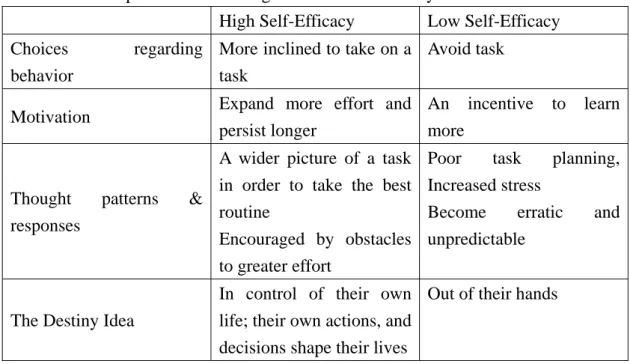
(21) They tend to be more successful in their careers and earn more money than their external counterparts. Internals are particularly well suited to leadership positions and other jobs requiring initiative, independent action, complex thinking, and high motivation. Internals are also more satisfied with their jobs, cope better in stressful situations, and are more motivated by performance-based reward systems.” Meanwhile, people who are internal locus of control believe they have control over their work environment. They prefer participative and achievement-oriented leadership styles and may become frustrated with a directive style. People with an external locus of control believe that their performance is due more to luck and fate, so they tend to be more satisfied with directive and supportive leadership. Logically, in a multicultural team, it is better to have more members who are internal locus of control. These are converging forces that push a team to perform. Self-Efficacy: Perceived self-efficacy according to Alberta Bandura (1994) is defined as people’s beliefs about their capabilities to produce designated levels of performance that exercise influence over events that affect their lives. People who have high self-efficacy will approach task as challenge to be tackle with and mastered, while people with low self-efficacy will try to avoid it. Below is a table of the difference between people with high self-efficacy and low self-efficacy regarding choice/behavior, motivation, thoughts patterns & responses and the idea about one’s destiny: Table II-1: Comparison between high and low self-efficacy High Self-Efficacy Choices behavior. regarding More inclined to take on a Avoid task task Expand more effort and An incentive persist longer more. Motivation. Thought responses. Low Self-Efficacy. patterns. The Destiny Idea. A wider picture of a task in order to take the best & routine Encouraged by obstacles to greater effort. to. learn. Poor task planning, Increased stress Become erratic and unpredictable. In control of their own Out of their hands life; their own actions, and decisions shape their lives. Bandura points out four factors that affecting self-efficacy: experience, modeling, 21.
(22) social persuasions, and physiological factors. The most effective way of creating a strong self-efficacy is through mastery experiences. This means success builds or reinforces self-efficacy, while failure demolishes or undermines it. Modeling happens when someone see other people’s success, their self-efficacy will rise, but when he/she sees someone fail, he or she will somehow turn into lower self-efficacy. This is most influential when someone is not so sure about him/herself. Social persuasions refer to if people have been told what it takes to be successful, and they believe in it. They are more likely to make effort than harbor self-doubt to sabotage themselves. Physiological factors, such as emotions and moods, can alter someone’s self-efficacy. Positive mood enhances perceived self-efficacy, and pessimistic mood lowers it. Logically, in a multicultural team, members who have high self-efficacy are more motivated, and believe they are able to accomplish the task. Compare to other members who have lower self-efficacy, they are stronger converging forces that push a team to perform Self-Leadership: Self-leadership refers to the process of influencing oneself to establish the self-direction and self-motivation needed to perform a task. (McShane & Von Glinow 2005) There are five main elements in self-leadership process. They are personal goal setting, constructive thoughts, designing natural rewards, self-monitoring, and self-reinforcement. The personal goal setting is different from what a team goal in that it is set by oneself instead of by others. With personal goal setting, one will be more focused on what they do. Research reports by Strickland, Galimba and others had shown that students are more effective, use better learning strategies and develop stronger self-efficacy when they rely on personal goal settings. In short, McShane and Von Glinow indicates setting specific, challenging, and relevant goals for your own work effort can help you to focus on key performance areas and motivating yourself. Constructive thoughts include self-talk and mental imagery. According to McShane and Von Glinow, self-talk refers to talking to ourselves about our own thoughts or actions, for the purpose of increasing our self-efficacy and navigating through decision in a future event. Mental imagery means mentally practicing a task and visualizing its successful completion. Positive self-talk and mental imagery can prepare you in accomplishing tasks by anticipating and evaluating your situations. Designing natural rewards is a set of mind that motivating oneself to be enjoyable on the process of achieving his or her goal. People have preferences. And by altering a bit to suit their needs will help they accomplish their tasks. Self-Monitoring is a process of keep adjusting oneself/things to be on track of the process. It is feedback within oneself from the current performance so he or she 22.
(23) can make adjustment to be better geared toward the final goal. Self-Reinforcement is giving oneself reward if certain positive performance is reached at certain stage of the project. The cueing strategies component of self-leadership relates to the process of self-managing the antecedents (cues) of behavior and further on behavior modification. (McShane & Von Glinow, 2005) In self-leadership, cueing strategies are self-set or self-controlled antecedents rather than introduced and controlled by others. Logically, in a multicultural team, members have high self-leadership are more well prepared and perhaps more suitable on team-works. They are stronger converging forces that push a team to perform better. In a self-directed team, self-leadership is valuable. In a team of peers when no one has formal authority over anyone, self-leadership counts toward achieving objectives. The convergence factor of the locus of control refers to the generalized beliefs of whether people are in control of their fate; or it is up to external factors such as luck and environment. People with internal locus of control believe they can control the destiny, and are responsible for their own actions and outcomes. The convergence factor of perceived self-efficacy is people’s beliefs about their capabilities to produce designated levels of performance and change events that affect their lives. People who have high self-efficacy will approach tasks as challenges. Meanwhile, the convergence factor of self-leadership refers to the process of influencing oneself to establish the self-direction and self-motivation needed to perform a task. Therefore, the convergence factors looking from the individual perspectives call attention to individual team member’s determinations. The determinations to explore the possibilities, the motivation to make more efforts, to persist, and the will to overcome the obstacles are team’s crucial path to achieve objectives. Nonetheless, motivation seems to be the link between the divergence and convergence. It also seems to be the link between divergence and attribution factors, as well as between convergences and attribution factors.. Attribution Factors: Attribution factors are complementing factors that result in team effort: The formation of a multicultural team, however, does not guarantee that members will exert the effort required to complete team assignments. Namely, a meaningful task is required but not sufficient condition for encouraging team effort and commitment. An understanding of what drives team effort will be critical because one can take action to promote greater effort and member commitment. Perspective taking, team player inventory as well as team roles can be a good indication on team efforts. 23.
(24) Cognitive Empathy: Empathy is a sensitive understanding of other people’s thoughts, feelings as well as set your own foot in other’s situations. Cognitive empathy refers only to the thinking part of empathy excluding emotions. Therefore, this component is also called perspective taking, which is more of intellectual part of understanding. People who possess higher cognitive empathy are more sensitive to external cause of someone else’s behavior, thus minimize fundamental attribution errors. 13 An active listener empathizes with a speaker or other team members and takes them into consideration. Logically, in multicultural team, members who are high on perspective taking will help the team concentrate on the tasks instead of individual difference. This will help on getting other team members ideas understood and not ignored. This build relationship to face whatever difficulties lie ahead. Team Role Preference: Some roles help the team achieve the goal while others help to maintain the relationship of team members so the team can function. If the roles are not assigned, team members usually take on different roles from time to time. This could be from each team member’s value or personality. However, it is during the forming stage of the team building that team members “develop” their preferred roles inside the team. People have their preference on type of role they represent. Meantime, researches have indicated that teams require a balance of roles. The team role preference scale identifies someone’s preferred roles in meetings and team activities. According to McShane, encourager praises and supports the ideas of other team members, thus showing warmth and solidarity to the group. Gatekeeper encourages all team members to participate in the discussion. Harmonizer mediates intra-group conflicts and reduces tension. Initiator identifies goals for the meeting, including ways to work on those goals. Summarizer keeps track of what was said in the meeting. Logically, in multicultural team, members who like to be on certain role will be more likely to take on that role in the team. However, if there is more than one member in the team that would also prefer to take on that role, then, who is going to do what is not clear unless specified. First, it is more important that in a team that there is certain level of willingness that each roles functions are taken care of. So in general, it is better to have a level of medium to stronger willingness on each role in the team. Meanwhile, there is also possibility that a member likes every roles and a member don’t like to be any of these roles. This can show there are possible dominant. 13. Fundamental attribution error is the tendency to attribute the behavior of other people more to internal than to external factors. (McShane & Von Glinow) Internal factors refer to the cause of an event is due to someone’s “internal” “dysfunctions” instead of some external causes. 24.
(25) individual or individual that is not going to express his or her own opinions. If this is the case, a team’s potential probably won’t be reached. This becomes less of a team. In situation when the roles are not specified, if a individuals strongest two or three preferences are happened to be “taken” by someone who even has “stronger” preferences, then, individuals may have to take on the roles that he or she is not normally willing to do when he works alone. However, this also gives him or her an opportunity to grow. This is an opportunity growth, which may result in something more than one could expect or perhaps some cultural synergetic solutions. So, it is probably not a problem if someone is up for all roles, but it will be a problem if one is not up for any roles. There will be also problems if one of the roles is not being performed due to there is no one in the team that is willing to take on this role. But more than likely, when the team is performing, this will be “appointed” somehow. It is important that attribution factors are what help the team concentrate on the tasks instead of individual difference. This will help on getting other team members ideas understood and not ignored. This build relationship to face whatever difficulties lie ahead. Team Player Inventory: The team player inventory self-assessment is designed to estimate the extent to which people are positively predisposed to work in teams. When someone is a team player, more than not, he or she has at least developed certain soft skills. Cognitive empathy is considered a kind of soft skills. However, there are some soft skills that are more cultural specific. Individuals who claim that they are a team player, in a multicultural environment, these “soft skills” probably have to adjust. However, there is certainly universal “truth” on working in a team. If there is a member in the team that is not really interested in working in a team, this does not suggest that this individual will not make efforts on his part of work. However, this suggests that this individual will more than likely to avoid the meetings, less openly and eagerly exchange information as well as getting feedbacks from other members. This in itself, is not a deciding factor of the team’s “success”, but it is indeed a factor that will help team to reach his potentials or beyond. Therefore, attribution factors are forces that “manage” the divergence and convergence forces: “Highly productive and less-productive teams differ in how they manage their diversity, not, as is commonly believed, in the presence of absence of diversity in the team. When well managed, diversity becomes an asset and a productive resource for the team.” (Alder, 2002) Public vs. Private In the multicultural team, members interact with one another from different 25.
(26) cultures. The degree of interaction and whether it is appropriate depend on personal space of different cultures. Each individual is custom to what is considered private and what is public space in his or her own cultural domain. Trompenaars has indicated two categories of culture regarding private and public. He classified them as specific vs. diffused oriented cultures. People from specific cultures analyze from the specific elements separately before they put them together. In this kind of cultures, the whole is merely the sum of the parts. Individual’s life has different “segments” like work, family, and friends are different segments of one’s life. Interactions are within each segment and with defined purposes. Because of these, the public area of his or her life is much larger than the private area. People interact easily in the public sphere but it is very hard to get into the private sphere of that person, since the specific culture individuals consider each segment separate from one another. They stress on the facts, standards, and contracts. People from diffusely oriented cultures see things from the whole picture, then to individual parts. All parts are somehow related. These relationships among them are more important than merely the individual parts. In this kind of cultures, the whole is more than the sum of parts. As a result, individual from diffused oriented culture will have a large private sphere and a small public one. It is not easy to enter into this culture’s individual’s life and it takes time. But once you are accepted, one will be admitted into “all” levels of this individual’s life. You will be a friend in all aspects from work to family. These roles are not separated, and this kind of culture values trust and understanding. In summary, specific cultures people tend to have a larger public area; and small, more guarded private area. They are more direct and prefer to keep private life separate. In diffused cultures, the private space is usually larger, while the public space is smaller and more guarded. They are more indirect and introvert, and also view private and work are linked. However, the flexibility is very important to them. Cultural differences in private and public spaces make communicating more difficult. The slight unintentional offense may cause further conflicts. As the result, the motivation is also simple and complex immediately. Simple, in that it explains much of what we see happening in human behavior, yet complex when it poses contradictions. However, there are some general principles that help to explain. So as we attempt to understand motivation, Grazier, P. says, “we need to appreciate the subtleties that exist in human behavior, and focus our attention on general principles of motivation that have wider application.” Cultural Synergy Synergy from the dictionary defines, “the interaction of two or more agents or 26.
(27) forces so that their combined effect is greater than the sum of their individual effects.” Nonetheless, synergy is “the behavior of whole systems that can’t be predicted by the behavior of any parts taken separately. In order to really understand what is going on, we have to abandon starting with parts, and we must work instead from whole to particular” (Fuller, 1981) In multicultural team, after members took every culture’s perspectives into account, it is possible to not only choose the best alternatives on hand but also develop something that is “creative”. Culturally synergistic solutions are not what a particular culture’s method. It is transcended from these existing methods, behaviors and patterns to some novel ones. For multicultural team, members learn from other cultures to enhance the overall team productivity and effectiveness. This is a process of combining and leveraging various cultures’ ways (working, thinking & etc.). The first step is to develop cultural self-awareness (an understanding of the other cultures’ assumptions and patterns of behaviors). (Adler, 2002) Only after the understanding of involved cultural dynamics can someone propose “changes” that won’t seem to be absurd. Meanwhile, synergy is more likely to occur in a multicultural team than a homogeneous team. This is because in the multicultural team, people are more open to hear the new ideas simply because when the ideas are proposed from someone that is different from you own culture, it is easier to hear than reject it at the first place. In order for the multicultural team to perform, members have to converge into a norm to form a new convention. But to perform, the multicultural team has to diverge again to find the possible alternatives. On the path of diverging, a multicultural team will have more alternatives than a homogenous team and have more aspects have to take into considerations. The drawback is that this process might take longer time. But if it has the potential to come with a cultural synergetic solution, then, its values outweigh much more than time spent. 14. 14. A multicultural team or any team should be careful on when to diverge and when to converge. “Trying to diverge and converge at the same time makes people crazy and sucks the juice out of the creative process, leaving you with pale, lifeless ideas.” (innovation tools) 27.
(28) III. Objectives & Approaches: Objectives: The objectives of this case study are to conceptualize the divergence, convergence and attribution factors of multicultural teams, and to observe the possible impact of cultural differences on team performance. The sub-objectives are: ٛ The observations on 6 multicultural teams. ٛ The graphical representations of this conceptual model ٛ Cultural synergy and the changes after the team is adjourned Approach: From the points of departures with support from the literature review, the research method consists of two parts. One is from Hofstede cultural dimensions, and the other is from assessments of individual dimensions on topics of individualism, collectivism, locus of control, self-efficacy, empathy, self-leadership, team role, and team player inventory. The first part is to observe the cultural difference base on these dimensions within and among multicultural teams. Assume people works better in “the preferred coordination mechanism” (Hofstede, 1991) with limited complexity. These cultural dimensions suggest a member’s preferred conditions. The second part is to measure the individual level and to correlate this assessment with individual outcomes, behaviors, attitudes, and beliefs. This approach avoids some assumptions required to apply as Hofstede cultural dimensions. However, this will assume that cultural frame is a form of declarative awareness that respondents can “report”. Nonetheless, cultural aspects can be subtle and implicit practices of social structures, and some practices are intertwined into everyday life or become part of living. The members probably are not aware of these. The direct assessment approach does not consider these sets of underlying subtleties. In observational (non-experimental) studies, no attempts are made to control or influence the variables of interest. The results are analyzed using statistical and graphical methods. Below are some methods: I. Basic Frequency Analysis: Data Analysis: (frequency analysis, charts and raw data) See Appendix A & C. II. Scatter Diagram A scatter diagram is a graphical presentation of the relationship between 28.
(29) two quantitative variables. III. Graphs Steps: The research uses 6 steps to develop a concept to form a conceptual model of a multicultural team. There are 38 students in International Organizational Behavior class by Professor Gary Hu at National Sun Yat-Sen University, in fall semester 2005. These students are from 13 different countries that including Canada, France, Indonesia, Japan, South Korea, Netherlands, Philippine, Poland, Sweden, Taiwan, Thailand, US and Vietnam. With 13 students having Taiwanese cultural background is the largest segment, followed by Philippine and Vietnam both with 5 students, and Netherlands with 4 students. The rest ethnic groups are less than 4 people in total. These 38 students are divided into 6 teams, working on a team project regarding a specific country. The textbook used in this class is International Dimensions of Organizational Behavior 4th Edition by Nancy J. Adler. The class is conducted in English. The objectives of the course according to course syllabus are: a. To understand the impact of culture on organizations, describes the ways in which cultures vary, how that variance systematically affects organizations, and how people can recognize, manage, and effectively use cultural variance within their own work environment. b. To leverage cultural diversity, presents an integrated approach to managing in multicultural work environments, investigates cross-cultural problem solving and organizational development, presents the dynamics of multicultural teams, reviews approaches to leading, motivating, and decision making from a global perspective, and summarizes global approaches to resolving conflict and to negotiating. c. To manage global managers, presents a series of issues that are unique to global management, addresses the human resource management dilemmas involved in managing one’s life and career while moving across international borders. As a result, these students are more open-minded on cultural difference already. 1.. The first step is to find out each team members’ nationality and apply Hofstede’s cultural dimensions of each country. For example, in TEAM V, there are members from South Korea, Philippine, Sweden, Taiwan, U.S and Vietnam. For TEAM V member, apply values of PDI equals 31, IDV is 71, MAS is 5 and UAI is 29 from the Hofstede’s cultural dimensions. 29.
(30) 2.. The second step is to give questionnaires to these people. There are total of 7 questionnaires are given out. They are Individualism-Collectivism Scale, Identifying Your Locus of Control, Assessing Your General Self-Efficacy, Assessing Your Perspective-Taking (Cognitive Empathy), Assessing Your Self-Leadership, Team Role Preference Scale and Team Player Inventory. The description and purpose of each questionnaire are as follows: a) Individualism-Collectivism Scale: The source of this scale is: T. Singelis, H. Triandis, D. Bhawuk, and M. Gelfand. (1995) A score of 8~22 is low individualism, 23~30 is moderate individualism, and 31~40 is high individualism. Likewise, a score of 8~22 is low collectivism, 23~30 is moderate collectivism, and 31~40 is high collectivism. Directions: “Individualism refers to the extent that you value independence and personal uniqueness. Highly individualist people value personal freedom, self-sufficiency, control over their own lives, and appreciation of their unique qualities that distinguish them from others.”. b). c). “Collectivism refers to the extent that we value our duty to groups to which we belong, and to group harmony. Highly collectivist people define themselves by their group membership and value harmonious relationships within those groups.” Identifying Your Locus of Control: The source of this scale is: Copyright Paul Spector. (1988). A score of 16~42 is internal locus, 43~69 is in-between locus, and 70~96 is external locus. Directions: “Individuals who feel that they are much in charge of their own destiny in the workplace have an internal locus of control.” “Individuals who think that events in their work life are due mainly to fate/luck or powerful others have an external locus of control.” Assessing Your General Self-Efficacy: The source of this scale is: G. Chen, S. M. Gully, and D. Eden. (2001) A score of below 24 is low self-efficacy, 24~27 is below average, 28~31 is average, 32~34 is above average, and above 34 is high self-efficacy. Directions: “Self-efficacy refers to a person’s belief that he or she has the ability, 30.
(31) d). e). motivation, and resources to complete a task successfully. This particular scale is called a “general” self-efficacy scale because it estimates a person’s self-efficacy in a broad range of situations. The average general self-efficacy score varies from one group of people to the next. For example, managers tend to have a somewhat higher general self-efficacy than do young undergraduate psychology students.” “Score on the general self-efficacy range from 8 to 40. Higher scores indicate that you have a higher general self-efficacy.” Assessing Your Perspective-Taking (Cognitive Empathy): The source of this scale is M. Davis. (1980) A score of 7~15 is low perspective taking, 16~25 is moderate perspective taking, and 26~35 is high perspective taking. Definitions: “ Empathy refers to a person’s understanding of and sensitivity to the feelings, thoughts, and situations of others. The “understanding” part of empathy is called perspective taking or cognitive empathy. It represents an intellectual understanding of another person’s situational and individual circumstances” “Perspective taking is an important part of the perceptual process because it makes us more aware of the external causes of another person’s performance and behavior. It also improves the communication process by helping us to put the words of other people in their proper context.” “ A higher score indicates a higher level of perspective taking (also called cognitive empathy). The average score in recent studies across several Canadian and U.S. groups of people is approximately 20. Also, women tend to score about 1.5 points higher than man on this perspective taking scale.” Assessing Your Self-Leadership: The source of this scale is from C. Manz. (1992) A score of 18~64 is low score, 65~72 is average score, and 73~90 is high score. Definitions: “Self-leadership is the process of influencing yourself to establish the self-direction and self-motivation needed to perform a task. It recognizes that individuals mostly regulate their own actions through various behavioral and cognitive (thought) activities. The six 31.
(32) components of self-leadership measured in this scale are personal goal setting, mental practice, designing natural rewards, self-monitoring, self-reinforcement, and cueing strategies.” A score of 3~7 is low score, 8~12 is average score, and 13~15 is high score. “Personal Goal Setting: Self-leadership includes the practice of setting your own performance-oriented goals and, more specifically establishing specific, challenging, and relevant goals. A higher score indicates a higher level of personal goal setting.” “Mental Practice: (called mental imagery) involves mentally rehearsing future events. Mental practice includes thinking through the activities required to perform the task, anticipating obstacles to goal accomplishment, and working out solutions to those obstacles before they occur. Mentally walking through the activities required to accomplish the task helps us to see problems that may occur. A higher score indicates a higher level of mental practice.”. f). “Designing Natural Rewards: is the process of altering tasks and work relationships to make the work more motivating. This might involve changing the way you complete a task so the activity is more interesting. Or it might involve making slight changes in your job duties to suit your needs and preferences. A higher score indicates a higher level of designing natural rewards.” “Self-Monitoring: is the process of keeping track of your progress toward a goal. It includes consciously checking at regular intervals how well you are doing. A higher score indicates a higher level of self-monitoring.” “Self-Reinforcement: is the practice of rewarding yourself after successfully completing a task. It occurs whenever you have control over a reinforcer but don’t “take’ the reinforcer until completing a self-set goal. A higher score indicates a higher level of self-reinforcement” “Cueing Strategies: relates to the process of self-managing the antecedents (cues) of behaviors on behavior modification. In self-leadership, cueing strategies are self-set or self-controlled antecedents rather than introduced and controlled by others. A higher score indicates a higher level of cueing strategies.” Team Roles Preferences Scale: The source of this scale is from S. McShane. (2005) A score of 3~7 is low preference, 8~11 is moderate preference, and 32.
(33) 12~15 is strong preference. Definition: “The Team Role Preferences Scale estimates your preferred roles in meetings and similar team activities. Some roles helps focus the team on its objectives, such as giving and seeking information, elaborating ideas, coordinating activities, and summarizing the discussion or past events.” “Encourager: People who score high on this dimension have a strong tendency to praise and support the ideas of other team members, thereby showing warmth and solidarity to the group. The average score in a sample of MBA students is 10.25.” “Gatekeeper: People who score high on this dimension have a strong tendency to encourage all team members to participate in the discussion. The average score in a sample of MBA students is 10.0”. 3.. “Harmonizer: People who score high on this dimension have a strong tendency to mediate intra-group conflicts and reduce tension. The average score in a sample of MBA students is 9.85.” “Initiator: People who score high on this dimension have a strong tendency to identify goals for the meeting, including ways to work on those goals. The average score in a sample of MBA student is 9.79.” “Summarizer: People who score high on this dimension have a strong tendency to keep track of what was said in the meeting (i.e., act as the team’s memory). The average score in a sample of MBA students is 8.44.” g) The Team Player Inventory: The source of this scale is from T. Kline. (1999) A score of 10~20 is low preference for teamwork, 21~39 moderate preference for teamwork, and 40~50 is strong preference for teamwork. Definition: “The Team Player Inventory estimates the extent to which you are positively predisposed to working on teams. Some people would like to work in teams for almost everything, whereas other people would like to keep as far away from teams as possible. Most of us fall somewhere in between.” The third step is to collect the questionnaires and input the scores from the questionnaires. Quantitatively analyze the data by finding out the average, upper scores, lower scores, and range within the team and the class. (See Appendix A & C) Qualitatively analyze the results by changing the numbers into different 33.
(34) 4. 5.. degree of levels such as high, medium, and low on each character. (See Appendix B) Then, draw the graph to easier compare them. (See Figures IVs) Through observations, applying points of departures on applicable results. Develop conceptual models.. 34.
數據
![Figure IV-1: PDI Ranges & Norms (Moderate range is [46~66], see Appendix A & B)](https://thumb-ap.123doks.com/thumbv2/9libinfo/8898631.257576/36.892.138.764.188.588/figure-iv-pdi-ranges-norms-moderate-range-appendix.webp)
![Figure IV-2: IDV Ranges & Norms (Moderate range is [26~59], see Appendix A & B)](https://thumb-ap.123doks.com/thumbv2/9libinfo/8898631.257576/38.892.141.754.375.770/figure-iv-idv-ranges-norms-moderate-range-appendix.webp)
![Figure IV-3: MAS Ranges & Norms (Moderate range is [44~59], see Appendix A &](https://thumb-ap.123doks.com/thumbv2/9libinfo/8898631.257576/40.892.139.761.304.714/figure-iv-mas-ranges-norms-moderate-range-appendix.webp)
+7
![Figure IV-4: UAI Ranges & Norms (Moderate range is [52~81], see Appendix A & B)](https://thumb-ap.123doks.com/thumbv2/9libinfo/8898631.257576/42.892.142.755.516.911/figure-iv-uai-ranges-norms-moderate-range-appendix.webp)
![Figure IV-5: IND Ranges & Norms (Moderate range is [23~30], see Appendix A & B)](https://thumb-ap.123doks.com/thumbv2/9libinfo/8898631.257576/46.892.142.755.143.561/figure-iv-ind-ranges-norms-moderate-range-appendix.webp)
![Figure IV-6: COL Ranges & Norms (Moderate range is [23~30], see Appendix A &](https://thumb-ap.123doks.com/thumbv2/9libinfo/8898631.257576/47.892.138.758.411.825/figure-iv-col-ranges-norms-moderate-range-appendix.webp)
![Figure IV-7: LC Ranges & Norms (In-Between range is [43~69], see Appendix A &](https://thumb-ap.123doks.com/thumbv2/9libinfo/8898631.257576/50.892.138.756.151.589/figure-iv-lc-ranges-amp-norms-range-appendix.webp)
相關文件
The IEC endeavours to ensure that the information contained in this presentation is accurate as of the date of its presentation, but the information is provided on an
When risk factors are high and protective factors are low, proximal risk factors. (or stressors) can interact with a person’s long term or underlying
The academic achievement of math of high-grade elementary school students is significant related to their SES and the self-concept in math, but is non-related to their
Finally, the Delphi method is used to verify and finalize the assessing framework.. Furthermore, the AHP method is used to determine the relative weights of factors in the
However, if we do not analyze the bus driving behavior and driving safety factors (e.g., car following gap or passing sight distance) while designing the control and safety systems
This research tries to understand the current situation of supplementary education of junior high school in Taichung City and investigate the learning factors and
The purpose of the study aims at discussing the important factors of affecting junior high school students in aboriginal areas in terms of learning mathematics.. The research
This purpose of study was to realize, as well as the factors of influence of information technology integrated in teaching by junior high school special education teachers in
