
由創新擴散理論探討大專英文教師使用電腦輔助語言教學之信念
105
0
0
全文
(2) College English Teachers’ Beliefs about the Use of CALL in Taiwan: A Diffusion of Innovation Theory Perspective. A Master Thesis Presented to Institute of TESOL,. National Chiao Tung University. In Partial Fulfillment of the Requirements for the Degree of Master of Arts. by Yen Chou June, 2006.
(3) Acknowledgements I would like to recognize and thank a number of people who support and help me a lot in writing my thesis. My special thanks go to Dr. Po-Sen Liao, my advisor, for his perspicacious guidance and constant encouragement. Because of his inspiring idea and endorsement, the return rate of the questionnaire in my thesis was higher than what we expected. Despite his tight schedule, he always tries his best to discuss and revise my thesis. Without his support, it would have been impossible to complete this thesis. For the assistance on the complicated procedures of the statistical analysis, I want to thank Men-pei Liou. His full support and suggestions help me a lot in managing and analyzing the research data. He is also a supportive and considerate friend who helps me overcome many difficulties. In addition, I also want to thank Szue-hui Li, who helps me a lot edit the thesis. Equal gratitude is also extended to Dr. Sunny Lin and Pei-Lan Lei for their help in constructing an online questionnaire for my research. It is their assistance that makes this research conducted in a smoother and more efficient way. I am also deeply grateful to my committee members, Dr. Sun and Dr. Hsieh. Their valuable insights and comments contributed a lot to the revision of this thesis. Additionally, I would like to express my thanks to all the participants in my research. Without their cooperation and valuable opinions, the data collection procedure for this study would have been impossible. Finally, I would like to give my warmest thanks to my parents and Kai-hung Wang. Their understanding and tolerance is the great power in my graduate school life. Without their wholehearted support, I may not be able to go through the whole process.. i.
(4) 論文名稱:由創新擴散理論探討大專英文教師使用電腦輔助語言教學之信念 校所組別:國立交通大學英語教學所 畢業時間:九十四學年第二學期 指導教授:廖柏森博士 研究生:周 彥. 中文摘要 教師信念與教學實踐間關係緊密,且電腦輔助語言教學(CALL)為時下英 語教學一大趨勢,許多研究致力於探討電腦輔助語言教學的成效,然而對於教師 對使用 CALL 的信念並未獲得足夠的研究關注。教師既為教學主體之一,其信 念將影響 CALL 在教學上的使用成效,因此瞭解其潛在的影響因素將有助於 CALL 的推廣。有鑑於以往文獻對此議題關注之不足,本研究之主要目的為調查 教師對於 CALL 的信念以瞭解 CALL 在台灣大專院校使用的現況,並藉由創新 擴散理論(Diffusion of Innovation)來分析教師教學上的問題與需求。 本研究以全台大專院校的英語教師為研究對象進行問卷調查與訪談,希望瞭 解教師對於 CALL 的看法及實施現況,同時針對教師所面臨的困境及需要協助 之處提供具體建議。問卷含有五大類別:相對優勢 (Relative Advantages), 相容 性(Compatibility), 複雜性(Complexity), 試用性(Trialability), 與可觀察性 ( Observability)。回收問卷共計 186 份,有效問卷共計 176 份。另亦針對 9 位大 專英語教師進行深入訪談,以便充分反映教師的意見。研究結果發現:(1) 聽力 與閱讀為 CALL 最常運用的教學項目;(2)本研究所調查與 CALL 相關的四項應 用領域包含:超/多媒體、E 化教學平台、線上參考工具與學習網站均為大部分 教師所知,且運用在其教學中;(3)每週使用電腦時數在使用 CALL 與未使用 CALL 兩組教師間有顯著差異; (4)問卷中的五大類別均為教師考量使用 CALL 時的主要因素(M 值 > 3);試用性(Trialability)與相對優勢 (Relative Advantages) ii.
(5) 分數最高;而試用性(Trialability)與相容性(Compatibility)為預測 CALL 使用率最 顯著的兩因素。教師教學所需之配套措施則包括:充分有效的在職訓練、電腦技 術方面的支援、軟硬體及時更新、教師社群間的互助合作管道等。對於教學上應 用 CALL 的建議如下:教師自身對於科技知識應持續更新、行政者需重視教師 的教學風格與需求、教師需謹慎考慮課程性質、學習者的需求與投入重於技術操 作。 本研究的發現證實 CALL 雖為一流行趨勢,教師在實際教學應用上仍有其 諸多考量與限制。若要將 CALL 更成功地運用於英語教學,除了問卷調查中五、 大潛在影響因素,尚須將其他相關因素如學習者的參與、課程性質與行政資源充 足與否納入考量。. iii.
(6) Abstract Teachers’ beliefs play an important role in understanding the actual practices of classroom instruction. CALL is a relatively intriguing area prevailing throughout the last few decades in language teaching and learning. However, most of the literature on CALL has been concerned with the pedagogical effectiveness of different types of technology or computer programs in language teaching. Research on teachers’ beliefs about using CALL has often been ignored, resulting in research which explores the link between language teachers’ beliefs and their use of CALL is relatively rare. The present research aims to examine the underlying factors affecting the adoption of CALL in Taiwan based on the theoretical model of “Diffusion of Innovation Theory” proposed by Rogers (1995). A questionnaire partly modified from Martins et al (2004) was administered to 186 college English teachers to identify the possible factors for adopting CALL-related resources as a vehicle to teach English at colleges. Five attributes were explored in the survey, including Relative Advantages of CALL compared with other instructional methods or tools, Compatibility with teachers’ existing values and experiences, Complexity to understand and adopt CALL, Trialability of CALL prior to adoption, and Observability of the teaching results. In addition, semi-structured and in-depth individual interviews were conducted to elicit relevant data to make a more comprehensive investigation. Data analysis of the questionnaires involved descriptive statistics, independent t-test, Chi-square, and logistic regression. The major findings suggested the following: (1) listening and reading were the two language skills with the highest adoption rate of CALL; (2) the four major CALL categories including hypermedia/multimedia, E-learning delivery platform, on-line reference tools and. iv.
(7) learning websites were generally known and accepted by most teachers; (3) weekly computer using hours showed significant difference between CALL and non-CALL groups of teachers; (4) among the five attributes in Rogers’ theory, Trialability was the most significant factor to predict teachers’ adoption rate of CALL. This study would shed some light on the understanding of language teachers’ beliefs about CALL and raise their awareness of the benefits and limitations of using technology in classroom. The results may provide both language teachers and school administrators a different view into teachers’ beliefs about the use of CALL. It is hoped that the field of foreign language teaching and learning may also benefit from insights into the potential factors for adopting CALL for English college teachers.. Key words: diffusion theory, CALL, teachers’ beliefs, EFL teaching and learning. v.
(8) Table of Contents Acknowledgements..................................................................................................... i Chinese Abstract ........................................................................................................ ii English Abstract........................................................................................................ iv List of Tables ............................................................................................................ ix List of Figures ............................................................................................................ x CHAPTER Chapter 1 INTRODUCTION.................................................................................. 1 General Background ........................................................................................... 1 Teachers' Beliefs ................................................................................................ 1 Computer-Assisted Language Learning ....................................................... 2 Purpose of the Study........................................................................................... 3 Major Research Questions.................................................................................. 6 Significance of the Study.................................................................................... 7 The Organization of the Thesis .......................................................................... 7 Chapter 2 LITERATURE REVIEW....................................................................... 9 Teachers’ Beliefs ................................................................................................ 9 Definitions of Belief Systems....................................................................... 9 The Important Roles of Beliefs .................................................................. 10 Methods for Examining Beliefs.................................................................. 12 Computer-Assisted Language Learning ........................................................... 14 Definitions of CALL .................................................................................. 15 Computer-Assisted Instruction ............................................................. 15 Hypermedia/Multimedia....................................................................... 16 Databases and Concordancing.............................................................. 16 Computer Networks and Web-based CALL ........................................ 17 The Roles of CALL in Language Teaching and Learning ......................... 19 The Advantages and Limitations of CALL ................................................ 20 Teachers’ Beliefs about the Use of CALL ................................................. 22 The Factors for Adopting or Refusing CALL ............................................ 24 Diffusion of Innovation Theory........................................................................ 26 The Theory of the Perceived attributes....................................................... 26 vi.
(9) Research on Diffusion of Innovation Theory ............................................. 27 Chapter 3 METHOD............................................................................................. 30 Participants ....................................................................................................... 30 Instrumentation................................................................................................. 31 Format and Content of the Questionnaire................................................... 31 The Interview Guide ................................................................................... 33 Survey Reliability and Validity ........................................................................ 34 Pilot Study ........................................................................................................ 35 Data Collection ................................................................................................. 36 Questionnaire Administration..................................................................... 36 Interviews ................................................................................................... 37 Data Analysis.................................................................................................... 37 Statistical Analysis ..................................................................................... 37 Analysis of the Open-ended Questions ...................................................... 38 Analysis of the Interview Data ................................................................... 39 CHAPTER 4 RESULTS ....................................................................................... 40 Background Information of the Participants .................................................... 40 The Use of CALL ............................................................................................. 43 Descriptive Statistics of the Five Attributes in the Questionnaire.................... 44 The Correlations among the Five Attributes ..................................................... 45 The Idependent T-Test and Chi-squire Between CALL and non-CALL Groups ........................................................................................................ …..46 The Relationship between CALL Adoption Rate and Demographic Data46 The Relationship between CALL Adoption Rate, Gender and CALL Availability ............................................................................................... 47 The Logistics Regression of the Five Attributes .............................................. 48 Results from the Open-ended Questions .......................................................... 50 More Areas of Language Teaching with CALL......................................... 50 The Suggestions for Using CALL .............................................................. 51 Results from Interviews.................................................................................... 52 Teachers’ Attitudes towards CALL............................................................ 54 The Effectiveness of CALL in Language Teaching ................................... 55 The Advantages and Disadvantages of Using CALL................................. 56 The Potential Factor for Using CALL........................................................ 57 vii.
(10) The Suggestions for EFL Teachers ............................................................ 58 CHAPTER 5 DISCUSSION AND CONCLUSION ............................................ 60 Discussion of the Findings ............................................................................... 60 The Skills with the Most Adoption Rate of CALL .................................... 61 The Common Elements of CALL .............................................................. 62 The Differences between the CALL and the non-CALL Groups............... 63 The Potential Factors Affecting Adoption of CALL.................................. 64 More Discussion on the Significant Quantitative Findings........................ 66 Teachers’ Perspectives on CALL ............................................................... 68 Teachers’ Perspectives on Learners............................................................ 69 Teachers’ Perspectives on Administrators.................................................. 70 Implications and Suggestions ............................................................... . . ……71 Theoretical Implications ............................................................................. 71 Pedagogical Implications............................................................................ 72 Suggestions for EFL Teachers.................................................................... 72 Suggestions for School Administrators ...................................................... 73 Suggestions for Researchers ....................................................................... 74 Limitations of the Study ................................................................................... 75 Suggestions for Future Research ...................................................................... 76 Conclusion ........................................................................................................ 77 APPENDIXES ........................................................................................................ 79 Appendix A ....................................................................................................... 79 Appendix B ....................................................................................................... 81 Appendix C ....................................................................................................... 86 Appendix D ....................................................................................................... 87 REFERENCES....................................................................................................... 87. viii.
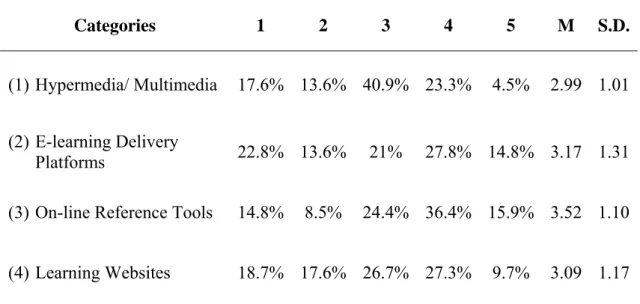
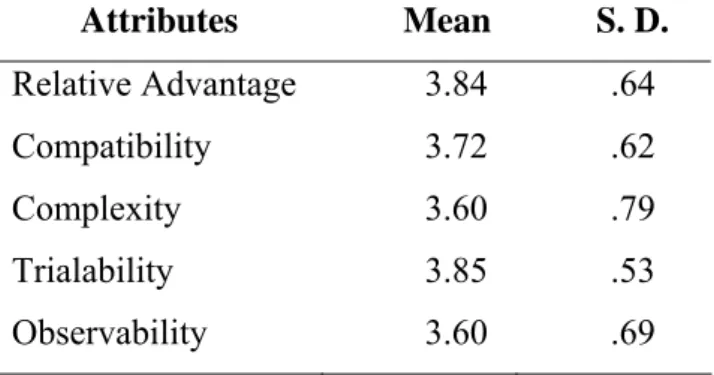
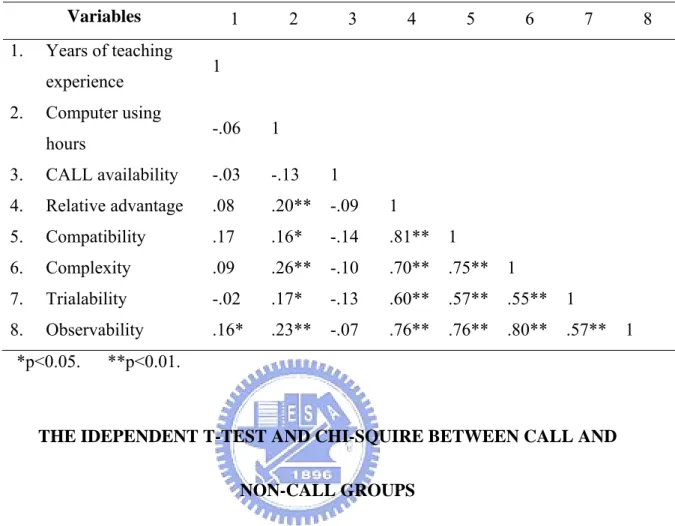
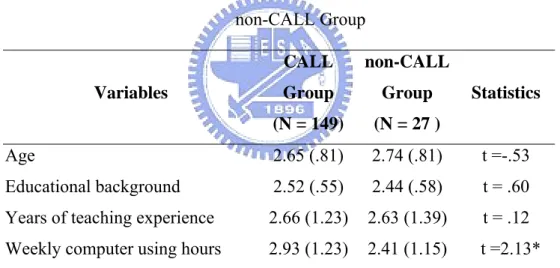
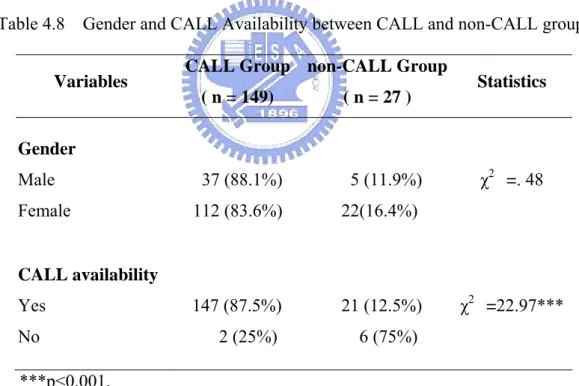
(11) List of Tables Table 3.1 Numbers of the Colleges in Taiwan ........................................................... 31 Table 4.1 Personal Information of the Participants .................................................... 41 Table 4.2 CALL Relevant Data of the Participants .................................................... 42 Table 4.3 The Application of CALL in the Four Skills Teaching............................... 43 Table 4.4 The Descriptive Statistics of Using CALL in Different Categories............ 44 Table 4.5 Means and Standard Deviations for the Questionnaire Items ..................... 45 Table 4.6 The Correlations among Measures ............................................................. 46 Table 4.7 CALL Adoption and Demographic Data between CALL Group and non-CALL Group........................................................................................ 47 Table 4.8 Gender and CALL Availability between CALL and non-CALL groups ... 48 Table 4.9 Respective Logistic Regression on Relative Advantage, Compatibility, Complexity, Trialability, Observability ...................................................... 50 Table 4.10 Background Information of the Interviewees .............................................. 53. ix.
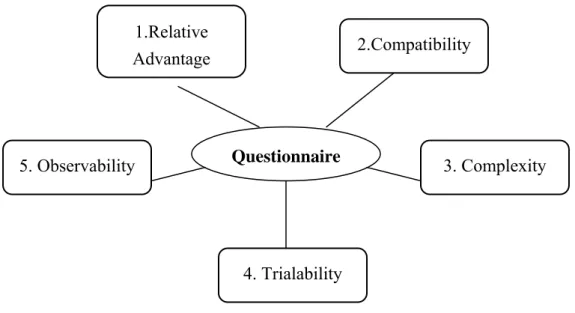
(12) List of Figures Figure 3.1 The 5 Constructs Contained in the Questionnaire..................................... 33. x.
(13) CHAPTER 1 INTRODUCTION GENERAL BACKGROUND Teachers’ Beliefs In educational research, the earlier attention of belief research has been focused on investigating self and teacher efficacy, causes of teachers’ or learners’ performance, consciousness and feelings of oneself, specific subject matters and the nature of knowledge (Pajares, 1993). Within the area of the second or foreign language education, learners’ beliefs about the nature of knowledge and learning or epistemological beliefs, have been widely investigated. (i.e. Palmer, & Goetz, 1988; Schommer, 1990; Schommer, 1994a; Schommer, 1994b; Horowitz, 1994; Mori, 1999a; Mori, 1999b). There is a lot of evidence to suggest that individuals’ epistemological beliefs may have a profound influence on their ways of learning and the result of their learning. Beliefs may contribute to a better understanding and prediction of an individual’s learning processes and outcomes. Since teaching and learning are analogous to the two sides of a coin, some researchers in education have started studying teachers’ beliefs as well as learners’ beliefs. They attempted to explore to what extent teachers’ conceptualization may affect their teaching process. As a result, over the last few decades, there has been a growing research interest within such fields as educational psychology and second language acquisition. The findings from these research supported that teachers’ perceptions and attitudes, or more generally, teacher’s beliefs are closely related to their classroom teaching behaviors. Furthermore, in the educational literature, teachers’ beliefs have been further pointed out as an important predictor to understanding teachers’ thinking processes and classroom practices. (Rokeach, 1968;. 1.
(14) Nespor, 1987; MacArthur & Malouf 1991; Pajares 1992; Richardson 1996; Sandholtz, Ringstaff, & Dwyer, 1997; Drenoyianni & Selwood, 1998; Donaghue, 2003). Computer-Assisted Language Learning Language education is an area with a variety of aspects worth investigation, in addition to the studies of beliefs, Computer-Assisted Language Learning (CALL) has become very popular in recent years. The result has been a wave of enthusiasm of many language researchers and teachers devoting noticeable amount of attention to the study of CALL. Broadly speaking, much of the research on CALL either categorizes the computer as a teaching tool or a catalyst for changing the ways of teaching and learning (Dexter & Anderson & Becker, 1999; Hinostroza & Mellar, 2000; Jones & Paolucci, 1999; McDonald & Ingvarson, 1997). It is widely accepted that computer and technology have great impact on the process and results of language teaching and leaning. Thus it has resulted in the increased attention to the use of CALL in classrooms. Though CALL is in fact a well-known innovation, there seems to be no general consensus on what the essential knowledge base of the field consists of. As a matter of fact, CALL is a “relatively new, interdisciplinary field of study” that adopted different elements from various areas, such as psychology, computational linguistics, instructional technology, and artificial intelligence and so forth (Levy, 1997, p.47). CALL is such a complex discipline, which could be further divided into various sub-categories. The categories could range from basic tools (e.g., word processor) to more sophisticated communication tools (e.g., CMC). Thus the progress of CALL as a discipline is essentially a reflection of the development of the technology with time (Levy, 1997). On the whole, the different applications of CALL have been used in several sectors of language education from speech recognition (Aist, 1999), grammar. 2.
(15) checker (Tschichold, 1999), multimedia (Kempen, 1999), corpus to databases (Holmes, 1999; Beaudoin, 2004). In the literature about the applications of CALL in language education, it is also worth pointing out that Diffusion of Innovation Theory has also started to be used to explain the potential factors that may influence the adoption of an innovation in a number of areas (Rogers, 1995; Surry 1997).. PURPOSE OF THE STUDY In the research on second language education, the literature is full of discussions surrounding the definitions of “belief”, and scholars have debated its nature and constructs for decades. Obviously, previous studies on teachers’ beliefs were generally conducted in the field of educational psychology and teacher training courses in ESL contexts; therefore, the perceptions and understanding of teachers’ beliefs in foreign language education are mostly derived from the broader discipline. As a newly developing discipline, foreign language education also needs research directly relating to its research contexts rather than the adoption of results from other more general fields. With reference to the teaching contexts in Taiwan, we are wondering about the views of English teachers in Taiwan. In order to have a better understanding of the present situations, it is necessary to take a closer look at their thoughts and perceptions about English teaching. Moreover, most previous research was devoted to investigating teachers’ beliefs about their students, the nature of knowledge, their subject matters, their own professions, and the relationship between those beliefs and teaching practices, and others. The constructs and the nature of beliefs have been argued and dealt with for several decades, and the values of teachers’ beliefs are generally recognized all over the teaching areas.. 3.
(16) On the other hand, as the dramatic growth in a relatively new sub-area of language education, CALL brings a promising vision for many language teachers. In educational research, a substantial number of CALL studies have been conducted over the past years, as proven by the number of papers presented at conferences, and there is no sign that this trend will diminish any time soon. Under such a general impression on the development of CALL, however, what are the English teachers’ reactions to this newly used medium in Taiwan? There seems to be relatively little evidence in the perceptions and viewpoints of language teachers despite the documented power of computer and technology in language teaching (Pennington, 2004). Research exploring the links between English teachers’ beliefs and their use of CALL is usually ignored, and the teachers’ perceptions of using CALL have not been given the attention they deserve. It needs to call for much more attention to this issue since teachers’ beliefs are an indicator of the successful or unsuccessful practices. As far as EFL contexts in Taiwan are concerned, while CALL is used and advocated by a lot of language researchers and teachers, it appears that most of the literature to date has been primarily concerned with the pedagogical effectiveness of different types of CALL used in the English classroom. However, this is not to say that any type of innovation could be “delivered” or “distributed” like a commercial product to language teachers (Widdowson, 1993). In Widdowson’s opinion, innovation should be diffused in a manner so as to be tailored to meet different pedagogical needs and educational contexts. Teachers are the mediators instead of retailers who aggressively promote the innovation to their target “consumers”, i.e. students. Though some research has been done on teachers’ beliefs and perceptions of the use of CALL or other instructional technology, it has been found that the participants. 4.
(17) in these studies are generally elementary, middle or high school teachers without the participation of college teachers (i.e. Marcinkiewicz, 1994; Wills & Mehlinger, 1996; Ertmer, 1999; Brent et al, 2002; Hémard, 2003; Liou, 2004, ). In reality, colleges are the places where CALL can be more flexibly applied and evaluated, so the college English teachers usually have much more opportunities to try out CALL in their classes. If we can probe into the college teachers’ thoughts and perceptions, it will contribute a better understanding of the current state of CALL in Taiwan. In fact, few of the earlier studies were carried out in the classroom of English as a foreign language, and most were conducted in the ESL teaching environments. English has become a dominant international language in the world; the viewpoints from EFL teachers about the applications of CALL are worth investigating because their perspectives and attitudes will have a profound influence on their students. If we explore this issue in Taiwan, we can have more diverse views on the use of CALL in addition to the ESL perspectives. In foreign language education, CALL could be treated as a new novelty. In order to explore how Taiwanese English teachers adopt CALL as a teaching innovation, the Diffusion of Innovation Theory is served as a substantially systematic framework for the researchers. The theory could function as a bridge between teachers’ beliefs and CALL in that it provides us with an avenue to examine teachers’ underlying perceptions about the use of CALL. In fact, Rogers’ theory has been extensively used in many different disciplines, but very few language education studies have been conducted based on it. The inclusion of the Diffusion of Innovation Theory could be used as an alternative to build up a bigger picture of the college teachers’ beliefs about the use of CALL. By means of using Rogers’ theory, we could examine the current state of and. 5.
(18) the potential factors for the adoption of CALL in Taiwan. The theory of the perceived attributes allows us to explore the underlying thoughts held by the language teachers toward the new teaching medium, CALL. By applying this theory as a theoretical framework, we not only can understand the possible factors for adopting or refusing CALL for college English teachers, but also can derive significant information from their beliefs and attitudes. These results could in turn constructively provide useful recommendations for both researchers and language teachers to use CALL efficiently. As mentioned earlier, much attention on CALL has been paid to the practices and evaluations of the computer programs and its technology, with only a paucity of research into teachers’ perceptions in terms of Diffusion of Innovation Theory, or more specifically, the theory of perceived attributes. It is hoped that this study could yield some insights on the actual adoption of CALL and the viewpoints about using CALL from EFL college teachers in Taiwan.. MAJOR RESEARCH QUESTIONS Form the above-mentioned purposes, the present study intends to identify the underlying factors that may support or hinder the adoption of CALL as a teaching tool for teaching English in Taiwan based on the view of Rogers’ theory of perceived attributes. The present research would like to investigate what factors are most influential for college English teachers as they decide to apply CALL into their classroom. Thus, the following research questions will be addressed: 1) What language skills are taught with the adoption rate of CALL? 2) What CALL elements are widely used by college teachers? 3) What are the differences between the responses of the CALL and the Non-CALL teacher groups?. 6.
(19) 4) What factors may affect the adoption of CALL in the college English teaching contexts?. SIGNIFICANCE OF THE STUDY By probing into the issue of teachers’ belief about CALL and identifying the possible factors for adopting CALL based on the theory of perceived attributes, the present study is intended to serve as a preliminary attempt to study the current situation of using CALL in Taiwan and as a reference for the language teachers to examine the relationship between foreign language courses and the use of CALL. For those non-CALL teachers, the present study could be conducive to providing a better understanding of college teachers’ beliefs about the actual use of CALL in Taiwan and provide more empirical evidence for them to understand the current trend. Moreover, with a more in-depth investigation of the underlying factors for adopting CALL, the findings of the study could offer some significant insights for language teachers and the administrators in Taiwan’s colleges to reflect deeply on the trendy issues of CALL. For language teachers, who are the potential users of CALL, the findings could give them more perspectives on language courses design and the roles of CALL in English teaching and learning. Furthermore, administrators in foreign language institutions could have an alternative avenue to find out the needs and policy design suggestions from the teachers. In these ways, both practitioners and executives could cooperate with one another and contribute to the enhancement of foreign language instruction in Taiwan.. THE ORGANIZATION OF THE THESIS In addition to Chapter 1, which contains the background, purpose and research. 7.
(20) questions as well as the significance of the present study, this thesis is organized based on the following structure. In Chapter 2, some important and related studies and issues of teachers’ belief, Computer-Assisted Language Learning, and Diffusion of Innovation Theory will be reviewed. The methods, participants, instrumentation, data collection procedures and the pilot study will be addressed in Chapter 3. The results and discussion will be summarized in Chapter 4. Finally, a brief conclusion and the suggestions for the future research will be given in Chapter 5.. 8.
(21) CHAPTER 2 LITERATURE REVIEW The education literature provides a plethora of evidence for the importance of teachers’ beliefs and the applications of CALL. In this chapter, some important studies and related issues of teachers’ beliefs, Computer-Assisted Language Learning, and Diffusion of Innovation Theory will be reviewed to form a theoretical background for the present study.. TEACHERS’ BELIEFS Definitions of Belief Systems Since the literature is filled with discussions surrounding the issue of beliefs, it is crucial to examine and review the definitions concerning beliefs before we take a closer look at the studies in various contexts. In addition, different researchers might hold different attitudes and define beliefs in somewhat different ways. Though different researchers may have different opinions on the definitions of beliefs, many researchers argued that the terms should be used as consistently and appropriately as possible once they have been basically and locally defined. Firstly, beliefs are defined as “a set of conceptual representations which signify to its holder a reality or given state of affairs of sufficient validity, truth and/or trustworthiness to warrant reliance upon it as a guide to personal thought and action” (Anders and Evans, 1994). Moreover, belief systems could be described as “the information, attitudes, values, expectations, theories, and assumptions about teaching and learning that teachers built up over time and bring them to the classroom” (Richard, 1998, p.66). Kagan (1990) categorized teachers’ beliefs under the super ordinate term “teachers’ cognition”. In a broad and loose definition provided by. 9.
(22) Kagan, teachers’ cognition could include “teachers’ self-reflections, beliefs and knowledge about teaching, students and content, and awareness of problem-solving strategies endemic to classroom teaching” (p. 421). However, teachers’ beliefs are also referred as “the highly personal ways in which a teacher understands classrooms, students, the nature of learning, the teacher’s role in a classroom, and the goals of education” (p.423). There is no precise boundary separating beliefs and other terms; therefore, problems may arise from the inconsistent use of those terms along the same concepts. Besides, Rokeach (1968) described a belief system as “having represented within it, in some organized psychological but not necessarily logical form, each and every one of a person’s countless beliefs about physical and social reality” (p.2). To put it differently, beliefs are heuristic propositions that may begin a typical phrase with “I believe…” (p.2). Along the same lines, he also argued that some beliefs are more central than others, which implied that those central beliefs are not subject to change easily. Nespor (1987), on the other hand, addressed that beliefs systems involve “proposition or assumptions about the existence or nonexistence of entities” (p.318). Richardson (1996) further added an element of attitude to the definition: “attitudes and beliefs are a subset of a group of constructs that name, define, and describe the structure and content of mental states that are thought to drive a person’s actions” (p.103). The Important Roles of Beliefs Teachers’ beliefs can inform researchers and educators about how teachers are likely to guide their efforts to implement their teaching practices. Research on examining the teachers’ beliefs and the links between beliefs and behaviors has been investigated on several grounds. One justification is due to the conceptual deficiency of the behavioral models, and the other arises from the evident relationship between. 10.
(23) these two constructs, that is, teachers’ beliefs and practices (Shavelson and Stern, 1981). They have suggested that what teachers do is governed by what they think, and that teachers’ theories and beliefs serve as a “filter” through which a host of instructional judgments and decisions are made. The importance of asking teachers to speak out their minds and decision-making processes with regard to their teaching methods was demonstrated in Feiman-Nemser and Floden’s (1986) research on the culture of teaching. Since teachers’ beliefs have been recognized as a significant issue and predicator for the actual practices in the real classroom, the need to find out the sources of teachers’ beliefs has become important. Richardson (1996) also summarized the findings in the literature on learning and suggested that there are three categories of experience which influence beliefs. These categories include personal experience, experience with schooling, experience with instruction and experience with formal knowledge. What roles, if any, will beliefs play in the field of teaching? In some respects, belief systems could serve as a lens through which we can view both the content of the teachers’ development program and their language teaching experiences (Richard, 1998). As many researchers, including Richards et al. (2001) have pointed out, teachers’ beliefs play a central part in the teaching process and do affect their practices. Anders and Evan (1994) also further noted that the contradiction between beliefs and practices becomes another reflective process for change in that the inconsistencies are indicative of the possibilities for the acceptance and uptake of new approaches, techniques and activities (Anders & Evan, 1996; Donaghue, 2003). From the perspective of these researchers, the reflective process when properly implemented in teacher education programs will help teachers to modify their understanding of teaching and learning apart from affecting their views of themselves. 11.
(24) professionally. The study of beliefs apparently is not only important but also complex for the people who are interested in the issue. In addition, the importance of personal beliefs to instructional evolution has been reported in a number of recognizable studies as well (Nespor, 1987; Rokeach, 1968; Sandholtz, Ringstaff, & Dwyer, 1997). As for the importance of teachers’ beliefs, it is generally believed that teachers’ beliefs will greatly influence their teaching practices in the classroom; in other words, beliefs held by teachers may shape their behaviors, and teachers’ ways of thinking and understanding are vital components of their practice. Thus knowing how to replace and modify teachers’ misconceptions becomes critically important. (Nespor, 1987; Sandholtz, Ringstaff, & Dwyer, 1997). Methods for Examining Beliefs In studying the cognitive skills held by teachers, diverse approaches have been employed ranging from questionnaires, interviews, think-aloud procedures, planning tasks to stimulated recall. In addition, other methods employed include written accounts of teachings from journals, case studies and narratives (Richards, 1998). One of the crucial concerns regarding the importance of teachers’ thinking process is the difficulty to “get inside teachers’ head” in order to understand their beliefs, knowledge, attitudes or values (Feiman-Nemser & Floden, 1986). Since belief systems are an important yet illusive issue, another problem indicated by Nespor (1987) is that the studies on beliefs lacked a “theoretically-grounded model.” Furthermore, additional evidence in support of the difficulties in eliciting teachers’ beliefs was provided by Kagan (1990). In this review article, the author was in strong agreement with the previous researchers’ viewpoints in which teachers’ cognition is hard to be accessed directly. Even though the research on teacher’ cognition is not in its infancy, the ambiguity of the term is a major problem. The reasons for the. 12.
(25) difficulties, according to Kagan, result from the vagueness of results in previous research compounded by the ambiguous definitions of teachers’ cognition, that the teachers’ beliefs are generally held unconsciously. Also noted were the time-consuming nature of the research methods, the disparate data from the limited scope studies, and the objectivity or lack thereof in the self-report accounts. Along the same vine, Richardson (1996) summarized the findings from previous studies and suggested that the contextualized and classroom experience have a great effect on the change in teacher’s beliefs. Given the nature of beliefs, it can be argued that the most difficult part in eliciting teachers’ beliefs lies in how to articulate those subconsciously personal concepts, which by its nature somewhat challenging for most teachers. Moreover, it is impossible for teachers to express their thoughts frankly because beliefs are tightly related to their self-images. Some of them may not exactly present their beliefs for the sake of protecting the positive images of themselves (Donaghue, 2003). In addition, as Richardson (1996) noted, the measurement of beliefs in recent literature has been shifted toward quantitative and focused merely on teachers’ perceptions of classrooms. In other words, beliefs were measured in the way of multiple choice surveys; however, it was criticized as too constraining and often failed to truly represent teachers’ beliefs. In more recent research, more qualitative methods have been employed to inductively explore teachers’ beliefs. Nevertheless, in spite of arguments that teachers’ beliefs play a crucial role in the ways teacher conceptualize tasks and learn from experience, relatively little attention has been accorded to the structures and functions of teachers’ beliefs about their roles, their students ,the subject matter they teach and the schools they work in (Nespor, 1987). Moreover, the research that does exist on these issues has relied either on very. 13.
(26) broad and inclusive concepts or on descriptive frameworks closely bound to specific cases and of limited use for generalization or comparison. Furthermore, when it comes to the language teaching contexts in Taiwan, most literature has been undertaken to investigate language teachers’ actions and practices, and learners’ perceptions and performance in the classroom, resulting in less attention being paid to look in to teachers’ beliefs and perceptions.. COMPUTER-ASSISTED LANGUAGE LEARNING (CALL) Over the last few decades, within the field of second language education, we have witnessed considerable interest in the research of Computer-assisted Language Learning (CALL). A number of researchers have reviewed the history and developments of computers and technology from different perspectives (Warschauer, 1998; Salaberry, 2001; Zhou 2003; Bax, 2003). Warschauer (1998) divided the history into three major stages: behavioristic CALL, communicative CALL, and integrative CALL. He further classified the approaches to CALL into structural, cognitive and sociocognitive orientations based on the changing nature of computers (Warschauer, 2000). Another representative example is a retrospective article that critically reviewed and analyzed all the papers published in the Modern Language Journal since 1916 (Salaberry, 2001). In this article, all the pedagogical and technological resources proposed during these decades were assessed. The author aimed to verify whether the advanced technologies have achieved an equal degree of pedagogical effectiveness and benefits in second language teaching as those did in the overall contexts of human interaction. It is a mirror which leads us to take a glance at the chronological and rapid developments of computers and technology in the past century.. 14.
(27) In another illustrative review article which attempted to assess the potentials of technology in language education, Zhou (2003) proposed another avenue for us to witness the popularity of CALL in the past decades. For example, increased attention has been paid to the research of pre-service teacher education (Jones, 2002; Brent et al., 2002; Rilling et al., 2005). In particular, Rilling et al. (2005) drew attention to the integration of the theory and practice of CALL in four graduate-level language teaching courses, and aimed to demonstrate the processes and effectiveness of CALL in language teaching. They further suggested that CALL-related courses could facilitate the novice teachers to apply theories learned into classroom practices. Definitions of CALL As suggested by Levy, CALL is a multidisciplinary field. Therefore, the role of CALL in language education is somewhat jumbled and confusing. In Wtatt’s view (1987), computers are a potentially practical tool in a language classroom. CALL has become a widespread terminology in the field of second and foreign language education; for the purpose of research, an overall understanding of CALL should be reviewed. In essence, CALL is multidisciplinary facet that comprises a great number of ingredients. Thus, there is little agreement about the meanings of some terms in literature on CALL (Pusack, 1987). Among those terms, such as CAI, CBI, or CALL, are generic so they could be applied to all forms of educational computing not only for use in language education. In order to seek an overall picture of CALL, the jungle of the terms need to be cleared up. Several current and important terms concerning CALL are further provided and discussed below. Computer-Assisted Instruction (CAI) Computer-Assisted Instruction (CAI) could be seen as a generic term which may have different connotations. Firstly, CAI involves the use of the computer, usually by. 15.
(28) means of a student-computer dialogue in which the student and the computer take turns providing information to each other, and in which that information affects the course. of. the. interaction.. It. is. also. called. computer-based. instruction,. computer-enhanced learning, or computer-assisted learning (Hope et al, 1984). The interactivity is also a noticeable feature of CAI as mentioned by Pusack (1987). In his view, CAI usually could be referred to as “interactive teaching program” which derived from traditional CAI with programmed learning concepts (p. 14). Hypermedia/Multimedia The emergence of hypermedia contributes a more vigorous resource to the content of CALL. It combines the merely fundamental elements of CALL, such as linear text, with a variety of functions, like animation, digital graphics and sounds. According to Ashworth’s definition (1996), hypermedia usually refers to “electronic documents that can access and link together a rich collection of resources in various media” (p. 81). Multimedia are the combinations of sound, video, and other resources. However, hypertext only refers to the linking of texts to text and graphics. It is noteworthy that though Ashworth indicated that hypermedia seems to be more inclusive than multimedia, he generally treats multimedia and hypermedia synonymously. Databases and Concordancing With the spread and availability of the Internet, a broad variety of electronic resources have been around in language education. Among these resources, a typical element is databases, which is “a collection of information typically stored on a computer and organized in such a way that it can be processed” (Beaudoin, 2004). The most useful aspects of using databases in language education are the dynamic information processing capabilities. Furthermore, databases in CALL are commonly. 16.
(29) used for three main purposes, including reference, management of large websites, and data processing (Beaudoin, 2004). Concordancing, on the other hand, refers to “a mean of accessing a corpus of text to show how any given word or phrase in the text is used in the immediate contexts in which it happens” (Flowerdew, 1996). For language teachers, Concordancing can be used as a linguistic informant, a source of input for teaching, and the input for materials development. To learners, concordancing is also helpful in error analysis, serendipity learning, and inductive reasoning (Flowerdew, 1996). Computer Networks and Web-based CALL Although the Internet or World Wide Web (WWW) has existed for nearly 30 years, only recently has its surge of mainstream popularity motivated researchers to acknowledge its educational value (Felix, 2003). This is particularly the case with the rapid technological advances in multimedia, hypermedia, web-based CALL applications and computer-mediated communications. With the advent of multimedia technology and the Internet, the role of computers in language education has been a remarkable issue confronting many researchers and language teachers all over the world. This can be vividly illustrated by the interesting metaphors being “Information Superhighway” and “Orchestra” cited in the introduction of the book edited by Felix (2003, p.8). The latter is more suitable to describe the Internet in that it goes through a process of performance with a specific goal to finish in the end. To give one illustrative example, one form of CALL called “network-based language teaching (NBLT)”, has been shifted attention from the sole usage of computer itself to the connection of the computer and the Internet. In their edited book, Kern and Warschauer (2000) indicated that “NBLT is language teaching that involves the use of computers connected to one another in either local or global. 17.
(30) networks” (p.1). Kern and Warschauer (2000) claimed that CALL could be superficially divided into pre-network CALL and NBLT, and these two stages could be roughly distinguished from each other in terms of “networking”. The most apparent distinction between traditional CALL and NBLT lies in the focus of the latter is the “human-to-human communication” rather than the applications of different kinds of programs. Chapelle (2000) echoed Kern and Warschauer’s view and suggested that NBLT could be seen as one type of broad CALL. Similarly, a computer network, based on Hoffman’s (1996) definition, is “a linkage of two or more workstation of software, data and peripheral devices” (p. 56). It is also a comprehensive term to include the Internet, World Wide Web, e-mail, asynchronous and synchronous communication, virtual reality, and the list goes on and on. With reference to language learning situations, both teachers and students intend to meet an ultimate goal of learning. On-line learning is also another instance of people’s endeavor to promote the more effective learning outcomes. Nevertheless, people are generally conscious that they are using something related to the Internet, but they are not necessarily able to define what online language learning is. Felix (2003) attempted to solve this problem in the way of providing a global view of online language learning instead of giving a specific definition. According to Felix, it is generally said online language learning could be classified into two major forms: one is operated as “virtual classroom” in which technology plays the roles of both tutor and tool; the other form is extra activities for class in which technology mainly acts as a communicative tool. The rapid growth of the Internet and other forms of technology also contributed to the development of Computer-mediated Communication (CMC). Murray regarded Computer-Mediated Communication (CMC) as “the process by which people create,. 18.
(31) exchange, and perceive information using networked telecommunications systems (or non-networked computers) that facilitate encoding, transmitting, and decoding messages” (1997, p.1). Also, Warschauer (1997) pointed out five distinguishing characteristics regarding CMC, including text and computer-based interaction, many-to-many communication, time and space independence, long distance exchanges, and hypermedia links. In terms of these features, CMC seems to be a promising and comprehensive medium for language learning. The Roles of CALL in Language Teaching and Learning To have a better understanding of computer use in language education, it is necessary to make a distinction between the medium itself, that is, the computer, and the approach or methodology (Wyatt, 1987). Many people are familiar with the term, CALL, but the role of computers needs more elaboration in the area of CALL. There is considerable disagreement among researchers about the roles of computer play in language learning. For the most of part, a computer is regarded as a tool for language teaching and learning and is greatly applied into different language tasks. Wyatt (1987) argued that a computer could be a more promising element of a wide range of approaches than a limited type of methodology. Levy (1997) adopted Taylor’s framework (see Taylor 1980) in which computer plays the roles of tutor, tool, and tutee. The distinction between the tutor and tool is that tutor assumes the ability to “evaluate” student’s input. In contrast to tutor, the computer is taught and tutored by teachers and learners. Levy also compares two triangular models of CALL: the Ahmad-model consisting of the learner, language and computer, and Farrington’s ‘triangular model involving the participation of the teacher, class and computer. In Levy’s viewpoints, Ahmad’s model emphasizes the role of the computer as a tutor or a ‘helpful teacher’, while Farrington’s model regards the computer as a tool rather. 19.
(32) than a tutor with a less dominant role assigned to the computer. The teacher’s role in Farrington’s model becomes more significant. Meskill (1999) claimed that the efficacy and values of computers would be enhanced if it is successfully integrated into classroom tasks. The cognitive participation and active engagement of learners is a key to the expediency of technological innovations, or the machine itself could not assume the powerful and subservient role in language learning alone. For many researchers or language teachers, courseware development of CALL is a fundamental issue regarding the role of computer. Generally speaking, there are four categories for the distinction of CALL materials in education which are drills, tutorials, simulations, and management (Pusack, 1987). The material production is closely related to the role of language teachers; however, the roles of CALL have suffered from much criticism. On the one hand, language teachers are expected to participate in the materials development; meanwhile, there is no generally accepted framework by which to guide their work (Levy, 1997). With regard to the teacher-made instructional materials, it has been pointed out that one of the most serious problems for language teachers in Taiwan is the development of materials. Teachers do not seem to have enough time and support to learn additional technical skills for producing their own materials even though they would like to do so (Kin & Lee, 2003). In their view, they can learn the practical instructional technology skills only through effective workshops and demonstrations so that they can turn their current materials into dynamic forms. The Advantages and Limitations of CALL The merits of computers and technology have been indicated in the previous literature. For one thing, the value of technology has been recognized at least as effective as human teachers by many researchers. This point is supported by the. 20.
(33) review article written by Zhao (2003). From this perspective, we can realize why there is a rise in the numbers of first and second language studies conducted on the use of computers and technology for language teaching and learning. However, this idea that computer and technology may enhance teaching quality has also created “mixed feelings” and aroused a variety of reactions. Computers on one hand have drawn a lot of attention and interests from teacher community, but they make teachers worry about the dominate role of technology. If the computer has rapidly and markedly come into the teaching discipline as an educational aid, many educators and researchers are curious about the overtly attractive characteristics of CALL. For example, Kenning & Kenning (1983) claimed that the most distinguishing feature of the computer compared with other pieces of equipment in education like tape recorder is its “interactive capacity” (p. 2). More specifically, computers are able to analyze and correct students’ responses which cannot be done by books or other tools. As far as learners are concerned, the computer also plays the role of partner, or reference book, offering privacy and amusement. For teachers, it helps them make better use of time and classroom activities (Kenning & Kenning, 1983). Colpaert & Decoo (1999) indicated that two important factors need to be taken into account with regard to the swell of CALL; in other words, the rapid advancement of technological innovations and the public reactions to the fever of CALL. We have found that CALL has been accepted, justified, and even promoted over the years; as a result, more and more products of CALL are available though the commercial success is per se not a valid indication of quality. It is a commonly held view that the elements of CALL seem to be very promising for language teaching and learning. CALL has its own attractive nature, but. 21.
(34) there are also some drawbacks of CALL if we take a closer look at the existing applications in educational contexts. Lacking a theoretical or conceptual framework to direct researcher is one of the major problems among CALL research, which is indicated by Levy (1997). We can also analyze this negative aspect from the perspectives of both teachers and learners. Firstly, teachers are generally discouraged by the limitations of the available authoring tools in spite of that they are aware of the attractiveness generated by CALL (Levy, 1997; Felix, 2003). However, if teachers intend to create their own CALL materials, it will be too time-consuming not to mention the ability to deal with the unexpected problems from predetermined fashion of the computer (Kenning & Kenning, 1983). In practice, unfortunately, whether to use computers or not in a language courses is largely determined by the availability of technical equipment and financial funding. From the perspectives of learners, they may be discouraged by the technical problems during the computerized courses, because most of the problems cannot be solved immediately. As a result, learners may not pay full attention to the learning process (Kenning & Kenning, 1983). Teachers’ Beliefs about the Use of CALL It is important to realize that the human teachers can not be completely replaced by the computer. Nevertheless, teachers’ roles in CALL, like other general language teaching fields, are usually neglected (Liou, 2004). In some sense, teachers can enhance themselves professionally through reflective practice and active research with the aid of computers. To this point, the question that how the teachers or the practitioners react to the computer still remains unanswered. The wide acceptance of CALL, or certain types of CALL materials among the public does not imply that most teachers are genuinely willing to apply CALL-related resources in their language. 22.
(35) teaching processes (Colpaert & Decoo, 1999). Generally speaking, though there has been an abundance of implications derived from the research in such diverse areas as educational psychology and psycholinguistics, the prominent concerns for many teachers are about the dramatic variations and change of technology. (Curtin & Shinall, 1987). In the literature regarding teachers’ reaction to the use of computer, Colpaert and Decoo (1999) pointed out three proactive reasons to explain this much-debated phenomenon; that is, why the claimed popularity of CALL in education cannot truly reflect teachers’ applications in their teaching process? Firstly, the training provided for language teachers is not enough to assist them to deal with their students. The second reason is from the impediment of the executive and personal schedules. Without sufficient finance to accommodate and update equipments is another important factor for this problem. On one hand, Levy (1999) illustrated the “vividness” effect, as characterized by Taylor and Thomson (1982, cited in Levy, 1999), and further suggested that the superficial appearance of a program or learning contexts do not sufficiently support the justification of a design and the good understanding of learning. As Levy stated, the task and the learners’ engagement matter more than the multimedia devices. On the other hand, some researchers contended that language teachers should be responsible for the access to computer and technology in the teaching community. As a language teacher, Pennington (2003) suggested that it is necessary to become “directly involved in resolving computer issues and deciding the best ways to make use of computer potentials for our own population of students” (p. 306). In Liou’s (2004) three-year project, she constructed an online environment for teachers to use, and she analyzed how language teachers adopt technology into their teaching process. She believed that a virtual teacher. 23.
(36) learning world could enhance student-teachers’ beliefs to be real teachers. Very often, language teachers are encouraged or even forced to keep up with the burgeoning technological movement. However, just reading about CALL without any sufficient contact does not equip the practitioners with the confidence and ability to use the technology (Curtin & Shinall, 1987). Before we accept that the computer and technology are the magical and effective remedy for language teaching and learning, it is necessary to examine what kind of factors that may facilitate or impede teaches to use computers in education, how the teachers perceive CALL, and to what extent they believe in the power of CALL. The Factors for Adopting or Refusing CALL Understanding the underlying factors that may be the obstacle for teachers to use computers in the classroom can help both researchers and practitioners gain insights into how to make appropriate use of computers. Many researchers have concerned about the disparity between the actual and expected use of computer and technology. As a result, many studies attempted to explore the potential factors that may affect the teachers or administrators to choose CALL as a form of teaching tool during the decision-making or implementation process (Braak, 2001; Debski, 2000; Egbert, Paulus, & Nakmichi, 2002; Ertmer et al. 1999; Knezek et al. 1996; Lam, 2000; Marcinkiewicz, 1994; Yildirim, 2000; Brent et al. 2002). Based on the findings from previous studies, a wide range of factors for adopting or refusing CALL have already been identified. For instance, Ertmer et al. (1999) suggested that the underlying reasons for whether or not to use computers range from “internal” to “external” barriers. According to these researchers, internal barriers refer to teachers’ beliefs about teaching, computers, classroom practices, and unwillingness to change, all of which are intrinsic to teachers themselves. By contrast, external. 24.
(37) barriers are extrinsic and flexible to change. These include the barriers such as lack of computers and software, time pressure, and insufficient technical and administrative support. Their study examined the relationships between internal and external barriers by exploring how teachers’ beliefs about technology relate to their classroom practices. They indicated that both barriers are closely associated with the teachers’ decisions. In addition to the mechanical and personal variables, Brent et al. (2002) found that the supportive and knowledgeable cooperating teachers are an important factor influencing student teachers’ effective use of technology. An important, albeit often ignored, concern needs to be taken into account is to design the applicable and useable programs; that is, a language learning system is not only has to be effective, but also should be user-friendly and easy to learn (Hémard, 2003). Besides, as suggested in Marcinkiewicz’s study (1994), innovativeness, teacher locus of control, relevance to teaching, and teachers’ self-confidence in using computers are the relevant variables worth being considered. The general situations appeared to parallel with the statement made by Willis and Mehlinger (1996): teacher education programs, particularly pre-service training, do not equip the teachers with the competent knowledge to work in the classroom with computers and technology. In Pennington’s view (1996), a reflective practitioner in education is able to approach reflective practice and cultivate professional expertise by interacting with the problems and by learning from the problem-solving processes. From this perspective, understanding underlying factors affecting the use of CALL could provide some suggestions for improvements in future teaching. Providing thorough pre-service training on the applications of the new medium in language teachers’ curriculum is suggested as a better way to solve their problems (Curtin & Shinall, 1987).. 25.
(38) DIFFUSION OF INNOVATION THEORY One can say that computers and technology are the new types of innovation in recent decades. The adoption of CALL in the language classroom is closely concerned with the notion of “diffusion” proposed by Rogers (1995). This view corroborated with the White’s argument (1993) that the focus of diffusion in language teaching is with respect to technological change. The term “diffusion” is described as “a process by which an innovation is communicated through certain channel over time among the members of a social system” (Roger, 1995, p.5). The author in his seminal work “Diffusion of Innovation” proposed a set of variables to explain the rate of adoption of innovations. Combining with other variables, such as types of innovation-decision, communication channels, nature of the social system, and extent of change agents’ promotion efforts, perceived attributes of innovations could possibly affect the rate of an innovation among potential users or consumers. Rogers’ theories have been widely promoted and used in a number of fields, such as environmental degradation, economic development, public health, educational opportunity, and so forth. Take Surry’s study (1997) for example, it described how Rogers’ theories have been incorporated into the field of instructional technology. Among Rogers’ theories of diffusion, four most extensively used theories are Innovation Decision Process, Individual Innovativeness, Rate of Adoption, and Perceived Attributes. The Theory of the Perceived Attributes Rogers (1995) pointed out the theory of the perceived attributes can be treated as an indicator to explain the rate of adoption of an innovation, which including five major attributes: Relative Advantage, Compatibility, Complexity, Trialability, and Observability. Based on Rogers’ definitions, the first attribute is Relative Advantage,. 26.
(39) which refers to the degree to which an innovation is perceived as better than the idea it supersedes. The second one is Compatibility, which means the degree to which an innovation is perceived as being consistent with existing values, past experiences, and needs. The third element is Complexity, which indicates the degree to which an innovation is perceived as difficult to understand and use. The fourth category is Trialability, which relates to the degree to which an innovation may be experimented with on a limited basis. The last category is Observability, which suggests the degree to which results of an innovation are visible to others and to potential users. With reference to the applications of CALL in language teaching, CALL could be regarded as an innovation in that computer and technology are truly a type of innovation. This theory invites us to look from a different perspective at teachers’ perceptions of the factors that may affect their use of technology. Research on Diffusion of Innovation Theory Though Rogers’s theories have been applied as a theoretical model into various research areas; however, such a view has rarely been used in language education to examine to what extent teacher’s perceptions of CALL may influence the actual implementation in the teaching context. One of the rare examples can be seen is Bax’s review article about the history of CALL (2004). The author not only offered a critical examination of the development of CALL in the past decades, but also proposed an alternative model to shed new lights on the conceptualization and analysis of the history of CALL. As suggested by Bax (2004), the end goal of CALL is to attain a state of “normalization” in which the technology becomes an “invisible” and natural part in everyday life, and then CALL is truly accepted and integrated into language teaching environments. He further suggested that the “normalization” may be attained through adopting and modifying the diffusion of innovations to suit the. 27.
(40) particular research and teaching contexts. Indeed, before the publication of Rogers’ book, Markee(1993) and some other pioneer researchers, have argued that a diffusion of innovations perspective could provide as a set of coherent guidelines for language teachers to examine the development of language teaching innovation. Furthermore, this perspective also allowed the researchers to evaluate the actual implementation retrospectively. Based on this framework, both researchers and practitioners could conceptualize either evaluation or development in language teaching. Therefore, some researchers in the field of language teaching called for attention on the adoption of Rogers’ theoretical model. The earlier focus on the role of diffusion of innovation and language learning is mainly concerned with syllabus design and teacher development, as affected by the wave of the communicative movement (Markee 1993; White, 1993; Widdowson, 1993).. Then the attention was paid to the different types of teaching instruments and. tools. For example, Pennington (2004) provided a more elaborated model based on that of Rogers (1995) involving three consecutive phases for examining the adoption of Information Technology in language teaching. In Pennington’s view, the attention of CALL within education has given away from mechanical elements to more interactive applications. However, his model and arguments were based solely on the example of online chatting, which seems to be weak and unconvincing. Though the discussion on the Diffusion of Innovation Theory is highly pertinent to the study of language education, the direct adoption of Rogers’ theory in the field of language teaching and learning is only found in Martins et al’s study (2004). In Brazil, these researchers used Roger’s theory of the perceived attributes in Diffusion of Innovation Theory as the theoretical framework in order to investigate the underlying factors which influence the adoption of the Internet as a teaching tool at. 28.
(41) foreign language schools. They found that the variables of “observability” and “trialability” were the two most important factors for the administrators to determine to adopt the Internet as a teaching tool. Another interesting finding was that language teachers’ requests for adopting the Internet have greatly influenced the pedagogical decision. Moreover, administrators at Brazil schools played a key role in the Internet adoption rate. Besides, appropriate training and enough time for exploring in the language classroom were two important components in the innovative process. Generalizing from the related literature, a gap between teachers’ beliefs and CALL could be bridged for more elaborated understanding of teachers’ beliefs about CALL. The perceived attributes theory, a subpart of Rogers’ Diffusion of Innovation Theory, could offer a theoretical framework for investigating teachers’ beliefs about CALL and potential factors for CALL adoption. Through the investigation of college teachers’ beliefs about CALL based on Diffusion of Innovation Theory, it is hoped that this research could shed some lights on teachers’ perceptions about CALL in Taiwan.. 29.
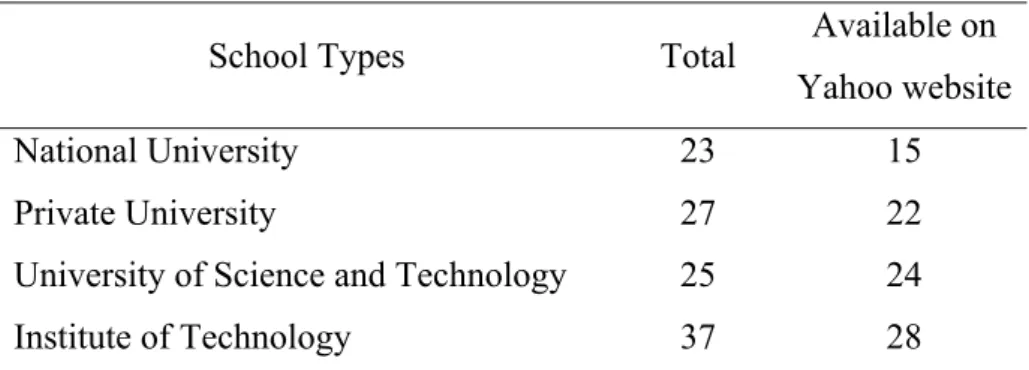
(42) CHAPTER 3 METHOD In this chapter of research method, both quantitative and qualitative approaches, applied in the present study will be presented and discussed. The first section describes the information on the participants and the sampling criteria. In the second part, instruments including the questionnaire and the interviews will be provided. The third section focuses on the data collection procedures involving the pilot study as well as the formal investigation, and the methods of data analysis will be explained in the last part.. PARTICIPANTS According to the statistics released by the Ministry of Education in 2006, there are 162 college-level schools around Taiwan, including 70 universities/colleges and 92 universities of science and technology and institutes of technology. In order to search for more specific information on each college, the researcher browsed the websites of most schools via Yahoo search engine. The total of accessible numbers of the schools is displayed in Table 3.1. Moreover, the research also collected email addresses of the target participants provided by the foreign or applied language department of each school, which followed the simple random sampling strategy addressed by Nunan (1992). In this way, the participants were selected at random from the population so that the results could more accurately reflect the whole picture of English teaching situation all over the island. That is, most participants were selected from different geographic areas of Taiwan to ensure that the sample is representative of the population as a whole. A total of 186 college English teachers participated in the current study. Of the 186 questionnaires, 10 were invalid, so 176. 30.
(43) valid questionnaires were used for this study. Table 3.1 Numbers of the Colleges in Taiwan School Types. Total. Available on Yahoo website. National University. 23. 15. Private University. 27. 22. University of Science and Technology. 25. 24. Institute of Technology. 37. 28. Source: http://tw.dir.yahoo.com/Education/Education_Unit/Universities/. INSTRUMENTATION Both quantitative and qualitative research methods were implemented in the present study based on the following stances. Firstly, quantitative method could gather the anonymous participants’ opinions from a relatively larger pool of samples. Moreover, it could elicit more full-fledged viewpoints about certain questions once at a time (Nunan, 1992). However, the major weaknesses of quantitative research lie in the low return rate and limited written answers from the respondents (Brown, 2001). In addition to the questionnaire survey, the oral interview could be used as a complementary tool to supplement the quantitative data. It allows more flexibility than the questionnaire in that more profound and rich information would be obtained throughout the interview.. Therefore, these two different research methods were. administered in the current study. Format and Content of the Questionnaire The questionnaire was composed of three major sections (see Appendix B). The first part was the demographic information of the participants, including gender, age, educational background, location of school, years of teaching experience, weekly computer using hours, CALL availability condition, and the domain with application. 31.
數據

+7
相關文件
Application via internet: Please use the on-line application function in Work Permit Application Webpage for Foreign Professional, the address:
6 《中論·觀因緣品》,《佛藏要籍選刊》第 9 冊,上海古籍出版社 1994 年版,第 1
• helps teachers collect learning evidence to provide timely feedback & refine teaching strategies.. AaL • engages students in reflecting on & monitoring their progress
Robinson Crusoe is an Englishman from the 1) t_______ of York in the seventeenth century, the youngest son of a merchant of German origin. This trip is financially successful,
fostering independent application of reading strategies Strategy 7: Provide opportunities for students to track, reflect on, and share their learning progress (destination). •
Strategy 3: Offer descriptive feedback during the learning process (enabling strategy). Where the
• Examples of items NOT recognised for fee calculation*: staff gathering/ welfare/ meal allowances, expenses related to event celebrations without student participation,
Application via internet: Please use the on-line application function in Work Permit Application Webpage for Foreign Professional, the address:
