Gravity-Assisted Chemical Vapor Deposition of Vertically
Aligned Single-Walled Carbon Nanotubes
Effects of Temperature and CH
4/H
2Ratio
C. M. Yeh,aM. Y. Chen,aJ.-Y. Gan,a J. Hwang,a,zC. D. Lin,bT. Y. Chao,band Y. T. Chengb
a
Department of Materials Science and Engineering, National Tsing Hua University, Hsin-Chu City, 30043 Taiwan
b
Department of Electronics Engineering, National Chiao Tung University, Hsin-Chu, 30043 Taiwan
Temperature and CH4/H2 ratio of gas-flow rates are the two factors that strongly affect the qualities of vertically aligned single-walled carbon nanotubes共SWCNTs兲 in gravity-assisted chemical vapor deposition 共CVD兲. The qualities of SWCNTs and other carbon products grown by gravity-assisted CVD were characterized by scanning electron microscopy and Raman spectros-copy. At temperatures between 850 and 900°C, SWCNTs of very good quality stand alone on the substrate. At other temperatures, nanofibers or irregular islands of carbon are present on the substrate. The CH4/H2ratio influences the quality of SWCNTs more abruptly than temperature. At low ratio, no carbon nanotube is formed. The window of CH4/H2ratio for the growth of vertically aligned SWCNTs ranges from 160:80 to 160:40. At a ratio higher than 160:40, multiwalled CNTs replace SWCNTs and become the dominant product.
© 2007 The Electrochemical Society. 关DOI: 10.1149/1.2735914兴 All rights reserved.
Manuscript submitted November 17, 2006; revised manuscript received March 2, 2007. Available electronically May 8, 2007.
The growth of aligned single-walled carbon nanotubes 共SWCNTs兲 on flat substrates has recently become an attractive method for fabricating nanotube-based devices such as nanotransistors,1nanoelectrodes for DNA detection,2 and electron emitters for display.3The alignments of SWCNTs are divided into horizontal共parallel to the substrate兲 and vertical 共perpendicular to the substrate兲. The horizontal alignment has been achieved either by applying an electric field between two electrodes4,5or by controlling the direction of the gas flow.6,7 The vertical alignment of multi-walled carbon nanotubes共MWCNTs兲 has been realized in the past few years. In contrast, the growth of vertically aligned SWCNTs on various substrates remains challenging. Until recently, the vertical alignment of SWCNTs has been achieved by applying a dc bias in plasma-enhanced chemical vapor deposition共PECVD兲8,9or by us-ing the gravity force in CVD.10In the dc-biased PECVD method, SWCNTs are aligned in the direction of the electric field, as reported by Maschmann et al.8One drawback of this method is a decrease in the amount of SWCNTs due to the bombardment of positively charged hydrogen ions that are accelerated by a negative dc bias. A very simple method for growing vertically aligned SWCNTs on Co/Si共100兲 based on the gravity effect in the CVD process was recently developed.10 In the gravity-assisted CVD method, the Co/Si共100兲 substrate is tilted such that its surface normal points downward, enabling SWCNTs to align in the direction of gravity. The success of growing vertically aligned SWCNTs is attributed to the formation of liquid drops of the metal catalyst at high tempera-tures. The SWCNTs are precipitated out of the liquid-metal drops and aligned with gravity.10
The merit of the gravity-assisted CVD process is its simplicity as a method for constructing three-dimensional electronic devices that require vertical SWCNTs. The characteristics of the gravity-assisted CVD process thus deserve further investigation. In this paper, the effects of growth temperature and CH4/H2 ratio on the growth of
vertically aligned SWCNTs using the gravity-assisted CVD process are discussed.
Experimental
Vertically aligned SWCNTs were grown on Co/Si共100兲 by gravity-assisted CVD, shown schematically in Fig. 1. A Co catalyst 1 nm thick was deposited onto p-Si共100兲 by magnetron sputtering. The as-deposited Co/Si共100兲 substrate was cleaned by alcohol and
deionized water before it was placed in the center of the CVD fur-nace. An Al2O3holder designed to place samples is⬃0.5 cm deep and 3⫻ 5 cm2in area. The as-cleaned substrate was then placed on
an Al2O3 holder with its surface pointing downward in the CVD
furnace and then heated from room temperature to the growth tem-perate共800–1000°C兲 in the CVD furnace with argon flow. The as-heated substrate was maintained at the selected temperature in an atmosphere of H2 for 10 min before the growth of SWCNTs to remove any metal oxide. An H2/CH4 mixed gas was fed into the
furnace for 1.5 min to grow SWCNTs hung on the Co/Si共100兲 sub-strate. The CH4/H2ratio varies from 160:160 to 160:20 for growing vertically aligned SWCNTs at a fixed growth temperature. The sur-face morphologies of the as-grown samples were characterized us-ing a JEOL JSM-6500F field-emission scannus-ing electron microscope 共FESEM兲. Raman spectra were obtained to characterize the chemi-cal information of the as-grown products, using a high-resolution micro-Raman system 共Renishaw 2000 Raman microscope兲 with a laser source at a wavelength of 532 nm.
Results and Discussion
Effect of temperature.— The growth of SWCNTs in a CVD
pro-cess has been shown to be highly sensitive to temperature.11,12 Tem-perature is considered to be a major factor in the gravity-assisted CVD process because of a similar chemical reaction in the synthesis of SWCNTs. Figures 2a-e show a series of SEM images regarding the morphologies of as-grown Co/Si共100兲 at various temperatures. The growth time共1.5 min兲 and CH4/H2 ratio 共160:80兲 were kept constant while the temperature was varied. At 800°C, nanoscale fibers with morphologies that are similar to those of carbon nano-tubes form on the Si substrate. The morphologies of SWCNTs ap-pear on the substrate at temperatures higher than 850°C. Vertically aligned SWCNTs of good quality can be achieved at a growth tem-perature of 900°C. The directions of SWCNTs are within 30° from
z
E-mail: [email protected]
Figure 1. 共Color online兲 Schematic of the furnace design for the gravity-assisted CVD process.
Journal of The Electrochemical Society, 154共7兲 K15-K17 共2007兲
0013-4651/2007/154共7兲/K15/3/$20.00 © The Electrochemical Society K15
) unless CC License in place (see abstract).
ecsdl.org/site/terms_use
address. Redistribution subject to ECS terms of use (see
140.113.38.11
the surface normal. Most SWCNTs orient vertically within 5°, al-most aligned with the direction of gravity. The force due to gravity is estimated to be⬃10−20N.10If other forms of larger force were
applied, gravity would not lead the direction of SWCNTs. The tem-perature window for growing vertical SWCNTs are less than 100°C, because some nanofibers with a larger diameter begin to appear at 950°C, as shown in Fig. 2d. At 1000°C, SWCNTs disappear com-pletely. Irregular islands on the substrate, as presented in Fig. 2e, replace the nanofibers in Fig. 2d.
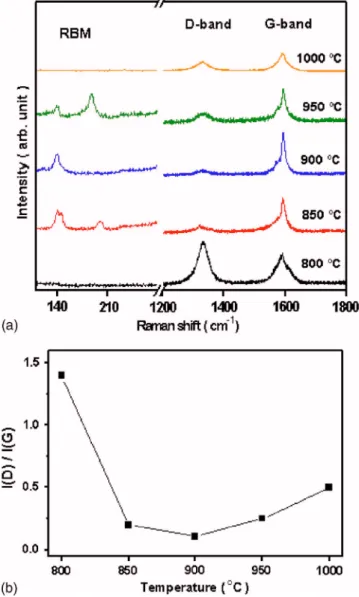
Figure 3a shows a series of Raman spectra that correspond to the nanoscale structures presented in Fig. 2a-e. Two major peaks cen-tered at 1590 and 1320 cm−1appear at 800°C. No radial breathing
mode共RBM兲 signals in the range of 100–300 cm−1were observed, which are the evidence for the existence of SWCNTs.13The G-band peak at around 1590 cm−1 has been attributed to the tangential
modes of a graphite structure in CNTs.14,15 The D-band peak at around 1320 cm−1arises from the presence of disordered graphite
and the defects of CNTs.14,15The ratio of D-band to G-band inten-sity关I共D兲/I共G兲兴 is used to characterize the chemical information of CNT-related nanostructures.16,17 The ratio I共D兲/I共G兲 at 800°C is about 1.4, which corresponds to MWCNTs, according to previously published results for MWCNTs.18At 850°C, the Raman spectrum exhibits two main features. One is the appearance of three RBM signals in the range 100–300 cm−1, indicating the existence of
SWCNTs. The RBM peaks are located at 140, 145, and 200 cm−1, corresponding to SWCNTs with diameters of ⬃1.77, 1.71, and 1.24 nm, as estimated using the equation d共nm兲 = 248/关共cm−1兲兴,19
where d is the diameter and is the RBM frequency. The other feature is the decrease in the I共D兲/I共G兲 ratio, supporting that no MWCNTs appear with SWCNTs on Co/Si共100兲 at 850°C. As the temperature increases to 900°C, a single RBM peak at 140 cm−1
appears, corresponding to SWCNTs with a diameter of⬃1.77 nm. At 950°C, two RBM signals are observed at 140 and 186 cm−1,
corresponding to SWCNTs with diameters of⬃1.77 and 1.33 nm, respectively. The increase in I共D兲/I共G兲 ratio indicates that the chemi-cal constituent of the nanofibers in Fig. 2e is carbon. Notably, the
RBM signals are completely absent at 1000°C. Only D and G peaks are present in the Raman spectrum, implying that the irregular is-lands in Fig. 2e mainly consist of sp2carbon bonds. Very probably, carbon nanofibers dominate at 1000°C, linking with each other and forming the irregular islands.
Figure 3b plots the I共D兲/I共G兲 ratio as a function of growth tem-perature. The I共D兲/I共G兲 ratio declines substantially from 1.4 to 0.2 as the growth temperature increases from 800 to 850°C, because of the appearance of SWCNTs at 850°C. The I共D兲/I共G兲 ratio reaches a minimum value of 0.11 at 900°C before rising back to 0.5 at 1000°C, supporting the fact that the SWCNTs grown at 900°C are of the highest quality. The increase of I共D兲/I共G兲 ratio reveals that the quality of SWCNTs becomes worse at temperatures higher than 900°C, which has been attributed to the thermal pyrolysis of CH4to
amorphous carbon 共disordered graphite兲 at high temperatures, as reported by Hornyak et al.11
Effect of CH4/H2ratio.— The effect of CH4/H2 ratio on the
growth of SWCNTs by gravity-assisted CVD at 900°C is thus in-vestigated based on the results in the previous section. Figures 4a-d show SEM images of the as-grown samples at various CH4/H2
ra-tios of gas-flow rates. No CNTs 共SWCNT and MWCNTs兲 were observed at a CH4/H2 ratio of 160:160. As the CH4/H2 ratio
in-Figure 2. SEM images of CNTs grown on Co/Si共100兲 at various tempera-tures:共a兲 800, 共b兲 850, 共c兲 900, 共d兲 950, and 1000°C.
Figure 3.共Color online兲 共a兲 Raman spectra of CNTs grown on Co/Si共100兲 at various temperatures and共b兲 I共D兲/I共G兲 ratio as a function of growth tempera-ture.
K16 Journal of The Electrochemical Society, 154共7兲 K15-K17 共2007兲
K16
) unless CC License in place (see abstract).
ecsdl.org/site/terms_use
address. Redistribution subject to ECS terms of use (see
140.113.38.11
creases to 160:80, vertically aligned SWCNTs are present, as shown in Fig. 4b. At a CH4/H2 ratio of 160:40, SWCNTs and MWCNTs coexist共Fig. 4c兲. MWCNTs completely replace SWCNTs at a higher CH4/H2ratio of 160:20共Fig. 4d兲.
The Raman spectra in Fig. 5 characterize the qualities of CNTs 共MWCNTs and SWCNTs兲. No RBM signals appear at a CH4/H2
ratio of 160:160, confirming the SEM observation in Fig. 4a. The weak D-band and G-band signals are attributed to the low carbon supply, which limits the growth of CNTs. At a CH4/H2 ratio of
160:80, a strong RBM peak appears at 140 cm−1, corresponding to
SWCNTs with a diameter of ⬃1.77 nm. The low I共D兲/I共G兲 ratio reveals the high quality of SWCNTs. The appropriate carbon con-centration leads to the growth of SWCNTs. As the CH4/H2 ratio
increases to 160:40, two weak RBM peaks appear at 190 and 205 cm−1, corresponding to SWCNTs with diameters of⬃1.31 and
⬃1.21 nm, respectively. The I共D兲/I共G兲 ratio increases to 0.5, sug-gesting the existence of MWCNTs on the substrate.20This result agrees very well with the SEM images in Fig. 4c. At a CH4/H2ratio
of 160:20, RBM signals disappear and the I共D兲/I共G兲 ratio is ⬃0.5, implying the existence of MWCNTs. Increasing the CH4 concentra-tion causes more carbon to diffuse into the catalysts, reflecting the precipitation of more carbon and consequent MWCNT growth. This finding is consistent with the SEM images in Fig. 4d. The window of CH4/H2ratios for the vertically aligned SWCNTs growth is from
160:80 to 160:40. The growth region of SWCNTs at various CH4/H2
ratios is between the growth regions of non-CNT and MWCNT.
Conclusions
Vertically aligned SWCNTs can be grown on Co/Si共100兲 at ap-propriate ranges of temperature and CH4/H2ratios. At temperatures between 850 and 900°C, SWCNTs of very good quality stand alone on the substrate. At other temperatures, nanofibers or irregular is-lands of carbon are present on the substrate. The window of CH4/H2
ratios for the growth of vertically aligned SWCNTs ranges from 160:80 to 160:40. At a low ratio, no CNTs were grown on the substrate. The supply of appropriate amounts of CH4and H2cause
SWCNTs to form. At a ratio higher than 160:40, MWCNTs gradu-ally replace SWCNTs as the dominant species on the substrate.
Acknowledgment
The work is sponsored by the National Science Council of Tai-wan, through project NSC95-2221-E-007-064-MY2.
National Tsing Hua University assisted in meeting the publication costs of this article.
References
1. W. B. Choi, J. U. Chu, K. S. Jeong, E. J. Bae, J. W. Lee, J. J. Kim, and J. O. Lee, Appl. Phys. Lett., 79, 3696共2001兲.
2. J. Li, H. T. Ng, A. Cassell, W. Fan, H. Chen, Q. Ye, J. Koehne, J. Han, and M. Meyyappan, Nano Lett., 3, 597共2003兲.
3. L. M. Dai, Smart Mater. Struct., 11, 645共2002兲.
4. A. Ural, Y. Li, and H. Dai, Appl. Phys. Lett., 81, 3464共2002兲.
5. Y. Zhang, A. Chang, J. Cao, Q. Wang, W. Kim, Y. Li, N. Morris, E. Yenilmez, J. Kong, and H. Dai, Appl. Phys. Lett., 79, 3155共2001兲.
6. S. Huang, X. Cai, and J. Liu, J. Am. Chem. Soc., 125, 5636共2003兲. 7. Z. Yu, S. Li, and P. J. Burke, Chem. Mater., 16, 3414共2004兲.
8. M. R. Maschmann, P. B. Amama, A. Goyal, Z. Iqbal, and T. S. Fisher, Carbon, 44, 2758共2006兲.
9. T. Kato and R. Hatakeyama, Chem. Vap. Deposition, 12, 345共2006兲.
10. C. M. Yeh, M. Y. Chen, J. S. Syu, J.-Y. Gan, and J. Hwang, Appl. Phys. Lett., 89, 033117共2006兲.
11. G. L. Hornyak, L. Grigorian, A. C. Dillon, P. A. Parilla, K. M. Jones, and M. J. Heben, J. Phys. Chem. B, 106, 2821共2002兲.
12. M. R. Maschmann, P. B. Amama, A. Goyal, Z. Iqbal, R. Gat, and T. S. Fisher,
Carbon, 44, 10共2006兲.
13. S. Bandow, S. Asaka, Y. Saito, A. M. Rao, L. Grigorian, E. Richter, and P. C. Eklund, Phys. Rev. Lett., 80, 3779共1998兲.
14. A. C. Ferrari and J. Robertson, Phys. Rev. B, 61 14095共2000兲. 15. M. S. Dresselhaus and P. C. Eklund, Adv. Phys., 49, 705共2000兲.
16. G. S. Duesberg, W. J. Blau, and H. J. Byrne, Chem. Phys. Lett., 8, 310共1999兲. 17. J. Robertson, Mater. Sci. Eng., R., 37, 129共2002兲.
18. C. L. Lin, C. F. Chen, and S. C. Shi, Diamond Relat. Mater., 13, 1026共2004兲. 19. A. Jorio, R. Saito, J. H. Hafner, C. M. Lieber, M. Hunter, T. McClure, G.
Dressel-haus, and M. S. DresselDressel-haus, Phys. Rev. Lett., 86, 1118共2001兲. 20. W. Qian, T. Liu, F. Wei, and H. Yuan, Carbon, 41, 1851共2003兲. Figure 4. SEM images of CNTs grown on Co/Si共100兲 at various CH4/H2
ratios of gas flow rates:共a兲 160:160, 共b兲 160:80, 共c兲 160:40, and 共d兲 160:20.
Figure 5. 共Color online兲 Raman spectra of CNTs grown on Co/Si共100兲 at various CH4/H2ratios of gas-flow rates.
K17
Journal of The Electrochemical Society, 154共7兲 K15-K17 共2007兲 K17
) unless CC License in place (see abstract).
ecsdl.org/site/terms_use
address. Redistribution subject to ECS terms of use (see
140.113.38.11