METALLURGICAL AND MATERIALS TRANSACTIONS A VOLUME 29A, FEBRUARY 1998—693
Communications
Grain Boundary Precipitation
Reactions in a Wrought
Fe-8Al-5Ni-2C Alloy Prepared
by the Conventional Ingot Process
C.N. HWANG and T.F. LIUPhase transformations in the Fe-8Al-5Ni-2C alloy, pre-pared by rapid solidification processing (RSP), have been studied by Choo and Kim.[1] They showed that the
micro-structure of the alloy in the as-solidified condition was aus-tenite phase (g) containing fine ordered L'l2-type
pre-cipitates. The formation of these fine ordered L'l2-type
precipitates, lying along the^100& directions in the matrix, was attributed to the spinodal decomposition. It was also shown that, on aging at 823 K, the fine ordered precipitates grew and, at the same time,a(ferrite) and k-carbide formed by a heterogeneous reaction at the g/g grain boundaries. With increasing aging time, the heterogeneous reaction be-came predominant, leading to a two-phase microstructure of a and k-carbide in the end.[1] Recently, we performed
transmission electron microscopy (TEM) observations of the phase transformations in the Fe-8Al-5Ni-2C alloy, pre-pared by conventional casting process. It was found that the microstructure of the alloy in the as-quenched condition was austenite phase containing fine ordered L'l2-type
pre-cipitates, similar to the previous results for the as-solidified alloy. However, when the as-quenched alloy was aged at 823 K for a long time, the equilibrium microstructure was observed to be a mixture of (a 1 B2 1 k-carbide), rather thana 1 k-carbide as reported by Choo and Kim.
The alloy, Fe-8Al-5Ni-2C, was prepared in an air induc-tion furnace by using 99.5 pct iron, 99.7 pct aluminum, 99.5 pct nickel, and pure carbon powder. After being ho-mogenized at 1523 K for 12 hours under a protective argon atmosphere, the ingot was hot forged and then cold rolled to a final thickness of 2.0 mm. The sheet was subsequently solution heat treated at 1323 K for 2 hours and quenched into room-temperature water. The aging treatments were performed at 823 K for various times in a salt bath. The microstructures of the alloy were examined by means of optical microscopy and TEM. Thin foil specimens for TEM were prepared in a double jet electropolisher, using an elec-trolyte of 30 pct acetic acid, 60 pct ethanol, and 10 pct perchloric acid at 263 to 283 K. The current density was kept in the range from 1.5 to 2.0 3 104 A/m2. Electron
microscopy was performed on a JEOL* 2000FX scanning *JEOL is a trademark of Japan Electron Optics Ltd., Tokyo. transmission electron microscope (STEM) operating at 200 kV. Elemental distributions were examined using a LINK-AN 10000 energy-dispersive X-ray spectrometer
C.N. HWANG, Graduate Student, and T.F. LIU, Professor and Chairman, are with the Institute of Materials Science and Engineering, National Chiao Tung University, Taiwan, 30049, Republic of China.
Manuscript submitted October 30, 1996.
(EDS). Quantitative analyses of elemental concentrations for Fe, Al, and Ni were made with the aid of a ZAF-cor-rected program on the LINK system (where Z5 backscat-ter coefficient, A 5 absorption coefficient, and F 5 fluorescence coefficient).
The optical micrograph of the as-quenched alloy exhib-ited austenite grains with annealing twins, as shown in Fig-ure 1(a). FigFig-ures 1(b) and (c) are bright-field (BF) and dark-field (DF) electron micrographs of the as-quenched al-loy, revealing that a high density of fine ordered precipitates formed within the austenite matrix. Figure 1(d), a se-lected-area diffraction pattern (SADP), demonstrates that the fine precipitates have an ordered L'l2-type structure.[1–9]
Hence, obviously, these observations are essentially iden-tical to those reported by Choo and Kim for their as–rapidly solidified alloy.[1]When the as-quenched alloy was aged at
823 K for moderate times, the fine ordered L'l2-type
pre-cipitates grew in the matrix. At the same time, a hetero-geneous reaction started to occur on the g/g grain boundaries. Electron diffraction analysis indicated that the two kinds of coarse precipitates werea and k-carbide hav-ing an ordered L'l2-type structure,
[1–4]respectively. Figures
2(a) through (c) are BF, 110a, and 100 k-carbide DF electron micrographs of the same area, showing the presence of thea andk-carbide. This reaction can be written as g →a 1 k-carbide. With increasing aging time at the same temperature, theg→a 1 k-carbide transition proceeded toward the inside of austenite grains. Apparently, the microstructure of the alloy in the equilibrium stage at 823 K seems to be a mixture of (a 1 k-carbide), as reported earlier.[1]
Figure 3 shows an optical micrograph of the alloy aged at 823 K for 20 minutes, in which grain boundary reactions have taken place. However, a careful TEM examination re-vealed that B2-type precipitates were formed within thea phase, as follows. Figure 4(a) shows a BF image of lamella product. Figure 4(b) is an SADP taken from an area cov-ering a (a 1 B2) particle and a k-carbide, indicating the Nishyama–Wassermann orientation relationship[10]between
thea (or B2) and k-carbide: [001]a//[0 1]1 k, ( 10)1 a//( 11)1 k.
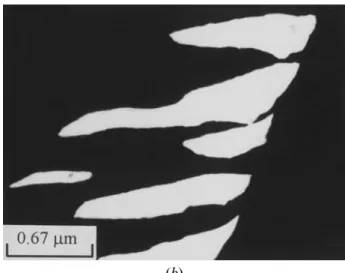
Figures 4(c) and (d), 100 k-carbide, and 100 B2 DF elec-tron micrographs clearly exhibit thek-carbides and B2 pre-cipitates, respectively. Accordingly, the stable microstructure of the present alloy at 823 K should be a mixture of (a 1 B2 1 k-carbide).
This result is quite different from that reported by Choo and Kim.[1] The apparent discrepancy may be attributed to
the following two possible reasons. (1) The preparations of the alloys were different. In Choo and Kim’s studies, the Fe-8Al-5Ni-2C alloy was prepared by RSP, whereas the present alloy was prepared by conventional casting process. (2) In their studies, only low magnification BF electron mi-crographs were provided. No electron diffraction investi-gation was made. In order to get some insight into the origin of the precipitation of B2 phase, EDS analyses were undertaken. The average concentrations of the substitu-tional alloying elements were obtained from at least ten different EDS profiles of each phase. The results are sum-marized in Table 1. It is worthwhile to note that, since in the present study the EDS analyses were made in the STEM mode and the size of the B2 precipitates (about 70 nm) examined is slightly larger than that of the electron beam spot (40 nm), some errors are inevitable in determining the elemental concentrations in the B2 precipitates.
Nonethe-694—VOLUME 29A, FEBRUARY 1998 METALLURGICAL AND MATERIALS TRANSACTIONS A
(a) (b)
(c) (d)
Fig. 1—(a) An optical micrograph. (b) through (d ) Electron micrographs of the as-quenched alloy: (b) BF, (c) a 100 DF of the L'l2precipitates, and (d ) an SADP taken from an area covering the austenite matrix and fine precipitates. The foil normal is [001] (hkl5 austenite matrix, and hkl 5 L'l2precipitate).
less, the results given in Table 1 indicated that the nickel concentration in both thea and B2 precipitates is distinctly higher than that in thek-carbide.
Therefore, it is reasonable to conclude that both the a and B2 phases are enriched in nickel. In a previous study, we have shown that the addition of 4.1 at. pct nickel to an Fe-23.1Al alloy pronouncedly expanded the B2 phase field and caused the formation of a high density of B2 precipi-tates within the a matrix.[11]Therefore, it is reasonable to
believe that during the heterogeneous precipitation of (a 1 k-carbide) on the g/g grain boundaries, the ferrite particle would be enriched in nickel. The enrichment of nickel then would lead to the formation of the B2 precipitates within thea phase. Since this process involves diffusion of nickel, it is thus anticipated that the formation of the B2 precipi-tates occurred only after prolonged aging at 823 K.
Finally, it is worth mentioning that the microstructures of the Fe-Al-C alloys have been studied by many work-ers.[12–19] However, because of high temperature instability
of the alloys, all of their studies were only focused on the as-quenched microstructures. To the authors’ knowledge, no detailed information concerning the aged microstructure has been provided. In order to enhance the phase stability of austenite, some elements such as manganese and nickel
have been added to the alloys so as to form Fe-Al-Mn-C and Fe-Al-Ni-C alloy systems. In fact, the phase transitions in the Fe-Al-Mn-C austentic alloys have been extensively investigated recently.[2,3,5–9,20–26]In contrast, the experimental
studies of the Fe-Al-Ni-C austentic alloys are relatively de-ficient. The present preliminary study provided further ev-idence that, although both manganese and nickel are austenite-stabilizing elements, the later stage microstruc-tural changes occurring during aging of Fe-Al-Ni-C alloys differ from those in the Fe-Al-Mn-C alloys. Obviously, in order to further understand the phase transitions in the Fe-Al-Ni-C alloys, much more work is needed.
The authors are pleased to acknowledge the financial sup-port of this research by the National Science Council, Re-public of China, under Grant No. NSC86-2216-E009-009. They are also grateful to Miss M.H. Lin for typing the manuscript.
REFERENCES
1. W.K. Choo and D.G. Kim: Metall. Trans. A, 1987, vol. 18A, pp. 759-66.
METALLURGICAL AND MATERIALS TRANSACTIONS A VOLUME 29A, FEBRUARY 1998—695
(a) (b)
(c)
Fig. 2—Electron micrographs of the alloy aged at 823 K for 3 min: (a) BF (F5 ferrite, and K 5k-carbide), (b) 110 a DF, and (c) 100 k DF images.
Fig. 3—An optical micrograph of the alloy aged at 823 K for 20 min.
Table I. Chemical Compositions of Substitutional Elements in the Phases, as Determined by EDS Ignoring the Carbon
Content
Chemical Composition (Wt Pct)
Heat Treatment Phase Fe Al Ni
823 K aging a 85.98 7.81 6.21
3 min k 88.88 8.35 2.77
823 K aging a 88.85 7.52 4.01
20 min B2 81.67 8.42 9.51
2. W.K. Choo and K.H. Han: Metall. Trans. A, 1985, vol. 16A, pp. 5-10.
3. C.N. Hwang, C.Y. Chao, and T.F. Liu: Scripta Metall., 1993, vol. 28, pp. 263-68.
4. C.Y. Chao and T.F. Liu: Metall. Trans. A, 1993, vol. 24A, pp. 1957-63.
5. K.H. Han, J.C. Yoon, and W.K. Choo: Scripta Metall., 1985, vol. 20 (1), pp. 33-36.
6. C.C. Wu, J.S. Chou, and T.F. Liu: Metall. Trans. A, 1991, vol. 22A, pp. 2265-76.
7. T.F. Liu, J.S. Chou, and C.C. Wu: Metall. Trans. A, 1990, vol. 21A, pp. 1891-99.
8. J.E. Krzanowski: Metall. Trans. A, 1988, vol. 19A, pp. 1873-76. 9. C.Y. Chao, C.N. Hwang, and T.F. Liu: Scripta Metall., 1993, vol. 28,
pp. 109-14.
10. J.W. Edington: The Operation and Calibration of the Electron
Microscope, The Macmillan Press Ltd., London and Basingstoke,
1985, vol. 2, p. 116.
11. C.C. Wu, S.C. Jeng, and T.F. Liu: Metall. Trans. A, 1992, vol. 23A, pp. 1395-1401.
12. M. Watanabe and C.M. Wayman: Metall. Trans., 1971, vol. 2, pp. 2221-27.
13. M. Watanabe and C.M. Wayman: Metall. Trans., 1971, vol. 2, pp. 2229-36.
14. R. Oshima and C.M. Wayman: Metall. Trans., 1972, vol. 3, pp. 2163-69.
696—VOLUME 29A, FEBRUARY 1998 METALLURGICAL AND MATERIALS TRANSACTIONS A
(a) (b)
(c) (d)
Fig. 4—Electron micrographs of the alloy aged at 823 K for 20 min: (a) BF (b ) An SADP taken from an area covering (a 1 B2) particle and k-carbide lamella. The foil normals of thea and k-carbide are [001]aand [011]k, respectively (hkl5a, hkl 5 B2, and (hkl) 5 k carbide). (c) and ( d ) 100 k-carbide and 100 B2 DF images, respectively.
15. T. Tadaki and K. Shimizu: Trans. JIM, 1975, vol. 16, pp. 105-10. 16. Z. Nishiyama, K. Shimizu, and M. Harada: Trans. JIM, 1970, vol.
11, pp. 152-58.
17. A. Inoue, T. Minemura, A. Kitamura, and T. Masumoto: Metall.
Trans. A, 1981, vol. 12A, pp. 1041-46.
18. C.H. Kao and C.M. Wan: J. Mater. Sci., 1988, vol. 23, pp. 894-99. 19. A. Inoue, T. Minemura, A. Kitamura, and T. Masumoto: Metall.
Trans. A, 1981, vol. 12A, pp. 1041-46.
20. K.H. Han, W.K. Choo, and D.E. Laughlin: Scripta Metall., 1988, vol. 22, pp. 1873-78.
21. K.H. Han and W.K. Choo: Metall. Trans. A, 1989, vol. 20A, pp. 205-14.
22. K. Sato, K. Tagawa, and Y. Inoue: Metall. Trans. A, 1990, vol. 21A, pp. 5-11.
23. K.H. Han: Mater. Sci. Eng., 1995, vol. A197, pp. 223-29.
24. Y. Ikarashi, K. Sato, T. Yamazaki, Y. Inoue, and M. Yamanaka: J.
Mater. Sci. Lett., 1992, vol. 11, pp. 733-35.
25. H. Huang, D. Gan, and P.W. Kao: Scripta Metall., 1993, vol. 30 (4), pp. 499-504.
26. Y.G. Kim, J.M. Han, and J.S. Lee: Mater. Sci. Eng., 1989, vol. A114, pp. 51-59.
Sticking Mechanism during Hot
Rolling of Two Stainless Steels
SUNGHAK LEE, DONGWOO SUH, SEUNGCHAN OH, and WON JINSticking refers to the phenomenon occurring in the hot-rolling process in which fragments of a rolled material are detached and get stuck to a work roll surface, deteriorating the surfaces of both the roll and the rolled material.[1] It
SUNGHAK LEE, Professor, Center for Advanced Aerospace Materials, and WON JIN, Senior Research Engineer, Stainless Steel Research Team, Technical Research Laboratories, are with the Pohang University of Science and Technology, Pohang, 790-784 Korea. DONGWOO SUH, formerly Research Assistant, Center for Advanced Aerospace Materials, Pohang University of Science and Technology, is Postdoctoral Research Associate, Department of Materials Science and Engineering, Massachusetts Institute of Technology, Cambridge, MA 02139-4307. SEUNGCHAN OH, formerly Research Assistant, Center for Advanced Aerospace Materials, Pohang University of Science and Technology, is Research Scientist, Materials Research Department, Kia Technical Center, Seoul, 152-030 Korea.