Tunable Er
3+-doped fiber amplifiers covering S- and C + L-bands (1490 ~ 1610 nm) using
discrete all-fiber ASE suppressing filters
Nan-Kuang Chen1, Kuei-Chu Hsu1, Sien Chi1,2, and Yinchieh Lai1
1Department of Photonics and Institute of Electro-Optical Engineering, National Chiao Tung University,
Hsinchu, Taiwan 300, R.O.C.
2Department of Electrical Engineering, Yuan Ze University, Chungli, Taiwan 320, R.O.C.
TEL: +886.3.5731125 FAX: +886.3.5731125 E-mail: [email protected]
S-band (1480 ~ 1520 nm) has been recently studied as a new frequency band for fiber-optic communication.
So far, the most promising S-band EDFAs employ the EDFs with depressed inner cladding to achieve fundamental-mode cutoff λc at the longer wavelengths [1]. The depressed inner cladding in EDFs modifies the waveguide dispersion, which in terms varies the refractive index dispersion (RID) n(λ) curves. The effective indices of the longer (shorter) wavelengths become lower (higher) than the index of the outer silica cladding respectively. The ASE at the longer wavelengths can then be substantially suppressed so that in the shorter wavelengths (S-band) higher population inversion and sufficient amplification can be obtained. The λc can be tuned toward shorter wavelengths by bending the fiber and the total distributed loss for wavelengths longer than the λc can be > 200 dB through an entire 15-m-long EDF. However, a specially designed EDF is required for S-band amplification and the cutoff efficiency and insertion loss become worse and higher, respectively, when the radius of bending curvature gradually decreases [1].
In contrast to the λc induced by waveguide dispersion, we have demonstrated widely tunable (1250 ~ 1650 nm) side-polished fiber short-pass filters based on material dispersion [2]. The λc is thermo-optically tunable (no moving part) and the high cutoff efficiency (deep stopband and sharp filter skirt) can still be maintained while tuning to different wavelengths. The short-pass filter can be further incorporated into the ring cavity of an EDF to locally suppress the unwanted wavelengths and achieve a high efficiency tunable fiber laser. However, a single local λc is inefficient for the standard EDFs (no depressed inner cladding) to be operated as an amplifier at the shorter wavelengths (S-band) of the gain bandwidth. Consequently, we employ multistage tunable fused-tapered fiber short-pass filters discretely located in the standard silica-based EDF to achieve S-band amplification [3] in this work.
1.25 1.30 1.35 1.40 1.45 1.50 1.55 1.60 1.65 -60 -50 -40 -30 -20 -10 0 (b) 27oC 26oC 25o C 24oC 23o C 28oC 30o C 29oC 32o C 31oC T rans m issio n L oss ( T .L .) ( dBm ) Wavelength (µm)
Fig. 1. (a) Schematic of the tunable EDFA covering S- and C + L-bands with 17.5-m-long EDF. (b) Spectral responses of the tapered fiber short-pass filters using Cargille liquid with nD = 1.456 at different temperatures. (RES: 1 nm)
In fabrication, the fused-tapering method was utilized to fabricate the four tapered fibers. Fig. 1(a) shows the schematic structure of the tunable EDFA, where the four fused-tapered single-mode fibers are discretely located within the 17.5-m-long EDF, spaced by sections of 3.5-m-long silica-based single-cladding EDF which is designed for C-band applications (EDFH0790: Prime Optical Fiber Corp.). In material dispersion, a tunable λc with high cutoff efficiency is highly related to the cross angle between the RID curves of the fiber and the dispersive materials [2]. A large cross angle can give rise to a sharp λc with high rejection for the stopband wavelengths. The RID curves of the dispersive materials (Cargille index-matching liquids) and the SMF-28 (Corning) are shown in Ref. 2. In waveguide structure, the cutoff efficiency is influenced by the interaction length and the shape of the fused-tapered region [4]. The four fused-tapered fibers were individually fabricated using hydrogen flame and the flame must be traveling back-and-forth during fabrication to guarantee a uniform waist with long interaction length which induces more attenuation for stopband wavelengths. The total elongation length was about 30 mm and the diameter and length of the uniform waist were respectively measured around 26 µm and 18 mm. The Cargille
396
TuAA5 16:30 – 16:45
index-matching liquid (nD = 1.456 and dnD/dT = -3.74 × 10⁻⁴/°C) was applied to surround the whole tapered region at different temperatures to generate a sharp λc. This is because the interaction length containing the tapered transition will not only make the RID curve of tapered fiber raised but also make whose dispersion slope steeper to produce a sharp λc. The spectral responses of the short-pass filters were measured using broadband superluminescent diodes spanning 1250 ~ 1650 nm and the data with the best cutoff efficiency is shown in Fig. 1(b). In Fig. 1(b), the best rejection efficiency at 28°C at 1530 nm can be as high as 55 dB and the 55 dB isolation bandwidth is around 80 nm (1450 ~ 1530 nm). From 1450 nm (T.L. = 1.62 dB) to 1530 nm (T.L. = 55.02 dB), the short-pass filter provides a very sharp roll-off curve with a gradient of −0.67 dB/nm at different temperatures. For the four filters, the maximal difference among the cutoff wavelengths was measured to be around 15.2 nm at 28.6°C while the average rejection efficiency and gradient of roll-off curve were 46.4 dB and −0.53 dB/nm, respectively.
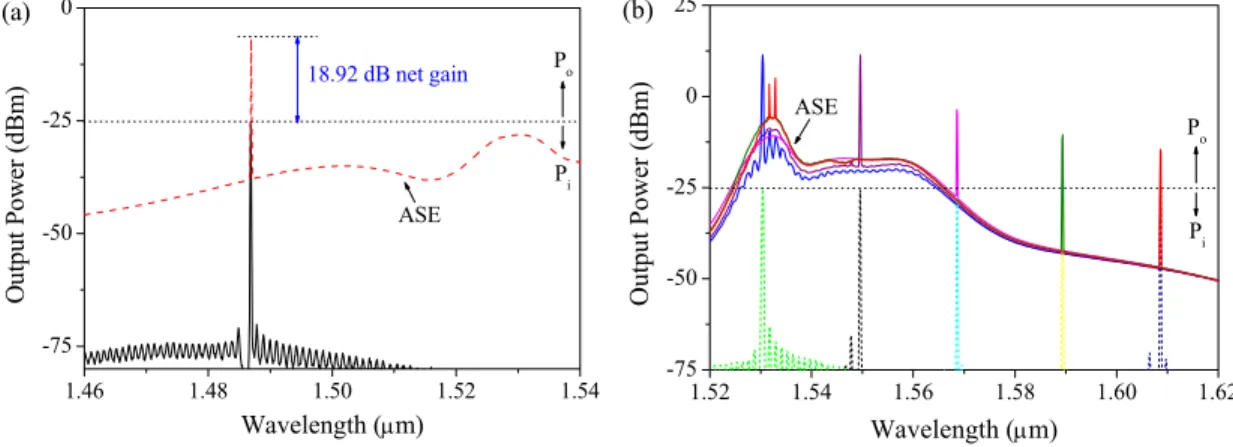
1.46 1.48 1.50 1.52 1.54 -75 -50 -25 0 18.92 dB net gain ASE (a) Pi Po Ou tp ut P owe r ( dB m ) Wavelength (µm) 1.52 1.54 1.56 1.58 1.60 1.62 -75 -50 -25 0 25 ASE Pi Po (b) Outpu t Power ( dBm) Wavelength (µm)
Fig. 2. Amplification spectra of the signals in (a) S-band at 28.6°C and (b) C + L-band at 40°C (RES: 0.1 nm). Pi and Po are input and output signal spectra, respectively.
To investigate the amplification characteristics in S- and C + L-bands, a 980 nm pump laser with 135 mW fiber-pigtailed output power was launched into our EDF in a forward pumping scheme through this work. The high-cutoff-efficiency short-pass filters in the 17.5-m-long EDF fiber can discretely suppress the unwanted ASE in the C + L-band and pass the S-band signal and 980 nm pump wavelengths. Subsequently, an input power of -25 dBm was respectively launched into the EDF for DFB laser signals in S-, C-, and L-bands. The input signal spectra (Pi) and amplified output signal spectra (Po) in S-band at 28.6°C are shown in Fig. 2(a) while in C + L-band at 40°C are shown in Fig. 2(b), under 0.1 nm resolution bandwidth (RES) of optical spectrum analyzer (OSA). In S-band, the net signal gain at 1486.9 nm was measured to be 18.92 dB while in C + L-band, the net signal gains at 1530.4, 1549.6, 1568.6, 1589.4, and 1608.6 nm were measured to be 36.80, 37.18, 28.89, 15.19, and 10.60 dB, respectively. At 28.6°C, the S-band signal gradually grew with increasing pump power because the C + L-band ASE was discretely and substantially suppressed every 3.5-m-long EDF. At 40°C, the optical gain moved to C + L-band and, as well as the conditions in conventional EDFAs, the S-band output signal turned out to suffer 7.1 dB loss compared with the -25 dBm input signal.
In conclusion, we have demonstrated thermo-optically tunable EDFAs using a 17.5-m-long silica-based single-cladding C-band EDF with discrete ASE suppressing filters in a simple and cost-effective way. The short-pass filters can provide widely tunable λc with high cutoff efficiency such that the amplification of
EDFA can be tuned to cover S- and C + L-bands over 1490 ~ 1610 nm.
This work was supported by the National Science Council of R.O.C. under contracts NSC 95-2752-E-009-009-PAE.
References
1. M. A. Arbore, “Application of fundamental-mode cutoff for novel amplifiers and lasers,” in Optical Fiber Communication Conference OFC’05 (Optical Society of America, Washington, D.C., 2005), paper OFB4. 2. N. K. Chen et al., “Wideband tunable fiber short-pass filter based on side-polished fiber with dispersive
polymer overlay,” Opt. Lett., Vol. 29, pp. 2219-2221, 2004.
3. N. K. Chen et al., “Tunable Er3+/Yb3+ codoped fiber amplifiers covering S- and C-bands (1460 ~ 1580 nm) based on discrete fundamental-mode cutoff,” in Optical Fiber Communication Conference OFC’06 (Optical Society of America, Washington, D.C., 2006), paper OThJ5.
4. J. Villatoro et al., “In-line tunable band-edge filter based on a single-mode tapered fiber coated with a dispersive material,” IEEE Photon. Technol. Lett., Vol. 17, pp. 1665-1667, 2005.