
區域創新共同體之研究—以京津冀創新共同體為例
124
0
0
全文
(2)
(3) 致 謝 碩士生涯匆匆,緣分讓獨一無二的我遇到了每一個獨一無二的人,感謝 的話已經不及言表。我想感謝的人真的實在太多,但是我想最值得感謝的應 該是從這個碩士生涯學到的是什麼? 論文進行得坎坎坷坷,但也順順利利地完成了,最幸運的是碰到指導教 授李亭林老師,亭林老師教會我很多知識,但老師不僅僅是傳授知識而已, 該沉默的時候絕不逞強,該主動的時候絕不後退,該反對的時候不會苟同, 該竭力的時候也不拖延,這樣的勇氣是我從老師那裡學到最多的,英文論文 的要求難度不容小覷,但讓我對世界更加渴望。而何柏正老師也可以稱之為 我碩士生涯的貴人,從何老師身上學到的是用心對待每一個人和每一件事, 命運雖然會開玩笑但是從來不虧待這樣的人。中科院康大臣老師也協助論文 進展,指正批評讓我對現實的殘酷以及社會人際的重要有了更深的瞭解。口 委蕭乃沂、劉佳玲老師敢問敢質疑,苛刻不失邏輯的大膽要求,都是寶貴的 經驗。 同樣其他碩士時期教導幫助過我的老師,包含盧昆宏老師,黃英忠校長、 陳一民老師、陳宜伶老師、劉信賢老師等都值得尊敬以及愛戴。最重要的是 碩士生涯遇到的一班可愛的同學、學長姐和學弟妹,一起嬉笑和拼搏的日子 讓我知道快樂是生活的調味劑,合作是進步的催化劑。 遠在異鄉唸書,家的感覺總是能讓人寧神,父母給予我最好的支持和幫 助,不管是學業、生活和感情,讓我體會到最純真的大愛無疆。而在台灣認 識了一群朋友,讓我台灣的生活得以多姿多彩,留下一段非常美好的回憶。 致此,為我求學生涯中幫助過,教導過,合作過,生活過,瘋狂過,愛 過的所有人獻上最誠摯的謝意。. 沈毅謹致 於國立高雄大學亞太工商管理研究所 民國一百零六年七月. I.
(4) 區域創新共同體之研究—以京津冀創新共同體為例 指導教授:李亭林 博士,何柏正 博士 國立高雄大學亞太工商管理學系,國立中山大學公共事務管理研究所 學生:沈毅 國立高雄大學亞太工商管理學系. 摘要 進入 21 世紀,利用科技創新實現區域間協同互補效應是提升競爭力主要模 式。歐盟、美國、日本等地區都發展其區域協同創新共同體,京津冀是中國首都 核心圈,其協同創新共同體也是中國近年重點工程之一。本研究目的首在了解何 謂區域協同創新共同體,尤其是中國京津冀協同創新共同體的所扮演的關鍵角色 及其成功的重要關鍵因素,和彼此間關係和影響,以了解可能的未來發展方向。 本研究兼採質性(文獻回顧和專家訪談)與量化(決策實驗室法、層級網絡分析法、 和評分排序法)方法,以達成上述研究目的。研究發現京津冀協同創新共同體之 產官學三關鍵角色相輔相成,產業影響力最大,政府次之,學術最後;影響因素 中吸收和自創能力最強。產官學不同領域專家認知不同,對比後產業需增強自主 創新能力,政府需更完善政府法令,學術需更注重整體能力;京津冀三個地區發 展以北京為首天津、河北次之。而與其他國家地區共同體不同的是,京津冀政府 擁有絕對導向性,但產業具有絕對影響力。本文認為政府應更積極媒合產業和學 術,同時增強自我監管,讓三者關係更加緊密。本研究以全新產官學三角度出發, 區別以往單一政府角度質化研究,通過不同領域專家視角,結合網路層級分析的 方式,不僅發現角色間的互相作用,同時不忽略角色內部之影響,全方位理清京 津冀協同創新共同體中各角色的影響力和作用。. 關鍵字:決策實驗室法,網路分析法,區域協同創新共同體,政府,產業,學術 單位,北京天津河北(京津冀). II.
(5) The study of Regional Collaborative Innovative -The Case of Beijing-Tianjin-Hebei Collaborative Innovation Community Advisors: Dr. Ting-Lin Lee Department of Asia-Pacific Industrial and Business Management National University of Kaohsiung Advisors: Dr. Po-Cheng Ho Institute of Public Affairs Management National Sun Yat-sen University Student: Yi Shen Department of Asia-Pacific Industrial and Business Management National University of Kaohsiung. ABSTRACT Into the 21st century, use the scientific and technological innovation to achieve synergies and complementary synergistic effect for a region or country to enhance the competitiveness has become the main development model. The EU, American, Japan and other regions have developed their regional collaborative innovation community, Beijing-Tianjin-Hebei is China's capital core circle, and Beijing-Tianjin-Hebei collaborative innovation community is also one of China's key projects. The objective of this study is to understand what is the regional collaborative innovation community, and above all the key actors and success selected factors of China's Beijing-Tianjin-Hebei collaboration innovation community, obtain their relationship and influence, so as to realize future direction. To achieve the objective of the above study, this research employed both qualitative (Literature review and expert interviews) and quantitative (DEMATEL, ANP and Score Ranking) methods. The study found that the three key actors of the Beijing-Tianjin-Hebei collaborative innovation community complement each other. Industry influenced the largest, followed by the government, academic final. The strongest selected factors are capacity of the absorptive and R & D. Different thinking from expert in different actors, through comparison, industry needs more R & D ability, government needs to make the policy perfect, academic need to pay more attention to the comprehensive strength. Beijing-Tianjin-Hebei development in three regions headed by Beijing, Tianjin and Hebei followed. It is different from the community of other countries and regions, which is the government of the Beijing-Tianjin-Hebei collaborative innovation community has absolute orientation, and Industry has absolute influence. III.
(6) This paper argues that the government of Beijing-Tianjin-Hebei should enhance self-regulation, at the same time it have more match-making in the industry and academic, let the relationship between the three actors more closely. This study starts from the new three points industry, government, academic. Distinguish from the government point of view of qualitative research in the past, through different expert perspective combined with ANP, not only the interaction between the actors, but also not ignore the role of the internal impact, to clarify the Influence and effect of the actors in Beijing-Tianjin-Hebei collaborative innovation community.. Keywords: Decision Making Trial and Evaluation Laboratory (DEMATEL), Analytic Network Procedure (ANP), Collaborative Innovation Community, Government, Industry, Academic institutes, Beijing-Tianjin-Hebei. IV.
(7) Table of Contents. 致 謝........................................................................................................... I 摘要........................................................................................................... II ABSTRACT ............................................................................................ III Table of Contents ..................................................................................... V List of Figures...................................................................................... VIII List of Tables .......................................................................................... IX Chapter One Introduction ......................................................................1 1.1 Research Background ......................................................................................... 1 1.2 Research Objectives and Research Questions ...................................................... 4 1.3 Research Process .................................................................................................. 5. Chapter Two Literature Review ....................................................... 6 2.1 Territorial Agglomeration, Innovation and Collaborative ................................... 6 2.1.1 Innovation ...................................................................................................... 6 2.1.2 The region as a locus of innovation ............................................................... 7 2.1.3 A regional perspective on innovation ............................................................ 9 2.2 Regional Collaborative Innovation Community ................................................ 14 2.2.1 Europe-European Institute of Innovation and Technology ......................... 14 2.2.2 USA-The Association of University Research Parks (AURP) .................... 19 2.2.3 JAPAN - Regional Innovation Strategy Support Program .......................... 22 2.2.4 Netherlands- Dutch Innovation Platform .................................................... 27 2.2.5 South Korea - Korean regional innovation systems .................................... 31 2.3 Key Actors and Success selected Factors .......................................................... 43 V.
(8) 2.3.1 Key Actors ................................................................................................... 43 2.3.2 Success selected Factors .............................................................................. 43 2.3.3 Simplify Actors and Selected factors .......................................................... 47. Chapter Three Methodology .................................................................49 3.1 Research Framework .......................................................................................... 49 3.2 Research Design ................................................................................................. 49 3.3 DEMATEL ......................................................................................................... 51 3.4 ANP .................................................................................................................... 52 3.4.1 How to produce ANP .................................................................................. 52 3.4.2 Operations Process of ANP ......................................................................... 53 3.4.3 Operational Steps of ANP ........................................................................... 56 3.5 DEMETAL and ANP Technique ....................................................................... 57. Chapter Four Empirical Study..............................................................63 4.1 Important actors in Beijing-Tianjin-Hebei Collaborative Innovation Community .................................................................................................................................. 63 4.2 ANP weight constructs the super-matrix ........................................................... 67 4.2.1 The un-weighted super matrix of ANP........................................................ 67 4.2.2 DEMATEL combined with ANP construction the Strategy Map ............... 69 4.2.3 The weighted super matrix of ANP ............................................................. 69 4.2.4 ANP analysis in different group .................................................................. 73 4.3 The Performance evaluation of Beijing / Tianjin / Hebei .................................. 78 4.4 Summary ............................................................................................................ 82. Chapter Five Conclusion and Recommendation .................................84 5.1 Conclusion.......................................................................................................... 85 5.2 Managerial implication and Suggestions ........................................................... 88 5.3 Limitations ......................................................................................................... 89 5.4 Future Research .................................................................................................. 90 VI.
(9) Reference .................................................................................................91 Appendix I: DEMATEL Questionnaire ...............................................99 AppendixⅡ: ANP Questionnaire ........................................................103 AppendixⅢ: Performance Evaluation Questionnaire ......................113. VII.
(10) List of Figures. Figure 1-1: Research Process .................................................................................... 5 Figure 2-1: Establishment of Regional Innovation System through Effective Industry-Academia-Government Collaboration ................................... 25 Figure 2-2: Innovation Promotion Council ............................................................. 25 Figure 2-3: The Position of Dutch Innovation Platform in R & D System ............. 29 Figure 3-1: Research Framework ............................................................................ 49 Figure 3-2: Research design Map ............................................................................ 51 Figure 3-3: Product planning in quality function deployment using a combined analytic network process and goal programming approach ................. 54 Figure 4-1:Impact relation map (ANP network map) ............................................. 65 Figure 4-2: Causal diagram of three categories ....................................................... 66 Figure 4-3:Casual diagram of total relationship strategic map ............................... 69 Figure 4-4:Actors weight distribution radar map .................................................... 72 Figure 4-5: Radar map of different group ............................................................... 75 Figure 4-6: Expert rating line chart ......................................................................... 81. VIII.
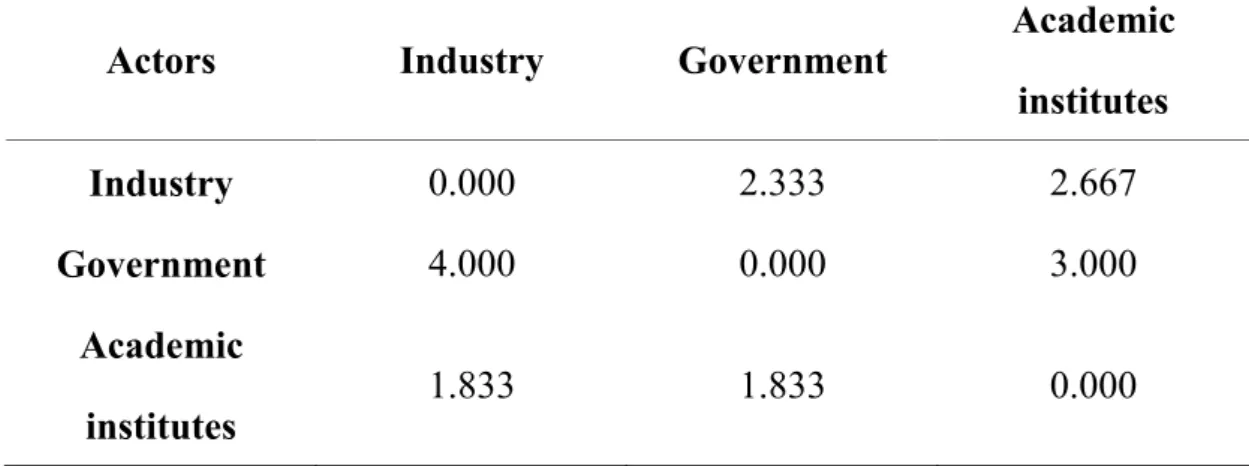
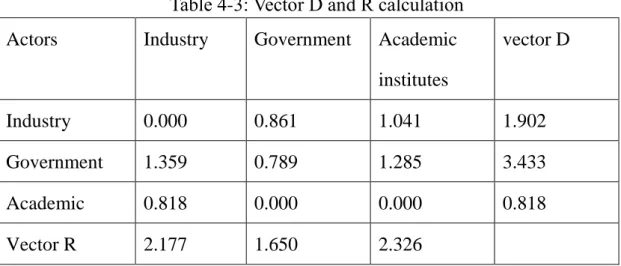
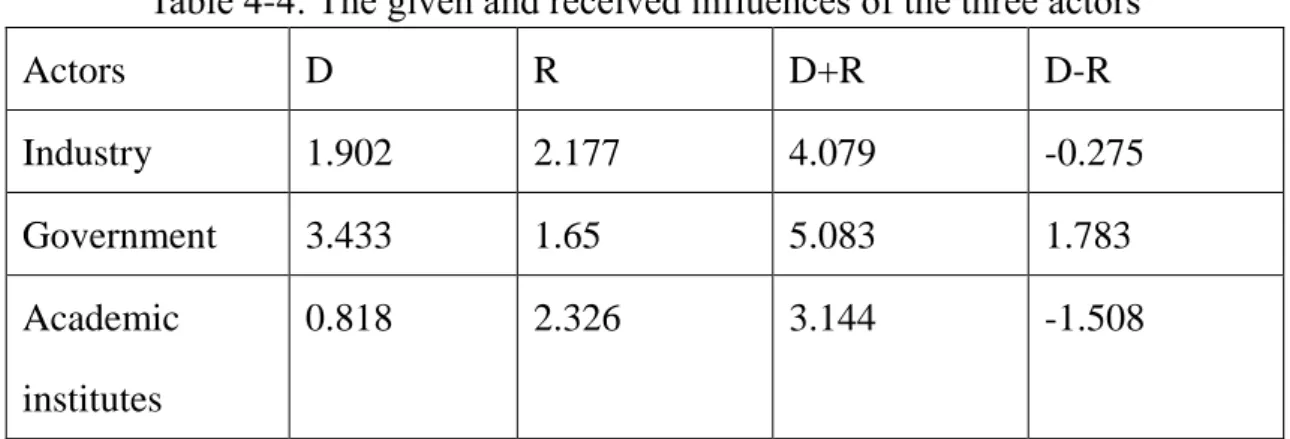
(11) List of Tables. Table 2-1: Definition and References of the Actors and Selected factors ............... 47 Table 4-1: The initial direct influence matrix S of the three actors ......................... 64 Table 4-2: Total influence matrix T ......................................................................... 65 Table 4-3: Vector D and R calculation ..................................................................... 65 Table 4-4: The given and received influences of the three actors ........................... 66 Table 4-5: The un-weighted super matrix of the 9 selected factors ......................... 68 Table 4-6: Cluster Priorities Matrix ......................................................................... 70 Table 4-7: The weighted super matrix of the 9 selected factors .............................. 70 Table 4-8: The limiting super matrix of the 9 selected factors ................................ 71 Table 4-9: Relative weights of the Actors and Selected factors .............................. 71 Table 4-10: Relative weights in different group ...................................................... 74 Table 4-11 Expert scoring summary ........................................................................ 78 Table 4-12 Weighted score and ranking .................................................................. 79. IX.
(12) Chapter One Introduction 1.1 Research Background National or regional competitiveness is no longer dependent on raw materials, abundant natural resources, or a solid financial capital, it has been converted into scientific and technological innovation. Innovation represents the technological progress and change, and productivity enhance. In the era of globalization, cities/regions themselves not only exist hostile competition but also cooperation and collaboration. Achieving synergies and complementary synergistic effect for a city group to enhance the competitiveness has become the main development model. Countries in the world had developed their own culture and characteristic of regional collaboration innovation community, such as the European Innovation and Technology Institute is a key driver who maintains Europe's sustainable economic growth and competitiveness. It promotes the innovation capability of the EU and its Member states to face the enormous challenges which came from European society. The main objective of the innovative community for US is to achieve the integration of intellectual property and the collision of human capital and financial capital. (Su & Tu, 2013). It can promote the system to fully assume the main tasks of the US R&D competitiveness, while promote the development of clusters as the core of investment and economic development. From the 70s of last century, Japan has implemented a series of regional science and technology policy to promote the “regional innovation strategy support program” which launched in 2011. It was designated to improve the regional innovation environment, support the innovation priority area, and cultivate the characteristic competitive industry cluster which has the sustainable competitive ability (Xue & Wu, 2014). The Dutch Government set up the Dutch Innovation Platform in September 2003. 1.
(13) Platform members include government, business and intellectual celebrities; the Dutch Prime Minister himself is as the chairman of the platform. In 2007, the Dutch Innovation Platform (Phase II) was launched and continued to enhance the competitiveness of the Netherlands (Deng, Li, & Chu, 2009). A Korean regional innovation system is an important science and technology initiative launched by the Korean central and regional government in the 1995. Among provinces, there are significant differences in the degree of economic development. Metropolitan areas have traditionally been industrialized areas, so the Korean government has tried to bring up regional clusters. They have established an organization for S&T promotion in their administrations, increased their S&T budgets, and strongly promoted cooperation between innovation actors in their regions. The innovation community of the above countries, the common characteristics of the government, enterprises, universities, research institutions to form a partnership, the establishment of several different areas of innovation platform. For example, the Climate KIC (The Knowledge and Innovation Communities), KIC InnoEnergy, European Institute of Innovation & Technology (EIT) Digital Labs and so on. The Dutch Innovation Platform identified six research areas: flower & food, high-tech system and material, water, creative industry, pension & social security. The Beijing-Tianjin-Hebei Collaborative Innovation Community is an early case of China in developing collaborative innovation community. The region is a world-class city cluster with Beijing as its core. Beijing, Tianjin and Hebei have their own position according to their different advantages. Tianjin is an economic center in the north, an international shipping center in the north, a gathering area for advanced manufacturing industry, a demonstration area for financial innovation and application, and a center for Hebei Province. Hebei is the center of economic and technological innovation. Hebei province is an important base for new industrialization, a new urbanization and urban-rural demonstration area, an important shipping and logistics base in the north, and a support area for the ecological environment of Beijing, Tianjin and Hebei. 2.
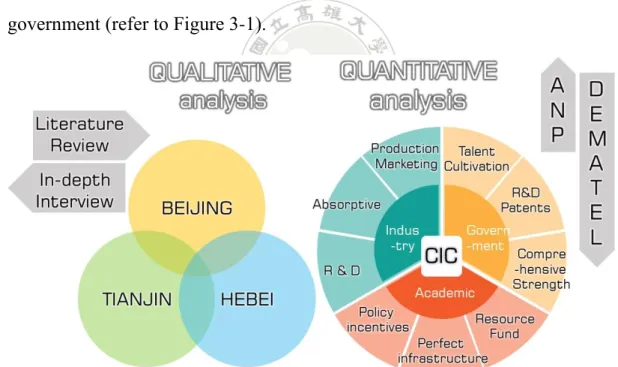
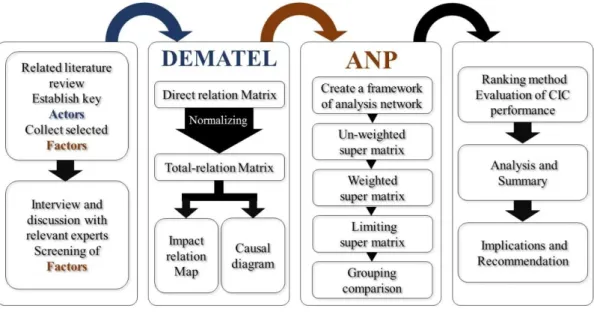
(14) The Beijing-Tianjin-Hebei Collaborative Innovation Community is a destiny community, a community of interests and a community of responsibility. Collaboration among regions can enhance the competitiveness of the regions in which they work together. Beijing promotes Zhongguancun to cooperate with Tianjin, and Tianjin in key areas, including Tianjin Binhai New Area, Baodi ; Hebei Tangshan, Chengde, Langfang, Baoding, Zhangjiakou(Big Data Cloud Computing Industry). Shijiazhuang (Integrated circuit packaging and testing industry) and other regions, they jointly established a strategic collaborative relationship. This community promotes the non-governmental exchange activities. And it plays a key role in promoting the interaction and collaboration among firms and institutes in this region. A lot of researches in Beijing-Tianjin-Hebei Collaborative Innovation Community in the past use the expert interview and other qualitative research. Furthermore quantitative studies explored the industrial concentration of the Beijing-Tianjin-Hebei Collaborative Innovation Community which used the Geospatial aggregation index such as HHI (Herfindahl-Hirschman Index). However, less research use systemic point of view, expert decision-making methods to explore the key actors, operating mechanism, success selected factors, operation performance for the Beijing-Tianjin-Hebei Cooperation and Innovation Community. One of the motivations is to use multidisciplinary expert decision-making method to conduct in-depth research. Regarding the key actors and successful selected factors, literature review will be adopted to extract the key actors, the weight of the key actors obtained by Decision Making Trial and Evaluation Laboratory (DEMATEL), in-depth interviews will be adopted to extract the factors and index from the expert consensus, moreover the weight of the factors and index is obtained by ANP (Analytic Network Procedure). Based on the weight of ANP, and then sorted by expert rating.. 3.
(15) 1.2 Research Objectives and Research Questions Except the related issues of the regional collaborative innovation community, this study will focus on the building of key actors, operating mechanism, target type, realistic path and success selected factors (SSFs) of Beijing-Tianjin-Hebei Collaborative Innovation Community. The SSFs and operating performance of Beijing-Tianjin-Hebei Collaborative Innovation Community is taken by expert interview of innovation platform, (15 expert interviewees come from government agencies, industry, colleges/universities, research institutions, industry investment institutions and technological consultation institutions, associations, alliance, and other service institutions of the Beijing-Tianjin-Hebei Collaborative Innovation Community), DEMATEL, ANP and other quantitative study. Based on the previous research background and motivations, the objectives of this research are as follow: 1. To understand the meaning and connotation of the regional innovation community, compare the differences between different regional innovation communities 2. To review the collaborative innovative community in EU, American, Japanese, European countries and explore the key success selected factors. 3. To get the most needed attention factors in Beijing-Tianjin-Hebei Collaborative Innovation Community Based on the research objectives, the research questions are: 1. What is regional collaborative innovation community? Does it differ from regional innovation systems? 2. What actors construct this regional collaborative innovation community, especially in Beijing-Tianjin-Hebei of China? How do these actors interaction/cooperation each other? 3. What practical experiences and lessons we can learn from the collaborative innovation community in EU, USA, Japan, Dutch and South Korea? In other words, what are the key successful factors of the regional 4.
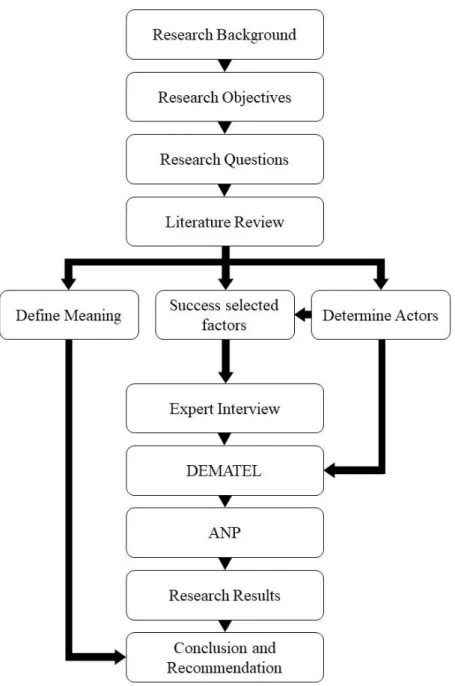
(16) collaborative innovation community? 4. How do different actors (industry, government and academic) learn about regional collaborative innovation communities? What is the holistic and individual view on the collaborative innovation community from different actors' perspective?. 1.3 Research Process The research process is as follows:. Figure 1- 1: Research Process 5.
(17) Chapter Two Literature Review 2.1 Territorial Agglomeration, Innovation and Collaborative. In an increasingly globalized world economy, how to make the region or country remain competitiveness become more and more important. Innovation is very important from the aspect of competitiveness strengthening. In addition to this, the territorial agglomeration is a good way which can increase region competitiveness. It follows from what has been said that combined with innovation and regional is important; this subject deserves more than a passing notice.. 2.1.1 Innovation Innovation is a concept which is interesting and efficient to improve the competitiveness of many domains. Innovation is defined simply as a "new idea, device, or method" (Merriam-Webster, 2016). However, as Maranville supposes, innovation is often also viewed as the application of better solutions that meet new requirements, unarticulated needs, or existing market needs (Maranville, 1992). This is accomplished through more-effective products, processes, services, technologies, or business models that are readily available to markets, governments and society. The term "innovation" can be defined as something original and more effective and, as a consequence, new, that "breaks into" the market or society (Frankelius, 2009). It is related to, but not the same as, invention (Bhasin, 2012). Innovation is defined simply as a "new idea, device, or method". However, innovation is often also viewed as the application of better solutions that meet new requirements, unarticulated needs, or existing market needs. This is accomplished. through. more-effective 6. products,. processes,. services,.
(18) technologies, or business models that are readily available to markets, governments and society. The term "innovation" can be defined as something original and more effective and, as a consequence, new, that "breaks into" the market or society. It is related to, but not the same as, invention. Innovation is often manifested via the engineering process. These changes which apart from the new product and also include market development, new production organization, new industrial structure and etc. “Innovation” for manufacturers is a significance which can make it first use the new production technology to produce new product, thus creating competitive advantage in business. The competitiveness of manufacturers will directly affect the country or the community's productivity, economic performance. Therefore, the significance of innovation lies in the commercialization of knowledge and technology constitute the productive forces, rather than simply research and development of the knowledge and technology. Put it in another way, R & D and innovation are only tools and attitudes. The main purpose of innovation is whether the whole society is fully innovative and the use of knowledge for production. In a literature review on innovation, Edison et al. found over 40 definitions (Edison, Bin Ali, & Torkar, 2013).They also took an industrial survey to capture how innovation is defined in the software industry. After analysis of the existing definitions whether these definitions comprehensively cover all the dimensions of innovation, they found the following definition to be the most complete. innovation is: production or adoption, assimilation, and exploitation of a value-added novelty in economic and social spheres; renewal and enlargement of products, services, and markets; development of new methods of production; and establishment of new management systems. It is both a process and an outcome.. 2.1.2 The region as a locus of innovation This study is intended as an investigation of the Beijing-Tianjin-Hebei Collaborative Innovation Community. Beijing and Tianjin are municipalities 7.
(19) which are located in the heart of China, and Hebei surrounds these two cities in geographically. So, territorial agglomeration occurs in them due to the advantages of geographical and administrative. One explanation for territorial agglomeration may be that the word "regional". “Regional” is a word which is abstract, we can't accurately describe the size of it, but we can understand definition and means of it through the dictionary: 1. Cambridge Dictionary: relating to or coming from a particular part of a country (Cambridge University, 2016). 2. Collins Dictionary: Regional is used to describe things which relate to a particular area of a country or of the world (Cobuild, 2003). Taking each element of the term in turn (Asheim & Cooke, 1999), the concept of region highlights an important level of governance of economic processes between the national level and the level above the local or municipal level (Cooke & Leydesdorff, 2006). We may note that the objectives at different levels are also different. The importance of territorial agglomerations in innovations concerns largely(Asheim & Isaksen, 1997). The region is an important basis for the coordination of the economy at the meso-level, but there may be a big difference in the level of regional administration in each country. To varying degrees, regional governance is expressed in both private representative organizations, such as branches of industry associations and chambers of commerce, and public organizations, such as regional agencies with powers devolved from the national (or, within the European Union, supra-national) level to promote enterprise and innovation support(Asheim, Isaksen, Nauwelaers, & Todtling, 2003; Cooke, Boekholt, & Todtling, 2000) The conception of innovation as a partly territorial phenomenon is to a great extent based on the ‘success stories’ of some specialized industrial agglomerations or regionally concentrated networks of SMEs and industrial clusters (Asheim & Gertler, 2004). There is also growing empirical evidence that, in many cases, parts of learning process and knowledge transfer are highly 8.
(20) localized (Maskell & Malmberg, 1999). It is increasingly recognized that important elements of the process of innovation become regionalized. The theoretical discourses on regional development highlight a number of key features.. 2.1.3 A regional perspective on innovation 1. Regional innovation system, RIS Since the early 1990s, the concept of regional innovation system (hereafter, RIS) has been the concern of policy makers and academic researchers. The approach has received considerable attentions as a promising analytical framework for advancing our understanding of the innovation process in the regional economy (Asheim et al., 2003). The concept of regional innovation systems has no generally accepted definitions, but usually is understood as a set of interacting private and public interests, formal institutions and other organizations that function according to organizational and institutional arrangements and relationships conducive to the generation, use and dissemination of knowledge (Doloreux, 2003). A widely understood definition of the regional innovation system was a regional innovation system consists of interacting knowledge generation and exploitation sub-systems linked to global, national and other regional systems for commercializing new knowledge” (Cooke et al., 2000). RIS is considered to be an instrument for regional development policy in Europe (Cooke et al., 2000). For example, the European Union adopted a Socio-Economic Research Program entitled, “Regional Innovation Systems: Designing for the Future (REGIS),” for the less developed regions in Europe. Highlights of the European experience can be seen in Braczyk et al. and will also be discussed in this paper later(Cooke, Braczyk, & Heidenreich, 1998). One of the distinctive examples of RIS is industrial clustering or regional clustering. In some parts of world, such as the U.S. and Japan, the term “cluster” 9.
(21) is more popular than RIS. Following the initiative of Porter (1998), policy makers in the U.S. use the concept of clustering for all kinds of industries and for regional development. Similarly, the expression RIS is not frequently used in Japan. Instead industrial clustering is adopted as a Japanese national policy (Ishikura, 2003). Japan seems to rely on the success of newly designated industrial clusters for regional development. The regional innovation system can be thought of as the institutional infrastructure supporting innovation within the production structure of a region. Thus, in case the following two subsystems of actors are systematically engaged in interactive learning it can be argued that a regional innovation system is in place (Cooke et al., 1998). (1) The regional production structure or knowledge exploitation subsystem which consists mainly of firms, often displaying clustering tendencies. (2) The regional supportive infrastructure or knowledge generation subsystem which consists of public and private research laboratories, universities and colleges, technology transfer agencies, vocational training organizations, etc. Furthermore (Cooke et al., 1998). 2. Regional Innovation Strategies Authorities at the regional level are increasingly involved in designing their own strategies to support and enhance innovative local dynamics and improve the performance of their regional innovation systems. Governments are also seeking to strengthen national innovation systems through these regional systems (OECD, 2010). One of the well-documented facts about the region and innovation is its diversity. Many typologies have been developed to describe this diversity, based on qualitative assessment and use of a series of quantitative indicators. The implication of this diversity is that there is no one-size-fits-all policy applicable to any region. On the contrary, policies need to be adapted to the degree of autonomy that industrial formation, the culture of innovation, political institutions and regional authorities hold. Some areas may be stronger in knowledge generation and more in knowledge exploitation. Regional 10.
(22) Innovation Strategies aim to identify these specificities and fine-tune the support system accordingly. The systematic assessments lead to the definition of strategic priorities, their translation into specific operational objectives and the establishment of monitoring and evaluation systems to ensure continuous policy adjustment and effectiveness. Regional Innovation Strategies refer to the process for conducting these goal-oriented exercises in specific regional environments. There are two similar but different features of terminologies: Regional Innovation Strategies and Regional Innovation Systems. Thus, the terminology and content of strategic part are different, especially in Regional Innovation Systems while emphases on partnership are the same (Oldrich, Pavel, & Jiri, 2011). 3. Regional Innovation Platform What is the difference between regional innovation system, regional innovation strategy, and regional innovation platform, where some emphasize “system”, some highlight “strategy”, and some stress “platform”. A system is a way of working, organizing, or doing something which follows a fixed plan or set of rules. The system has a hierarchical structure, and strategy is a general plan or set of plans intended to achieve something, especially over a long period, but if someone has a platform, they have an opportunity to tell people what they think or want, and it is noteworthy that the relationship is equal in platform. Frequently used platform concepts first appeared in Henry Ford's "modern man", used to describe to improve the technology level. The venerable 1930’s DC3 was a successful example of platform usage. It was developed for the fledging commercial airlines. And it was then modified to serve as a troop carrier as well as a cargo carrying plane. Literature has presented definitions and application of platforms for different types of products, including assembled products, systems, software and information products (Kleinschmidt & Cooper, 1991; Sundgren, 1999; Wheelwright & Clark, 1992). And Meyer defines the product platform is a set 11.
(23) of subsystems and interfaces that form a common architecture from which derivatives can be effectively developed and produced (Meyer & Dalal, 2002). Resent research has begun to apply these definitions to a large extent. Technical elements were also studied in the context of new product development. Such as the degree of innovation, the proprietary nature of the technology, or the novelty of the core technology embodied in the product. And the definition of technology platform is supports a variety of product development and commercialization of technology or technical capacity (Cooper & Kleinschmidt, 1987; Robert & Meyer, 1991; Souder, 1987). Platform thinking advantage in management actually depends on the platform’s strong foundation, continual interchange, close linkage, and rapid expanding scale. Still, there are natural barriers in platform construction: the common technology platform is difficult to pursue as a direction, since predicting the future is not so easy; central R & D often lacks the funds to support platform development, since this means an additional burden for platform users; platform development is often misidentified by business unit needs; And the product may be a huge gap between the transfer of technology (Lin, Hu, Li, & Zhang, 2009).. 4.. Regional Collaborative Innovation Community Regional Collaborative Innovative Community is a word will be used for. illustrating purposes throughout this study and how to define it is open to question. But it offers the key to an understanding of this word by summarizing the above three organizations, they have similarities and differences. Take Regional Innovation System for example, it can be thought of as the institutional infrastructure supporting innovation within the production structure of a region, and often displaying clustering tendencies. The Regional Collaborative Innovative Community can accommodate a variety of industries, not limited to clustering tendencies and mutual learning each other, exchange information, exchange of ideas, get knowledge of all aspects by connecting them in series. 12.
(24) The most important addition to be made to what we have said about community is a kind of strategic level; we can narrow from a national strategy to the provincial regional strategy or expanded to regional strategies between countries. Obviously, we need to narrow in this paper. In addition to this, there is one further Regional Innovation Platform that we must not ignore, Common platform provides a base for helping to establish the trust and communication between firms, and it attract more external resources lead to evokes the generation. of. innovation clusters. Regional Collaborative. Innovative. Community is not only a firm's platform, but also is involved in government, industry, academia, and research institution. Then we make it clear what we intend by these expressions, synthesize three concepts about regional innovation (Regional innovation system, Regional Innovation Strategies, Regional Innovation Platform), Regional Collaborative Innovative Community the most likely explanation is that the means of “Regional Innovation System” and we should not overlook that the role of the cooperation and competition in it. Regional collaborative innovation community is unique to China it draws on the success stories of the Western innovation community, combined with the real situation of the China's industrial structure, scientific and technological strength and university education vitality. Regional collaborative innovation community is a strategic concept that clearly stated by the third plenary session of the eighteenth central committee of the Chinese Government. (Liu & Dong, 2015). 13.
(25) 2.2 Regional Collaborative Innovation Community Currently, only few research and practice is using the appellation of “Regional Collaborative Innovative Community”. From the previous literature review we found that Regional innovation system, Regional Innovation Strategies or Regional Innovation Platform are the alternative terms which their content are similar. The term of “Collaborative Innovative Community” will be adopted in this study as the terminology. Our attention in the next section will be centered on “Collaborative Innovative Community”.. 2.2.1 Europe-European Institute of Innovation and Technology Horizon 2020 is the biggest EU Research and Innovation programme which nearly €80 billion of funding available over 7 years (2014 to 2020) and without counting the money that attract private investment. It hopes to deliver more breakthroughs, discoveries and world-firsts ideas from lab to market (European Commission, 2014). The one of key pillar of the Innovation Union is Horizon 2020, a Europe 2020 flagship initiative aimed at enhancing Europe's global competitiveness. Seen as a means to drive economic growth and create jobs, Europe’s leaders and the Members of the European Parliament is the political backing of Horizon 2020. They agreed that research is an investment in our future and therefore put it at the heart of the EU’s blueprint for smart, sustainable and inclusive growth and jobs. By coupling research and innovation, Horizon 2020 is helping to achieve this thanks to its emphasis on excellence in science, industrial leadership and by tackling societal challenges. The object is to ensure Europe produces world-class science, removes barriers to innovation and makes it easier for the public and private sectors to work together in delivering innovation (European Commission, 2011). The objectives are strongly contributed by the European Institute of Innovation and Technology (EIT) to 14.
(26) set out in Horizon 2020, in particular by addressing societal challenges in a mode that is complementary to other initiatives in these areas. What is it? The EIT is a key navigator of sustainable European economic growth and competitiveness. The innovation capacity of the EU reinforced by EIT, and its Member States for purpose of address grand challenges facing European society (European Commission, 2016). The EIT is an independent body of the European Union set up in 2008 to stimulate innovation and entrepreneurship across Europe to overcome some of its greatest challenges. EIT brings together leading higher education institutions, research. labs. and. companies. to. form. dynamic. cross-border. partnerships-Knowledge and Innovation Communities, the KICs work is to develop innovative products and services, start new companies, and train a new generation of entrepreneurs. The main priorities of the EIT include: 1. The integrating education and entrepreneurship with research and innovation can enhance Europe’s ability to innovate; 2. Encouraging the most innovative individuals and companies to join a collaborative community; 3. A long-lasting economic and societal change can be achieved; 4. Creating high quality jobs in Europe. Why is it needed? In spite of excellent research, education, and inventions, Europe faces difficulties in fully capitalizing on its innovation potential. Fragmented systems, a loose entrepreneurial culture, and limited cooperation between higher education, research, business, and innovation organizations impede Europe’s ability to compete in research and innovation at a global level. The Knowledge and Innovation Communities (KICs) is a network which the EIT tackles issue through. In the KICs, the EIT develops and tests new models of how innovation is approached, managed, financed, and delivered in Europe. Through its work, the goals of the EU2020 Strategy and its flagship 15.
(27) initiatives contributed by the EIT, in particular the Innovation Union, the Agenda for New Skills and Jobs and the Digital Agenda. The EIT is part of Horizon 2020, the EU Framework Programme for Research and Innovation, which engages for that the EIT works in partnership with other EU initiatives and programmes.. What has been done so far? In 2010 three KICs is established by the EIT. These communities are supporting. innovation. and. entrepreneurship,. as. well. as. generating. breakthroughs in the ways that the higher education, research, and business sectors collaborate. The current KICs are in the areas of: . Climate change (EIT Climate-KIC link outside the EC domain). . Sustainable energy (EIT InnoEnergylink outside the EC domain). . Digital technologies (EIT Digitallink outside the EC domain). . Healthy living and active ageing (EIT Healthlink outside the EC domain). . Raw materials – sustainable exploration, extraction, processing, recycling and substitution (EIT RawMaterialslink outside the EC domain). . Food4Future – sustainable supply chain from resources to consumer (EIT Foodlink outside the EC domain). In a record time, the EIT and its existing KICs, have trained more than 1000 students is a promising result, creating more than 100 start-ups which have launched more than 400 products and services.. How does the EIT work? The EIT achieves its mission by sufficient integrating all three sides of the “knowledge triangle”, i.e. higher education, research and business, in Knowledge and Innovation Communities (KICs). The KICs should bring together leading players from all these dimensions to cooperate, the EIT is capable of promoting innovation in Europe. The EIT's first three KICs were 16.
(28) launched in 2010: . Climate-KIC: addressing climate change mitigation and adaptation. . EIT ICT Labs: addressing information and Communication Technologies. . KIC InnoEnergy: addressing sustainable energy The Budapest (Hungary) where the EIT´s Headquarters are situated in, the. EIT is not concentrated in one campus as a traditional institute, and through the KICs operating instead it. Each of the KICs operates across a number of hubs called ‘co-location centers’ and there are currently 19 co-location centers spread across Europe, including Budapest, London, Solana, Barcelona, Mannheim, Paris, Madrid, Budapest, Stockholm and Plus node. Climate-KIC additionally operates through six regions, each led by a regional or local government in Regional Implementation and Innovation Communities (RICs). EIT Strategy 2014-2020 The European Parliament and Council adopted the Strategic Innovation Agenda (SIA) and the EIT’s amended Regulation in December 2013, define the framework for the EIT's operations for the period from 2014 to 2020. The EIT will contribute strongly to the objectives set out in Horizon 2020, in particular by addressing societal challenges in a complementary way to other initiatives in these areas. Horizon 2020 is a key pillar of the Innovation Union, a Europe 2020 flagship initiative aimed at improves Europe's global competitiveness. Some of the key elements are: •. A proposed budget of EUR 2.7 billion within a budget of almost EUR 80 billion for Horizon 2020, the EU's Framework Programme for Research and Innovation.. •. Consolidation and further development of the three existing KICs (Climate-KIC, EIT Digital and KIC InnoEnergy).. •. Creation of five new KICs to be launched in three waves. The themes (outlined in more details in the EIT’s Strategic Innovation Agenda) to be addressed by the new KICs are: 17.
(29) 2014: . Innovation for healthy living and active ageing; and. . Raw materials - sustainable exploration, extraction, processing, recycling and substitution. 2016: . Food4Future - sustainable supply chain from resources to consumers;. . Added-value manufacturing. and 2018: •. Urban mobility. The EIT Regional Innovation Scheme (RIS) is activities which the EIT’s way of ensuring wider participation in. The aim of the RIS is to draw others, outside the KIC partnership, into the world of innovation – to engage with other companies, universities, labs and stakeholder organizations that could help or be helped by the KIC (European Institute of Innovation & Technology, 2014).. How do the EIT's KICs work? KICs carry out a whole range of activities that cover the entire innovation chain – including training and education programmes, reinforcing the journey from research to the market, business incubators and innovation projects. KICs have been conceived so that they need to react in an effective and flexible way to new challenges and changing environments. Each KIC has been set up as a legal entity and has appointed a CEO to run its operations – a first for an EU initiative. The EIT has provided the KICs with a great degree of autonomy to define their legal status, internal organization and working methods. The KICs are driven by a pursuit of excellence in all of their activities and are established with the aim of reaching the necessary critical mass to achieve systemic impact, including the creation of new jobs and new businesses, and make new skills and entrepreneurial talent in the economy promote (Ulmann, 18.
(30) 2013).. 2.2.2 USA-The Association of University Research Parks (AURP) Priorities space is an important part of the country and collaborative innovative community. The technological innovation and space of industry development is highly-focused by the United States to fight the global financial crisis; The Power of Place is a plan which focused on creating a America’s Communities of Innovation can systematic connect all innovation subject in country have been put forward in 2008 (Bowman & Darmody, 2008). Entities eligible for designation as an American Innovation Zone would be those research institutions that have historically been producers of intellectual property and high technology economic development. The newly created Innovation Zone designation would apply to the following types of entities: Element 1: Research Parks (Including technology incubators adventure accelerators) These clusters of research encompass a wide universe of cooperating entities, including institutions of higher education, start-up incubators, stand-alone incubators, federal labs and their partners that are designed to promote technology transfer, research and business partnerships, and economic growth. Element 2: Colleges and Universities This would include accredited colleges and universities, including community colleges (those that are eligible for federal financial aid), and facilities located on land owned or controlled by one of these entities, as defined in the Higher Education Reauthorization Act. Element 3: Federal Laboratories 19.
(31) (As defined in the Stevenson-Wylder technology Innovation Act) This definition includes federal laboratories, federally-funded research and development centers, or other centers owned, leased, or otherwise funded by a federal agency and the federal government, whether operated by the government or by a contractor. Element 4: Enhanced Use Lease (EUL) Locations Certain federal agencies are currently authorized to lease land and improvements to land to private sector entities. Recommend expanding this authority to all other federal agencies. The Association of University Research Parks (AURP) proposes the creation of a new concept for innovation in the U.S.: a system of American Innovation Zones. The Innovation Zones would serve as the centerpiece of efforts to modernize the U.S. approach to fostering competitive research and development. Innovation Zones are a critical next step towards American competitiveness: encouraging research in such a way as to accelerate investment and economic development around research clusters. The Innovation Zone approach envisions establishing objective criteria for national innovation assets, including research parks, technology incubators, universities, federal laboratories, and adjacent properties – and then providing regulatory reforms and economic incentives for their accelerated development. Introduction of AURP The mission of AURP is to achieve commercialization and economic growth in a global economy through university, industry and government partnerships, fostering innovation. In 1986, a handful of farsighted research, technology and science park directors, recognizing that the concept of research-institute related parks was 20.
(32) taking hold in board rooms around the world, organized the first international conference in the United States to discuss the future of research, science and tech parks. From that gathering in Tempe, Arizona, the Association of University Related Research Parks (AURRP), was formed in response to a growing interest in research and development activities based in such unique planned properties. The name was changed to the Association of University Research Parks (AURP) in 2001. A non-profit international organization, AURP represents the leadership of these technology developments, which are designed to promote research institute-industry relations, to foster innovation, and to facilitate the transfer of technology from such institutions to the private sector. Creating Communities of Innovation 1. Custom Programs Taught by Community Innovation Experts Bring your stakeholders together with this custom program taught by highly experienced, successful research park directors and university-led economic development experts. By focusing on your region’s unique strengths and minimizing challenges, AURP’s on-site seminars help communities find the path to successful high technology economic development endeavors. Learn from AURP’s team of university research park experts who have actually built and operated the world’s leading research parks. Their experience and advice will be invaluable as you tackle challenges: just getting started or “remodeling” your innovation efforts. AURP’s “Research Parks 101” and “Creating Communities of Innovation” is tailored to your community, your challenges and your own assets. 2. Research Parks 101 Research Parks 101 is a comprehensive, interactive seminar taught by 21.
(33) highly-experienced and successful research park directors. It is presented once a year at AURP's Annual International Conference. This highly-interactive seminar illuminates the complex world of high technology-based economic development, and includes nuts and bolts information on how to make your new or existing university research park more successful. 3. Advantages of Innovative Communities This seminar, delivered on site to university administrators, city officials and other stakeholders, highlights how it is done-- the path to the creation of successful community high technology economic development endeavors. "Creating Communities of Innovation" ramps up the process and greatly improves the team's ability to make the project a success. Learn from the most experienced and successful research park directors in the world how to capitalize on your region's unique strengths, and minimize challenges.. 2.2.3 JAPAN - Regional Innovation Strategy Support Program The environment surrounding Japan is changing dramatically. For example, the remarkable growth of emerging nations in recent years has further intensified the global competition. Against this backdrop, Japan − a country where there are limited natural resources and the population is rapidly aging while the birthrate is declining − must take action to maintain and strengthen its international competitiveness in order to enjoy continued economic growth and development and to secure a central position in the global community. To that end, Japan needs to strategically utilize the science and technology infrastructure that the nation has built and link it with various related policies aiming to create innovations for systematic promotion of the "Science, 22.
(34) Technology, and Innovation Policies."(MEXT, 2011) From Fiscal 2011, the Ministry of Education, Culture, Sports, Science and Technology (MEXT), the Ministry of Economy, Trade and Industry (METI) and the Ministry of Agriculture, Forestry and Fisheries (MAFF) have jointly selected regions with excellent original visions toward the creation of regional innovations and designate them as "regional innovation strategy promoting regions." To that end, the Innovation Promotion Council (composing members: local governments, business groups, universities and other research organizations, financial institutions, etc.) was established to promote the creation of new regional innovations in the long term. A Shift from "Science and Technology Policies" to "Science, Technology, and Innovation Policies" The First Basic Plan (FY1996 to FY 2000): Promotion of science and technology in regions (First Stage). The Second Basic Plan (FY 2001 to FY 2005): Establishment and improvement of an environment for the promotion of science and technology in regions (Second Stage). 1. Formation of "knowledge clusters" in regions. 2. Smooth execution of the Science and Technology Policies in regions. The Third Basic Plan (FY 2006 to FY 2010): Establishment of regional innovation systems and revitalization of local communities (Third Stage). 1. Formation of regional clusters. 2. Smooth execution of the Science and Technology Policies in regions. The Fourth Basic Plan (FY 2011 to FY 2015): Promotion of system reforms towards the advancement of regional Science, Technology, and Innovation (Fourth Stage). 23.
(35) 1. Strengthening of knowledge networks of industry, academia and government, and establishment of places for knowledge exchange. 2. Establishment of regional innovation systems (MEXT, 2012d).. Ministry of Education, Culture, Sports, Science and Technology: MEXT's Efforts for the Creation of Regional Innovations The project for developing innovation systems is intended to establish systems which enable individual regions to proactively create innovations through the revamped function of universities for promoting the collaboration of industry, academia and government; the regional joint research by industry, academia and government; the formation of regional university networks; and the establishment of advanced interdisciplinary research and development centers. To achieve this goal, MEXT promotes the Regional Innovation Strategy Support Program and other programs listed below.. Regional Innovation Strategy Support Program Provides support to the "Regional Innovation Strategy Promoting Regions" selected jointly by the relevant ministries, with special focus on the formation of intellectual property and the development of human resources. Provides support for universities and other organizations for strengthening their innovation creation activities through integrated management of matching strategic research & development with non-apparent seeds & needs. Provides support for the realization of center for fusion of advanced technology.. 24.
(36) Figure 2-1: Establishment of Regional Innovation System through Effective Industry-Academia-Government Collaboration Source: Innovation Promotion Council(MEXT, 2012a). Figure 2-2: Innovation Promotion Council Source: Regional Innovation Strategy Promoting Regions(MEXT, 2012c) 25.
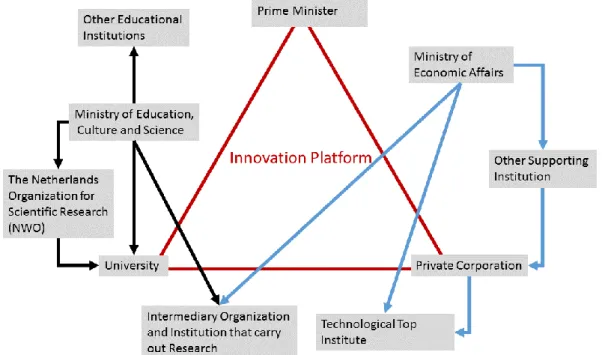
(37) Flow of Processes of Receiving Support from Relevant Ministries To establish the regional project to promote systems, construct Innovation Promotion Council, and make recommendations. Local governments, universities, companies and financial sector participated Innovation Promotion Council. With its members consisting of participating organizations in the industry-academia-government and financial sector, the Innovation Promotion Council formulates "regional innovation strategies," and also confirms the efforts, achievements, etc. of each participating organization toward the realization of its innovation strategy and decides on the direction of future efforts and activities. Select the relevant ministries to jointly promote regional innovation strategy. Regions focused on strengthening international competitiveness: Regions. where. local. universities. possess. internationally. outstanding. technology "seeds" or companies are concentrated to offer powerful potential to attract human resources, materials and funds from all over the world. Regions focused on advancement of research function/industrial concentration: Region where creation of innovations by making use of regional characteristics is expected to offer potential to explore overseas markets in the future. Selection of support programs offered by ministries, such as the Regional Innovation Strategy Support Program (MEXT, 2013). MEXT's support menu MEXT's responsibilities are concentration of researchers who play core roles in regional innovation strategies. Develop and implement human resource development programs to achieve regional innovation strategies. Establishment of knowledge networks of universities and other research institutions. Support for sharing of research facilities and equipment among local universities and 26.
(38) other research institutions. METI's support menu METI's responsibilities are strengthening a local industry competitive power. It will subsidize the establishment of growth industries and promotion of establishment of new business. METI’s subsidy is for creating innovations by regional SMEs, also for the development of growth industries and promotion of establishment of new business facilities, etc. Regional innovation strategies are taken into consideration during the adoption of projects. MAFF's support menu Research and development projects, apply to promote agriculture, forestry and fisheries new policy. Regional innovation strategies are taken into consideration during the adoption of projects.. 2.2.4 Netherlands- Dutch Innovation Platform The Holland is one of the world’s most advanced economies, its long-term development underpinned by entrepreneurship and innovation. The Holland is one of the countries who was a strong scientific and technological strength and innovative in history. But In the 21st century, Holland economy is in severe recession and stagnation and the economy has not fully recovered from the crisis, in order to return to the world’s five major powers of the knowledge economy, Holland must improve their international competitiveness. However, Dutch exporters have benefited less than others from an expansion into emerging markets. While levels of productivity are high, productivity growth has been rather weak. Strengthening investment in knowledge and innovation is a key to future growth and competitiveness and is necessary to address social 27.
(39) challenges(OECD, 2014), so government of the Netherlands established the Dutch Innovation Platform in September 2003, have three and a half years for the initial run time. Dutch Innovation Platform members include government, business and intellectual celebrities, chaired of Platform is the Dutch Prime Minister. Dutch Innovation Platform (second phase) starts In 2007, and continue to play the above functions (Deng, Li, & Wen, 2009).. Netherlands Science and Technology System Netherlands technology system consisted by six levels components. 1. Politics and government: Responsible for developing science and technology policy in the Netherlands, including the Parliament, Cabinet and government departments. 2. Advisory body: Formulate the strategic agenda, submitted to the Advisory reports provide recommendations for the government's science and technology policies, including Advisory Council for Science, Technology and Innovation (AWTI), Royal Netherlands Academy of Arts and Sciences (KNAW), innovation platform, sector council… 3. Body funding research: Provide financial support for the R & D activities, including government departments, public bodies, domestic and foreign enterprises and the European Union (The provide funding from the EU Plans) 4. Intermediary organization: assign the R & D funding from the government agency to research institutes, universities, identifying suitable projects funded. Including The Netherlands Organization For Scientific Research (NOW), Royal Netherlands Academy of Arts and Sciences (KNAW), Senter Novem (Twist, Steen, & Wijk, 2013). 28.
(40) 5. Institution that carries out research: Engaged in R & D activities and other such as universities, research institutes and enterprises… 6. Other supporting institution: Institutions and organizations engaged in scientific research but does not directly provide support for scientific research, Such as SURF Foundation, EG Liaison, National Science Library etc.. Figure 2- 3: The Position of Dutch Innovation Platform in R & D System. The above figure reflects the position of the Innovation Platform in the Netherlands R & D system. Instead of directly funding appropriate R & D projects, the platform guides the allocation of government funds to appropriate projects and areas by identifying key areas, developing a strategic agenda, and advising governments on policy issues. (Deng, Li, & Wen, 2009). Platform Targeting Dutch Innovation Platform builds on the experience of Science and 29.
(41) Technology Policy Council (STPC). This platform plays a role of coordinating and advisory of the national level in science and technology system. Innovative platform plays an active role in helping the Dutch government formulate science and technology policy, the introduction of scientific and technological support projects and improve the competitiveness of national science and technology. Compared with other advisory institutions, innovation platform is more influential. On the one hand, most of the members come from the business community and academia platform, and have a wealthy experience in their respective fields. They come together through innovative platform to help negotiate a common science and technology policy recommendations creative and constructive. On the other hand, the platform members include the Prime Minister and the Minister of Innovation Policy Development (Education, Culture and Science and the Department of Economic Affairs) is closely related to the two government departments to ensure that these observations and recommendations can be passed to the Netherlands for the first time highest levels of government, the greatest degree of influence science and technology policy.. Operating Mechanism Sponsored plan is the main way Dutch innovation platform to influence government science and technology policy. Dutch innovation platform set up a program office, responsible for initiating the plan and monitor its implementation. Project office is in charge of the platform, the work report to the Prime Minister of Dutch. The plans include six categories: 30.
(42) Knowledge investment agenda, KIA Making the most of knowledge Entrepreneurship Netherlands in the world: In key area to gain a competitive advantage Social innovation: The human who talent. Social ambition Each program has a dedicated working group responsible for completing the work, the working group members from key figures from government, business, academia and other social organizations, including the platform members and non-members of the platform. The general process of the implementation plan is as follows: Set up a working group to study a particular area detailed investigation bottlenecks. The Working Group submitted to the Advisory report, make recommendations for the existing bottlenecks. The Netherlands Cabinet for responding advisory report, indicating the Cabinet decisions and attitudes. Since 2004, it has launched a series of innovative internet platform project, by the respective working group responsible for implementation. Such as “Dynamising the knowledge chain” give recommendation how to reduce Dutch 'knowledge paradox'. “Long term choice” is the possible future Dutch to regain the lead in key areas. What’s more the working group drafted the knowledge investment agenda, as a platform for the work of the guidance document.. 2.2.5 South Korea - Korean regional innovation systems Innovation and technology are the key factors that underpin South Korea's export competitiveness and drive significant economic growth in the country 31.
(43) over the past decades. The growth rate has been so impressive that East Asian countries have been exempted from being one of the poorest countries in the 1960s to become the world's 13th largest economy in 2014, according to the World Bank.. Why South Korea needs regional innovation systems? Seoul recognizes that the need for developing new ideas and regional collaboration is now more important than ever. It was only when Korea introduced a regional political system for the first time in 1995 that it has begun to recognize the importance of regional innovation activities. Since then, the Korean central and regional governments have made a great effort to develop their regional economies in terms of technological innovation. As of the end of 2016, there are 16 regions in Korea, including 1 special autonomous province, 6 metropolitan cities, 1 metropolitan autonomous city and 8 Province (Academy of Korean Studies, 2001). We can think of Korea has seven regions are metropolises and nine regions are provinces that are called as “Do”. Metropolitan areas have traditionally been industrialized areas, as the Korean government has tried to bring up regional clusters. Among provinces, there are significant differences in the degree of economic development. Kyonggi province has been developed remarkably well, based on its proximity to the capital, Seoul. The eastern regions of Korea, especially Kyongbuk and Kyongnam, have been much more developed than the western regions, e.g. Chunnam and Chunbuk. Kangwon and Chungbuk have been less developed, as they are not suited geographically for industrial activities (NSO, 1998). Developed regions, especially metropolises, were established by the central government’s effort to develop industrial clusters. 32.
(44) However, it raised the problem of the geographical concentration of economic activities. However, nowadays many less developed regions have been also making a great effort to extend innovation potential in their regions. They have prepared an organization in their regional administrations for regional S&T activities, increased regional S&T budgets, and tried to induce and establish research institutes in their regions (Chung, Lee, & Song, 1997).. How it works? RIS consists of three innovative actors: universities; public research institutions; and industrial enterprises. In addition, the role of regional governments must be emphasized in order to effectively direct and coordinate innovative activities in each region. However, the actual participants in innovation activities are public research institutions, private companies and universities. Despite some overlap, they differ in the innovation process and make a significant contribution to enhancing the regional and national technical competitiveness. In public research institutions, government-sponsored research institutes (GRIs) and national laboratories (NLs) are important. As a proxy for innovation activities in private companies, we work with private research institutions. University of South Korea is very focused on education, university research institutions are incorporated into the measurement of innovation potential of the university sector.. What characteristics? Approximately measure the innovation capability of the Korean regional innovation systems as a whole by the mapping of major innovation actors of 16 regions according to three major innovation groups and identify some 33.
(45) characteristics as follows (Chung, 2002). The Seoul metropolis has the most innovation actors, Research institutions accounted for 35% of Korea, Kyonggi and Inchon follow Seoul. Therefore, these metropolitan areas, i.e. Seoul, Kyonggi, and Inchon, owned research institutions in South Korea accounted for 64%, Provinces have relatively small number of innovation actors. In particular, Cheju, Kangwon, Chunbuk, Kwangju, and Chungnam have a small number of research institutes. However, some advanced provinces like Kyongnam, Kyongbuk, and Chungnam have relatively large number of innovation actors. Regard to the public research sector, public research institutes are heavily located in Seoul, Kyonggi, and Taejon. Some developed areas such as Busan and Kyongbuk lack public research institutions. It shows that their development is not based on technological innovation, but mainly low labor costs. Recognizing that public research institutions play an important role in basic research in academia and applied research in industrial enterprises, this weakness will hinder further development in these areas. In fact, the two regions have not succeeded in transforming their traditional industrial structures into high-tech fields, although in the past they have been very successful in low-tech fields, namely Busan's footwear and Gyeongbuk's textile industry. Seoul University College is focused on the absolute tendency. Seoul has 36.1% of the university, followed by the Kyonggi Bridge 8.7%, Busan 8.0% and 6.8%. Since the early 1990s, the number of university institutions has increased with the importance of the university sector in Korea's national innovation system. However, Korean universities are still in the initial stages of expanding their R & D potential compared to developed countries (Chung & 34.
(46) Lay, 1997; OECD, 1996). However, university research institutes are relatively distributed among regions, as compared to innovative participants in other organizations. As a result, universities can be used as focal points for regional innovation activities. Private research institutes are also concentrated in metropolitan areas and there is not much difference between the number of private schools in Seoul and in Kyonggi. The Seoul and Kyonggi areas have good R&D infrastructure and a relatively strong advantage in recruiting well-qualified research manpower. Therefore, Korean enterprises prefer these areas for the location of research institutes. Recently, many regional governments in Korea have been exerting a great effort to establish their regional innovation systems. They have established an organization for S&T promotion in their administrations, increased their S&T budgets, and strongly promoted cooperation between innovation actors in their regions. Also the central government has supported strongly the effective formulation and implementation of regional innovation systems. However, Korean regional innovation systems seem to be weak, basically because of their short history. Innovation actors, especially public research institutes, are unequally distributed among regions, regional governments invest poorly in S&T activities, and there are weak interactions between innovation actors. S&T’s importance in regional development has not yet been widely diffused among the regions. In addition, the major programs of the central government are concentrated on specific regions, i.e., Seoul and its outskirts. The world today is an ear of mutually-beneficial and win-win cooperation. Free trade zones are a good example, confirms that between countries and countries need to mutually-beneficial and win-win cooperation. Currently, 35.
數據

+7
相關文件
(一) 主計畫:共同集體創作一套事先公開且具創新功
由三位選手共同集體創作一套事先公開且具創新功能之機械(電)作品,工
由三位選手共同集體創作一套事先公開且具創新功能之機械
Small temporary groups are formed, based on book choice2. Different groups read
Without such insight into the real nature, no matter how long you cul- tivate serenity (another way of saying samatha -- my note) you can only suppress manifest afflictions; you
- - A module (about 20 lessons) co- designed by English and Science teachers with EDB support.. - a water project (published
CONFIDENTIAL: All capabilities and dates are for planning purposes only and may not be used in any contract Information Portal. Key Performance Indicators &
From literature review, the study obtains some capability indicators in four functional areas of marketing, product design and development, manufacturing, and human
