Running Title: Analgesic and Anti-inflammatory activities of Taraxeren-3-one 1
2
Analgesic Effects and the Mechanisms of Anti-inflammation of
3Taraxeren-3-one from Diospyros maritima in Mice
45
TIEN-NING CHANG †,SHYH-SHYUN HUANG †, YUAN-SHIUN CHANG†, ChI-I 6
CHANG #, HSIN-LING YANG ‡, JENG-SHYAN DENG, YUEH-HSIUNG KUO†, §,
7 ‖,┴,* , GUAN-JHONG HUANG †, * 8 9 †
School of Chinese Pharmaceutical Sciences and Chinese Medicine Resources, 10
College of Pharmacy, China Medical University, Taichung 404, Taiwan 11
#
Graduate Institute of Biotechnology, National Pingtung University of Science and 12
Technology, Pingtung 912, Taiwan 13
‡
Institute of Nurition,China Medical University, Taichung 404, Taiwan 14
Department of Health and Nutrition Biotechnology, Asia University, Taichung 413, 15
Taiwan 16
§
Department of Chemistry, National Taiwan University, Taipei 106, Taiwan 17
‖
Agricultural Biotechnology Research Center, Academic Sinica, Taipei 115, Taiwan. 18
┴Tsuzuki Institute for Traditional Medicine, China Medical University, Taichung 404, 19 Taiwan 20 21 * Corresponding author 22 Dr. Kuo Yueh-Hsiung 23 Tel.: +886 2 3366-1671; Fax: +886 2 2362-6359 24
E-mail address: [email protected] 25
Dr. Guan-Jhong Huang 26
Telephone: +886- 4- 2205-3366. Ext: 5508. Fax: +886- 4-2208-3362 27
In this study, we have investigated the analgesic effects of the taraxeren-3-one 29
which is an ingredient from Diospyros maritima (DM) using the models of acetic 30
acid-induced writhing response and the formalin test, the anti-inflammatory effects of 31
taraxeren-3-one using model of -carrageenan (Carr)-induced paw edema. Treatment 32
of male ICR mice with taraxeren-3-one inhibited the numbers of writhing response 33
and the formalin-induced pain in the late phase, significantly. In the anti-inflammatory 34
test, taraxeren-3-one decreased the paw edema at the 4th and 5th h after Carr 35
administration, and increased the activities of superoxide dismutase (SOD), catalase 36
(CAT), glutathione peroxidase (GPx) and glutathione (GSH) in the liver tissue at the 37
5th h after Carr injection. Taraxeren-3-one affects the malondialdehyde (MDA), nitric 38
oxide (NO), tumor necrosis factor-α (TNF-α) levels from both the edema paw and 39
serum at the 5th h after Carr injection. Western blotting revealed that taraxeren-3-one 40
decreased Carr-induced inducible NO synthase (iNOS) and cyclooxygenase-2 41
(COX-2) expressions. These anti-inflammatory mechanisms of taraxeren-3-one might 42
be related to the decrease in the level of MDA in the edema paw via increasing the 43
activities of SOD, CAT, GPx, and GSH in the liver. Also, taraxeren-3-one could 44
affect the production of NO and TNF-α, and therefore affect the anti-inflammatory 45
effects. 46
KEYWORDS: Chinese herb; Taraxeren-3-one; anti-inflammation; analgesic; MDA; 48 NO; TNF-α 49 50
INTRODUCTION
51The fruit or stem of Diospyros maritima (DM; Ebenaceae) are a sort of 52
traditional Chinese medicine in Taiwan. It has been used for the treatment of 53
abdominal pain, rheumatic arthralgia, detumescence and fever. The fruits of DM 54
contain naphthoquinone derivatives, 6-(1-ethoxyethyl) plumbagin, 55
ethylidene-3,3'-biplumbagin, ethylidene-3,6'-biplumbagin, isozeylanone, 56
3,3'-biplumbagin (1). The stems of DM contain phenolic acid, 57
bis(6-hydroxy-2,3,4-trimethoxylphen-1-yl)methane, butylmethyl succinate, 58
epi-Isoshinanolone, 5,7-dihydroxy-2-methylchomanone (2). Study of both cytotoxicity
59
and antimicrobial assay of DM bark was reported (3). Stems of DM were evaluated 60
for in vitro cytotoxicity in 4 cancer cell lines (4). However, little information is 61
available on the analgesic and anti-inflammatory effects of taraxeren-3-one. 62
Some researches demonstrated that inflammatory effect induced by Carr could 63
be associated with free radical. Free radical, prostaglandin and NO would be released 64
when administrating with Carr for 1-6 h (5). The edema effect was raised to maximum
65
at the 3th h (6) and MDA production of tissue was due to free radical attack plasma
membrane (7). Thus, inflammatory effect would result in the accumulation of MDA. 67
Therefore, in this paper we examined the analgesic effects of taraxeren-3-one on 68
nociception induced by acetic acid and formalin. We also evaluated the 69
anti-inflammatory effects of taraxeren-3-one on paw edema induced by Carr in mice. 70
And we detected the levels of MDA, NO and TNF-α in either paw edema or serum. 71
Also, the activities of SOD, CAT, GPx and GSH in the liver at the 5th h after Carr 72
injection was investigated the relationship between the anti-inflammatory mechanism 73
of taraxeren-3-one and antioxidant enzymes. 74
75
MATERIALS AND METHODS
76Chemicals. λ-Carrageenan (Carr), indomethacin (Indo), Griess reagent and other
77
chemicals were purchased from Sigma-Aldrich Chemical Co. Formalin was 78
purchased from Nihon Shiyaku Industry Ltd. TNF-α concentration was quantified 79
using a commercial ELISA (Biosource International Inc., Camarillo, CA). 80
81
Plant Material. The stem of D. maritima Blume (Ebenaceae) was collected in
82
September 1992 on Lin-Ko, Taiwan. They were identified and authenticated by Dr.
83
Yuan-Shiun Chang, Professor, School of Chinese Pharmaceutical Sciences and
84
Chinese Medicine Resources, College of Pharmacy, China Medical University. A 85
voucher specimen (No. 00393) is deposited at the National Research Insitute of 86
Chinese Medicine. 87
88
Extraction and Isolation. The dried stems of D. maritima (16 kg) were an exhaustive
89
extraction completed with ethanol. The crude ethanol syrup was extracted five times
90
with hexane. The n-hexane extract (125 g) was chromatographed on a silica gel 91
column (1.7 kg) with n-hexane/EtOAc (5 : 1) to give 6 fractions (each 21), fr. 1-6. 92
The bioactive fr. 2 was further separated by column chromatography on silica gel 93
(600 g) eluting with n-hexane, n-hexane-EtOAc (20 : 1), n-hexane-EtOAc (10 : 1), 94
n-hexane-EtOAc (5 : 1), n-hexane-EtOAc (1 : 1), n-hexane-EtOAc (1 : 2), and EtOAc
95
to yield ten fractions, fr. 2-1 to 2-10 (each 1L). Taraxeren-3-one was obtained from fr. 96
4-6 (54 mg) (Fig. 1). 97
98
Taraxeren-3-one. The IR spectrum (KBr) of taraxeren-3-one exhibited absorption
99
bands at 1715, 3050, 1640 and 810 cm-1. The EI-MS (70 eV) showed the molecular 100
ion at m/z 424 [M]+ (61.3)(C30H48O). The spectrum also displayed other major
101
fragment ions at m/z 409[M-Me] + (27.4), 300(100), 285(52.3), 218(22.8), 204(85.6), 102
189(18.7), 133(48.7). The 1H-NMR spectrum (CDCl3, 500MHz) of taraxeren-3-one
103
displayed six singles of eight methyl groups at δ 0.81(3H, s), 0.89(6H, s), 0.93(3H, s), 104
1.05(3H, s), 1.06(6H, s), 1.12(3H, s) and one olefinic proton at δ 5.54 (J=8.1, 3.2 Hz), 105
which are assigned to the eight tertiary methyl groups of the pentacyclic triterpenoid 106
skeleton containing one olefinic group(4). 107
108
Animals. Imprinting control region (ICR; 6-8 weeks male) mice were obtained from
109
the BioLASCO Taiwan Co., Ltd. The animals were kept in plexiglass cages at a 110
constant temperature of 22±1°C, relative humidity 55 ± 5% with 12 h dark-light cycle 111
for at least 2 weeks before the experiment. They were given food and water ad libitum. 112
All experimental procedures were performed according to the NIH Guide for the Care 113
and Use of Laboratory Animals. The placebo groups were given 0.1 mL/10 g saline 114
intraperitoneally using a bent blunted 27-gauge needle connected to a 1 mL syringe. 115
All tests were conducted under the guidelines of the International Association for the 116
Study of Pain (8). Taraxeren-3-one (5 mg/kg, 10 mg/kg, and 20 mg/kg) and Indo (10
117
mg/kg) which were dissolved in 0.5% sodium carboxyl methyl cellulose (CMC)
118
suspension.
119 120
Acetic Acid-Induced Writhing Response. After a 2-week adaptation period, male
121
ICR mice (18-25 g) were randomly assigned to five groups (n=8). These include a 122
normal and a positive control, and taraxeren-3-one administered groups. Control mice 123
received normal saline. Positive control animals were pretreated with Indo (10 mg/kg, 124
i.p.) 20 min before acetic acid (0.1 mL/10 g). Each taraxeren-3-one administered 125
group was pretreated with 5 mg/kg, 10 mg/kg, and 20 mg/kgp.o. 60 min before acetic 126
acid (0.1 mL/10 g). Five minutes after the i.p. injection of acetic acid, the number of 127
writhings during the following 10 min was counted (9, 10). 128
129
Formalin Test. The antinociceptive activity of the drugs was determined using the
130
formalin test described by Dubuisson and Dennis (11). Male ICR mice (18-25 g) were 131
randomly assigned to five groups (n = 8). These include a normal and a positive 132
control group, and taraxeren-3-one administered groups. The normal control group 133
received only drugless vehicle (0.1 mL/10 g). Taraxeren-3-one (5 mg/kg, 10 mg/kg 134
and 20 mg/kg, p.o.) and Indo (10 mg/kg, i.p.) were suspended in tween 80 plus 0.9% 135
(w/v) saline solution and administered i.p. in a volume of (0.1 mL/10 g). One hour 136
before testing, the animal was placed in a standard cage (30 cm×12 cm×13 cm) that 137
served as an observation chamber. Taraxeren-3-one (5 mg/kg, 10 mg/kg and 20 mg/kg, 138
p.o.) was administered 60 min before formalin injection. Indomethacin (10 mg/kg, i.p.) 139
was administered 30 min before formalin injection. The control group received the 140
same volume of saline by oral administration. Twenty microlitres of 5.0% formalin 141
was injected into the dorsal surface of the right hind-paw. The mice were observed for 142
40 min after the injection of formalin, and the amount of time spent licking the 143
injected hindpaw was recorded. The first 5 min post formalin injection is referred to 144
as the early phase and the period between 15 min and 40 min as the late phase. The 145
total time spent licking or biting the injured paw (pain behavior) was measured with a 146
stop watch. The activity was recorded in 5 min intervals. 147
148
-Carrageenan-Induced Edema. The anti-inflammatory activity of taraxeren-3-one
149
was determined by the Carr-induced edema test in the hind paws of mice. Male ICR 150
mice (eight per group, 18-25 g) were fasted for 24 h before the experiment with free 151
access to water. Fifty microlitres of a 1% suspension of Carr in saline was prepared 30 152
mins before each experiment and was injected into the plantar side of right hindpaws 153
of the mice. Taraxeren-3-one and indomethacin were suspended in tween-80 plus 154
0.9% (w/v) saline solution. The final concentration of tween-80 did not exceed 5% 155
and did not cause any detectable inflammation. After 2 hrs, taraxeren-3-one at the 156
doses of 5, 10 and 20 mg/kg were administered orally, and after 90 min, Indo was 157
administered intra-peritoneally at a dose of 10 mg/kg before the Carr treatment. Paw 158
volume was measured immediately after Carr injection and at 1, 2, 3, 4, and 5 h 159
intervals after the administration of the edematogenic agent using a plethysmometer 160
(model 7159, Ugo Basile, Varese, Italy). The degree of swelling induced was 161
evaluated by the ratio a/b, where a was the volume of the right hind paw after Carr 162
treatment, and b was the volume of the right hind paw before Carr treatment. Indo was 163
used as a positive control (12). After 5 h, the animals were sacrified, the Carr-induced 164
edema paws were dissected and stored at -80 ºC. Blood samples were withdrawn and 165
kept at -80 ºC. 166
Therefore, the right hind paw tissue and liver tissue were taken at the 5 h. The 167
right hind paw tissue was rinsed in ice-cold normal saline, and immediately placed in 168
cold normal saline four times their volume and homogenized at 4 ºC. Then the 169
homogenate was centrifuged at 12,000×g for 5 min. The supernatant was obtained and 170
stored at −20 ºC refrigerator for MDA assays. The whole liver tissue was rinsed in 171
ice-cold normal saline, and immediately placed in cold normal saline one time their 172
volume and homogenized at 4 ºC. Then the homogenate was centrifuged at 12,000g 173
for 5 min. The supernatant was obtained and stored in the refrigerator at −20 ºC for 174
the antioxidant enzymes (CAT, SOD, GPx and GSH) activity assays. The protein 175
concentration of the sample was determined by the Bradford dye-binding assay 176
(Bio-Rad, Hercules, CA). 177
178
MDA assay. MDA was evaluated by the thiobarbituric acid reacting substances
179
(TRARS) method (13). Briefly, MDA reacted with thiobarbituric acid in the acidic 180
high temperature and formed a red-complex TBARS. The absorbance of TBARS was 181
determined at 532 nm. 182
183
Determination of NO. The production of NO was assessed indirectly by measuring
184
the nitrite levels in plasma and paw edema tissue determined by a calorimetric method 185
based on the Griess reaction (14). Plasma and paw edema tissue samples were diluted
186
four times with distilled water (v/v) and deproteinized by adding 1/20 volume of zinc 187
sulfate (300 g/L) to a final concentration of 15 g/L. After centrifugation at 10,000×g 188
for 5 min at room temperature, 100 μL supernatant was applied to a microtiter plate 189
well, followed by 100 μL of Griess reagent (1% sulfanilamide and 0.1% 190
N-1-naphthylethylenediamine dihydrochloride in 2.5% polyphosphoric acid). After 10
191
min of color development at room temperature, the absorbance was measured at 540 192
nm with a MicroReader (Hyperion, Inc., FL, USA). Nitrite was quantified by using 193
sodium nitrate as a standard curve. 194
195
Measurement of Serum and Paw Tissue TNF-α by ELISA. Paw tissue and serum
196
levels of TNF-α were determined using a commercially available enzyme linked 197
immunosorbent assay (ELISA) kit (Biosource International Inc., Camarillo, CA).
198
according to the manufacturer’s instruction. TNF-α was determined from a standard 199
curve for the combination of these cytokines. The concentrations were expressed as 200
pg/mL (15). 201
202
Protein Lysate Preparation and Western Blot Analysis of iNOS and COX-2. Total
203
protein was extracted with a RIPA solution (radioimmuno-precipitation assay buffer) 204
at -20°C overnight. We used BSA (bovine serum albumin) as a protein standard to 205
calculate equal total cellular protein amounts. Protein samples (30 g) were resolved 206
by denaturing sodium dodecyl sulfate–polyacrylamide gel electrophoresis 207
(SDS–PAGE) using standard methods, and then were transferred to PVDF 208
membranes by electroblotting and blocking with 1% BSA. The membranes were 209
probed with the primary antibodies (iNOS, COX-2, and -actin) at 4°C overnight, 210
washed three times with PBST, and incubated for 1 h at 37 °C with horseradish 211
peroxidase conjugated secondary antibodies. The membranes were washed three 212
times and the immunoreactive proteins were detected by enhanced 213
chemiluminescence (ECL) using hyperfilm and ECL reagent (Amersham 214
International plc., Buckinghamshire, U.K.). The results of Western blot analysis were 215
quantified by measuring the relative intensity compared to the control using Kodak 216
Molecular Imaging Software and represented in the relative intensities. 217
Antioxidant Enzymes Activity Measurements. The following biochemical
219
parameters were analyzed to check the hepatoprotective activity of ECH by the 220
methods given below. Total superoxide dismutase (SOD) activity was determined by 221
the inhibition of cytochromec reduction (16). The reductionof cytochrome c was 222
mediated by superoxide anions generatedby the xanthine/xanthine oxidase system and 223
monitored at 550 nm.One unit of SOD was defined as the amount of enzyme required 224
to inhibit the rate of cytochrome c reduction by 50%. Total catalase (CAT) activity 225
estimation was based on that of Aebi (17). In brief, the reduction of 10 mM H2O2 in
226
20 mM of phosphate buffer (pH 7) was monitored by measuring the absorbance at 227
240 nm. The activity was calculated by using a molar absorption coefficient, and the 228
enzyme activity was defined as nanomoles of dissipating hydrogen peroxide per 229
milligram protein per minute. Total GPx activity in cytosol was determined as 230
previously reported (18). The enzyme solution was added to a mixture containing 231
hydrogen peroxide and glutathione in 0.1 mM Tris buffer (pH 7.2) and the absorbance 232
at 340 nm was measured. Activity was evaluated from a calibration curve, and the 233
enzyme activity was defined as nanomoles of NADPH oxidized per milligram protein 234
per minute. Hepatic GSH level was determined according to the method of Davis et al. 235
(19) with slight modifications. Briefly, 720 μL of liver homogenate in 200 mM Tris 236
buffer (pH 7.2) was diluted to 1440 μL with the same buffer. 5% TCA (160 μL) was 237
added and mixed thoroughly. The samples were then centrifuged at 10,000 × g for 5 238
min at 4 ºC. Ellman’s reagent (DTNB solution) (660 μL) was added to the supernatant 239
(330 μL). Finally the absorbance was recorded at 405 nm. 240
241
Histological examination. For histological examination, biopsies of paws were taken
242
5 h following the intraplantar injection of Carr. The tissue slices were fixed in Dietric 243
solution (14.25% ethanol, 1.85% formaldehyde, 1% acetic acid) for 1 week at room 244
temperature, dehydrated by graded ethanol and embedded in Paraplast (Sherwood 245
Medical). Sections (thickness 7 μm) were deparaffinized with xylene and stained with 246
trichromic Van Gieson. All samples were observed and photographed with BH2 247
Olympus microscopy. Histological examination of these tissue slices revealed an 248
excessive inflammatory response with massive infiltration of neutrophils 249
[ploymorphonuclear leukocytes (PMNs)] by microscopy. The numbers of neutrophils 250
were counted in each scope (400 x) and thereafter obtained their average count from 5 251
scopes of every tissue slice. 252
253
Statistical analysis. Data are expressed as mean ± S.E.M. Statistical evaluation was
254
carried out by one-way analysis of variance (ANOVA followed by Scheffe's multiple 255
range test). Statistical significance is expressed as *p < 0.05, **p < 0.01, ***p < 256
0.001. 257
RESULTS
259Effects of Taraxeren-3-one on Acetic-Induced Writhing Response. The
260
cumulative amount of abdominal stretching correlated with the level of acetic acid 261
induced pain (Figure 2). Taraxeren-3-one treatment (10 mg/kg) significantly inhibited 262
the number of writhings in comparision with the normal controls (p < 0.01). 263
Taraxeren-3-one (20 mg/kg) further inhibited the number of writhings (p < 0.001), as
264
well as Indo (10 mg/kg).
265 266
Formalin Test. Taraxeren-3-one (20 mg/kg) significantly (p < 0.001) inhibited
267
formalin-induced pain in the late phase (Figure 3). However, it did not show any 268
inhibition in the early phase. The positive control Indo (10 mg/kg) also significantly 269
(p < 0.001) inhibited the formalin induced pain in the late phase. 270
271
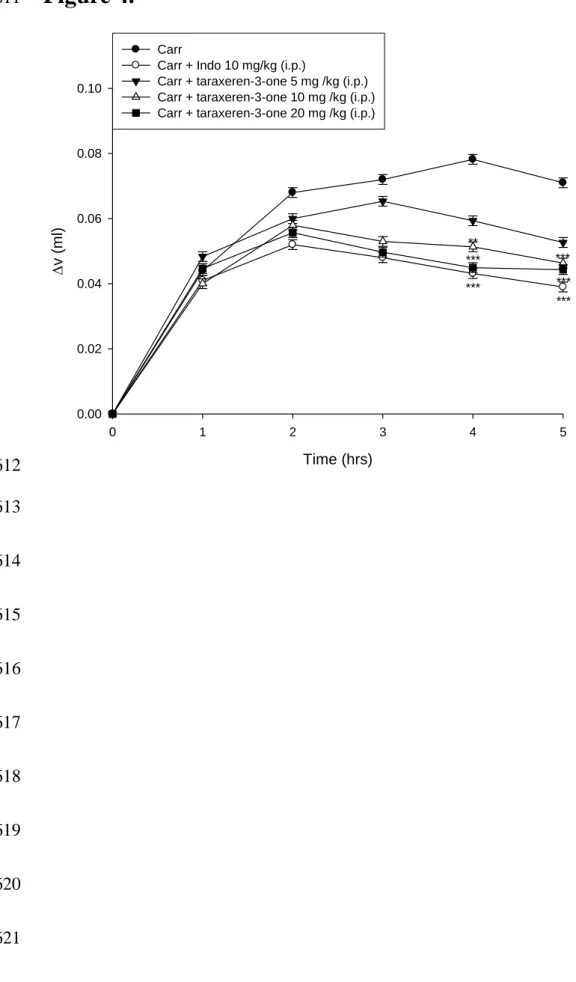
Effects of Taraxeren-3-one on -Carrageenan-Induced Mice Paw Edema. As
272
shown in Figure 4, Carr induced paw edema. Taraxeren-3-one (20 mg/kg) 273
significantly inhibited (p < 0.001) the development of paw edema induced by Carr 274
after 3 and 4 h of treatment. Indo (10 mg/kg) significantly decreased the Carr induced 275
paw edema after 3 and 4 h of treatment (p < 0.001). 276
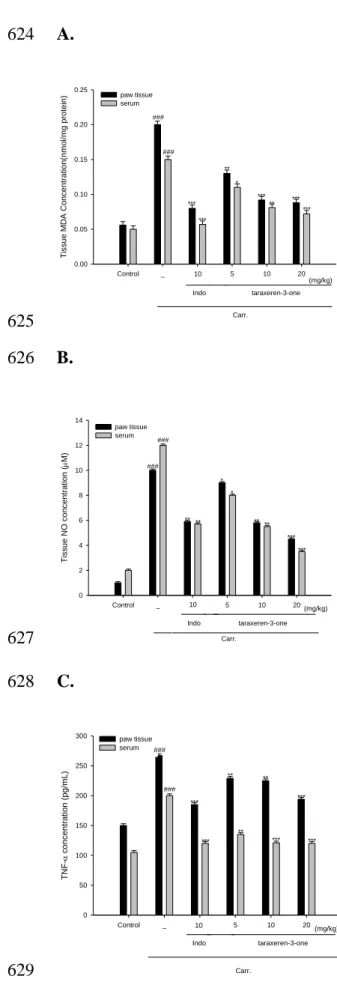
Effects of Taraxeren-3-one on MDA Level Measurements. In Figure 5A, we
278
indicated taraxeren-3-one (10 mg/kg) decreased the MDA level in the edema paw and 279
serum at the fifth hour after Carr injection (p < 0.01 or p < 0.001). And 280
taraxeren-3-one (20 mg/kg) decreased the MDA level in the edema paw and serum at 281
the fifth hour after Carr injection (p < 0.001). 282
283
Effects of Taraxeren-3-one on NO Measurement. Taraxeren-3-one (5, 10 and 20
284
mg/kg) decreased the NO level from the edema paw and serum at the fifth h after Carr 285
injection. Taraxeren-3-one (10 mg/kg) significantly decreased the edema paw and 286
serum NO level (p < 0.01). However, taraxeren-3-one (20 mg/kg) decreased the the 287
edema paw and serum NO level (p < 0.001) (Figure 5B). 288
289
Effects of Taraxeren-3-one on TNF-α Measurement. Taraxeren-3-one (10 mg/kg)
290
decreased the TNF-α level in paw tissue and serum at the fifth hour after Carr 291
injection (p < 0.01). And taraxeren-3-one (20 mg/kg) decreased the TNF-α level at the 292
fifth hour after Carr injection (p < 0.001) (Figure 5C). 293
294
Effects of Taraxeren-3-one on Carr-Induced iNOS and COX-2 Protein
295
Expressions in Mice Paw Edema. To investigate whether the inhibition of NO
production was due to a decreased iNOS and COX-2 protein level, the effect of 297
taraxeren-3-one on iNOS and COX-2 proteins expression were studied by Western 298
blot. The results showed that injection of taraxeren-3-one (20 mg/kg) on Carr-induced 299
for 5 h inhibited iNOS and COX-2 proteins expression in mouse paw edema (Figure 300
6A). The intensity of protein bands were analyzed using Kodak Quantity software in 301
three independent experiments and showed an average of 72.4% and 61.3% 302
down-regulation of iNOS and COX-2 protein, respectively, after treatment with 303
taraxeren-3-one compared with the Carr-induced alone (Figure 6B). In addition, the 304
protein expression showed an average of 52.8% and 56.2% down-regulation of iNOS 305
and COX-2 protein after treatment with Indo at 10.0 mg/kg compared with the 306
Carr-induced alone. The down-regulation of iNOS and COX-2 activity of 307
taraxeren-3-one (20 mg/kg) was better than Indo (10.0 mg/kg). 308
309
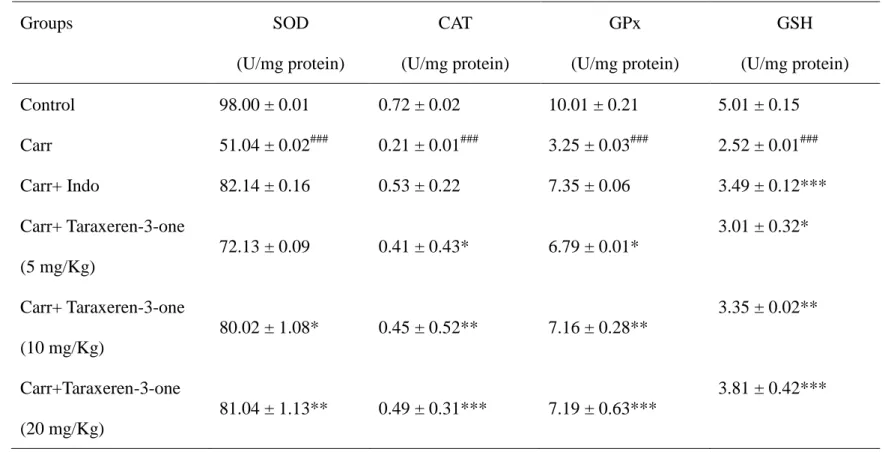
Effects of Taraxeren-3-one on Activities of Antioxidant Enzymes. At the fifth hour
310
following the intrapaw injection of Carr, liver tissues were also analysed for the 311
biochemical parameters such as SOD, CAT, GPx and GSH activities (Table 1). SOD, 312
CAT, GPx and GSH activities in liver tissue was decreased significantly by Carr 313
administration. SOD, CAT, GPx and GSH activities was increased significantly after 314
treated with 20 mg/kg taraxeren-3-one and 10 mg/kg Indo (P<0.01 or P<0.001) 315
(Table 1). 316
317
Histological Examination. Paw biopsies of control animals showed marked cellular
318
infiltration in the connective tissue. The infiltrates accumulated between collagen 319
fibers and into intercellular spaces. Paw biopsies of animals treated with the extract, at 320
a dose of 20 mg/kg, showed a reduction in inflammatory response Carr-induced. 321
Actually inflammatory cells were reduced in number and confined to near the 322
vascular areas. Intercellular spaces did not show any cellular infiltrations. Collagen 323
fibers were regular in shape and showed a reduction of intercellular spaces. Moreover 324
the hypoderm connective tissue was not damaged (Figure 7). 325
326
DISCUSSION
327We have evaluated the putative analgesic and anti-inflammatory activities of 328
taraxeren-3-one to clarify the pain and inflammation relieving effects. Two different 329
analgesic testing methods were employed with the objective of identifying possible 330
peripheral and central effects of the test substances. The acetic writhing test is 331
normally used to study the peripheral analgesic effects of drugs. Although this test is 332
nonspecific (e.g., anticholinergic, antihistaminic and other agents also show activity in 333
the test), it is widely used for analgesic screening (20). In our study, we found that 334
taraxeren-3-one (10 and 20 mg/kg) exhibited antinociceptive effect in acetic 335
acid-induced writhing response (Figure 2.). This effect may be due to inhibition of the 336
synthesis of the arachidonic acid metabolites (21). 337
The in vivo model of pain, formalin-induced paw pain has been well established 338
as a valid model for analgesic study. The formalin test produces a distinct biphasic 339
response and different analgesics may act differently in the early and late phases of 340
this test. Therefore, the test can be used to clarify the possible mechanism of an 341
anti-nociceptive effect of a proposed analgesic (22). Centrally acting drugs such as 342
opioids inhibit both phases equally (20), but peripherally acting drugs such as aspirin, 343
Indo and dexamethasone only inhibit the late phase. The inhibitory effect of 344
taraxeren-3-one on the nociceptive response in the late phase of the formalin test 345
suggested that the anti-nociceptive effect of taraxeren-3-one could be due to its 346
peripherial action (Figure 3). 347
The Carr test is highly sensitive to nonsteroidal anti-inflammatory drugs, and has 348
long been accepted as a useful phlogistic tool for investigating new drug therapies 349
(23). The degree of swelling of the Carr-injected paws was maximal 3 h after injection. 350
Statistical analysis revealed that taraxeren-3-one and Indo significantly inhibited the 351
development of edema 4 h after treatment (p<0.001) (Figure 4). They both showed 352
anti-inflammatory effects in Carr-induced mice edema paw. It is well known that the
3th h of the Carr-induced edema, in which the edema reaches its highest volume, is
354
characterized by the injection of Carr into the rat paw induces the liberation of
355
bradykinin, which later induces the biosynthesis of prostaglandin and other autacoids,
356
which are responsible for the formation of the inflammatory exudates (24, 25).
357
Besides, in the Carr-induced rat paw edema model, the production of prostanoids has 358
been through the serum expression of COX-2 by a positive feedback mechanism (26). 359
Therefore, it is suggested that the action mechanism of taraxeren-3-one may be related 360
to prostaglandin synthesis inhibition, as described for the anti-inflammatory 361
mechanism of Indo in the inhibition of the inflammatory process induced by Carr (27). 362
In addition, the classification of antinociceptive drugs is usually based on their 363
mechanism of action either on the central nervous system or on the peripheral nervous 364
system (28). 365
In the studies of mechanism on the inflammation, L-arginine–NO pathway has 366
been proposed to play an important role in the Carr -induced inflammatory response 367
(29). Our present results also confirm that the level of NO production increased in the
368
Carr-induced paw edema model. The expression of the inducible isoform of NO 369
synthase has been proposed as an important mediator of inflammation (30). In our 370
study, the level of NO was decreased significantly by treatment with 10 and 20 mg/kg 371
taraxeren-3-one. We suggest the mechanism of anti-inflammatory of taraxeren-3-one 372
may be through the L-arginine–NO pathway since taraxeren-3-one significantly 373
inhibits the NO production (Fig. 5A). 374
TNF-α is a major mediator in inflammatory responses, inducing innate immune 375
responses by activating T cells and macrophages, and stimulating secretion of other 376
inflammatory cytokines (31). Also, TNF-α is a mediator of Carr-induced 377
inflammatory incapacitation, and is able to induce the further release of kinins and 378
leukotrienes, which is suggested to have an important role in the maintenance of 379
long-lasting nociceptive response (32). In this study, we found taraxeren-3-one 380
decreased the TNF-α level in serum after Carr injection (Figure 5C). 381
The Carr-induced inflammatory response has been linked to neutrophil infiltration 382
and the production of neutrophil derived free radicals, such as hydrogen peroxide, 383
superoxide and hydroxyl radicals, as well as the release of other neutrophil derived 384
mediators (33). Some researches demonstrate that inflammatory effect induced by 385
Carr is associated with free radical. Free radical, prostaglandin and NO will be 386
released when administrating with Carr for 1–6 h (5). The edema effect was raised to 387
the maximum at the third hour (6). Janero et al., demonstrated that MDA production 388
is due to free radical attack plasma membrane (7). Thus, inflammatory effect would 389
result in the accumulation of MDA. GSH is a known oxyradical scavenger. Enhancing
390
the level of GSH conducive toward reduces MDA the production. Cuzzocrea 391
suggested that endogenous GSH plays an important role against Carr-induced local 392
inflammation (34). In this study, there is significantly increased in SOD, CAT, GPx, 393
and GSH activities with taraxeren-3-one treatment (Table 1). Furthermore, there is a 394
significant decrease in MDA level with taraxeren-3-one treatment (Figure 6). The
395
result indicated that the suppression of MDA production is probably due to the
396
increases of SOD, CAT, GPx, and GSH activities.
397
In conclusion, these results suggested that taraxeren-3-one possessed analgesic 398
and anti-inflammatory effects. The anti-inflammatory mechanism of taraxeren-3-one 399
may be related to iNOS and COX2 activity (35) and it is associated with the increase 400
in the activities of antioxidant enzymes (SOD, CAT, GPx, and GSH). 401
Taraxeren-3-one may be used as a pharmacological agent in the prevention or 402
treatment of disease in which free radical formation in a pathogenic factor. 403
404
ACKNOWLEDGEMENTS
405
The authors want to thank the financial supports from the National Science 406
Council (NSC 97-2313-B-039 -001 -MY3), China Medical University (CMU) 407
(CMU96-171, CMU99-S-29, CCM-P99-RD-042, and CMU99-COL-10) and Taiwan 408
Department of Heath Clinical Trial and Research Center of Excellence 409
(DOH100-TD-B-111-004) and the Cancer Research Center of Excellence 410
(DOH100-TD-C-111-005). The authors would like to thank Dr Jeffrey Conrad for 411
criticallyreading the manuscript. 412
413
LITERATURE CITED
4141.Higa, M.; Noha, N.; Yokaryo, H.; Ogihara, K.; Yogi, S. Three new naphthoquinone 415
derivatives from Diospyros maritima Blume. Chem. Pharm. Bull (Tokyo). 2002, 50, 416
590-593. 417
2.Chang, C. I.; Chen, C. R.; Chiu, H. L.; Kuo, Y. H. Chemical constituents from the 418
stems of Diospyros maritima. Molecules. 2009, 14, 5281-5288. 419
3. Gu, J. Q. ; Graf, T. N. ; Chai, H. B. ; Mi, Q. ; Kardono, L. B. ; Setyowati, F. M.; 420
Ismail, R.; Riswan, S.; Farnsworth, N. R.; Cordell, G. A.; Pezzuto, J. M.; Swanson, 421
S. M.; Kroll, D. J.; Falkinham, J. O. 3rd.; Wall, M. E.; Wani, M. C.; Kinghorn, A. D.; 422
Oberlies, N. H. Cytotoxic and antimicrobial constituents of the bark of Diospyros 423
maritima collected in two geographical locations in Indonesia. J. Nat. Prod. 2004,
424
67, 1156-1161.
425
4. Kuo, Y. H.; Chang, C. I.; Li, S. Y.; Chou, C. J. ; Chen, C. F. ; Kuo, Y. H. ; Lee, K. H. 426
Cytotoxic constituents from the stems of Diospyros maritima. Planta Med. 1997, 63, 427
363-365. 428
5. Dudhgaonkar, S. P.; Tandan, S. K.; Bhat, A. S.; Jadhav, S. H.; Kumar, D. 429
Synergistic anti-inflammatory interaction between meloxicam and aminoguanidine 430
hydrocholide in carrageenan-induced acute inflammation in rats. Life Sci. 2006, 78, 431
1044–1058. 432
6. Kirkova, M.; Kassabova, T.; Russanov; E. In vivo effects of indomethacin-I. 433
Activity of antioxidant enzymes and lipid peroxidation. Gen. Pharmacol. 1992, 23, 434
503–507. 435
7. Janero, D. R. Malondialdehyde and thiobarbituric acid-reactivity as diagnostic 436
indices of lipid peroxidation and peroxidative tissue injury. Free Radic. Biol. Med. 437
1990, 9, 515–540.
438
8. Zimmermann, M. Ethical guidelines for investigations of experimental pain in 439
conscious animals. Pain 1983, 16, 109-110. 440
9. Koster, R.; Anderson, M.; DeBeer, E. J. Acetic acid for analgesic screening. Fed. 441
Proc. 1959, 18, 418-420.
442
10. Taber, R. I.; Greenhouse, D. D.; Rendell, J. K.; Irwin, S. Agonist and antagonist 443
interactions of opioids on acetic acid induced abdominal stretching in mice. J. 444
Pharmacol. Exp. Ther. 1969, 169, 29-37.
445
11. Dubuisson, D.; Dennis, S. G. The formalin test: a quantitative study of the 446
analgesic effects of morphine meperidine, and brain stem stimulation in rats and 447
cats. Pain 1977, 4, 161-174. 448
12. Mascolo, N; Jain, R.; Jain, S. C.; Capasso, F. Ethnopharmacologic investigation of 449
ginger (Zingiber officinale). J. Ethnopharmacol 1989, 27, 129-40. 450
13. Tatum, V. L.; Changchit, C.; Chow, C. K. Measurement of malondialdehyde by 451
high performance liquid chromatography with fluorescence detection. Lipids 1990, 452
25, 226–229.
453
14. Moshage, H.; Kok, B.; Huizenga, J.R.; Jansen, P.L. M. Nitrite and Nitrate 454
Determinations in Plasma: A Critical Evaluation. Clin. Chem. 1995, 41, 892-896. 455
15. Shiratoria, K.; Ohgamia, K. Ilievaa, I.; Jina, X. H.; Koyamab, Y.; Miyashitac, K.; 456
Yoshida, K.; Kasea, S.; Ohnoa, S. Effects of fucoxanthin on 457
lipopolysaccharide-induced inflammation in vitro and in vivo. Exp. Eye Res. 2005, 458
81, 422–428.
459
16. Flohe, L.; Otting, F. Superoxide dismutase assays. Methods Enzymol. 1984, 105, 460
93-104. 461
17. Aebi, H. Catalase in vitro. Methods Enzymol. 1984, 105, 121-126. 462
18. Paglia, D. E.; Valentine, W. N. Studies on the quantitive and qualitative 463
characterization of erythrocyte glutathione peroxidase. J. Lab. Clin. Med. 1967, 70, 464
158-169. 465
19. Davis, M. H.; Birt, D. F.; Schnell, R. C. Direct enzymatic assay for reduced and 466
oxidized glutathione. J. Pharmacol Methods. 1984, 12, 191-194. 467
20. Shibata, M.; Ohkubo, T.; Takahashi, H.; Inoki, R. Modified formalin test: 468
characteristic biphasic pain response. Pain 1989, 38, 347-352. 469
21. Franzotti, E. M.; Santos, C. V.; Rodrigues, H. M.; Mourao, R. H.; Andrade, M. R.; 470
Antoniolli, A. R. Anti-inflammatory, analgesic activity and acute toxicity of Sida 471
cordifolia L. (Malva-branca). J. Ethnopharmacol. 2000, 72, 273–277.
472
22. Tjolsen, A.; Berge, O. G.; Hunskaar, S.; Rosland, J. H.; Hole, K. The formalin test: 473
an evaluation of the method. Pain 1992, 51, 5-17. 474
23. Just, M. J.; Recio, M. C.; Giner, R. M.; Cuellar, M. J.; Manez, S.; Bilia, A. R.; Ríos, 475
J. L. Antiinflammatory activity of unusual lupine saponins from Bupleurum 476
fruticescens. Planta Med. 1998, 64, 404-407.
477
24. Spector, W. G.; Willoughb, D. A. The inflammatory response. Bacteriol. Rev. 1963, 478
27, 117–154.
479
25. Ueno, A.; Naraba, H.; Ikeda, Y.; Ushikubi, F.; Murata, T.; Naramiya, S.; Ohishi, S. 480
Intrinsic prostacyclin contributes to exudation induced by bradikinin or 481
carrageenan: a study on the paw edemainduced in ip-receptordeficient mice. Life 482
Sci. 2000, 66, 155-160.
483
26. Nantel, F.; Denis, D.; Gordon, R.; Northey, A.; Cirino, M.; Metters, K. M.; Chan, 484
C. C. Distribution and regulation of cyclooxygenase-2 in carrageenan induced 485
inflammation. Br. J. Pharmacol. 1999, 128, 853–859. 486
27. Di, R. M.; Papadimitrion, J. P.; Willoughby, D. A. Studies of the mediators of the 487
acute inflammatory response induced in rats in different sites by carrageenan and 488
turpentine. J. Pathol. 1971, 104, 15–29. 489
28. Planas, E.; Sanchez, S.; Rodriguez, L.; Pol, O.; Puig, M. M. 490
Antinociceptive/anti-edema effects of liposomal morphine during acute 491
inflammation of the rat paw. Pharmacol. 2000, 60, 121–127. 492
29. Salvemini, D.; Wang, Z.; Bourdon, D. M.; Stern, M. K.; Curne, M. G.; Manning, P. 493
T. Evidence of peroxynitrite involvement in the carrageenaninduced rat paw 494
edema. Eur. J. Clin. Pharmacol. 1996, 303, 217–220. 495
30. Cuzzocrea, S.; Zingarelli, B.; Calapai, G. ; Nava, F. ; Caputi, A. P. 496
Zymosanactivated plasma induces paw oedema by nitric oxide and prostaglandin 497
production. Life Sci. 1997, 60, 215–220. 498
31. Beutler, B.; Cerami, A. The biology of cachectin/TNF-α primary mediator of the 499
host response. Annu. Rev. Immunol. 1989, 7, 625–655. 500
32.Tonussi, C. R.; Ferreira, S. H.; Tumour necrosis factor-alpha mediates 501
arrageenin-induced knee-joint incapacitation and also triggers overt nociception in 502
previously inflamed rat knee-joints. Pain 1999, 82, 81-87. 503
33. Dawson, J.; Sedgwick, A. D.; Edwards, J. C.; Lees, P. A comparative study of the 504
cellular, exudative and histological responses to carrageenan, dextran and zymosan 505
in the mouse. Int. J. Tissue React. 1991, 13, 171–185. 506
34. Cuzzocrea, S.; Costantino, G.; Zingarelli, B.; Mazzon, E.; Micali, A.; Caputi, A. P. 507
The protective role of endogenous glutathione in carrageenaninduced pleurisy in 508
the rat. Eur. J. Pharmacol. 1999, 372, 187–197. 509
35. Bonnie, S. P. ; Ying, Y. K. ; Tsui, Y. C. ; Yeuk, C. L. Anti-oxidative and 510
anti-inflammatory activities of two different species of a Chinese herb I-Tiao-Gung. 511 Life Sci. 2005, 77, 2830–2839. 512 513 514 515 516 517 518 519 520 521 522 523 524 525 526 527 528 529 530 531 532
533 534
FIGURE LEGENDS
535Figure 1. Chemical structure of taraxeren-3-one 536
537
Figure 2. Analgesic effects of taraxeren-3-one and indomethacin (Indo) on acetic 538
acid-induced writhing response in mice. Each value represents as mean ± 539
S.E.M. *p < 0.05, **p < 0.01 and ***p < 0.001 as compared with the only 540
acetic acid induced group (one-way ANOVA followed by Scheffe’s 541
multiple range test). 542
543
Figure 3. Effects of taraxeren-3-one and indomethacin (Indo) on the early phase and 544
late phase in formalin test in mice. Each value represents as mean ± S.E.M. 545
*p < 0.05, **p < 0.01 and ***p < 0.001 as compared with the control (Con) 546
group (one-way ANOVA followed by Scheffe’s multiple range test). 547
548
Figure 4. Effects of taraxeren-3-one and indomethacin (Indo) on hind paw edema 549
induced by -carrageenan in mice. Each value represents as mean ± S.E.M. 550
*p < 0.05, **p < 0.01 and ***p < 0.001 as compared with the -carrageenan 551
(Carr) group (one-way ANOVA followed by Scheffe’s multiple range test). 552
553
Figure 5. Effects of taraxeren-3-one and indomethacin (Indo) on carrageenan 554
(Carr)-induced MDA (A), NO (B), and TNF-α (C) concentrations of edema 555
paw and serum were detected at 5rd h in mice. Each value represents as 556
mean ± S.E.M. ###compared with sample of control group. *p < 0.05, **p < 557
0.01 and ***p < 0.001 as compared with the Carr group (one-way ANOVA 558
followed by Scheffe’s multiple range test). 559
560
Figure 6. Inhibition of iNOS and COX-2 protein expression by taraxeren-3-one 561
induced by Carr of foot at 5th hour in mice. Tissue suspended were then 562
prepared and subjected to Western blotting using an antibody specific for 563
iNOS and COX-2. β-actin was used as an internal control. (A) A 564
representative Western blot from two separate experiments is shown. (B) 565
Relative iNOS and COX-2 protein levels were calculated with reference to a 566
Carr-injected mouse. ###compared with sample of control group. The data 567
were presented as mean ± S.D. for three different experiments performed in 568
triplicate. ***p < 0.001 were compared with Carr-alone group.
569 570
Figure 7. Histological appearance of the mouse hind footpad after a subcutaneous 571
injection with 0.9% saline (Control group) or carrageenan stained with H&E 572
stain. (A) Control mice: show the normal appearance of dermis and 573
subdermis without any significantly lesion. (B) Hemorrhage with 574
moderately extravascular red blood cell and large amount of inflammatory 575
leucocyte mainly neutrophil infiltration in the subdermis interstitial tissue of 576
mice following the subcutaneous injection of Carr only. Moreover, detail of 577
the subdermis layer show enlargement of the interstitial space caused by 578
edema with exudate fluid. (C) Indomethacin (Indo) significantly reduces the 579
level of hemorrhage, edema and inflammatory cell infiltration compared to 580
subcutaneous injection of Carr only. (D) Taraxeren-3-one significantly 581
show morphological alterations compared to subcutaneous injection of Carr 582
only (100×). (E) The numbers of neutrophils were counted in each scope 583
(400×) and obtain their average count from five scopes of every tissue slice. 584
###p < 0.001 as compared with the control group. *p < 0.05, **p < 0.01 and 585
***p < 0.001 as compared with the Carr group. 586
587 588
Figure. 1.
589 590 591 592 593 594 595 596 597 598 599 600 601 602 603Figure. 2.
605 _ 5 10 20 N um bers of W rith ing R espons e 0 10 20 30 40 50 *** ** Indo taraxeren-3-one *** * 1% Acetic acid (mg/kg) 10 606 607Figure 3.
608 _ 5 10 20 Li cking t im e (sec) 0 20 40 60 80 100 120 140 Early phase Late phase Indo taraxeren-3-one 5 % Formalin *** ** *** * (mg/kg) 10 609 610Figure 4.
611 Time (hrs) 0 1 2 3 4 5 v ( m l) 0.00 0.02 0.04 0.06 0.08 0.10 CarrCarr + Indo 10 mg/kg (i.p.)
Carr + taraxeren-3-one 5 mg /kg (i.p.) Carr + taraxeren-3-one 10 mg /kg (i.p.) Carr + taraxeren-3-one 20 mg /kg (i.p.)
*** *** *** *** *** ** 612 613 614 615 616 617 618 619 620 621
Figure 5.
623 A. 624 Indo taraxeren-3-one Carr. Control _ 5 10 20 T iss ue M D A C oncent rat ion(nm ol/ m g pr ot ein) 0.00 0.05 0.10 0.15 0.20 0.25 paw tissue serum *** *** ### ### ** *** *** *** * ** (mg/kg) 10 625 B. 626 Indo taraxeren-3-one Carr. Control _ 5 10 20 T iss ue N O concent ratio n ( M) 0 2 4 6 8 10 12 14 paw tissue serum ** ** *** *** ### ### ** ** * * (mg/kg) 10 627 C. 628 Indo taraxeren-3-one Control _ 5 10 20 T N F- c oncent rat ion (pg /m L) 0 50 100 150 200 250 300 paw tissue serum ** ### ### *** *** *** *** *** ** ** (mg/kg) 10 629Figure 6.
630A.
631 632B.
633 *** ** ** iN OS and C OX -2 (% of control) 0.0 0.2 0.4 0.6 0.8 1.0 1.2 iNOSCOX-2 ### ### ** Control - 10 20 (mg/kg) Indo taraxeren-3-one Carr ** ** *** 634 635 636 637 638Figure 7.
640 641 C o n t r o l _ 10 20 N eut roph il s c ope / ( c ell) 0 20 40 60 80 ### *** *** taraxeren-3-one Carr. (mg/kg) Indo 642 ETable 1. Effects of taraxeren-3-one and indomethacin (Indo) on the liver SOD, CAT, GPx and GSH activities in mice. 643 Groups SOD (U/mg protein) CAT (U/mg protein) GPx (U/mg protein) GSH (U/mg protein) Control 98.00 ± 0.01 0.72 ± 0.02 10.01 ± 0.21 5.01 ± 0.15 Carr 51.04 ± 0.02### 0.21 ± 0.01### 3.25 ± 0.03### 2.52 ± 0.01### Carr+ Indo 82.14 ± 0.16 0.53 ± 0.22 7.35 ± 0.06 3.49 ± 0.12*** Carr+ Taraxeren-3-one (5 mg/Kg) 72.13 ± 0.09 0.41 ± 0.43* 6.79 ± 0.01* 3.01 ± 0.32* Carr+ Taraxeren-3-one (10 mg/Kg) 80.02 ± 1.08* 0.45 ± 0.52** 7.16 ± 0.28** 3.35 ± 0.02** Carr+Taraxeren-3-one (20 mg/Kg) 81.04 ± 1.13** 0.49 ± 0.31*** 7.19 ± 0.63*** 3.81 ± 0.42***
Each value represents as mean ± S.E.M. ### p < 0.001 as compared with control group, 644
* p < 0.05 and ** p < 0.01 as compared with the Carr (-carrageenan) group (one-way ANOVA followed by Scheffe’s multiple range test). 645