Broadband access technology for passive optical network
Sien Chi*
a, b, Chien-Hung Yeh
c, Chi-Wai Chow
ba
Department of Electro-Optical Engineering, Yuan Ze University, Chungli 320, Taiwan
bDepartment of Photonics and Institute of Electro-Optical Engineering, National Chiao Tung
University, Hsinchu 300, Taiwan
c
Information and Communications Research Laboratories, Industrial Technology Research Institute,
Chutung, Hsinchu 310, Taiwan
ABSTRACT
We will introduce four related topics about fiber access network technologies for PONs. First, an upstream signal power-equalizer is proposed and designed using a FP-LD in optical line terminal applied to the TDM-PON, and a 20dB dynamic upstream power range from -5 to -25dBm having a 1.7dB maximal power variation is retrieved. The fiber-fault protection is also an important issue for PON. We investigate a simple and cost-effective TDM/WDM PON system with self-protected function. Next, using RSOA-based colorless WDM-PON is also demonstrated. We propose a cost-effective CW light source into RSOA for 2.5Gb/s upstream in WDM-PON together with self-healing mechanism against fiber fault. Finally, we investigate a 4Gb/s OFDM-QAM for both upstream and downstream traffic in long-reach WDM/TDM PON system under 100km transmission without dispersion compensation. As a result, we believe that these key access technologies are emerging and useful for the next generation broadband FTTH networks.
Keywords: Fiber to the home, Passive optical network, WDM/TDM, Self-Protection
1. INTRODUCTION
Recently, passive optical network (PON) is considered as a promising candidate for fiber-to-the-home (FTTH) to overcome the last mile bottleneck in broadband optical access network [1], [2]. Time division multiplexed PON (TDM-PON) systems such as Ethernet PON (E(TDM-PON) and Gigabit PON (G(TDM-PON) have already been standardized [3], [4]. They are currently operating at the nominal line rates of 1.25 Gb/s and 2.5 Gb/s for EPON and GPON, respectively. In Taiwan, the M-Taiwan (Mobile Taiwan) project was advanced by the government to supply the broadband access. Chunghua Telecom Co. Ltd. will lend an impetus to provide FTTH from 2007 to 2009. Industrial Technology Research Institute (ITRI) not only develops GPON system for commercial applications, but also works closely with the National Chiao Tung University (NCTU) on PON related research to provide the best choice and solution for FTTH. In this paper, we introduce several technologies for broadband access PON applications, including the upstream power equalization for high speed TDM-PON, self protection PON system against fiber cut, the reflected semiconductor amplifier (RSOA) based colorless wavelength division multiplexing PON (WDM-PON), and orthogonal frequency division multiplexing- quadrature amplitude modulation (OFDM-QAM) WDM/TDM PON network [5-9].
2. TECHNICAL RESEARCH
First, we proposed a cost-effective power-equalized technique for GPON using a Fabry-Perot laser diode (FP-LD) to serve as a power equalizer, as illustrated in Figure 1.The equalizer consisted of an optical circulator (OC) and a FP-LD connecting the receiver (Rx) in the optical line terminal (OLT). The upstream signals from laser diode (LD-2) will pass through the 1310/1490 nm WDM coupler and OC into the proposed equalizer (LD-1) to equalize the power level. The operating bias current (Ib) of LD-1 was set at 9 mA, which was less than the threshold current (Ith). When upstream
signals of power ranging from −1.5 to −25 dBm were injected into the LD-1, the output power only varied from −11 to −15.3 dBm, as shown in Figure 2. This is because the high injection upstream signal will be absorbed while the low power signal will be amplified by the slightly under biased FP-LD inside the equalizer.
Invited Paper
Broadband Access Communication Technologies III, edited by Benjamin B. Dingel, Raj Jain, Katsutoshi Tsukamoto, Proc. of SPIE Vol. 7234, 723408 · © 2009 SPIE · CCC code: 0277-786X/09/$18 · doi: 10.1117/12.816599
Proc. of SPIE Vol. 7234 723408-1
L
OLT
OC: Optical CirculatorLD: Laser Diode
Power-Equalized Amplifier1 PD: Photodiode
I WDM: Wavelength Division Multiplexed Coupler I OLT : Optical Line Terminal
MAC: Media Access Control FP-LD : Fabry-Perot Laser Diode 2
\
IUpstr earn 1 >I 1310 (LD-2)0
lSlOhiii Downstream 1490 nm FP-LD (LD-1) .1.-'
-5 10 -1-s -20 -25 -30 FP-LD = 9mA -25 -20 -15 -10 -5Input Upstream Power (dBm)
Fig. 1. Proposed power equalizer in GPON for equalizing the uplink power from each ONU. The equalizer is integrated in the OLT.
Fig. 2. Received average output power of the proposed equalizer versus different upstream injection powers from −1.5 to −25 dBm.
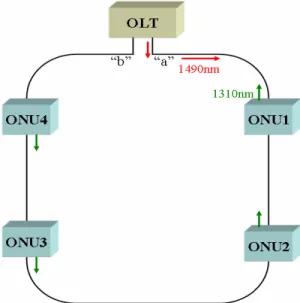
A ring-based PON to prevent fiber failure in a single-path was proposed. The self-protection mechanism is as follow: assuming the proposed self-restored architecture system consists of four optical networking units (ONUs), as shown in Figure 3. The downstream signal of the OLT was transmitted through the path “a” (in clockwise) without any fiber failure (in normal state). As illustrated in Figure 4, the OLT can determine two different transmission paths for data traffics by the proposed combiner integrating in the OLT. The proposed combiner consisted of two 1×2 optical couplers (CPRs) and a 1×2 optical switch (OS). The switching direction of OS can be controlled by the media access control (MAC). In normal state, the OS was placed at “1” point for the downstream traffic through the “a” fiber path, as shown in Figure 4(a). Figure 4(c) presents the proposed ONU with bidirectional function to access the downstream and upstream links. Physical layer of each ONU was constructed by a 2×2 CPR and two line terminations (LTs). The upstream traffic will be transmitted from the LT(1) through path “a” (counterclockwise) without any fiber failure. LT(0) of ONU was prepared for the fiber failure. When a fiber fault occurs between ONU2 and ONU3, then the data traffics of
ONU3 and ONU4 cannot link with the OLT. At this time, the two unreachable ONUs will start driving the LT(0) to
reconnect the data links simultaneously. And the OLT will switch the direction of OS to the “2” point by MAC, as shown in Figure 4(b). Then, the downstream signal will be separated to pass through the “a” (clockwise) and “b” paths (counterclockwise) simultaneously. As a result, the data links from OLT to ONU1 and ONU2 were routed through the “a”
path (counterclockwise), and the ONU3 and ONU4 were routed through the “b” path (clockwise). The restoration time
was achieved within 7 ms in the proposed access network. When the fiber failure is restored, the operation mechanism of
Proc. of SPIE Vol. 7234 723408-2
F
OLT ONTJ2 1 490mn l3lOmnt ONTJ1-r
ONU4 (c) 1310 .in 1490 m 1310.m a Data RouterONU
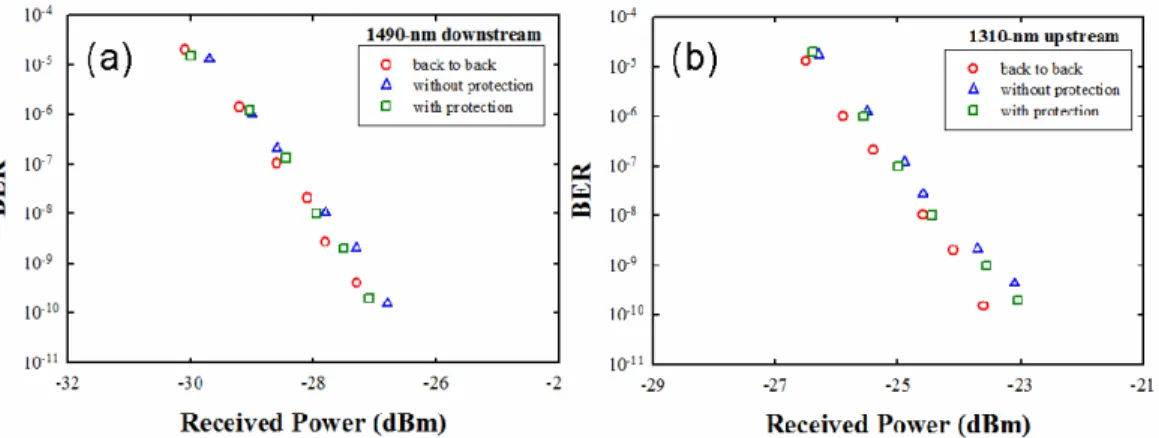
LT(1) LT(0)PON system will be restored. Beside, before the transmission failure (normal state), this downstream signal was passed the “a” path. However, in case of fiber cut, it is no longer possible to receive the upstream signals behind the fault point. Thus, this downstream signal was split and transmitted through the “a” and “b” paths by switching the direction of OS to “2” point, simultaneously. Bit error rate (BER) performance was measured at 1.25 Gb/s non-return-to-zero (NRZ) pseudo random binary sequence (PRBS) with a pattern length of 231−1 for the downstream and upstream traffics between
the OLT and ONU4 through “a” (without protection) and “b” (with protection, fault between ONU3 and ONU4) paths.
The output power of 1490 and 1310 nm transmitters were 2 and 2.5 dBm, respectively. Figures 5(a) and 5(b) show the measured downstream and upstream BERs in the self-protected ring-based PON against the received power through “a” and “b” paths between OLT and ONU4. The observed optical power penalties were smaller than ~0.2 dB.
Fig. 3. The data traffics of the proposed self-protection ring-based PON with four ONUs in normal state
Fig. 4. The proposed combiner in the OLT to control the transmitted direction of downstream signal, when the direction of the OS is set to (a) the “1” point and (b) “2” point. (c) The proposed ONU module with the bidirectional function.
Proc. of SPIE Vol. 7234 723408-3
0 10.10 10.11 -32 -30 -28 -26 10 000 00-jo-s
(b)
0 1310-nm upstream O hack to bask I without pratochon o with protortion00
0 0 a 1°_Il -29 -2 -23 -21 1(3_sj.t
j1
j9
(a)
QJ. 0 1490-nm downstream o 0 bacstobaek without wotoction with çrotecüonReceived Power (dBm) Received Power (dBm)
Fig. 5. BER performance of (a) downstream and (b) upstream traffics at 1.25 Gb/s. The distance between the OLT and ONU4 is 20 km.
We proposed and demonstrated a simple self-protection configuration for RSOA-based colorless WDM-PON against fiber fault. The proposed network architecture is illustrated in Figure 6. Here, we use the duplicated fiber in the distributed section between the remote node (RN) and the ONUs; together with a 1x2 optical switch (OS), which keep monitoring the optical power at the downstream receiver (Rx) for automatic switching. The switching of data traffic from working to protection fiber is controlled by the ONU itself, and the centralized protection control at OLT is not required. In addition, based on the array of self-seeding FP-LDs to serve as the WDM CW injected wavelengths, the RSOA-based upstream signal on each ONU can be modulated up to 2.5 Gb/s. The proposed CW injection lightwave consisted by FP-LD, polarization controller (PC), array waveguide grating (AWG) and fiber mirror (FM), as also shown in Figure 6. Based on the laser scheme, the multi-mode FP-LD can generate a single-mode wavelength due to self-seeding, as seen in Figure 7. The DFB-LD in the OLT was set at 1560.4 nm for downstream signal (λdown). The upstream signal was
generated by directly modulated the RSOA with a 2.5 Gb/s NRZ 27−1 PRBS data, using driving voltages of 5.2 V peak-peak.
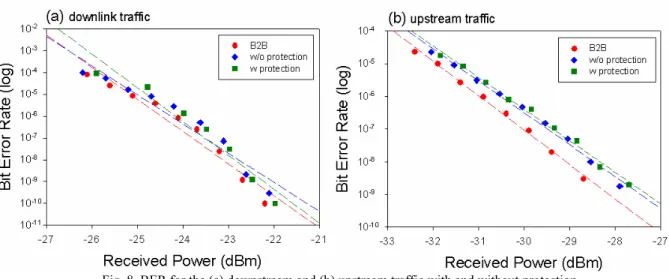
Therefore, the BER curves for the downstream and upstream traffics with and without protection are shown in Figures 7(a) and 7(b), respectively. The power penalties of downstream and upstream traffics are below 0.4 and 0.7 dB respectively at BER of 10−9, successfully demonstrating the feasibility for the proposed colorless self-protected WDM-PON with simple architecture.
AW G AW G CP CP RN RN DFB-LD1 DFB-LD2 DFB-LDN AW G AW G
L-Band Downlink Signals Proposed CW Lasers OLT OLT PC FP-LD1 FP-LD2 FP-LDN AW G AW G PC PC FM OLT OLT Rx1 CP AW G AW G Rx2 RxN C-ba nd L-ba n d WC EDFA RSOA WC Rx RSOA WC Rx RSOA WC Rx Colorless
Colorless ONUsONUs
1 1 1 2 2 2 working path working path protecting path protecting path
Fig. 6. Experimental setup of the self-protected RSOA-based colorless WDM-PON (in nominal state).
Proc. of SPIE Vol. 7234 723408-4
0 a) 0 -lo -20 -30 0 - -40 -5o 0--60 1545 1525 VVavei 1535 (nm) L (b) upstream traffic 10 N B2B 10-0 'Mo protection 0 NeN wprotection 10.6 N-I N N (0 ft 10-i N N
-0 NN N 108 *NNNNN N N i0- N N-NNN N
N 10-10 N 10.2(a) doiiIink traffic
1 o-0) i0 0 10.0 ci) (0 10.6 10-v b0 10-s 10-10 10.11 N N- N
N N
N N
N- N *NUNk,
NN U N B2B wfo protection wprotection N NN N NN NN .NNN N NN-NN -27 -26 -25 -24 -23 -22 -21 -33 -32 -31 -30 -29 -28 -27Received Power (dBm) Received Power (dBm)
Fig. 7. The output spectra of MLM FP-LD and SLM FP-LD without and with self-seeding.
Fig. 8. BER for the (a) downstream and (b) upstream traffic with and without protection.
We proposed and demonstrated a WDM long reach (LR)-PON that makes use of OFDM signal. By using the highly spectral efficiency of the QAM in each subcarrier of the OFDM signal, low-bandwidth optical components can still be used. This means the data rate of the system can be increased directly while the existing optical components developed for GPONs can still be used. Besides, the frequency diversity transmission feature of the OFDM signal allows simple equalization of frequency response by baseband digital signal processing (DSP). This can also be used to mitigate fiber chromatic dispersion which is one of the major impairments in LR-PONs. 256 split-ratio of the 100 km reach PON was achieved without dispersion compensation. The experimental setup is illustrated in Fig. 9.
A baseband DSP and a digital to analog converter (DAC) were used in the experiment. The DAC is an arbitrary waveform generator with 4 GHz sampling rate to generate the OFDM-QAM signal. The incoming bit streams were packed into 16 subcarrier symbols, each subcarrier symbol was in a 16-QAM format. By employing the inverse fast Fourier transform (IFFT), these subcarrier symbols were converted to a real-valued time-domain waveform, called an OFDM symbol. Then the DAC converted the digital data to an analog signal. In the downstream experiment, this OFDM signal was applied to an electro-absorption modulator (EAM) with proper bias via a bias-tee. The signal was then launched into a 100 km standard single mode fiber (SMF) (dispersion parameter = 17 ps/nm/km) without dispersion compensation. In the local exchange, an erbium doped fiber amplifier (EDFA) with saturated output power of 21 dBm and noise figure of 6 dB was used to amplify the signal. In the ONU, the analog to digital converter (ADC), which is a real-time 10 GHz sampling oscilloscope, converted the downstream signal to digital signals for demodulation. The synchronizer extracted the carrier phase and aligned the OFDM symbol boundaries. The time- to frequency-domain translation was performed with fast Fourier transform (FFT). A QAM decoder analyzed the symbol on each subcarrier to
Proc. of SPIE Vol. 7234 723408-5
B
16 carriers (1GHz)
a15Q-80
2-70
-80
-90
I I I0 02505 0.75
11251.5
Fiequency (Gl-Iz)
[IF- r
Lscdb
fEET=
E 4- DAC is. .s. su 51 551 iii I Pi-ar1ifiecEE EL11jltZE IADC fynchronize:I.
EEl
-TI modukitr
make the final decision. In the upstream experiment, the DAC was connected to a distributed feedback (DFB) laser diode (LD) operating at a nominal wavelength of 1543nm, for direct modulation.
Fig. 9. Schematic of OFDM-QAM over WDM ER-PON. S/P: serial to parallel, P/S: parallel to serial, IFFT: inverse fast Fourier transform, FFT: fast Fourier transform, DAC: digital analog converter, ADC: analog digital converter, EAM: electroabsorption modulator, SMF: single mode fiber.
Fig. 10. Measured RF spectrum of the 4Gb/s OFDM-QAM signal, occupying 1GHz bandwidth
Proc. of SPIE Vol. 7234 723408-6
a
-4
-5
w-6
4c
4(1
'C
-8
Downstream
Down()
()
x Down (1001cm)
.L(50km)
L(100km)
Upstream
-10
-33-31 -29-27-25-23-21 -19 -17-15
receiid power (dBm)
Fig. 11. Measured BER of down-and-upstream signals
Fig. 12. Measured OFDM-16QAM constellation diagrams of (a) downstream and (a) upstream signals with 100km SMF transmission.
The 1 G symbol/s OFDM signal occupied the spectrum from 62.5 MHz to 1,125 MHz (as shown in Figure 10), with data pattern consisted of 8192 OFDM symbols. The BER was calculated from the measured error vector magnitude (EVM). Figure 11 shows the BER measurements of both upstream and downstream OFDM 16-QAM signals. About 2 dB power penalty was observed at the back-to-back between the upstream signal generated by the directly modulated LD and the downstream signal generated by the EAM. The power penalty is due to the increased noise generated by the direct modulation of the DFB-LD. Negligible penalty was observed in both upstream and downstream signals after 0, 50 and 100 km SMF transmissions, respectively, without dispersion compensation. The measured constellation diagrams of the downstream and upstream signals after transmission of 100 km are shown in Figures 12(a) and (b), respectively.
Proc. of SPIE Vol. 7234 723408-7
3. CONCLUSION
The current research of FTTH in our fiber communication group was presented and discussed. Several related technologies are reviewed, including upstream signal power equalization technique, fiber access network with self-healing function, RSOA-based colorless WDM-PON together with self-protection function and OFDM-QAM WDM/TDM PON.
REFERENCES
[1] F. T. An, D. Gutierrez, K. S. Kim, J. W. Lee and L. G. Kazovsky, “SUCCESS-HPON: A next-generation optical
access architecture for smooth migration from TDM-PON to WDM-PON,” IEEE Commun. Mag. 43, S40-S47 (2005).
[2] G. Kramer and G. Pesavento, “Ethernet passive optical network (EPON): building a next-generation optical access
network,” IEEE Commun. Mag. 40, 66-73 (2002).
[3] IEEE Standard for Information Technology, IEEE Std 802.3ah, 01-623 (2004).
[4] ITU-T Recommendation G.984.2, “Gigabit-capable passive optical networks (GPON): physical media dependent
(PMD) layer specification,” 2003.
[5] C. H. Yeh, D. Z. Hsu and S. Chi, “Upstream power equalization in Gigabit passive optical network,” Opt. Express
15, 5191-5195 (2007).
[6] C. H. Yeh and S. Chi, “Self-healing ring-based time-sharing passive optical networks,” IEEE Photonics Technol.
Lett. 19, 1139-1141 (2007).
[7] C. H. Yeh, C. W. Chow, C. H. Wang, F. Y. Shih, H. C. Chien and S. Chi, “A self-protected colorless WDM-PON
with 2.5 Gb/s upstream signal based on RSOA,” Opt. Express16, 12296-12301 (2008).
[8] C. W. Chow, C. H. Yeh, C. H. Wang, F. Y. Shih, C. L. Pan and S. Chi, “WDM extended reach passive optical
networks using OFDM-QAM,” Opt. Express 16, 12096-12101 (2008).
[9] C. W. Chow, C. H. Yeh, C. H. Wang, F. Y. Shih, and S. Chi, “Rayleigh backscattering performance of
OFDM-QAM in carrier distributed passive optical networks,” IEEE Photon. Technol. Lett. 20, 1848-1850 (2008)..
Proc. of SPIE Vol. 7234 723408-8