科技部補助專題研究計畫成果報告
期末報告
境外教育、跨國文化資本與弱勢處境:向上流動或持久邊緣化
?(第2年)
計 畫 類 別 : 個別型計畫 計 畫 編 號 : MOST 102-2410-H-004-106-MY2 執 行 期 間 : 103年08月01日至105年07月31日 執 行 單 位 : 國立政治大學社會學系 計 畫 主 持 人 : 馬藹萱 計畫參與人員: 碩士班研究生-兼任助理人員:阮靖權 碩士班研究生-兼任助理人員:李國豪 碩士班研究生-兼任助理人員:郭楨廷 碩士班研究生-兼任助理人員:陳艾欣 大專生-兼任助理人員:潘宣 大專生-兼任助理人員:馮垂華 報 告 附 件 : 移地研究心得報告 出席國際學術會議心得報告中 華 民 國 105 年 12 月 30 日
中 文 摘 要 : 這項研究計畫的目的,在於透過探究馬來西亞華裔學生在中國、日 本、新加坡與台灣四國取得的國際學術資歷在價值與交換上的差異 性,以彰顯學術資歷賦值(valuation)與文化資本的跨區域差異。 同時,這項研究也探討在國外取得的學歷與文化資本對如馬來西亞 華裔之少數族群來說,在社會流動上所具有的影響力。這項研究從 留學中國、日本、新加坡與台灣的返國者中,透過立意抽樣以蒐集 共62 個樣本並進行深入訪談。此外,研究者亦經由參與觀察和實物 蒐集以瞭解校友團體間與團體內(以族群,國籍與畢業學校為基礎 )的網絡聯繫,和校友會在馬來西亞社會所扮演的角色。 這項研究具有重要的理論與實證意義。第一,研究發現將可擴展人 力資本與文化資本在概念上的應用性,並能對國際遷移、國際教育 、族群研究、社會階層化等研究領域做出重要貢獻。第二,研究成 果將可對亞洲政府與大學在發展與評估招募國際學生和高等教育國 際化的相關政策上,提供重要參考。 中 文 關 鍵 詞 : 國際學生、人力資本、文化資本、族群、國際遷移、國際教育、社 會階層化
英 文 摘 要 : This two-year study aims at illuminating the nuances of academic credential valuation and geographies of cultural capital through examining the variability in the value and exchange of international academic credentials Malaysian Chinese students acquired from China, Japan, Singapore, and Taiwan. In this study I examines to what extent overseas education and cultural capital acquired overseas are useful for members of an ethnic minority such as Malaysian Chinese to engage in social mobility at home. Forty-eight Chinese Malaysian alumni who returned from China, Japan, Singapore, and Taiwan would be sampled for in-depth interviews, with twelve interviewees from each host country. In addition, participant observation and unobtrusive measures will be adopted to collect data on networking among intra-group and inter-group alumni (based on ethnicity, nationality, and Alma Mater) and the role of international alumni associations in the Malaysian society. Data will be
analyzed to build a grounded theory on the gradation of credential valuation in international education as well as the portability and transferability of transnational
cultural capital.
The study will have important theoretical and empirical implications. First, the findings will expand the
conceptual application of the theories of human capital and cultural capital and will make significant contribution to the fields of international migration, international
education, race and ethnicity, and social stratification. Second, the results will provide an importance reference to the governments and universities in Asia in designing and
assessing their international student recruitment policies as well as internationalization strategies.
英 文 關 鍵 詞 : international students, human capital, cultural capital, ethnicity, international migration, international
Overseas Education, Transnational Cultural Capital, and Minority Status:
Upward Mobility or Perpetual Marginalization?
境外教育,跨國文化資本,與弱勢處境:向上流動或持久邊緣化? 科技部專題研究計畫(NSC102-2410-H-004-106-MY2) 期末報告 計畫主持人: 馬藹萱(國立政治大學社會學系副教授) 參與人員: 阮靖權(兼任研究助理,政大社研所碩班生) 陳艾欣(兼任研究助理,政大社研所碩班生) 李國豪(兼任研究助理,政大社研所碩班生) 郭楨廷(兼任研究助理,政大社研所碩班生) 馮垂華(兼任研究助理,政大社研所碩班生) 潘宣(兼任研究助理,政大社研所碩班生) 執行期間:102 年 8 月 1 日至 105 年 7 月 31 日
Table of Content
Introduction ... 3
The Migration-Education Nexus in Asia ... 10
Ethnic Chinese in Malaysia ... 12
Research Questions ... 14
Research Design and Methods ... 15
Overseas Education and Market Positioning ... 20
Academic Training and Career Trajectory ... 23
Factors Affecting the Transferability of Overseas "Credentials Currency" ... 26
Recognition ... 26
Knowledge Applicability, Technological Gap, and Authenticity ... 36
Market Demand and Expected Return ... 40
Functional Values of Embodied Cultural Capital ... 44
a.Work ethics ... 44
b.Ways of thinking and problem-solving strategies ... 46
c.Language ... 46
Mediating Factors of the Transferability of Overseas “Credentials Currency” ... 50
1.Social networks ... 50
2.Transnational production networks and regional economies ... 52
Discussion ... 55
Appendix 1: The Question Outline for Alumni Interviews... 59
Tables and Figures
Table 1: A Proposed Typology of Host Countries in Generating Transnational Cultural Capital ... 10 Table 2: The Distribution of Sample Profile of Respondents in In-Depth Interviews . 17 Table 3: Returned Graduates in the Distribution of Market Segments ... 21
Figure 1: Degree of relevance between overseas graduates’ educational training and employment, by study country ... 25
i
中文摘要
這項研究計畫的目的,在於透過探究馬來西亞華裔學生在中國、日本、新加坡與台 灣四國取得的國際學術資歷在價值與交換上的差異性,以彰顯學術資歷賦值 (valuation)與文化資本的跨區域差異。同時,這項研究也探討在國外取得的學歷 與文化資本對如馬來西亞華裔之少數族群來說,在社會流動上所具有的影響力。這 項研究從留學中國、日本、新加坡與台灣的返國者中,透過立意抽樣以蒐集共 62 個樣本並進行深入訪談。此外,研究者亦經由參與觀察和實物蒐集以瞭解校 友團體間與團體內的網絡聯繫,和跨國校友會在馬來西亞社會所扮演的角色。 研究結果顯示,國際教育在學歷賦值的差異化與文化資本的跨國可攜性受到下列 因素之形塑:官方與社會認可、知識的可應用性、科技落差、正統性、市場需求 與預期回饋、與內含文化資本(embodied cultural capital)的功能性價值。此外, 海外資歷、技術與知識的可攜性以及對社會流動的效用,也受到跨國社會網絡、 跨國生產鏈與區域經濟的中介性影響。本研究的發現,大致支持有關教育與遷移 有利於社會流動的主張。但是,對馬來西亞華人而言,海外教育本身不足以使他 們,或說服他們,去跨越馬來西亞社會中的水平性(有時亦包括垂直性)區隔。 關鍵字:國際學生、人力資本、文化資本、族群、國際遷移、國際教育、社會階 層化ii
Abstract
This two-year study aims at illuminating the nuances of academic credential valuation and geographies of cultural capital through examining the variability in the value and exchange of international academic credentials Malaysian Chinese graduates acquired from China, Japan, Singapore, and Taiwan. It examined to what extent overseas education and cultural capital acquired overseas are useful for members of an ethnic minority such as Malaysian Chinese to engage in social mobility at home. Sixty-two Chinese Malaysian alumni who had returned from China, Japan, Singapore, and Taiwan were interviewed. In addition, participant observation and unobtrusive measures we re adopted to collect data on networking among intra-group and inter-group alumni and the role of transnational alumni associations in the Malaysian society.
The gradation of credential valuation in international education and the transnational portability of cultural capital were found to be shaped by official and social recognition, knowledge applicability, technological gap, authenticity, market demand and expected return, and the functional values of embodied cultural values. The portability of overseas credentials, knowledge, and skills as well as their efficacy on social mobility were further mediated by transnational social networks as well as transnational production networks and regional economies. The findings of this study generally affirm the claim that education and migration facilitate social mobility. Nevertheless, for Malaysian Chinese as an ethnic minority, overseas education was itself insufficient for them or to convince them to cross the horizontal (and sometimes also vertical) divides in the stratified Malaysian society.
Keywords: international students, human capital, cultural capital, ethnicity, international migration, international education, social stratification.
3 Introduction
More and more students are inspired to seek training abroad for diversified linguistic skills and cultural knowledge that are highly demanded in the age of globalization (OECD, 2001, 2004). Asia has long been the largest market for transnational educational enterprises (Altbach, 2004). This region not only sends the largest numbers of students worldwide for overseas education, the number and the share of Asian students in the total international student population are also rapidly growing from 52% in 2009 to 70% in 2010 (OECD, 2011, 2012). While many Asian students aim for North America as their destination for overseas study, they also compose the majority of the international student body in the Asian region (IOM, 2009). The high proportion of intra-regional student mobility not only shows the growing importance of regional mobility over global mobility but also signifies this region as an emerging contender in the global student market (OECD, 2011; Verbik and Lasanowski, 2007). Indeed, in recent years, several East Asian countries, particularly Japan, Korea, Singapore, China, and Taiwan, have strived to recruit international students and to increase their global prominence as education hubs (Mok, 2006). The efforts of higher education institutions (HEIs) in these Asian countries also represent the possibility of alternative and competing forms and substance of knowledge in which international students may find increasing value. To the extent that such efforts are successful, a new space of expanding educational opportunities is created which is distinctive from the established education markets of North America, Europe and Australia.
According to human capital theory, just as financial capital seeks the highest return on investment, so too does each unit of human capital move to wherever the best return can be achieved (Schultz, 1962; Sjaastad, 1962; Stalker, 1994; Chen, 1995). Migration thus becomes a means of personal investment that will be made only if returns for the behavior are justified, and the decision to move is made often with the goal of enhanced opportunities for social mobility (Ma, 2000). Higher education also produces “positional goods” (Hirsch, 1976) that provide access to social prestige and greater economic resources, thus is an essential element in cultural capital. According to Bourdieu (1986), cultural capital has three subtypes: “institutionalized” cultural
4
capital based on academic qualification; “embodied” cultural capital based on the attributes and characteristics one actively acquires or passively inherits; and “objectified” cultural capital based on material artifacts. The active accumulation of cultural capital is the principal means utilized by upper- and middle-class for class reproduction (Bourdieu, 1996; Brown, 1995).
One important reason why people seek overseas education is the perceived higher value and quality that overseas education entails vis-à-vis its local equivalent or the lack of local opportunities for education (Mazzarol and Soutar, 2001; 2002). In this aspect, the attainment of overseas degrees may enhance the chance in upward social mobility (Barber et al., 1984; Li and Bray, 2007), for international credentials entail both valuable human capital and cultural capital that can be subsequently converted into economic capital and social status (Bourdieu, 1986; Waters and Brooks, 2010). With the growing competition in the domestic education system, middle-class families increasingly look to overseas education to expand their opportunities for the accumulation of valuable cultural capital and as an alternative means for securing class reproduction (Ong and Nonini, 1997; Waters, 2007). Factors such as recognition of foreign degrees, the academic reputation of particular institutions or programs, the limitations of tertiary education in the home country, restrictive university admission policies at home, and future employment and residency opportunities were found to play an important part in students’ decision to study abroad and their choices of country and institution (Brooks and Waters, 2010; Mazzarol and Soutar, 2002; OECD, 2011; Verbik and Lasanowski, 2007). A closer look at these factors reveals underlying links between overseas higher education and the accumulation of positional goods as well as between utility maximization of human capital investment and positive outcomes of social mobility.
While much of current literature has pointed out the disparity in the value and exchange of academic credentials acquired between home and overseas, our understanding of the geographic variegation in the value and exchange of academic credentials should not be limited only on the local-foreign dichotomous scale. The flow of international students has been directed largely from the developing countries in the periphery to the Western industrialized countries at the center of the global
5
academic system (Altbach, 2006; Chen and Barnett, 2000). Furthermore, the direction and magnitude of international student mobility as well the practices of internationalization of HEIs worldwide often manifest the way cultural (such as Anglo-American academic systems and traditions as well as popular culture) and linguistic (such as English) hegemony operates on the international higher education market (Brock-Utne, 2007; Kerklaan, Moreira, and Boersma. 2008). At the macro level, the inequality of the international higher education is salient; the developed world dominates the production and dissemination of knowledge as well as provides leadership in research and teaching, while the developing countries attracted limited numbers of students and experience student outflows due to limited economic and academic capacities. At the micro level, these phenomena suggest the differential preferences for academic credentials and cultural capital obtained from different host countries. Such differential preferences may not be fully elucidated on the simple local-foreign dichotomous scale or even be in coherence with the hierarchical order of host countries in the world system. Indeed, some have contended that the success of the overseas graduates were uneven (e.g., Brooks et al., 2012); it does not guarantee a particular life trajectory but represents a "vital conjuncture" (Johnson-Hanks, 2002) through which further transformations and mobility are developed. Water (2006: 188) also pointed to a need for “a geographically sensitive account of cultural capital and the relative value of the overseas degree at different spatial scales.” As Asia rises in global influence and becomes increasingly competitive in the global market of higher education (Altbach and Balán, 2007), how the “credentials currency” earned from different destinations in this region are being valued and exchanged at home deserves special attention.
In response to this call, this study examined the variation in the value and portability of overseas education. For this purpose, Malaysian Chinese graduates who had obtained higher education from China, Japan, Singapore, and Taiwan and returned to Malaysia were sampled and interviewed, supplemented by data collected from field observation. This study investigated the linkage between the choice of overseas education and post-graduation pathways, compared the values (including instrumental and symbolic) of international academic credentials endorsed by
6
different institutions and countries, and assessed the portability and transferability of transnational cultural capital (including degrees, language skills, cultural knowledge and traits) accumulated across geographies. Furthermore, the study included the element of ethnicity for important reasons. Ethnicity has long been a central theme in migration studies since the monumental work The Polish Peasant in Europe and
America by William Issac Thomas and Florian Znanieski (1918/1920), and yet it has
largely been overlooked in the research on transnational student mobility. International students are mostly viewed and categorized based on the countries that they represent (either by origin or by destination). Those studies on international students with minority status (e.g., Hedberg and Kepsu, 2012; 王世英,蘇玉龍,許 雅惠,2006; 方慧,1996;黃璉華,1996;洪淑倫,2009; 夏誠華,2006;張琦, 2008;楊國煌,2003) often focused on these students’ motivations to study abroad and experiences overseas but nothing beyond their journey abroad as international students. Since race has been found to carry a significant impact on the accumulation of cultural capital and social mobility (James, 2012), it is important to examine the meaning and value of overseas education for international students with minority status and the effect of transnational cultural capital on these students’ experiences in social mobility when they return home. As an ethnic minority, the ethnic Chinese has strived to retain its language and culture in the Malaysian society. Although Malaysian Chinese is generally economically better off than the dominant Malays, they have experienced suppression and discrimination in political, social, and educational spheres. Therefore, this study also observed to what extent education and cultural capital acquired overseas are useful for members of an ethnic minority such as Malaysian Chinese to engage in social mobility at in their home country.
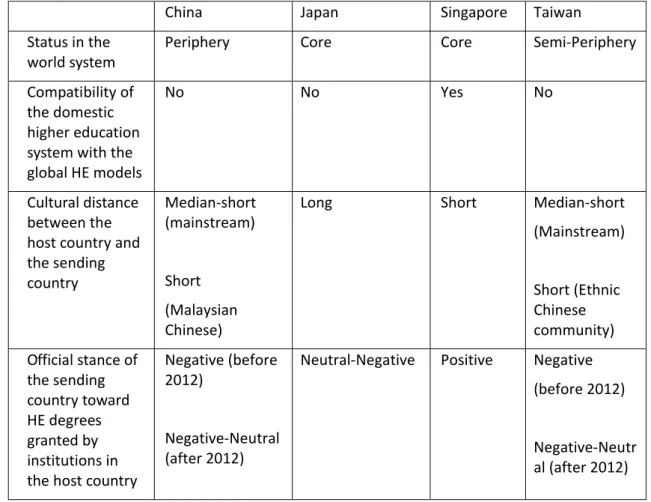
With reference to Malaysia as the base where students move out to pursue overseas education and return with overseas academic credentials and cultural knowledge, these four host countries - China, Japan, Singapore, and Taiwan - were chosen with an aim to establish a typology of transnational cultural capital in illuminating the nuances of academic credential valuation and geographies of cultural capital in the Asian region. This typology were conceptualized with four dimensions: the comparative status of the host country in the world system; the compatibility of
7
the host country’s higher education system with the global models of world-class universities, the cultural distance between the host country and the sending country, and the official stance of the sending country toward higher education degrees granted by institutions in the host country (see Table 1).
First, these four countries occupy different statuses in the world capitalist system. While Japan, Singapore and Taiwan are ahead of Malaysia in the global race of socio-economic development, China is a step behind Malaysia. For years, Japan was Asia's most powerful economy. Since mid- 1990s, however, Singapore surpassed Japan to take the lead in the region. According to International Monetary Fund (2016), in 2015 Singapore had the highest GDP per capita ($52,888) in Asia (and was 7th in the world ranking), Japan was ranked 3rd in the region (and was 25th in the world ranking) ($32,479), Taiwan was ranked 5th in the region (and was 36th in the world ranking) ($22,263), Malaysia was ranked 6th in the region (and was 64th in the world ranking) ($9,501), and China was ranked 7th in the region (and was 76th in the world ranking) ($8,141).
Second, these four countries vary in education systems and language environments. In this aspect, Singapore represents the Anglo-American prototype in Asia. Despite its multiethnic heritage and multilingual environment, Singapore is an English-speaking country with strong British and American influence on its culture and education system. On the other hand, Japan, Taiwan and China are generally monolingual (with Japanese or Mandarin Chinese as their respective dominant language) with more domestically oriented academic systems.
Third, the cultural distances between Malaysia and these societies are different. Singapore and Malaysia used to belong to the same country. Although Singapore is more cosmopolitan in comparison with Malaysia, they still share very similar cultural heritages and both adopt English as (at least one of) the official language(s). With Malaysian Chinese as the second largest ethnic group in Malaysia and the preservation of Chinese culture by Malaysian Chinese in the Malaysian society, China and Taiwan can be considered culturally proximate to Malaysia, especially to Malaysian Chinese (Ma, 2014). In view of the ethno-linguistic and cultural
8
similarities between Taiwan and the ethnic Chinese in Malaysia, the migration pattern of Malaysian Chinese students to China and Taiwan may be considered as a cultural expression of the ethnic Chinese in Malaysia (Hedberg and Kepsu, 2012). Comparatively, Japan represents a greater cultural distance from the Malaysian society.
Fourth, the Malaysian government holds different stances toward the credentials granted by HEIs in these four countries. Singapore represents one end of the spectrum, on which degrees offered by all Singaporean HEIs are recognized by the Malaysian government. Next is Japan. The degrees offered by most Japanese HEIs are officially acknowledged in Malaysia.1 In the 1980s, inspired by the Japan’s economic miracle,
the Malaysian government initiated programs to emulate from Japan's experience in development and started taking a more welcoming stance toward Japanese degrees and trainings (Ishikawa 2009, McConnell 2008). In 1981, the Malaysian government started implementing the “Look East Policy.” The Prime Minister Dato Seri Dr. Mahathir bin Mohamad attributed the remarkable development of Japan to not only its academic and technical knowledge but also to its work ethics and management capability. Therefore, he initiated this program as part of the nation-building project to send Malaysian students to Japan to learn not only knowledge and skills but also the work ethics and discipline styles.2 Upon the return of these students, what they’ve
learned in Japan will help them in contributing to the social and economic development of Malaysia (Embassy of Japan in Malaysia, n.d.).
China and Taiwan represent the third and fourth types on the spectrum. Before WWII, China was considered by many Malaysian Chinese as a destination for higher education. After WWII, however, the door from Malaya to China was closed by the colonial British government. Mainly for that reason, Nanyang University was established in southern Malaya (now Singapore) by Malaysian Chinese, led by a prominent business man Tan Lark Sye (陳六使). Those who wished to pursue higher
1 In 2016, degrees offered by 164 Japanese HEIs were recognized and authenticated by Jabatan
Perkhidmatan Awam (JPA).
2 For similar reasons, the “Look East Policy” also sends Malaysian students to Korea. (Embassy of
9
education in Chinese could choose to study at Nanyang University or to study in Taiwan.3 Malaysia and China resumed official interactions after the diplomatic tie
was reestablished in 1974, and both signed a Memorandum of Understand on Cooperation in the Field of Education (〈教育交流諒解備忘錄〉) in 1997 (Ministry of Foreign Affairs of China, 2015). Since then, the door to the HEIs in China was officially re-opened to Malaysian students, and the majority of Malaysian student population in China was Malaysian Chinese. Student mobility to China was further encouraged by another MOU signed by China and Malaysian on cooperation in education in 2009. However, the degrees granted by Chinese HEIs were not officially recognized by Malaysia until 2012, and the recognition was limited only in academic terms. Without the authentication by Jabatan Perkhidmatan Awam (JPA), Chinese degrees were not recognized in the public sector.4
Malaysian student mobility to Taiwan started in the 1950s, and the trend continued despite the end of diplomatic relationship between Malaysia and Taiwan in 1974. Due to the long history of the overseas Chinese student recruitment policy implemented by the Taiwanese government as well as the operation of the Chinese independent school system in Malaysia, Malaysian Chinese students, especially those who study in Chinese independent schools (獨立中學), are familiar with the education system in Taiwan. Similarly to the case of China, the Malaysian government did not acknowledge the degrees and diplomas granted by Chinese HEIs (with the exception of degrees granted in medicine, dentistry, and pharmacy), and this long-held policy was finally abolished only recently in August of 2012 (中央廣播電 台, 2012). Similarly to China, Taiwan's degrees are only recognized in academic terms and not authenticated by JPA. Therefore, Taiwanese degrees still cannot be accepted in the public sector in Malaysia.
3 From 1955 to 1980, Nanyang University (a.k.a. Nanta) stood the only Chinese university in the world
outside of Chinese societies. It was forced to close in 1980 by the Singaporean government, and on the campus Nanyang Technological University was established (馬來亞南洋大學校友會,2002).
4 The degrees granted by Chinese HEIs were recognized by Malaysian Qualifications Agency (Agensi,
Kelayakan Malaysia, MQA) but were not authenticated by JPA. Therefore, those with Chinese degrees still could not work in the public sector in Malaysia.
10
Table 1: A Proposed Typology of Host Countries in Generating Transnational Cultural Capital
China Japan Singapore Taiwan
Status in the world system
Periphery Core Core Semi‐Periphery
Compatibility of the domestic higher education system with the global HE models
No No Yes No
Cultural distance between the host country and the sending country Median‐short (mainstream) Short (Malaysian Chinese)
Long Short Median‐short (Mainstream) Short (Ethnic Chinese community) Official stance of the sending country toward HE degrees granted by institutions in the host country Negative (before 2012) Negative‐Neutral (after 2012)
Neutral‐Negative Positive Negative (before 2012)
Negative‐Neutr al (after 2012)
The Migration-Education Nexus in Asia
With the advent of globalization, an increasing number of universities in Asia are undergoing rapid transformations, which are manifested in the changes of universities’ structure, composition and objectives. One particular objective is internationalization, and often by means of recruiting greater numbers of international students. While the enrollment of international students in Asian universities is not a new phenomenon, the speed, scale and intensity at which this is taking place are.
Asia’s top universities also face the challenges arising from global positioning and global branding. Education brands in Asia focused mostly on building and consolidating particular kinds of national identities. However, the branding of universities is not simply limited to official rhetoric but rather circulated through interpersonal networks among current, former and potential students, those industries associated with educational mobility, and employers (Collins, 2008; Waters, 2006).
11
Certainly, students and their families utilize such imaginaries in their choices of destination but they also reproduce them as means of enhancing the cultural capital associated with qualifications after graduation. The potential for a mismatch of expectations is ever-present if brand value does not translate into positive learning experiences and outcomes for students or beneficial human and cultural capitals for alumni. This suggests a need to examine how university and national brand aspirations are translated into meaningful experiences for their international students as well as valuable international academic credentials for overseas graduates.
Moreover, education and migration have long been regarded and used as familial and sociopolitical strategies of social mobility in many Asian societies. Today, overseas education continues to be regarded as a positioning strategy to improve individual and family prospects and to contribute to the competitive advantage of nation states (Yeoh, Huang and Lam, 2005). International education also carries various symbolic connotations. Mitchell (1997) argued that international education in East Asia symbolizes the possession of more than just a credential, representing a whole host of cultural and personified traits that are essential to professional success in a global economy. Ong (1999) also pointed out the significance of a “Western university degree” in an Asian context, describing it as the “ultimate symbolic capital necessary for global mobility” (ibid, 90). Ong’s (2004) work on flexible citizenship suggests that international students studying in US universities aspire towards a transnationalized “flexible citizenship” that is characterized by hyper-mobility and the desire and potential for capital accumulation and power over others. Similarly, Waters’ (2006) study used Sklair’s (2001) definition of a transnational capitalist class (TCC) and Bourdieu’s notion of cultural capital and habitus to argue that transnational education is used as a class strategy by elites to counter moves by governments to democratize access into higher education. More needs to be done to understand how transnational education is implicated in social mobility and elite formation and consolidation in Asia.
12 Ethnic Chinese in Malaysia
Ethnic Chinese formed a significant minority group in Malaysia, constituting approximately 30 percent of the total population over the past decades (Suryadinata, 2004). Mass Chinese immigration to the Straits Settlements (Penang, Malacca, and Singapore) began in the nineteenth century as a result of both voluntary and forced migration. Since then the Chinese started to establish their own schools, business and cultural clubs, and dialect-based associations to safeguard their culture and commercial interests. By the 1920s, a Chinese community emerged in British Malaysia, and the source of its strength in maintaining Chineseness was the ties among the local ethnic Chinese, with other Chinese groups in Southeast Asia, and with those in Mainland China (Shamsul, 2004).
Wang (1970, 2001) suggested that the Chinese overseas can be divided into three groups (not including the fourth group of those who did not identify themselves as ethnic Chinese), and these three groups represented three stages of changing identities: huaqiao (overseas Chinese), huaren (ethnic Chinese), and huayi (Chinese descent). In the past, most Chinese overseas considered themselves huaqiao. They maintained links with the politics of China and identified with the destiny of China. Moreover, since both the Chinese and the British colonial government claimed Malaysian Chinese as their subjects, these Chinese often possessed dual citizenship (Shamsul, 2004). After World War II, the independent Malaysia and its subsequent nation-building challenged the local Chinese to choose their citizenship. The majority of the Malaysian Chinese took on the new Malaysian national identity, and faced the prospect of transforming their culture-based community into one that was required to pledge its loyalty to the new nation-state (Wang, 2004). Nevertheless, the drive to preserve a strong communal Chinese identity remained very strong. Consequently, the Chinese in post-war Malaysia were gradually transformed into huaren or huayi (Suryadinata, 2004). Post-war Chinese identity and Chineseness of Malaysia Chinese is in effect based on their ethic language and culture imparted mainly through education, and the Chinese schools are perceived as the custodian of Chinese language and culture in Malaysia (Shamsul, 2004; Tan, 1997). Although Malay is the
13
main teaching medium and that no access to higher learning was possible without it, students can choose to attend government-approved Chinese-language primary schools (Wang, 2001).
In addition to primary schools, there are sixty Chinese privately-funded “independent” high schools in Malaysia. The United Chinese School Committees Association of Malaysia (UCSCAM, better known as Dong Jiao Zon; 董教總) coordinates the curriculum adopted by these schools and organizes the annual Unified Examination Certificate (UEC) standardized test (UCSCAM, n.d). The diplomas of Chinese independent schools are acknowledged by domestic non-government sectors and foreign institutions, and yet they are not recognized by the Malaysian government.
Through institutional norms and systems, the Malaysian state has aimed at maintaining or even reinforcing the ethnic and cultural boundaries between the Chinese minority and the Malay majority (Freedman, 2001). It is noted that for the past forty years, Malaysia has been the only Asian country that officially discriminate against a division of its population in regards to higher education. As an act for affirmative action, a racial quota system for university admissions was set through the National Economic Policy and National Education Policy to assist the ethnic Malays (Hing, 2004). By allocating generous admission opportunities to ethnic Malay students, the policy has essentially been geared toward improving the social mobility of the country’s majority Malays over their financially dominant Chinese counterparts, an imbalance created during the British colonial period. As a result, though Chinese Malaysians account for approximately 30 percent of the country’s overall population, by some estimates they constitute less than 10 percent of the students at national universities (Cohen, 2001). Faced with deprived opportunities to enter into local universities and the expanding global market of higher education, many ethnic Chinese resort to overseas education.
For those who return, are they more likely to be recognized because of their overseas degrees, training, and languages and therefore can move upward on the ladders of socially stratified system? Or, would international credentials not sufficient
14
for these ethnic Chinese to overcome the institutional and social hurdles at home and the experiences overseas make them more alienated from the dominant Malay society? Would the credentials acquired from HEIs in different host countries vary in their transnational portability and transferability, thus affecting their “market” values in the home country after being brought back by these alumni? If so, what are the mechanisms behind the process of differentiation? These inquiries are both theoretical and empirical, and for which it is the aim of this study to find answers.
Research Questions
The objective of this study is to investigate the variation in the value and exchange of international academic credentials Malaysian Chinese students acquired from China, Japan, Singapore, and Taiwan, and how the variegation in the portability of overseas education affects the social mobility of these ethnic Chinese in Malaysia. Specifically, the proposed study aims at investigating the following questions:
1. How are the international credentials (including degrees, training, language skills and cultural knowledge) earned through overseas education in these four countries different in their values in the Malaysian society?
2. Based on the aforementioned proposed typology of transnational cultural capital, four factors pertaining to the host country are considered in examining the value and exchange of international academic credentials: the comparative status of the host country in the world system; the compatibility of the host country’s higher education system with the global models of world-class universities, the cultural distance between the host country and the sending country, and the official stance of the sending country toward higher education degrees granted by institutions in the host country. How do these four factors operate in shaping the values, as well as the portability and transferability of the values, of cultural capital accumulated through overseas education? Are there any other important factors involved?
3. For the ethnic Chinese as a minority in Malaysia, to what extent do international academic credentials affect their social mobility and class reproduction?
15
Can they rely on transnational cultural capital for upward social mobility, or are they subjected to perpetual marginalization even with overseas education?
Research Design and Methods
Based on my past experiences in conducting research on student transnational mobility and the internationalization of higher education in several Asian countries, the Principal Investigator (PI) was fully aware of the impossibility to conduct a representative alumni survey for this study. First, the responsibility to manage public relations with alumni is very often not centralized compared to the recruitment and management of international students at the university level. In Taiwan, Japan and China, the databases for international alumni are usually scattered in different departments and colleges, and the university’s alumni office usually has very limited information of international alumni. The universities in Singapore generally are more active in managing the relation with their alumni, including the international ones. However, since it is much more difficult for a university to maintain the contact information of alumni (not to mention international alumni) than of current students, the university’s data of alumni may still be outdated to a certain extent. Second, even if universities have the contact information of their international alumni, they are not willing to disclose such information to outside researchers or to help contact alumni for research unrelated to their own university objectives for confidentiality issues. Therefore, qualitative research methods would be the most feasible option to study the topic. Moreover, the examination of the life histories of Chinese Malaysian alumni would divulge the factors affecting their overseas education experiences, post-graduation migration plans and decisions, their participation in the transnational student migrant network, and the ways their international academic credentials, overseas experiences, and minority status shape their chances in social mobility at home. To serve this purpose, qualitative methods would be the best choice.
This study utilized in-depth interviewing, participant observation, and
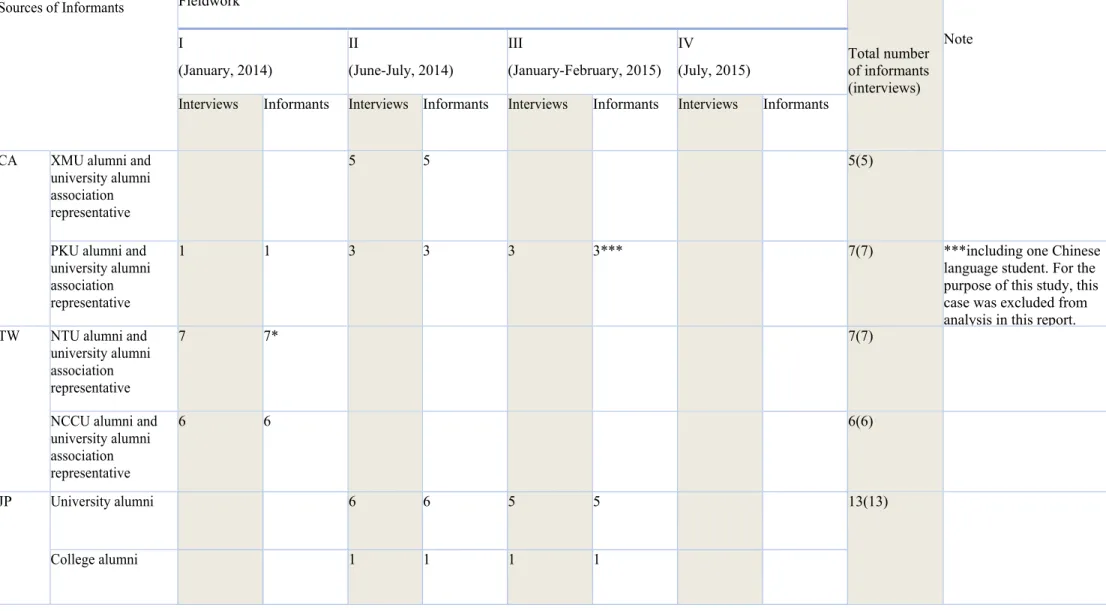
unobtrusive measures for data collection. Fieldwork was conducted from January of 2014 to July of 2015. Fifty-nine interviews were conducted with sixty-two Malaysian
16
Chinese alumni of universities in China, Japan, Singapore and Taiwan as well as relevant organizational leaders (such as alumni associations) (see Table 2). Two universities were selected in China, Taiwan and Singapore respectively: Peking University and Xiamen University in China, National University of Singapore and Nanyang Technological University in Singapore, and National Taiwan University and National Chengchi University in Taiwan. These universities were selected mainly for their academic reputation in their respective countries as well as in Malaysia. In the case of China, Xiamen University was selected for other reasons as well. First, due to the geographical expanse, Xiamen University was strategically chosen as a reputable representative among the universities in southern China to pair with Peking
University from the north. Second, it was in Fujian Province, a major sending region of overseas Chinese to Southeast Asia. To many Malaysian Chinese whose ancestors came from Fujian, it may be considered a cultural home and even a family root. Third, Xiamen University has a unique link with Malaysia. It was the first university
established in China by overseas Chinese. The funder Tan Kah Kee (陳嘉庚) was a successful Malaysian Chinese tycoon who created his business success in Malaya (now Malaysia and Singapore). Moreover, it is the first Chinese university to have a campus abroad, and its overseas campus is located in Selangor, Malaysia.5 In the case
of Japan, due to the small number of Malaysian Chinese graduates from Japanese universities and the dispersion of Malaysian Chinese students among Japanese HEIs, it was not viable to identify two universities for sampling Japanese graduates.
Therefore, Japanese graduates were not limited in their alma maters in the sampling process.
17
Table 2: The Distribution of Sample Profile of Respondents in In-Depth Interviews
Sources of Informants Fieldwork
Total number of informants (interviews) I (January, 2014) II (June-July, 2014) III (January-February, 2015) IV (July, 2015) Note
Interviews Informants Interviews Informants Interviews Informants Interviews Informants
CA XMU alumni and university alumni association representative
5 5 5(5)
PKU alumni and university alumni association representative
1 1 3 3 3 3*** 7(7) ***including one Chinese language student. For the purpose of this study, this case was excluded from analysis in this report. TW NTU alumni and
university alumni association representative
7 7* 7(7)
NCCU alumni and university alumni association representative 6 6 6(6) JP University alumni 6 6 5 5 13(13) College alumni 1 1 1 1
18 SG NUS alumni and
university alumni association representative
4 4** 4 4 8(8) **including one SG stayer.
NUS alumni and university alumni association representative
3 3 4 4** 7(7) ** including one SG stayer.
Nantah alumni and university alumni association representative
1 3 3(1) The informants went to study at Nantah at the time when Singapore was still part of Malaysia. These cases thus could not be considered as studying overseas. The data collected from this group was used as a reference and not included in the main analysis of this report. Representative of a Taiwan graduates' association in Malaysia 1 1 1(1) FAATUM Representative of a China graduates' association in Malaysia 1 1 1(1) AGUCCM Representative of a Japan graduates' association in Malaysia 1 1* 1* (1) JAGAM
* The informant was also included in the other category.
Representative of other relative organizations
1 4 4(1) Don Zong (United Chinese School Committees' Association of Malaysia) Total Number of Interviews
and Informants
23 27 19 19 12 12 4 4 62 (informants) 59 (interviews)
19
For the purpose of this study, Kuala Lumpur (KL) metropolitan area was chosen as the main field site. KL is not only the capital city of Malaysia but also contains the largest population in comparison with other cities in Malaysia. Since international graduates tend to be more cosmopolitan (Janes, 2011), KL was the ideal research site for this study. It was also learned from the early stay of fieldwork that a large Malaysian Chinese population concentrated in a nearby city Klang, and it was common to commute between KL and Klang (approximately a 40-minute drive). Therefore, some interviews were conducted in Klang as well. It was further revealed from the fieldwork that, unlike Chinese, Japanese and Taiwanese alumni who mostly returned to Malaysia, most Singaporean alumni chose to stay in Singapore after their graduation. Two interviews were thus conducted in Singapore (one with an NUS alumnus and the other with an NTU alumnus) to learn about their reasons and experiences of staying in Singapore as a reference. When the sample was drawn, field of training, gender, age, and employment status at the time of interview were taken into account. Interviews were recorded with the permission of the interviewees and later transcribed for analysis, and field notes were taken in and after interviews. Appendix 1 outlines the questions designed for in-depth interviews.
Among the sample of 62 respondents, 55 were returned graduates, 1 was a returned language learner, 2 were Singapore-trained graduates residing in Singapore, 1 was an organizational leader trained in an non-Asian country, 3 were Nanyang University graduates (see Table 2). There were a few interviewees who had received tertiary trainings from more than one of these four countries. These cases were categorized based on the country where their highest degrees were granted.
Other than in-depth interviews, participant observation and unobtrusive measures were employed to collect data on networking among intra-group and inter-group alumni (based on ethnicity, nationality, and alma mater) as well the role of international alumni associations in the Malaysian society. The PI visited the offices of the alumni associations and relevant organizations, attended official events organized by alumni associations and unofficial gatherings of alumni groups, and observed work settings of interviewees whenever possible. Relevant documents and
20
publications were collected onsite from organizations and individuals to enrich the understanding of the field data.
This study followed the guidelines of research ethics during the fieldwork to respect and protect the rights of all research participants. Grounded theory method was applied in data analysis.
Overseas Education and Market Positioning
We tried with field data to answer the first research question raised in this study: How are the international credentials earned through overseas education in these four countries different in their market values in the Malaysian society? With the field data of fifty-five returned alumni, the linkage between overseas education and market positioning was investigated. Data coding and categorization were initially conducted individually by the PI and two research staff and later triangulated and synthesized through group discussions. All but one of these fifty-five alumni from these four countries were employed or self-employed at the time of fieldwork, and that only one case had voluntarily left the labor market to fulfill family responsibilities. We compared these returned overseas graduates from these four countries in their latest occupations and types of employers at the time of interviews in order to locate their respective positions in the Malaysian labor market. Three market segments emerged from field data: the mainstream market, the niche market, and the marginalized market. The mainstream market refers to the market that produces and provides products and services that appeal and are available to the general public. It consists of the primary economy comprised mainly of major corporations in which overseas graduates were employed, and small businesses of which overseas graduates were owners. The niche market refers to a focused and targetable segment of the market, in which specific products and services were provided to the targeted audience in order to fulfill the needs and requirements not met by the mainstream market. The marginalized market refers to the market segment that is subsidiary, and employment in this segment is often unstable and has a limited (if any) prospect for promotion.
21
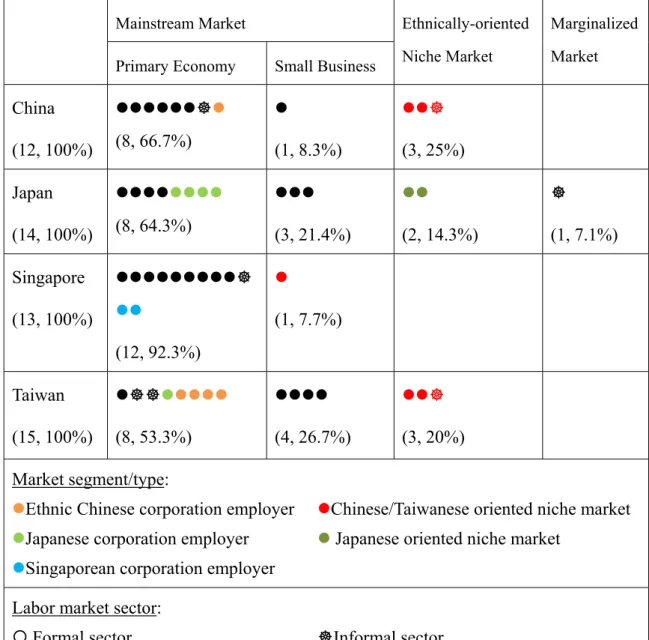
Table 3 indicates the comparison of returned graduates from these four countries in the distribution of market segments:
Table 3: Returned Graduates in the Distribution of Market Segments
Mainstream Market Ethnically-oriented Niche Market
Marginalized Market Primary Economy Small Business
China (12, 100%) (8, 66.7%) (1, 8.3%) (3, 25%) Japan (14, 100%) (8, 64.3%) (3, 21.4%) (2, 14.3%) (1, 7.1%) Singapore (13, 100%) (12, 92.3%) (1, 7.7%) Taiwan (15, 100%) (8, 53.3%) (4, 26.7%) (3, 20%) Market segment/type:
EthnicChinese corporation employer Chinese/Taiwanese oriented niche market
Japanese corporation employer Japanese oriented niche market
Singaporean corporation employer Labor market sector:
Formal sector Informal sector
Table 3 shows some important similarities and differences in the market segments in which overseas graduates from these four countries participated. In terms of similarities, the vast majority of these four groups worked in the mainstream market (from 75% to 92.3%) as well as in the formal sector (from 80% to 92.9%). Likewise, all four groups were shy away from the marginalized market. Furthermore, regardless of the country where they earned their degrees, these Asian-trained
22
overseas alumni generally were very unlikely to cross the cultural or ethnic boundary to work in a corporation that maintained cultural or economical ties, or was based in another Asian country that was not the country where they had studied. They tended to work in either international (multinational) or local businesses (or run their local businesses), or were employed by companies that had cultural and/or economic links with the countries where they had studied (for example, a Japan-trained alumnus worked at a Japanese firm). In cases which they worked in ethically-oriented niche markets, these markets either were local ones that were culturally similar to their study countries or targeted directly at their study countries. In addition, all organizations/corporations in the niche markets served as the role of a cultural, economic, or political "bridge" between Malaysia and these study countries.
The comparison also indicates different patterns of market positioning engaged by these four groups. First, the Singaporean alumni group demonstrated an overwhelmingly high concentration in the primary economy; all but one (92.3%) were employed in the primary economy, and the only exception worked in an ethnically-oriented niche market (a teacher in a Chinese high school). Second, comparing with other groups working in the mainstream market, Taiwanese alumni were least likely to work in the primary economy (53.3%) and yet most likely to run small businesses (26.7%). Third, comparing with the Japan- and Singapore-trained alumni, those returned from China and Taiwan were more likely to work in the ethnically-oriented niche market (25% and 20% respectively) that targeted specifically toward local ethnic Chinese. Fourth, among those who worked in the primary economy, Taiwanese alumni had a very high percentage (50%) working in the corporations run or owned by ethnic Chinese. The percentage of Japan-trained alumni working in the Japanese corporations were also very high; close to half (44.4%) of those who worked in the primary economy were employed by Japanese corporations. Fifth, among those who worked in ethnic or foreign organization/corporations in the mainstream market, the Japan- and Singapore-trained alumni tended to work in the organizations/corporations founded and financed by their respective study countries (e.g., founded or owned by Japanese or Singaporeans). On the other hand, the China and Taiwan-trained alumni tended to work in the organizations/corporations that were
23
locally owned and run by Malaysian Chinese. Sixth, although most of these four groups of Asian-trained overseas graduates worked in the formal sector, the Taiwanese alumni (20%) were far more likely than those returned from China (8.3%), Japan (7.1%) and Singapore (7.7%) to work in the informal sector.
Academic Training and Career Trajectory
We investigated the linkage between educational trainings and career trajectories by examining the extent to which respondents' first and latest full-time employments correspond with their disciplines in training (for the highest received degree). Again, data coding and categorization were initially conducted individually by the PI and two research staff and later triangulated and synthesized through group discussions. Fifty-six alumni from these four countries were included in this analysis.
Figure 1 illuminated the comparisons among these four groups in silhouette, and some interesting findings are noted here. First, on the spectrum of relevance between academic training and employment, the Singapore-trained graduates were located on the right end of the spectrum illustrating the highest degree of relevance between education backgrounds and field of employment; all informants’ first employments after graduation were in fields that were highly relevant to their academic trainings, and all but one informants stayed this way till their latest employments. The Japan-educated group came second, showing a similar pattern with a lesser degree of relevance between educational trainings and fields of employment. All but one informant's first jobs were highly relevant to their academic trainings. Although some informants later left behind their areas of academic trainings to work in other fields, more than half still stayed working in highly relevant fields. The China-trained group followed, nevertheless leaning somewhat toward the left end of the spectrum and illuminating a relatively low relevance between academic training and employment. Although two-third of China-trained informants initially worked in fields that were highly relevant to their academic trainings, one-third of informants’ first jobs were not related to their tertiary trainings. However, unlike the Singapore-trained and Japan-trained groups experiencing the slightly decreasing relevance between
24
academic training the employment over their career trajectories, the China-trained group demonstrated a slight increase in relevance between academic training and employment over time; more informants worked in fields that were highly related to their academic trainings in their latest jobs than in their first jobs. The Taiwan-trained group showed a pattern similar to the China-trained group and yet with a lower relevance between academic training and employment, especially at the beginning of their career trajectories. Less than half initially worked in fields that were related to their academic trainings education backgrounds, and the relevance between academic training and employment increased slightly at the later stage of their career trajectories.
These four groups further demonstrated different patterns in academic fields (Figure 1). Both the Japan-educated and Singapore-educated groups were heavily concentrated in business, finance, and engineering. Half of those who had studied in China were in humanities. The Taiwan-educated group was relatively evenly distributed in various disciplines, including business and finance, engineering, sciences, social sciences, and humanities. A closer look at those who had studied in humanities in these four groups, the ones in the China-educated and Taiwan-educated groups were mainly in Chinese studies or history, the ones in the Japan-educated group were mainly in Japanese studies, and the ones in the Singapore-educated group were mainly in Chinese studies.
25
Figure 1: Degree of relevance between overseas graduates’ educational training and employment, by study country
Note: 6: Humanities 5: Social Sciences 4: Medicine 3: Sciences 2: Engineering 1: Business and Finance
26 Factors Affecting the Transferability of Overseas "Credentials Currency"
The portability of overseas education hinges on the values ascribed to qualification and experiences earned overseas. The ascription of the values incurred from overseas education, or the exchange rate of overseas "credentials currency" at home, rest upon several factors. In this section, we will discuss how these factors affect the transferability of overseas "credentials currency".
Recognition
Whether or not overseas education and trainings can be recognized at home, and how easily and widely they are recognized, often strongly influence degree holders' employment opportunities and channels of employment. Recognition of overseas credentials involves official recognition by the home government and professional associations, and social recognition by employers and the general public at home. Recognition, especially social recognition, was not only built on the reputation of the HEI from which credentials were granted; it was also shaped by the cultural distance between home and study countries as well as the status of the study country in the strata of knowledge production in the capitalist world system.
For those who had graduated from NUS or NTU in Singapore, their degrees/diplomas were not only officially and socially recognized but considered prestigious at home. The prestige attached with their degrees was based on the perceptions that these institutions were highly competitive, and that Singapore was a more developed country. None of my interviewees encountered any difficulty in finding employment at home, though none were employed in the government sector. Many mentioned their experiences of earning special attention at job interviews, receiving recognition from colleagues and supervisors at work, and among friends and family. For example,
033: (NUS 學歷在找工作時)有很大幫助啦,而且如果你是 KL 找工作, NUS 的,我覺得 NUS 的文憑蠻值錢很好用,我那時候剛回... ... 然後有些工作就是直接看到你是 NUS 文憑直接給你 offer... 在
27
面試的當中,就說:嗯這個是 NUS 的文憑。所以就感覺到NUS
的文憑,還是蠻有價值的。
(An NUS alumnus)
001:上司他都會說:你新加坡國立大學回來的,會比較...就算我做 一點點比較好的東西,他會覺得哦,因爲我是那裏回來的,所以 我在這一方面比較好。因爲我,現在我的工作吧是要分析他們的 financial report,然後以前我是從來沒有學過這個東西的,然後我 回來這裡,我大概用了很快的時間,我就學會了,然後他就會説: 哦,no wonder因爲你是新加坡回來的,你可以學得這麽 快。...(NUS)有個很響亮的名字,就是從那個大學畢業的話, 就是説你是一個很smart的學生。... 馬:在金融界當中,新大畢業的,就你的觀察,大家的一般的評價是 怎樣? 001:是真的比較好。
(An NUS alumnus)
002:學歷其實有幫助啦我承認,因為我去的這三間剛好都是蠻名牌的 大學。我老闆也看到了,很多人都看到了,他們都覺得說誒,你 是名牌大學出來的。而且,在親戚間啊,我媽媽也有比較面子之 類的。這都是有享受到它的那個qualification。
(An NUS alumnus)
048: ...You said you were graduate from NTU, no one will question your credential.
Ma: So it's like a guarantee, like...
048: It's like a guarantee, because they know. It's such a good university... I'm talking about engineering... I'm talking about business and companies. They know all the NTU graduates can do the work. If I see an NTU, which I don't see any, none of them is coming back to work, in my firm yet. If I see any NTU, I would grab him. I would've grabbed him. And among some of my clients, some of them are from NTU, I can see. (An NTU-Singapore alumnus)
Another interviewee who had gone to Taiwan for university education and later to NTU in Singapore for his Master's study attributed the different recognition these two degrees would receive in Malaysia to the disparity in social recognition in level of study, HEI, and study country:
28 055:應該這樣子說吧,我去 NTU 的話,我做著碩士,我學著做,我老 師教我做研究的本領,這個一定的。第二個的話,至少我……ok 我還在馬來西亞現在,我告訴人家我是 XX 大學畢業的,他會覺 得 XX 大學就是...尤其是 60 歲以上的, XX 大學這個,你那時候 去 XX 大學肯定是很差勁的,才去 XX 大學。然後你只要跟他講碩 士新加坡 NTU 畢業的,那麼怎麼說?他就會覺得你一定成績很好 才去新加坡,對,因為怎樣講?因為你要在一個社會生存,你一 定要怎麼說 prepare 能夠說,怎麼說能夠滿足那個社會生態的那 個條件,然後 NTU 就是其中一個。
The experiences of the Japan-educated group demonstrated a somewhat different pattern of recognition received for their overseas credentials. Like the Singapore-educated group, none of the Japan-educated interviewee worked in the government-affiliated institutions in spite of the fact that their degrees were mostly officially recognized in Malaysia. However, most of the Japan-educated interviewees mentioned that the academic credentials and Japanese language ability they acquired from Japan, and in some cases the working experiences earned in Japan, helped them win impressions, recognition, and job opportunities especially from Japanese and in Japanese companies. An interviewee said:
Ma: When you think back, how did your degree you earned from XXX help you or did it help you in anyway?
025: I think it could have be any degree... Ma: Not necessarily from XXX?
025: No, it could have been any degree, but I appreciated the fact that it was from Japan because I think, because I could speak Japanese, I came from a good university so I could get good opportunities in Panasonic and in Kao. I was given a lot of opportunities because of who I was, what I knew, what I could do, you know. So I was always given special, what do you call the...my boss always looked at me differently.
29
Comparing with Singapore, Japan is more distant from Malaysia in terms of culture, language, and education system. Nevertheless, the transferability of the "credentials currency" acquired from Japan was high within the Japanese network because the appraisal system adopted was compatible with that in Japan. Therefore, as insiders, they could tell the "true value" of these credentials. For example, some interviewees stated that Japanese could appreciate more the degrees earned from prestigious universities in Japan:
Ma: Since both of you graduated from very prestigious universities, how do you think that your degree, did your degree help you in any way for example finding you employment, or...?
027a: Yes, especially when I came back to Malaysia, when I meet Japanese right? When they hear about my university, they were very
impressed.
Ma: So it was the same with you? 027b: Yes. I think is still important.
Ma: How about for people who graduated from like not so prestigious universities but from Japan?
027a: Uhh, because in Japan system they do not see like for example, in Malaysia here they have this CGPA system where they have the point system, in Japan they do not see that, because they have no point system, it’s just from which university you graduate.
Ma: So the university is like your nametag? 027b: Yes, correct.
(Japan-educated graduates)
Some Taiwan-educated graduates encountered the challenge on the job market for missing the official recognition at home. For a long time, the Malaysian government did not recognize the degrees and diplomas granted by Taiwanese higher education institutions with the exception of degrees granted by 18 programs in Taiwan in medicine, dentistry, pharmacy, and veterinary medicine(星洲日報,2013). The establishment of the Federation of Alumni Associations of Taiwan University, Malaysia (FAATUM) was mainly to advocate, as the official representative for all alumni association of Taiwan's universities in Malaysia, for official recognition for
30
degrees earned in Taiwan. After Malaysia joined Washington Accord in 2009 - two years after Taiwan in 2007, the Alumni Association of National Cheng Kung University of Malaysia and FAATUM took the initiative in gaining official recognition of engineering degrees granted by Taiwan's HEIs through the international accreditation system. In 2011, the Board of Engineers, Malaysia (BEM) acknowledged the recognition of engineering degrees accredited by Taiwan's engineering programs endorsed by the Institute of Engineering Education, Taiwan (IEET).6
Although the Malaysian government announced in July of 2012 that the degrees granted by Taiwanese HEIs would be recognized by Malaysian Qualifications Agency (Agensi, Kelayakan Malaysia, MQA), this recognition was only in academic terms. Except the degrees granted by the 18 programs in degrees in medicine, dentistry, pharmacy, and veterinary medicine, Taiwanese degrees have yet to be authenticated by the Public Service Department of Malaysia (Jabatan Perkhidmatan Awam Malaysia; JPA). Therefore, many of those with Taiwanese degrees still could not work in the government sector in Malaysia.
Partly due to the lack of official recognition, Taiwan was often not considered as a proper destination for overseas education. A few interviewees did mention the opposition from friends and family for their choice to study in Taiwan. For example, one interviewee explained her choice for studying in Taiwan:
007: ...衡量之下覺得,既然我出國學費比(在本地念私立大學) 便宜,而且我人又可以見識外國的文化,那我還是出國好了,對 啊。然後就是出國前其實還...怎麼說,就是跟家長在聊的時候, “喔,到台灣好像感覺不是很好。"不好的原因就是他們覺得馬 來西亞政府不承認台灣的(學歷),在那個時候啦。這只是政府 部門不承認而已,可是私人自己的都 OK,對所以就毅然去。 馬: 所以那時候家長有提醒你台灣學歷不承認的事情。 007:嗯,對!
6 BEM recognized the engieeering degrees granted after 2004 by the engineering tertiary programs
31
馬: 可是對你來講並不會阻礙你去台灣唸書。
007:嗯!對!那時候覺得說我想要跟別人不一樣,呵呵呵,我覺得就 是年少的時候,想法就覺得說:“如果我有機會可以出去的話, 那為何不出去? "
(An NCCU alumnus)
Nevertheless, all of the Taiwan-educated interviewees stated that the lack of official recognition for their Taiwan-earned degrees was not a concern either in their choice to study in Taiwan or in their job search upon return home. They were not interested in working in the government sector, and with degrees earned from Taiwan they could still work in the private sector.
011:我覺得(台灣學歷有沒有被承認)沒有差別,因爲承不承認是政 府的事情,就是因爲之前他們講什麽不承認,其實他們沒有講説 是政府不承認叻,還是說私人界不承認。其實主要的原因是政府 不承認,可是私人界承認。可是,大多數台灣回來的基本上我覺 得啦,多半都不是想要在政府企業上班。(馬:所以他們也不在 乎?)對,基本上都是在私人企業上班比較多。(馬:所以你那 時候去台灣的時候,知道台灣學歷不被承認的事嗎?)哦,這我 不懂。(馬:你不知道?)這我不懂。(馬:那你知道的時候,你 有覺得怎麽樣嗎?)我也沒有怎樣。(馬:也不會覺得怎樣啊?) 因爲我覺得那個是政府之間的事情,因爲私人企業是賺錢嘛,你 厲害我管你,我不管你是從哪裏畢業的,你只要可以給我賺錢, 我就收你,所以基本上不會影響到我。
(An NTU-Taiwan alumnus)
Although none of the Taiwan-educated interviewees worked or had wished to work in the government, many acknowledged that partly because of the lack of official recognition, the degrees they had acquired from Taiwan was not so widely recognizable and even was undervalued on the job market. One interviewee who had acquired undergraduate training in Taiwan and later received an MA degree from Harvard compared the values of these two degrees on the job market, in both Malaysia and in Singapore: