
DOI 10.1007/s11030-012-9383-0 F U L L - L E N G T H PA P E R
Novel ionic liquid supported-multicomponent reaction toward
chimeric bis-heterocycles
Chih-Hau Chen · Chan-Yu Chen · Po-Tsung Lin · Chung-Ming Sun
Received: 19 March 2012 / Accepted: 5 June 2012 / Published online: 22 June 2012 © Springer Science+Business Media B.V. 2012
Abstract A novel multicomponent reaction between IL-anchored 2-aminobenzoimidazoles, aldehydes, and electron-deficient dienophiles has been explored. The strategy was utilized to develop a rapid parallel synthesis for novel bis-heterocyclic skeleton of benzimidazole-linked dihydropy-rimidine on an ionic liquid support. This multicomponent reaction is compatible with a wide range of substrates and furnishes the new chimeric scaffolds with high purity and excellent yields. Use of the ionic liquid as a soluble sup-port facilitates purification by simple precipitation along with advantages like high loading capacity, homogeneous reaction conditions, and monitoring of the reaction progress by con-ventional NMR spectroscopy.
Keywords Multicomponent reaction· MCR · Ionic liquid support· Chimeric scaffolds · [1,5]Sigmatropic rearrangement· Benzimidazole-linked dihydropyrimidine
Introduction
Dihydropyrimidine and benzimidazole derivatives are key structural elements in many biologically active natural prod-ucts and pharmaceutical compounds. Some of those con-stitute key intermediates which have widespread applica-tions in drug discovery [1]. For instance, (R)-fluorastrol is a potent human kinesin Eg5 inhibitor by disrupting the Electronic supplementary material The online version of this article (doi:10.1007/s11030-012-9383-0) contains supplementary material, which is available to authorized users.
C.-H. Chen· C.-Y. Chen · P.-T. Lin · C.-M. Sun (
B
)Department of Applied Chemistry, National Chiao Tung University, Hsinchu 300-10, Taiwan
e-mail: [email protected]
establishment of the bipolar spindle [2]. MRS 2957 is a selective P2Y6receptor agonists for the treatment of muscle wasting and neurodegeneration [3]. Raltegravir is a potent, selective orally bioavailable HIV-integrase inhibitor [4]. The benzimidazole derivatives, ZSTK474 and compound A, display highly potent inhibitory activity again pan class I phosphatidylinositol 3-kinase (PI3K) [5] and prolylcar-boxypeptidase (PrCP) [6], respectively (Fig.1). As a conse-quence of their relevant pharmacological profile, the search for new methodologies to access bi-heterocyclic chimera is an interesting field of current research attention.
Furthermore, the integration of two privileged hetero-cyclic scaffolds into a novel core skeleton often creates unex-pected improvements on the interaction with biological tar-gets and becomes pivotal importance to discover new type of potent modulators [7,8]. Among those known methods are multicomponent reactions (MCRs) [9,10] which offer the opportunity to build up complex molecules in a fast, clean, and efficient way. This class of reaction enables the construction of molecules with great structural complex-ity with a minimum of manual operations, thereby saving time, effort, and synthetic cost. Moreover, given the cur-rent trend on the development of environmental friendly procedures, these one-pot reactions with their easy purifi-cation steps are useful alternatives to the classical stepwise approaches. Among many reported methods for the con-struction of polyheterocyclic chimera, the multicomponent reaction between aniline, aldehyde, and electron-rich olefin stood out as one of the most attractive route [11]. In spite of its versatility, many aspects of this multicomponent reaction have some limitations. For example, the range of aryl amines and dienophiles employed is relatively small since aniline and electron-rich dienophiles can only be used according to the literature. In addition, only protic or Lewis acids were applied as catalysts in all these processes [12,13]. In
Fig. 1 Heterocycles containing dihydropyrimidines and benzimidazole frameworks N N N N N O O N H2N OMe CHF2 ZSTK474 N O HN O NH2 N N Cl Cl OH N NH S (R)-fluorastrol F N H N EtO2C S F MeO N H O N N (S)-L-771688 H N O N N O OH H N O F N N O Raltegravir O Me CH3 F F A N
an effort to develop a practical approach toward the struc-tural class of benzimidazole-fused dihydropyrimidines, we envisaged a possible Lewis base-catalyzed, one pot three-component condensation of electron-deficient dienophiles with IL-anchored 2-aminobenzimidazoles.
Ionic liquids (ILs) have received considerable attention in the recent research community as the highly customizable solvents for almost any synthetic purpose [14]. Recently, ILs have attracted widespread interest as novel green reaction media and reagents for various chemical tasks due to their unique physical properties [15,16]. Aside from the homoge-neous reaction conditions and high loading capacity, ionic liquid supports have several other attractive advantages such as the reaction progress can be monitored by conventional NMR analysis. The excess amounts of reagents and byprod-ucts are removed by simple washing with low-polar organic solvents [17]. Furthermore, the high polarity and ionic char-acter of ionic-liquid support have proven to exert synergistic effects and reaction rate enhancements [18]. These advanta-geous IL features inspire that they are utilized as soluble sup-ports in organic synthesis. In this report, we present a highly efficient ionic liquid supported synthesis of novel benzimida-zole fused dihydropyrimidine derivatives catalyzed by Lewis base.
Results and discussion
3-Hydroxyethyl(1-methylimidazolium)tetrafluoroborate, as an ionic soluble support (IL), is readily available from the reaction of 1-methylimidazole and 2-bromoethanol for the exploration of current multicomponent reaction [19,20]. The IL immobilized 2-amino benzo[d]imidazole 1 was pre-pared through a four-step synthetic protocol to install the first diversity(R1) in the growing skeleton [21]. A careful
literature survey revealed that the multicomponent reaction involving aniline, aldehyde, and electron-rich olefins is usu-ally catalyzed by Lewis or Brønsted acid, such as BF3(OEt)2 [22], phosphoric acid [11] and metal triflates [23–26]. How-ever, application of Lewis or Brønsted bases as catalyst have not been explored to date. Furthermore, the presence of heavy transition metal impurities in the final products caused problem during purification [27]. The development of efficient and transition metal free processes will signif-icantly improve the synthetic process toward the assembly of chimeric heterocycles. With the IL-immobilized 2-amino benzo[d]imidazole 1a in hand, we studied the viability of the multicomponent reaction by a reaction of 1a with methyl propiolate 2 and furfural 3. IL-linked 2-aminobenzimidazole 1a was treated with aldehyde, alkyne, and piperidine in acetonitrile under reflux for 12 h. By taking advantage of the distinct solubility feature of the IL-anchored substrate, the excess amounts of reagents and the reaction byproducts are easily removed by precipitation in ether which the IL conjugate substrate is insoluble. Accordingly, IL conjugates 4 were purified and obtained in good yields after washing with diethyl ether. The progress of the ionic liquid sup-ported multicomponent reaction was directly monitored via 1H NMR spectroscopy without cleaving the intermediates from the ionic liquid support. The final coupling product was obtained, whose structure was considered as 4 according to the predicted results (Scheme1). With successful explo-ration of one pot reaction on the ionic liquid support, we tried to employ microwave irradiation on the same reaction to accelerate the reaction progress. Unfortunately, a com-plex mixture was obtained under MW. It is attributed to that the harsh reaction condition was created by the high-polar microwave absorbance medium, ionic-liquid support. More-over, the reactivities of the aldehydes also play an important
Scheme 1 Piperidine-catalyzed
one pot reaction and
[1,5]sigmatropic rearrangement O O N N R1 N R2 CO2R3 IL O O N N NH2 R1 + R2 H O O OMe IL piperidine, CH3CN reflux, 12 hrs O O N N R1 N CO2R3 IL R2 CH3ONa, MeOH r.t. 12 hrs O O N N R1 N CO2R3 R2 1 2 3 4 5 6 O O N N R1 N R2 IL CO2R3 Scheme 2 Observed by-products in multicomponent one-pot reaction
role in this multicomponent reaction. When inert aldehydes 3 were used, enamines 7 were isolated as the byproduct. In the case where furfural and thiophenecarboxaldehyde were applied, enamines 7 were the byproducts which diminished the yield of the condensed products 5 (Scheme2).
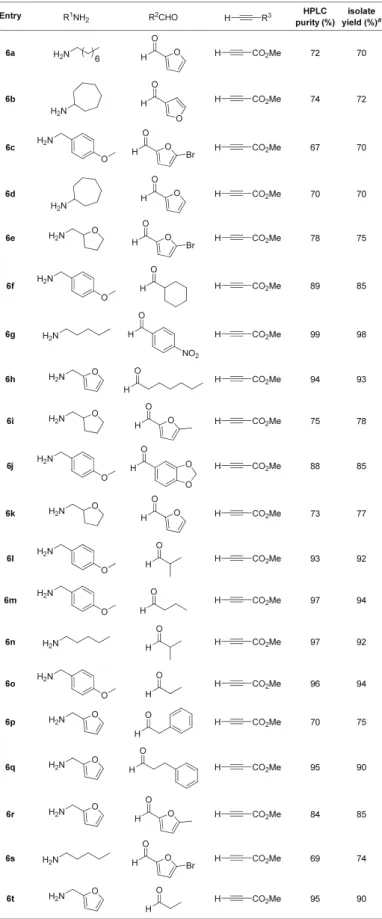
The removal of the ionic liquid support from 5a was car-ried out in sodium methoxide solution at ambient temperature in 12 hours to furnish 4,10-dihydropyrimido[1,2-a] benzimidazole derivative 6a. The cleaved IL was precipi-tated from the reaction mixture by the addition of diethyl ether and the desired products were separated by filtration. The recovered IL was recycled for future use in the synthetic process. The filtrate was concentrated and the crude final compounds were subjected to HPLC analysis. This ionic liq-uid supported multicomponent reaction afforded crude ben-zimidazole embedded dihydropyrimidines with high HPLC purity (67–99 %). Further column chromatography furnished 4,10-dihydro- pyrimido-[1,2-a]benzimidazole 6 in good to excellent yield (Table1, 70–98 %).
In addition to the spectroscopic studies, X-ray crystallog-raphy was carried out to confirm the structure and regios-electivity of the final products. To our surprise, the X-ray crystallographic revealed that the product structure is 5 instead of expected product 4. The ORTEP diagram of com-pound 6a is depicted in Fig.2. The furanyl group is linked to the C2 carbon rather than the expected C11 carbon atom. This result clearly indicates the rearrangement of the initial reaction product 4 to dihydropyrimidobenzimidazole 5. The furanyl group migrated from the C2 carbon to the C11 carbon through electronic rearrangement in the dihydropyrimidine ring system.
The putative mechanism for the piperidine-catalyzed imination of IL-conjugated 2-aminobenzoimidazoles 1 with aldehyde 3 is proposed in Scheme 3. Initially, piperidine reacted with aldehyde to form piperidinium hydroxide salt, which spontaneously reacted with 2-aminobenzoimidazoles 1 on the ionic liquid support to afford adduct A through the elimination of one equivalent of water. Finally, loss
Table 1 Reaction substrate
Fig. 2 ORTEP diagram of benzimidazolyl[1,2-a]dihydropyrimidine 6a
of piperidine from adduct A furnished imine product B [28]. Subsequently, the piperidine catalyzed cycloaddition between IL-tagged diazabutadienes B and electron deficient dienophile can proceed through a stepwise Mannich reac-tion followed by an intramolecular electrophilic aromatic substitution. The mechanism of the further rearrangement of 4 was envisioned through a series of electronic evolve-ment toward the formation of more stable conjugate system 5. Finally, the [1,5]sigmatropic transfer of aryl or alkyl group could be triggered by the electron transfer on the acrylate to form a fully conjugated stable system through stabiliza-tion of the ionic intermediate to furnish dihydropyrimido[1,2-a]benzimidazole 5.
With the successful exploration of IL-supported multi-component rearrangement reaction under basic conditions, the multicomponent reaction of IL-supported 2-aminobenzi-midazoles 1 with various aldehydes smoothly afforded the corresponding benzimidazolyl[1,2-a]dihydropyrimidine 6 with good yields after cleavage of the ionic liquid sup-port. Enamine 7 was the byproduct which reduces the yield of the condensed compounds 6. The substituents (R1) on the IL bound 2-amino benzo[d]imidazole 1 show no signif-icant effect on the yields of the multicomponent coupling reaction. This one-pot process worked well with a broad range of aldehydes to give the corresponding products in good yields. In sharp contrast to conventional multicom-ponent reaction which involves acid-catalyzed reaction of aniline, aromatic aldehydes electron-rich dienophiles, we have demonstrated the transition-metal-free, base-catalyzed multicomponent protocol can be applied to condensation of IL-bounded 2-amino benzo[d]imidazoles, electron-deficient acetylenes as well as aliphatic and heterocyclic aldehydes. In addition, ionic liquid supports allow for simple work-up procedures and straightforward protocols for products iso-lation through precipitation, particularly useful in multistep organic synthesis.
Conclusion
In summary, we have achieved the multicomponent condensation of 2-aminobenzimidazoles, aldehydes, and electron-deficient acetylenes to afford the benzimidazole fused dihydropyrimidines through novel sigmatropic rearrangement on the ionic liquid support. It is worth men-tioning that ionic liquid-supported intermediates and the ionic liquid support itself are stable during the refluxing condition and their easy purification was performed through precipitation and washings. Particularly, monitoring reaction Scheme 3 Proposed mechanism
for piperidine-catalyzed imination
progress in each step by1H NMR is feasible with the ionic liquid support attached. This novel one-pot multicomponent reaction was utilized for the efficient synthesis of biologi-cally promising novel chimeric scaffolds in high yields with excellent regioselectivity. The rapid synthesis and screening of focused combinatorial library including the union of these two privileged heterocycles will certainly provide ample opportunities to discover interesting biological activities.
General experimental methods
Methanol and acetone were distilled before use. All reactions were performed under an inert atmosphere with unpurified reagents and dry solvents. Analytical thin-layer chromatog-raphy (TLC) was performed using 0.25 mm silica gel coated plates. Flash chromatography was performed using the indi-cated solvent and silica gel 60 (230–400 mesh). All the microwave experiments were performed in a Biotage initia-tor under optimized reaction conditions of power and pres-sure.1H NMR (300 mHz) and13C NMR (75 mHz) spectra were recorded on a 300 mHz spectrometer. Chemical shifts are reported in parts per million (ppm) on the scale from an internal standard.
General procedures for synthesis of benzimidazole-fused dihydropyrimidine (6)
Aldehyde 2 (1.32 mmol, 3.0 equiv.), alkyne (0.44 mmol, 1.0 equiv.) and piperidine (0.22 mmol, 0.5 equiv.) were added to a solution of ionic liquid supported aminobenzimidazole 1 (0.20 g, 0.44 mmol) in dry acetonitrile. The reaction mixture was refluxed for 12 h. After completion, the reaction mixture was precipitated and washed (50 mL× 3) with cold ether. The precipitate was filtered and dried to furnish the IL bound ben-zoimidazotriazine 5 in quantitative yield. CH3ONa (0.01 g) was added to IL bound benzoimidazotriazine 5 (0.26 g, 0.44 mmol) in methanol (20 mL). The mixture was stirred at ambient temperature for 12 h. After completion of cleav-age in the ionic support site, the inorganic salt was removed by filtration and then filtrate was concentrated under reduced pressure. The ionic liquid was precipitated out with excess of cold ether (50 mL× 3) and removed by filtration. The fil-trate was dried and subjected to HPLC analysis which depicts high purity. The title compounds 5 were obtained in good to excellent overall yield after column chromatography purifi-cation.
Dimethyl 4-(furan-2-yl)-10-octyl-4,10-dihydropyrimido [1,2-a] benzimidazole-3,7-dicarboxylate (6a)
1H NMR (300 mHz, CDCl3)δ 8.03–7.92 (m, 3H), 7.28 (d, J = 1.8 Hz, 1H), 7.13 (d, J = 8.4 Hz, 1H), 6.55 (s, 1H), 6.39 (d, J = 3.3 Hz, 1H), 6.26 (dd, J = 3.3, 1.8 Hz, 1H), 4.08 (m, 2H), 3.94 (s, 3H), 3.72 (s, 3H), 1.87–1.76 (m, 2H), 1.43–1.20 (m, 10H), 0.87 (t, J = 6.3 Hz, 3H);13C NMR (75 mHz, CDCl3)δ 167.0, 167.0, 153.1, 150.9, 149.3, 142.9, 134.9, 129.4, 125.7, 124.7, 111.4, 110.9, 108.9, 108.2, 100.2, 52.7, 51.6, 50.2, 42.8, 32.1, 29.6, 29.5, 28.7, 27.1, 23.0, 14.4; IR (cm−1, neat): 2927, 1720, 1525; MS (EI-MS) m/z: 465 (M+); HRMS: calcd for C26H31N3O5m/z: 465.2264; Found 465.2253 (M+). Mimethyl 10-cycloheptyl-4-(furan-3-yl)-4,10-dihydropyrimido[1,2-a] benzimidazole-3,7-dicarboxylate (6b) 1H NMR (300 mHz, CDCl3)δ 7.89 (d, J =8.5Hz, 1H), 7.87 (s, 1H), 7.78 (s, 1H), 7.49 (s, 1H), 6.49 (s, 1H), 6.27 (s, 1H), 4.80 (s, 1H), 3.93 (s, 3H), 3.73 (s, 3H), 2.34–2.13 (m, 2H), 1.75–1.49 (m, 10H);13C NMR (75 m Hz, CDCl3)δ 167.1, 166.9, 150.7, 148.4, 143.9, 140.2, 133.8, 129.6, 125.6, 125.3, 124.3, 110.9, 110.2, 109.4, 102.3, 56.7, 52.7, 51.5, 48.7, 33.2, 33.0, 30.1, 27.8, 27.7, 26.0, 25.9; IR (cm−1, neat): 2927, 1718, 1518; MS (EI-MS) m/z: 449(M+); HRMS: calcd for C25H27N3O5m/z: 449.1951; Found 449.1945 (M+). Dimethyl 4-(5-bromofuran-2-yl)-10-(4-methoxybenzyl)-4,10-dihydro- pyrimido[1,2-a]benzimidazole-3,7-dicarboxylate (6c) 1H NMR (300 mHz, CDCl3)δ 7.99 (d, J =1.8Hz, 1H), 7.99 (s, 1H), 7.89 (dd, J = 8.3, 1.2 Hz, 1H), 7.31–7.25 (m, 2H), 7.06 (d, J = 8.7 Hz, 1H), 6.88 (d, J = 1.8 Hz, 1H), 6.85 (s, 1H), 6.54 (s, 1H), 6.42 (d, J = 3.3 Hz, 1H), 6.21 (d, J = 3.3 Hz, 1H), 5.29 (s, 2H), 3.94 (s, 3H), 3.78 (s, 3H), 3.76 (s, 3H); 13C NMR (75 MHz, CDCl3)δ 166.9, 159.9, 154.6, 151.2, 134.7, 129.3, 129.3, 129.2, 127.2, 126.0, 125.0, 122.5, 114.8, 112.8, 111.0, 111.3, 109.0, 99.8, 55.7, 52.7, 51.7, 50.4, 45.7; IR (cm−1, neat): 2927, 1718, 1518; MS (EI-MS) m/z: 551 (M+); HRMS: calcd for C26H22BrN3O6 m/z: 551.0692; Found 551.0693(M+). Dimethyl 10-cycloheptyl-4-(furan-2-yl)-4,10-dihydropyrimido[1,2-a] benzimidazole-3,7-dicarboxylate (6d) 1H NMR (300 mHz, CDCl3) δ 7.99 (s, 1H), 7.96 (s, 1H), 7.89 (dd, J = 8.4, 1.5 Hz, 1H), 7.28 (d, J = 1.5 Hz, 2H), 6.54 (s, 1H), 6.38 (d, J = 3.3 Hz, 1H), 6.26 (dd, J = 3.3, 1.8 Hz, 1H), 4.81 (m, 1H), 3.94 (s, 3H), 3.72 (s, 3H), 2.29–2.14 (m, 2H), 2.10–1.57 (m, 10H);13C NMR (75 mHz, CDCl3)δ 167.1, 167.0, 153.2, 150.3, 149.4, 142.9, 133.6, 129.8, 125.3, 124.3, 111.3, 110.9, 110.2, 108.9, 99.8, 56.7, 52.7, 51.6, 50.2, 33.1, 33.0, 27.8, 27.7, 26.0, 25.9; IR (cm−1, neat): 2927, 1720, 1519; MS (EI-MS) m/z: 449(M+); HRMS: calcd for C25H27N3O5m/z: 449.1951; Found 449.1948 (M+).
Dimethyl 4-(5-bromofuran-2-yl)-10-(tetrahydrofuran-2-ylm-ethyl)- 4,10-dihydropyrimido[1,2-a]benzimidazole-3,7-dicarboxylate (6e) 1H NMR (300 mHz, CDCl3)δ 7.99–7.92 (m, 3H), 7.38 (d, J = 8.4 Hz, 1H), 6.52 (s, 1H), 6.41 (d, J = 3.3 Hz, 1H), 6.20 (d, J = 3.3 Hz, 1H), 4.33 (m, 1H), 4.28 (dd, J = 14.4, 3.3 Hz, 1H), 4.16 (dd, J = 14.4, 6.0 Hz, 1H), 3.96 (s, 3H), 3,74 (s, 3H), 3.70 (m, 1H), 2.10 (m, 1H), 1.82–1.70 (m, 4H);13C NMR (75 mHz, CDCl3)δ 167.0, 166.9, 154.6, 151.3, 149.5, 135.7, 129.0, 125.9, 124.9, 122.3, 112.8, 111.5, 111.0, 110.1, 99.6, 68.8, 52.7, 51.7, 50.3, 50.3, 46.8, 29.0, 26.2; IR (cm−1, neat): 2927, 1716, 1525; MS (EI-MS) m/z: 515 (M+); HRMS: calcd for C23H22BrN3O6 m/z: 515.0692; Found 515.0690
(M+). Dimethyl 4-cyclohexyl-10-(4-methoxybenzyl)-4,10-dihydropyrimido [1,2-a]benzimidazole-3,7-dicarboxylate (6f) 1H NMR (300 mHz, CDCl3)δ 7.94 (s, 1H), 7.91–7.83 (m, 2H), 7.25 (d, J = 8.4 Hz, 2H), 7.04 (d, J = 8.4 Hz, 1H), 6.85 (dd, J = 6.9, 1.8 Hz, 2H), 5.54 (d, J = 2.7 Hz, 1H), 5.33 and 5.25 (Abq, J = 15.7 Hz, 2H), 3.95 (s, 3H), 3.80 (s, 3H), 3.78 (s, 3H), 1.97–1.40 (m, 11H);13C NMR (75 mHz, CDCl3)δ 168.0, 167.1, 159.8, 153.0, 150.5, 134.8, 130.0, 129.2, 127.5, 125.3, 124.6, 114.7, 111.2, 108.8, 101.0, 57.0, 55.7, 52.7, 51.6, 46.1, 45.5, 30.0, 27.9, 26.6, 26.6, 26.4; IR(cm−1, neat): 2927, 1718, 1516; MS (EI-MS) m/z: 489 (M+); HRMS: calcd for C28H31N3O5 m/z: 489.2264; Found 489.2276
(M+). Dimethyl 4-(4-nitrophenyl)-10-pentyl-4,10-dihydropyrimido[1,2-a] benzimidazole-3,7-dicarboxylate (6g) 1H NMR (300 mHz, CDCl3)δ 8,15 (d, J =8.7Hz, 2H), 7.89 (s, 1H), 7.92 (dd, J = 8.4, 1.2 Hz, 1H), 7.61 (d, J = 8.7 Hz, 2H), 7.55 (s, 1H), 7.17 (d, J = 8.4 Hz, 1H), 6.53 (s, 1H), 4.15 (t, J = 7.5 Hz, 2H), 3.88 (s, 3H), 3.67 (s, 3H), 1.89–1.79 (m, 2H), 1.43–1.32 (m, 4H), 0.89 (t, J = 6.9 Hz, 3H);13C NMR (75 mHz, CDCl3)δ 166.8, 166.6, 151.2, 148.6, 148.1, 148.0, 134.9, 128.9, 128.5, 126.1, 125.0, 124.5, 110.9, 108.6, 102.9, 57.0, 52.8, 51.6, 42.9, 29.2, 28.4, 22.7, 14.4; IR (cm−1, neat): 2952, 1720, 1525; MS (EI-MS) m/z: 478 (M+); HRMS: calcd for C25H26N4O6 m/z: 478.1852; Found 478.1862
(M+). Dimethyl 10-(furan-2-ylmethyl)-4-hexyl-4,10-dihydropyrimido[1,2-a] benzimidazole-3,7-dicarboxylate (16h) 1H NMR (300 mHz, CDCl3)δ 7.95 (dd, J =8.4, 1.2Hz, 1H), 7.87 (s, 2H), 7.36 (d, J = 1.2 Hz, 1H), 7.27 (d, J = 8.4 Hz, 1H), 6.41 (d, J = 3.3 Hz, 1H), 6.34 (dd, J = 3.3, 1.8 Hz, 1H), 5.70 (t, J = 4.2 Hz, 1H), 5.29 and 5.23 (Abq, J = 15.7 Hz, 2H), 3.96 (s, 3H), 3.79 (s, 3H), 1.99 (m, 1H), 1.85–1.72 (m, 3H), 1.49–1.27 (m, 2H), 1.20–1.17 (m, 2H), 0.94–0.81 (m, 2H), 0.79 (t, J = 6.6 Hz, 3H);13C NMR (75 mHz, CDCl3)δ 167.4, 167.0, 152.3, 149.9, 148.6, 143.3, 134.7, 129.4, 125.6, 125.0, 111.1, 110.5, 109.7, 109.0, 101.8, 53.3, 52.7, 51.6, 39.0, 33.1, 32.0, 29.4, 23.1, 22.8, 14.4; IR (cm−1, neat): 2927, 1720, 1520; MS (EI-MS) m/z: 451(M+); HRMS: calcd for C25H29N3O5m/z: 451.2107; Found 451.2104 (M+). Dimethyl 4-(5-methylfuran-2-yl)-10-(tetrahydrofuran-2-ylmethyl)- 4,10-dihydropyrimido[1,2-a]benzimidazole-3,7-dicarboxylate (6i) 1H NMR (300 mHz, CDCl3) δ 8.08–7.91 (m, 3H), 7.35 (d, J = 8.4 Hz, 1H), 6.48 (s, 1H), 6.26 (dd, J = 5.3, 3.2 Hz, 1H), 5.85 (d, J = 3.3 Hz, 1H), 4.37–4.26 (m, 2H), 4.12 (m, 1H), 3.95 (s, 3H), 3.89–3.63 (m, 3H), 3.73 (s, 3H), 3.50 (t, J = 5.7 Hz, 1H), 3.32 (t, J = 5.7 Hz, 1H), 2.18 (d, J = 6.3 Hz, 3H), 2.12 (m, 1H), 1.93–1.50 (8H); 13C NMR (75 mHz, CDCl3)δ 167.1, 152.7, 151.2, 149.2, 149.0, 135.8, 131.3, 129.2, 125.7, 124.7, 111.5, 109.9, 109.6, 107.0, 100.5, 68.7, 52.6, 51.6, 50.4, 46.8, 29.3, 26.1, 14.1; IR (cm−1, neat): 2927, 1718, 1525; MS (EI-MS) m/z: 451(M+); HRMS: calcd for C24H25N3O6m/z: 451.1743; Found 451.1733 (M+). Dimethyl 4-(1,3-benzodioxol-5-yl)-10-(4-methoxybenzyl)-4,10- dihydropyrimido[1,2-a]benzimidazole-3,7-dicarboxylate (6j) 1H NMR (300 mHz, CDCl3)δ 7.91 (s, 1H), 7.81 (dd, J =8.4, 1.5 Hz, 1H), 7.67 (d, J = 1.5 Hz, 1H), 7.28 (d, J = 8.7 Hz, 2H), 7.01 (d, J = 8.4 Hz, 2H), 6.85–6.90 (m, 3H), 6.73 (d, J = 7.8 Hz, 1H), 6.37 (s, 1H), 5.90 (dd, J = 7.2, 1.5 Hz, 2H), 5.30 and 5.22 (ABq, J = 15.6 Hz, 2H), 3.89 (s., 3H), 3.79 (s, 3H), 3.70 (s, 3H);13C NMR (75 mHz, CDCl3)δ 167.1, 166.9, 159.9, 151.5, 148.6, 148.0, 147.8, 135.4, 134.8, 129.5, 129.3, 127.4, 125.7, 124.8, 121.4, 114.8, 111.4, 108.8, 108.4, 107.9, 104.4, 101.6, 57.5, 55.7, 52.7, 51.5, 45.6; IR (cm−1, neat): 2927, 1720, 1520; MS (EI-MS) m/z: 527 (M+); HRMS: calcd for C29H25N3O7 m/z: 527.1693; Found 527.1697
Dimethyl 4-(furan-2-yl)-10-(tetrahydrofuran-2-ylmethyl)-4,10- dihydropyrimido[1,2-a]benzimidazole-3,7-dicarboxylate (6k) 1H NMR (300 mHz, CDCl3)δ 7.99 (d, J =1.2Hz, 1H), 7.97– 7.92 (m, 2H), 7.35 (dd, J = 8.4, 3.0 Hz, 1H), 7.28 (m. 1H), 6.56 (s, 1H), 6.40 (t, J = 3.0 Hz, 1H), 6.27 (dd, J = 3.0, 1.8 Hz, 1H), 4.40–4.25 (m, 2H), 4.10 (m, 1H), 3.94 (s, 3H), 3.88–3.65 (m, 2H), 3.73 (s, 3H), 2.10 (m, 1H), 1.94–1.72 (m, 3H);13C NMR (75 mHz, CDCl3)δ 167.1, 167.0, 153.0, 153.0. 151.3, 151.3, 149.3, 149.2, 142.9, 135.7, 135.6, 129.3, 129.2, 125.8, 124.8, 124.8, 111.2, 111.1, 109.9, 109.8, 109.0, 108.9, 100.4, 68.7, 52.7, 51.6, 50.2, 46.8, 29.3, 29.1, 26.1; IR (cm−1, neat): 2950, 1724, 1523; MS (EI-MS) m/z: 437 (M+); HRMS: calcd for C23H23N3O6 m/z: 437.1587; Found 437.1590
(M+). Dimethyl 10-(4-methoxybenzyl)-4-(propan-2-yl)-4,10-dihydro -pyrimido[1,2-a]benzimidazole-3,7-dicarboxylate (6l) 1H NMR (300 mHz, CDCl3)δ 7.96 (s, 1H), 7.90 (s, 1H), 7.86 (dd, J = 8.4, 1.4 Hz, 1H), 7.27 (d, J = 8.7 Hz, 2H), 7.04 (d, J = 8.4 Hz, 1H), 6.86 (d, J = 8.7 Hz, 2H), 5.61 (d, J = 2.7 Hz, 1H), 5.28 and 5.15 (ABq, J = 15.3 Hz, 2H), 3.94 (s, 3H), 3.79 (s, 3H), 3.78 (s, 3H), 2.26 (m, 1H), 0.90 (d, J = 6.9 Hz, 3H), 0.88 (d, J = 6.9 Hz, 3H);13C NMR (75 mHz, CDCl3)δ 168.0, 167.6, 159.8, 153.0, 150.8, 134.8, 129.9, 129.2, 127.5, 125.4, 124.6, 114.7, 111.2, 108.8, 100.5, 57.4 55.7, 52.7, 51.6, 45.5, 35.6, 19.5, 17.6; IR (cm−1, neat): 2950, 1718, 1525; MS (EI-MS) m/z: 449(M+); HRMS: calcd for C25H27N3O5 m/z: 449.1951; Found 449.1938(M+). Dimethyl 10-(4-methoxybenzyl)-4-propyl-4,10-dihydropyrimido [1,2-a]benzimidazole-3,7-dicarboxylate (6m) 1H NMR (300 mHz, CDCl3)δ 7.88 (s, 2H), 7.86 (dd, J =3.0, 1.5 Hz, 1H), 7.25 (d, J = 8.7 Hz, 2H), 7.03 (d, J = 8.7 Hz, 1H), 6.85 (d, J = 8.7 Hz, 2H), 5.72 (dd, J = 4.2, 3.0 Hz, 1H), 5.21 and 5.18 (ABq, J = 15.3 Hz, 2H), 3.94 (s, 3H), 3.79 (s, 3H), 3.76 (s, 3H), 2.10–1.90 (m, 2H), 1.77 (m, 1H), 1.48 (m, 1H), 0.80 (t, J = 7.2 Hz, 3H);13C NMR (75 mHz, CDCl3)δ 167.5, 167.0, 159.8, 152.7, 150.2, 134.8, 129.4, 129.2, 127.5, 125.5, 124.8, 114.7, 110.5, 108.9, 101.6, 55.7, 53.3, 52.7, 51.5, 45.5, 35.4, 16.7, 14.3; IR (cm−1, neat): 2952, 1716, 1529; MS (EI-MS) m/z: 449(M+); HRMS: calcd for C25H27N3O5 m/z: 449.1951; Found 449.1938(M+). Dimethyl 10-pentyl-4-(propan-2-yl)-4,10-dihydropyrimido [1,2-a] benzimidazole-3,7-dicarboxylate (6n) 1H NMR (300 mHz, CDCl3)δ 7.96 (dd, J =8.4, 1.2Hz, 1H), 7.92 (s, 2H), 7.15 (d, J = 8.4 Hz, 1H), 5.59 (d, J = 2.7 Hz, 1H), 4.19–3.95 (m, 3H), 3.97 (s, 3H), 3.78 (s, 3H), 2,20 (m, 1H), 1.85–1.73 (m, 2H), 1.30–1.25 (m, 6H), 0.89 (t, J = 6.9 Hz, 3H), 0.85 (t, J = 6.9 Hz, 3H);13C NMR (75 mHz, CDCl3)δ 168.1, 167.1, 152.7, 150.8, 135.1, 129.8, 125.3, 124.4, 111.2, 108.2, 100.2, 57.3, 52.7, 51.5, 42.6, 35.7, 29.2, 28.4, 22.7, 19.5, 17.6, 14.3; IR (cm−1, neat): 2956, 1718, 1522; MS (ESI-MS) m/z: 400 (M+H)+; HRMS: calcd for C22H29N3O4m/z: 399.2158; Found 399.2154(M+). Dimethyl 4-ethyl-10-(4-methoxybenzyl)-4,10-dihydropyrimido[1,2-a] benzimidazole-3,7-dicarboxylate (16o) 1H NMR (300 mHz, CDCl3)δ 7.91 (s, 1H), 7.87 (dd, J =6.3, 1.5 Hz, 2H), 7.25 (d, J = 8.7 Hz, 2H), 7.03 (d, J = 6.3 Hz, 1H), 6.85 (dd, J = 6.3, 1.5 Hz, 2H), 5.75 (dd, J = 4.1, 2.4 Hz, 1H), 5.24 and 5.15 (ABq, J = 15.6 Hz, 2H), 3.93 (s, 3H), 3.79 (s, 3H), 3.78 (s, 3H), 2.11 (m, 1H), 1.83 (m, 1H), 0.76 (t, J = 7.2 Hz, 3H);13C NMR (75 mHz, CDCl3)δ 167.5, 167.0, 159.8, 152.8, 150.4, 134.8, 129.4, 129.2, 127.5, 125.5, 124.8, 114.7, 110.6, 108.9, 100.8, 55.7, 53.9, 52.7, 51.5, 45.5, 25.7, 7.4; IR (cm−1, neat): 2951, 1716, 1522; MS (EI-MS) m/z: 435(M+); HRMS: calcd for C24H25N3O5 m/z: 435.1794; Found 435.1787(M+). Dimethyl 4-benzyl-10-(furan-2-ylmethyl)-4,10-dihydropyrimido [1,2-a]benzimidazole-3,7-dicarboxylate (6p) 1H NMR (300 mHz, CDCl3)δ 7.97 (dd, J =8.4, 1.5Hz, 1H), 7.77 (d, J = 1.5 Hz, 1H), 7.68 (s, 1H), 7.40–7.35 (m, 2H), 7.26 (m, 1H), 7.09 (t, J = 7.5 Hz, 1H), 6.99 (t, J = 7.5 Hz, 2H), 6.64 (dd, J = 6.9, 1.2 Hz, 2H), 6.34 (dd, J = 3.3, 1.8 Hz, 2H), 5.13 and 4.96 (ABq, J = 15.9 Hz, 2H), 3.97 (s, 3H), 3.84 (s, 3H), 3.29 (dd, J = 14.1, 3.6 Hz, 1H), 2.97 (dd, J = 14.1, 3.6 Hz, 1H);13C NMR (75 mHz, CDCl3)δ 167.4, 167.0, 151.8, 150.3, 148.5, 143.2, 136.2, 134.5, 130.0, 129.4, 128.3, 127.2, 125.7, 125.0, 111.1, 110.8, 109.8, 109.0, 101.0, 54.5, 52.7, 51.7, 38.8, 38.7; IR (cm−1, neat): 2927, 1716, 1525; MS (ESI-MS) m/z: 458 (M+H)+; HRMS: calcd for C26H23N3O5m/z: 457.1638; Found 457.1637 (M+). Dimethyl 10-(furan-2-ylmethyl)-4-(2-phenylethyl)-4,10-dihydropyrimido[1,2-a]benzimidazole-3,7-dicarboxylate (6q) 1H NMR (300 mHz, CDCl3)δ 7.95 (s, 1H), 7.91 (dd, J =8.4, 1.5 Hz, 1H), 7.83 (d, J = 1.0 Hz, 1H), 7.36 (m, 1H), 7.16
(d, J = 8.4 Hz, 1H), 7.17–7.10 (m, 3H), 6.97–6.91 (m, 2H), 6.40 (d, J = 3.3 Hz, 1H), 6.33 (dd, J = 3.3, 1.8 Hz, 1H), 5.80 (t, J = 3.3 Hz, 1H), 5.20 and 5.03 (Abq, J = 15.9 Hz, 2H), 3.95 (s, 3H), 3.81 (s, 3H), 2.81 (m, 1H), 2.57–2.31 (m, 2H), 2.20 (m, 1H); 13C NMR (75 mHz, CDCl3) δ 167.4, 167.0, 152.0, 150.4, 148.5, 143.4, 141.1, 134.6, 129.2, 128.4, 128.3, 126.0, 125.6, 124.9, 111.1, 110.5, 109.8, 108.9, 100.9, 53.2, 52.7, 51.6, 38.9, 33.2, 29.5; IR (cm−1, neat): 2949, 1716, 1529; MS (EI-MS) m/z: 471(M+); HRMS: calcd for C27H25N3O5m/z: 471.1794; Found 471.1786 (M+). Dimethyl 10-(furan-2-ylmethyl)-4-(5-methylfuran-2-yl)-4,10- dihydropyrimido[1,2-a]benzimidazole-3,7-dicarboxylate (6r) 1H NMR (300 mHz, CDCl3)δ 8.04 (d, J =1.5Hz, 1H), 7.97 (s, 1H), 7.92 (dd, J = 8.4, 1.5 Hz, 1H), 7.36 (dd, J = 1.8, 0.7 Hz, 1H), 7.25 (d, J = 8.4 Hz, 1H), 6.48 (s, 1H), 6.42 (d, J = 3.2 Hz, 1H), 6.34 (dd, J = 3.2, 1.8 Hz, 1H), 6.26 (d, J = 3.2 Hz, 1H), 5.85 (dd, J = 3.2, 0.9 Hz, 1H), 5.31 and 5.23 (ABq, J = 15.9 Hz, 2H), 3.94 (s, 3H), 3.73 (s, 3H), 2.19 (s, 3H); 13C NMR (75 mHz, CDCl3) δ 167.1, 167.0, 152.7, 151.2, 150.7, 149.0, 148.5, 143.4, 134.6, 129.5, 125.8, 125.0, 111.6, 111.1, 109.9, 109.9, 108.8, 107.0, 100.7, 52.7, 51.6, 50.5, 39.0, 14.0; IR (cm−1, neat): 2951, 1718, 1525; MS (EI-MS) m/z: 471(M+); HRMS: calcd for C24H21N3O6 m/z: 471.1794; Found 471.1786(M+). Dimethyl 4-(5-bromofuran-2-yl)-10-pentyl-4,10-dihydropyrimido [1,2-a]benzimidazole-3,7-dicarboxylate (6s) 1H NMR (300 mHz, CDCl3) δ 8.00 (s, 1H), 7.97 (d, J = 1.2 Hz, 1H), 7.96 (s, 1H), 7.16 (d, J = 8.4 Hz, 1H), 6.52 (s, 1H), 6.39 (d, J = 3.3 Hz, 1H), 6.20 (d, J = 3.3 Hz, 1H), 4.10 (t, J = 6.9 Hz, 2H), 3.96 (s, 3H), 3.74 (s, 3H), 1.87–1.78 (m, 2H), 1.41–1.31 (m, 4H), 0.91 (t, J = 6.6 Hz, 3H);13C NMR (75 mHz, CDCl3)δ 166.9, 166.9, 154.7, 150.8, 149.6, 134.9, 129.2, 125.9, 124.8, 122.4, 112.8, 111.6, 111.4, 108.4, 99.3, 52.7, 51.7, 50.3, 42.8, 29.2, 28.4, 22.7, 14.3; IR (cm−1, neat): 2929, 1720, 1525; MS (EI-MS) m/z: 501 (M+); HRMS: calcd for C23H24BrN3O5 m/z: 501.0899; Found 501.0898
(M+). Dimethyl 4-ethyl-10-(furan-2-ylmethyl)-4,10-dihydropyrimido [1,2-a]benzimidazole-3,7-dicarboxylate (6t) 1H NMR (300 mHz, CDCl3)δ 7.94 (dd, J =8.4, 1.5Hz, 1H), 7.90 (s, 1H), 7.85 (d, J = 1.5 Hz, 1H), 7.36 (dd, J = 1.8, 0.6 Hz, 1H), 7.25 (d, J = 8.4 Hz, 1H), 6.39 (dd, J = 3.3, 3.0 Hz, 1H), 6.33 (dd, J = 3.3, 1.8 Hz, 1H), 5.72 (dd, J = 3.9, 2.7 Hz, 1H), 5.27 and 5.21 (ABq, J = 15.9 Hz, 2H), 3.95 (s, 3H), 3.78 (s, 3H), 2.11 (m, 1H), 1.84 (m, 1H), 0.74 (t, J = 7.5 Hz, 3H); 13C NMR (75 mHz, CDCl3) δ 167.4, 167.0, 152.4, 150.3, 148.6, 143.4, 134.8, 129.3 125.6, 124.9, 111.1, 110.5, 109.7, 108.9, 101.1, 53.9, 52.7, 51.6, 39.0, 25.8, 7.4; IR (cm−1, neat): 2929, 1720, 1525; MS (EI-MS) m/z: 395(M+); HRMS: calcd for C21H21N3O5 m/z: 395.1481; Found 395.1492(M+).
Acknowledgments The authors thank the National Science Council of Taiwan for the financial assistance and the authorities of the National Chiao Tung University for providing the laboratory facilities. This work is particularly supported by “Center for Bioinformatics Research of Aiming for the Top University Program” of the National Chiao Tung University and Ministry of Education, Taiwan.
References
1. Fattorusso E, Taglialatela-Scafati O (2008) Modern alkaloids: str-ucture isolation synthesis and biology. Wiley, Weinheim 2. Kaan HYK, Ulaganathan V, Rath O, Prokopcov H, Dallinger
D, Kappe CO, Kozielski F (2010) Structural basis for inhibition of Eg5 by dihydropyrimidines: stereoselectivity of antimitotic inhibitors enastron, dimethylenastron and fluorastrol. J Med Chem 53:5676–5683. doi:10.1021/jm100421n
3. Maruoka H, Barrett MO, Ko H, Tosh DK, Melman A, Buri-anek LE, Balasubramanian R, Berk B, Costanzi S, Harden TK, Jacobson KA (2007) Synthesis and antiviral evaluation of 6-(alkyl-heteroaryl)furo[2,3-d]pyrimidin-2(3H)-one nucleosides and ana-logues with ethynyl, ethenyl, and ethyl spacers at C6 of the furopyrimidine core. J Med Chem 50:3897–3905. doi:10.1021/ jm070210n
4. Summa V, Petrocchi A, Bonelli F, Crescenzi B, Donghi M, Ferrara M, Fiore F, Gardelli C, Paz OG, Hazuda DJ, Jones P, Kinzel O, Laufer R, Monteagudo E, Muraglia E, Nizi E, Orvieto F, Pace P, Pescatore G, Scarpelli R, Stillmock K, Witmer MV, Row-ley M (2008) Discovery of raltegravir, a potent, selective orally bioavailable HIV-integrase inhibitor for the treatment of HIV-AIDS infection. J Med Chem 51:5843–5855. doi:10.1021/jm800245z 5. Rewcastle GW, Gamage SA, Flanagan JU, Frederick R, Denny
WA, Baguley BC, Kestell P, Singh R, Kendall JD, Marshall ES, Lill CL, Lee WJ, Kolekar S, Buchanan CM, Jamieson SMF, Shepherd PR (2011) Synthesis and biological evalua-tion of novel analogues of the pan class I phosphatidyli-nositol 3-kinase (PI3K) inhibitor 2-(difluoromethyl)-1-[4,6-di(4-morpholinyl)-1,3,5-triazin-2-yl]-1H -benzimidazole (ZSTK474). J Med Chem 54:7105–7126. doi:10.1021/jm200688y
6. Zhou C, Garcia-Calvo M, Pinto S, Lombardo M, Feng Z, Bender K, Pryor KD, Bhatt UR, Chabin RM, Geissler WM, Shen Z, Tong X, Zhang Z, Wong KK, Roy RS, Chapman KT, Yang L, Xiong Y (2010) Design and synthesis of prolylcarboxypeptidase (PrCP) inhibitors to validate PrCP as a potential target for obesity. J Med Chem 53:7251–7263. doi:10.1021/jm101013m
7. Schreiber SL (2000) Target-oriented and diversity-oriented organic synthesis in drug discovery. Science 287:1964–1969. doi:10.1126/science.287.5460.1964
8. Arya P, Chou DTH, Baek MG (2001) Diversity-based organic syn-thesis in the era of genomics and proteomics. Angew Chem Int Ed 40:339–346. doi:10.1007/s11030-010-9244-7
9. Ruijter E, Scheffelaar R, Orru RVA (2011) Multicomponent reac-tion design in the quest for molecular complexity and diversity. Angew Chem Int Ed 50: 6234–6246. doi:10.1002/anie.201006515
10. Yu J, Shi F, Gong LZ (2011) Brønsted-acid-catalyzed asymmet-ric multicomponent reactions for the facile synthesis of highly enantioenriched structurally diverse nitrogenous heterocycles. Acc Chem Res 44:1156–1171. doi:10.1021/ar2000343
11. Dagousset G, Zhu J, Masson G (2011) Chiral phosphoric acid-catalyzed enantioselective three-component povarov reaction using enecarbamates as dienophiles: highly diastereo- and enantioselec-tive synthesis of substituted 4-aminotetrahydroquinolines. J Am Chem Soc 133:14804–14813. doi:10.1021/ja205891m
12. Xie M, Chen X, Zhu Y, Gao B, Lin L, Liu X, Feng X (2010) Asymmetric three-component inverse electron-demand aza-Diels– Alder reaction: efficient synthesis of ring-fused tetrahydroquino-lines. Angew Chem Int Ed 49:3799–3802. doi:10.1002/anie. 201000590
13. Barluenga J, Mendoza A, Rodríguez F, Fañanás FJ (2010) Synthesis of spiroquinolines through a one-pot multicatalytic and multicomponent cascade reaction. Angew Chem Int Ed 47:7044– 7047. doi:10.1002/anie.200802582
14. Giernoth R (2010) Task-specific ionic liquids. Angew Chem Int Ed 49:2834. doi:10.1002/anie.200905981
15. Pârvulescu VI, Hardacre C (2007) Catalysis in ionic liquids. Chem Rev 107:2615–2665. doi:10.1021/cr050948h
16. Ni B, Headley AD (2010) Ionic-liquid-supported (ILS) catalysts for asymmetric organic synthesis. Chem Eur J 16:4426–4436. doi:10.1002/chem.200902747
17. Miao W, Chan TH (2006) Ionic-liquid-supported synthesis: a novel liquid-phase strategy for organic synthesis. Acc Chem Res 39:897–908. doi:10.1021/ar030252f
18. Song CE, Shim WH, Roh EJ, Lee SG, Choi JH, (2001) Ionic liquids as powerful media in scandium triflate catalyzed Diels– Alder reactions: significant rate acceleration, selectivity improve-ment and easy recycling of catalyst. Chem Commun 1122–1123. doi:10.1039/b101140p
19. Dzyuba SV, Bartsch RA (2002) Expanding the polarity range of ionic liquids. Tetrahedron Lett 43:4657–4659
20. Branco LC, Rosa JN, Moura Ramos JJ, Afonso CAM (2002) Preparation and characterization of new room temperature ionic liquids. Chem Eur J 8:3671–3677. doi:10.1002/1521-3765(20020816)
21. Hsiao YS, Yellol GS, Chen LH, Sun CM (2010) Multidisciplinary synthetic approach for rapid combinatorial library synthesis of triaza-fluorenes. J Comb Chem 12:723–732. doi:10.1021/ cc1000902
22. Smith CD, Gavrilyuk JI, Lough AJ, Batey RA (2010) Lewis acid catalyzed three-component Hetero–Diels–Alder (Povarov) reac-tion of N-arylimines with strained norbornene-derived dienophiles. J Org Chem 75:702–715. doi:10.1021/jo9021106
23. Batey RA, Simoncic PD, Lin D, Smyj RP, Lough AJ (1999) A three-component coupling protocol for the synthesis of substi-tuted hexahydropyrrolo[3,2-c]quinolones. Chem Commun 651– 652. doi:10.1039/A809614G
24. Kudale AA, Kendall J, Miller DO, Collins JL, Bodwell GJ (2008) Povarov reactions involving 3-aminocoumarins: synthe-sis of 1,2,3,4-tetrahydroc]coumarins and pyrido[2,3-c]coumarins. J Org Chem 73:8437–8447. doi:10.1021/jo801411p 25. Gaddam V, Nagarajan R (2008) An efficient, one-pot synthe-sis of isomeric ellipticine derivatives through intramolecular Imino–Diels–Alder reaction. Org Lett 10:1975–1978. doi:10.1021/ ol800497u
26. Vicente-García E, Catti F, Ramón R, Lavilla R (2010) Unsaturated lactams: new inputs for povarov-type multicomponent reactions. Org Lett 12:860–863
27. Sun CL, Li H, Yu DG, Yu M, Zhou X, Lu XY, Huang K, Zheng SF, Li BJ, Shi ZJ (2010) An efficient organocatalytic method for constructing biaryls through aromatic C–H. Nat Chem 2:1044– 1049. doi:10.1038/nchem.862
28. Correa WH, Edwards JK, McCluskey A, McKinnon I, Scott JL (2003) A thermodynamic investigation of solvent-free reac-tions. Green Chem 5:30–33. doi:10.1039/b210220j

![Fig. 2 ORTEP diagram of benzimidazolyl[1,2-a]dihydropyrimidine 6a](https://thumb-ap.123doks.com/thumbv2/9libinfo/7697035.144328/5.892.79.412.95.408/fig-ortep-diagram-of-benzimidazolyl-a-dihydropyrimidine-a.webp)
