Effects of Chitosan on xenograft models of melanoma in C57BL/6 mice
and hepatoma formation in SCID mice
MING-YANG YEH1,#, MING-FANG WU4,#, HUNG-SHENG SHANG5, JIN-BIOU CHANG5,6,
YUNG-LUEN SHIH7,8,9, YUNG-LIANG CHEN6, HSIAO-FANG HUNG10, HSU-FENG LU2,
CHUN YEH3, W. GIBSON WOOD11, FANG-MING HUNG12* and JING-GUNG CHUNG13*
Departments of 1 Office of Director, 2Clinical Pathology, 3Division of Gastroenterology, Cheng
Hsin General Hospital, Taipei, Taiwan, R.O.C.;
4Animal Medicine Center, College of Medicine, National Taiwan University, Taipei, Taiwan,
R.O.C.;
5Department of Pathology, National Defense Medical Center, Division of Clinical Pathology,
Tri-Service General Hospital, Taipei, Taiwan; R.O.C;
6Department of Medical Laboratory Science and Biotechnology, Yuanpei University, Hsinchu,
Taiwan, R.O.C.
7Department of Pathology and Laboratory Medicine, Shin Kong Wu Ho-Su Memorial Hospital,
Taipei Taiwan, R.O.C.
8School of Medical Laboratory Science and Biotechnology, Taipei Medical University, Taipei,
Taiwan, R.O.C.
9School of Medicine, Fu-Jen Catholic University, New Taipei City, Taiwan, R.O.C.
10Jen-The Junior College of Medicine, Nursing and Management, Miaoli County, Taiwan, R.O.C. 11Department of Pharmacology, University of Minnesota School of Medicine, and GRECC, VAMC,
Minneapolis, Minnesota, USA
12Department of Surgical Intensive Care Unit, Far Eastern Memorial hospital, Taipei, Taiwan,
R.O.C.
13Department of Biological Science and Technology, China Medical University, Taichung Taiwan,
ROC;
#Both authors contributed equally to this work *Both authors contributed equally to this work
Correspondence to: Jing-Gung Chung, Ph.D., Department of Biological Science and Technology, China Medical University. No 91, Hsueh-Shih Road, Taichung 40402, Taiwan. Tel: +886
422053366 ext. 2161, Fax: +886 422053764, e-mail: [email protected] and Dr. Fang-Ming Hung, Department of Surgical Intensive Care Unit, Far Eastern Memorial hospital, No. 21, Sec.2, Nan-Ya south Rd. Banciao 220, Taipei, Taiwan, R.O.C. e-mail: [email protected]
Abstract. The World Health Organization defined Complementary and alternative medicine
(CAM) as a comprehensive term referring to traditional medical treatments and various forms of indigenous medicine, also known as indigenous or folk medicine. Cancer patients often use CAM such as nutritional supplements, psychological techniques and natural medical approach in place of or with conventional medicine. This study determined if Chitosan would inhibit of lung metastasis and hepatoma formation using B16F10 melanoma cells in C57BL/6 mice and smmu 7721 cells in SCID mice, respectively. For the lung metastasis model, after a five-week treatment, the survival rates of B6 mice were 15% for the control group and 35%, 20%, 45% and 40% for the 320K, 173K, 86K and 8K molecule weight treatment groups, respectively. Chitosan treatment dramatically increased lifespan and it inhibited tumor metastasis especially treatment with the low molecular weight compound. For the hepatoma growth model, the size of the liver tumor mass was approximately >14 mm in the control group. In comparison with the control group, the tumor mass grew slowly with Chitosan treatment, especially at the low molecular weight treatment. Chitosan slowed the rate of tumor but did not inhibit tumor formation. These data demonstrate that Chitosan has anti-cancer effects and further study is warranted examining mechanisms and optimal dosage.
There were an estimated 12.7 million cancer cases worldwide in 2008, and of those 6.6 million cases were in men and 6.0 million in women. Total number is expected to increase to 21 million by 2030. Lung cancer is the most common cancer worldwide, contributing 1.61 million (nearly 13%) of the total number of new cases diagnosed in 2008 . Liver cancer is the sixth most common cancer in the world, with 750,000 new cases diagnosed in 2008. This accounted for about 6% of the total number of cases of cancer in 2008. Mongolia has the highest rate of liver cancer, followed by Gambia and Taiwan .
Surgery, chemotherapy, and radiotherapy are the major conventional cancer therapies. However, these therapies have numerous limitations and drawbacks: i) most cancer patients are diagnosed too late to undergo surgery or be effective; ii) most cancers have a postoperative survival rate of less than 5 years and recurrence is quite common in patients who have had a resection; iii) although chemotherapy and radiotherapy are effective against cancer, they also have serious side effects and complications (e.g. fatigue, pain, diarrhea, nausea, vomiting, and hair loss); and iv) since some cancers are relatively resistant to chemo- or radiotherapy . There is an urgent need for effective therapies or combination therapies to treat cancer. Over the past few years, use of complementary and alternative medicine (CAM) has become increasingly popular among cancer patients in Western countries with prevalence as high as 80% of patients using some form of CAM . Traditional medicine and herbal medicines in particular have been used in cancer treatment of for thousands of years in China, Japan, and other countries. These medicines are widely accepted as current forms of CAM in cancer treatment in the United States and Europe . As recent pre-clinical and clinical studies have shown, Traditional Chinese medicine (TCM) combined with conventional Western medicine (chemotherapy and radiotherapy) can provide effective supportive care for cancer patients. TCM has great advantages in terms of increasing the sensitivity of chemo- and radio-therapeutics, reducing the side effects and complications associated with chemotherapy and radiotherapy, and improving patient quality of life and survival time . Therefore, an understanding
of Chinese herbal medicines is needed by physicians and other health care providers.
Chitosan was first described by Rouget in 1859 and in 1894; and was formally named by Hoppe-Seyler . Chitosan, available largely in the exoskeletons of shellfish and insects, is a collective name for a group of partially and fully deacetylated chitin. Chitin is a linear polysaccharide consisting of β(1→4) linked N-acetyl–D -glucosamine (GlcNAc; A) residues . Deacetylation of chitin is established by boiling chitin from crab and shrimp shells in sodium hydroxide after decolorization with potassium permanganate . When the number of N-acetylglucosamine units exceeds 50%, the biopolymer is termed as chitin, whereas the term “chitosan” is used to describe an N-acetyl-glucosamine unit content less than 50% . The unique structural feature of chitosans is the presence of the primary amine at the C-2 position of the glucosamine residues. This polysaccharide is non-toxic, biocompatible and biodegradable. Chitosan has many uses either alone or in blends with other natural polymers (starch, gelatin, alginates) in agriculture, cosmetics, water treatment, medicine, environmental protection, biotechnology, functional food and the pharmaceutical industries, mainly due to its high biodegradability and antimicrobial properties . Chitosan exhibits a variety of interesting physicochemical and biological properties. Chitin is insoluble in water but chitosan is soluble in dilute aqueous acid solutions. Chitosan is digested by chitinases after oral administration. Chitinases are secreted by intestinal microorganisms and also present in plant ingredients of food, or by lysozymes . The US Food and Drug Administration approved chitosan as a feed additive in 1983. Because of its low production costs, biodegradability, biocompatibility and recent FDA approval, the pharmaceutical and food applications of chitosan have increased remarkably over recent years .
There is evidence that chitosan may have medicinal uses against asthma , cholesterol-lowering effect , antibacterial agents , ingredients in wound- dressings , vectors in gene-therapy , anti-fungal activities and reducing serum glucose levels in diabetics . Furthermore, chitosan may increase bone-strength in osteoporosis and it may inhibit the malaria Plasmodium parasites . The biological
activity of chitosan depends on different structural properties including molecular weight. The purpose of the present study was to determine if low molecular weights of chitosan were more effective in reducing tumor size as compared with high molecular weights. This hypothesis was tested in xenograft mouse models of melanoma and hepatoma.
Materials and Methods
Experimental animals and housing conditions. The studies involving mice were approved by the Institutional Animal Care and Use Committee of Chen Hsin General Hospital (Taipei, Taiwan, R.O.C.). C57BL/6 male mice and SCID male mice, specific pathogen-free and 6 weeks old, were obtained from the National Taiwan University College of Medicine Animal Medicine Center. Animals were kept in polypropylene cages (5 animals/cage) covered with metallic grids in a room maintained under constant environmental conditions, with air filter tops in a filtered laminar air flow, with an ambient temperature of 20±2˚C, relative humidity 75±15%, and a 12-h light-dark cycle. Mice were raised and cared for, given autoclaved water and fed laboratory pellet chow ad libitum following the animal procedures approved by the National Science Council of the Republic of China. Experiments were performed according to law, regulations and guidelines for animal experiments in Taiwan, which are in agreement with the Helsinki declaration.
Preparation of Chitosan with four different molecular weights. Chitosan powder with molecular weights of approximately 320K, 173K, 86K and 8K (Koyo Chemical Co., Ltd, Sakaiminato, Tottori, Japan) was obtained from the National Taiwan University College of Medicine Animal Medicine Center (Taipei, Taiwan, R.O.C.). The dose of 0.125 mg/per day/mouse was separately suspended in 0.2 mL distilled water at 50˚C for 10 min, then cooled to room temperature and stirred for 1 h.
C57BL/6 mice. B16-F10 mouse melanoma cell lines were purchased from the American Type Culture Collection (ATCC, Rockville MD, USA) and preserved by the National Taiwan University College of Medicine Animal Medicine Center. Cells were cultured in RPMI1640 medium (Gibico BRL, Grand Island, NY, USA) supplemented with 10% fetal bovine serum (FBS) plus 100 μg/ml amikacin in a 37°C humidified chamber containing 5% CO2.
Fifty-five 8-week-old C57BL/6 mice were inoculated with 5×10⁴ B16F10 cells suspended in 0.1
ml PBS into the tail vein and were then divided into 5 groups (each group consisted of 10 mice except the positive control group). The positive control group (5 mice) was killed between the 8th to 10th day to observe whether metastasis was present or not; from past experience, 10 days were needed for mice to show lung metastasis. All mice were fed with the regular diet and double distilled water. After 10-day inoculation, the positive control group was assessed for black points of needle size on the lung surface by visual inspection which was observed in the positive control group. Chitosan (molecular weights of 320K, 173K, 86K and 8K) was administered daily by oral gavage (0.125mg/per day/mouse) for 5 weeks. Lung tissue was collected and tumor lesions were scored immediately after the animals were sacrificed. The survival rate was assessed by counting the surviving mice at the end of the 5 week treatment. Survivors were sacrificed under anesthesia by CO2. We duplicated the experiment by the above procedures to the other 55 animals. The number of
melanotic nodules on each lung was counted and scored under gross examination. Tumor status was categorized into 4 scales: +, 1-12 tumor masses; ++, 13-24 tumor masses; +++, 25-36 tumor masses; ++++, more over 36 tumor masses.
Experimental design and treatment for hepatoma formation by Smmu 7721 cells in SCID mice. Mice were injected subcutaneously (s.c.) with Smmu 7721 cells (3×10⁷ cells/mouse) in the dorsal
area, while growing to 8 weeks old. Following 2-3 weeks (week 0) after the injection, mice with tumors of 1-3 mm in diameter were divided into five groups with 10 mice per group. Mice were fed
with the regular diet and double-distilled water. Chitosan at the different molecular weights was administered orally (0.125 mg/day) for 6 weeks and then surviving mice were sacrificed under anesthesia by CO2. Liver tumor status was defined by 4 sizes: +, <7 mm; ++, 7 <14 mm; +++, 14
-<21 mm; ++++, >21 mm.
Results
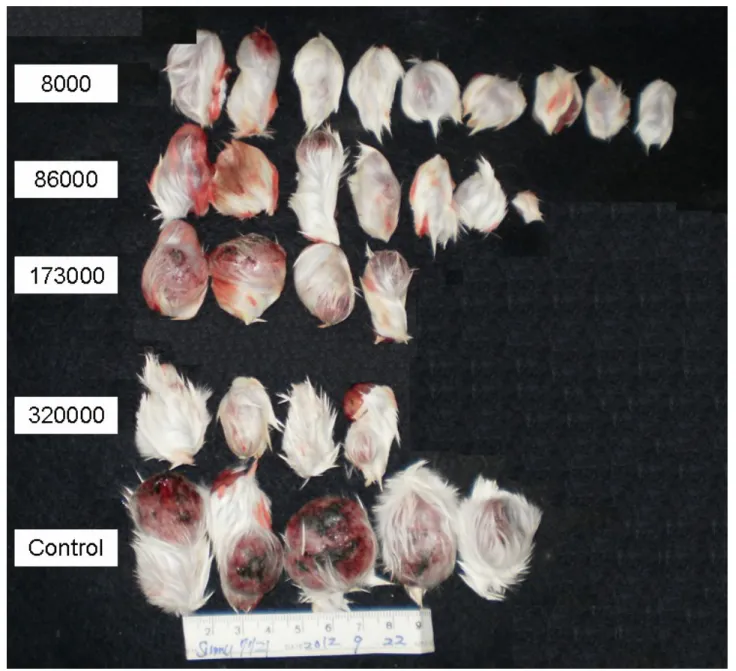
Chitosan reduces metastasis induced by B16F10 melanoma cells in C57BL/6 mice. Survivor rates improved after 5 weeks of treatment with different molecular weights of Chitosan. For the tumor metastasis model, all five mice of the indicator group formed metastases at around 10 days. Injection of B16F10 melanoma tumor cells into C57BL/6 mice induced metastasis. Chitosan treatment increased survival rates which were 15% for control mice and for the different Chitosan molecular weights: 320K 35%, 173K 20%, 86K 45% and 8K 40% (Table 1). Following 5 weeks of Chitosan administration, surviving mice were sacrificed to collect lung tissue (Figure 1). Treatment effects were dependent on the molecular weight of Chitosan. Table 2 shows the Chitosan reduced tumor mass.
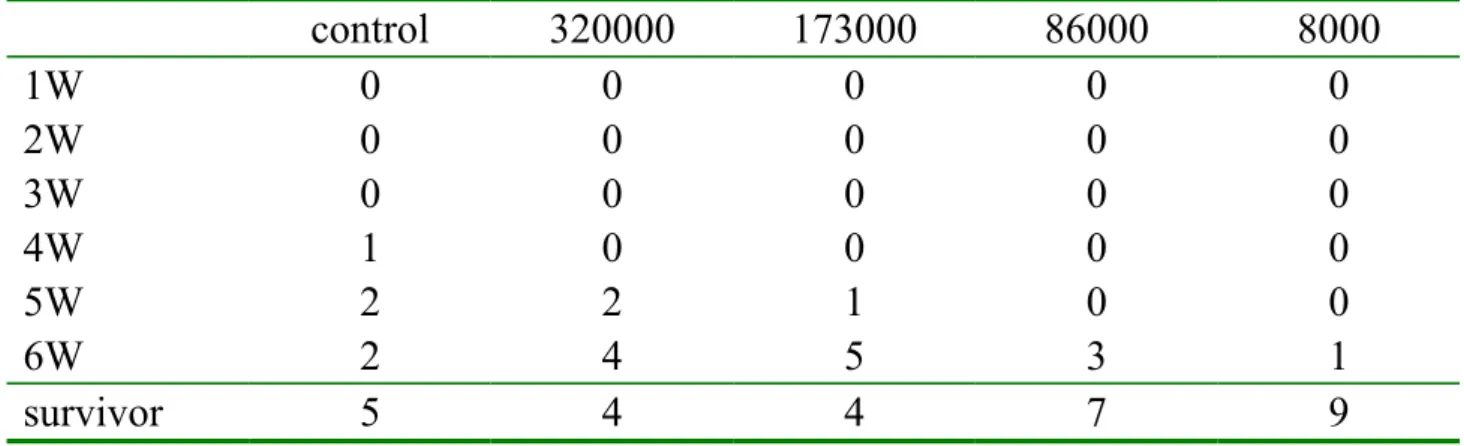
Chitosan alters hepatoma formation by Smmu 7721 cells in SCID mice. Injection of Smmu 7721 tumor cells into SCID mice induced tumors of 1-3 mm in diameter after 2-3 weeks post-injection. Hepatoma was successfully induced in 40 mice in this study. After 6 weeks of treatment, the survival rates were 50% for the control group and for the different Chitosan molecular weights: 320K 40%, 173K 40%,86K 70% and 8K 90% (Table 3). The 8K and 86K treatment groups had greater survivor rates than the higher Chitosan molecular weight groups.
Observation clearly revealed a tumor mass in the liver of the positive control group (Figure 2). Of the surviving mice in control group, all scored the highest in tumor mass (Table 4). The size of the tumor mass grew rapidly and was more than 21 mm at the end of 6 weeks post-injection. Chitosan did not inhibit tumor growth but compared with the positive control group, the tumor mass
seemed to grow more slowly among the different Chitosan molecular weight groups. Data in Figure 2 show that all four molecular weights were effective in inhibiting tumor growth especially the 8K and 86K groups. None of the surviving mice treated with 8K and 86K Chitosan scored at the highest level for tumor growth. Tumor growth may be dependent on molecular weight of Chitosan.
Disscussion
Recently, low molecular weight (LMW) chitosan has been shown to have advantages as a colloidal drug carrier due to its high water solubility, non-toxicity, biocompatibility, biodegradability, bioadhesive and absorption enhancing properties. Moreover, the potential biological activities of LMW chitosan, such as antioxidant and antitumor activities make it an ideal candidate for biomedical applications . The mechanisms of its bioactivities are poorly understood. Although activities have been reported only once or twice, providing insufficient basis to make general conclusions about the applicability of chitosan. Although numerous literatures are available on the aforementioned biological activities, the relationships of these activities with molecular weight and water-solubility of chitosan deserve to be investigated. It can be easily hypothesized that the biological properties of chitosan may be closely related to the molecular weight and water-solubility.
Chitosan has antitumor activity but there are only a few studies on B16F10 melanoma cells lung metastasis in C57BL/6 mice and hepatoma formation by smmu 7721 cells in SCID mice. The aim of the present study was to examine whether different molecular weights of Chitosan were effective against tumor-bearing mice. Chitosan has a wide spectrum of possible bioactivities .
There are some studies that reported on antitumor effects of Chitosan . The present study is the first to evaluate effects of Chitosan on inhibition of metastasis induced by B16F10 melanoma cells in C57BL/6 mice and hepatoma formation by Smmu 7721 cells in SCID mice. Chitosan reduced metastasis and tumor-growth with largest effect seen at the lower molecular weights tested. Chitosan had antitumor effects in mouse models, and our results provide the rationale for further
studies on potential mechanisms of this promising anti-cancer drug.
Acknowledgement
This study was supported by the grant CH101-02 from Cheng Hsin General Hospital.
Figure 1. The tumor mass from control and treatment of mice were inoculated with
B16F10 cells. Chitosan was daily administered orally for 5 weeks to four
experimental groups of mice. At the end of the experiments, all the survivors were
sacrificed and the number of melanotic nodules on lungs was counted and scored
under gross examination.
Figure 2. After inoculation by Smmu 7721 cells to initialize hepatoma, mice of
experimental groups were orally administered different molecular weight of
Chitosan. After 6 weeks’ treatment, all the survivors were sacrificed, and the size of
liver tumor was assessed. Low molecular weight treatment by Chitosan can evidently
reduce the tumor growth by comparison with control group.
Table 1. In the metastasis formation by B16F10 melanoma cells model, after 5
weeks’ treatment, the survival rates were 15%, 35%, 20%, 45% and 40% for the
control group, 320,000, 173,000, 86,000, 8000 molecule weight treatment groups,
individually.control
320000
173000
86000
8000
Dupli 1 Dupli 2 Dupli 1 Dupli 2 Dupli 1 Dupli 2 Dupli 1 Dupli 2 Dupli 1 Dupli 2
1W
0
0
0
0
0
0
0
0
0
0
2W
0
0
0
0
1
0
0
0
0
0
3W
1
1
1
1
1
2
1
0
0
0
4W
2
3
2
3
3
2
2
3
3
3
5W
5
5
3
3
4
3
2
3
3
3
survivor 2
1
4
3
1
3
5
4
4
4
Table 2. Data showed the score of all mice and apparently indicates that there may be
significant differences between the control group and the experimental groups.
control
320000
173000
86000
8000
Dupli 1 Dupli 2 Dupli 1 Dupli 2 Dupli 1 Dupli 2 Dupli 1 Dupli 2 Dupli 1 Dupli 2