
管理碩士畢業生的招募: 台灣與捷克的比較
160
0
0
全文
(2) .
(3) Acknowledgement First and foremost I would like to thank my thesis advisor, Professor Jin Feng Uen. Without him and his great support, guidance, and valuable comments and advices this thesis would not have been possible. Thank you one more time. You have my highest respect. Furthermore, I want to express gratitude to Martina Janská, my dearest friend, former colleague, girlfriend and also critic. Without her incentives, inspiring opinions and judgments this thesis would look completely different. She supported me not only professionally, but also personally. Thank you. I will never forget. And of course, I cannot forget those who shared with me their experiences and opinions on recruitment of recent business graduates during the interviews in both countries – František Kulvajt, Hynek Rychtář, James Ya Chen, Jessica Chang, L. C. Lewis Kuo and Joseph Chen. Thank you to all of you. It was a pleasure to meet you and talk to you. My gratitude belongs also to everyone who finished the questionnaire. It must have taken them at least 15 minutes to complete it. Time they could have spent doing something else. Time that enabled me to successfully answer the main question of this thesis. Thank you. I must also highlight the work of Tomáš Brejla, my friend, who provided me with lots of technical support during the questionnaire design and introduced me the LimeSurvey – an online tool without which I would not have been able to effectively collect answers to the questionnaires. Special thanks belong to my parents as well - for being so supportive during my whole life. Without them, nothing I achieved in my life would be possible. And finally, thank you, my beloved grand-mother and sorry that I decided to go to Taiwan. I knew that I would probably never see you again. This is for you. I will never forget you. Hope you have met grandpa in heaven..
(4) Abstract The thesis focuses on recruitment practices of recent business graduates and related issues in two countries, the Czech Republic and Taiwan. Firstly, it concentrates on what recruitment sources, such as internet job portals, job fairs and others, are popular among these particular groups acting in the labor market, and on the contrary, what sources are used by the organizations. Furthermore, the research explores what information companies advertize in their job advertisements and what information recent business graduates seek. It also tries to discover what skills, competencies and experiences Taiwanese and Czech HR professionals value and recommend graduates to have if they want to be successful in the recruitment and selection process. The importance of wants and values of recent business graduates, role of location, universities and culture is described as well. Collected data from the on-line questionnaire survey designed for companies and graduates, both from Taiwan and the Czech Republic, provided the major source of information for answering the main questions of this research. Nevertheless, several face-toface interviews with HR professionals from both countries were conducted as well. These interviews should have provided more in-depth view on the issues related to the recruitment of recent business graduates and present detailed insights based on their experiences into related practices and topics. Consequently, the thesis gives a comprehensive picture of the issues discussed above and it should help companies, and also graduates from both countries to better match mutual wants and values. The results show that currently, modern information and communication technologies significantly influence the recruitment practices. Therefore, internet job portals and companies’ websites are popular recruitment sources. Moreover, recent business graduates only seldom know what kind of job would suit them the best and thus, this factor influences their later performance at work. As a result, HR professionals recommend them to clarify it. Besides that, base salary and other financial incentives are no longer the main factors that influence graduates’ decision-making in both countries. The survey outcomes show that graduates rather seek career prospects, training and educational possibilities, and also interesting and enriching jobs. They want to be proud of what they are doing, respected by their peers and they would like to further develop themselves. Keywords: recruitment, Taiwan, Czech Republic, graduates.
(5) 摘要 本論文針對捷克與台灣兩國應屆商學院碩士畢業生的就業招募議題加以討論。首先探 討勞力市場裡最受到企業團體的歡迎的招募方式為何(如招募網站或就業博覽會), 進而再比較企業組織與畢業生雙方各自重視的招募資訊。此外本研究也將嘗試根據兩 國的人力資源專業評量來建議應屆畢業生所應擁有何種技能與經驗才能成功的在兩國 的招募與甄選過程中脫穎而出,同時在本文中亦陳述了畢業生需求與價值的重要性以 及地區、學校、文化在求職過程中所代表的角色。 本研究主要透過網路調查方式取得研究結果,並分別針對台灣與捷克的企業團體 與畢業生設計兩份問卷,同時也安排訪問兩國的人資專家。透過面訪的方式,對於應 屆商學院碩士畢業生的招募議題,人資專家依據他們的經驗提供了更詳細深入的現況 與見解。 本論文探討的結論應可連結兩國畢業生與企業主之間的需求與價值。結果顯示, 現代的資訊科技顯著的影響招募方式,因此求職入口網站以及公司網站是最受歡迎的 就業資訊來源。不僅如此,研究更顯示了應屆商學院碩士畢業生鮮少知道何種工作適 合自己,而影響了自身將來的工作表現,也因此人力資源專家建議畢業生應釐清明白 自身的需求。而在提及畢業生選擇工作的條件方面,結論發現基本薪資與獎金等金錢 誘因不再是兩國畢業生決定工作的主要因素,他們希望尋求的工作能提升自我價值、 提供豐富有意義的生涯規劃,並期望此份工作可讓他們感到驕傲與獲得同儕的肯定, 更能讓他們持續進一步的成長。 關鍵字:招募、台灣、捷克共和國、畢業生.
(6) Declaration I hereby declare that that I wrote this Masters’ thesis by myself using only the listed bibliography cited. Kaohsiung, 25th October 2008 Signature:.
(7) Recruitment of Recent Business Graduates. Table of Content 1. 2. INTRODUCTION .............................................................................................................. 1 1.1. Background .................................................................................................................. 1. 1.2. Purposes and Objectives .............................................................................................. 2. 1.3. Research Flow ............................................................................................................. 5. LITERATURE REVIEW ................................................................................................... 7 2.1. Recruitment ................................................................................................................. 7. 2.1.1. Definition ............................................................................................................. 7. 2.1.2. Recruitment Sources ............................................................................................ 9. 2.1.3. Recruitment Practices and Related Issues .......................................................... 22. 2.1.4. Wants, Values, Personnel Policies and Other Factors Influencing Recruitment of Recent Business Graduates ............................................................................ 31. 2.1.5 2.2. Taiwanese Educational System .......................................................................... 46. 2.2.2. Czech Educational System ................................................................................. 47. Influence of Culture on Recruitment Practices.......................................................... 49. 2.3.1. Insight into Taiwanese Culture .......................................................................... 51. 2.3.2. Insight into Czech Culture.................................................................................. 52. 2.4. 4. Influence of Educational Systems on Recruitment Practices .................................... 45. 2.2.1 2.3. 3. Location .............................................................................................................. 43. Concluding Remarks ................................................................................................. 53. RESEARCH METHODOLOGY ..................................................................................... 54 3.1. Questionnaires ........................................................................................................... 54. 3.2. Interviews .................................................................................................................. 59. RESULTS......................................................................................................................... 62 4.1. Recruitment Sources .................................................................................................. 62. 4.1.1. Taiwan ................................................................................................................ 62. 4.1.2. Czech Republic .................................................................................................. 63. 4.1.3. Comparison and Conclusion .............................................................................. 64. 4.2. Recruitment Practices and Related Issues ................................................................. 65. 4.2.1. Taiwan ................................................................................................................ 65. 4.2.2. Czech Republic .................................................................................................. 70. 4.2.3. Comparison and Conclusion .............................................................................. 74. 4.3. Wants, Values, Personnel Policies and Other Factors Influencing Recruitment....... 75 -I-.
(8) Recruitment of Recent Business Graduates 4.3.1. Taiwan ................................................................................................................ 75. 4.3.2. Czech Republic .................................................................................................. 78. 4.3.3. Comparison and Conclusion .............................................................................. 81. 4.4. 4.4.1. Taiwan ................................................................................................................ 82. 4.4.2. Czech Republic .................................................................................................. 84. 4.4.3. Comparison and Conclusion .............................................................................. 87. 4.5. 5. Location ..................................................................................................................... 82. Educational System ................................................................................................... 87. 4.5.1. Taiwan ................................................................................................................ 88. 4.5.2. Czech Republic .................................................................................................. 89. 4.5.3. Comparison and Conclusion .............................................................................. 91. DISCUSSION AND CONCLUSION .............................................................................. 93 5.1. Results and Implications ............................................................................................ 93. 5.2. Limitations of the Research ..................................................................................... 106. 5.3. Direction for Future Research ................................................................................. 106. 5.4. Conclusion ............................................................................................................... 107. 6. References ...................................................................................................................... 110. 7. Appendix ........................................................................................................................ 117. -II-.
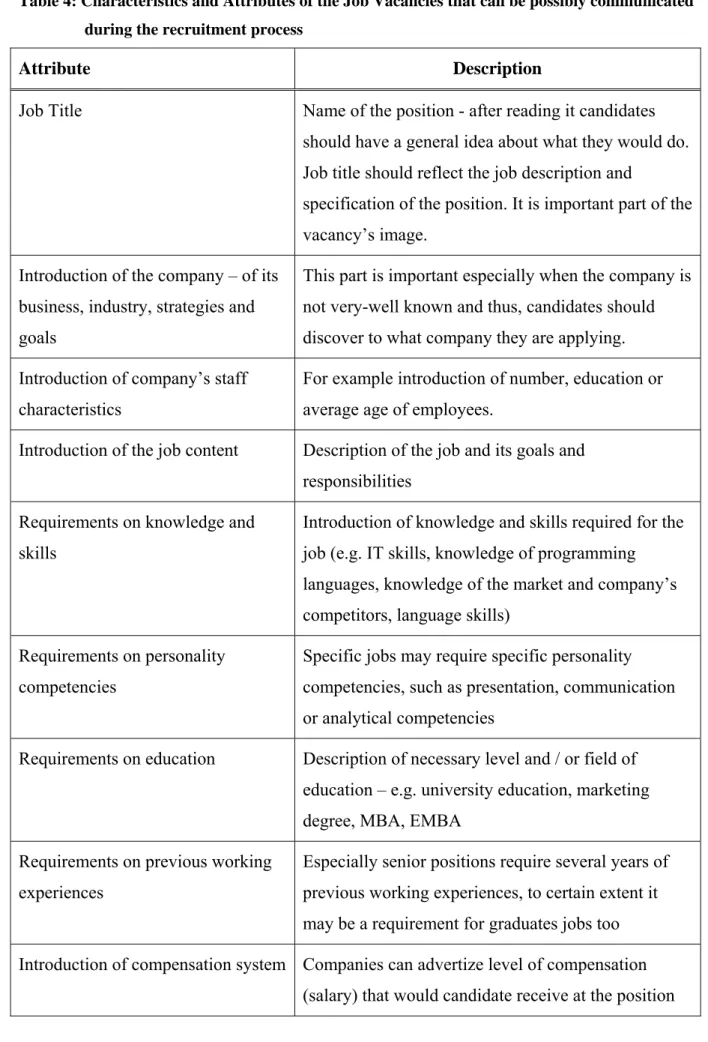
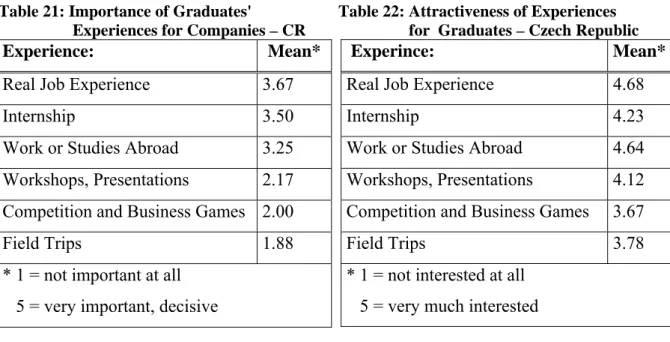
(9) Recruitment of Recent Business Graduates. List of Tables Table 1: Purposes and Objectives ……………………………………………………………..3 Table 2: Most Frequent Methods of Recent Graduates Recruitment in Czech Republic…….12 Table 3: Recruitment Sources - PROs and CONs………………………………………….... 21 Table 4: Characteristics and Attributes of the Job Vacancies that can be possibly communicated during the recruitment process……………………………………..24 Table 5: Benefits and Incentives……………………………………………………………...35 Table 6: Factors that Influence the Choice of an Employer – Graduates‘ Perspective (Czech Republic)……………………………………………………………………………39 Table 7: The GLOBE Dimensions……………………………………………………………51 Table 8: The GLOBE Project - Comparison of Taiwan and Eastern Europe………………...52 Table 9: Characteristics of Companies Participating in the Survey…………………………..59 Table 10: Recruitment Sources – Taiwanese companies..……………………………………62 Table 11: Recruitment Sources - Taiwanese graduates…………………………….………...62 Table 12: Recruitment Sources - Czech companies…………………………………………..63 Table 13: Recruitment Sources - Czech graduates…………………………………………...63 Table 14: Information presented in job advertisements by companies and their importance in graduates‘ minds – Taiwan……………………………………………………...66 Table 15: Importance of Graduates' Experiences for Companies – Taiwan………………….68 Table 16: Attractiveness of Experiences for Graduates – Taiwan……………………………68 Table 17: Experiences Offered by the Companies – Taiwan……………...………………….68 Table 18: Job-related Experiences of Taiwanese Graduates…………………………………68 Table 19: What Graduates' Characteristics Companies value – Taiwan……………………..69 Table 20: Information presented in job advertisements by companies and their importance in graduates‘ minds - Czech Republic…...………………………………………..70 Table 21: Importance of Graduates' Experiences for Companies – Czech Republic………...72 Table 22: Attractiveness of Experiences for Graduates – Czech Republic…………………..72 -III-.
(10) Recruitment of Recent Business Graduates Table 23: Experiences Offered by the Companies – Czech Republic………………………..72 Table 24: Job-related Experiences of Czech Graduates……………………………………...72 Table 25: What Graduates' Characteristics Companies value – Czech Republic…………….74 Table 26: Importance and Attractiveness of Job-related Characteristics and Attributes Taiwan……………………………………………………………………………...76 Table 27: Importance and Attractiveness of Job-related Characteristics and Attributes Czech Republic…………………………………………………………………….80 Table 28: Importance of Location for Companies – Taiwan…………………………..……..84 Table 29: Importance of Location for Graduates – Taiwan…………………………………..84 Table 30: Importance of Location for Companies – Czech Republic………………………...86 Table 31: Importance of Location for Graduates – Czech Republic…………………………86 Table 32: What skills universities develop in students – Taiwan…………………………….88 Table 33: What skills universities develop in students – Czech Republic……………………90 Table 34: Summary of the most important findings – recent business graduates…………….94 Table 35: Summary of the most important findings – companies……………………………96. -IV-.
(11) Recruitment of Recent Business Graduates. List of Figures Figure 1: Research Flow ............................................................................................................ 6 Figure 2: Three Aspects of Recruiting ...................................................................................... 8 Figure 3: The Multifaceted Nature of the Job Analysis ........................................................... 23 Figure 4: Development of Average Base Salaries of Recent Graduates, Czech Republic (in CZK) ................................................................................................................... 36 Figure 5: Factors Affecting Human Resource Management in International Markets ........... 49. -V-.
(12) Recruitment of Recent Business Graduates. 1 INTRODUCTION 1.1 Background Recruitment of recent business graduates is not as easy as it looks at first sight. Usually, recent graduates do not have a clear vision about their future career and field of interest, they are uncertain; they do not know what their strengths and weaknesses are. They can simply underestimate or on the contrary, overestimate themselves and they have little working experience. Moreover, because the recruitment process is mostly a new experience for them, they can easily feel stressed and make a mistake or a wrong choice right at the beginning of their career path. On the other hand, making the right choice is difficult not just for the recent graduates but also for the employers. Companies are spending large amounts of money to attract the best business graduates. They advertise in newspapers, on the Internet and they participate in many job fairs. In addition, after the successful recruitment and selection they need to invest in further education and initiatory basic training of the newly hired employees. Besides that, working can be very different from studying and therefore, graduates need to build up basic working habits and this process also takes time. Consequently, these situations can lead to conflicts. Recent graduates very often discover that the reality is quite different from their original expectations. Their discontent might be frequently related to the compensation, job description or to the company’s organizational culture and values. And it can very easily result into an early exit from the company during their first year. Taiwan and the Czech Republic are both relatively small countries in comparison to their close neighbors, China and Germany. Both nations have experienced oppression by stronger countries, both are still developing rapidly. At the same time, they attract lots of foreign organizations and the domestic companies are trying to expand and to be successful abroad, too. With the development, growth and internationalization of markets in Taiwan and in the Czech Republic, wants, values, skills and qualities of recent university graduates develop, too. They are aware of the international environment that surrounds them, they have highly developed computing and language skills, many of them have rich international experience and they are highly motivated to be successful in their future careers.. -1-.
(13) Recruitment of Recent Business Graduates. 1.2 Purposes and Objectives This paper closely examines recruitment and related issues in two countries, Taiwan and the Czech Republic. In addition, as it is possible to see in Table 1, it focuses at the same time on the recruitment of recent business graduates and its practices. The recruitment process often looks very similar in developed countries, but in every country there are some distinctions associated with common recruitment practices, cultural and infrastructural differences. Firstly, the research tries to describe and illustrate what recruitment sources are used for the recruitment of recent business graduates and explain the reasons why. There exist many ways how to announce a job vacancy, but not all of them have the same effect. Different sources can be used for different groups of job applicants. Consequently, the study should provide the answers on what recruitment sources are popular among recent business graduates and state the reasons of this situation. A comparison of Taiwan and the Czech Republic should also explain whether differences in culture might influence the usage of a particular recruitment source or not. Besides that, this work wants to show what information companies advertize in their job advertisements and if it corresponds to the information that graduates demand to find in the job descriptions. Providing enough relevant information about the vacancy can prevent later misunderstandings. Many recent graduates are inexperienced participants of the recruitment and selection process. They frequently do not know what they really want to do. Consequently, the research focuses also on this topic. When should graduates start looking for a job? When companies start their recruitment campaigns that focus on this group of job applicants? The study asks about the graduates’ ideas concerning their future occupations as well. One of the research objectives is also to show what skills, competencies and experiences HR professionals appreciate. Consequently, if some student who is about to graduate within several months or years read this paper, he or she could improve the most desired skills and gain the necessary experiences that might later give the student better chances to find a good job after graduation. Furthermore, this study should also discuss what the preferences and priorities of recent business graduates are when they are looking for a job. Are the salary and financial incentives the main factors that influence their decision-making or do they have different values? They can prefer interesting, enriching and creative jobs that pay less. Nevertheless, possible career prospects and international opportunities might be their main motives, too.. -2-.
(14) Recruitment of Recent Business Graduates Table 1: Purposes and Objectives. Purposes. Objectives and Methods. Description of. - find the most popular recruitment sources of companies and. Recruitment Sources used. graduates, describe why they are being used and whether they. for Recent Business. differ between Taiwan and the Czech Republic. Graduates Recruitment. - based on questionnaires, interviews and literature review - find information regarding common recruitment practices:. Description of Recruitment Practices and Related Issues. job advertisements, recruitment campaigns and their timing, ideas of graduates about their future occupation, speed of companies’ feedback to candidates’ replies, skills and competencies which Czech and Taiwanese business graduates have and which companies demand - based on questionnaires, interviews and literature review - find wants and values of business graduates in terms of job. Description of Values and Wants of Recent Business Graduates. related characteristics (compensation, training, benefits etc.) and if companies match these requirements, describe the possible differences between values of Taiwanese and Czech graduates - based on questionnaires, interviews and literature review - discover and explain the importance of location and what. Description of Location’s. factors (e.g. living conditions, level of salaries, sport and. role in Recent Business. cultural facilities, etc.) related to location influence the. Graduates Recruitment. recruitment practices of recent business graduates in Taiwan and the Czech Republic - based on questionnaires, interviews and literature review - describe the general features of Czech and Taiwanese. Explanation of Role of. educational systems and the way how they form skills and. Different Educational. knowledge of business graduates and match the requirements. Systems. of companies - based on questionnaires, interviews and literature review. Explanation of Role of Different Cultures. - find and describe how culture influences the recruitment practices in Taiwan and the Czech Republic and how it shapes the graduates’ behavior, wants and values - based on questionnaires, interviews and literature review -3-.
(15) Recruitment of Recent Business Graduates Consequently, the study should illustrate the differences in these wants and values between Taiwanese and Czech recent business graduates as well. Do they vary a lot or are they similar? And on the contrary, what are Taiwanese and Czech employers offering to recent business graduates? How are they trying to attract them? Does their offer match the graduates’ wants and preferences? These are some of the questions that this research tries to answer. In addition, one important aspect of recruitment and selection practices, not only of recent business graduates, is the location. People may favor certain places and cities which offer good quality of life, top cultural and sport facilities and a favorable natural environment and thus, select a job because of these characteristics. On the other hand, different individuals can rather sacrifice comfort in their lives for higher salary and better career prospects. Therefore, this paper will explore the importance of location and related factors in the graduates’ minds and try to find some popular towns or cities and illustrate the reasons why graduates choose those particular places. This could help companies in their recruitment efforts, but also towns and cities that are facing a drain of young well-educated people who decide to live in some other places. The research of issues related to the recent business graduates would not be complete without mentioning the educational system and the role of universities. These institutions greatly influence skills and competencies that recent graduates posses after completing their degrees. Subsequently, the research should illustrate the strengths and weaknesses in terms of graduates’ capabilities and qualifications, too. Because the study is comparing recruitment practices in two different countries, in Taiwan and in the Czech Republic, it provides a good opportunity to explain the impact of cultural factors on the recruitment process and related issues. Furthermore, the research could provide valuable information to Czech companies planning expansion to Taiwan (and to certain extent to China) and of course also to Taiwanese companies such as Foxconn or Quisda, and others that are already operating in or planning expansion of their business activities to the Czech Republic and other countries in the Central European region. Business graduates usually have very good language skills and they are not afraid of new challenges and thus, they could help these companies be profitable. However, firstly they need to be successfully attracted and hired by the company. Consequently, the results of this research, that should clarify the recruitment practices, associated topics and graduates’ wants and values, might assist companies in their effort. Results of the questionnaire survey should. -4-.
(16) Recruitment of Recent Business Graduates provide basic information for the research of this area. Afterwards, this information will be elaborated more closely during several interviews with HR professionals from both countries. In conclusion, because this work shows recruitment from both perspectives – from the companies’, but also from the graduates’ point of view, it should help both sides reveal common practices, potential conflicts and possible space for improvements and advancements. The comparison of Taiwan and the Czech Republic should show that even though the general recruitment process can look almost the same, it might be rather adjusted to local conditions and characteristics. It may reveal practices commonly used in one of the countries that are rare or completely absent in the other country, but which could help companies to attract the recent business graduates or on the contrary, assist graduates to find a better job in a country where the discovered practices are not present. Confrontation of skills and knowledge of recent business graduates can also show the strengths and weaknesses of the educational systems in these two countries and ways how to improve them, and propose what skills and what knowledge should be more developed.. 1.3 Research Flow From the chart in Figure 1 it is possible to uncover that at the beginning, it will be necessary to explain what the recruitment is and what practices and issues are related to it. Moreover, due to the comparison of two countries, Taiwan and the Czech Republic, it will be essential to introduce a cross-culture model which should help in finding differences between the above mentioned countries. Besides that, because the paper examines issues connected to recent graduates, it is important to describe also the features and characteristics of educational systems which greatly influence and form the skills and knowledge of the recent graduates. Obtained information from the outcomes of the questionnaires, completed by the graduates and HR professionals from both countries, should ensure enough relevant data to meet the previously discussed purposes and objectives. Nevertheless, interviews that follow present a deeper understanding of the recruitment of recent business graduates and attributes that affect associated practices. Moreover, conducting the interviews and analysis of their results together with the questionnaires’ outcomes should provide the foundation for the following final recommendations and conclusions.. -5-.
(17) Recruitment of Recent Business Graduates LITERATURE REVIEW. - Recruitment Sources - Recruitment Practices - Wants and Values, Personnel Policies… - Location - Educational Systems - Cultures – Taiwan and Czech Republic. RECENT GRADUATES. QUESTIONNAIRES. HR PROFESSIONALS. INTERVIEWS WITH HR PROFESSIONALS. COMPARISON AND ASSESSMENT of QUESTIONNAIRES AND INTERVIEWS RESULTS. RECOMMENDATIONS AND CONCLUSIONS Figure 1: Research Flow. -6-.
(18) Recruitment of Recent Business Graduates. 2 LITERATURE REVIEW Companies have their own visions, values, goals and strategies which they want to achieve. For example Société Générale (SG), one of the largest international banking groups, describes on its website (Socgen, 2007) that it values professionalism, team spirit and innovation. They want to assist individuals in reaching their goals, want to be perceived as a trusted partner in the development of companies, towns and regions. And the success of long-term growth policy relies on their values. Regarding the company’s strategy, their focus is on a balanced business mix, operating efficiency and long-term growth. However, behind all these issues there are people - people with different skills, different ideas and different styles of behavior. And it is up to the managers and HR specialists to balance it. HR strategy needs to be in accordance with the general strategy of the company. It is one of the key requirements for success and growth. Therefore, companies must look for employees who could help them to achieve their targets; they must realize the right balance of talents (Stedt, 2006). When incompetent people are hired in the wrong position, sooner or later they will become unmotivated and careless about the company’s goals. Consequently, organizations can very easily founder and eventually fail. The philosophy of talent balancing is quite simple. Companies need to find the right people, with the right skills for the right job. Recruitment has a significant role in this process. Afterwards, the organizations must use employees’ talents to meet personal and corporate goals and provide proper leadership. It is a dynamic process that works in all industries (Jackson & Mathis, 2007).. 2.1 Recruitment 2.1.1 Definition DeCenzo and Robins (2005) define recruitment as a process of discovering potential candidates for actual or anticipated organizational vacancies. From the other perspective, recruitment can be seen as a linking activity that brings together those with jobs to fill and those seeking jobs. Moreover according to Noe, Hollenbeck, Gerhart and Wright (2004), it creates a buffer between planning and actual selection of new employees. Jackson and Schuler (2003) complete the definition by saying that recruitment stops short of making decisions about which particular applicants should be hired. Recruitment is only a part of the hiring process and it is usually followed by the process of selection – interviews, reference checks, assessment centers, logical, psychological and other various sorts of tests that are all part of the selection process. -7-.
(19) Recruitment of Recent Business Graduates Noe, Hollenbeck, Gerhart and Wright (2004) also introduce three aspects that influence recruitment: personnel policies, recruitment sources and recruiter traits and behaviors (see Figure 2). These attributes affect the organization’s approach towards recruiting and at the same time define what sorts of applicants are attracted to apply for a job with the organization.. Personnel Policies. Recruitment Sources. Recruiter Traits and Behaviors. Vacancy Characteristics. Applicant Characteristics. Job Choice Figure 2: Three Aspects of Recruiting Source: Noe, Hollenbeck, Gerhart & Wright (2004). In the case of recruitment of recent business graduates, the graduates are there, they are looking for the job. However, it is frequently quite a new experience for them and thus, they are very often stressed and nervous. Consequently, the process of graduate recruitment should focus especially on three issues: where to find the best graduates, how to get their interest and what information and image the company should advertize in order to attract the right pool of applicants. Besides that, recruitment does not create the demands for new people, a company’s managers from different departments express their wishes for new employees and define the company’s needs and wants. Neither the goal of the recruitment is to select the right employee for the managers - recruitment is only one part of this ‘human supply chain’.. -8-.
(20) Recruitment of Recent Business Graduates. 2.1.2 Recruitment Sources Every job vacancy needs to be announced in some way, thus, someone can apply for it, a company can receive answers from job candidates and choose the best and the most suitable one for the advertized job. Consequently, the main goal of many companies is frequently not only to attract as many job candidates as possible, but to attract the most suitable candidates in order to find someone who will really help the company to achieve its goals. Sometimes it is possible to speak about personnel marketing. Nevertheless, instead of marketing and selling the products or services, in this case organizations are marketing and selling jobs. And there are several ways how to do it. •. Internal Search. In Jackson’s and Schuler’s opinion (2003) different methods may reach different types of applicants. Firstly, many companies post job announcements on their bulletin boards. This is called internal labor market and it is a good way how to recruit one’s own employees. However, organizations usually do not use this way to attract recent graduates, because only the people who are with the company are able to see the job announcement and apply for it. Therefore, the students would need to have some kind of relation with the company (e.g. internship or part-time job) in order to be able to discover it. Nevertheless, if the company provides either internships or part-time jobs for students, it has a good chance to find out whether these students are capable and have the right qualifications to work for the company. Consequently, it is much easier for the firm to hire them. On the other hand it is also easier for the graduates. If they worked during their studies for the company, they know the organization’s environment, culture and people and they are used to work. As a result, the transition from a student to a full-time employee is not so difficult for them and they can easily fit in. Moreover, according to DeCenzo and Robbins (2005), internal search is at the same time less costly than going outside to recruit. It is faster, it builds morale and it encourages good individuals who are ambitious. Besides that, it improves the probability of a good selection, because information on the individual’s performance is readily available. Nevertheless, if the company uses just internal recruiting, it can very easily lose the opportunity to bring new knowledge, ideas and skills to the company. Consequently, organizations should seek a balance between internal and external recruiting.. -9-.
(21) Recruitment of Recent Business Graduates Companies from the Czech Republic frequently offer part-time or summer jobs to students. Usually these jobs have mainly supportive (administrative) function and are not very well paid. Nevertheless, due to these jobs students can obtain very valuable working experience that can help them very much afterwards when they are seeking the first job after their graduation. With reference to the research conducted by students of the University of Economics in Prague (Bohm, Dolezal, Mruz & Sabo, 2008), working experiences are really important when recent business graduates are applying for a job in the Czech Republic. According to the feedback from companies, graduates’ experiences show that they are proactive, systematic and goal-seeking. And consequently in the Czech Republic, working experiences may be more decisive in recruitment and selection process of recent business graduates than good grades or the excellent reputation of the university. One of the Czech companies that applies the internal search for the recruitment of recent graduates is Unicorn - the most successful, purely Czech software development company founded and run by Vladimir Kovar. The organization hires students mainly of information technology related majors for part-time jobs (linked to IT or administration), provides them with intensive training and lets them work on the company’s projects. On one hand their salary is not so high; on the other hand, thanks to their work in Unicorn, students are able to obtain very valuable knowledge and maybe even more valuable working experience. After the student’s graduation, Unicorn managers will decide whether they will offer the recent graduate, who has usually worked for the company for several years and therefore knows the company’s culture and procedures very well, a full-time job or whether they will let him go. If Unicorn decides to hire such a person, this individual will usually become a senior employee and has a chance to move to IT management (e.g. project management) or business (e.g. sales and marketing) positions. Moreover in 2007, Vladimir Kovar decided to open Unicorn College, a private university that would help to develop top professionals for technical and business positions related to information and communication technologies. This move can be also considered as an effort to apply a certain kind of internal search. Instead of a company’s employees, Unicorn can directly hire students and graduates from its own university who previously proved their skills and competencies during their studies (Unicorn, 2007). •. Employee Referrals and Recommendations (word-of-mouth). Noe, Hollenbeck, Gerhart and Wright (2004) define employee referrals as a process when people apply for a vacancy because someone in the organization prompted them to do so. Moreover DeCenzo and Robbins (2005) explain that referrals and recommendations are one -10-.
(22) Recruitment of Recent Business Graduates of the best recruitment sources when companies want to find individuals who will perform effectively on the job. In their opinion there are several reasons for that: “Employees would rarely recommend someone unless they believe the individual can perform adequately”. If the employee recommended someone who would completely fail, his own reputation and prospects would be at stake. Therefore, employees tend to refer people who are, according to them, really good and who have the suitable skills and competencies for the job vacancy. In addition, companies sometimes give financial or other incentives and special bonuses in order to motivate their employees to recommend possible job candidates. Nevertheless this approach is beneficial also for the candidates. The recommender will usually give them more realistic information and a more detailed picture about the job, workplace, colleagues and the company. And as the employees feel obliged to their employer to only recommend suitable candidates, they frequently feel maybe even more obliged to the people who they are recommending. Because by recommending the wrong job or company to people who they know, they can very easily lose their friendship and reputation (DeCenzo & Robbins, 2005). Jackson and Schuler (2003) explain that employee referrals and recommendations is a very low-cost approach. Nevertheless, there exist several threats related to this way, too. A potential disadvantage of referrals is that employees tend to refer others who are similar in age, gender, ethnicity and religion. And subsequently, like in the case of internal search, the organizations are not able to achieve diversity in people and their skills, competencies, ideas and opinions. Moreover, DeCenzo and Robbins (2005) explain that using referrals and recommendations can be extremely useful especially when the companies are searching for employees in hard-to-fill positions – e.g. IT professionals, engineers or nurses. Logos, another Czech company that focuses on IT services, offers interesting incentives to their employees for recommending job candidates. If the job candidate is successfully hired, the employee, who provided the reference, will receive a very high financial amount which furthermore depends on the seniority of the newly hired professional. Other examples can be seen in the activities of the Czech private recruitment agency called Talents Technology. When the company is not able to fill a certain job vacancy, it will even offer some incentives to the general public. The individual recommending the job candidate, who must be later successfully hired for the job, will receive some gift – e.g. iPod.. -11-.
(23) Recruitment of Recent Business Graduates •. Direct (walk-in) Applicants. People can have certain preferences for products made by a particular company, for example cell phones by Nokia or cars by Volkswagen. And the same kind of behavior can be frequently found in the case of job choice, too. It might happen that the job candidate has a company where he or she would prefer to work. All around the world Google is very often perceived as a good company to work for. This case will be also discussed later, in the following part of the thesis. In the Czech Republic, Komerční banka has been chosen as the most desired company of students for several years in a row (Zamestnavatel roku, 2007). In Taiwan IBM, Uni-President or TSMC are examples of companies of choice (China Post, 2005a). Therefore, these companies have a high probability of attracting direct applicants. Jackson and Schuler (2003) explain that such candidates may be motivated by an advertisement indicating that the company is recruiting, or they may simply have a good impression of the organization and want to explore the opportunity of working there. Furthermore Noe, Hollenbeck, Gerhart and Wright (2004) describe direct applicants as people who apply for a vacancy without prompting from the organization. Besides that, they mention one very important attribute of direct applicants. In most cases these candidates have already done some research and concluded there is enough fit between themselves and the vacant position to warrant submitting an application - a process called self-selection, which, when it works, eases the pressure on the organization’s recruiting and selection systems. Consequently, also the costs might be lower. With reference to the results of the research conducted by Hay Group from the year 2000 to 2005 in the Czech Republic, which you can find in Table 2, newspaper advertisements were the most popular recruitment method in the year 2000. However since then, direct applications (open application), internet, job fairs and recommendations have been voted the most popular recruitment sources of recent graduates. The main reason may be seen in large-scale development and the spread of information and communication technologies all around the world and consequently also in the Czech Republic. Table 2: Most Frequent Methods of Recent Graduates Recruitment in Czech Republic. Rank / Year. 2000. 2001. 2002. 2003. 2005. Ads in press. Open application. Open application. Open application. Open application. 2nd place. Open application. Internet. Recommend. Internet. Recommend. 3rd place. Internet. Recommend. Ads in press. Job fairs. Job fairs. 1st place. Source: Hay Group (2006). -12-.
(24) Recruitment of Recent Business Graduates •. Advertisements in Newspapers and Magazines. According to DeCenzo and Robbins (2005), advertisement in newspapers and magazines is one of the most popular methods for recruitment. Commonly the type of job determines where the advertisement is placed. The higher the position in the company, the more specialized skills, competencies and experiences are required. Subsequently, the advertisements will not appear in the classified section of local newspapers, but rather in specialized publications (professional or industry journals) with a high probability of being read by possible job candidates. DeCenzo and Robbins (2005) also define three important variables that influence the response rate to advertisements: identification of the organization, labor market condition and the degree to which the advertisement includes specific requirements. In addition Noe, Hollenbeck, Gerhart and Wright (2004) recommend that companies should be aware of what they need to say and to whom do they need to say it. There needs to exist a balance between the amount of information and the price for the advertisement. The advertisement should provide readers with enough information to evaluate the job and its requirements, so they can make a good decision whether they would be capable to do the job or not and whether they like all the other characteristics related to the job – image of the company, compensation system, benefits, workplace, location and several others. Furthermore, if the advertisement is vague and does not provide enough information, it can easily generate a huge number of applicants, including many who are not reasonably qualified and would not accept the job if they learned more about it. Additionally, there is also the time constraint. Recruiters need to go through all the answers which can take a lot of their valuable time and subsequently, it generates additional costs for the company. From Table 2 it is possible to see that currently advertisements in newspapers are not a very popular recruitment source for recent graduates in the Czech Republic. Nevertheless every spring, before the graduation of majority of students, most popular newspapers regularly publish special sections focused on recent graduates and their possible future occupation (Janska, 2008). Subsequently, these sections are very popular among companies and many employers frequently post their job openings for recent graduates there in order to attract their attention (see Appendix 2 for the demonstration of a possible job advertisement in this section).. -13-.
(25) Recruitment of Recent Business Graduates •. Private Employment Agencies. When an organization is not capable to find the right pool of candidates for a job vacancy, it may ask a private employment agency for help. Due to this process, the company is able to save valuable efforts and time of its recruitment staff and therefore sometimes also costs. At the same time, thanks to the private employment agency the organizations might find better job candidates. These specialized companies usually have large databases of possible candidates and can put all their effort and know-how into finding appropriate individuals with required profiles (DeCenzo & Robbins, 2005). Sometimes this process is very sensitive. Because of the costs that are usually connected to this approach, companies frequently use this method only for certain kinds of applicants who are hard to find on the market (e.g. executive positions, IT professionals). Very often private employment agency tries to offer the job to individuals who are already employed. This procedure is also known as headhunting. Moreover, private employment agencies also carry out a certain kind of pre-selection. Their employees go through the answers for the advertized job vacancy and they can also conduct first round of interviews with the applicants. Later, if the applicant is successful, the employment agency sends his resume, related documents and feedback from the interview to the company. Afterwards, the company’s HR professional can decide whether he likes the candidate’s profile or not and therefore, invite him for an interview and/or other events connected to the recruitment and selection process of the company. If the organization decides to hire a person who has been found through the private employment agency, it needs to pay the agency for its services. This fee can be very high and frequently depends on the salary of the newly hired employee. Furthermore, the fresh employee needs to stay with the company for an agreed period of time. If he or she leaves early, the private recruitment agency should usually return the money back to the company (Jackson & Mathis, 2007). Mainly because of the costs that companies need to pay when they decide to use the services of the private employment agencies, organizations will think carefully whether to choose these specialized agencies for recruitment of recent business graduates. Therefore, this kind of recruitment method might be used mainly for graduates in high demand who are difficult to find and consequently, in most cases, do not spend a long time on the labor market. In the case of the Czech Republic this approach is applied especially for graduates of technical (e.g. IT, engineering) or finance related majors.. -14-.
(26) Recruitment of Recent Business Graduates •. Public Employment Agencies (Labor Offices). Noe, Hollenbeck, Gerhart and Wright (2004) try to explain the role of public employment agencies. They should collect information from unemployed individuals about their education, experiences and skills and try to help them with finding a new job. Consequently, these unemployed individuals will become employed; they will start to earn their own money and stop being dependent on government aid. Furthermore, employers can register their job vacancies with their nearest public employment agency and the agency will try to find someone suitable for them. For matching, these organizations frequently use special software and databases. Afterwards the agency refers candidates to the employers at no charge. Once they are recommended, companies usually conduct their common selection process to find out whether the candidate is suitable or not. Noe, Hollenbeck, Gerhart and Wright (2004) also see several advantages in using public employment agencies. Thanks to this approach companies can obtain candidates for very low costs and also achieve a certain level of employee diversity. Public employment agencies frequently keep special records about representatives of minorities, disabled individuals and other groups. However, how DeCenzo and Robbins (2004) described in their book, public agencies tend to attract and list individuals who are very often unskilled or have minimum training. Therefore, the organizations also offer training and education courses for unemployed individuals in order to increase their chances of finding a new job. Zuzana Kohoutová (2006), journalist of MF DNES, explains in her article how public employment agencies can help recent graduates in the Czech Republic. According to her, enlistment to the agency’s database has advantages especially for graduates without any working experience. Consequently, these graduates have access to new job offers and the public employment agencies usually pay higher attention to them. Besides that, a company that will provide employment to this person from the evidence of the public employment agency is eligible to receive special support from the labor office. In Taiwan, there exists the Bureau of Employment and Vocational Training which is under the supervision of Council of Labor Affairs (BEVT, 2008). Its functions are very similar to the goals of the Czech Labor offices described above. Firstly, it should establish a sound employment security service; then it focuses on improvement of employment competences of disadvantaged groups and on removing their employment obstacles. At the same time, The Bureau of Employment and Vocational Training wants to adopt diversified -15-.
(27) Recruitment of Recent Business Graduates job-oriented vocational training in order to adapt to the trend of industry development and to assist the enterprises in promoting human capital resources and motivate employed workers to independent learning. Finally, its last goal is the timely evaluation and adjustment of foreign labor force policy in order to meet the needs of social and economic development. •. Universities and Job Fairs. Cooperation between companies and universities will be widely discussed in the following chapter focusing on recruitment practices and related issues. Nevertheless, it still needs to be explained more closely from the point of view referring to the recruitment sources. With reference to Jackson and Mathis (2007), universities are logical sources for the recruitment of recent business graduates. Consequently, companies that want to attract the top business graduates are always trying to settle different forms of collaboration with educational institutions in order to promote themselves and create a favorable image. They want to be perceived as a company providing good opportunities for students and graduates. Moreover the university, which has the best reputation in the country for the quality of its education and subsequently the quality of its graduates, usually attracts the top companies and the most offers. There exist several types of possible cooperation between companies and universities. They can differ a lot in terms of the time and costs needed. However their goal is very much the same. It should bring added value to both sides. Firstly, this cooperation can very often benefit the company in its recruitment effort and on the other hand also benefit the students in terms of their knowledge related to their field of interest and possible future job offers. The simplest way for companies to promote themselves and show what they are doing is to send the employees or managers to the university to give a presentation - either on a specific topic related to the students’ field of study, or on an introduction of the company and its business. In addition the companies can provide real working experiences for business students – usually in a form of an internship or a job (part-time, summer job etc.). However, in this case, it depends very much on the intensity of the university education. Pursuit of their master’s degree is frequently the students’ number one priority and consequently, it can be very hard for them to find enough time to combine both, studies and work. Nevertheless, having this kind of experience can favor them very much later, after their graduation, when they start looking for a job (Benzing & Callanan, 2004). Besides that, Noe, Hollenbeck,. -16-.
(28) Recruitment of Recent Business Graduates Gerhart and Wright (2004) see internship programs as one of the best ways to establish a stronger presence on a university campus. Another approach that requires lots of work, time and organizational effort from both students and the company’s employees may be seen in business games - held or sponsored by particular organizations. Furthermore, some cooperation with universities is also usually needed. It helps companies attract attention to them, their business, products and services, and at the same time help them discover future graduates with very high potential. On the contrary, students can obtain valuable experience and make themselves visible among companies’ recruiters. In addition, Noe, Hollenbeck, Gerhart and Wright (2004) describe the university – company cooperation from other point of view. In their opinion, universities should have placement services that seek to help their graduates to obtain good employment. Furthermore they consider on-campus interviewing as the most important source of recruits for entry-level professional and managerial vacancies. And as was mentioned above, organizations tend to focus especially on universities that have strong reputation in the areas for which employers have critical needs. Taiwanese universities very often provide this kind of placement services for their students and graduates. However Czech universities have just started to adopt these practices a few years ago. For example, the most famous business university in the Czech Republic, University of Economics in Prague, founded an office that provides employment-related consultancy and services in 2006 (Vysoká škola ekonomická, 2008). And so far only several universities have followed its example. Nevertheless, at least most of the universities provide opportunities and space for companies to advertize their job vacancies for graduates – either on universities’ web-sites or in universities’ bulletins. Another way how to increase the employer’s presence on campus is to participate in university job fairs. This event can be described as an activity where many companies gather for a short time to meet large numbers of potential job applicants (Noe, Hollenbeck, Gerhart & Wright, 2004). Job fairs can be held almost everywhere, for example in hotels, exhibitions grounds or conference centers. Nevertheless the university campus is still the best place for it – mainly because of the many well-educated, yet unemployed, individuals who can be found there. Job fairs are usually not so cost-demanding and they can provide face-to-face dialogue with potential candidates – dialogue that would be impossible through less interactive media, such as newspaper ads. -17-.
(29) Recruitment of Recent Business Graduates As was mentioned above, university placement agencies are rarely found in Czech universities, however job fairs are quite common. Usually each major university holds one regularly – e.g. job fair called Šance (=Chance) is held two times a year at the University of Economics in Prague. Furthermore, AIESEC (Association Internationale des Etudiants en Sciences Economiques et Commerciales) every year organizes the biggest job fair in the Czech Republic. It is always held in Prague (capital city) and students from all Czech universities can participate. AIESEC (2008) claims, that Career Days is an opportunity for students to meet prominent employers, to improve their potential in the labor market and to start their career. It is a traditional meeting of more than 30 major companies (e.g. Microsoft, SAP, Hewlett-Packard, Accenture, Citibank, or Ernst & Young) and hundreds of students and graduates from over 40 Czech universities. Students and graduates get a complete overview about the Czech labor market and have a chance to compare what the attending companies are offering. Moreover, participants may also find there training oriented on career and how to succeed in the selection process. In addition, Career Days offers a chance for students and graduates to see the companies’ presentations and attend individual meetings where they might meet managers and obtain valuable contacts and useful information. •. Electronic (Cyberspace) Recruiting. Rapid development, mass popularization and decreasing prices of new technologies and especially of the Internet in the last few years gave rise to a new form of recruitment source. It is called electronic, or cyberspace recruiting. Due to this trend, companies do not need to rely any longer on printed advertisements in newspapers and journals; they can post their job vacancies online either on their own company’s website, or frequently on specialized job portals. Some companies even create advertisement banners that can be found on other popular websites that are not necessarily job oriented and that usually attract large numbers of visitors, and in the case of specialized websites, more relevant visitors, who consequently can read about the company’s current offers. Employers that want do use online recruiting should also think of sending their web documents to the major web search engines for indexing, because many people use only simple web search while online job-seeking (Jansen, Jansen & Spink, 2005). Posting job vacancies on a company’s website is effective especially when this website can attract enough visitors. Therefore, the company and its products or services should be very well-known in order to achieve it. Job candidates visit websites of Google, Hewlett Packard or Microsoft with a view to find their current job vacancies there. Moreover, such -18-.
(30) Recruitment of Recent Business Graduates advertisements are almost costless, because companies do not need to pay any third-party for posting the job vacancy. Besides that the organizations can customize their website. Consequently, for example the job candidates of Hewlett Packard (2008) do not see only the job descriptions, but when they want to apply for the job, they usually need to fill in also several forms, e.g. about their motivation, goals or self-evaluation, and therefore, after receiving more complete information, this helps Hewlett Packard’s recruiters in pre-selecting the candidates and in speeding the whole recruitment and selection process. On the contrary, minor local companies probably do not find this approach effective because people simply do not know about them and therefore, very few of them will actually visit their internet pages. However, it has nearly become custom that almost every company, which has its own internet presentation, creates a special career section on the company’s website even though the number of actual job candidates visiting the website might be quite low. Nevertheless at present, companies frequently rely on job portals. Basically these specialized websites offer two kinds of services. Firstly, companies can post their current job vacancies there (usually for a certain fee) – they will specify particular attributes of the job, such as its location or industry and others, in order to make the search process easier and faster. Secondly, job candidates can post their curriculum vitaes and other information related to their personnel preferences and experiences online. DeCenzo and Robbins (2005) call these profiles websumes. Consequently, due to their online profiles, candidates attract the attention of recruiters who can contact them with possible job offers. Moreover, they can decide if they want to receive a message to their mailbox whenever a new job vacancy from the candidate’s area of interest is posted online. Besides that, companies that operate these websites frequently provide career guidance and conduct research of the labor market and related issues. Due to these services they want to help and educate both, firms and candidates in the matching process. Furthermore, these researches and other activities increase the credibility of the website and consequently, attract a larger number of visitors. Moreover, the website of the job portal can be divided into several sections according to the different groups of the job candidates. Therefore, for example, it is very often possible to find a section dedicated purely to recent graduates. Or sometimes, unique websites focusing only on some specific niche of the labor market can be created (Noe, Hollenbeck, Gerhart & Wright, 2004). Subsequently, these specialized job portals usually attract just the target group of the job candidates and thus, organizations receive maybe fewer applications, but from more adequate and job-descriptionmatching candidates. -19-.
(31) Recruitment of Recent Business Graduates Anne Freedman (2002) describes newly risen difficulties related to the cyberspace recruitment. When companies put their job vacancies online, they make it easily and quickly accessible to the audience all around the world. Therefore, employers are able to conduct global recruiting and attract job candidates from many countries. However recruitment practices are not the same all around the world. Consequently, companies and candidates can face several threats. The language, cultural and legislative differences are the obvious challenges. Freedman mentions that job candidates in Holland and France expect that employers will ask about such characteristics as age, gender and marital status, but asking the same questions would violate federal law in United States. Moreover, online recruiters should also consider the values and expectations of job seekers. Both countries, Taiwan and the Czech Republic, have a large number of Internet users and that amount is still growing, especially among young people. Therefore, not surprisingly, recent graduates very often use the Internet for job seeking. In the Czech Republic, www.jobs.cz is one of the most favorite job portals. This website provides many services related to the recruitment and labor market – job searching, websume creation, career consultancy or online interviews of job candidates with HR professionals. Moreover, one section of jobs.cz is dedicated purely to recent graduates. There also exist other Czech websites providing (to a certain extent) similar services, e.g. www.sprace.cz or www.jobpilot.cz. Furthermore, the international student association AIESEC runs special internet pages (www.tvojekariera.cz) that focus especially on recent business and IT graduates and students. There, these two groups of young people can find current offers of job vacancies and internships of many Czech and international companies. In Taiwan, job candidates may find the actual job vacancies for example on www.1111.com.tw or www.104.com.tw that provide many of the above mentioned services and belong to the major players on the labor market. •. Concluding Remarks. Therefore, the research will try to find which of the recruitment sources that were previously described and that are summarized in Table 3 are being used for the recruitment of recent business graduates by Taiwanese and Czech companies. Furthermore, graduates from both countries will also have a chance to express their opinions on this topic. Results of the questionnaires should answer which sources are the most, or on the contrary least popular.. -20-.
(32) Recruitment of Recent Business Graduates Table 3: Recruitment Sources - PROs and CONs. Recruitment. PROs. Source:. CONs. low costs, low risk, opportunity possible to Internal Search. choose. already. loss. of. external. proved incentives, ideas and experiences,. candidates – important for recent usually none or very few internal graduates. candidates for recent graduates positions. Employee. low costs, higher probability of possible. loss. of. external. Referrals and. finding candidates with required incentives, ideas and experiences. Recommendations. profile low costs, candidates are already usually applicable only for very. Direct (walk-in) Applicants. identified with the company and well. known. and. successful. have some knowledge about it companies with favorable image and its products Æ self-selection. that. is. attractive. for. recent. graduates (e.g. Google) possible to reach either a large may be expensive, with growing Advertisements in. audience,. or. the. particular popularity. of. Internet. among. Newspapers and. audience – depending on the young people it can be risky. Magazines. medium. source for recruitment of recent business graduates. Private. finding of suitable candidates, usually very costly and therefore. Employment. may save time and lot of effort not so common in case of recent. Agencies. of company’s recruiters. business graduates recruitment. low costs, possible to achieve threat of finding candidates with Public. diversity and receive several impropriate profile - in case of. Employment. subsidies. recent graduates danger of lacking experience,. Agencies. skills. and. long. term. competencies Possible. to. find for. a. lot. of Establishing. Universities and. candidates. graduates relationships with universities may. Job Fairs. positions with suitable profiles take lot of time of company’s and meet them face-to-face. Electronic (Cyberspace) Recruiting. recruiters and managers. Possible to address large (global) May lead to receiving a high audience for reasonable costs, number of unsuitable answers, acceleration of the recruitment threats related to the different process. cultures, laws and regulations -21-.
(33) Recruitment of Recent Business Graduates And besides that, interviews with HR professionals offer a good opportunity to understand this topic more from different points of view. They are the ones who work with several of these sources on a daily basis and thus, HR managers are capable to evaluate their strengths and weaknesses, and related costs and effort which is needed while using the particular recruitment source. They can also assess when and under which circumstances it is appropriate to use what source.. 2.1.3 Recruitment Practices and Related Issues Before making the job vacancy public and posting it in any of the previously described recruitment sources, DeCenzo and Robbins (2005) explain, that it is important to conduct a job analysis. It is necessary to systematically explore all the activities within the job, because, as it is possible to see in Figure 3, facts obtained during this procedure are linked to other HR activities, including recruitment. DeCenzo and Robbins see job analysis as a technical procedure used to define a job’s duties, responsibilities and accountabilities. Furthermore, this procedure generates 3 major outcomes: job description, job specification and job evaluation. •. Job Descriptions and Job Advertisements. The authors mentioned above, explain that job description is a written statement of what the jobholder does, how it is done, under what conditions and why. This document should in detail describe the job content, environment and conditions of employment. Furthermore, it acts as an important resource for describing the job to potential candidates (either verbally by recruiters and interviewers or in written advertisements). The job specification describes the qualifications that are required for successful performance in the position. Therefore it states the necessary knowledge, skills, education, experiences, certification and abilities. Individuals with these characteristics should perform the job more effectively than those without them. Consequently, finding these attributes and their subsequent description to potential candidates during the recruitment process is important part of the HR practices as well. Finally, due to the job evaluation, it is possible to find the relative value of each job in the organization and thus, compare it to other jobs within and outside the organization. This can be important especially for the organization’s compensation system. Noe, Hollenbeck, Gerhart and Wright (2004) also emphasize the role of the job analysis. According to them, it is important for human resource planning. The planners analyze the needs and how to meet them and thus, they must have accurate information about the levels of -22-.
數據


+7



相關文件
In order to apply for a permit to employ Class B Foreign Worker(s), an Employer shall provide reasonable employment terms and register for such employment demands with local
Should an employer find it necessary to continue the employment of the Class A Foreign Worker(s), the employer shall, within four (4) months prior to the expiration of the
Teachers may encourage students to approach the poem as an unseen text to practise the steps of analysis and annotation, instead of relying on secondary
Milk and cream, in powder, granule or other solid form, of a fat content, by weight, exceeding 1.5%, not containing added sugar or other sweetening matter.
Consistent with the negative price of systematic volatility risk found by the option pricing studies, we see lower average raw returns, CAPM alphas, and FF-3 alphas with higher
This study examines the causes of the crisis and its spread, its impact on Taiwan, the bailout measures adopted by various countries, and the likely impact of those measures on
Framework Agreement on Comprehensive Economic Cooperation Between the Republic of India and the Association of Southeast Asian Nations. Global Economics
15 Framework Agreement on Comprehensive Economic Cooperation Among the Governments of the Member Countries of the Association of Southeast Asian Nations and the Republic of
