Wen-Chih Chang
Department of Information Management, Chung Hua University, HsinChu City 300, Taiwan
Received 25 June 2006; Revised 1 August 2006 ; Accepted 20 September 2006
Abstract. E-learning makes people learn things conveniently and efficiently. SCORM (Sharable Content
Ob-ject Reference Model) is an international specification for e-learning. It provides sharable content, compati-ble run-time environment and learning profile. With the advantage, SCORM can support cooperative learning in traditional learning. We use Petri net to simulate the learning behavior. In cooperative learning, the learn-ers are more than one plearn-erson. SCORM helps collect the learning progress and learning record.
Keywords: SCORM, Petri Net, e-learning, cooperative learning
1 Introduction
In traditional education, the teacher can modify his/her lecturing style or content to maximize the teaching qual-ity with students’ response. However, it is hard for teachers to modify the learning content or style immediately in the distance learning. Before being published on the Internet, class material has to be perfectly organized and fully understood by students. It implies that instructor can predict his/her students’ learning ability thoroughly before the class begins. In addition to predict the students’ learning ability, the instructor can use the students learning record in the past to make accurate analysis. Accurate analysis makes the teachers to modify the learn-ing content or style much appropriate and fast.
Nowadays there are many learning management systems (LMS) which provide learning content, member login, discussion board and content viewer. Each LMS has its own learning content format, so that it is hard for different LMSs to exchange their content to each other. In Figure 1, the SCORM [1] learning content called Sharable Content Object (SCO) can import to any LMS which is SCORM compatible. With SCORM assistance, the SCOs from any LMS can import to other LMSs without additional transformation.
A few committees proposed infrastructures or specifications of standards for asynchronous distance learning, such as the Learning Technology System Architecture (LTSA)[2] , the Sharable Content Object Reference Model (SCORM), and the IMS [3] Simple Sequence Specification. It is very important to have standardized representation of contents, which can promote the development of e-learning in industry, academic and govern-ment. It is a trend to standardize the learning content.
Because of the lack of an evaluation mechanism and distance learning standard, our system is designed under consideration to the characteristics of systematic design, situation occurring in a real classroom, constructed a strategic, organizational, and reasonable system for building up course content in distance education.
1.1 Distance learning
With so many distance learning specifications and standards support, the learning environment and tools are becoming more and more power. While the Internet using percentage is getting higher and higher with the con-venience and reliability. High technology and basic infrastructure for Internet promoted the Internet usage for many activities. Distance learning on the Internet also provides students a flexible, convenient and stable envi-ronment. Various kinds of course content like animation, video, audio, and image file formats are used to sup-port in distance learning. While people welcome the more flexible learning environment provided by the Internet, web-based distance education faces numerous challenges. Effective assessment is one of the challenges. To judge student’s learning behavior and progress becomes a significant role. On the other hand, some traditional education methods are appropriate to apply in distance learning. Cooperative is one of the methods. If we can integrate these methods in distance learning, distance learning will become more powerful and effective.
1.2 Why Assessment is important
Instruction and assessment operates together as a complete learning cycle whether in distance learning programs, e-learning portals, or the traditional education environment,. But, how could a teacher realize the blind spot of a learner? This is the weakness of learning cycle. Assessment provides a suitable method to gather student feed-back. A good assessment not only offers test, but also analysis test results for a teacher. With the interaction and analysis, teachers can fix their teaching strategies, and redesign or reorganize learning materials. In addition, the teacher can derive benefit from the assessment; the students can also realize what the key point of learning mate-rials is. Assessment responses to the learners in terms of what the major and most important part in each subject and each course are.
Good assessment can diagnose if a learning activity achieves the learning object and whether the learning content is good for learners. However, it is hard for most instructors who are not familiar with distance learning standard, such as SCORM, to port learning content and exam to the standard. In addition to the learning content, editing and reorganization of exam has a similar difficulty.
1.3 Cooperative Learning
Cooperative learning is an instructional approach that integrates social skills objectives with academic content objectives in education. Cooperative learning procedures are designed to engage students actively in the learning process through inquiry and discussion with their peers in small group. The cooperative learning activities are well organized and structured to promote the participation and learning in groups. Collaborative learning is a situation in which two or more people learn or attempt to learn something together so that the students maximize their own and each other’s learning. There are many research devoted to build the environment to meet the re-quirements of a virtual collaboration space and to support e-learning services. Collaborative learning means the students learn and work in groups. In collaborative learning, the instructors can arrange proper courses for stu-dents. The students can learn more themselves and others. One definition is, “the instructional use of small groups so that the students work together to maximize their own and each other’s learning.”
Each kinds of cooperative learning have its functions and activities. These are generally handled by the instruc-tors. There are a list of basic functions includes:
z Forming Group
z Presentation guides for small-group operation z Initial group activity
z Preparing new learning material in the introduction of the cooperative learning (Some of these materi-als are prepared for all the classes; some are readied for small groups.)
z Interacting with all the small group in all kinds of methods (giving hint, asking questions, giving feed-back, check the progress, observing group, answering questions)
z Thinking and trying ideas or problems together z Evaluating student performance
The above functions are used in different ways of cooperative learning. Some functions are depending on the cooperative models.
Many researches have shown that students participated in collaborative learning can benefit many areas. There are some advantages in the following:
z Improved collaborative skills
z Improved motivation to learn
z Providing good chance for the teacher to observe students learning and activity z Improved academic achievement
However collaborative learning does not guarantee students will benefit. Students are in groups does not mean that they are collaborating. The collaborative learning activity may be just several individuals enjoy their learning and others are helpless or have nothing to do in the learning environment.
The architecture of this thesis is organized as following. Section 2 proposed a Petri net model to map SCORM sequence. This model described cooperation learning behavior in SCORM. The last section is conclusion and future work.
2 Mapping Petri Net onto SCORM Sequence
Cooperation means people work together to accomplish shared goals. Individuals seek outcomes that are benefi-cial to themselves and benefibenefi-cial to all other group members in cooperative activities. Cooperative learning is the instructional use for small groups. Students work together to maximize their own and each other's learning. Class members work through the assignment from instructors until all group members successfully understand and complete it. In cooperative learning, students perceive that they can reach their learning goals if and only if the other students in the learning group also reach their goals [4, 5].
What is the benefit of Cooperative Learning? There are some situations in students learning activity. Coop-erative situation and competitive situation are happened in learning activities. In competitive situations, students work against each other to achieve a goal that only one or a few can attain. A negative interdependence among goal achievements will appear in competitive situations. Students perceive that they can obtain their goals if and only if the other students in the class fail to obtain their goals [4, 5]. Some evaluation of achievement result showed that students either work hard to do better than their classmates, or they take it easy because they do not believe they have a chance to win. In individualistic learning situations, students work alone to accomplish goals. Students' goal achievements are independent; students perceive that the achievement of their learning goals is unrelated to what other students do (Deutsch, 1962, Johnson & Johnson, 1989). This result is to focus on self-interest and personal success and ignore as irrelevant the successes and failures of others.
About 600 experimental studies and over 100 co relational studies have been conducted (see [5] for a com-plete review of these studies). The multiple studies can be classified into three major categories: achieve-ment/productivity, positive relationships, and psychological health. The research clearly presents that coopera-tion, compared with competitive and individualistic efforts, typically results in (a) higher achievement and greater productivity, (b) more caring, supportive, and committed relationships, and (c) greater psychological health, social competence, and self-esteem. The positive effects that cooperation has on so many important out-comes makes cooperative learning one of the most valuable tools educators have.
There are many research [6, 7, 8, 9] devoted to build the environment to meet the requirements of a virtual collaboration space and to support e-learning services. Our proposed model (DCPN) can illustrate all the flow of collaborative learning that is the key point issue of distance learning well.
In this section, we introduced the Distance Learning Color Petri Net (DCPN) first. We applied the DCPN to construct various sequence controls in SCORM specification. We also showed examples using sequencing sub-module. We implemented a prototype based on DCPN, which is shown at the end of this section.
We adopt the traditional Petri Net, with refinement and new changes. Our DCPN model is defined as a di-rected graph PN = (P, T, F, W, M0); where
P = {p1, p2,…, pm} U {cp1, cp2,…,cpn} is a finite set of places that consist of two subset, ordinary place subset (circle) and control place subset (double circle), respectively. This is different from an ordinary Petri Net where only one type of places.
T = {t1, t2,…, tK} is a finite set of transitions that draw by bars.
F : {P * T} U {T * P} is a finite set of arcs representing the flow relations .
W: F→ I is a weight function, I = {1, 2 , ... } representing set of nonnegative integers. The function W can be extended to incorporate with a weight k. Therefore, represents a set of k parallel arcs with the same sources and destination.
I
F
W
k:
⎯
⎯→
kM0: P → { IC1, IC2, IC3,…} is the initial marking (dot), which assigns color tokens to each place in the net, IC={n1, n2, n3, …}, is a nonnegative integer set represents number of color tokens.
Generally speaking, there are some typical interpretations of place such as preconditions, input data, condi-tions, and resource needed. As indicated above, the ordinary places represent learning material including lessons, assessments or courses; the other type of place is control place that give assistance to model management. T is a finite set of transitions which are events, computation steps, or state changing operators. According to [7], arc
directs the information flow outgoing form input place as either a point of departure or a temporary pause. The dynamic behavior of model is simulated by the firing rules. A transition will be fired if the number of color tokens in its input place is equal to or greater than the weight of each color on input arc. If the transition is fired, the token of input place will be moved to the output place according to the weight of output arc.
Sequence Construction
The learning behaviors from different learners will lead to different learning paths which were stressed in the SCORM 2004 sequencing definition model. In order to provide the proof of feasibility study of sequence and a preview of SCORM sequence features, ADL released the Photoshop sequence example [10]. It illustrates se-quence in several ways based on the same course content using various instructional strategies, such as linear, linear choice and knowledge paces, etc., using original content to create textual and visual representations of learning design and sequencing frameworks. Finally, the design maps these frameworks to an activity tree for sequencing. To probe into the patterns of instructional strategies, we can get the categories of routing constructs and possible constructs as follows:
Routing Constructs – Flow and Choice. The routing construct is the atomic structure being able to control the sequencing behavior of a cluster.
Possible Constructs – Skip, Limit Condition, Suspend and Roll up. Skip is one of actions of set [ if [condi-tion_set] then [action/behavior] ] in the sequence rule; Limit Condition is based on the Tracking Model of SCORM. Limited conditions override Sequencing Rules. Suspend indicates when the learner want to exit the course temporarily. Roll up is the process of evaluating the Objective and Attempt Progress data for a set of child activities of a parent activity.
The above concepts follow the specification of SCORM 2004, which has good examples in [10].
Map DCPN onto SCORM Sequence
The DCPN model is able to accomplish the SCORM routing constructs easily, including flow and choice. Flow displays a straight linear learning path. It ensures the learner progresses through the content aggregation in a pre-determined order. Choice allows the learner to jump and select other lessons in an arbitrary order. In the Figure 2, and Figure 3, we illustrate these routing constructs of flow and choice, respectively. In Figure 3, the learner can choose “Lesson1” or “Lesson 2” by firing transition 1 or transition 2, after he has completed “Intro-duction”
Fig. 2. Flow Construct
Introduction t1 Lesson1 t2 Lesson2
Fig. 3. Choice Construct
t2 Lesson2
t1 Lesson1
Introduction
For other SCORM constructs, we have identified them as follows. Skip is the action when the learner wants to ignore some learning material temporarily in a linear structure. We add the control place with an initial token and use the choice structure to allow a learner to either goes through the content in a linear manner, or skip one of the learning materials. In the Figure 4, the double circle represents the control place. If transition t4 is fired then the learner will skip “Lesson2” and learn “Lesson3” immediately. The reason of the input arc of t4 to be two-way is to preserve the learning opportunity of skipped learning material (i.e., Lesson2). An example that a learner learned Lesson 1, Lesson 3 and Lesson 4, the learner has an opportunity to study the skipped Lesson 2. After the learner learned lesson 2, he/she can continue.
Limit Condition describes condition under which an activity is not allowed to deliver. Since SCORM does not requires the evaluation of any time-based limit conditions, our model focus on the maximum number of attempts for the activity. By the number of token in the control place, we limit the times that the learning mate-rial can be read. In Figure 5, because each number of tokens in input places ( cp1 and Lesson1 ) is equal to ( M(Lesson1)=1 ) and greater than ( M(cp1)=2 ) each weight of the directed arcs connects places to transition t1 simultaneously, and transition t1 is said to be enabled. If we fire t1, the number of tokens in input places de-crease ( M(Lesson1)=0, M(cp1)=1 ), but the number of token in output place inde-creases ( M(Lesson2)=1 ). In other words, we utilize the token number of control place to limit the entering times.
Suspend means when the learner need to terminate learning activities temporarily, the LMS should record the break point in order to restart learning. In our model, one type of arcs can represent the suspend drawing, with
“s” above the arc. It can distinguish whether the source place of an outgoing arc terminates or is temporarily paused when the mark leaves that place.
Roll up is the process of evaluating the Objective and Attempt Progress data for a set of child activities for a parent activity. It involves Objective Satisfaction, Objective Measure, and Activity Completion Status. In SCORM, activities are placed within an Activity tree that consists of clusters. A cluster includes a single parent activity and its immediate children activities. Sets of rules are associated with each activity and its cluster. The concept can be mapped onto the valuable feature of Petri Net to construct framework. An entire activity tree may be replaced by a single place or transition for modeling at a more abstract level or places and transitions may be replaced subnets to provide more detailed modeling. In our model, we make use of the token number and the weight of arc to determine whether the roll up condition is satisfied.
We illustrate the Exam model in Figure 6. When transition t1 is fired, the token is moved from Question1 to cp1 to judge whether the answer is correct. If so, the net fires t5 and move token from cp1 to cpcorrect; other-wise, the net fires t4 and move token from cp1 to cperror. After all questions are finished, the number of tokens in cpcorrect and cperror represents the total number of correct and error answer respectively. And, we use the weight of arc connecting to t10 to set the filter of whether exam is satisfied. In this example, we didn’t separate each question because the module would calculate the correct question number. In the example, we simulate the real operation of an exam.
Fig. 5. Limit condition (attempt=2) Construct
t3
Lesson1 t1 Lesson2 t2 Lesson3 cp1
Fig. 4. Skip Construct
Lesson1 t2 Lesson2 Lesson 3 Lesson4 t1 t3 t4 cp1
Fig. 6. Exam subnet Question1 t1 t4 t5 Cperror 2 2 t2 t3 cp1 cp2 cp3 Cpcorrect t6 t7 t9 t10 Question2 Question3 cp4 t1 Abstract Module1 t2 t3 t4 t5 t6 cp1 tsatisfied 3 Abstract Module2 Abstract Module3 cp
Fig. 8. Modules subnet
Lessons t2 t3 t4 cp1 ppretest t1 pposttest t5 cp2 tsatisfied tnot-satisfied
Fig. 7. Abstract Module 1 subnet
If the learner passes an exam (pretest or posttest), the module’s learning objective has been satisfied and the module becomes disabled – the learner is unable to select any of its lessons. In Figure 7, we draw the Abstract Module 1 in the SCORM example. We can observe that the arc connects from ppretest to two transitions t1 and t2 are the hierarchical relationship with Figure 8. In other words, ppretest is the abstract place that can contain Question1, Question2, Question3. And, its output is the result of the assessment t1 and t2. If the learner entered into Abstract Model 1 and pass the Pretest, he/she can ignore this immediate Lessons and Posttests to experience next Module. If the learner does not pass the Pretset, one is directed to that module of instruction, and once com-pleted, one must take the Posttest. Module Posttests are not selectable by the learner. They are only encountered after ‘flowing’ through the modules Lessons.
The same operation to construct the Modules is demonstrated in Figure 8. The subnet replacements on Ab-stract Module 1, AbAb-stract Module 2 and AbAb-stract Module 3 have each output transitions represent whether each model is satisfied.
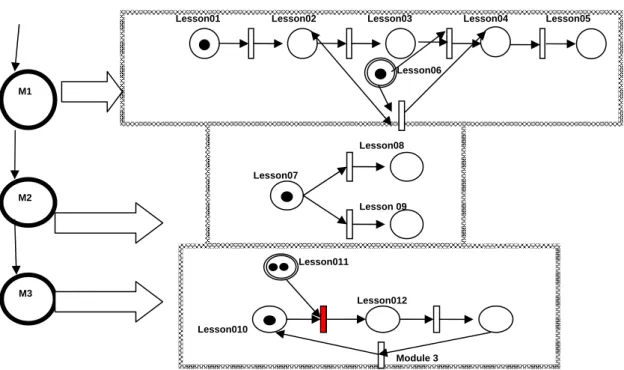
In order to show the compositionality of the constructs, we use two examples to show the concept. In Figure 9, the example is comprised of three major nodes. Node M1 shows the Flow with Skip construct. Node M2 shows the Choice structure. Node M3 shows the Limit condition construct with attempt=2.
M1
M2
M3
Lesson01 Lesson02 Lesson03 Lesson04 Lesson05
Module 3 Lesson010 Lesson011 Lesson 09 Lesson08 Lesson07 Lesson06 Lesson012
Fig. 9. An example with Flow, Skip, Choice and Limit condition
Supporting Collaborative Learning
Another issue in this paper is collaborative learning. Collaborative learning means the students learn and work in groups. One definition is, “the instructional use of small groups so that the students work together to maximize their own and each other’s learning.”
Collaborative learning is a situation in which two or more people learn or attempt to learn something together so that the students maximize their own and each other’s learning. There are many research [11, 12] devoted to build the environment to meet the requirements of a virtual collaboration space and to support e-learning ser-vices. Our DCPN model can illustrate all the flow of collaborative learning that is the key point issue of distance learning well.
Construct Collaborative Learning (CL) with DCPN
The most important feature of collaborative learning is grouping by heterogeneity such as different back-ground, various learning path and diverse instruction styles. According to this feature, what may we concern about before entering into CL? The one is what capability is necessary and the other is whether the number of group is satisfied.
DCPN utilized the token color through an exam to verify the learner capability and the token number to vali-date specified amount of group. The learner should take an exam to tell the system what the role he can play before enter into the collaborative learning. As shown in Figure 10, taking the Exam and dividing into two cate-gories (red token and blue token), p3 collected the results and wait until the condition is satisfied. That is, if there are two fess tokens and one white token, the transition can be fired and then three learners make up a team to enter into the CL mode.
After enter into CL, team member has to learn some knowledge or skill then gathered together to solve mis-sion. In our model (Figure 11), “s” above the arc represents the LMS record the break point of suspending the lesson to enter into chartroom to facilitate the learner getting assistance from other partners. When the learner gets the information enough, he can go back the break-point and keep going on. In order to conform the learner not only achieve the global mission but also personal mission of CL, we identify individual accountability by place.
With the underlying definition of the model using Petri net, the developed system implements a Petri net en-gine to control learning behaviors. The proposed collaborative learning of SCORM and its supporting theoreti-cal model is the main contribution of our research.
3 Conclusion
In SCORM specification, we referenced Sharable Content Object Reference Model (SCORM) for its advantages. These advantages are following:
z Accessibility: the ability to locate and access instructional components from one remote location and deliver them to many other locations.
z Adaptability: the ability to tailor instruction to individual and organizational needs.
z Affordability: the ability to increase efficiency and productivity by reducing the time and cost in-volved in delivering instruction.
z Durability: the ability to withstand technology evolution and changes without costly redesign, re-configuration.
Fig. 10. Construction before entering into collaborative learning
Learnern Condition CL Learner1 Learner2 Exam p1 p2 p3 Exam Exam Exam s tnot-satisfied tsatisfied According to identify individual accountability Fig. 11. CL Construct
z Interoperability: the ability to take instructional components developed in one location with one set of tools or platform and used them in another location with a different set of tools and platform. z Reusability: the flexibility to incorporate instructional components in multiple applications and
con-texts.
However, standard also means the functions are limited that it is hard to integrate with educational theory. We found that learner sequencing behavior can provide necessary information to combine cooperative learning in SCORM learning environment. In addition to cooperation learning, assessment can help the learner and instruc-tors realize the learning performance.
As we mentioned, cooperation learning is another learning style for the learners. Cooperative learning is the instructional use for small groups. Students work together to maximize their own and each other's learning. We believed the cooperation learning model which is constructed with Petri net may provide learning sequencing behavior for the instructors to monitor the learning status.
This thesis focused on the cooperative learning in SCORM. We constructed the framework of SCORM Se-quence using subnet oriented and firing rule of Distance-learning Color Petri Net. The available advantage of mapping DCPN on SCORM sequence is making all of construction process traceable and trustworthy. Besides, it gives different thought what’s the importance capabilities of distance learning have never been probed into in SCORM but has expressed on Petri net. An e-learning standard can not proceed in opposite directions with edu-cation. We believed that collaborative learning and learning content management are important to e-Learning. So far there is little research talked about collaborative learning. As a result, our model has developed more complete model with SCORM standard which can suit for collaborative learning.
We also proposed the MINE Assessment Metadata to support e-Learning assessment. The assessment meta-data strengthen its SCORM counter part. The elements are simple but effective for analysis of test results. They are also important for guaranteeing teaching quality. The analysis result can tell the instructor if the teaching goal is achieved. Also, the student can understand the key point of the course and the blind spot of learning process.
The files produced by the system are compatible with the SCORM standard and the authoring concept is also referenced IMS QTI. Besides, the system provides a monitor function for capturing learner’s picture during an examination. Regarding the experience of using the metadata model and the assessment system, defining the metadata is the most difficult part. In e-Learning standards, there are too many metadata. Only required metadata attributes are added in our assessment system.
For the future work, we can focus on the following aspects. The way we developed the cooperative learning is the basic prototype. Actually, there are various kinds of cooperative learning procedures. With different kinds of cooperative learning style, the assessment method should be different. Also, strengthen interaction for as-sessment and multimedia asas-sessment. Secondly, combine the asas-sessment metadata to learning content. Thirdly, cooperative learning can be just a basic course or a sharable content.
References
[1] ADL Technical Team, Sharable Content Object Reference Model (SCORM) V.1.3 Working Draft 1, Advanced
Distrib-uted Learning (ADL), October 2003.
[2] F. Farance and J. Tonkel, "Draft Standard for Learning Technologies. Learning Technology Systems Architecture (LTSA)", IEEE Technical report, http://ltsc.ieee.org/wg1/files/IEEE_1484_01_D09_LTSA.pdf, Nov. 2003.
[3] IMS Global Learning Consortium, Inc., IMS Simple Sequencing Specification, http://www.imsglobal.org, 2002. [4] M. Deutsch, “Cooperation and trust: Some theoretical notes” in M. R. Jones (Ed.), Nebraska symposium on motivation,
Lincoln, NE: University of Nebraska Press, 1962, pp.275-319.
[5] D. W. Johnson, and R. T. Johnson, R. T. Cooperation and competition: Theory and research. Edina, MN: Interaction Book Company, 1989.
[7] D.W. Johnson, Reaching out: Interpersonal effectiveness and self-actualization (6th Ed.). Needham Heights, MA: Allyn & Bacon, 1993.
[8] D. W. Johnson and R. T. Johnson, Teaching students to be peacemakers (3rd Ed.). Edina, MN: Interaction Book Com-pany, 1995.
[9] D. W. Johnson, R. T. Johnson, and E. J. Holubec, Cooperation in the Classroom (6th Ed.). Edina, MN: Interaction Book Company, 1993.
[10] ADL Technical Team, SCORM Examples, Advanced Distributed Learning (ADL), October 2003.
[11] T. K. Shih, J. C.-S. Hung, W.-C. Ko, W.-C. Chang, and N. H. Lin, “Cooperative Courseware Authoring Based on SCORM Metadata,” in Proceedings of the International Conference on Computers in Education, Hong Kong, China, Dec. 2003.
[12] C. Bouras, E. Giannaka and T. Tsiatsos,”Virtual Collaboration Spaces: The EVE Community”, in Proceedings of The