Clusters of Humor Expression and Related Factors among
Junior High School Students
in
Taiwan
Yi-Chen Chiang
School ofPublic Health, ChlUlg Shan Medical University Department ofFamily and Community Medicine,ChlUlg Shan Medical University Hospital
Wen-Chi Wu
Department ofHealing Science and Health Marketing, Kainan University
Hui-Shan Sheng
Institute ofHealth Policy and Management, National Taiwan University
Lee-Lan Yen
Institute of Health Policy and Management, National Taiwan University Institute ofPopulation Health Sciences,
National Health Research Institutes
Little research has examined the aggregation of humor expression among adolescents. The purposes of this study were to understand the natural clusters of types of humor expression among youth in Taiwan and to discover any related background factors that may shape these aggregations of humor styles. A nationwide survey was conducted of 1,639 students in the seventh to ninth grades. Participating junior high schools were randomly selected in Taiwan. Cluster analysis was used to explore types of humor expression. Multinomial logistic regression modeling was used to examine factors related to types of humor expression. The sample was divided into four clusters based on humor expression and personality: (a) frequent use of various humor types (16.1%); (b) used of deprecating humor group (26.7%); (c) non-hurtful witty group (22.4%); and (d) serious or austere (or rarely use of humor) group (34.9%). Individual (e.g., grade, birth order, academic perfonnance, perceived stress and allergy-related problems) and family factors (e.g., mother's education, parent's marital status and family income) were related to clusters of humor expression. Our study discovered that different aggregations of humor expressions exist among youth and that significant associations exist between different background factors and the natural clusters. Based on our study results, we recommend early contact with junior high school students to help establish positive ways that they can express their humor during this crucial period of time. Such insights may very well lead to educational programs or coursework that can enhance students' understanding of the proper use of humor and its overall role in society.
290
The relationship between humor and health is an important topic of research. In the past, it was believed that a good sense of humor was related to better health (Boyle & Joss-Reid, 2004), and humor expression was believed to benefit one's health on several levels (Kuiper, Grimshaw, Leite, & Kirsh, 2004; McGhee, 1979). Humor has been found to relieve feelings of stress and provide a cushioning effect against daily pressures (Svebak, GOtestam, & Jensen, 2004). Humor and laughter have also been regarded as helpful mechanisms for relieving tension in the body and protecting the body and spirit (Kuiper & Martin, 1993; Kuiper, Martin, & Olinger, 1993; Nezlek & Derks, 2001; Abel, 2002). Modem theories, however, employ a more tentative tone when discussing the correlation between humor and health (Martin, Puhlik-Doris, Larsen, Gray, & Weir, 2003).
During adolescence, dramatic physical and psychological changes take place. Lifelong regrets may stem from ignorance and misunderstanding of problems derived from one's lack of guidance during adolescence (Yen, Liu, & Yen, 1987). In addition to coping with the effects of physical growth and development, junior high school students face increasing demands from family members, school, peers, friends of the opposite sex, and others in their social environment (Ho & Lin, 2000). To adapt during this period of instability and dramatic change, adolescents must develop coping strategies (Chiang et aI., 2011). Previous studies have found that 12- to 16-year-old adolescents learn to express and use humor to solve problems and participate in social activities and that their expressions of humor begin to involve the topics of sex and aggression (Fiihr, 200 I). The psychodynamic theory proposed by Freud (1960) claims that humor is a type of release through which individuals can channel their complicated emotions. During adolescence, sexual maturity becomes a driving force behind changes in humor expression and humor response mechanisms. In stressful situations, the individual will use humor as an emotional outlet to reduce or express anxiety and tension. Therefore, the mechanisms of humor expression in young people are worthy of further study.
"Sense of humor" refers to humor as a stable personality trait or individual difference variable (Ruch, 1998). In the past three decades, researchers have made use of a number of self-report measures that focus on some aspects of sense of humor considered to be germane to well-being (Martin, 2003). These measures assess such aspects of humor as the degree to which individuals use humor as a coping strategy (Coping Humor Scale, CHS; 7 items; Cronbach's a = .61; Martin & Lefcourt, 1983), or noticing and enjoying humor (Sense of Humor Questionnaire, SHQ-6; a short version-6 items- of the SHQ for use in epidemiological surveys where space limitations preclude the use of longer measures; Svebak, 1996). Another scale measures how individuals smile and laugh in 18 different situations including 7 pleasant situations and 11 unpleasant situations, and includes 3 items where respondents self-rate their perceived likelihood of laughing in a variety of situations (Situational Humor Response Questionnaire, SHRQ; 21 items; Cronbach's a=.70 to .79; Martin & Lefcourt, 1984). A further scale assesses several elements of the personal construct of sense of humor: (1) humor production and creative ability; (2) playfulness or a sense of whimsey, joie de vivre, the ability to have a good time; (3) the ability to use humor to achieve social goals; (4) recognition of humor; (5) appreciation of humor; and (6) use of humor as an adaptive or coping mechanism (Multidimensional Sense of Humor Scale, MSHS; Thorson & Powell, 1993).
Since the 1990s, however, some researchers have begun to question the degree to which these measures adequately assess health-relevant dimensions of sense of humor. Correlations between self-report humor scales and various measures of psychological health and well-being reported in the literature, when significant, are typically less than .25, suggesting that these dimensions of humor account at best for less than 6% of the variance in mental health (Martin et aI., 2003). Thus, despite the widespread view that a sense of humor is an important component of healthy psychological functioning, existing self-report humor measures show, at best, only weak and inconsistent relations with various indicators of psychological, physical, and social well-being (Martin et aI., 2003). One possible reason for these generally weak findings to date may be that current self-report humor measures generally do not explicitly distinguish between potentially adaptive functions of humor and uses of humor that may be less conducive and possibly even detrimental to well-being (Kuiper & Martin, 1998; Martin, 2001). However, Martin et al. (2003) has indicated that this focus on the functions served by humor and the distinction between potentially more or less healthy uses of humor seems to have been largely ignored in recent research on humor and well-being. Although existing humor scales were designed to assess presumably adaptive aspects of humor (Ruch, 1996), they do not typically address the specific ways in which individuals use or express humor.
Early research on humor expression focused on its relationship with the promotion of interpersonal relationships (Abel, 2002; Chapman& Speck, 1977). Existing research has used factor analysis to divide types of humor expression into groups (Fiihr, 2002; Martin, 2003). In a humor expression survey of high school students by Fiihr (2002), humor expression was divided into three categories: coping humor with uncertainty and stress, making fun at others and getting cheered up. Martin et al. (2003) developed the "Humor Styles Questionnaire" (HSQ), which identified four humor styles in western countries: the benign "affiliative humor" and "self-enhancing humor" styles, and the deleterious "aggressive humor" and "self-defeating humor" styles. This divides humor expression into four categories according to the object of humor and the environmental adaptation strategies employed. However, recent research in Taiwan using the HSQ-Traditional Chinese Version to explore humor styles found contrasting results to previous western research in that positive humor styles (including the self-enhancing type and affiliative type) were significantly positively correlated with the self-defeating type of humor (a negative humor style) (Chan, Chen, Cho,& Martin, 2011). In other words, Taiwanese undergraduates will perhaps lower themselves to please others or use self-deprecating humor to arouse attention and obtain approval. They may also use self-ridicule to make others laugh as a way of promoting interpersonal relationships or reducing tension in interpersonal relationships. These differences could be due to the collectivistic nature of Eastern cultures as opposed to the more individualistic nature of western cultures. As a result, Taiwanese adults do not consider the self-defeating type of humor as a negative humor style (Chan, Chen, Cho,& Martin, 2011) but rather an expression of humility. Yue (2010) pointed out that Chinese humor has been mostly characterized by joke-telling and funny show-performing. Humor has been traditionally given little respect in Chinese culture mainly due to the Confucian emphasis on keeping proper manners of social interactions. That is to say, Chinese culture values humility and self-deprecation especially in adults (Wang & Lo, 2008). Furthermore, by using a qualitative approach (Yen et aI., 2008) and a quantitative approach (Chiang et aI., 2011) among adolescents, these studies have found that expressions of humor among junior high school students in Taiwan may be different from previous patterns observed using the HSQ. The expressions of humor among Taiwan's young adolescents can be classified into another four types: self-deprecating humor, other-devaluing humor, body-language humor and witty-response humor. The maladaptive self-deprecating and other-devaluing types of humor were thought to be associated with adverse effects on health, while the adaptive body-language and witty-response types were viewed as positively influencing mental health and social well-being (Yen et aI., 2008). This shows that due to cultural differences between Chinese and western cultures, measurement instruments that have been developed overseas are not completely suitable for use in local research investigating humor styles (Chiang et aI., 2011). Past research in Taiwan has mostly used humor scales that have been translated or modified versions of overseas scales that were designed using western cultural ways of thinking (Chen & Chen, 2005). A humor scale that is designed specifically for local adolescents would better resemble the types of humor styles expressed by Taiwanese adolescents (Chiang et aI., 2011). Chiang et al. (2011) has developed a new multidimensional humor scale which can be used to measure sense of humor, the experience of humor expression, and the experience of receiving humor messages among adolescents. Moreover, the good reliability and validity of this scale has been confirmed in a nationally representative sample. As a result, we used the classification developed by Chiang et al. (2011) in the present study.
Different types of humor expression are related to many individual factors. In the past, many studies (McGhee, 1979; Freud, 1960; Fiihr, 2002) have argued that gender differences in humor expression exist, partly due to the observation that men more frequently employ humor to attract the attention of the opposite sex (Bressler& Balshine, 2006). Men prefer the subject of offensive and sex-related humor, and are more likely to use self-deprecating humor than women (Storch et aI., 2003). In regards to age, Fiihr (2002) reports that adolescents at 14 years of age more frequently use humor than ll-year-olds who are likewise faced with the stress of adolescent physical development. In addition, it is generally accepted that older individuals can better respond to stress through the use of humor (Martin, 2001). McGhee (1979) also points out that birth order affects children's humor expression. Eldest children express humor more frequently to receive greater attention from their parents. The eldest child of a family under stress also tends to employ humor more frequently to improve rapport within the family. Another study (Ho& Lin, 2000) argues that young people under greater stress possess a greater appreciation of humor and better humor coping mechanisms. In addition, in a review of the research on humor and physical health,
292
Martin (200 I) found no consistent evidence for relations between self-reported humor measures and such health indicators as immunity, pain tolerance, or illness symptoms.
Family factors have rarely been used to analyze individual differences in humor expression. In a study of humorous children by Fern (1991), children viewed by their peers as being the most humorous came from families that had stable incomes. However, studies have shown that 30.7% of very humorous children come from single-parent families. In some instances, family trauma breeds humor coping mechanisms in children. When couples struggle to get along with one another, their children often develop a more sophisticated sense of humor as a way of coping with their problems.
Studies using patterning methods have increased substantially in the past two decades. Factor and cluster analysis are two commonly used methods to derive behavioral patterns (Newby & Tucker, 2004). Factor analysis involves grouping input variables according to the degree to which they are correlated with each other, thus aggregating behavioral data into distinct patterns (factors). Cluster analysis involves grouping individuals into mutually exclusive categories (clusters) (Yen, Chiu, Wu, & Pan, 2006). Most previous humor research has used factor analysis to classify types of humor expression. Moreover, the major focus to date has been on such styles considered individually rather than the combination of styles characteristic to any given person (Galloway, 20 10). Previous studies (Galloway, 20 I0; Dyck & Holtzman, 2013) have suggested that it is also important to consider humor style "c1usters"(i.e., the interplay of all four styles within individuals.) However, little research has examined the aggregation of humor expression among adolescents by using cluster analysis (Chen & Yen, 200 I) and this phenomenon and related factors remain ambiguous. As a result, the purposes of the present study were to understand the natural clusters of types of humor expression among youth and to discover any related background factors that may shape these aggregations of humor styles. We have two hypotheses: (I) individuals may express more than one style of humor at the same time and Taiwanese adolescents will express similar but diversified patterns of humor styles; (2) Taiwanese adolescents who belong to different clusters will be influenced by different factors.
Method
Participants
Data was collected from a nationwide survey in 2007. Five public junior high schools were randomly selected from various areas in Taiwan. Then, one class of students from each grade was randomly selected from each school, resulting in a total of 60 classes of seventh to ninth graders in the sample. A total of 1,639 students completed the questionnaire giving a response rate of 85.7%.
Data Collection
Before the survey was completed, informed consent was obtained from the participants' parents. Data collection was carried out by ten trained interviewers under supervised conditions. All participants were asked to complete a set of self-report questionnaires during class-time.
Measures
This study employed a research framework that considered several variables related to personality, other individual factors, and family factors. The main variables of interest included in this study are as follows:
Humor expression clusters
A humor expression cluster is not a variable that can be measured per se, but it can be studied in relation to the patterns of an individual's humor expression and personality following cluster analysis.It
1. Humor expression: Humor expression was classified in accordance with the measures from the Taiwan Adolescent Humor Instruments (abbrev. TAHI) (Chiang et aI., 2011). This scale divides 18 total types of humor expression into four kinds of humor expression through confirmatory factor analysis and discriminant validity: Self-deprecating (4-item), Other-devaluing humor (4-item), Body-language humor (4-item), and Witty-response humor (6-item). The scale dimensions and individual items are presented in Appendix 1. Respondents must choose the type that best represents them by rating their frequency of using each of the four kinds of humor expression on a scale of 1-5, where I equals "never" and 5 equals "always." The reliability of the scale was assessed by the internal consistency coefficient that for each dimension of the scale ranged from .85 to .86, indicating good reliability. The validity of the scale was assessed using a panel of experts, exploratory factor analysis, confirmatory factor analysis, and discriminant validity. Exploratory factor analysis showed that the factor structure of each dimension of the scale was similar to the factor structure developed in the preliminary draft. Results of confirmatory factor analysis showed that all dimensions of the scale fitted the data well. In particular, the value of GFI and AGFI were both .98, indicating good validity. Further analysis of discriminant validity found that the chi squared for the difference between the four-factor model and the single factor model was 748.84
(6df= 6) which was statistically significant (p<.00 I), indicating that the four factor model best fitted the data. In addition, the 95% confidence interval around the paired correlations among the latent variables did not include 1.00, which supports discriminant validity (Chiang et aI., 2011).
2. Personality: This study selected several aspects of personality that have been analyzed in conjunction with humor expression in previous studies, including self-esteem (IO-item), restraint (lO-item), extraversion (lO-item), and aggression (lO-item) using a scale developed by Yen et al. (2007), and sense of humor (7-item) using a scale developed by Chiang et al. (2011). The specific items used in these scales are shown in Appendix 2 and Appendix3. For these items, individuals rated themselves by selecting from 5 choices: strongly disagree, disagree, neutral, agree, or strongly agree. The reliability of these measures using the internal consistency coefficient were .84, .75, .81, .70, and .87, indicating appropriate reliability.
Individual andfamily factors related to humor expression
Individual factors included sex, grade, birth order of the child in the family, academic performance, self-perceived stress, and allergy-related problems. Academic performance was measured by asking respondents: "What was your academic performance like in your class last semester?" A response of "I'm in the top ten students" was categorized as high academic performance, a response of "I'm ranked 11-20" was categorized as average performance, and a response of "I'm ranked 21 or lower" was categorized as low academic performance. Family factors included parent's academic attainment, parent's marital status, and family income. Parent's academic attainment was assessed by asking students "What is your father's/mother's level of education?" Responses were grouped as low (Junior high school and below), medium (Senior high school/technical college), and high (University and above).
Data Analysis
Descriptive statistics including frequency distributions and percentages were used to provide a better understanding of the individual and family factors related to participant's humor expression. This study used a two-stage cluster analysis. The first stage was called a stratified cluster analysis (Huadefa's method) and was used to determine the number of clusters; the second stage was a non-stratified cluster analysis that applied the K-means methodology to group participants. By using ANaYA and Scheffe's test, we were able to determine a descriptive name for the clusters according to type of humor expression and personality characteristics. Finally, we used multinomial logistic regression modeling to determine the individual and family factors related to humor expression clusters.
294
Results
As shown in Table 1,51.9% of students were boys and 48.1% were girls; 44.2% of students reported that they did not perceive any stress in their lives; and 70.6% had no allergy-related problems. In regards to family factors, parents were currently married in 82.9% of families; and 38.2% of families could be considered as middle-class.
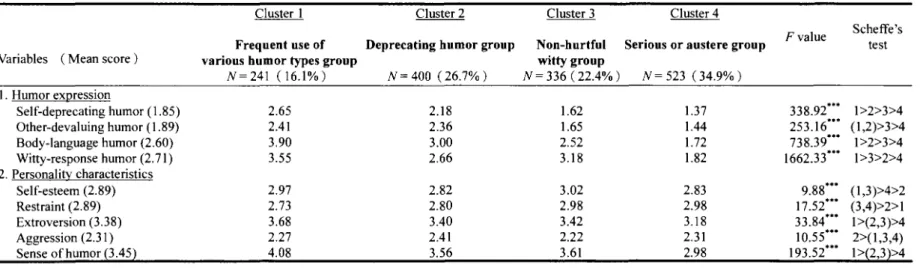
This study uses Huadefa's method for cluster analysis and found that the most stable model was the four-cluster solution (R2= .60). As shown in Table 2, after dividing the sample into humor expression clusters, 241 students belonged to the frequent use of various humor types group (16.1%); 400 to the deprecating humor group (26.7%); 336 to the non-hurtful witty group (22.4%); and 523 to the serious or austere group (34.9%). Using ANOYA and Scheffe's test, we compared humor expression and personality characteristics between the four clusters. We found that cluster I had the highest scores for the four styles of humor expression (2.65, 2.41, 3.90, and 3.55, respectively) and the highest self-esteem, extraversion and sense of humor scores (2.97, 3.68, and 4.08, respectively). The restraint level of cluster I was the lowest among the four clusters (2.73), so we named cluster 1 the "frequent use of various humor types group." Cluster 2 had the highest score for other-devaluing humor (2.36) and lower scores than cluster 1 for self-deprecating humor (2.18 vs. 2.65). Cluster 2 had the highest aggression scores of any of the four clusters (2.41) and had extraversion and sense of humor scores that were lower than those of cluster 1. In addition, self-esteem scores in cluster 2 were the lowest of any of the four clusters (2.82), therefore, we named cluster 2 the "deprecating humor group." Cluster 3 had a lower score than cluster 1 for "use of witty-response humor" (3.18), and had the highest scores for self-esteem and restraint of all four clusters (3.02 and 2.98, respectively). In addition, the extraversion and sense of humor scores of cluster 3 were less than that of cluster 1, and as a result, we named cluster 3 the "non-hurtful witty group." Cluster 4 had the lowest scores on all of the above-mentioned styles of humor expression (1.37, 1.44, 1.72, and 1.82, respectively) and the highest restraint level of all the four clusters (2.98). The extraversion and sense of humor scores of cluster 4 were also the lowest of all the four groups (3.18 and 2.98, respectively). As a result, we named cluster 4 the "serious or austere group."
Table 1 Distribution of individual and family characteristics
Variables N ('Yo) Variables N ('Yo)
I. Individual characteristics 2.Family characteristics
Sex Father's academic attainment
Boys 848 (51.9) Junior high school and below 686 (42.
Girls 785 (48.1) Senior high school/technical college 813 (49.
Grade University and above 136 (8.
Seventh 500 (30.6) Mother's academic attainment
Eighth 562 (34.4) Junior high school and below 669 (40.
Ninth 572 (35.0) Senior high school/technical college 855 (52.
Birth order University and above III (6.
Only child 80 (4.9) Parents' marital status
Eldest child 546 (33.4) Married 1349 (82.
Middle child 393 (24.4) Other 278 (17.
Youngest child 610 (37.3) Family income
Academic performance High 486 (29.
High 553 (33.8) Medium 625 (38 Average 541 (33.1 ) Low 524 (32 Low 540 (33.1) Perceived stress None 723 (44.2) Little 500 (30.5) A lot 412 (25.2) Allergy-related problems No 1154 (70.6) Yes 481 (29.4)
Table 2
Comparison of humor expression and personality characteristics among the four clusters
Cluster I Cluster 2 Cluster 3 Cluster 4
Fvalue Scheffe's Frequent use of Deprecating humor group Non-hurtful Serious or austere group test Variables ( Mean score) various humor types group witty group
N
=
241 (16.1 % ) N=
400 (26.7%) N=336 (22.4%) N=523 (34.9%) I. Humor expression Self-deprecating humor (1.85) 2.65 2.18 1.62 1.37 338.92""" 1>2>3>4 Other-devaluing humor (1.89) 2.41 2.36 1.65 1.44 253.16""" (1,2»3>4 Body-language humor (2.60) 3.90 3.00 2.52 1.72 738.39""" 1>2>3>4 Witty-response humor (2.71) 3.55 2.66 3.18 1.82 1662.33""" 1>3>2>4 2. Personality characteristics Self-esteem (2.89) 2.97 2.82 3.02 2.83 9.88""" (1,3»4>2 Restraint (2.89) 2.73 2.80 2.98 2.98 17.52""" (3,4»2>1 Extroversion (3.38) 3.68 3.40 3.42 3.18 33.84""" 1>(2,3»4 Aggression (2.31) 2.27 2.41 2.22 2.31 10.55""" 2>(1,3,4) Sense of humor (3.45) 4.08 3.56 3.61 2.98 193.52""" 1>(2,3»4***
p<.001296
.-
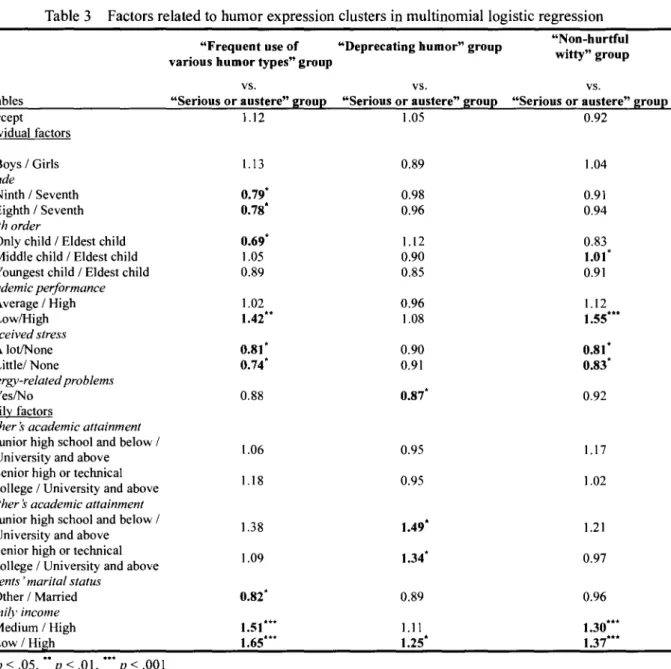
FJTable 3 lists the individual and family factors related to the humor expression clusters in multiple multinomial logistic regression analysis.
I. "Frequent use of various humor types group" versus "serious or austere group"
These two clusters demonstrated clear differences in grade, birth order, academic performance, self-perceived stress, parent's marital status and family financial status. Students in grade 7, eldest children and those with poorer academic performance were more likely to be in the frequent use of various humor types cluster. Not surprisingly, children who reported no pressure were more likely to frequently use various humor types than those with a lot or little self-perceived stress. In addition, children whose parents were married at the time of the survey and children from middle-class or low-class families were more likely to be in the frequent use humor group than children with divorced or single parents or those from more financially wealthy families.
2. "Deprecating humor group" versus "serious or austere group"
These two clusters demonstrated clear differences in allergy-related problems, mother's education level and family financial status. Students reporting allergy-related problems were more likely to belong to the "serious or austere group ", as were students whose mother had an above university level of education. Students from families with worse than average financial status were more likely to be in the "deprecating humor group".
3. "Non-hurtful witty group" versus "serious or austere group"
There were clear differences between these two groups in birth order, academic performance, self-perceived stress and financial status. Students who were the middle child of a family were more likely to belong to the witty cluster than those who were eldest children. In addition, children who had poorer academic performance, perceived no stress and were from families with medium or low financial status were more likely to belong to the non-hurtful witty cluster.
4. Different patterns between the "Frequent use of various humor types group," "Deprecating humor group," and "Non-hurtful witty group"
Different patterns were observed within these three clusters that expressed more humor than the "serious or austere group." Students in grade 7 were more likely to be in the frequent use of various humor types cluster. The eldest child was more likely to express various humor types than the only child, while the middle child expressed more non-hurtful witty humor styles than the eldest child. Students with poorer academic performance and who perceived no stress were more likely to frequently use various humor types or non-hurtful witty humor styles. Students reporting allergy-related problems and students whose mother had an above university level of education were more likely to belong to the "serious or austere group," especially compared to belonging to the "deprecating humor group." Children with divorced or single parents at the time of the survey were more likely to belong to the "serious or austere group," especially compared to belonging to the "frequent use of various humor types group." In addition, children from high income families were more likely to be in the "serious or austere group." No gender differences were observed within these clusters.
Table 3 Factors related to humor expression clusters in multinomial logistic regression
"Frequent use of "Deprecating humor" group various humor types" group
"Non-hurtful witty" group 1.13 0.89 1.04 0.79· 0.98 0.91 0.78· 0.96 0.94 0.69· 1.12 0.83 1.05 0.90 1.01· 0.89 0.85 0.91 1.02 0.96 1.12 1.42·· 1.08 1.55·" 0.81· 0.90 0.81· 0.74· 0.91 0.83· 0.88 0.87· 0.92 1.06 0.95 1.17 1.18 0.95 1.02 1.38 1.49· 1.21 1.09 1.34· 0.97 0.82· 0.89 0.96 1.5.... 1.11 1.30"· 1.65·" 1.25· 1.37"· riables tercept :Iividual factors ex Boys / Girls :rade Ninth / Seventh Eighth / Seventh 'irth order
Only child / Eldest child Middle child / Eldest child Youngest child / Eldest child cademic performance Average / High Low/High 'erceived stress A lotINone Little/ None llergy-related problems Yes/No lmily factors
'ather
s
academic attainment Junior high school and below / University and above Senior high or technical college / University and above ,fothers
academic attainmentJunior high school and below / University and above Senior high or technical college / University and above 'arents ' marital status
Other / Married 'amily income Medium / High Low / High • p<.05, ..p <.01, ...p <.001 vs.
"Serious or austere" group 1.12
vs.
"Serious or austere" group 1.05
vs.
"Serious or austere" group 0.92
298
Discussion
Patterns and related factors in the "Frequent use
of various humor types group"
Based on cluster analysis, humor use among junior high school students in Taiwan can be divided into four clusters. Among the four clusters, the first cluster (frequent use of various humor types) includes a group of students that are particularly active in expressing their humor skills. Students who belonged to this particular cluster scored higher on witty reactions and funny actions, and they also frequently used self-devalued and other-devalued humor. Moreover, they had high self-esteem, extroversion, and sense of humor, but showed considerably lower restraint. This means that such children may be prone to expressing more humorous behaviors on impulse. Such students may require encouragement and guidance so that the adverse effects of self-devalued and other-devalued humor expression can be avoided.
In the past, it was widely believed that students who performed better in the academic setting would be more adept at utilizing a wide array of humor styles (McGhee, 1979; Kuiper & Nicholl, 2004; Ho & Lin, 2000; Masten, 1986). However, individuals who performed worse in the academic setting were also more likely to fall within this cluster in our study. Fisher and Fisher (1981) suggest that for students with worse academic performance who fall within this cluster, school and academic pursuits (in general) are not taken very seriously. The classroom is but a training ground in which to hone their humor. Furthermore, despite these students' academic problems, their ability to express themselves in humorous ways reinforces their popularity amongst their peers. In addition, our study also found that students in grades 8 and 9 do not perform as well with regard to humor expression as do students in grade 7, which was inconsistent with previous studies (Freud, 1960; Fiihr, 2002; Martin, 2003). This could be due to the pressures of school becoming considerably greater in these higher grades, giving them less of a chance to express themselves in humorous ways.
A previous study (Fern, 1991) found that individuals who are adept at expressing humor tend to come from more financially stable families, primarily because such families are also likely to be more emotionally stable. However, this study demonstrates that students from financially unstable households are more likely and able to utilize humor expression. This is believed to be a response to their financial and economic problems. Furthermore, Fern (1991) contended that family trauma stimulates the development of humor within an individual. Prasinos and Tittler (1981) have also asserted that individuals who come from estranged families are more likely to try different humor techniques to reinforce their worth in society. In other words, they argued that these individuals seek approval from their peers through various humor tactics. In contrast, our study found that students whose parent's marital relationship was stable were more likely to try different humor techniques. Previous studies (Fern, 1991; Prasinos & Tittler, 1981) contend that individuals who come from unstable or estranged households are less likely to experiment with humor techniques due to greater self-perception of stress within their lives, whereas children from stable familial situations are more likely to use humor expression tactics simply because they do not have the same degree of stress looming over them. However, because these studies (Fern, 1991; Prasinos & Tittler, 1981) seldom reported on family factors relative to humor expression and because they used purposive samples instead of random samples, it is almost impossible to develop unbiased theories regarding humor expression based on such research. For example, Fern chose students who were voted their class's "funniest or most humorous" individuals rather than using a random sample. This approach prevents the development of unbiased ideas regarding students' use of humor.
Patterns and related factors in the "Deprecating humor group"
Children who enjoy using deprecating humor may not know how to use witty humor and tend to act in a derogatory manner toward both themselves and others. Students who belonged to this cluster scored fairly low on self-esteem and were viewed as considerably aggressive. Therefore, it is important to
encourage and educate such students about limiting their use of derogatory humor methods and increasing their use of more positive humor expressions.
This study found that students suffering from allergy-related problems were less likely to use derogatory or deprecating humor to express themselves. The majority of researchers (Carroll & Schmidt, 1992; Fry, 1995) believe that little relationship exists between one's physical state and the expression of humor, however, another study (Dillon, Minchoff , & Baker, 1985) has suggested that those suffering from the effects of allergy-related symptoms (e.g., asthma, congestion, lethargy) are less likely to use deprecating humor.
Students whose mothers attained a level of education below high school or technical college level were more likely to fall within the cluster of individuals who used deprecating humor to express themselves than were students whose mothers achieved at least a university-level education. Itmay be that less-educated mothers may be less adept at instilling within their children a sense of what is acceptable and unacceptable as far as humor is concemed. Furthermore, students from families with financial difficulties were more likely to use deprecating humor than were students from financially stable or wealthy households. One explanation for these findings is that humor acts as a personal defense mechanism in those from financially disadvantaged households against others who may also use deprecating or derogatory humor. To counter the use of derogatory humor as an expression mechanism among students, teachers and guardians must be especially vigilant toward individuals expressing such humor styles and ensure that derogatory or deprecating humor is not permitted in the home or school setting.
Patterns and related factors in the "Non-hurtful witty group"
The use of witty reactions but non-hurtful humor, and infrequent use of funny actions and devalued humor expression indicates that the children in this cluster know how to think imaginatively and adapt themselves to different situations. Students in this cluster scored higher on self-esteem and restraint and rarely offended other individuals, which indicates that they have considerably more positive self-perceptions than students in the other clusters and hold themselves in high regard. Students who fall within this cluster need nothing more than continued encouragement and reinforcement of their positive behavior.
This study found that children who performed poorly in an academic setting or who came from households of moderate to meager financial means were more likely to belong to the non-offensive or non-hurtful witty humor expression group. Another study (Fisher & Fisher, 1981) has also shown that schools that have an overall lower level of academic performance are more likely to have students that use similar expressions of non-hurtful humor in interacting with one another. Researchers have found a correlation between low-ranking academic individuals who are cognizant of their poor academic performance and humor expression. Due to the emphasis placed upon schooling in Asia, children of low academic standing may feel inferior to their peers. Thus, it is argued that these individuals often use non-hurtful or non-injurious wit to ingratiate themselves with their peers and, ultimately, gain their respect.
Patterns and related factors in the "Serious or austere group"
Students who fell within the serious or austere cluster scored significantly lower on positive humor expression and also reported little or no derogatory humor. These findings are indicative of their relative inability to express humor in almost any circumstance. Although these students scored significantly higher than others in the area of restraint, they tended to be considerably introverted individuals. In this study, this cluster represented the largest proportion of students among all the four clusters. Students who fall within this cluster should be encouraged to appreciate positive humor styles and to leam to express themselves in a humorous manner.
300
Comparison of clusters using measures from TARI and RSQ
A cluster analysis of Australian adult participants (aged from 18 to 71 years) based on their self-ratings regarding HSQ (including Aggressive, Self-defeating, Affiliative, and Self-enhancing humor styles) was performed by Galloway (2010). Four clusters of people were identified consisting of those who scored: (I) above average on all of the styles, or (2) below average on all of the styles, or (3) above average on the positive styles (Affiliative and Self-enhancing), and below average on the negative styles (Aggressive and Self-defeating), or (4) above average on the negative styles and below average on the positive styles. In the present study, we used TAHI (including Witty-response, Self-deprecating, Other-devaluing, and Body-language humor expressions) to analyze the clusters among adolescents (aged from 12 to 16 years) and also found four similar clusters:(I)Frequent use of various humor types group, or (2) Deprecating humor group, or (3) Non-hurtful witty group, or (4) Serious or austere group. In terms of gender difference, Galloway (2010) found that Australia females were more likely to belong to the "below average on each style" and the "above average on the positive styles, below average on the negative styles" than males. However, we found no gender difference within any of these four clusters in Taiwanese youth. As for the relationship between personalities and humor expression clusters, Galloway (2010) found that Australians of Cluster I (above average on all of the styles) were close to the mean on self-esteem, while we found that Taiwanese adolescents belonging to the frequent use of various humor types group had the highest scores on self-esteem among these clusters. Galloway (20 I0) has suggested that future research should concern the effects that not only gender but specific personalities can have on particular patterns of humor styles. In the present study, we found that several individual and family factors had a significant relationship with different clusters. These findings improve our understanding of the patterns of humor expression clusters for further research and intervention design.
Conclusions and Implications
Our study discovered that different aggregations of humor expressions exist among youth and demonstrates significant associations between different background factors and the natural clusters. The results of the present study that has used a nationwide representative sample are therefore extremely valuable. Findings from this study are not only relevant for humor expression within Taiwan but will also be of benefit to researchers and health educators and experts working with adolescents seeking to understand the modus operandi of humor expression in adolescents. Students should be encouraged to use witty humor styles that are not aimed at hurting others. Students who use all kinds of humor or solely deprecating humor styles should be encouraged to use less negative humor expression styles. Those who are lacking in humor expression (serious or austere group) should be shown positive ways of expressing humor. Such insights may very well lead to educational programs or coursework that can enhance students' understanding of the proper use of humor and its overall role in society. Therefore, our findings could be used as a basis for the design of interventions in the future. Based on our study results, we recommend early investigation ofjunior high school students to help establish positive ways that they can express their humor in this crucial period. In addition, factors associated with adolescents entering a specific group could be detected and modified.
Limitations and recommendations
There are some limitations of this study. First, the variables used in our study were collected from students, an approach that may result in Common Method Variance (CMV). To decrease CMV, we adopted procedural and statistical remedies suggested by Podsakoff, MacKenzie, Lee, and Podsakoff (2003). With respect to the procedural remedy, we counterbalanced the order of the measurements of independent and dependent variables in the questionnaires, which helps control for priming effects. Second, because this study was a secondary data analysis and participants were all selected from public junior high schools, the results of this study may be generalized only to the students of public junior high schools. Third, social desirability may lead to overestimation of positive humor expressions and
underestimation of negative humor expressions reported by students. In order to limit this problem, the trained interviewers were asked to describe the procedures for confidentiality to all students.
We recommend that future research focuses on whether the patterns of humor expression clusters and their individual and family factor correlates observed in this study can be replicated in similar adolescent populations in other countries or cultures. Replication of the results would serve to increase confidence in the reliability of the patterns observed in this study. Future research could also compare the clusters observed in the present study to those obtained using another measurement of humor expression (e.g. HSQ) in Taiwanese youth. We found the existence of different aggregations of humor expressions in adolescents in the present study. However, we didn't investigate the relationship between these four clusters and their health. This could be a valuable direction of research in future studies. The individual and family characteristics related to the clusters of humor expression found in our study could provide further insight into the effects of humor expression on mental and physical health and provide researchers with an understanding of what types of humor should be encouraged and promoted.
Human
Subjects Approval Statement
This study was approved by the institutional review board of the College of Public Health, National Taiwan University.
References
Abel, M. H. (2002). Humor, stress, and coping strategies. Humor: International Journal of Humor Research, 15(4),365-381.
Boyle, G J., & Joss-Reid, J. M. (2004). Relationship of humour to health: A psychometric investigation.
British Journal ofHealth Psychology, 9(1),51-66.
Bressler, E. R., & Balshine, S. (2006). The influence of humor on desirability. Evolution and Human Behavior, 27(1),29-39.
Carroll, J. L., & Shmidt, 1. L., JR. (1992). Correlation between humorous coping style and health.
Psychological Reports, 70(2), 402.
Chan, Y.
c.,
Chen, H. C., Cho, S. L., & Martin, R. A. (20 II). Development of a traditional Chinese version of the humor styles questionnaire. Psychological Testing, Special Issue: Positive Traits Assessment, 207-234.Chapman, A. 1., & Speck, L. 1. (1977). Humorous laughter and relief of anxiety in first-born children.
Journal ofIndividual Psychology, 33( 1),37-41.
Chen, S. J., & Chen, H. C. (2005). Development of the multidimensional sense of humor scale.Research in Applied Psychology, 26,167-187.
Chen,F. L., & Yen, L. L. (200 I). The aggregate patterns of health behaviors among different age groups in Taiwan.Public Health Quarterly, 28(1),37-47.
Chiang,Y.
c.,
Yen, L. L., Wu, W.c.,
Chiu,Y.c.,
Cheng, C. C., & Sheng, H. S. (2011). Development and Compilation of Taiwan Adolescent Humor Instruments (TAHI). Psychological Testing, Special Issue: Positive Traits Assessment, 179-205.Dillon, K. M., Minchoff, B., & Baker, K. H. (1985). Positive emotional states and enhancement of the immune system. The International Journal ofPsychiatry in Medicine, 15( I), 13-18.
302
Dyck, K.T.H., & Holtzman, S. (2013). Understanding humor styles and well-being: The importance of social relationships and gender.Personality and Individual Differences, 55( 1), 53-58.
Fern,T.L.(1991). Identifying the gifted child humorist.Roeper Review, 14( I), 30-34.
Fisher, S., & Fisher, R. L.(1981). Pretend the world is funny and forever: A psychological analysis of comedians, clowns, and actors. Hillsdale, NJ:L.Erlbaum Associates.
Freud, S. (1960). Jokes and their relation to the unconscious. London, England: Routledge & Kegan
Paul.
Fry, P. S. (1995). Perfectionism, humor, and optimism as moderators of health outcomes and determinants of coping styles of women executives. Genetic, Social, and General Psychology Monographs, 121(2),211-245.
Fiihr, M. (2001). Some aspects of form and function of humor in adolescence. Humor: International Journal ofHumor Research, 14(1), 25-36.
Fiihr, M. (2002). Coping humor in early adolescence.Humor: International Journal ofHumor Research,
15(3), 283-304.
Galloway, G (2010). Individual differences in personal humor styles: Identification of prominent patterns and their associates.Personality and Individual Differences, 48(5), 563-567.
Ho, M. J., & Lin, S. H. (2000). The moderating effect of sense of humor to life stress and physical-mental health for junior high school students.Bulletin ofEducational Psychology, 32( I), 123-156.
Kuiper, N. A., & Martin, R. A. (1993). Humor and self-concept.Humor: International Journal ofHumor Research, 6(3), 251-270.
Kuiper, N. A., & Martin, R. A. (1998). Is sense of humor a positive personality characteristic? InW.Ruch (Ed.),The sense of humor: Explorations ofa personality characteristic (pp. 159-178). New York,
NY: Mouton de Gruyter
Kuiper, N. A., & Nicholl, S. (2004). Thoughts of feeling better? Sense of humor and physical health.
Humor: International Journal ofHumor Research, 17( 1/2), 37-66.
Kuiper, N. A., Grimshaw, M., Leite, C., & Kirsh, G (2004). Humor is not always the best medicine: Specific components of sense of humor and psychological well-being. Humor: International Journal ofHumor Research, 17(1/2), 135-168.
Kuiper, N. A., Martin, R. A., & Olinger,L. J. (1993). Coping humour, stress, and cognitive appraisals.
Canadian Journal ofBehavioural Science, 25( 1), 81-96.
Martin, R. A. (2001). Humor, laughter, and physical health: Methodological issues and research findings.
Psychological bulletin, 127(4),504-519.
Martin, R. A. (2003). Sense of humor. In S. J. Lopez & C. R. Snyder (Eds.), Positive psychological assessment: A handbook of models and measures (pp. 313-326). Washington, DC: American
Psychological Association.
and moods.Journal ofPersonality and Social Psychology, 45(6), 1313-1324.
Martin, R. A., & Lefcourt, H. M. (1984). Situational humor response questionnaire: Quantitative measure of sense of humor.Journal ofpersonality and social psychology, 47(1), 145-155.
Martin, R. A., Puhlik-Doris, P., Larsen,G.,Gray, J., & Weir,K (2003). Individual differences in uses of humor and their relation to psychological well-being: Development of the Humor Styles Questionnaire.Journal ofresearch in personality, 37(1),48-75.
Masten, A. S. (1986). Humor and competence in school-aged children. Child development, 57(2),
461-473.
McGhee, P. E. (1979).Humor, its origin and development. San Francisco, CA:W.H. Freeman.
Newby, P.K,& Tucker,K L.(2004). Empirically derived eating patterns using factor or cluster analysis: A review.Nutrition reviews, 62(5), 177-203.
Nezlek, J.8.,& Derks, P. (2001). Use of humor as a coping mechanism, psychological adjustment, and social interaction.Humor: International Journal ofHumor Research, 14(4), 395-413.
Podsakoff, P. M., MacKenzie, S. B., Lee, 1. Y, & Podsakoff, N. P. (2003). Common method biases in behavioral research: A critical review of the literature and recommended remedies. Journal of applied psychology, 88(5), 879-903.
Prasinos, S., & Tittler, B.1. (1981). The family relationships of humor - oriented adolescents. Journal of Personality, 49(3), 295-304.
Ruch, W. (1996). Measurement approaches to the sense of humor: Introduction and overview. Humor: International Journal ofHumor Research, 9(3/4),239-250.
Ruch, W. (Ed.). (1998).The sense ofhumor: Explorations ofa personality characteristic. New York, NY:
Mouton de Gruyter.
Storch, E. A., Bravata, E. A., Storch, J. B., Johnson, J. H., Roth, D. A., & Roberti, J. W. (2003). Psychosocial adjustment in early adulthood: The role of childhood teasing and father support.
Child Study Journal, 33(3), 153-163.
Svebak, S. (1996). The development of the Sense of Humor Questionnaire: From SHQ to SHQ-6.Humor: International Journal ofHumor Research, 9(3/4),341-361.
Svebak, S., Gotestam,K G.,& Jensen, E. N. (2004). The significance of sense of humor, life regard, and stressors for bodily complaints among high school students. Humor: International Journal of Humor Research, 17(112),67-83.
Thorson, J. A., & Powell, F. C. (1993). Development and validation of a multidimensional sense of humor scale.Journal ofClinical Psychology, 49(1), 13-23.
Wang, C. K, & Lo, K Y (2008). Cognitive representation of emotional intelligence: Similarity and difference between genders and cohorts.Research in Applied Psychology, 39,215-251.
Yen, L. L., Liu, J. X., & Yen, H. W. (1987). The association of perceived health status, life style and psychosomatic symptoms among seventh graders.Public Health Quarterly, 13(4),482-492.
304
Yen, L. L., Chiang Y. C., ChiuY. C., Cheng C. C., Wu W. C., & Yang H. J. (2008). The concept of humor and performance patterns among junior high school students: Results of focus group discussions.
Taiwan Journal ofPublic Health, 27(6), 519-529.
Yen, L. L., Chiu, C. J., Wu, W. C., & Pan, L. Y.(2006). Aggregation of health behaviors among fourth graders in northern Taiwan. Journal ofadolescent health, 39(3),435-442.
Yen, L. L., Chiu Y. C., Cheng C. C., Chiang Y. C., ChangY. M., Yang H. J., & Sheng H. S. (2007). The
concept and style of humor among junior high school students in Taiwan: A study on the effect of humor on personal health.National Science Council, Taiwan. (NSC94-2516-S-002-0 13).
Yue, X. D. (2010). Exploration of Chinese humor: Historical review, empirical findings, and critical reflection. Humor: International Journal ofHumor Research, 23(3),403-420.
~)(
fr.'1i B M:
2013:if
02R
26B
--fr.'1i{I~nBM
:
2013if
10R
16B
-~fr.'1i~~nBWJ
:
20141f. 03R
06B
--Jr.'1i{I~nBM
:
2014'rf.
03R
17B
t~~flJ!£BM:
20141f 04R
01B
Appendix 1 Types of expressions of humor based on the Taiwan Adolescent Humor Instruments (TAHI) (Chiang et al.,2011).
Way of expressing humor Question Choice
Self-deprecating humor (4 items)
Other-devaluing humor (4 items)
1. 2. 3. 4.
I will mock myself to show humor. I will vilify myself to show humor. I will criticize myself to show humor. I will tell my secrets to show humor.
A 5-point scale ranging from 1 ("never") to 5 ("always")
Body-language humor (4 items)
Witty-response humor (6 items)
8. I will mock others to show humor. 9. I will vilify others to show humor. 12. I will criticize others to show humor.
13. I will tell other people's secrets to show humor. 5. I will make funny faces and actions to show humor.
6. I will make strange laughing sounds or voices to show humor.
10. To show humor, I will imitate the moves or looks of people not present. 11. To show humor, I will imitate the voices or laughs of people not present. 7. I will act stupid to show humor.
14. I will tell jokes to show humor. 15. I will use metaphors to show humor.
16. I will put irrelevant things together to show humor. 17. I will be ridiculous to show humor.
306
Personality characteristic Self-esteem (10 items)
Restraint (10 items)
~!J..
f'f {"
!I
~ ¥~Appendix 2 Four personality measures developed by Yen et al. (2007). Question
I. Ioften think thatIdon't have any good points.(*)
2. I think that I'm not very capable.(*)
3. I always feel that I'm not as good as others at anything.(*)
4. I feel that I don't have any value.(*)
5. I think that others don't like me.(*)
6. I think that I deserve other people's trust. 7. I always do things well.
8. My family are often proud of me. 9. I think that I'm a pretty good person.
10. People that know me all really like me.
I. I often do whatever I feel like doing.(*)
2. I often do things without considering the consequences.(*)
3. I say whatever comes into my head.(*)
4. I get angry easily when things don't go well.(*)
5. I think I am very impulsive.(*)
6. I always do things carefully.
7. I can do things for a long time without getting distracted. 8. Before I do something I plan it carefully.
9. I am able to control my emotions when things don't turn out.
10. I think I am a calm person.
Choice
A 5-point scale ranging from strongly disagree, disagree, neutral, agree, or strongly agree
Personality characteristic Extraversion (10 items)
Aggression (10 items)
Appendix 2 (continued) Four personality measures developedbyYen et a1. (2007). Question
I. I'm not good at social interactions.(*) 2. I don't like to tell others what I think.(*) 3. I like to be alone most of the time.(*)
4. IfI can I do my best to avoid talking to others.(*)
5. I don't like to perform in front oflarge groups of people.(*) 6. I often actively talk with others.
7. I will make an effort to make new friends. 8. I like to be with someone when I am upset. 9. I am always the most lively person in a crowd. 10. I think I'm an extroverted person.
I. I attack others whose opinions are different to mine.(*) 2. I like to argue with others. (*)
3. I can't stand it when other people are rude to me.(*) 4. I retaliate when someone hurts or insults me. (*) 5. I often attack other people's self confidence.(*) 6. I don'ttryto hurt other people on purpose. 7. I avoid arguing with others.
8. I am able to get on with others harmoniously. 9. I readily accept other people's opinions. 10. Everyone says I have a good temper.
Choice
A 5-point scale ranging from strongly disagree, disagree, neutral, agree, or strongly agree
308
Appendix 3
Sense of humor based on the Taiwan Adolescent Humor Instruments (TAHI)
(Chiang et aI., 2011).
Personality Question characteristic
Choice Senseof humor (7 items)
I.
2. 3.
4.
5.
I like to hear or tel1 good jokes.
People think that I am a person with a sense of humor.
I regard myself as a humorous person. I usual1y think of jokes and funny things. I like to make people laugh in different ways.
A 5-point scale ranging from strongly disagree, disagree, neutral, agree, or strongly agree 6. Others say I can describe something general in a
vivid and funny way.
國立臺灣師範大學教育心理與輔導學系 教育心理學報, 2014 , 46 卷, 2 期, 289-310 頁 DOl: 1O.6251IBEP.20140516
台灣地區國中生的幽默表現集群及相關
因素探討*
江宜珍 中山醫學大學公共衛生學系 中山醫學大學附設醫院家庭監社區醫學部吳文琪*
開南大學 養生與健康行銷學系盛慧珊
固立臺灣大學 健康政策與管理研究所 李蘭 固立臺灣大學健康政策與管理研究所 國家衛生研究院群體健康科學研究所11 的欲Ilf,{ WI'台灣青心、 {j 附默表現方式所形成的集群&1' 11關|朴素。利用 2007 {j 收集之全國 tl:資 料進行分析 u 先 I'] 台灣北、'il 、南、東山區各隨機制1卅 A國巾,於七至九{f 級各隨機抽 Hi -倒
班;被 tllitjJfJI 級的全體校生的怯受 /1\1谷捌&. (1 ,639 人)。似據樣本之幽默表現 }j 式執行集群分 析, II}以多'lifi圳邂帕斯jj"!師恢式fj/i,i1yil此 ~ilf牛II峭的 lλl 素。*r'i!是發現樣木 IIJ 分為山{[司集群,根
據各群中乎也命名的慎用各類陶'!VUi 式肘( 16.1%) 、愛用貶低式陶默方式群 (26.7%) 、機智風趣
不傷人併 (22 .4% )、 II 經嚴肅卅日4.9%) 。以"。經做 lil:[群府對 \1,1仔細進u 多類別邏輯斯迴歸模式 分析後殺況:部分{[古|人IλI ,且是 ({I 級、科I i' J 、牧業尖叫、 I" 閉門大 )J 、過i鼓吹II站)及家庭i划素(tJ: 糾教育科皮、父 j在炯炯狀況、來)在收人)與附默尖叫來Ilf1J'I糾 r 木研,先發現分!屬喝於各種幽默表 叫f來↓矢制SI卅!作干的古少f什I',' I吋IJ能吹與[-1不、|川I叫川iJ 的|川朴井主;1訂州JI關捌 !也也Ii議義釗J提丸ι'1f Illb於?凶 l小1扣付川1刊咐1\峙L恃、手抖?刊!則U別惦恥J,扣Ii捌周合杏:青少f付! 附l附4綱局縛F默I炎E現兇 }j式,
、攸圳)f,攸叫[丘叫t叫|協d泓A日助j力I) 1只{一且位迎」主:tJE
教育 j力j來宋!JJi:介人 l,'i[l}j之參考,日 111 吋|對不 liil附默尖叫來仰的青少作,和段迫切的課科 |λj 衍。
關鐘詞:台灣、青少年、幽默表現、集群
* 1.木~言論交通.iHfl' f'j· :此火琪,尬,汎力式:[email protected]
2. 木交係盛慧 ~IIH是凶 /f.辛灣大學健康政策與 7\,flJi研究所 (IJ;C1'1 '衛生政策與竹理研究所 J) 之fin 上一論火;而 ;';JIλ] 谷, 在二利益j教提指導 F 完成, t'}lfli T'內,珍故別的股市 ~':j ~之;市