Asymmetries in intrinsic spin-Hall effect in low in-plane magnetic field
L. Y. Wang,1 C. S. Chu,1,2and A. G. Mal’shukov1,2,31Department of Electrophysics, National Chiao Tung University, Hsinchu 30010, Taiwan 2Physics Division, National Center for Theoretical Sciences, Hsinchu 30043, Taiwan 3Institute of Spectroscopy, Russian Academy of Science, 142190 Troitsk, Moscow oblast, Russia 共Received 22 June 2008; revised manuscript received 2 September 2008; published 2 October 2008兲 Effects of low in-plane magnetic field on bulk spin densities and edge spin accumulations of a diffusive two-dimensional semiconductor stripe are studied. Focusing upon the Dresselhaus-type intrinsic spin-orbit interaction共SOI兲, we look for the symmetry, or asymmetry, characteristics in two magnetic-field orientations: along and transverse to the stripe. For longitudinal field, the out-of-plane spin density Szexhibits odd parity across the stripe and even parity in the magnetic field and is an edge accumulation. For transverse field, the out-of-plane Szbecomes asymmetric in both spatial and field dependencies and has finite bulk values for finite magnetic fields. Our results support utilizing low in-plane magnetic fields for the probing of the underlying SOI.
DOI:10.1103/PhysRevB.78.155302 PACS number共s兲: 72.25.Dc, 71.70.Ej, 73.40.Lq
I. INTRODUCTION
Generation and manipulation of spin densities by electri-cal means are major goals of semiconductor spintronics that are made possible by spin-orbit interactions 共SOI兲.1–8 SOIs being considered are either intrinsiclike: the Rashba2,5,7,9–11 and the Dresselhaus SOIs4,8,12,13 or extrinsiclike: the impurity-induced SOI.1,3,6,10,14 These SOIs contribute, in an external electric field, to either spin densities in the bulk or spin accumulations at lateral edges, or both.
Out-of-plane spin polarization is of particular interest be-cause it permits efficient optical probe by Kerr rotation. The edge spin accumulation, according to the spin-Hall effect 共SHE兲, has an out-of-plane component and is resulted from a transverse spin current induced by the electric field.1,4–6 However, for the case of intrinsic SOI, it is understood that the SHE is quenched by background scatterers, be they iso-tropic or anisoiso-tropic,15 as long as the intrinsic SOIs consist of only linear-momentum dependence term. Meanwhile, no out-of-plane bulk spin densities are expected in an electric field.2,10,16 When applying an in-plane magnetic field to a two-dimensional 共2D兲 system, one might be led by the in-plane nature of the effective spin-orbit magnetic field heff
=具hk典⫽0, obtained by averaging the spin-orbit effective
field over the distribution of the electron momentumបk, to expect that there were no out-of-plane spin densities. This is shown not to be the case by Engel et al.11for a Rashba-type 2D system, where out-of-plane spin densities are found when the external in-plane magnetic field is longitudinal: a con-figuration studied by recent experiments.17,18However, either the scatterer has to be anisotropic or the electron dispersion has to be nonparabolic for the effect to hold.11Here, longi-tudinal denotes the direction parallel to the electric field and its orthogonal counterpart in the 2D plane is denoted trans-verse.
In this paper, we have shown that out-of-plane bulk spin density can be generated in another system configuration with less restrictive assumptions. The configuration is a Dresselhaus-type 2D system and the external in-plane mag-netic field is in a transverse orientation. More importantly,
the effect holds for isotropic background scatterers and for parabolic dispersion for electrons. Our calculation has in-cluded the cubic Dresselhaus SOI.
This paper also addresses the symmetrical properties of the spin densities and spin accumulations in a weak in-plane magnetic field. We believe that this is important for distin-guishing the dominant type of SOI in a particular sample. Out-of-plane spin accumulations at the lateral edges of an extrinsic SOI two-dimensional electron gas共2DEG兲 are sym-metric with respect to a transverse magnetic field.6The sup-pression that it exerts on the spin accumulations is exhibited in the position-dependent Hanle profiles.19 Study on the same field configuration, but in an extrinsic SOI normal metal, has found similar field suppression in another physical quantity: the out-of-plane spin-Hall potential.20 For the in-trinsic SOI, studies on the in-plane magnetic-field effects have focused on the spin-Hall conductivity21,22and the bulk spin densities11,23but not on the symmetry properties. Thus it is legitimate to perform a thorough and systematic investiga-tion on both the spatial as well as the field-dependent sym-metry characteristics of the spin distributions for the case of intrinsic SOI.
Our results show, for the case of a Dresselhaus-type 2DEG stripe, strong anisotropy in the symmetry characteris-tics with respect to the field orientations. For longitudinal field, the out-of-plane spin density Sz exhibits odd parity across the stripe and even parity in the magnetic field and is an edge accumulation. For transverse field, Sz becomes asymmetric in both spatial and field dependencies and has finite bulk values for finite magnetic fields. As the Rashba and the extrinsic SOIs do not depend on the crystal orienta-tions, while the Dresselhaus SOI does, the strong anisotropy in the symmetry characteristics obtained in this work is dis-tinct for the Dresselhaus SOI. Our work thus serves to com-mence the notion of utilizing low in-plane magnetic fields as a characterizing tool for the probing of the underlying SOI in a particular sample.
In this paper, we consider a diffusive Dresselhaus-type 2DEG stripe in a weak in-plane magnetic field as shown in Fig.1. The diffusive regime has lsoⰇle, where lsoand leare, respectively, the spin-relaxation length due to the SOI and
momentum relaxation length. Spin distributions across the entire width of the stripe are investigated for all three spin directions including out-of-plane and in-plane components. In Sec. II we present the spin-diffusion equation and the associated boundary conditions. In Sec. III, we present our numerical results. Finally, in Sec. IV, we will present a sum-mary and discussion of our results.
II. SPIN-DIFFUSION EQUATION
Following on the procedure of deriving the spin-diffusion equation for B = 0 from the Keldysh nonequilibrium Green’s function technique,16we extend the derivation to include an in-plane magnetic field. The spin-dependent term in the Hamiltonian is given by HB·=共hk+ B˜ 兲·, where is the
Pauli-matrix vector, hk= −h−kis the SOI effective field and a
function of the 2D wave vector k, and B˜ =gⴱBB/2 is the Zeeman term. Here gⴱis the effective g factor andBis the Bohr magneton. We consider the weak magnetic-field regime where EFⰇhk⬎B˜.
A brief outline of the derivation is presented below. Start-ing with the perturbation from a four potential given by H
⬘
=兺i⌽i共r,t兲i, where the 2⫻2 matrices 0= 1 and x,y,z =x,y,zand the four densities Di共r,t兲=−i Tr关iG−+共r,r,t,t兲兴 are expressed in terms of the full Green’s function. Within the linear-response regime, and forⰆEF, it becomesDi共r,兲 =
冕
d2r⬘
兺
j⌸ij共r,r
⬘
,兲⌽j共r⬘
,兲 + Di0共r,兲. 共1兲
With 2N0, the electron density of states Di
0共q,兲
= −2N0⌽i共q,兲 are easily understood as the local equilib-rium densities.16 This term turns out to be the driving term for the spin-Hall effect; and within the linear response, it suffices to neglect the correction due to HB·in Di0.
The response function in the k representation is
⌸ij共q,兲 = i
兺
p1k1冕
d⬘
2 fFD共⬘
兲 ⬘
具Tr关G a共k 1,p1− q,兲 ⫻i Gr共p1,k1+ q,+⬘
兲j兴典, 共2兲where fFD共
⬘
兲 is the Fermi-Dirac distribution function aten-ergy
⬘
and the angular brackets denote averaging over the random impurity configurations. The averaged Green’s func-tion is given by Gr共0兲共p,兲=1/共− Ep− HB·+ i⌫兲, where
EF is the Fermi energy and ⌫=1/2. In the following, we
consider the regime EFⰇ⌫⬎hk. Evaluating Eq. 共2兲 within the ladder series24 leads to the summation, up to all orders, of a basic diagram ⌿␣␥共,
⬘
, q兲=ciV兩Vsc兩2兺pG␥␣r 共p,
+
⬘
兲Ga 共p−q,⬘
兲. The response function becomes ⌸ij共q,兲 = i 2兺
j冕
d⬘
fFD ⬘
冉
N0 ⌫冊
␣ i j ⌿␣␥共,⬘
,q兲 ⫻兵关1 − ⌿共,⬘
,q兲兴−1其␥, 共3兲 where 1␥⬅␦␥␦and⌫/共N0兲=ci兩Vsc兩2/V. Here, V is totalarea of the sample and ciand Vscare, respectively, the
rity density and the Fourier transform of a short-range impu-rity potential at q = 0. Making use of the transformation ⌿␥␥⬘⬘=共1/2兲兺ij␥i ⌿ij⬘␥⬘
j
, Eqs.共1兲 and 共3兲 together gives
共1 − ⌿兲il共D l− Dl 0兲 = i⌿il Dl 0 , 共4兲 where ⌿il = ⌫ 2N0
兺
p⬘ Tr关i Gr共0兲共p⬘
,+⬘
兲lGa共0兲共p⬘
− q,⬘
兲兴. 共5兲 The charge neutrality is maintained by the condition D0= 0, since EFⰇ1 and= 0.The spin-diffusion equation can be obtained by expanding ⌿il in lower orders of q and then by obtaining the Fourier transform of Eq.共4兲 to the position representation.
Expand-ing⌿ilup to lower orders in h
kand to first order in B˜ results in a total of five terms given by
⌿il =
兺
=1 5 ⌿il , 共6兲where q anddependences are not shown. The term⌿1il=共1+i− Dq2兲␦
ilwith D =vF
2/2 produces
the regular diffusion equation. The second term ⌿2i⬘l = iqmRi⬘lm, where Rilm= 4兺nilnhk
n
vFm and iln as the Levi-Civita symbol, causes the spin densities to precess about its local variations. The overline denotes the angular average over the Fermi surface and m , n are the component indices. The third term ⌿3il= −⌫il, where ⌫il= 4h
k 2共␦il− n k i nk l兲 for
i , l⫽0, and for unit vector nk= hk/hk, describes the Dyakonov-Perel’ spin relaxation.1The last two terms contain new contributions from the in-plane magnetic fields. In the fourth term, we have ⌿4il=RB
ilm
, where RB ilm= −兺
m2ilmB˜m and m is the field component index. This gives rise to pre-cession of the spin densities about the magnetic field. In the fifth term we have the spin-charge coupling ⌿5 i⬘0 =共−iq兲共MB i⬘0 − Mi⬘0兲. Here Mi0= 43hk 3 nki k and MB i0 = 22共B˜ x hky k− B˜y hkx
k兲␦iz. The latter contains the effect of the in-plane magnetic field. Up to this point we have kept a FIG. 1. Top-view schematic illustration of the 2D stripe. The 2D
stripe has a width d. In the system, electric field E and in-plane magnetic field B are applied. The direction along the stripe, or xˆ, is denoted longitudinal and that along yˆ, transverse.
generic form of the SOI. Applying to the case of Rashba SOI, when hk=␣k⫻zˆ, we find no out-of-plane bulk spin densities and no edge spin accumulations, which is consis-tent with previous findings.11A more interesting case is the
Dresselhaus SOI, where hk=关kx共ky
2
−2兲,ky共2− kx
2兲兴.25Here 2=具k
z
2典 is the average over the thickness of the 2DEG and
具hk
z典=0. From Eqs. 共
4兲 and 共6兲 and the form of hk, we obtain the static spin-diffusion equations
冦
D 2 y2Sx+ Rxzy ប ySz− ⌫xx ប2Sx+ 2 បB˜ySz− C1 ប2 = 0, D 2 y2Sy− ⌫yy ប2Sy− 2 បB˜xSz= 0, D 2 y2Sz+ Rzxy ប ySx− ⌫zz ប2Sz− 2 បB˜ySx+ 2 បB˜xSy− B ˜ y បC2= 0,冧
共7兲where Si= Di/2 and the homogeneity along x is assumed. Effects of the in-plane magnetic field enter Eqs.共7兲 in two
places. The first is the precession effect given exactly by
d/dt=共2/ប兲B˜⫻. The second is through the coefficient
C2, which is originated from the spin-charge coupling term MB
i0
. Its expression is given by C2=共hk x/
kx兲共D0 0/
x兲,
where D00= −2N0eEx for e⬎0 represents the effects of the
driving electric field.
Expressions for other coefficients in Eqs. 共7兲 are the
Dyakonov-Perel’ spin relaxation rates ⌫xx=⌫yy=⌫zz/2 =2k
F
6共1/4−C2+ 2C4兲, where C=/k
F. Precessions about
local variation in spin densities are given by the coefficients
Rzxy= −Rxzy=kF4
mⴱ共2C
2− 1/2兲=2D/l
so. Finally, the
spin-charge coupling that originates from Mi0 is the coefficient
C1= Mx0D00/2.
The bulk spin densities obtained from Eqs.共7兲 are
冦
Sz b =⌳y冉
− 1 2C2+ C1 ⌫xx冊
冒
共1 + 2⌳x2+ 2⌳y2兲, Sy b = − 2⌳xSz b , Sx b= 2⌳ ySz b − C1 ⌫xx,冧
共8兲where⌳, the dimensionless B˜, is given by ⌳i= B˜i/⌫xx. Sbis checked to reproduce the correct B = 0 limit.16Except for the ⌳yC2 term in Sz
b
, which is originated from the spin-charge coupling, all other terms in Sbthat are proportional to⌳
iare related to spin precessions about B˜ .
The boundary condition for the spin-diffusion equation is established in the following by connecting the spin current to the spin densities and their spatial gradients and then requires the transverse flow of the spin current to be zero at the lateral edges.16 This is appropriate for hard wall boundary.26,27 We start from the conventional form of the spin current operator
Jli⬅共1/2兲共Vli+iVl兲, where spin unit of ប/2 is implied. The velocity operator is given by
Vl⬅ kl mⴱ+ hk· kl , 共9兲
wherevl=共kl/mⴱ兲. The expression for the spin current is16
Il i 共q,兲 = i
冕
d⬘
2 dNF d⬘
兺
k,k⬘冓
冉
vli+ hk i kl冊
⫻Gr冉
k +q 2,k⬘
+ q 2,+⬘
冊
j ⫻Ga冉
k⬘
− q 2,k − q 2,⬘
冊
冔
⌽j共q,兲, 共10兲 where the summation convention for repeated indices is adopted. In the dc limit 共= 0兲 and at zero temperature 共⬘
= EF兲, the spin current is related to the four densities inthe form Il i = 1 mⴱ关Xl ij⬘ Dj⬘− Xl i0D 0 0+ Y l ij⬘ Dj⬘− Yl i0D 0 0兴, 共11兲
where j
⬘
denotes the spin indices. The operators to the spin densities are Xl ij⬅冉
⌫ 2N0冊
兺
k kl ⫻Tr冋
i Gr共0兲冉
k +q 2,+ EF冊
j Ga共0兲冉
k −q 2,EF冊
册
, 共12兲 andYl ij⬅
冉
⌫ 2N0冊
兺
k hk i kl ⫻Tr冋
Gr共0兲冉
k +q 2,+ EF冊
jGa共0兲冉
k −q 2,EF冊
册
. 共13兲 Specifying to the flow of spin along y, we calculate Xyij and Yy ij to give Xy ij = − mⴱ
冉
iqyD␦ij+ 1 2R ijy共␦ iz+␦jz兲冊
− 2iqxmⴱ2vF y冉
hk⫻ hk kx冊
z ␦iz␦j0− hk i ky ␦j0, 共14兲 and Yy ij = hk i ky ␦j0, 共15兲with the latter being exactly canceled by a term in Eq.共14兲.
Finally, substituting Eqs. 共13兲 and 共14兲 into Eq. 共10兲, we
arrive at the spin current expression that provides us the boundary condition Iyi= 0 at the lateral edges for the spin-diffusion equation with
Iy i共r兲 = − 2DSi y − Rijy ប 共Sj− Sj b兲 +IsH ប ␦iz. 共16兲 The first term of Iy
i
describes the spin diffusion due to spatial variation in Si, the second term is the spin precession prompted by the SOI, and IsH␦izis the bulk spin current with
IsH= − RzjySj b+ 42eEN 0vF y
冉
hk kx ⫻ hk冊
z . 共17兲Equations共16兲 and 共17兲 appear to be the same as their
coun-terparts for the B = 0 case;16 but the magnetic field contrib-utes, in its lowest order, via the spin density Sj
b
in Eq.共8兲. It
is worth pointing out here that the primary purpose of deriv-ing Eq.共17兲 is to apply it to a region within a distance much
less than lsofrom the sample boundary. As such, the effect of
spin torque28,29 on the boundary condition should be of sec-ondary importance, and the results in this work should also remain intact. An eventual exploration on this issue, how-ever, is left for future study.
III. NUMERICAL RESULTS: IN-PLANE B FIELD IN A DRESSELHAUS 2D STRIPE
In this section, we present the electric-field-induced bulk spin densities and edge spin accumulations in a Dresselhaus-type 2DEG stripe acted upon by an in-plane magnetic field. Symmetries, or asymmetries, of the spin distributions with respect to spatial coordinates and the magnetic field are pre-sented in two field orientations: longitudinal and transverse. For definiteness, we use material parameters consistent with GaAs: effective mass mⴱ= 0.067m0, with m0 the
elec-tron mass; effective g factor gⴱ= 0.44 共Ref. 30兲; and the
Dresselhaus SOI= 27.5 eV Å3.25Other typical parameters are electron density n = 2.4⫻1015 m−2, quantum well
thick-ness w = 300 Å, le= 1 m, and lso= 2.9 m. The electrons
occupy only the lowest subband in the quantum well. An electric field E = 25 mV/m is applied along x to set up the spin-Hall phenomenon.
Longitudinal field orientation case is presented in Figs.
2共a兲–2共c兲. Shown here are the spatial variations in all spin components of Si across the stripe. Sx has both finite bulk spin density and edge spin accumulation. It exhibits even parity in its spatial variation and remains so for finite field
Bx. The magnetic field causes only a minor change to the Sx profile while it has an even parity in its Bxdependence. Syis zero at Bx= 0 and has an edge spin accumulation in finite Bx. It is of odd parity in both its spatial and field dependencies.
Sz has an edge spin accumulation. It is of odd and even parities in its spatial and field dependencies, respectively. Overall, except for Sy, the effects of Bxfor the chosen range of field strengths is weak. That the spatial profile of Sy for finite fields mirrors that of Szcorroborates a spin precession picture as suggested by Eqs. 共7兲. Following the d/dt
=共2/ប兲B˜⫻time evolution, the precession of Szcontributes to Sy.
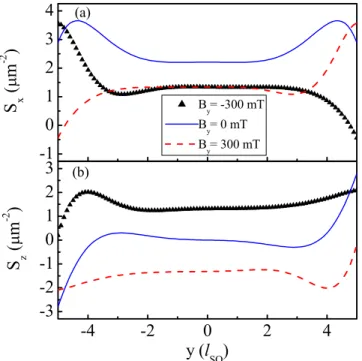
Transverse field orientation case is presented in Figs.3共a兲 and 3共b兲. The field effects on the spin distributions and on the parity of the Siprofiles are much more dramatic. In short, the Sxand Szprofiles become asymmetric in both their spatial and field dependencies. Sy, however, remains zero in all these cases. Qualitative understanding of these changes can be ob-tained again from the spin precession picture. We take, for instance, the Bx= −300 mT curve for Sz in Fig. 3共b兲. The FIG. 2. 共Color online兲 Spin densities Siversus y, in units of lso, for the case of a longitudinal in-plane magnetic field. Spin densities
Sx, Sy, and Sz in units of m−2 are shown in 共a兲, 共b兲, and 共c兲, respectively, for magnetic fields Bx= −300 mT 共black/ triangles兲,
Bx= 0 mT共blue/solid curve兲 and Bx= 300 mT共red/dashed curve兲. The edges of the stripe are at y =⫾5lso.
out-of-plane spin density Sz⯝1.5 m−2 in the bulk is re-sulted from the precession of the zero-field Sxand also from a spin-charge coupling term in Eq. 共8兲. On the other hand,
the Szedge spin accumulation is resulted from two spin pre-cession processes, if we treat Sias individual entities. First, the magnitude of Szedge accumulation is reduced due to its own precession. However, it may be increased due to the precession of Sx. As the zero-field Sx is even and the zero-field Szis odd in their spatial parity, it is inevitable that the magnitude of Sz will receive enhancement at one edge and suffer suppression at another. This leads to the breaking of the spatial parity of the Sz profile as is confirmed in Fig.3. The zero-field Sithus play a pivotal role in the shaping of the low in-plane magnetic-field Siprofile.
Figure4 presents the edge spin accumulations of Si⫾and their parity in their field dependencies. Si⫾denote edge spin densities at y =⫿d/2. For the longitudinal field orientation depicted in Figs.4共a兲and4共b兲, Sx⫾and Sz⫾are of even parity in Bx, whereas Sy⫾is of odd parity in Bx. The magnitude of the variation is comparable for Sy⫾and Sz⫾, a feature consis-tent with our spin precession picture. More detailed symme-tries can be read off from Eq.共7兲 and is given in the
follow-ing: Sy共z兲 + = −Sy共z兲 − , Sx + = Sx − , Sx⫾共z兲共Bx兲=Sx⫾共z兲共−Bx兲, and
Sy⫾共Bx兲=−Sy⫾共−Bx兲. For the transverse field orientation de-picted in Figs.4共c兲and4共d兲, Sx⫾and Sz⫾become asymmetric in their field dependencies, whereas Sy⫾= 0. The extremum points in Sz⫾at By= 50 and −50 mT in Figs. 4共c兲and 4共d兲, respectively, demonstrate the competition between the two spin precession processes: decreasing in magnitude due to its own precession and increasing in magnitude due to spin pre-cession in Sx⫾. Finally, if we include both the spatial and the
field reversals, we obtain symmetries Sz+共By兲=−Sz−共−By兲 and
Sx
+共B
y兲=Sx
−共−B
y兲.
The entire spatial and field symmetries of the out-of-plane spin densities are presented in the contour plots in Fig.5. In Fig. 5共a兲, the longitudinal field case exhibits even parity in
Bxand odd parity in y. In contrast, the transverse field case, depicted in Fig. 5共b兲, exhibits much richer features. Even though the asymmetry of Sz with respect to Byand y, indi-vidually, is evident, the symmetry Sz共By, y兲=−Sz共−By, −y兲 is also clearly shown. At the lateral edges, the highest spin densities are shifted from By= 0. It is resulted from the two competing spin precession processes. Near the center of the sample, Szis odd in Byand its magnitude increases with the field as indicated in Eq.共8兲 already.
FIG. 3. 共Color online兲 Spin densities Siversus y for the case of a transverse in-plane magnetic field. Spin densities Sx and Sz in units ofm−2are shown in共a兲 and 共b兲, respectively, for magnetic fields By= −300 mT共black/triangles兲, By= 0 mT共blue/solid curve兲, and By= 300 mT共red/dashed curve兲. Sy remains zero in all these cases.
FIG. 4. 共Color online兲 Edge spin densities Si⫾versus magnetic field for both field orientations: longitudinal Bxcases in共a兲 and 共b兲 and transverse Bycases in共c兲 and 共d兲. Si⫾denotes spin densities at the edges y =⫿d/2. Sx is labeled by the dashed curve, Sy by the dashed-dotted curve, and Szby the solid curve.
−5 −4 −3 −2 −1 0 1 2 3 4 5 −400 −200 0 200 400 B x (mT) y( so) −5 −4 −3 −2 −1 0 1 2 3 4 5 −400 −200 0 200 400 B y (mT) l −3 −2 −1 0 1 2 3 l y( so) Sz(µm−2) (b) (a)
FIG. 5. 共Color online兲 Contour plot of Szon the Bi-y plane for 共a兲 the longitudinal and 共b兲 the transverse field orientations.
The strong in-plane magnetic-field anisotropy in the sym-metry characteristics of the Siprofiles shown here is distinct for the Dresselhaus SOI. For the edge spin accumulation Sz in a transverse magnetic field, the Dresselhaus SOI leads to an asymmetric field dependence, whereas extrinsic SOI leads to a symmetric field dependence.6This symmetry character-istic for the extrinsic SOI is clearly seen in the experiment of Kato et al.6关Fig. 1共c兲 in Ref.6兴, and also in their demonstra-tion the Sz profile fits well to a Lorentzian function
A0/关共Ls兲2+ 1兴 which depends on even power of B through
the square of the electron Larmor precession frequency L.
The factor A0 is a proportionality constant and s is the
electron-spin lifetime. As for the Rashba SOI, symmetry governs that we turn to longitudinal magnetic field. We find no Szboth in the bulk and at edges, which is consistent with previous finding.11 In contrast, we find that the Dresselhaus SOI leads to an even-parity field dependence. Nonvanishing bulk spin density Szdue to Rashba SOI, but for the case of either anisotropic scatterers or nonparabolic electron disper-sion, has been obtained by Engel et al.11and the field depen-dence is of odd parity.11,17Thus we commence the notion of utilizing low in-plane magnetic field for the determination of the underlying SOI in a particular sample, without the need
to prepare controlling samples of different crystal orienta-tions.
IV. CONCLUSION
In conclusion, we have performed a systematic and com-prehensive study on the effects of a weak in-plane magnetic field on the bulk spin densities and edge spin accumulations in a diffusive Dresselhaus-type 2D stripe. Our results show that out-of-plane spin density can be generated in the case of transverse field orientation without assuming anisotropic scatterers or nonparabolic electron dispersion relations. The breaking of the parity of the spin distributions with respect to their spatial and field dependencies provide a unique signa-ture for the Dresselhaus SOI. This work thus points to the possibility of invoking weak in-plane magnetic fields for the determination of the SOI in a particular sample.
ACKNOWLEDGMENTS
This work was supported by Taiwan NSC共Contract No. 96-2112-M-009-0038-MY3兲, NCTS Taiwan, Russian RFBR 共Contract No. 060216699兲, and a MOE-ATU grant. We are grateful to the Centre for Advanced Study in Oslo for hospitality.
1M. I. Dyakonov and V. I. Perel, Phys. Lett. 35A, 459共1971兲. 2V. M. Edelstein, Solid State Commun. 73, 233共1990兲. 3J. E. Hirsch, Phys. Rev. Lett. 83, 1834共1999兲.
4S. Murakami, N. Nagaosa, and S. C. Zhang, Science 301, 1348 共2003兲.
5J. Sinova, D. Culcer, Q. Niu, N. A. Sinitsyn, T. Jungwirth, and A. H. MacDonald, Phys. Rev. Lett. 92, 126603共2004兲.
6Y. K. Kato, R. C. Myers, A. C. Gossard, and D. D. Awschalom, Science 306, 1910共2004兲.
7J. Wunderlich, B. Kaestner, J. Sinova, and T. Jungwirth, Phys. Rev. Lett. 94, 047204共2005兲.
8S. Q. Shen, Phys. Rev. B 70, 081311共R兲 共2004兲.
9E. I. Rashba, Sov. Phys. Solid State 2, 1109 共1960兲; Yu. A. Bychkov and E. I. Rashba, JETP Lett. 39, 78共1984兲.
10H. A. Engel, B. I. Halperin, and E. I. Rashba, Phys. Rev. Lett.
95, 166605共2005兲.
11H. A. Engel, E. I. Rashba, and B. I. Halperin, Phys. Rev. Lett.
98, 036602共2007兲.
12G. Dresselhaus, Phys. Rev. 100, 580共1955兲.
13A. G. Mal’shukov and K. A. Chao, Phys. Rev. B 71, 121308共R兲 共2005兲.
14W. K. Tse and S. DasSarma, Phys. Rev. B 74, 245309共2006兲. 15J. I. Inoue, G. E. W. Bauer, and L. W. Molenkamp, Phys. Rev. B
70, 041303共R兲 共2004兲; E. G. Mishchenko, A. V. Shytov, and B.
I. Halperin, Phys. Rev. Lett. 93, 226602共2004兲; A. A. Burkov, A. S. Núñez, and A. H. MacDonald, Phys. Rev. B 70, 155308 共2004兲; R. Raimondi and P. Schwab, ibid. 71, 033311 共2005兲; O. V. Dimitrova, ibid. 71, 245327共2005兲; B. A. Bernevig and S. C. Zhang, Phys. Rev. Lett. 95, 016801共2005兲.
16A. G. Mal’shukov, L. Y. Wang, C. S. Chu, and K. A. Chao, Phys.
Rev. Lett. 95, 146601共2005兲.
17Y. K. Kato, R. C. Myers, A. C. Gossard, and D. D. Awschalom, Phys. Rev. Lett. 93, 176601共2004兲.
18N. P. Stern, S. Ghosh, G. Xiang, M. Zhu, N. Samarth, and D. D. Awschalom, Phys. Rev. Lett. 97, 126603共2006兲.
19H. A. Engel, Phys. Rev. B 77, 125302共2008兲.
20R. V. Shchelushkin and A. Brataas, Phys. Rev. B 72, 073110 共2005兲.
21Q. Lin, S. Y. Liu, and X. L. Lei, Appl. Phys. Lett. 88, 122105 共2006兲.
22P. Lucignano, R. Raimondi, and A. Tagliacozzo, Phys. Rev. B
78, 035336共2008兲.
23M. Milletarì, R. Raimondi, and P. Schwab, Europhys. Lett. 82, 67005共2008兲.
24A. A. Abrikosov, L. P. Gorkov, and I. E. Dzyaloshinskii, Method
of Quantum Field Theory in Statistical Physics 共Dover, New
York, 1975兲.
25Spin-Orbit Coupling Effects in Two-Dimensional Electron and
Hole Systems, edited by Roland Winkler共Springer-Verlag,
Ber-lin, 2003兲.
26O. Bleibaum, Phys. Rev. B 74, 113309共2006兲.
27Y. Tserkovnyak, B. I. Halperin, A. A. Kovalev, and A. Brataas, Phys. Rev. B 76, 085319共2007兲.
28J. R. Shi, P. Zhang, D. Xiao, and Q. Niu, Phys. Rev. Lett. 96, 076604共2006兲.
29P. Zhang, Z. G. Wang, J. R. Shi, D. Xiao, and Q. Niu, Phys. Rev. B 77, 075304共2008兲.
30V. Sih, W. H. Lau, R. C. Myers, V. R. Horowitz, A. C. Gossard, and D. D. Awschalom, Phys. Rev. Lett. 97, 096605共2006兲.