IOP Conference Series: Materials Science and Engineering
PAPER • OPEN ACCESS
Carrier dynamics in Zn
x
Cd
1-x
O films grown by
molecular beam epitaxy
To cite this article: F J Cheng et al 2016 IOP Conf. Ser.: Mater. Sci. Eng. 131 012005
View the article online for updates and enhancements.
Related content
Investigation of resistive switching of ZnxTiyHfzOi nanocomposite for RRAM elements manufacturing
R V Tominov, E G Zamburg, D A Khakhulin et al.
-The effect of electronic orbital interactions on p-type doping tendency in ZnO series: First-principles calculations
Zhang Fang-Ying, You Jian-Qiang, Zeng Zhi et al.
-Low temperature ESR in spin ladder (C7H10N)2Cu(1x)ZnxBr4
Yu V Krasnikova, V N Glazkov, M A Fayzullin et al.
Carrier dynamics in Zn
xCd
1-xO films grown by molecular
beam epitaxy
F J Cheng1, Y C Lee2,*, S Y Hu3,**, Y C Lin4, K K Tiong4, and W C Chou5
1 Department of Electrical Engineering, Tungnan University, Shenkeng, New Taipei
City, Taiwan
2 Department of Electronic Engineering, Tungnan University, Shenkeng, New Taipei
City, Taiwan
3 Department of Digital Technology Design, Tungfang Design Institute, Kaohsiung,
Taiwan
4 Department of Electrical Engineering, National Taiwan Ocean University, Keelung,
Taiwan
5 Department of Electrophysics, National Chiao Tung University, Hsinchu, Taiwan
Corresponding author’s e-mail: * [email protected]
Abstract. In this work, the carrier dynamics in Zn1-xCd xO thin films with different Cd contents grown by molecular beam epitaxy system have been investigated using photoluminescence and time-resolved photoluminescence measurements. The carrier lifetime can be estimated from the PL decay curve fitted by triple exponential function. The emission energy dependence and temperature dependence of the PL decay time indicate that carrier localization dominate the luminescence mechanism of the ZnCdO alloy semiconductor.
1. Introduction
Recently, ZnO-based semiconductors materials have been rapidly and widely developed for laser diodes (LDs) and light-emitting diodes (LEDs), owing to theirs tunable band gap by alloying with MgO to reach ultraviolet region or by alloying with CdO to achieve the visible region [1-4]. For the application in the region from ultraviolet to green light spectra, the ZnCdO alloy is useful to fabricate ZnCdO-related heterostructures or quantum well structures, which are the key elements in ZnO-based light emitters and detectors [5]. Therefore, it is quite necessary to investigate the optical characteristics in the ZnCdO alloys, such as the properties of band gap engineering, exciton behavior, and luminescence. The luminescence behavior provides not only a fundamental insight into recombination process but also information about the carrier localization.
In this work, we investigate the luminescence characteristics of ZnCdO thin films with different Cd contents grown by plasma assisted molecular beam epitaxy (PA-MBE) system by temperature-dependent photoluminescence (PL) and time-resolved photoluminescence (TRPL) spectra.
2. Experimental
The investigated Zn1-xCdxO films were grown on the c-plane Al2O3 substrates by SVT Associates
molecular beam epitaxy system equipped with conventional effusion cells for evaporation of elemental Zn (6N) and Cd (6N). Oxygen (5N5) was supplied via an rf-plasma source after additional gas
MOIME 2016 IOP Publishing
purificat films we concentr concentr and 0.13 details ab The PL with 50 (Zolix o (PMT). T The lum TimeHar Model C temperat 3. Resul Figures content o shifts to ZnCdO figure 1( curve ca As show experime Figure 1 (d) 0.13. tion. In orde ere firstly gro ration of Z rations applie 3, respectivel
bout the grow and TRPL w ps duration omni 500) TRPL was p minescence d rp counting CCS-150 an ture-depende lts and discu 1(a)~(d) sho of 0.06, 0.08 lower energ thin films th (a)~(d) displ an be fitted by wn in the ins ental data an 1. 12 K PL s . The open ci er to reduce own at 350 ° Zn1-xCdxO w
ed for the fou ly by using t wth procedu were measur and a repeti with a grat performed us decay was d card, which nd LakeShor ent PL and T ussion ow the norm 8, 0.10, and 0 gy with incre he carrier li lay the lumi y a triple exp I sets of figure nd to obtain t spectrum of Z ircles display the lattice m C following was controlle ur ZnCdO sa the energy-d res have bee red by using
tion rate of ting of 1200 ing the techn detected with h was trigge re Model 3 TRPL spectra malized PL s 0.13, respect easing Cd co fetime were inescence de ponential fun
t A e1 ( e 1, the red the value of τ ZnCdO thin y the emissio mismatch be a 70 nm thic ed by adju amples are ap dispersive X-en described g a diode las 1 MHz. PL 0 grooves/mm nique of time th a high-sp ered with a 21 temperat a. spectra recor tively. It is o ontent. To fur e measured b ecay profile nction as [7] 1 ) ( 2 t A e solid curve τ. films with C on-energy-de etween Zn1-x ck ZnO buff usting the C pproximately -ray spectros in the previo ser (PicoQua measuremen m, and detec e-correlated peed PMT, f signal from ture controll rded at 12 K bserved that rther clarify by time-reso monitored a 2 ) ( 3 t t A e described fr Cd content o ependent life xCdxO and Afer layer grow Cd/Zn beam y estimated t scopy (EDX) ous work [6]. ant), which p nt was setup cted using a single-photo followed by the diode l ler were us K of ZnCdO the peak pos the luminesc olved PL tec at the PL pea ) 3 t rom equation f (a) 0.06, ( time. Al2O3, the Z wn at 650 °C m pressure. to be 0.06, 0 ) measureme . produces lig using a spec photomultip on counting ( a compute laser. Janis sed to carry O thin films sition of PL cence mecha chnique. The ak and the P n (1) can we (b) 0.08, (c) Zn1-xCdxO C. The Cd The Cd .08, 0.10, ent. More ght pulses ctrometer plier tube (TCSPC). r plug-in Research y out the with Cd spectrum anisms in e inset in PL decay (1) ell fit the
0.10, and
MOIME 2016 IOP Publishing
IOP Conf. Series: Materials Science and Engineering 131 (2016) 012005 doi:10.1088/1757-899X/131/1/012005
The estimated PL lifetime as a function of emission energy is further plotted as open circles in figure 1. The emission energy dependence of carrier lifetime shows that the luminescence decay is faster on the high energy side than the low energy side of PL spectrum. The decrease in the lifetime with increasing emission energy has been known as the characteristic of a localization effect and attributed to the localized carriers transfer process to lower energy states [8,9]. The decay rate of localized carriers is expressed as the radiative recombination rate plus the rate of transfer to lower energy sites, which results in the observed lifetime decreasing as the emission energy increases. The relationship between lifetime and emission energy can be expressed by [8,9]
me 0 1 exp / E E E E (2) where
is the radiative recombination lifetime, and E0 is the characteristic energy for the depth of thelocalized states. Eme is a definite energy for the decay time that equals the transfer time, which is
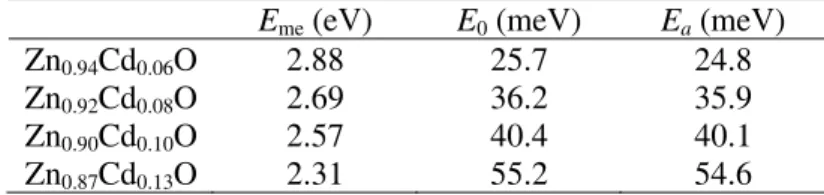
similar mobility edge. The red solid line in figure 1 indicates the best fit according to equation (2), and the obtained values of Eme, and E0 are listed in table 1. The value of Eme decreases from 2.88 eV to
2.15 eV as increasing Cd content. In addition, the obtained E0 for the Zn0.94Cd0.06O sample is 25.7 meV
and that increases to 55.2 meV for the Zn0.87Cd0.13O sample.
Table 1. The values of Eme, E0, and Ea estimated from equation (2) and (3), respectively. Eme (eV) E0 (meV) Ea (meV)
Zn0.94Cd0.06O 2.88 25.7 24.8
Zn0.92Cd0.08O 2.69 36.2 35.9
Zn0.90Cd0.10O 2.57 40.4 40.1
Zn0.87Cd0.13O 2.31 55.2 54.6
The lifetime
of the PL decay as a function of the reciprocal temperature, for the ZnCdO thin films with Cd content of 0.06, 0.08, 0.10, and 0.13, are further plotted in figure 2(a)~(d), respectively. It decreases slowly at low temperature region, but rapidly at the high temperature region. The temperature-dependent lifetime can be fitted using the function [10]
0
1 exp a/ T C E kT (3) where
0 is the lifetime at low temperature, the coefficient C is a fitting constant, and Ea is thethermal activation energy. It is known that the carriers would be delocalized from the localized states in thermalization process, which results in the reduction of the carrier lifetime. Therefore the activation energy Ea means the localization energy of the localized carriers [10]. The values of Ea are
estimated by fitting using equation (3) shown as the solid line in figure 2 and listed in table 1. The obtained values of Ea are in agreement with the values of E0, which confirm the delocalization of
carriers from the localized states in the thermalization process.
MOIME 2016 IOP Publishing
Figure 2 0.08, (c) 4. Summ We have and 0.13 the PL d the chara carriers w the carri mechani 5. Refer [1] Ö [2] La [3] W [4] Ye [5] Ca [6] C [7] Ha [8] Ya [9] M [10] Sh 2. Arrhenius 0.10, and (d mary e investigate 3 by PL and decay is faste acteristic of would be de er localizatio ism in ZnCdO rences Özgür Ü, Ali Morkoç H ange M, Die Grundman Wang Y, He 112103. e Z, Ma D, H aglar Y, Cag hien K F, H Cryst. Gro an N S, Shim ang M D, Ch Murotani H, Y Phys. 104 hu G W, Lo M 109. s plot of the d) 0.13. The s ed the lumin TRPL meas er on the hig a localizatio elocalized fro on would be O semicondu ivov Ya I, L 2005 J. Appl etrich C P, nn M 2010 J. H, Zhang Y He J, Huang glar M, Ilican Hsu W L, Tzo owth 378 208 m H S, Seo J hen K W, She Yamada Y, T 053514. M H, Yang M PL decay tim solid line is a nescence mec surements. T gh energy sid on effect. Th om localized increased w uctors Liu C, Teke l. Phys. 98 0 Czekalla C, Appl. Phys. , Sun L, Hu J, Zhao B, L n S and Ates ou A J, Lin Y 8. H, Kim S Y, en J L, Wang Taguchi T, Is M D, Hsu C L me of ZnCd a curve fitted chanism of t The emission de than on th he temperatur d states due t with increasin A, Reshchik 041301. , Zippel J, B 107 093530 L, Wu K, H Luo X and Xu A 2009 J. P Y C, Chou W , Park S M a g J C and Hs shibashi A, K L, Shen J L dO thin films d using equat the Zn1-xCdx -energy-depe he low energy re-dependen to thermal ac ng Cd conten kov M A, D Benndorf G, 0. Huang J and u Z 2003 J. C Phys. D: Appl W C, Lee L, and Song J K su C 2007 Na Kawaguchi Y and Lan S M s with Cd co tion (3). O films with endent PL d y side of PL t PL decay t ctivation. Ou t, which dom Doğan S, Avr Lorenz M, Ye Z 2012 A Cryst. Growt l. Phys. 42 06 Chia C H an K 2010 J. App anotechnolog Y and Yokog M 2007 Solid. ontent of (a) h x=0.06, 0. decay time sh L spectrum, e time present ur results ind minates the lu rutin V, Cho , Zúñiga-Pér Appl. Phys. th 256 78. 65421. and Yang C S pl. Phys. 107 gy 18 405707 gawa T 2008 d. State. Com 0.06, (b) .08, 0.10, hows that exhibiting s that the dicate that uminesce o S J and rez J and Lett. 100 S 2013 J. 7 084306. 7. 8 J. Appl. mun. 141
MOIME 2016 IOP Publishing
IOP Conf. Series: Materials Science and Engineering 131 (2016) 012005 doi:10.1088/1757-899X/131/1/012005