Using a 1.2 GHz bandwidth reflective
semiconductor optical amplifier with
seeding light by 64-quadrature
amplitude modulation orthogonal
frequency division multiplexing
modulation to achieve a 10-gbits
∕s
upstream rate in long-reach passive
optical network access
Chien-Hung Yeh
Hsing-Yu Chen
Chi-Wai Chow
Yu-Fu Wu
Using a 1.2 GHz bandwidth reflective
semiconductor optical amplifier with
seeding light by 64-quadrature
amplitude modulation orthogonal
frequency division multiplexing
modulation to achieve a 10-gbits
∕s
upstream rate in long-reach passive
optical network access
Chien-Hung Yeh
Hsing-Yu Chen
Chi-Wai Chow
Yu-Fu Wu
Using a 1.2 GHz bandwidth reflective semiconductor
optical amplifier with seeding light by 64-quadrature
amplitude modulation orthogonal frequency division
multiplexing modulation to achieve a 10-gbits
∕s upstream
rate in long-reach passive optical network access
Chien-Hung YehHsing-Yu Chen
Industrial Technology Research Institute Information and Communications Research
Laboratories
Chutung, Hsinchu 31040, Taiwan E-mail: [email protected] Chi-Wai Chow
National Chiao Tung University
Department of Photonics and Institute of Electro-Optical Engineering
Hsinchu 30010, Taiwan Yu-Fu Wu
Industrial Technology Research Institute Information and Communications Research
Laboratories
Chutung, Hsinchu 31040, Taiwan and
National Chiao Tung University
Department of Photonics and Institute of Electro-Optical Engineering
Hsinchu 30010, Taiwan
Abstract. We use a commercially available 1.2 GHz bandwidth reflective semiconductor optical amplifier (RSOA)—based optical network unit (ONU) to achieve10-gbits∕s upstream traffic for an optical orthogonal fre-quency division multiplexing (OFDM) long-reach passive optical network (LR-PON). This is the first time the 64—quadrature amplitude modulation (QAM) OFDM format has been applied to RSOA-ONU to achieve a 75 km fiber transmission length. In the proposed LR-PON, the upstream power penalty of 5.2 dB at the bit error rate of3.8 × 10−3is measured by using a 64-QAM OFDM modulation after the 75 km fiber transmission without dis-persion compensation.© 2012 Society of Photo-Optical Instrumentation Engineers (SPIE). [DOI: 10.1117/1.OE.51.1.015004]
Subject terms: reflective semiconductor optical amplifier; orthogonal frequency divi-sion multiplexing–quadrature amplitude modulation; continuous-wave injection. Paper 111357 received Oct. 30, 2011; revised manuscript received Nov. 15, 2011; accepted for publication Nov. 21, 2011; published online Feb. 6, 2012.
1 Introduction
In order to deliver the future broadband multi-services eco-nomically (such as data, voice, CATV, IPTV, 3D-TV, etc.), network operators need to reduce costs to sustain profit mar-gins. One possible method is to simplify the fiber network architecture, which would lead to the reduction of the num-ber of equipment interfaces and network devices. Hence, a long-reach (LR) access network has been proposed to solve this issue.1,2 The LR passive optical network (PON) can
combine metro and access networks into a single system that has the benefit of high capacity and a high split ratio, and the transmission can reach 40 to 100 km.3
Moreover, hybrid wavelength division multiplexing— time division multiplexing (WDM-TDM) PON has been considered as a potential solution for next-generation PON. Due to the bandwidth sharing of the TDM-PON, the hybrid WDM-TDM PON would provide a relative lower per-subscriber cost than pure WDM-PON by dividing a single wavelength to multiple subscribers while still maintaining a relatively high per-subscriber bandwidth.4 In the WDM
PON and hybrid WDM-TDM PON, using a centralized light source in a central office (CO) has been proposed to
reduce costs by removing the laser sources from the subscri-bers in PON, which can in turn reduce the inventory cost and simply the wavelength management.5Recently, using opti-cal orthogonal frequency division multiplexing–quadrature amplitude modulation (OFDM-QAM) modulation in carrier-distributed PONs to effectively enhance the transmission data rate and reduce costs has raised research interests.6,7 In these carrier-distributed PONs, a reflective semiconductor optical amplifier (RSOA) is usually used in each optical network unit (ONU) with upstream data rates of 1.25- or 2.5 g bits∕s OOK remodulation depending on the injection powers from the CO,5,8and the current commercially avail-able RSOA can only achieve 2.5 g bits∕s OOK remodulation even under a high optical injection power.
We propose and demonstrate 10 g bits∕s upstream traffic in a carrier-distributed LR-PON using a 1.2 GHz bandwidth RSOA-based ONU and 64-QAM OFDM modulation. In the carrier-distributed PON, a continuous wave (CW) optical signal is launched into the RSOA from the CO. Here, 20, 50, and 75 km-long single-mode fiber (SMF) transmissions are investigated in the proposed PON to determine the rela-tionship between transmission length and the signal-to-noise ratio (SNR). Moreover, we also discuss and analyze the upstream traffic performance when different CW injection levels are launched into RSOA.
2 Experiment
Figure 1 shows the proposed carrier-distributed hybrid WDM-TDM PON using RSOA-based ONU for 10 g bits∕s optical OFDM-QAM modulation upstream traffic. In the CO, we used two wavelength bands for the downstream data and CW signals distributed to each ONU via a 1× N WDM multiplexer and a 1× M optical splitter. The down-stream data and CW wavelengths were divided by a 1× 2 WDM coupler on each ONU, as shown in Fig. 1. Here, the CW wavelength was launched into the RSOA to generate the upstream optical OFDM-QAM signal. In the practical PON system, we used two fibers to avoid the Rayleigh back-scattering noise when the colorless upstream wavelength was employed.
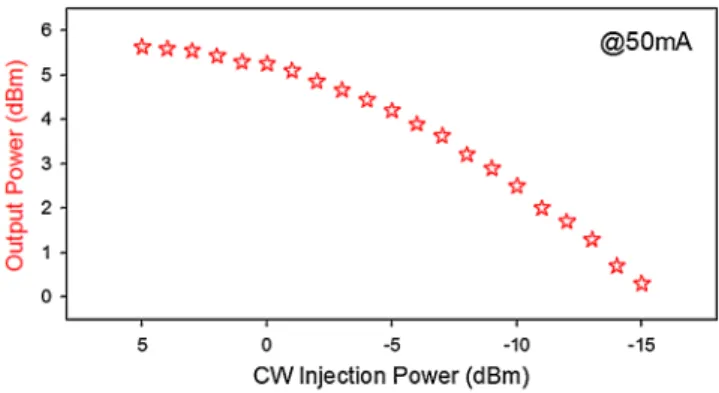
Figure2shows the experimental setup for evaluating the proposed RSOA-based ONU to achieve the 10 g bits∕s 64-QAM OFDM upstream data rate in the carrier-distributed PON. The RSOA (produced by CIP) had a 1.2 GHz band-width when operated at a 50 mA bias current. A CW wave-length of 1550.0 nm was distributed from the CO through the upper SMF with different lengths of 20, 50, and 75 km and was then injected into the RSOA via an optical circulator (OC), as illustrated in Fig.2. An erbium-doped fiber ampli-fier (EDFA) (with a gain of 23 dB and noise figure of 5 dB) and optical variable attenuator were utilized to adjust the dif-ferent CW injection power levels launching into the RSOA. Furthermore, the relaxation oscillation frequency of RSOA could be increased by optical injection;8hence, a higher opti-cal power increased the modulation speed of the RSOA. Here, Fig.3presents the output powers of the RSOA versus different CW injection power levels of−15 to 5 dBm, and the corresponding output powers of RSOA are also measured among 0.3 and 5.6 dBm.
In our experiment, the baseband electrical OFDM upstream signal was generated by an arbitrary waveform generator (AWG) utilizing the Matlab® program. The signal processing of the OFDM transmitter consisted of a serial-to-parallel conversion, QAM symbol encoding, inverse fast Fourier transform (FFT), cyclic prefix (CP) insertion, and digital-to-analog conversion (DAC). A 12 g sample∕s sam-pling rate and an 8 bit DAC resolution were set by the AWG, and a CP of 1∕64 was used. Thus, 72 subcarriers of the 64-QAM format occupied nearly 1.66 GHz bandwidth of 0.26 to 1.92 GHz, with an FFT size of 512. Here, a yield of approximately 22 MHz subcarrier spacing and approxi-mately 10 g bits∕s total data rate were observed. Thus, the produced electrical 64-QAM OFDM signal could be applied on RSOA via a bias tee. The upstream signal was then pro-pagated via the OC and lower SMF to the CO, as shown in Fig.2. The upstream signal was direct detected via a 2.5 GHz PIN receiver at the CO without using a pre-amplifier, and the received OFDM signal was captured by a real-time 50 GHz sampling oscilloscope for signal demodulation. To demodu-late the vector signal, the off-line DSP program was employed, and the demodulation process contained the syn-chronization, FFT, one-tap equalization, and QAM symbol decoding. Therefore, the bit error rate (BER) was calculated according to the observed SNR.
Figure4 shows the measured SNR of each OFDM sub-carrier in the frequency bandwidth of 0.26 to 1.92 GHz with different SMF transmissions at back-to-back (B2B), 20 km, 50 km, and 75 km, respectively, without dispersion compen-sation under different CW injection power levels of−3 to 0 dBm launching into RSOA. In this measurement, the opti-cal received power was fixed at−6 dBm and the CW injec-tion power of−2 dBm was launched into RSOA. The entire measured subcarriers achieved the forward error correction (FEC) threshold [BER¼ 3.8 × 10⁻³ (SNR¼ 21.2 dB) and redundancy ratio of 7%],9at B2B, 20 km, and 50 km,
respec-tively, as shown in Fig.4. However, when the transmission fiber length was 75 km, the measured SNR for some high frequency subcarriers could not achieve the FEC threshold due to fiber chromatic dispersion. As also shown in Fig.4, when we decreased the CW injection power level gradually, the subcarriers at high frequency also experienced a SNR penalty simultaneously owing to the reduction in relaxa-tion oscillarelaxa-tion frequency of the RSOA. Due to the power fading and fiber dispersion effects after a 100 km fiber trans-mission via the 64-QAM OFDM modulation, the required SNR of each subcarrier was worse in the measurement. Fig. 1 The proposed carrier-distributed PON access system using
RSOA-based ONU for 10 g bits∕s upstream traffic by OFDM-QAM modulation.
Fig. 2 Experimental setup of proposed RSOA-based ONU to achieve the10 g bits∕s upstream rate by 64-QAM OFDM modulation.
Fig. 3 The output power of RSOA with a 50 mA bias current versus a different CW injection power level of−15 to 5 dBm.
Here, even when we increased the injected power to 4 dBm, the upstream signal was unable to transmit over 100 km in length.
We also investigated the BER measurement in different CW injection levels and transmission lengths. Figure 5 shows the BER performance of RSOA-based upstream sig-nal at the B2B, 20-, 50-, and 75 km SMF transmissions, respectively, in the CW injection power levels of 4 to −10 dBm, when the received power is fixed at −6 dBm. The inserts of Fig.5are the corresponding constellation dia-grams measured at the FEC threshold. To achieve the FEC threshold level at the B2B, 20-, 50-, and 75 km transmis-sions, the minimum CW injection powers had to be larger than −9, −8, −6, and −1 dBm, respectively, as illustrated in Fig. 5.
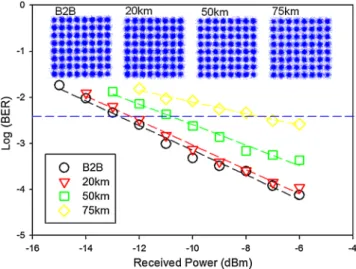
Finally, according to the measured results of Fig.5, we set the CW injection power of −1 dBm launching into RSOA for the upstream transmission. Figure 6 presents the BER performances of RSOA-based 10 g bits∕s 64-QAM OFDM upstream signal at the B2B, 20-, 50-, and 75 km SMF propagations, respectively. The inserts of Fig. 6 are corre-sponding constellation diagrams. In Fig.6, we can observe
the received powers at−12.6, −12.2, −10.8, and −7.4 dBm at B2B, 20-, 50-, and 75 km fiber transmissions, respectively, at the FEC threshold level. The measured power penalty of 5.2 dB was observed after a 75 km SMF transmission at the BER of 3.8× 10⁻³. In a LR-PON system, we added the EDFA, with a 23 dBm saturated power and approximate 5 dB noise figure, in the exchange node to enhance the injection power of seeding light for maintaining a−1 dBm seeding power.
3 Conclusion
We have proposed and demonstrated 10 g bits∕s upstream traffic in a carrier-distributed LR-PON using a commercially available 1.2 GHz bandwidth RSOA-based ONU and a 64-QAM optical OFDM modulation. In this carrier-distributed PON, a CW optical signal was launched into the RSOA from the CO, and 20-, 50-, and 75 km SMF transmissions were evaluated. In the measurement, when the CW injection power was−1 dBm, the SMF transmission length of the RSOA-based upstream could achieve 20, 50, and 75 km simultaneously at the FEC threshold level (BER¼ 3.8 × 10⁻³). The generated penalties of 0.4, 1.8, and 5.2 dB were also measured after 20-, 50-, and 75-km fiber transmissions, respectively, in the proposed RSOA-based ONU LR-PON system.
References
1. P. D. Townsend et al.,“Long reach passive optical networks,” presented at the IEEE LEOS Annual Meeting, IEEE Photonics Society, Florida, USA (2007).
2. C. H. Wang et al.,“Rayleigh noise mitigation using single sideband modulation generated by a dual-parallel MZM for carrier distributed PON,”IEEE Photon. Technol. Lett.22(11), 820–822 (2010). 3. C. W. Chow and C. H. Yeh,“Long-reach DWDM PON,” presented at
the IEEE Photonics Society Annual Meeting, IEEE Photonics Society, Denver, Colorado, USA (2010).
4. H. H. Lee et al.,“A bidirectional SOA-Raman hybrid amplifier shared by 2.5 Gb∕s, 60 km long-reach WDM-TDM PON,” in Proc. ECOC, IEEE Photonics Society, Brussels, Paper P.6.05 (2008).
5. C. H. Yeh et al.,“Wavelength tunable laser for signal remodulation in WDM access networks using DPSK downlink and OOK uplink,”IEEE Photon. Technol. Lett.21(22), 1710–1712 (2009).
6. Y. M. Lin, “Demonstration and design of high spectral efficiency 4 Gb∕s OFDM system in passive optical networks,” in Proc. OFC, OSA, Anaheim, CA, Paper OThD7 (2007).
Fig. 4 The SNR of each OFDM subcarrier under different CW injec-tion levels launching into RSOA at the B2B, 25-, 50-, and 75 km fiber transmissions, respectively.
Fig. 5 BER measurements of RSOA-based ONU at B2B, 20-, 50-and 75 km SMF transmissions, respectively, under the different CW injection power of−10 to 4 dBm. The inserts are corresponding constellations.
Fig. 6 BER measurements of RSOA-based ONU at B2B, 20-, 50-, and 75 km SMF transmissions, respectively, at the CW injection power of−1 dBm. The inserts are corresponding constellations.
7. B. Liu et al., “A WDM-OFDM-PON architecture with centralized lightwave and PolSK-modulated multicast overlay,” Opt. Express 18(3), 2137–2143 (2010).
8. C. H. Yeh et al.,“A self-protected colorless WDM-PON with 2.5 Gb∕s upstream signal based on RSOA,”Opt. Express16(16), 12296–12301 (2008).
9. ITU-T Recommendation G.975.1,“Forward error correction for high bit-rate DWDM submarine systems,” Appendix I.9 (2004).
Chien-Hung Yeh received his PhD degree from the Institute of Electro-Optical Engineering at National Chiao Tung University in Hsinchu, Taiwan, in 2004. He is a lead researcher in the Information and Communications Research Laboratories at the Industrial Tech-nology Research Institute in Taiwan and oversees the Advanced Project of Optical Access Networks. His major research interests are optical fiber communication; TDM-, WDM-, and ROF-PON access; WiMAX-ROF in high-speed rail; fiber laser; fiber amplifier; optical sensor; THz over fiber; and green LED communication. He is a member of IEEE and OSA.
Hsing-Yu Chen received his MS degree from the Institute of Electro-Optical Engineering at the National Taipei University of Technology in Taipei, Taiwan, in 2009. He currently is an associate engineer in the Information and Communications Research Laboratories at the Indus-trial Technology Research Institute in Taiwan.
Chi-Wai Chow received BEng (with first-class honors) and PhD degrees from the Department of Electronic Engineering at the Chinese University of Hong Kong in 2001 and 2004, respectively. He was then appointed as a postdoctoral fellow at the CUHK, working on hybrid integration of photonic components and silicon waveguides. Between 2005 and 2007, he was a postdoctoral research scientist at the Tyndall National Institute and in the Department of Physics at the University College Cork in Ireland, working mainly on two European Union projects—PIEMAN (the photonic integrated extended metro and access network) and TRIUMPH (the transparent ring intercon-nection using multi-wavelength photonic switches). In 2007, he joined National Chiao Tung University in Taiwan, where he is currently an associate professor in the Department of Photonics.
Yu-Fu Wu received his MS degree from the Department of Photonics Engineering at Yuan Ze University in Taipei, Taiwan, in 2009. He currently is an associate engineer in the Information and Communi-cations Research Laboratories at the Industrial Technology Research Institute in Taiwan.