
朝鮮糧食安全 1994-2011 - 政大學術集成
118
0
0
全文
(2) 立立. 政 治 大. •‧. •‧ 國. ㈻㊫學. n. er. io. sit. y. Nat al. Ch. n engchi U. 2. iv.
(3) Acknowledgements. I would like to express my gratitude to all those who helped me during the writing of this thesis. I gratefully acknowledge the help of my supervisor, Dr. WenYang Chang, who has offered me valuable suggestions in the academic studies. During the time preparing of the thesis, he has spent much time reading through each draft and provided me with inspiring advice. Without his patient instruction, insightful criticism and expert guidance, the completion of this thesis would not have been possible.. 政 治 大. I also owe a special debt立立of gratitude to my thesis committee members, Dr.. •‧ 國. ㈻㊫學. Pai-Po Lee and Dr. Sally Ping. They also spent lots of time on reading through my. •‧. thesis draft and provided constructive advises and assisted me on how to solve the. sit. y. Nat. er. io. problems. I would like to thank all the professors in IMPIS program, from whose. a. n. v. i devoted teaching and enlighteningl C lectures I have benefited a lot and academically hengchi Un prepared for the thesis.. Last my thanks would go to my beloved family for their loving considerations and great confidence in me. I also owe my sincere gratitude to my friends and my fellow classmates who gave me their help and time in listening to me and helping me work out my problems during the difficult course of the thesis. 3.
(4) Table of Contents List of Tables ....................................................................................................................... 5 List of Figures ...................................................................................................................... 6 Acronyms ............................................................................................................................. 7 Chapter 1 Introduction ................................................................................................. 10 1-1 Research Purpose ................................................................................................................ 12 1-2 Research Methods ............................................................................................................... 18 1-3 Research Limitations .......................................................................................................... 20 1-4 Research Outline ................................................................................................................. 21 Chapter 2 Literature Review ...................................................................................... 24 2-1 Human Security ................................................................................................................... 24 2-2 Food Security ........................................................................................................................ 27 2-3 Foreign Food Aid ................................................................................................................. 32 Chapter 3 The Leadership and Famine in North Korea ..................................... 38 3-1 Famine in North Korea ...................................................................................................... 38 3-2 Kim Jong-Il’s Leadership .................................................................................................. 40 政 治 大 3-3 Public Distribution System ................................................................................................ 48 . 立立. •‧. •‧ 國. ㈻㊫學. Chapter 4. Bilateral Food Aid to the DPRK ............................................................. 54 4-1 Bilateral Food Aid ............................................................................................................... 54 4-2 South Korean Food Aid to the DPRK ............................................................................. 58 4-3 Chinese Food Aid to the DPRK ........................................................................................ 68 4-4 ROK and China Comparison ........................................................................................... 73 . Nat. n. er. io. sit. y. Chapter 5 International Food Aid to the DPRK .................................................... 78 5-1 International Food Aid ....................................................................................................... 79 5-2 FAO/WFP Food Aid to the aDPRK .................................................................................. 82 iv l C n 5-3 The Role of the NGOs ......................................................................................................... 90 U h. engchi. Chapter 6 Conclusion and Future Prospects ......................................................... 98 6-1 Kim Jong-il and the Famine .............................................................................................. 99 6-2 Was Food Aid Enough? .................................................................................................. 100 6-3 Key Factors Leading to Food Insecurity in North Korea ........................................ 101 6-4 The Alleviation of Food Insecurity in North Korea .................................................. 104 References ...................................................................................................................... 108 . 4.
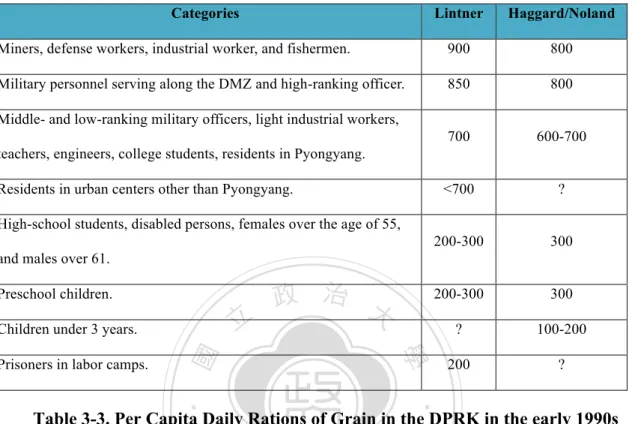
(5) List of Tables Table 1-1. Undernourished Population in Asia Countries Table 3-1. The Personality and Related Incidents of Kim Jong-Il. Table 3-2. Membership of the Korean Workers Party (KWP) Table 3-3. Per Capita Daily Rations of Grain in the DPRK in the early 1990s Table 4-1. The UN Sanctioned Resolutions and the Chinese Reactions. Table 5-1. Stunting, Wasting and Underweight Prevalence, By Province (%) Table 5-2. The Four Types of NGOs Working in North Korea Table 5-3. Timeline of NGO Aid to North Korea from 1950–2005. 立立. 政 治 大. •‧. •‧ 國. ㈻㊫學. n. er. io. sit. y. Nat al. Ch. n engchi U. 5. iv. 13 42 45 47 69 87 90 93.
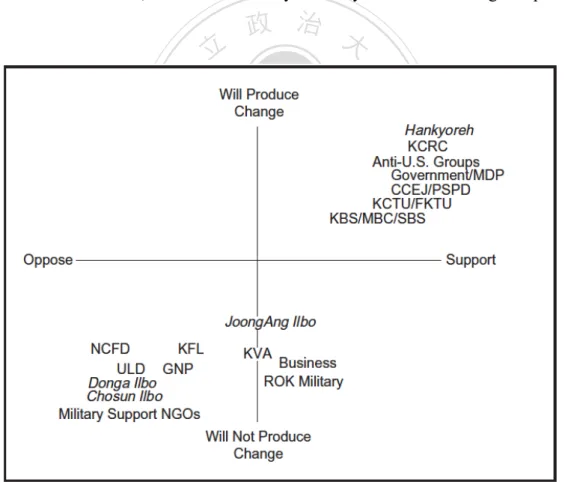
(6) List of Figures Figure 1-1. GDP Per Capita in DPRK and Its neighbors 1970-2011 (Unit: USD). 14. Figure 2-1. Number of the DPRK Defectors Entering South Korea, 1998-2013. 28. Figure 2-2. Rice Production in the DPRK (Unit: tons), 1990-2012. 33. Figure 2-3. Total Estimated Food Aid to North Korea, 1995-2012. 34. Figure 2-4. Thesis’ Dependent Variables and Independent Variables. 35. Figure 4-1. Notional Position of Major Actors on Sunshine Policy. 60. Figure 4-2. ROK - Top 10 Recipients of Bilateral ODA (2007-11, in US$M). 62. Figure 4-3. ROK - Top 10 Recipients of Multilateral ODA (2007-11, in US$M). 63. Figure 4-4. Public and Private Aid to the政 North治 from the South (2001-2012). 64. 大. Figure 4-5. Number of Inter-Korean立立Talks (Unit: times). 65. •‧ 國. ㈻㊫學. Figure 4-6. Timeline in North Korea: Domestic Policies Related to Food Supply. •‧. Figure 5-1. DPRK’s Cereal Production 1981-2012 (Unit: 1000 tons). 72. Nat. sit. y. 82 84. er. io. Figure 5-2. DPRK Cereal Imports, from 2005 to 2013 (1000 tons). n. a. v. i GHI (%) l C Million) and nthe Figure 5-3. International Food Aid (USD hengchi U. 6. 85.
(7) Acronyms ACA. Arms Control Association. ADB. Asian Development Bank. CIA. Central Intelligence Agency. NKHR. Citizens' Alliance for North Korean Human Rights. CESVI. Cooperation and Development (Italy). CFSAM. Crop and Food Security Assessment. CFSAM. Crop and Food Security Assessment Mission. DPRK. Democratic People's Republic of Korea. DAC. Development Assistance Committee. EDCF. Economic Development Cooperation Fund. EIU. Economist Intelligence Unit. EXIM Bank. 政 Export-Import Bank of Korea. 大. FAO. Food and Agriculture Organization. FFCD. Food-For-Community Development. GATT. General Agreement on Tariffs and Trade. GHA. Global Humanitarian Assistance. GHI. al Global Hunger Index. •‧. •‧ 國. ㈻㊫學. FAC. 立立 Food Aid Convention. n. er. io. sit. Nat. y. 治. iv. GNP. n engchi U Grand National Party (ROK). GNI. Gross National Income. HRD. Human Resources Development. IGO. Inter-governmental Organization. IBRD. International Bank for Reconstruction and Development. IDA. International Development Association. IEFR. International Emergency Food Reserve. IFPRI. International Food Policy Research Institute. IFDA. International Foodservice Distributors Association. IO. International Organization. KOICA. Korea International Cooperation Agency. KEDO. Korean Peninsula Energy Development Organization. KWP. Korean Workers Party. Ch. 7.
(8) LiNK. Liberty in North Korea. MDP. Millennium Democratic Party (ROK). NGO. Non-governmental Organization. ODA. Official Development Assistance. OECD. Organization for Economic Cooperation and Development. ODI. Overseas Development Institute (UK). PRROs. Protracted Relief and Recovery (WFP). PDS. Public Distribution System. ROK. Republic of Korea. SEZ. Special Economic Zone. UNICEF. The United Nations Children's Fund. US. The United States of America. NPT. Treaty on the Non-Proliferation of Nuclear Weapons. US GAO. U.S. Government Accountability 政 治Office. UN. United Nations. UNCTAD. United Nations Conference on Trade and Development. UNDP. United Nations Development Programme. UNHCR. United Nations High Commissioner for Refugees. UNSC. United Nations Security Council. UDHR WFP. Universal Declaration a l of Human Rights i v n C World Food Programmeh e n g c h i U. WHO. World Health Organization. WTO. World Trade Organization. 大. 立立. n. er. io. sit. y. •‧. •‧ 國. ㈻㊫學. Nat. 8.
(9)
(10) Chapter 1 Introduction. Do foreign aid and food supplies make North Korea more secure? It is hard to find a parallel case in the international community for the Democratic People’s Republic of Korea (DPRK, or North Korea1), which has been plagued by economic failure, hereditary politics, national historical division, and international sanctions. The nuclear weapons program and unpredictable leadership in North Korea have received most of the international attention. In the post-Cold War era, non-traditional security has become an important arena in the study of international relations. Based. 政 治 大 on the assumption that observers study non-traditional security issues in North Korea 立立. •‧ 國. ㈻㊫學. less than traditional security, this thesis aims to analyze the food security issue in the. •‧. country. In chapter one, the author will discuss the fundamental structure of this. io. sit. y. Nat. thesis, which includes the research background, research methodology, the. er. n. delimitation of research, the research a outline and the list of acronyms.. iv l C hengchi Un. According to Food and Agriculture Organization (FAO) statistics, there are 870 million hungry people in the world and 98 percent of them are in developing countries. Furthermore, there are 66.4 percent (578 million) of the hungry people living in the Asia-Pacific region (WFP N.d.-b). Food security is one of the seven dimensions of human security according to the definition used by United Nations Development Programme (UNDP), and it is highly related to individual security, health security, and economic security (UNDP 1994)2. The United Nations Development Programme. 1 2. DPRK and North Korea will be used interchangeably in the thesis. The three other dimensions of human security are political security, environmental security, and community security.. 10.
(11) (UNDP) is devoted to partnering “with people at all levels of society to help build nations that can withstand crisis, and drive and sustain the kind of growth that improves the quality of life for everyone,” and it “offers global perspective and local insight to help empower lives and build resilient nations (UNDP 1994).” Malnutrition could cause disease hindering the physical or mental development of an individual, while undernourishment could affect a student’s school performance or lead to lower income as an adult.. North Korea is a socialist state with a one-man dictatorship political system headed by the Kim family, with Kim Il-Sung (1948-1994), his son Kim Jong-Il (1994-. 治. 政 being its 2011), and grandson Kim Jong-Un (2011-) 大 three consecutive leaders. This. 立立. •‧ 國. ㈻㊫學. study is going to examine the nature and implications of food security in the DPRK. •‧. from 1994 to 2011 under the leadership of Kim Jong-Il. It will also focus on related. sit. y. Nat. cross border issues such as North Korean refugees fleeing to other countries. Most. er. io. North Korean defectors are economic migrants 3 , and they choose China’s. al. n. v ni C U h northeastern provinces, such as Jilin, where e n gthere c h i are about 2 million ethnic Koreans, as the most convenient safe haven for making a better life. This study will confine itself to human security in the DPRK. It will also study how international organizations provide the DPRK with food aid and how they manage on the food supply issue in North Korea.. Before proceeding with this study, it is necessary to define what the concept of food security is. According to the definition provided by the FAO, “Food security exists when all people, at all times, have physical, social and economic access to 3. The term economic migrants mentioned here mean those North Korean defectors decided to flee to China out of economic considerations instead of political or other consideration.. 11.
(12) sufficient safe and nutritious food that meets their dietary needs and food preferences for an active and healthy life (FAO N.d.-a).”. 1-1 Research Purpose Humankind deserves the food they need no matter where or who they are. Among all the dimensions of human security,4 the author chooses food security, particularly in relation to the shortage of food supplies in North Korea. Food security is one of the fundamental human rights. Civilians in North Korea still face shortages and difficulties in accessing daily food requirements due to late spring droughts, summer flooding, economic downturns, 治 capacity to access international 政 limited. 立立 (WFP. 2012). On the other hand, inter-governmental. ㈻㊫學. •‧ 國. capital markets, and so on. 大. organizations (IGOs) and non-governmental organizations (NGOs) provide food year-. •‧. round for the people in North Korea. Even with the international assistance, domestic. sit. y. Nat. al. n. food supplies.. er. io. polices of the DPRK deprive the most needy people from getting access to foreign. Ch. n engchi U. iv. Geographically speaking, North Korea is close to Taiwan. Although there are no diplomatic relations between North Korea and Taiwan, it is still important to understand neighboring countries’ roles in the region. Issues related to North Korea, including nuclear weapons testing, illegal migrants, defectors, and the relationship between the two Koreas, are a crucial aspect of East Asian regional affairs. Furthermore, the paper aims to address North Korean food supply issues through a. 4. The UNDP's 1994 Human Development Report's definition of human security argues that the scope of global security should be expanded to include threats in seven areas: Economic security, food security, health security, environmental security, personal security, community security, and political security.. 12.
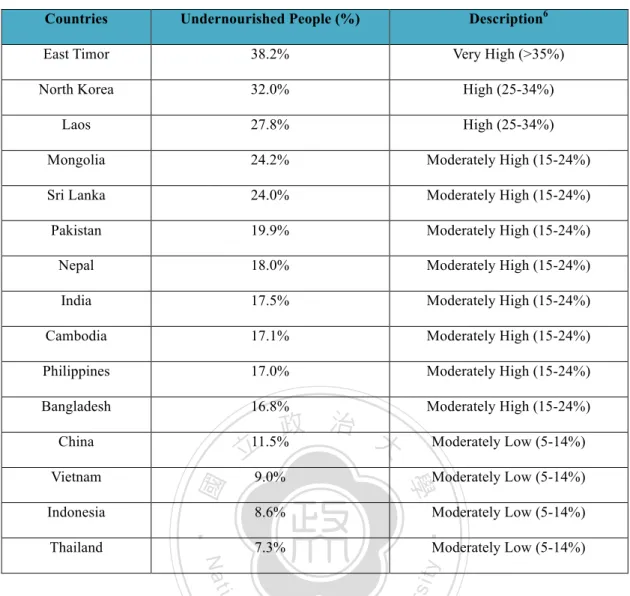
(13) non-traditional international relations approach in order to attract more attention from the international community to the violation of human security in that country.. To further address the broader issue of human security, it is necessary to gain a more focused understanding of food security developments in North Korea. As Liu (2009) notes, “[r]ecently, food production and supply has been affected by unpredictable climate change and unaccountable manmade factors in the region. With increased pressure from food security issues, personal health and human security is badly affected. It poses a threat to human security and becomes a concern of all states (Liu 2009).”. 立立. 政 治 大. •‧ 國. ㈻㊫學. Various sources have indicated that food security in North Korea is a serious,. •‧. if not the most serious, issue affecting human security in the country. According to. sit. y. Nat. the United Nations Conference on Trade and Development (UNCTAD), the. er. io. population of North Korea was 24,554,000 in 2012 (UNCTAD 2010). According to. al. n. v ni C U h the statistical data published by the International e n g c h iFoodservice Distributors Association (IFDA), World Food Program (WFP), and Food and Agriculture Organization (FAO), the number of undernourished persons in North Korea was 8 million in 2012 and the prevalence of undernourishment was around 32 percent (IFDA et al. 2012). According to the 2012 Hunger Map provided by WFP, three Asian countries (Laos, North Korea, and East-Timor) were facing serious famines. This data classifies the severity of famines and degree of undernourishment on five-point ordinal scales, with the categories being very low, moderate low, moderate high, high, and very high. North Korea and Laos had famine levels of category 4 (high), with 32 percent and 27.8 percent, respectively, of their populations undernourished, while East-Timor is a. 13.
(14) category 5 (very high) with 38.2 percent of the population undernourished, the most serious in Asia (Table 1-1) (WFP 2012). Another statistic provided in the 2012 Global Hunger Index indicated that North Korea scored 19 (serious), while Laos scored 19.7 (alarming) and East Timor scored 27.3 (alarming) (IFPRI N.d.). Global Hunger Index (GHI) 5 highlights successes and failures in hunger reduction and provides insights into the drivers of hunger (IFPRI et al. 2012).. 立立. 政 治 大. •‧. •‧ 國. ㈻㊫學. n. er. io. sit. y. Nat al. 5. Ch. n engchi U. iv. The Global Hunger Index (GHI) is a statistical tool used to evaluate and describe the state of countries’ hunger situation. The Index was developed by the International Food Policy Research Institute (IFPRI), and was first published in 2006 and is updated once a year. The index considers multidimensional variables and is generated under the formula. Countries with the higher GHI are facing severe hunger problem. GHI has five categories, which are Extremely Alarming (GHI≥30), Alarming (GHI: 20.0-29.9), Serious (GHI: 10.0-19.9), Moderate (GHI: 5.0-9.9), and Low (GHI≤4.9).. 14.
(15) Countries. Undernourished People (%). Description6. East Timor. 38.2%. Very High (>35%). North Korea. 32.0%. High (25-34%). Laos. 27.8%. High (25-34%). Mongolia. 24.2%. Moderately High (15-24%). Sri Lanka. 24.0%. Moderately High (15-24%). Pakistan. 19.9%. Moderately High (15-24%). Nepal. 18.0%. Moderately High (15-24%). India. 17.5%. Moderately High (15-24%). Cambodia. 17.1%. Moderately High (15-24%). Philippines. 17.0%. Moderately High (15-24%). Bangladesh. 16.8%. Moderately High (15-24%). 政 治 大 11.5% 立立. China. 8.6%. Moderately Low (5-14%) Moderately Low (5-14%). •‧. Thailand. •‧ 國. Indonesia. 9.0%. ㈻㊫學. Vietnam. Moderately Low (5-14%). 7.3%. Moderately Low (5-14%). io. sit. y. Nat al. er. Table 1-1. Undernourished Population in Asia Countries. n. v ni U e n g cMap,” Source: Compiled from “2012 Hunger h i World Food Programme, Ch. http://cdn.wfp.org/hungermap/#TL (accessed July 30, 2013).. By comparing the elements that affect food security in these three countries, one can find similarities, such as the prevalence of deforestation, extreme climatic instability, droughts, and floods. However, North Korea has faced unique problems, such as economic instability, lack of agricultural inputs (e.g., fertilizers), and limited capacity to access international capital markets and imported food. Problems facing East-Timor and Laos are related to the environment and natural disasters, such as 6. There are five categories of the percentage of undernourished level shows in the Hunger Map. The higher the percentage leads to the more serious hunger situation in the country. The five levels are very low (<5%), moderate low (5-14%), moderate high (15-24%), high (25-34%), and very high (>35%).. 15.
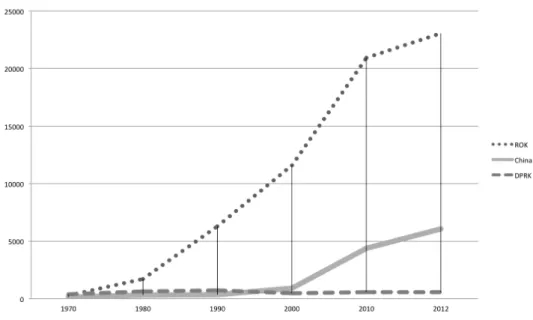
(16) droughts, floods, pest outbreaks, environmental degradation, relocation to areas without sufficient land for rice cultivation, unexploded ordnance, poor education, etc. (WFP 2012). However, the problems plaguing North Korea are more related to domestic policies adopted by its political leaders. Figure 1 indicates that the GDP per capita of the DPRK was more than that of the Republic of Korea (ROK) before 1974. How DPRK economic development stagnated and was overtaken by its neighbors explains why the case study of DPRK food security has become a great concern for the international community.. 立立. 政 治 大. •‧. •‧ 國. ㈻㊫學. n. er. io. sit. y. Nat al. Ch. n engchi U. iv. Figure 1-1. GDP Per Capita in DPRK and Its neighbors 1970-2011 (Unit: USD) Source: “Gross Domestic Product (GDP) of DPRK, 1970-2011,” World Microeconomic Research, http://kushnirs.org/macroeconomics/gdp/gdp_dprk.html#t1 (accessed Sep 29, 2013).. Academic research related to North Korea is mainly focused on its nuclear program and seldom touches upon the fundamental human rights issues. The North Koreans deserve daily basic food supplies, no matter where and who they are. This thesis intends to shift the spotlight from high politics in North Korea to the issues of low politics, namely, the food insecurity of the Korean people. 16.
(17) An important aim of this study is to help increase awareness of food security in the DPRK and its ramifications for neighboring countries such as China, South Korea and for the international community as a whole. A survey on the subject of food security in the DPRK may stimulate other scholars to examine this important human security issue. In general, most academic topics when mentioning East Asian countries are dealing with territorial disputes or DPRK’s nuclear program. The subject of food security is scarcely researched in this region. This study does not seek to avoid the difficulties of collecting sufficient documents or raising provocative questions. These are important means to challenge our assumptions and deepen our. 治. 政 understanding of important issues. Presenting controversial positions, provided they 大. 立立. •‧ 國. ㈻㊫學. are accurate and defensible, will spur other scholars to conduct research into this. •‧. neglected facet of the DPRK’s security.. sit. y. Nat. er. io. This thesis argues that food security in North Korea is predominantly affected by. al. n. v ni C U h three factors: domestic politics, international and neighboring countries. e n g organizations, chi First, it seeks to explore how the North Korean government treats the issue of food security. In particular, it focuses on the years from 1994 to 2011, when North Korea was governed by Kim Jong-Il and faced its most serious famine (Haggard and Noland 2007).. Secondly, this thesis identifies which international organizations are involved and how they deal with food security in the DPRK. The DPRK is a food insecure country that depends on bilateral food aid and imports to address internal food production shortfalls. Increasing global food and fuel prices and reductions in the. 17.
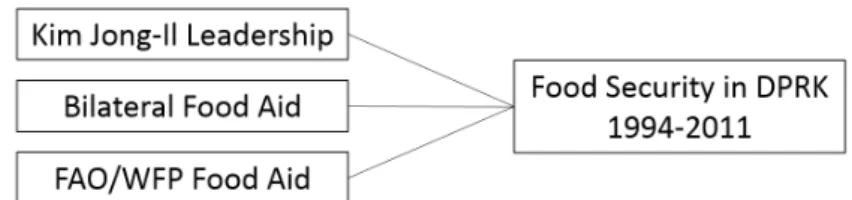
(18) country’s export capacity are impairing bilateral food aid (especially from South Korea) and have resulted in the failure of the DPRK to meet its population’s food demands without international humanitarian intervention.. The third major aim of this thesis is to examine how China, South Korea, and other major states play a role in the process of providing international assistance. Does China assist North Korean refugees out of Socialist brotherly relations? Will South Korea take care of their compatriots in the north because they are considered to be of the same nation?. 治. In short, this thesis focuses on 政 the food insecurity in North Korea and the 大. 立立. •‧ 國. ㈻㊫學. asssitance from China, South Korea and international organizations. Based on. •‧. empirical data and reports from IGOs and neighboring states, the author provides. sit. y. Nat. some recommendations for future international assistance programs to North Korea. er. io. for the sake of alleviating the suffering that results from food shortages and achieving. n. al. ni Ch fundamental human rights in the country. engchi U. v. 1-2 Research Methods By using qualitative research methods and document analysis, the author collects data from books, articles and websites to further survey international food aid toward North Korea. This also requires exploring the data from China, South Korea and other Western countries.. Issues of low politics, such as food and health security, are better ways for the international community to have a better understanding of people’s daily lives in 18.
(19) North Korea. In providing humanitarian assistance to people in North Korea, the FAO/WFP has been advancing the concept of human security over the past few decades. Therefore, human security, especially the dimension of food security, serves as an important approach in studying the DPRK (FAO and WFP 2012).. There are three main questions that the author deals with in the thesis. First, under the leadership of Kim Jong-Il, did the famine issue in North Korea improve or deteriorate? Second, was bilateral and international food aid sufficient to relieve North Koreans of hunger? Last, what factors contribute to food security in North Korea? In order to conduct the research and answer to these three questions, the. 治. author uses a historical approach in 政 the research,大 and document analysis and case. 立立. •‧. •‧ 國. ㈻㊫學. study for the research methodology.. sit. y. Nat. By using a historical approach, one can learn and understand the historical. er. io. background of the problems. Although the main concern is Kim Jong-Il, the. al. n. v ni C U h paramount leader before and after him will i studied, as pertains to the issue of e n gbec halso. food security. Since North Korea is an isolated state with a dictatorial government, it is more practical to conduct document analysis than field research in getting a closer understanding of the country. The document analysis includes literature reviews and Internet-based research. The literature review contains well-known international academic journals, such as East Asian Review, North Korean Review, Asian Perspective, the Journal of Asian Studies, Asian Survey, Korea Observer, Human Rights Quarterly, and so on. Well-known scholarly publications on North Korea will also be major references in the thesis. For example, Victor Cha’s The Impossible. 19.
(20) State, Andrei Lankov’s North of the DMZ, and Bruce Cumings’ North Korea Another Country.. The Internet survey part will focus on international organizations, including both governmental and non-governmental, and the statistical databases and other resources available from governments and private institutions. For example, the author will investigate reports from IGOs, such as the UNDP, IFPRI, WHO, UN, WFP, FAO, and the U.S. Congressional Research Service. Databases from the Economist Intelligence Unit, UNCTAD, Statistics Korea, FAOSTAT, and the Ministry of Unification of South Korea will be also explored.. 立立. 政 治 大. •‧ 國. ㈻㊫學. The case study of this thesis is North Korea with the focus on the period. •‧. between 1994 and 2011. There are two reasons for the author to only focus on this. sit. y. Nat. period. The first one is that North Korea faced severe food shortages after the extreme. er. io. floods in the mid-1990s when the famine took place. This is the reason why the. al. n. v ni C U h author is not going to discuss the situation e n gbefore c h i the famine took place. The second reason is that, during the period between 1994 and 2011, the former dictator Kim Jung-il governed North Korea. Constraining the analysis to the timeframe of this peculiar dictator in the history of North Korea enables the thesis to be more precise and more manageable.. 1-3 Research Limitations In this thesis, the food security issue in North Korea is the dependent variable with the focus on the years between 1994 and 2011. This is the delimitation of this research. The research focuses on the period before 2011 because the current North 20.
(21) Korean leader Kim Jong-un took office in December of that year, and there is not sufficient information to discuss his policies on food security.. As mentioned above, North Korea is an isolated country. Therefore, it is almost impossible to get precise data or information related to the North Korean domestic situation. In order to conduct the research, the only way is to base a significant portion of it on the materials derived from document analysis of secondary sources. Moreover, due to the questionable reliability of the information provided by the North Korean government, the author chooses to conduct the research based on the materials provided by the Republic of Korea, the U.S. government and reliable international organizations.. 立立. 政 治 大. •‧ 國. ㈻㊫學. •‧. Another significant challenge in conducting this research is personal inability. n. al. er. io. most crucial sources of information used in this thesis.. sit. y. Nat. to read Korean- or Japanese-language books and articles. English materials will be the. Ch. n engchi U. iv. 1-4 Research Outline The thesis is organized into six chapters that elaborate upon the food security issue in North Korea. Chapters 1 and 2 include the introduction to the food security situation in North Korea and the literature review. From the third chapter to the fifth, the author discusses the three main independent variables in the thesis, which are the Kim Jong-Il leadership, bilateral food aid from other countries to North Korea, and international food aid to the country. By examining these three variables related to food security, the author reveals the key factors that caused the 1994–1998 famine in North Korea. In the concluding chapter, it provides some findings and suggestions for 21.
(22) international food aid policies for alleviating hunger in North Korea.. This chapter has given the introduction of the thesis, including the research purposes, research methods, the limitation of research and the research outline. Chapter 2 will move on to the literature review. The author examines and focuses on three topics in conducting the literature review: human security, food security and the foreign assistance. In chapter three, the author discusses the relationship between the famine in North Korea and the domestic leadership. It provides a background of the famine that took place in North Korea in the 1990s and then elaborates on the background information of Kim Jong-Il’s leadership. The chapter finishes by. 治. 政 in North大Korea. Chapter 4 assesses the discussing the public distribution system. 立立. •‧ 國. ㈻㊫學. bilateral provision of food aid to North Korea. After a brief introduction about. •‧. bilateral food aid in general, it then separately discusses food aid from the ROK and. sit. y. Nat. China to North Korea. In the end of chapter 4, a comparison between food aid policies. er. io. toward North Korea from the ROK and China is given. Chapter 5 in the thesis focuses. al. n. v ni C U h on international food aid for the DPRK.eThe h i of IGOs, including FAO and WFP, n g croles and NGOs are mentioned in this chapter. Chapter 6 is the concluding chapter. In chapter six, the author will reviews the research findings and provides relevant policy suggestions and directions for future research.. 22.
(23)
(24) Chapter 2 Literature Review In this chapter, the literature review is divided into three parts: human security, food security, and foreign food aid. Each of these is directly related to the famine in North Korea. The concept of human security was first mentioned in the UNDP's 1994 Human Development Report. It brought low politics issues such as food, health, and the environment into the field of international politics. Food security is one of the dimensions of human security. When discussing foreign food aid, the author focuses not only on international organizations, such as FAO, WFP and IFDA, but also on the bilateral food aid from neighboring countries, including China, South Korea and other 政 治. 大. 立立. major countries.. er. io. sit. y. •‧. •‧ 國. ㈻㊫學. Nat. 2-1 Human Security n. Realism and liberalism a are i vapproaches to the study of l C two traditional hengchi Un international security. Among critical approaches to the study of security, referent objects are expanded to include individuals, and securitization studies and constructivist approaches are often adopted in analyzing human security topics in the post-Cold War era. Critical approaches to security studies have some common themes. They move away from the state as the sole referent object of security – that is, beyond state security. With military threat not considered as the sole form of threat, they are concerned with “creating a better world” instead of enjoying the “absence of war.” They focus on issues related to non-traditional security or non-military aspects of security. They also question the privileged status of the state in traditional IR theory and turn to questions of how individuals are threatened by crime, pollution, scarcity,. 24.
(25) disease, economic collapse, poverty, poor education, political oppression, and so on. They argue that the state itself might be a source of insecurity and that some states cannot provide their people with an adequate quality of life, democracy, liberty, or economic prosperity. For human security, the referent object is personal or individual. Among other issues, the threat is related to unemployment, disease, and scarcity, and the attainment of security is referred to as access to basic food supplies, socioeconomic justice, freedom of expression, and so on.. The first major statement concerning human security appeared in the 1994 Human Development Report, an annual publication of the United Nations. 治. Development Program (UNDP 1994).政With the end 大 of Cold War and decreasing. 立立. •‧ 國. ㈻㊫學. military threats, the concept of human security has become more prevalent. As the. •‧. United Nations Secretary-General Kofi Annan said, “the need for a more human-. sit. y. Nat. centered approach to security is reinforced by the continuing dangers that weapons of. er. io. mass destruction, most notably nuclear weapons, pose to humanity: their very name. al. n. v ni C U h reveals their scope and their intended objective, e n g c hifi they were ever used” (Annan 2000).. The definition of security was once restricted to the study of the threat and use of military force with a concern for its control and management in international politics. Human security is expected to cover both the old concepts of state security and the new non-state threats, by embracing the notions of protection and human rights (Adelman 2001).. There are different definitions regarding human security, but these could be separated into two main aspects. One is safety from chronic threats, such as hunger,. 25.
(26) disease and repression, and the other is protection from sudden and hurtful disruptions in the patterns of daily life, whether in homes, in jobs or in communities. According to the UNDP’s definition, categories of human security include economic security, food security, health security, environmental security, personal security, community security and political security (UNDP 1994). These definitions are pretty broad, so Professor Paris concludes that any kinds of unexpected or irregular discomfort could constitute a threat to one’s security (Paris 2011). In other words, human security can be treated as an emerging paradigm, which challenges the traditional concept of national security by proposing a new notion of security, which is focused on individuals rather than states. Kim Sung Won points out that human security contains. 治. 政 of security a fundamental belief in the indivisibility 大 and human rights in his article. 立立. •‧ 國. ㈻㊫學. “Human Security with an Asian Face?” Under the concept of human security, there. •‧. can be no security for individuals if the right to life is threatened. Security would be. sit. y. Nat. also be lacking when individuals are denied the right to survive through the denial of. n. al. er. io. food, clothing, or housing (Kim 2010).. Ch. n engchi U. iv. The concept of human security suggests that the people-centered view of security is necessary for national, regional and global stability (HSI 2011). For example, Sadako Ogata, United Nations High Commissioner for Refugees (UNHCR) divided the concept into four key elements. The first essential element is the possibility for all citizens to live in peace and security within their own borders. The second element is that people should enjoy without discrimination all rights and obligations. The third element is social inclusion rather than social exclusion. The fourth element is that of the establishment of the rule of law and the independence of the justice system. These four basic elements are predicated on the equality of all. 26.
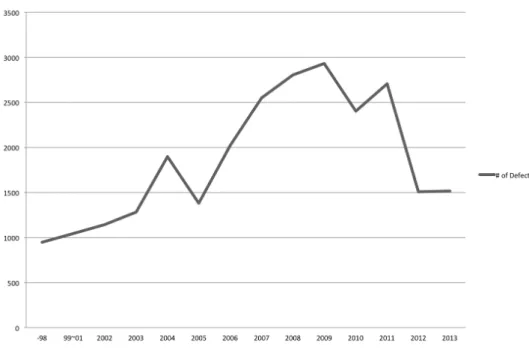
(27) before the law; effectively removing any risk of arbitrariness that so often manifests itself in discrimination, abuse or oppression (Ogata 1998).. The development of the concept of human security is a meaningful trend in the process of human history. The concept is acceptable to most people, and it is also rational and worthy of consideration for policy makers and scholars. One of the earliest studies on North Korean human security was Nicholas Eberstadt and Judith Banister’s 1992 study, The Population of North Korea. Eberstadt and Banister provided optimistic findings before the great famine hit the DPRK in 1993-1994. They concluded “North Korea has achieved a relatively high expectation of life at. 治. 政 birth and low infant mortality for a developing country.” 大 They continued to argue that. 立立. •‧ 國. ㈻㊫學. both North and South Korea “have achieved fairly low mortality and are characterized. •‧. by similar patterns of cause of death” (Eberstadt and Banister 1992).. er. io. sit. y. Nat n. a l Food Securityi v 2-2 n C hengchi U. The Universal Declaration of Human Rights (UDHR) in 1948, a milestone document in the history of human rights, mentions food security in Article 25.7 The World Food Summit of 1996 defined food security as “when all people at all times have access to sufficient, safe, nutritious food to maintain a healthy and active life.” The concept of food security is commonly defined as including both physical and economic access to food that meets people’s dietary needs and food preferences (WHO N.d.). 7. Article 25 of the Universal Declaration of Human Rights (UDHR) states that “Everyone has the right to a standard of living adequate for the health and well-being of himself and of his family, including food, clothing, housing and medical care and necessary social services, and the right to security in the event of unemployment, sickness, disability, widowhood, old age or other lack of livelihood in circumstances beyond his control.”. 27.
(28) The definition of food security provided by the UNDP is that “all people at all times have both physical and economic access to basic food.” This requires not just providing enough food but also requires that people have ready access to food – that they are “entitled” to food, by growing it for themselves, by buying it or by taking advantage of a public food distribution system (UNDP 1994). The concept of food security can be classified into three aspects: food availability, food access and food use. Food availability means having sufficient quantities of food available on a consistent basis. Having sufficient resources to obtain appropriate foods for a nutritious diet is “food access.” The term “food use” means appropriate use based on. 治. knowledge of basic nutrition and care 政 as well as adequate 大 water and sanitation (WFP. 立立. •‧ 國. ㈻㊫學. 2012). Food security can serve as a measurement of ensured access to essential. •‧. nutrition which refers to a household’s or country’s ability to provide future physical. sit. y. Nat. and economic access to sufficient, safe, and nutritious food that fulfills “the dietary. n. al. er. io. needs and food preferences for an active and healthy life (FAO 2006).”. Ch. n engchi U. iv. Per Pinstrup-Andersen, a Danish economist and professor at Cornell University, argued that food security is related to whether a country can provide access to enough food for its own citizens or not, and this definition was agreed upon at the World Food Summit in 1996 (Pinstrup-Andersen 2009)8. In the article, “Food Security, Population and Environment,” the authors concluded that food security is of the utmost importance because it is causing serious international problems related to global trade, the global environment, famine, and the mass migrations that can be triggered by regional food scarcity (Ehrlich et al. 1993). 8. Food security exists when all people, at all times, have physical and economic access to sufficient safe and nutritious food to meet their dietary needs and food preferences for a healthy and active life.. 28.
(29) Two broader studies of the DPRK are Robert L. Worden’s 2008 North Korea: A Country Study and Victor Cha’s 2012 study, The Impossible State: North Korea, Past and Future. The former book is an edited volume of experts on Korean studies. David Kang, a professor at University of Southern California, reviewed the North Korean famine of 1995–1998 and concluded that the famine was a “result of both systemic and proximate causes” including the loss of China and the Soviet Union as major subsidy providers, massive summer floods in 1995, and a chronic shortage of energy resources (Kang 2008).. 治. 政many North The economic situation pushed 大Koreans to leave their country. 立立. •‧ 國. ㈻㊫學. temporarily to search for food and also to ultimately resettle in South Korea or other. •‧. countries (Selinger 2004). William Moon compares the number of deaths during the. sit. y. Nat. North Korean famine (0.22 Million to 3.5 Million) with the Great Leap Forward in. er. io. the People’s Republic of China’s (from 14 million to 40 million deaths), India’s Great. al. n. v ni C U h Bengal famine in the 1940s (between 1.5 e nmillion g c h i and 3 million) and the Irish famine (1 million people). He describes the famine as one of the greatest human tragedies of. our time and food insecurity in North Korea as related to issues of both food production and governance structure. Famine, under the situation of global food abundance, is a by-product of nature and human behavior (Moon 2009).. 29.
(30) Figure 2-1. Number of the DPRK Defectors Entering South Korea, 1998-2013. 政 治 大 Source: Ministry of Unification, South Korea, “Number of North Korean Refugees Entered the South,” 立立 http://eng.unikorea.go.kr/index.do?menuCd=DOM_000000204003000000 (accessed July 1, 2014). •‧ 國. ㈻㊫學. •‧. Figure 2-1 shows that the number of defectors arriving in South Korea. io. sit. y. Nat. increased in the years before 2010. Several reasons for this include the famine and the. er. North Korean government policya toward defectors. The DPRK authorities treated an. n. v l C ni U h i e n g c h crime. attempted border crossing as a serious political However, since the beginning. of the Great Famine around 1996, North Korean authorities have dramatically softened their policy toward fugitives, because of their large numbers and the obvious lack of political motivation behind their behavior. Illegal border crossings were later treated as a relatively minor offense, even if the authorities did not recognize this openly (Lankov 2004). On the other hand, the number of North Korean defectors in China, according to the official Chinese estimate, was 10,000, but the real figure is several times larger than that number. It is possible that there were as many as 200,000 at the peak of the famine (Seymour 2005).. 30.
(31) People cross borders for many different reasons. Some choose to do so voluntarily, others are forced to leave or flee as a matter of life or death. “Push” and “pull” factors are terms used to explain why people move. Despite limited access to information, it is clear that two key elements driving North Koreans to cross the borders into China, including deterioration of humanitarian conditions mainly due to food shortages and human rights violations (Margesson et al. 2007). This thesis will only focus on the food shortage issue.. The collapse of the Soviet Union and socialist state economy in the 1990s brought down the public distribution system (PDS), the national system for allocating. 治. 政 to less大politically favored regions and food supplies in the DPRK. Food supplies. 立立. •‧ 國. ㈻㊫學. sections of society were cut first. The resulting famine killed up to one million people. •‧. in the mid to late 1990s, making it one of the worst famines of the 20th Century. sit. y. Nat. (LiNK N.d.-b). Disastrous floods in the summer of 1995 plunged North Korea into a. er. io. severe famine that, by some estimates, caused 600,000 to two million deaths,. al. n. v ni C U h approximately 2 to 8 percent of North Korea’s Extreme poverty within the e n g c population. hi DPRK in general, and food shortages in particular, appear to have a significant impact on movement across the border into China (Margesson et al. 2007). North Korea’s failed agricultural policies and susceptibility to adverse climate conditions, compounded by “environmental mismanagement, and an inability to purchase necessary agricultural inputs or food imports[,] mean that North Korea has had chronic food shortages” ever since the famine (LiNK N.d.-b). Some argue that food shortages are closely linked to the regime itself, in part because the PDS favors the ruling elite and the military and is tied to the government’s ongoing broader political and military motivations (Margesson et al. 2007). This has left an entire. 31.
(32) generation of North Koreans with stunted growth and higher susceptibility to health problems (LiNK N.d.-b).. 2-3 Foreign Food Aid In the twentieth century, North Korea experienced several major famines. These occurred in the mid-1940s, 1950s, early 1970s and 1990s (Cha 2012). The real problem began with the collapse of the Soviet Union at the end of the Cold War. In 1987, the Soviet Union began to cut off all forms of aid to, trade with and investment in the DPRK. North Korea was so critically dependent on the aid from the Soviet Union that it faced immediate adverse 治 on its ability to maintain sufficient 政impacts. 大. 2012). From 1994 to 1998, North Korea. ㈻㊫學. •‧ 國. levels of agricultural. 立立 (Cha production. experienced a great famine that caused 600,000 and 1,000,000 people deaths from. •‧. starvation or hunger-related illnesses, with deaths peaking in 1997 with around 4. sit. y. Nat. er. io. percent of total population (Cha 2012). These great tragedies aroused international. n. al v attention to the food security issue n i followed by international C h in North UKorea engchi humanitarian assistance. There is no perfectly correct statistic data about exactly how many people died during the famine in North Korea in 1990’s. The data provides above shows the difference sources from Professor Cha and Professor Margesson, and the NGOs’ reports. Therefore, the numbers written here is not going to prove which one is the correct one but shows the whole picture about the closest fact about the famine in North Korea.. In the article “A Primer on Foreign Aid,” Steven Radelet lists four broad economic and development goals that most foreign aid is intended to achieve. Through building infrastructure, supporting productive sectors, or bringing in new 32.
(33) ideas and technologies, foreign aid aims (1) to stimulate local economic growth; (2) to strengthen health, education, political, or environmental systems; (3) to support subsistence consumption of food, especially during relief operations or humanitarian crises; or (4) to help stabilize an economy following economic shocks (Radelet 2006). The value of international food aid is shown in an article, “From Food Aid to Food Security: the Case of the Safety Net Policy in Ethiopia”. The Ethiopian Productive Safety Net Programme provided food aid and food-for-work for 5 million regularly food-insecure people in Ethiopia in order to achieve a greater level of food security. There is no doubt that many people in Ethiopia are alive today due to the contribution of food aid (Bishop and Hilhorst 2010).. 立立. 政 治 大. •‧ 國. ㈻㊫學. The causes of the North Korea famine are many, but they mainly revolve. •‧. around misguided government policy in Pyongyang. In 1995 and 1996, North Korea. sit. y. Nat. experienced flooding on a biblical scale and the food shortage became more acute. At. er. io. the same time, the number of defectors swimming across the river to China and the. al. n. v ni C U h infant mortality rate began to skyrockete(Cha h i A quarter of the infant mortality n g c2012). at that time was due to the lack of food and the extremely poor living conditions. The motivations of defectors who crossed the border to China were mainly due to the survival difficulty rather than criticism toward the regime or being afraid of punishment from government (Kim 2005). During the serious food shortage in North Korea, Kim Jong-Il still decided to spend 25 percent of GDP on military construction and development. Moreover, in 1996, the DPRK depended heavily on international food aid while diversifying its own resources into other non-food related programs (Cha 2012).. 33.
(34) The North Korean regime was sanctioned by the United Nations because of its nuclear program, but its people are innocent and should be entitled to food security (UNSCR N.d.). North Korea is the only East Asian country on the global list of 22 low-income food-deficit countries in the FAO Food Security Assessment Report (FAO 2010). Defeating hunger in the world is the goal of the FAO, which helps needy countries to improve agriculture, forestry and fishery practices, ensure good nutrition and food security for all (FAO N.d.-b).. The scale of the international assistance to North Korea, from both governmental and non-governmental organizations, increased from US$39 million in 1997 to. 治. 政 Although大many international organizations US$416 million in 2007 (MOU N.d.-a).. 立立. •‧ 國. ㈻㊫學. offered food and financial aid to North, the food security situation today is still not. •‧. encouraging. The people of North Korea have unceasingly borne the brunt of the. sit. n. al. er. io. important issues (Cha 2012).. y. Nat. regime’s human rights abuses, and the “right to food” is one of the most basic and. Ch. n engchi U. iv. One study in the DPRK in 2011 was organized by FAO/WFP Crop and Food Security Assessment Mission (CFSAM), which was requested by the DPRK Government in October 2011 in order to assess the 2011 main-crop harvest, to forecast the 2012 production of winter and spring crops, to estimate cereal import requirements for the 2011/12 marketing year, and to assess the household food security situation and estimate food aid needs (FAO and WFP 2012). A delegation was sent by the FAO to conduct a large geographic area field study in North Korea. Mission members represented a wide variety of skills and perspectives on agriculture and food security. Korean speaking international staff from WFP accompanied the. 34.
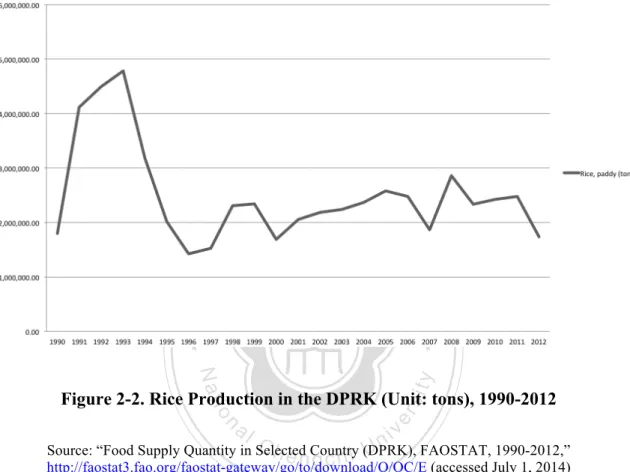
(35) teams in the field (FAO and WFP 2012). The invitation from Kim Jong-Il indicated that he had understood the necessity of having international food aid to save his country from further human tragedies.. 立立. 政 治 大. •‧. •‧ 國. ㈻㊫學 sit. y. Nat. er. io. Figure 2-2. Rice Production in the DPRK (Unit: tons), 1990-2012. n. al. ni. v. C h Country (DPRK), Source: “Food Supply Quantity in Selected FAOSTAT, 1990-2012,” engchi U http://faostat3.fao.org/faostat-gateway/go/to/download/Q/QC/E (accessed July 1, 2014). 35.
(36) Figure 2-3. Total Estimated Food Aid to North Korea, 1995-2012 Source: World Food Program’s International food Aid Information System (INTERFAIS) database. http://www.wfp.org/fais/ (accessed October 1, 2013). 政 治 大. 立立. The above charts show quantities of food support from the FAO from 1992 to. •‧ 國. ㈻㊫學. 2009 with an average of 3.5 million metric tons annually. The FAO assistance was. •‧. evaluated regularly and was not affected by the political or military developments in. sit. y. Nat. er. io. the Korean Peninsula, such as the inter-Koreas summits of 2000 and 2007, DPRK’s. n. a. v. i nuclear testing in 2006 and 2009, lorCconstant military U n tensions. Contrary to Juche, or hengchi. the spirit of self-reliance, the North Korean government was greatly dependent on the large-scale food aid from the IGOs. North Korea is the third-greatest recipient of food aid in WFP history, behind only Ethiopia (919.2 million metric tons) and Bangladesh (14.3 million metric tons) (Cha 2012).. A number of US NGOs have been actively involved in the food aid program in North Korea since the 1990s (Taylor and Manyin 2011). Although their work is relatively limited in scope, it is an indication of U.S. interest in gaining first-hand observation of the Pyongyang regime. Several American and international NGOs have provided various kinds of humanitarian relief and assistance to North Korea 36.
(37) through. channels. of. development,. health,. informal. diplomacy,. science,. communication and education (Taylor and Manyin 2011).. The NGOs’ work in North Korea was controversial. Some observers believe that NGOs’ projects represent one of the few ways to improve the lives of North Koreans and that their work provides first-hand accounts of social conditions in North Korea (Taylor and Manyin 2011). On the other hand, NGOs’ programs assist the North Korean regime, given the lack of transparency and tight restrictions imposed on NGOs, and those humanitarian aids are vulnerable to diversion by North Korean officials (Taylor and Manyin 2011). Although the DPRK has benefitted from. 治. 政 international NGO assistance, Pyongyang has大 placed strict restrictions on. 立立. •‧ 國. ㈻㊫學. international efforts to gather data on the health and nutritional status of the affected. •‧. population (Robinson et al. 2001). It is estimated that as much as 30 percent of. sit. y. Nat. donated food was diverted into the military since international aid started pouring into. er. io. the country in 1995 (Cha 2012). International NGOs’ actions have also faced other. al. n. v ni C U h difficulties. The NGOs’ home country and state’s political relations played i e n gthe c htarget. an important role in the assistance process. Therefore, Jim White of the international relief organization Mercy Corps, which took the lead in U.S. aid efforts to North Korea, once said, “There has clearly been a political lens put over a humanitarian issue (Quinn 2011).”. Figure 2-4. Thesis’ Dependent Variables and Independent Variables. 37.
(38) Chapter 3 The Leadership and Famine in North Korea. The reasons for famine are many. It may be extreme weather causing floods or drought, the failure of economic policies, mismanagement of domestic agricultural policies, wars, or one of many other contributing factors. While natural phenomena can lead to famine, its causes are also highly related to man-made factors and domestic policy making. In the case study of North Korea, the famine is related to the dictatorial leadership.. In chapter 3, this thesis. 政 治 大 examines the famine in North 立立. Korea and discusses its. •‧ 國. ㈻㊫學. relation to Kim Jong-Il’s leadership. By focusing on the public distribution system. •‧. (PDS) in North Korea, which can be understood as the outcome of the domestic food. n. between famine and Kim Jong-Il’s a leadership.. er. io. sit. y. Nat. policy, this chapter highlights the main cause of famine in the DPRK and the linkage. iv l C hengchi Un. 3-1 Famine in North Korea In the contemporary world, there is no reason for anyone to starve as a result of weather conditions, food shortages, or even failures in distribution because global food supplies are adequate. Information on weather patterns and crop conditions is now readily available, thus providing an effective early warning system for potential shortfalls and crises. Global markets for basic grains are well developed and highly integrated, and the world community has developed a well-institutionalized system of humanitarian assistance. The North Korean famine has commonly been attributed to natural disasters and external factors such as Soviet and Chinese trade behavior. In. 38.
(39) fact, the decline in food production was visible before the floods of 1995. However, the government did not take the necessary steps to secure adequate food supplies. North Korea’s tragic famine could only have occurred in a system in which the political leadership was lacking in accountability to its own people (Liang-Fenton 2007).. One of the direct causes of the famine was that the North Korean government and its PDS proved too fragile to effectively mitigate the negative impacts of the disaster. Though the worst of the famine in North Korea has passed, the country still relies heavily on foreign aid. The food shortage and the lack of food self-sufficiency. 治. 政 to its citizens. continue to bring starvation and malnutrition 大. 立立. •‧ 國. ㈻㊫學. •‧. Generally speaking, North Korean officials link the famine situation to. sit. y. Nat. extreme climatic conditions, floods and droughts in order to avoid criticism of their. er. io. economic policies and to seek more external humanitarian assistance. The. al. n. v ni C U h international community regularly monitors e n g c h i the food supply situation and continuously delivers food aid to North Korea, on an international level, through NGOs and IGOs (e.g., WFP, FAO, IDA9) and, on a bilateral level, from China, the ROK, and the US. However, the famine in North Korea seems to have no end point. The following sections examine Kim Jong-Il’s leadership and apply the selectorate theory to elaborate how political structure and regime type in North Korea could lead the country to famine.. 9. The IDA here refers to International Development Association.. 39.
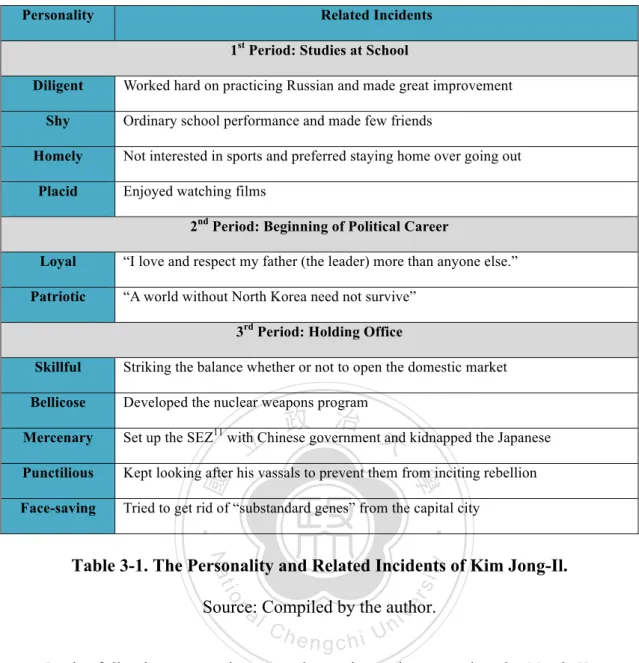
(40) 3-2 Kim Jong-Il’s Leadership The personality of the dictator of a reclusive country like North Korea is expectedly mysterious. This section analyzes Kim Jong-Il’s personality and leadership style from three different periods in his lifetime, namely, the period he studied at Namsan, the period in which he began his political career, and the period after he took power in North Korea.. Kim Hyun-Sik, the private Russian language tutor hired by Kim Il-Sung to teach his son Kim Jong-Il, observed Kim Jong-Il’s personality in an article, “The Secret History of Kim Jong-Il”. Kim Il-Sung spoke fluent Russian in order to maintain solid. 政 治 大 relations with the Soviet Union,立立 which is North Korea's biggest political, economic,. •‧ 國. ㈻㊫學. and military partner. In Namsan High School, Kim Jong-Il worked hard on practicing. •‧. his Russian, and he was a shy but determined high school student. Namsan High. Nat. er. io. sit. y. School is a school reserved for children of the elite in North Korea and offers the best. n. teachers, best facilities and the best a learning environment i v of any high school in the. l C hengchi Un country. To put the contrast between schools into perspective, the children of ordinary North Koreans would cornmeal with chemical soy sauce and unseasoned kimchi. The students of Namsan, on the other hand, would eat high-grade white rice with meat, fish, and eggs. Kim Jong-Il, at the time he studied in Namsan, made few friends and was a very ordinary student in terms of his performance in academics, art, sports and extracurricular activities. As he noted himself during an oral examination, he enjoyed watching films more than playing sports (Kim 2008). Kim Jong-Il did not have his father’s charisma. He was diminutive, pear-shaped, and homely, and he looked like his mother, Kim Chong-suk, who passed away in 1949 when Kim Jong-Il was at the age of 7 (Cumings 2012).. 40.
(41) After Kim Jong-Il graduated from school and started his political career, the family and the political system soon began to shape its next dictator. Kim Jong-Il exhibited a high level of filial piety to his father. He kept mentioning, “I love and respect my father more than anyone else.” This Confucian teaching strengthened the bond between Kim Il-Sung and Kim Jong-Il. While it may reflect basic filial piety, it can also be seen as representing a coherent ideology that both dictators believed in. Once, Kim Il-Sung asked his staff what would have happened if North Korea lost the war against the U.S. As the military generals remained silent, only Kim Jong-Il answered “Great Leader! I will be sure to destroy the Earth! What good is this earth. 治. 政 matched without North Korea?” The answer directly 大 the thought in Kim Il-Sung’s. 立立. •‧ 國. ㈻㊫學. mind, and he was willing to transfer the operational command of the North Korean. •‧. military to Kim Jong-Il. Until now, one of the famous quotes of Kim Jong-Il is that “a. sit. y. Nat. world without North Korea need not survive” (Kim 2008). Despite mainstream. er. io. international perceptions of Kim Jong-Il as psychotic, he was, in many ways, a. al. n. v ni C U h rational leader. He commanded an enormous e n g carmy h i with few signs of disloyalty to his. leadership. He consolidated his political and military power by rewarding his friends and followers in the same way that other dictators have (Cumings 2012).. In an autocratic country, the national strategies and policies reflect the personality of its paramount dictator and his style of leadership. Scholars often link Kim Jong-Il’s 17-year reign with droughts, floods, famines, the collapse of the market economy, and mass starvation leading to hundreds of thousands of deaths. Soon after the death of Great Leader Kim Il-Sung, Kim Jong-Il met a series of crises, including a near collapse of the energy system, two years of unprecedented floods (1995–1996), a. 41.
(42) summer of drought (1997), a hailstorm (1998), and the serious famine. In 1996, Kim Jong-Il once complained that no officials could assist him in effectively solving the famine and helplessly admonished “the highest officials for the nauseating street scenes of people starving, begging for grain, and boarding trains for the countryside in search of something to eat (Cumings 2004).”. According to Bruce Cumings, a veteran Korea expert and a professor at the University of Chicago, concluded with the observation that Kim Jong-Il “is a homeboy who doesn’t socialize much, doesn’t drink much, and works at home in his pajamas scribing marginal comments on the endless reams of documents,” routinely. 治. 政 and then大sleeping into the late morning working into the early morning hours. 立立. •‧ 國. ㈻㊫學. (Cumings 2004). Kim Jong-Il’s “achievement” was to continue the development of. •‧. nuclear weapons, which lead to North Korea being listed, along with Iraq and Iran,. sit. y. Nat. not just as a member of the “axis of evil” but as a potential target for preemptive. er. io. strikes under the “Bush Doctrine” (Cumings 2012). Kim Jong-Il's core means of. al. n. v ni C U h maintaining power was through extortion. e n gNuclear c h i weapons were his key means of. doing so and were financed in part by the reparation payments from Japanese government by kidnappings of Japanese citizens10 (Rowen 2003). After the fall of the Soviet Union, Kim Jong-Il started Songun, the Military-First Policy. He believed that “[t]he military is the core force of the revolution and the pillar of the state.” Although North Korea was a smaller state than China or the U.S., Kim Jong-Il managed to politically stabilize the nation and make the country powerful by growing the military (Kim 2008).. 10. North Korean government had tried to kidnap Japanese citizens from the seashore of Japan and brought them back to North Korea. Different cases of kidnapped have different kinds of purposes some were the tools to blackmail Japanese government for the ransom and some for political usage, like teach Kim’s family Japanese.. 42.
(43) Kim Jong-Il set up a special economic zone with the support of the Chinese government and received several billion dollars assistance from China. He struck a balance between the level of openness of the North Korean market and the degree of threat from the West. Kim Jong-Il also had to keep his eyes on other military or political elites in the country in order to immediately eliminate any opinions or factions that threatened the regime (Rowen 2003). Pyongyang hosted the World Festival of Youth and Students in the year 1989. Six months before the festival, Kim Jong-Il launched a “purification policy” toward the citizens living in Pyongyang. The policy tried to move all the disabled residents of Pyongyang away from the capital to. 治. 政 image 大 remote villages to create a more “attractive” of the city for the coming festival.. 立立. •‧ 國. ㈻㊫學. During that period, the official doctors claimed that the state had developed a drug. •‧. that could raise a person's height and was recruiting people to receive the new. n. al. er. io. order to get rid of the “substandard genes” (Kim 2008).. sit. y. Nat. treatment. After the recruitment, they sent the shortest residents out of the city in. Ch. n engchi U. iv. One can identify several key aspects of Kim Jong-Il’s personality through the way he dealt with things and the decisions he made. Kim Jong-Il’s personality traits developed along with related incidents in different periods.. 43.
(44) Personality. Related Incidents 1st Period: Studies at School. Diligent Shy. Worked hard on practicing Russian and made great improvement Ordinary school performance and made few friends. Homely Placid. Not interested in sports and preferred staying home over going out Enjoyed watching films 2nd Period: Beginning of Political Career. Loyal Patriotic. “I love and respect my father (the leader) more than anyone else.” “A world without North Korea need not survive” 3rd Period: Holding Office. Skillful Bellicose. Striking the balance whether or not to open the domestic market Developed the nuclear weapons program. 政 治 大. Mercenary. Set up the SEZ11 with Chinese government and kidnapped the Japanese. Punctilious. Kept looking after his vassals to prevent them from inciting rebellion. Face-saving. Tried to get rid of “substandard genes” from the capital city. 立立. •‧. •‧ 國. ㈻㊫學. Nat. er. io. sit. y. Table 3-1. The Personality and Related Incidents of Kim Jong-Il.. n. Source: a Compiled by the author. v. i l C hengchi Un. In the following part, selectorate theory is used to examine the North Korean political structure and decision-making procedure in order to reveal the correlation between the political structure and the style of leadership.. The definition of selectorate and winning coalition are as follows. The selectorate is the set of people in the polity who can take part in choosing a leader (Morrow et al. 2008). In contrast, all the other citizens of the polity are relatively disenfranchised (Hanson and Gallagher 2012). The selectorate can also be known as the group in a country that can directly influence the selection of a leader (Arena and 11. The SEZ here refers to special economic zone.. 44.
(45) Nicolettiz 2013). For example, it refers especially to those people responsible for choosing a candidate for election in a political party. Public goods, such as personal freedoms, effective economic policies, and national security, benefit everyone in a society. Private goods, such as grants of monopolies, access to scarce hard currency, and direct payments, can be targeted at the leader’s essential supporters. Bruce Bueno de Mesquita, a political science professor at New York University, made the definition of the selectorate in his 2003 book the Logic of Political Survival. He stated that “the selectorate is the set of people whose endowments include those qualities or characteristics institutionally required to choose the government’s leadership and necessary for gaining access to private benefits doled out by the government’s. 治. leadership.” Moreover, he pointed out政 four defining 大 categories that can sort people. 立立. •‧ 國. ㈻㊫學. out and into the selectorate. These defining characteristics include: (1) personal origin:. •‧. birthplace and lineage; (2) special proficiency: skills, beliefs, and/or knowledge; (3). sit. y. Nat. wealth; and (4) gender and/or age qualifications. Selectorates have been shown to. n. al. er. io. include only one or any mix of these four elements (Bruce 2003).. Ch. n engchi U. iv. The winning coalition is comprised by those who support is essential to the leader taking and staying in office and is also known as the leader’s support coalition. The minimum size of the winning coalition is created by the nature of the selection process. Differences in the sizes of the selectorate and winning coalition signify fundamental aspects in which polities differ. In electoral democracies, the winning coalition typically constitutes a large proportion of the selectorate. In non-democratic regimes, the winning coalition may be small and restricted to certain narrowly defined classes. North Korea is a case in point. Members of the winning coalition often receive a share of whatever private benefits the incumbent leader can offer to his. 45.
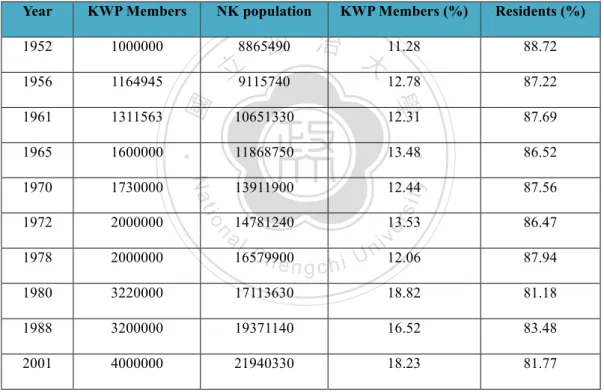
(46) supporters (Bruce 2003). In short, the selectorate is a group of people who can play a role in selecting their leader, and the winning coalition includes a group of people whose support is necessary for the leader to stay in power.. The residents of all polities are selectorates and, within each selectorate, there is a winning coalition. When facing challenges, leaders try to maintain their coalitions of supporters by taxing and spending in ways that produce an optimal distribution of public and private goods. Bruce Bueno de Mesquita stated, “The nature of the mix depends upon the size of the winning coalition while the total amount spent depends both on the size of the selectorate and the winning coalition. Coalitions are built to. 治. maximize the prospect of winning and政 retaining office 大 (Bruce 2003).” In any country,. 立立. •‧ 國. ㈻㊫學. leaders want to maximize their control over policy choices and minimize the price. •‧. they must pay to their coalition members, preferring to build as minimal a winning. sit. y. Nat. coalition as possible. The size of the winning coalition influences the price that must. n. al. er. io. be paid to assemble it (Bruce 2003).. Ch. n engchi U. iv. Usually a ruler or a leader competes with others for support from members of the selectorate by offering public and private goods. The size of the winning coalition is what controls the contents of the ruler’s policy-making process. When rulers have large winning coalitions, they have incentives to provide public goods that enhance social welfare and promote labor in the process strengthening their countries’ economic development. In general, larger coalitions lead to higher levels of political rights, lower levels of corruption, and even better performance in fighting wars. On the contrary, the non-democratic or autocratic political structures that favor a small coalition and strong norms of loyalty to incumbent leaders have been seen to promote. 46.
(47) low incomes, low growth, high taxes, and leisure over productive labor (Hanson and Gallagher 2012).. One-party autocracies, as is the case in North Korea, have smaller winning coalitions than democracies, whose selectorates may be large. Monarchies and military juntas have both small selectorates and small winning coalitions. Leaders maintain the loyalty of their winning coalition by producing public goods and private benefits through state policy.. KWP Members. NK population. 1952. 1000000. 8865490. 1956. 1164945. 1961. 1311563. 1965. 1600000. 1970. 1730000. 1972. 2000000. 1978. 2000000. 1980. 3220000. 1988 2001. KWP Members (%). Residents (%). 立立9115740. 12.78. 87.22. 10651330. 12.31. 87.69. 11868750. 13.48. 86.52. 13911900. 12.44. 87.56. 14781240. 13.53. 86.47. 12.06. 87.94. 17113630. 18.82. 81.18. 3200000. 19371140. 16.52. 83.48. 4000000. 21940330. 18.23. 81.77. io. y. sit. Nat n. al. er. •‧ 國. 88.72. •‧. 政 治 大 11.28. ㈻㊫學. Year. n ngchi U. Ch 16579900 e. iv. Table 3-2. Membership of the Korean Workers Party (KWP) Sources: William J. Moon, The Origins of the Great North Korean Famine, p.109.. The above table shows the numbers and percentage of the citizens who participated in Korean Workers Party (KWP), the North Korean communist party, from 1952 to 2001. North Korea has only one political party and all the high officials and political leaders belong to this party. KWP can be known as the real selectorate. 47.
數據
+7

相關文件
According to the Heisenberg uncertainty principle, if the observed region has size L, an estimate of an individual Fourier mode with wavevector q will be a weighted average of
Monopolies in synchronous distributed systems (Peleg 1998; Peleg
Corollary 13.3. For, if C is simple and lies in D, the function f is analytic at each point interior to and on C; so we apply the Cauchy-Goursat theorem directly. On the other hand,
Corollary 13.3. For, if C is simple and lies in D, the function f is analytic at each point interior to and on C; so we apply the Cauchy-Goursat theorem directly. On the other hand,
During the period of Jin Dynasty and Northern and Southern Dynasties, minorities migrated into Central Plain and established different regimes in north China. With the
* School Survey 2017.. 1) Separate examination papers for the compulsory part of the two strands, with common questions set in Papers 1A & 1B for the common topics in
Since huge quantities of transactions are involved in daily operations of a hotel, the accounting department always has to deal with complicated calculations which undoubtedly
Teacher / HR Data Payroll School email system Exam papers Exam Grades /.
